Social Media Video Content: What Actually Performs (2026)
Social media video content guide for Instagram, TikTok, Facebook, and LinkedIn: best formats, lengths, and metrics for 2026.

If there’s one thing social media has taught me about video, it’s that “professional” and “effective” aren’t always the same thing.
I’ve seen beautifully produced videos disappear into the feed while simple, seemingly effortless clips generate comments, shares, and conversations.
So, what separates the two? Usually, it comes down to understanding the platform, the audience, and the moment.
In this guide, I’ll break down the social media video content worth creating and the practical techniques that can make each video marketing strategy more engaging and effective, according to Laurent François, strategic & creative advisor at Maison Prose.
Key takeaways
- The best-performing social video formats in 2026 are recurring short-form series, talking-head authority videos, behind-the-scenes content, UGC and creator collaborations, and product demos, each built around repetition and recognizability rather than one-off trends.
- The clearest signals that a social video is working are engagement and retention rather than views, with saves and shares indicating stronger viewer intent than likes alone.
- The most effective way to repurpose social video content is to extract the underlying idea that resonated, such as a tutorial step, a statistic, or a quote, and rebuild it natively for each new format instead of reposting the same video.
What types of video content perform on social media now?
So, what should you actually be posting? Because “make more videos” isn’t particularly useful advice.
There are plenty of types of video content for social media, but the formats worth your time are the ones that give people a reason to stop, watch, and (ideally) do something afterward.
And if you’re wondering how to create content for social media without chasing every new trend that lands on your feed, these are the formats I’d start with.
Short-form/native vertical (Reels, TikTok, Shorts)
Short-form video needs to feel at home in the feed. Think vertical, easy to follow, and quick to get into. People are scrolling fast, so you don’t have much time to make them curious.
What I find more interesting, though, is how brands are giving people a reason to recognize their videos before they even see the username. Recurring characters, running jokes, familiar formats, and ongoing stories can all help with that.
Scrub Daddy is a great example.
Its smiley sponge has become a character of its own, showing up in trends, jokes, and increasingly ridiculous situations.
You know it’s Scrub Daddy content almost immediately.

Find an idea, character, or format your audience responds to, keep developing it, and give people a reason to wonder what you’ll do with it next.
Here's Laurent's perspective on this as well:
I like to look beyond just direct category competitors. Direct competitors tell us what the category is doing and where conventions are forming, but indirect and aspirational brands are often more useful for understanding where audience expectations are headed.
On Instagram especially, we’re competing for attention against everything in someone’s feed — not just brands selling the same product. So I’ll typically look at a mix of direct competitors, brands competing for the same audience or cultural territory, and best-in-class brands that are setting the standard for how people engage on the platform.

Talking-head / authority and POV videos
You don’t always need a clever concept. Sometimes, you just need someone with something genuinely interesting to say.
Talking-head videos are particularly useful when you have expertise, an opinion, or experience your audience can learn from.
Put your founder, an employee, or an expert in front of the camera and let them explain one idea clearly. Skip the lengthy introduction and get to the point people came for.
Blueland does this well by putting the people who actually develop its products in front of the camera.
In this Reel, its Chief Innovation Officer walks viewers through the thinking and testing behind a new laundry detergent tablet. The expertise is already inside the company, so why hide it?

Behind-the-scenes and process content
If your audience usually only gets to see the finished product, show them what happens before it gets there.
Take them into the studio, warehouse, office, photoshoot, product-development meeting, or wherever the interesting part of your process happens.
Sometimes the details that feel completely ordinary to you are exactly what your audience is curious about.
Jolie does this well by taking people behind the scenes of building the brand and showing some of the people and work behind the product.

That little bit of access can make people feel much closer to a brand.
They get to see the personalities, decisions, and work happening behind the product, which makes the whole thing feel more human and easier to connect with.
UGC and creator collabs
You can tell people your product is great. Or you can let someone they already enjoy watching show them why.
That’s the advantage of UGC and creator collaborations: they put your product into a real person’s voice, style, and context.
Bubble Skincare is a good example. Its products regularly appear in creator routines, tutorials, and everyday skincare content, where you can actually see how someone uses them and where they fit into their routine.

The temptation here is to control every word. Try not to.
Give creators the information and boundaries they need, but leave room for the personality that made you want to work with them in the first place. If every creator sounds exactly like your brand’s marketing team, you’ve probably over-scripted it.
Product/feature demos
Some products are simply easier to sell once people see them in action. So show them.
The strongest product demos usually don’t try to squeeze every feature into 30 seconds. Pick one problem, feature, transformation, or use case and make that the story. Show me what the product does and, more importantly, why I should care.
BÉIS does this particularly well with its luggage. Its videos show things like how much you can actually pack inside a suitcase, how the compartments work, or how specific features come in handy while traveling. You get the value of the product almost immediately because you can see yourself using it.

What this means for briefing your creators and agencies
If you're the one setting strategy rather than shooting the video, the formats above translate directly into a creative brief: name the recurring device you want (a character, a series, a POV), specify who's on camera and why they're credible, and set the one boundary that matters for UGC ( brand safety and disclosure) rather than a full script. The goal is a brief tight enough to protect the message and loose enough that the creator's voice still comes through.
Best video lengths by platform
Does video length really affect performance? You might ask.
Socialinsider’s recent social media video statistics suggest it does.
But there’s more to it than simply making every video shorter. The ideal length changes from one platform to another, and views vs. engagement don’t always follow the same pattern.
Let’s break down what the data shows for each platform, so you can decide when to keep things snappy and when it pays to give your content more room.
TikTok
For views
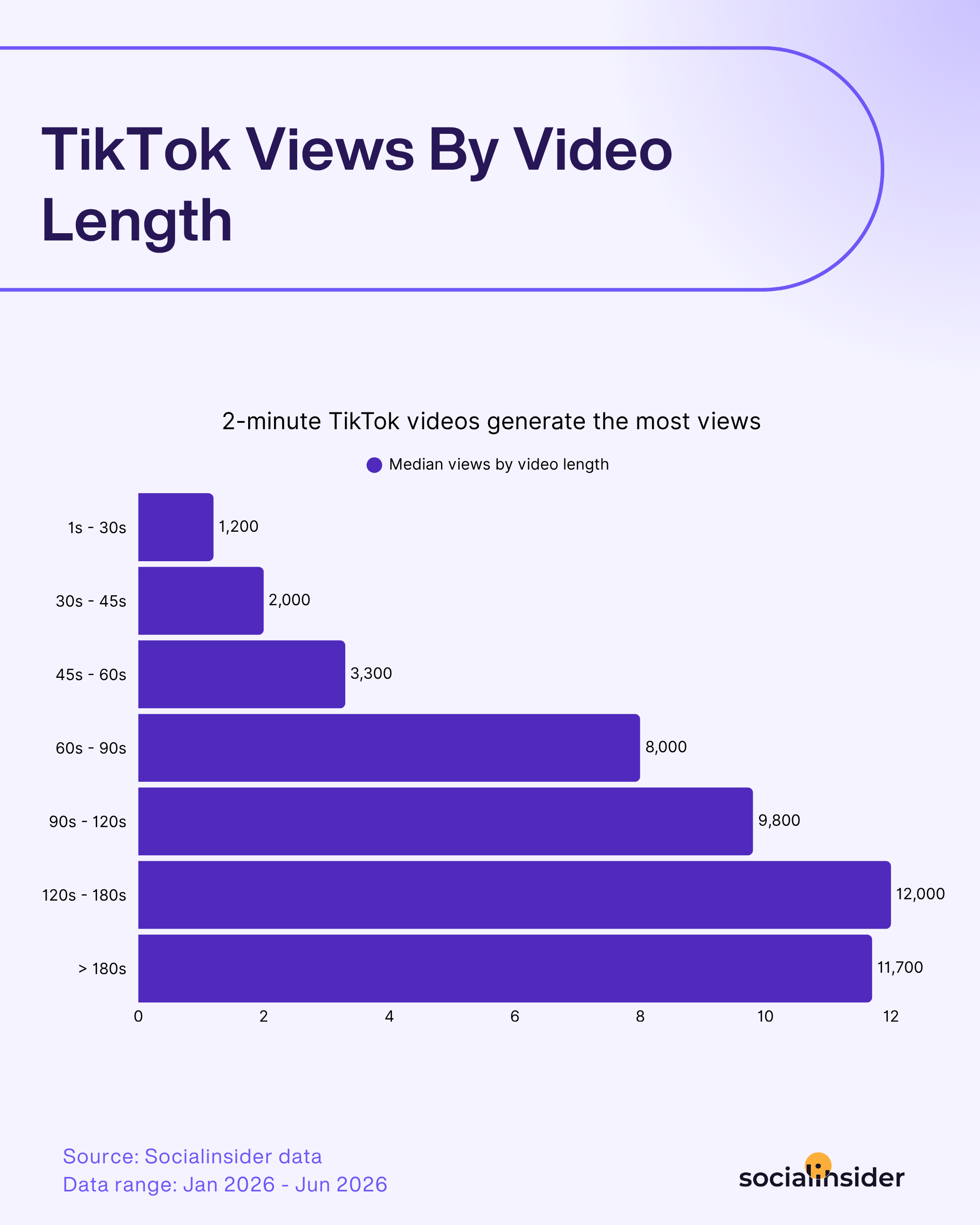
If you’ve been keeping your TikToks short because that’s what the platform is known for, the data might surprise you.
Videos over two minutes average more than 12K views—around ten times more than clips under 30 seconds.
So, when you have something worth saying, give yourself the time to say it.
For engagement
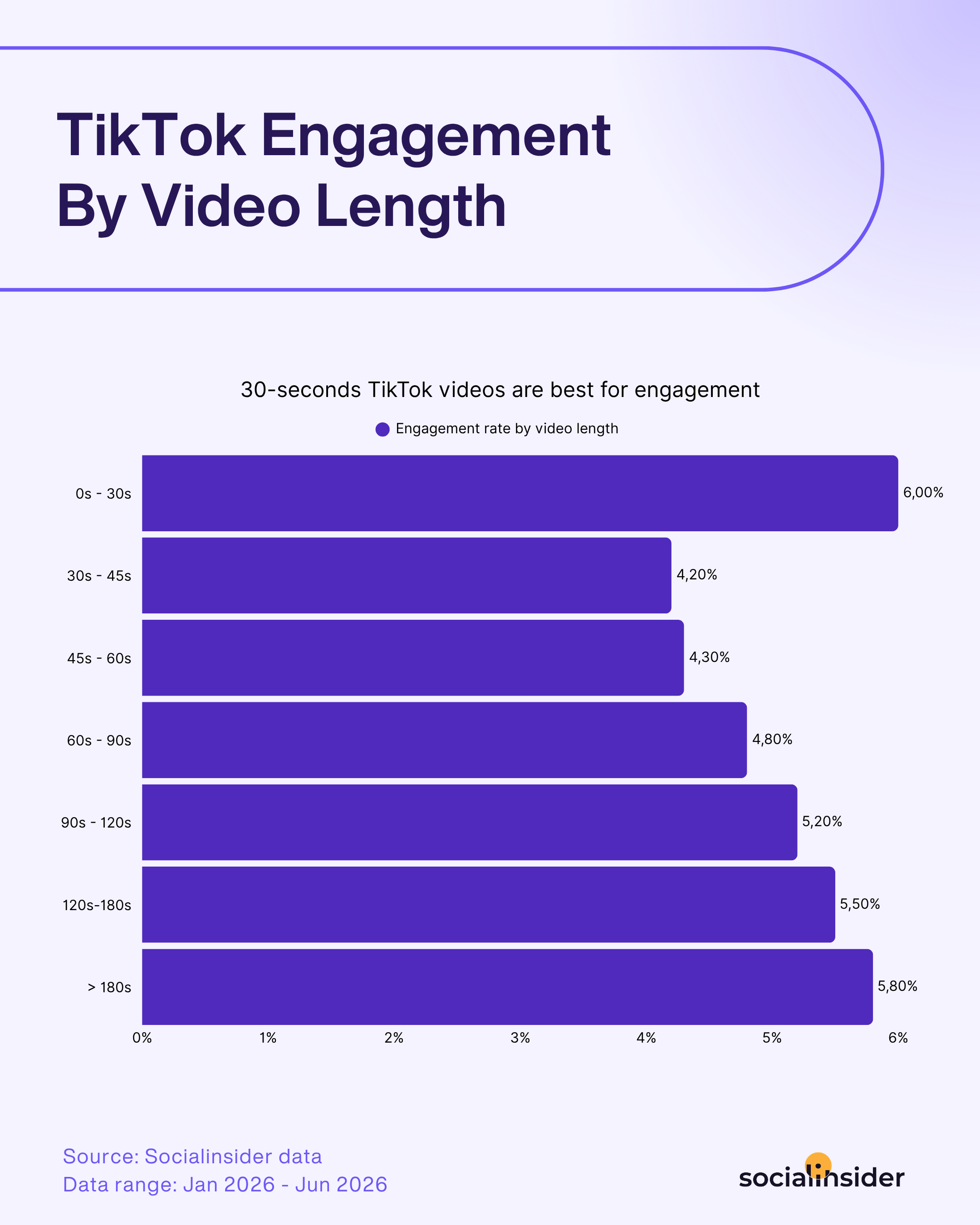
Short videos take the lead here, with TikToks under 30 seconds reaching the highest engagement rate at 6%. Interestingly, videos over three minutes aren't far behind, with an average engagement rate of 5.8%.
For views
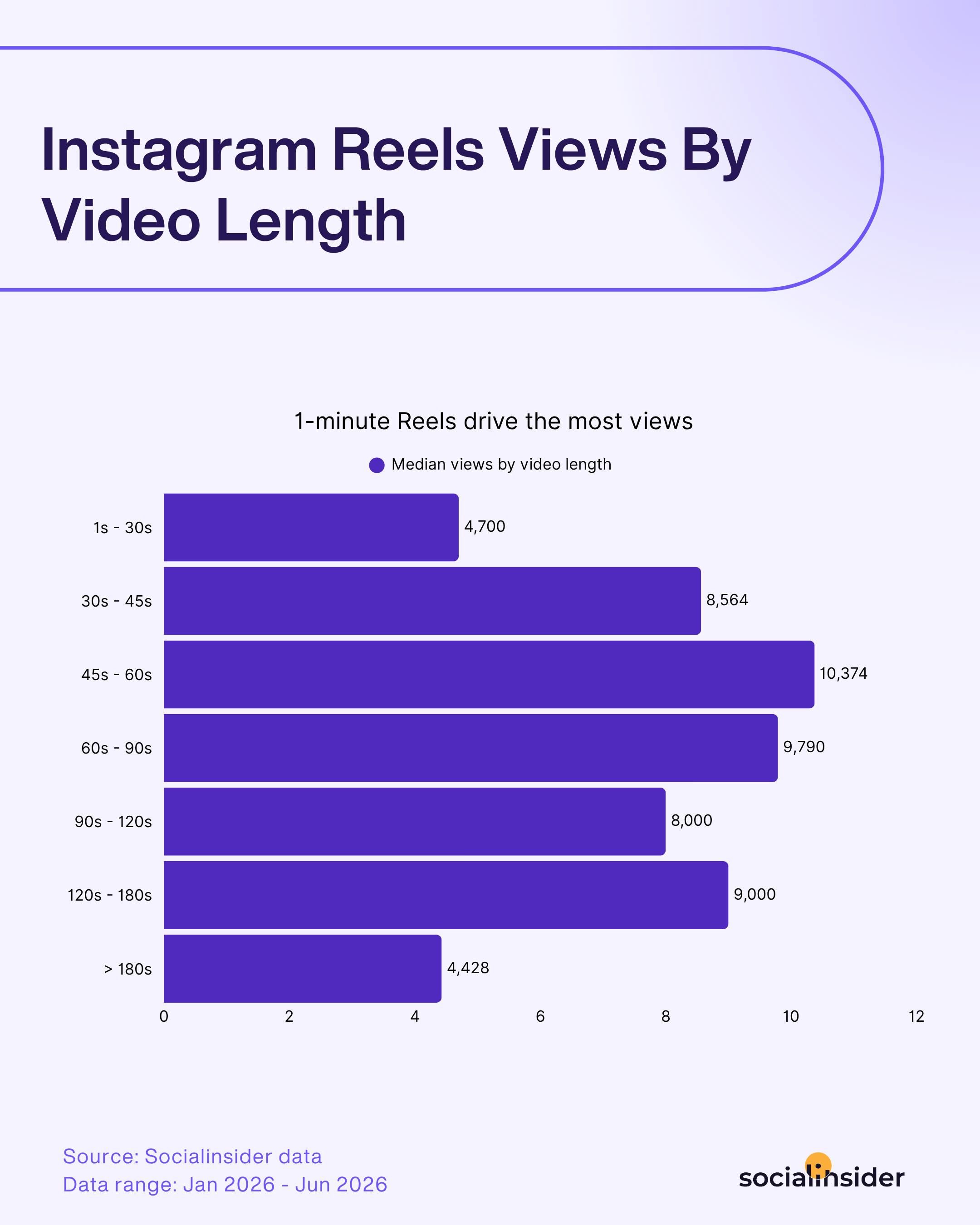
Instagram has a clearer sweet spot.
Reels between 45 and 60 seconds get the most views, averaging around 10.3K.
So, if you have enough substance, giving your Reel around a minute to develop could work in your favor.
For engagement
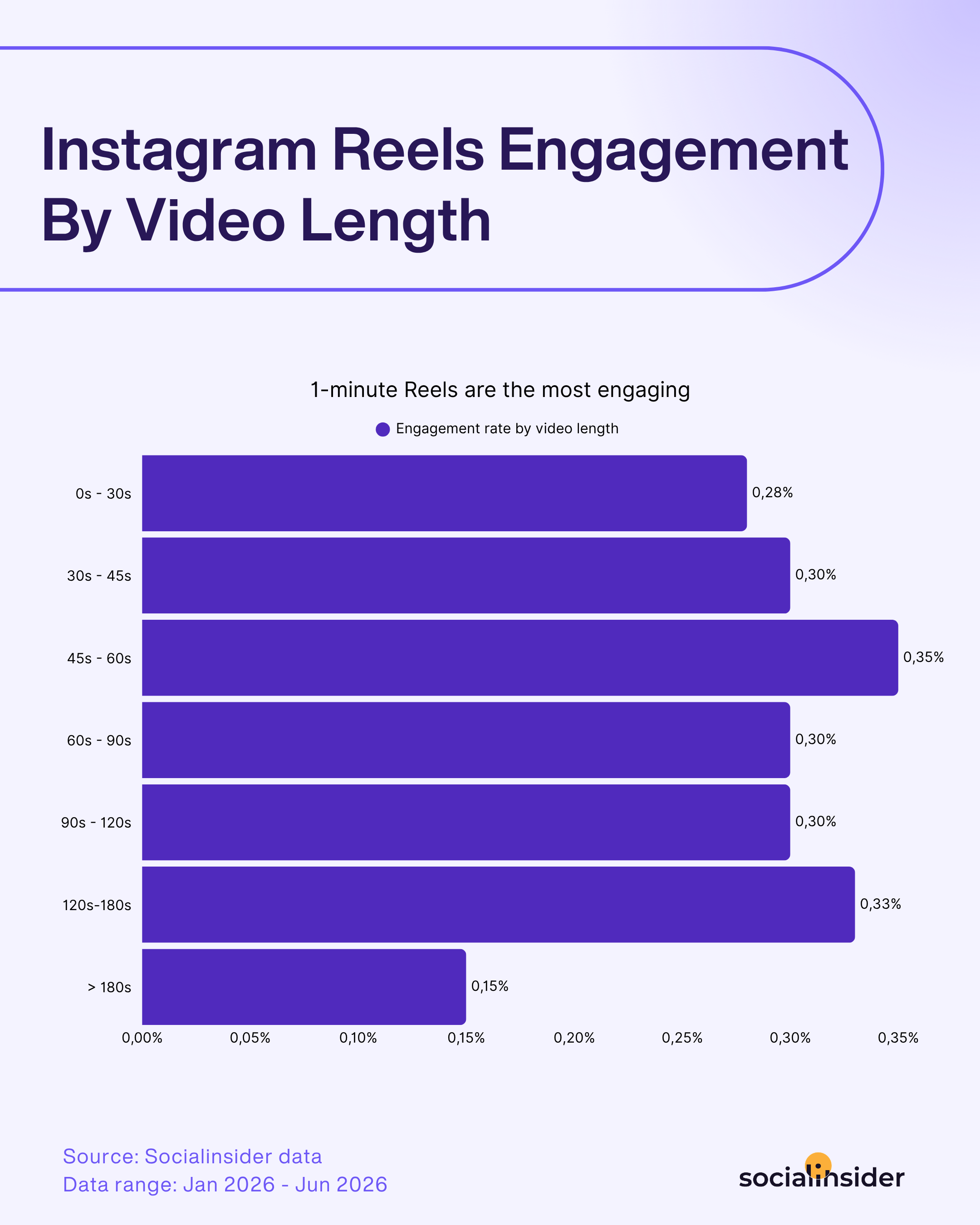
The 45–60-second range wins again, with the highest engagement rate at 0.35%.
For Instagram, then, around one minute looks like a particularly strong window for balancing attention with interaction.
For views
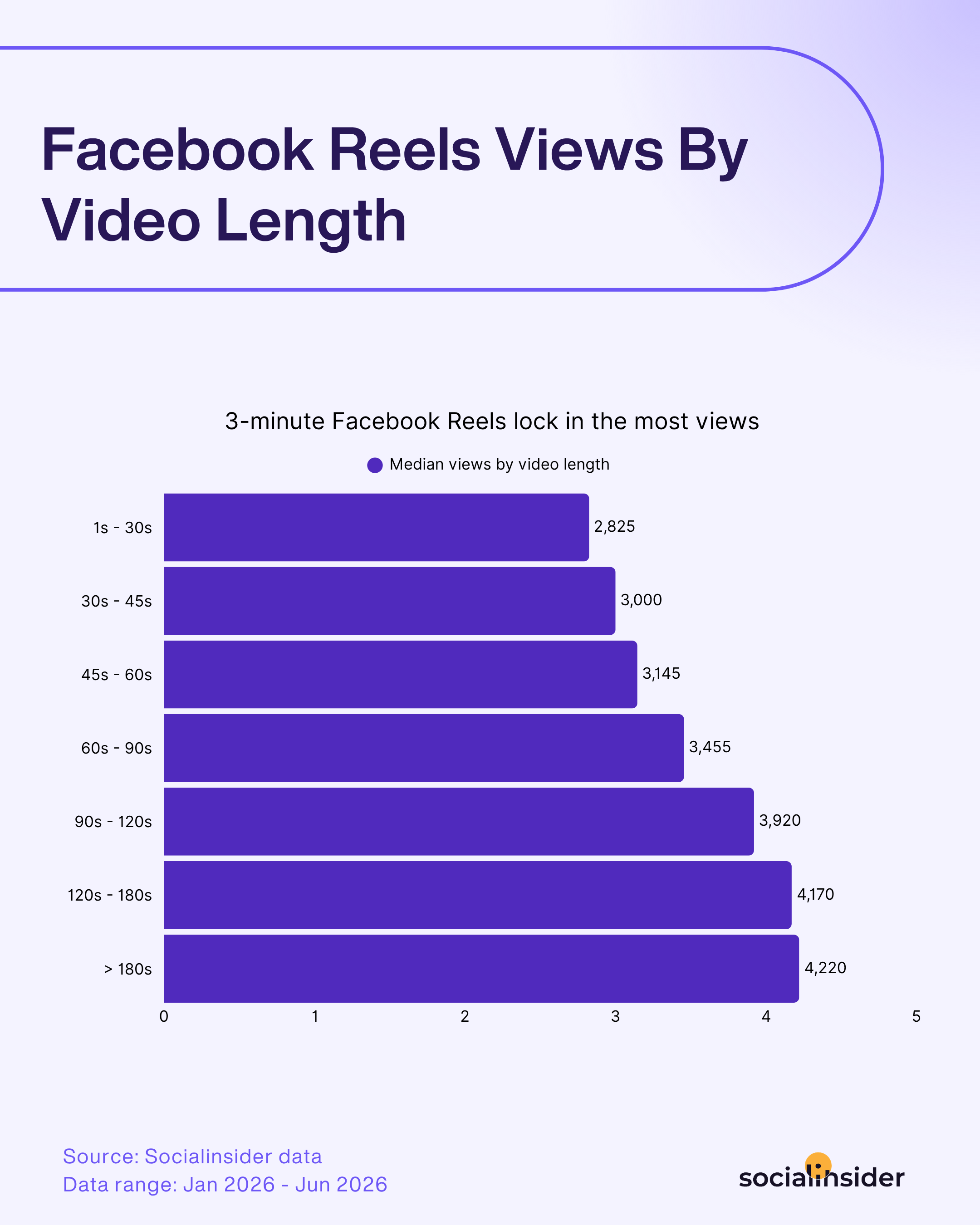
On Facebook, views actually climb the longer a Reel runs, with videos over three minutes pulling in the most views at around 4.2K. There's no real dip anywhere along the way; performance just builds steadily from the shortest videos onward.
If social media reach is your priority, keeping your Reel around the three-minute mark looks like a solid bet.
For engagement
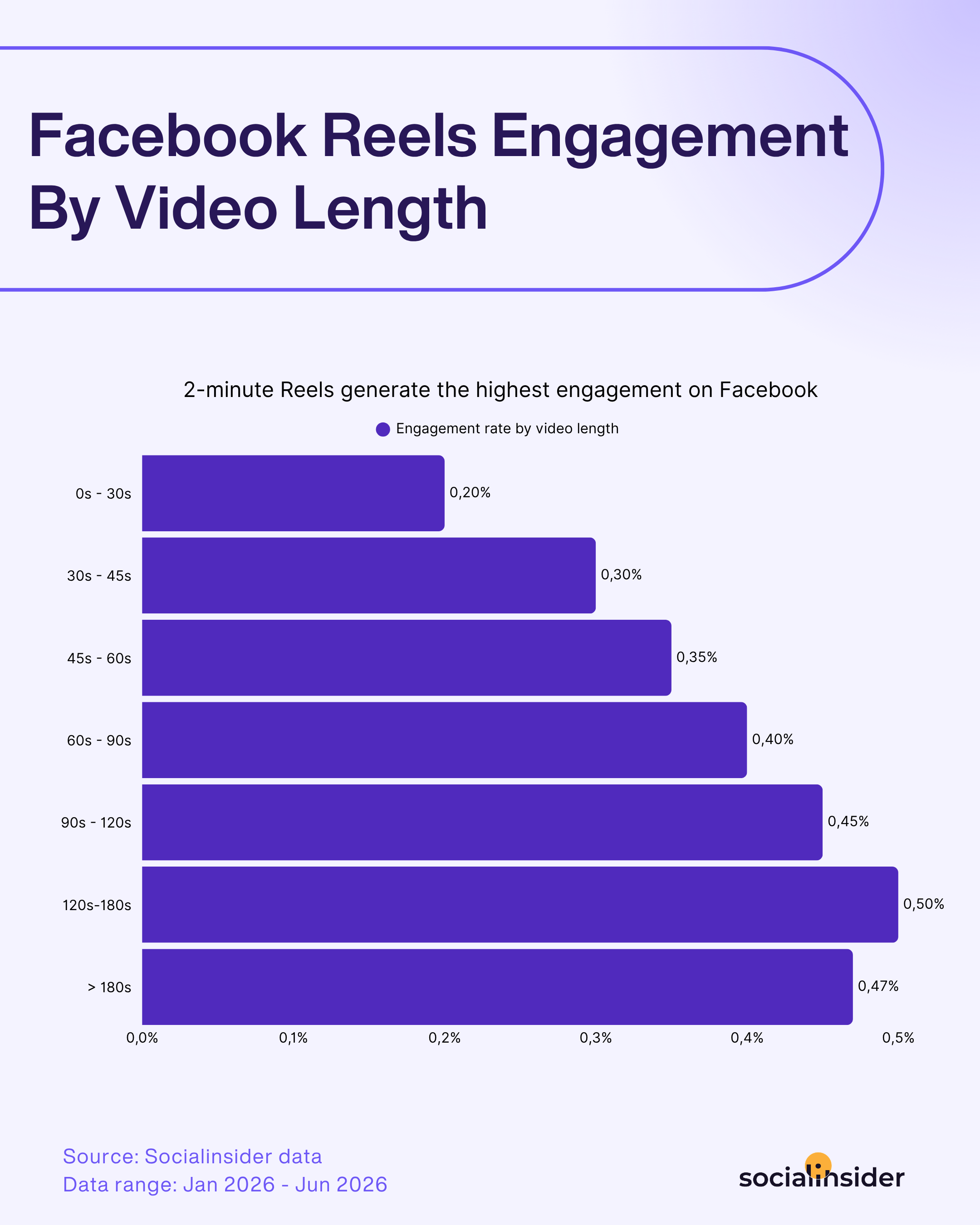
Facebook Reels engagement climbs steadily right alongside views, peaking in the 120–180 second range at 0.50%. It barely eases off past the three-minute mark, holding at 0.47%. So on Facebook, the sweet spot really is around the three-minute mark: unlike other platforms, going long here comes with little to no penalty.
LinkedinIn
For views
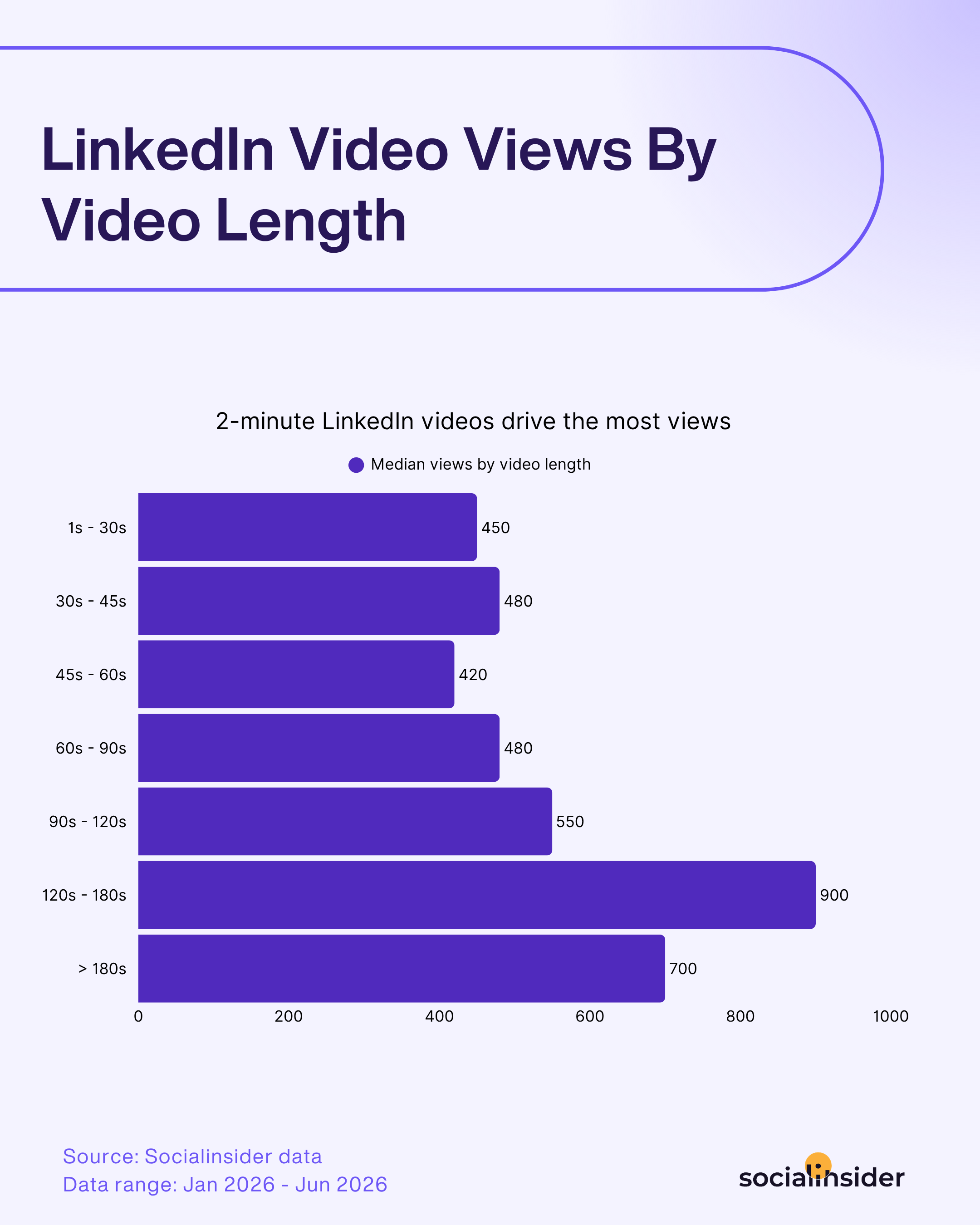
LinkedIn gives longer videos an edge, but only up to a point.
Views stay fairly flat through the shorter brackets, then jump sharply in the 120–180 second range to around 900, before easing back to 700 past the three-minute mark.
So if you're sharing an interview, expert insight, or a topic that needs more explanation, the two-to-three-minute window is the one to aim for, not the longest video you can make.
For engagement
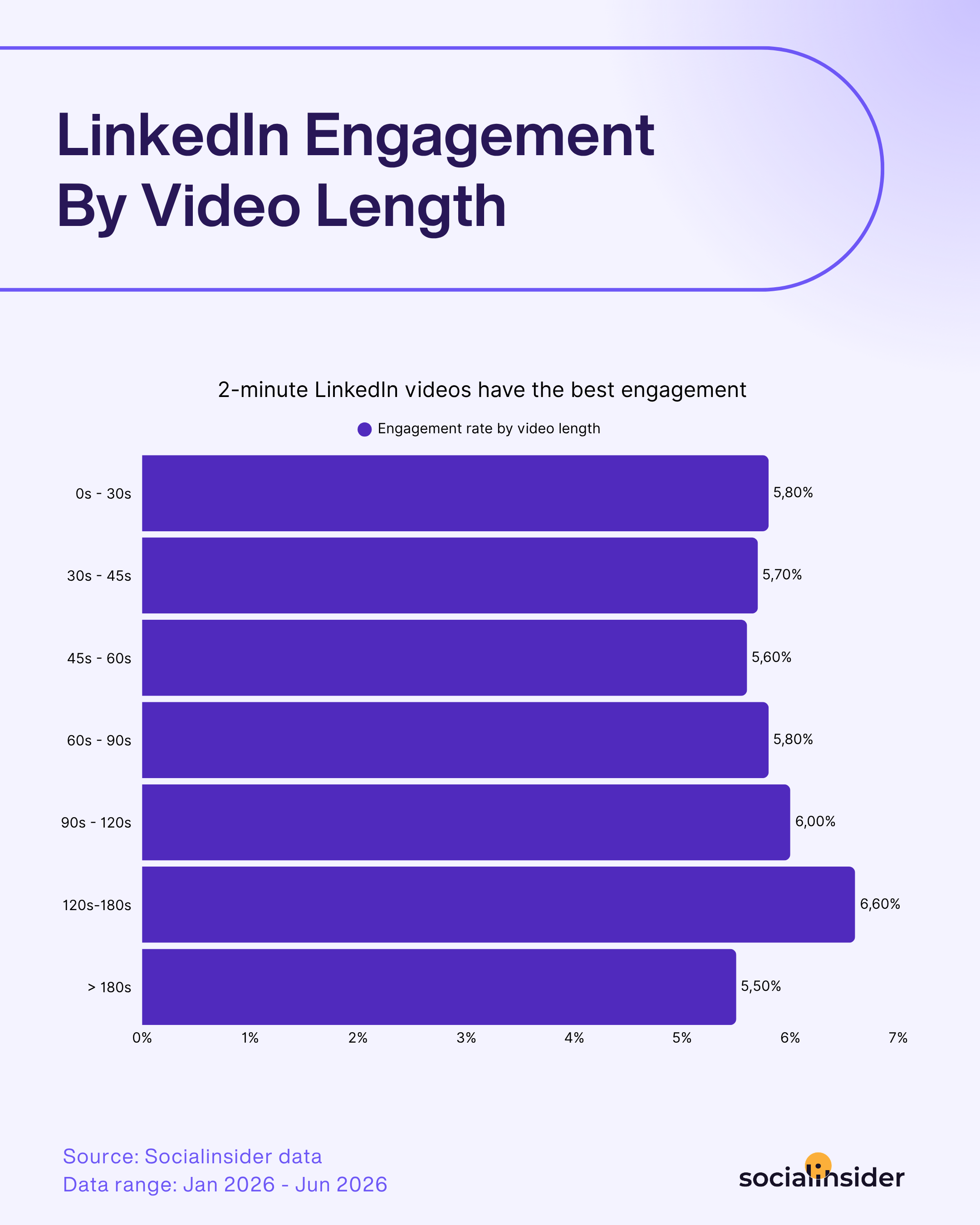
For LinkedIn, both views and engagement now peak in the same window: 120–180 seconds, with engagement climbing to its clear high of 6.6%, and both ease back once videos cross the three-minute mark.
So the two-to-three-minute range isn't just a good compromise between reach and interaction on LinkedIn, it's the single sweet spot for both.
How to know if your video content is actually working?
This is where your analytics stack does the real work. Socialinsider gives you the two metrics that matter more than views: engagement and retention, without needing platform-native admin access, so you can pull performance for any public account, not just your own.
Did people stick around to watch, or did you lose them early? Did they scroll on, or did they comment, save, and share? Views tell you that you got attention; these signals tell you what happened once you had it.

And with Socialinsider, you can take your video analysis to the next level, by going beyond a raw number, identifying trends and even the posts that led to some specific changes.
See a spike or an uncomfortable dip? Click into it. You can see the individual Reels published around that point and compare their engagement and views.

Now you have something to work with. Go back to those videos and look for the reason. Was there a stronger hook? A different length? Was the video useful enough to save? This kind of social media evaluation is far more valuable than watching a dashboard number rise or fall.
I'd pay particularly close attention to saves and shares, as well.
Laurent François makes a great point about what those actions can tell us:
Saves prove intent, very close to a screenshot of something customers like to see and will consult afterwards. Sharing is key as well because it gives a stronger life to our video content, by entering dark social, like private groups.
That's an important distinction. A like can be almost instinctive. A save says, I want this for later. A share says, someone else needs to see this.
For engaging video content, those are strong signals that the video did more than simply earn a few seconds of attention.
Then zoom out. Individual winners are useful, but patterns are better.
If you’re looking for more ways on how to use Socialinsider, the tool also lets you compare social media engagement across formats, so you can see whether Reels, images, or carousels are doing more of the heavy lifting.

That's the part of social media optimization that matters most: taking what your audience is already telling you and using it to make smarter content decisions. Your social media metrics shouldn't just tell you how the last video performed. They should give you a better idea of what to make next.
Lastly, here's Laurent's takeaway on the topic as well.
The real success of a video happens after the video itself. A lot of brands stop their strategy once the video is live; but if the content strategy extends beyond that moment—by thinking about pre-play, play, replay, and remix—it suddenly transforms a very broadcast-driven approach into an opportunity for the video to become a social artefact.
Reporting video performance to leadership
Views make a slide look good; engagement and retention are what justify the next quarter's video budget.
When you report upward, lead with the trend line, not the single best clip. A rising engagement rate across your last five videos in a format is a stronger case for continued investment than one viral outlier.
Pair that with a save/share ratio: it's the cleanest proxy you have for whether video is actually building pipeline awareness or just generating passive reach, and it's a number leadership can compare quarter over quarter.
How to repurpose video content into other social media content formats?
Creating video content on social media takes time, so when something works, it’s worth finding new ways to use it. But content repurposing works best when you’re selective.
You don’t need to turn every video into a carousel or static post. Instead, let your audience’s response tell you which ideas are worth taking further.
Start with your best-performing videos on each channel. But don’t stop at this one got the most views. Take a closer look and ask yourself: why did people respond to it?
Maybe you shared a genuinely useful takeaway. Maybe you touched on a problem your audience knows all too well, surfaced an interesting statistic, or picked a topic people had plenty to say about.
Whatever made that video click, that’s the part you want to take with you into the next format, not necessarily the video itself.
Socialinsider can help you spot those opportunities quickly. By filtering your posts by media type, you can isolate your video content and see which posts performed particularly well.

And by the way, it's worth running the same filter on competitor accounts, too. Comparing which of their video formats overperform against your own gives you a second source of ideas worth repurposing, not just a defensive read on where you stand.
Once you know what worked, you can have a little more fun with it. What other form could that idea take?
If you have a tutorial, turn the steps into a carousel people can swipe through and save. Pull a strong insight from a video and build a text or graphic post around it. An interview could give you several standalone quotes, while a product demo could easily become a comparison or before-and-after post.
Just remember: adapt, don't duplicate.
Think about how you use different formats. You probably don't watch a Reel in the same way you swipe through a carousel. And neither does your audience. The idea can stay the same, but the way you deliver it should feel native to the format.
Done consistently, this can make your social media content strategy much more efficient, too.
Every time you create video content for social media, you're potentially creating more than one post. You're building a bank of ideas that can feed future social media content. Your performance data can tell you which of those ideas deserve to travel further, while your social media content distribution determines where—and in what form—they should show up next.
That way, repurposing becomes a natural part of your social media strategy, not just another box to tick on your content calendar.
Common video mistakes that quietly kill the reach of your social media videos
Sometimes, the problem isn’t your video marketing ideas, but how you package and publish them.
When you’re making video content for social media, seemingly small choices can make your posts harder to watch, easier to scroll past, or simply less suited to the platform.
So before you hit publish, make sure you’re not making these four common video mistakes:
- Reposting without adapting
One video, five platforms, job done? Not quite.
Reposting can save time, but uploading the exact same edit everywhere ignores how differently people consume video content on social media.
A TikTok that feels natural and fast-paced may need a different opening, length, caption, or edit to work as a LinkedIn post or YouTube Short.
Platform-specific features matter, too.
Instead of starting from scratch every time, create a strong master video and adapt the hook, pacing, text placement, CTA, and length for each channel.
- Ignoring captions
If your video only makes sense with the sound on, you’re creating an unnecessary barrier. People may encounter your content while commuting, at work, or simply browsing with their phone muted.
Captions make the message accessible without audio and can help viewers follow fast dialogue or information-heavy videos. Keep them accurate, easy to read, and timed to the speech.
Just as importantly, check where they appear on screen so platform buttons, usernames, and descriptions don’t cover them.
- Over-polishing
High production quality can be valuable, but polished doesn’t automatically mean engaging.
On platforms built around quick, personal content, a video that looks too much like a traditional ad can feel out of place in the feed.
That doesn’t mean shaky footage and poor audio are suddenly the goal. Aim for clear rather than flawless: good lighting, understandable audio, intentional editing, and a strong idea.
A natural delivery or simple phone-shot video can often feel more immediate and credible than something edited within an inch of its life.
- Wrong aspect ratio
You could have a great video and still undermine it by giving viewers a tiny, awkwardly cropped version of it.
Aspect ratio determines how much screen space your content occupies, and the ideal format varies depending on where you publish.
Vertical 9:16 is generally the natural fit for full-screen short-form formats such as Reels, TikTok, and YouTube Shorts, while other placements may call for different dimensions.
Before publishing, check the platform and placement requirements rather than assuming one size works everywhere.
And don’t just resize at the end.
When making video content for social media, plan the framing from the start and keep faces, text, products, and other important elements within safe areas. That way, your video still looks intentional after the platform adds its interface around it.
Final thoughts
The best practices for social media video content are useful, but I wouldn’t turn them into a checklist. A 90-second video can work brilliantly and the next one can flop. A rough phone video can outperform something you spent weeks producing.
What matters is figuring out why. What made someone stay? What made them send it to a friend? What made a product demo genuinely useful instead of promotional?
That’s the habit I’d work on. Make the video, watch how people respond, and get a little smarter with the next one.

Anda Radulescu
Anda Radulescu is a SaaS content writer and copywriter with 5+ years in digital marketing, turning social media data into practical ideas for Instagram, LinkedIn, and beyond

Know what your competitors do — before your manager asks
Get instant social benchmarks & reports without manual work.