10 Social Media Content Types That Drive Engagement In 2026
See the 10 types of social media content driving engagement in 2026, from video and carousels to AI-generated posts, with real brand examples.
Effective social media content is not built from one universal format. The right choice depends on the platform, audience behavior, business objective, production effort, repeatability, and the metric used to judge success.
I know that's a lot to consider, especially when your team is already balancing content calendars, approvals, reporting, and leadership requests. The good news is that you do not need to publish every format everywhere. You need a repeatable way to decide what belongs on each platform.
That's why, in this guide, I'll walk through the types of content for social media that are actually driving engagement in 2026, anchored in real data, the ones worth testing now, and where each one performs best. Let's dive in!
Key takeaways
- Video, carousels,and text-based posts are the content formats generating the highest engagement rates across social platforms in 2026.
- User-generated content, influencer collaborations, guides, and original industry research are the content categories that help build brand credibility.
- AI-generated content, shoppable posts, and episodic series are the three emerging content types brands should test in 2026 before they become standard practice.
Most engaging social media content formats nowadays
First things first, I would want to start by mentioning that "engaging" here means formats that consistently score above-average performance, not just the ones that get talked about the most. Because personally, I would say those two lists don't always overlap: a format can dominate marketing conversation while quietly underperforming, and a format nobody's discussing keeps winning because it fits how people actually use a platform.
Below you'll find the three social media content types that show up at the top of engagement benchmarks across nearly every network.
#1. Carousels and multi-image posts
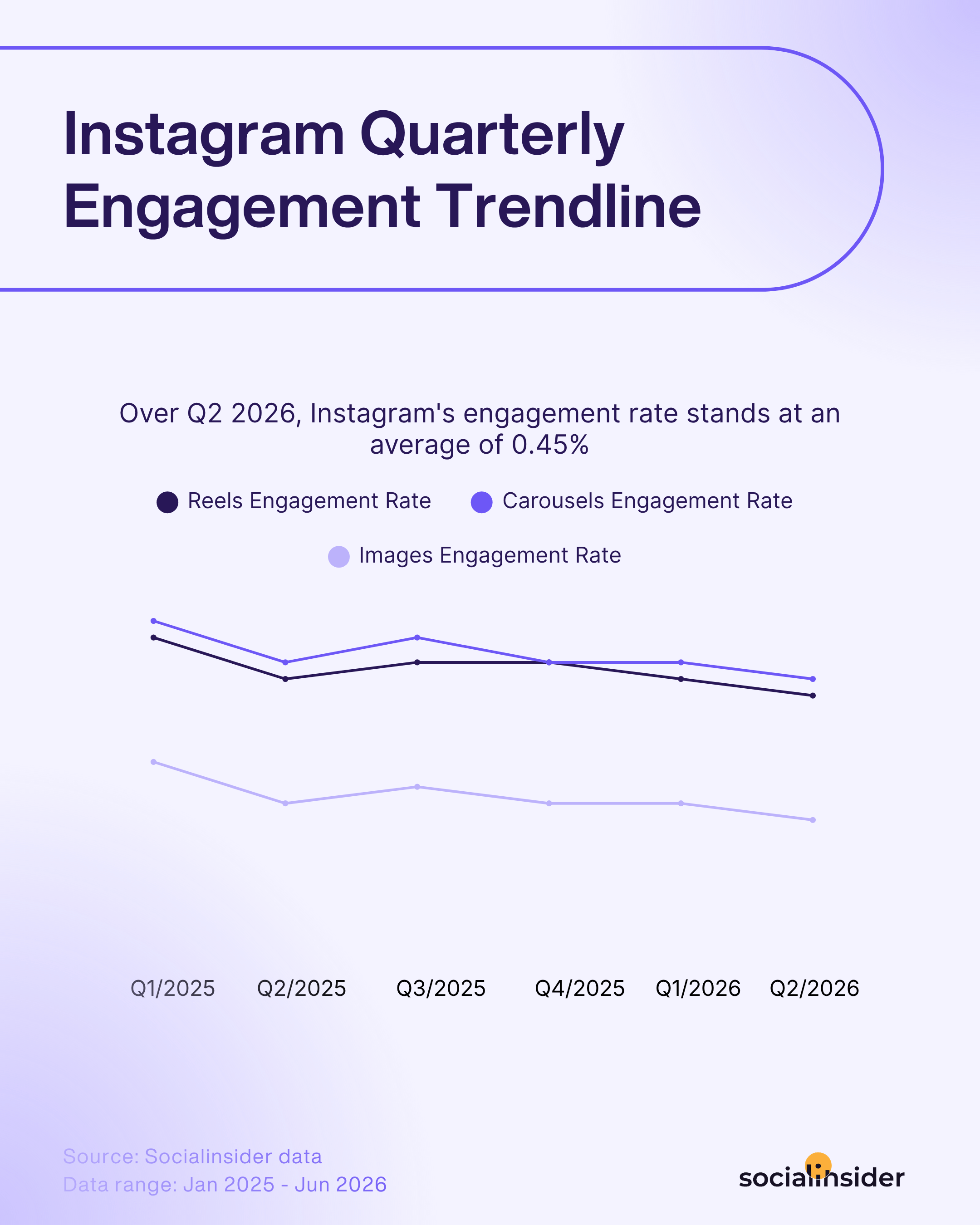
According to Socialinsider's social media benchmark reports, Carousels are one of the most consistently engaging types of social media posts across Instagram, LinkedIn, and Facebook, whether they're used for infographics, product breakdowns, or step-by-step guides.
Here are a few carousel angles I've seen performing well on social, worth building into your content calendar:
- How-tos and step-by-step guides
- Product or feature walkthroughs
- Team or expertise highlights
- Benchmark and industry data breakdowns
#2. Video content
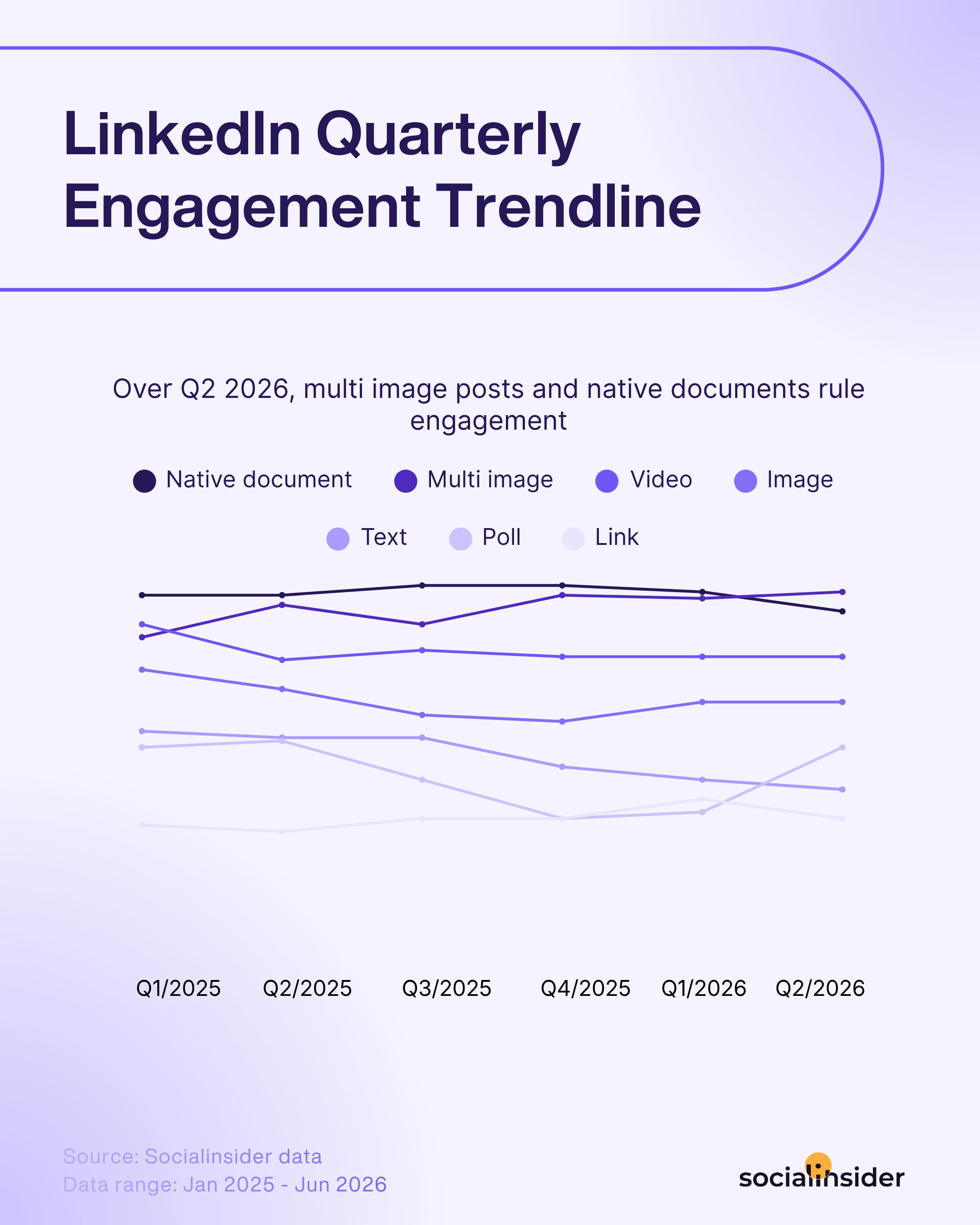
Video, whether short-form or long-form, is still one the most reliable types of social media content when it comes to reach, retention, and repurposing potential.
Video earns its place in this top because it is the best format that can show a process instead of describing one, which makes it especially effective for anything complex: a product walkthrough, a multi-step tutorial, or an idea that's hard to compress into a caption.
If you're deciding what kind of short-form video to prioritize, these are the formats I'd test first:
- Inspirational or educational videos: how-tos, product tutorials, feature walkthroughs
- FAQ-style videos answering real customer questions
- Light, funny content with subtle brand placement
- Behind-the-scenes clips
- Teasers for upcoming launches or events
- Recaps of past events or campaigns
#3. Text-based posts
Text-based content, also known as microblogging, still earns its place on platforms like X (Twitter), LinkedIn, and Threads, particularly when the message itself is the value, not whatever visual it's wrapped in. A sharp take on industry news or a clearly stated opinion can outperform a polished graphic simply because it's faster to read and easier to react to.
Text posts do a few things other types of posts can't:
- They get the message across with zero production time.
- They're fully accessible and easy to publish at scale.
- They carry real SEO value thanks to higher indexing rates.
Content categories for social media that build authority and trust
Engagement is one goal. Trust is another. These are the content categories for social media I'd lean on when the objective is credibility, not just reach.
#4. User-generated content
UGC remains one of the most underrated types of social media posts, mainly because of how little it costs relative to what it delivers. It's authentic by nature, and it costs a brand almost nothing to produce compared to in-house content.
It also carries more trust than almost anything a brand can post itself. People are used to tuning out polished ads, but a video from another customer, unscripted and unpaid, reads as a recommendation rather than a pitch.
Gap's #GapHoodie revival is a good recent example of this in action. A vintage brown hoodie went viral through organic UGC, with customers posting their own styling videos and reviews long before Gap said anything about it.

The brand leaned into the momentum by relaunching the product and letting the TikTok community vote on the next color release, turning a one-off viral moment into an ongoing feedback loop with its audience.

#5. Influencer collabs
Influencer collaborations sit in a category of their own among the different types of social media content, mostly because they combine two different value systems: brand trust and creator credibility.
The trick isn't just finding a popular creator. It's finding the right one for your campaign and audience. Salesforce's 2026 Super Bowl partnership with MrBeast is a good example of that fit working at scale: pairing a B2B brand with the platform's biggest creator to reach an audience it couldn't have accessed on its own.

#6. Guides
Guides sit at the intersection of two other content categories for social media: infographics and carousels. Most social guides are actually repackaged versions of a longer, more in-depth article, condensed into a format built for scrolling.
The condensing is the hard part. A guide that just crams a full article onto ten slides reads like homework, not something worth swiping through. The ones that work pick a single thread from the source material, whether that's a process, a framework, or a numbered list, and build the whole post around walking through it step by step, with the rest of the context left for whoever clicks through to the full piece.

What I particularly like about content type is that guides also tend to have a longer shelf life than most other content types on this list. A well-made how-to doesn't expire the way a trend-based post does, which makes it worth resurfacing every few months instead of treating it as a one-time publish.
#7. Industry research and original data
Sharing original research is one of the highest-authority content types for social media, and one of the most underused. It signals to your audience, and to search engines, that you're a source, not just a distributor of other people's takes.
This is also the one content type on this list where the barrier to entry is data, not design skill or a big production budget. Any brand sitting on proprietary usage data, survey results, or performance benchmarks has the raw material for it already.
For example, here's how we packed our Instagram benchmarks study into an Instagram post.

Emerging types of social media content to test
Not every content type on this list is fully mainstream yet, but each of these is worth testing now rather than waiting until it's the standard.
#8. AI-generated content
AI is showing up across nearly every part of the content pipeline: drafting captions, powering chatbot replies, and shaping the algorithms that decide what shows up in a user's feed in the first place.
Where this gets interesting for brands is production speed. AI-generated visuals, video clips, and voiceovers let a small team produce publish-ready content variations (different angles, different hooks, different lengths) in the time it used to take to brief and wait on a single asset.
#9. Shoppable content
Shoppable posts (tagged products inside an image, video, or ad that let someone buy without leaving the app) are quickly becoming one of the more commercially valuable types of social media content, particularly on Instagram and TikTok.
As social commerce keeps growing, this format matters less as a "nice to have" and more as a direct revenue channel, especially for brands with a strong product catalog.
#10. Episodic content
Serialized, multi-part content (a recurring series with a consistent format or storyline) is one of the more effective ways to build a returning audience rather than a one-time viewer.
Episodic formats work because they give people a reason to come back: a character to follow, an ongoing story, or a format they've come to expect on a set cadence. It's a content type built for retention, not just reach.
How to find the content types that drive engagement for your audience
With this many types of social media content to choose from, figuring out what actually works for your brand takes more than trial and error. It takes data, and a social media analytics tool like Socialinsider starts with the broadest cut: a straight performance breakdown by post format across all the major platforms, so you can see at a glance which one is actually earning its place in your calendar.
From there, you can go more granular and break performance down by content pillars instead of format, either by tagging your own posts manually or letting AI classify them for you automatically.
Tagging and grouping your own content
I would say the most hands-on way to do this is by tagging and grouping your posts by content pillar, whether that's by keyword, campaign name, or a custom category you define yourself, so every post you publish gets sorted into a theme instead of sitting as one more undifferentiated entry in your feed.

Here's how to do that within Socialinsider:
- Go to the Posts section
- Click on the Tag Post button from a post
- Create a content pillar
- Then assign that content tag to the post.
Once posts are tagged, you can get aggregated performance data about the created content themes. You can pull engagement, reach, and growth, such as in the example below.

Letting AI classify your content automatically
Manual tagging works well once you know which pillars matter to your brand, but it takes setup time, and it says nothing about how you stack up against everyone else in your industry. That's where Socialinsider's AI-based Industry Content Pillars come in.
Instead of tagging posts one by one, this feature uses AI to automatically classify content, both yours and your competitors', into the pillars that are already standard for your specific industry.

This matters most when you're trying to answer a slightly different question than "what works for us." The AI-based industry content pillars let you see which content themes are winning across your whole competitive set, not just your own feed, so you can spot a gap (a pillar your competitors are leaning into that you've barely touched, for example) before it shows up as a traffic or engagement problem.
Final thoughts
There's no shortage of content types to choose from, and this list will keep growing as platforms roll out new features. What matters more than the list itself is what you do with it: test a handful of formats against your own audience, watch what the data says, and drop the ones that don't earn their spot.
FAQs on social media content types
When is it best to use interactive content?
Interactive content (polls, quizzes, Q&As) works best when you want to deepen engagement rather than collect passive views. It's especially effective during:
- Product or campaign launches, when quick feedback or buzz matters
- Live streams or AMAs, where real-time audience participation builds connection
- Educational or onboarding content, where interactive guides simplify complex information
- Contests or giveaways, where submissions, votes, or comments naturally drive engagement

Elena Cucu
As Content & SEO Manager at Socialinsider, Elena Cucu helps social media leaders make sense of the numbers behind their performance. Featured in TechCrunch, TNW, and ReadWrite.

Know what your competitors do — before your manager asks
Get instant social benchmarks & reports without manual work.