How to Create Content for Social Media Using Analytics Insights
A 9-step social media content creation framework, from research to performance review, with real engagement benchmarks by platform.


Most guides to creating content for social media give you the same three tips: know your audience, post consistently, use video. None of that is wrong, but it doesn't explain why some accounts turn out successful content week after week while others burn out a content calendar.
Here's what actually separates the two: it isn't about picking the right content type or the right posting time. It's a repeatable process that connects what you post to what your data tells you is working.
In this guide, I'll walk through what that process actually looks like, the content types worth prioritizing right now, and a 9-step, data-backed framework you can use to build content that holds up over time. Are you ready to dive in?
Key takeaways
- The best-performing format differs by platform, Instagram favors carousels, Facebook favors status updates, and LinkedIn favors native documents, but all three beat passive formats because they ask for more than a glance.
- Content that performs consistently comes from a repeatable nine-step process, from persona research to performance review, not from a single good idea.
- Creating engaging content consistently comes down to a few compounding habits, drawing ideas from the platform itself, keeping a content vault, prioritizing video, and being selective with trends, rather than any one trick.
Why does it take both creativity and data to create engaging social media content?
Creativity is what makes content on social media stand out in a crowded feed. But creativity without a plan produces hit-or-miss results: a few great posts surrounded by a lot of noise.
Content creation for social media performs consistently when creative ideas are grounded in a clear read of the audience, the goal, and what's already worked.
In practice, that means looking at your own performance data before you brainstorm, not after. Which formats are already earning saves and shares? Which topics keep resurfacing in your top posts? Which posting times consistently outperform the rest? Those answers narrow the brief before a single idea gets pitched, so creative time goes into execution instead of guessing what might work.
Which content formats are actually worth the effort right now?
Not every format deserves a slot on the calendar, and which one wins looks different depending on where you're posting.
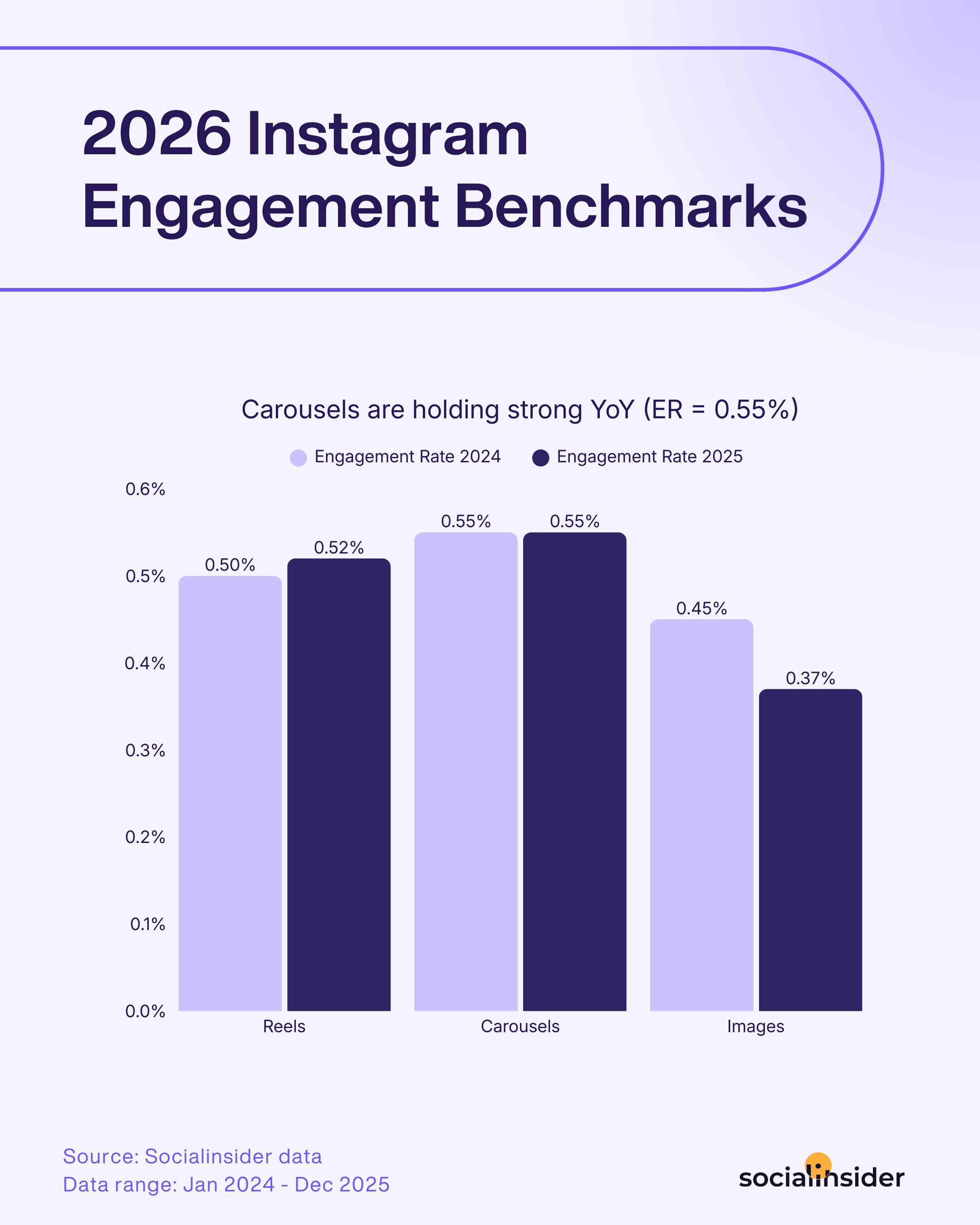
Carousels are holding a 0.55% average engagement rate, still ahead of Reels at 0.52%, while static images have slid to 0.37% and keep declining. Carousels also lead on saves and views across every follower size, largely because Instagram resurfaces unseen slides back into the feed for a second shot at attention.
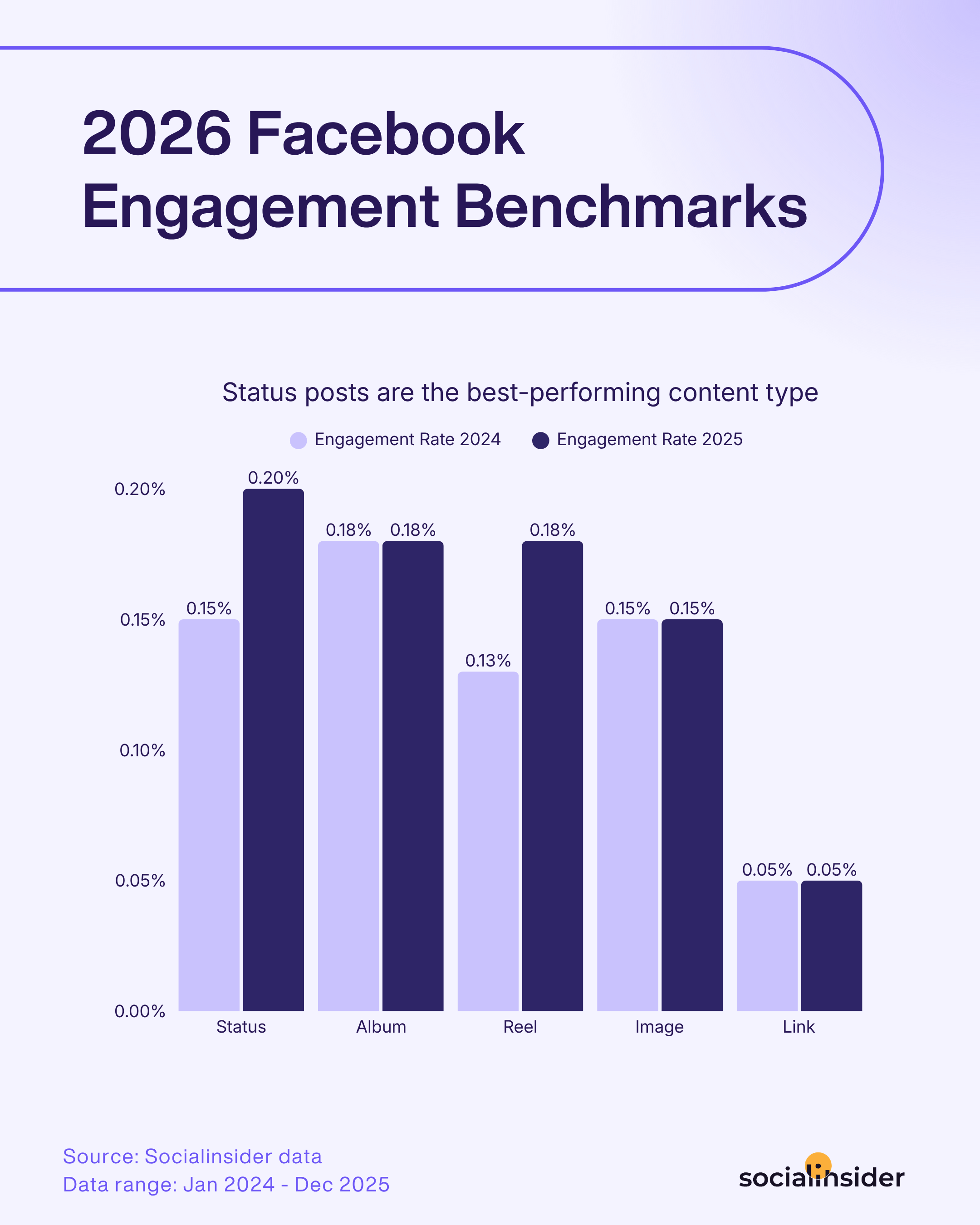
Status posts have quietly become Facebook's top format, at 0.20% engagement, ahead of albums and Reels (both at 0.18%) and well ahead of images (0.15%). My take on this is that their performance is based on the fact that plain text updates read as conversation starters rather than content.
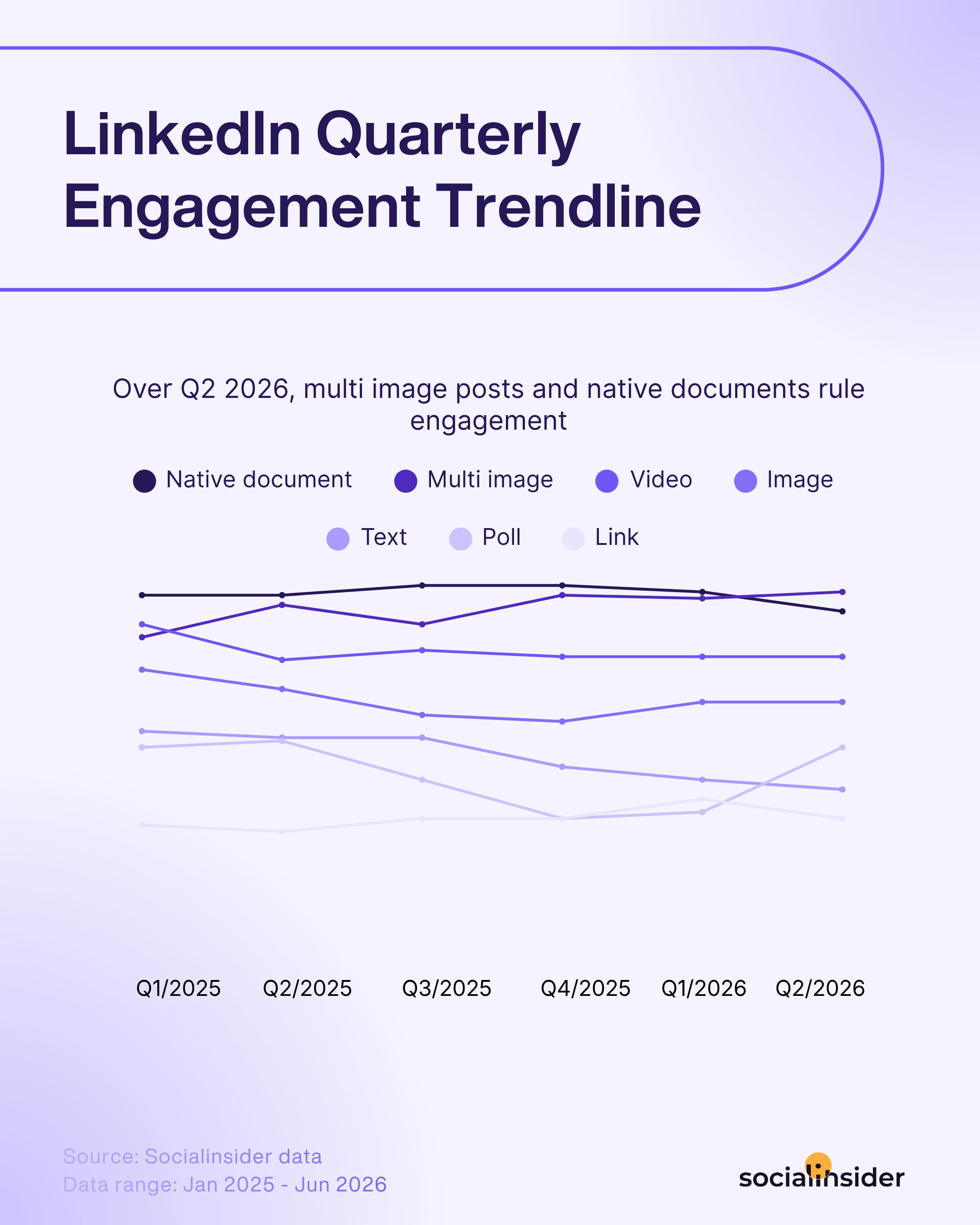
Native documents lead by a wide margin at 7.00% engagement, ahead of multi-image posts (6.45%) and video (6.00%), with text and link posts trailing at the bottom. Documents work because they double as free, saveable resources, and that's exactly what LinkedIn's audience shows up looking for.
Line up all three platforms and a pattern shows through the differences: the specific format that wins depends on where you're posting, but every top performer asks for more than a glance, a swipe, a save, or a moment spent reading, and that's what's outperforming passive, single-image posts everywhere right now.
How to create content for social media: a 9-step framework
If you're the one explaining last month's content performance to a manager or client, having a process behind it gives you something concrete to point to, not just a guess at what worked. These nine steps are what make that process repeatable.
#1. Research your buyer persona's pains and gains
When it comes to social media content creation, your work begins long before any posts land on your followers’ feeds.
Start by understanding your audience’s problems, motivations, questions, and desired outcomes before you decide what to publish.
To produce quality content for social media, you need to research target audience needs through surveys, customer interviews, community listening, customer-support conversations, and comments on relevant posts.
#2. Set content goals
Set a content goal before you choose the format, message, or call to action. A clear goal gives you a fair way to evaluate the post later.
At the end of the day, goals are milestones you expect your content to reach, so you know whether you are on the right track. Different goals result in different forms of content creation.
A post designed to build awareness may prioritize reach or views. An educational Instagram carousel may be evaluated through saves and shares. A community-building LinkedIn post may focus on meaningful comments and engagement rate.
The important point is to align the goal with the metric. Do not judge every post by the same number.
#4. Define and adjust your content pillars
Content pillars are the recurring themes that organize your social media content around audience needs and brand priorities.
Most brands run somewhere between three and five, such as, let's say... product education, behind-the-scenes, customer stories, or industry commentary, chosen because they match what the audience engages with at a given point in time. But this also implies that content pillars can change from one strategy review to another; the audience interests they're built around keep shifting, so a theme that earned its place last year isn't guaranteed to still deserve it a year later.
And the only way to catch that early is by checking performance at the pillar level, not just post by post.

Luckily, Socialinsider's AI-based industry content pillar analysis breaks pillars performance automatically, offering offering engagement and views insights, for your to have a quick understanding which ones are still worth the calendar space and which ones need to be refreshed or retired.
#5. Brainstorm creative ideas
My advice for you is to choose three inputs as sources for your brainstorming: audience needs, brand purpose, and evidence about what has already worked.
Sometimes, the best ideas come from unexpected places: a conversation with my team, a comment from a follower, or something I see another brand doing that sparks a new angle. I make it a habit to jot down these sparks in a running list or content vault, so I always have inspiration to draw from.
Personally, I use data too to guide my brainstorming. And here's how I approach this: I’ll review which types of posts have performed well lately, then challenge myself to put a creative twist on those formats.
#6. Identify social media content gaps
Look at what competitors and industry leaders are posting: how they frame messages, and which of their content gets real engagement.
If you need a hand with this, Socialinsider's competitor analysis makes this step fast by surfacing a competitor's top-performing posts directly, so you're not scrolling their feed by hand to figure out what's actually working for them.

#7. Build your content calendar
With pillars in place, map out what gets published and when: platform, format, pillar, and status, so anyone on the team can see what's coming without asking. A calendar built this way does two jobs at once. It stops the same topic from getting covered twice in one week, and it makes it obvious when a pillar is being neglected because nothing's been scheduled against it in a while.
#8. Adjust your strategy based on results
Now, for further content creation and strategy optimization, your own performance data is the best source of ideas for what to create next; focus on the formats, content themes, and posting times that are actually earning engagement.
Reviewing this on a set cadence, weekly or monthly, turns that observation into something you can actually plan around, rather than a vague sense of what's working.
#9. Master content repurposing
The first question isn't what to repurpose into, it's what's worth repurposing at all. Instead of cycling through everything you've published, start from what your analytics already flags as a strong performer, a post with unusually high saves, a Reel that held watch time longer than usual, a carousel that got picked up in shares. That way, repurposing isn't a guess at what might work a second time; it's a bet on something you already have proof for.
From there, one piece of content can go further than a single post. A webinar can become a LinkedIn carousel, a set of Shorts, a thread, and an Instagram Reel, all from the same core idea. The part that actually takes work is adapting it per platform: rewriting the hook for how each audience scrolls, and adjusting tone so a LinkedIn breakdown doesn't just get resized and dropped onto TikTok. Done well, repurposed content shouldn't be recognizable as repurposed at all.
How to create engaging content for social media: essential tips
Creating engaging content is less about a single trick and more about a few habits that compound. Here's how to create good content for social media without reinventing the process every week.
Get content ideas from your target platform
Treat each platform as a source of ideas, not just a place to publish. If you need engaging content for social media on Instagram, spend time on Instagram watching what strategy accounts are doing. Same logic applies on TikTok, LinkedIn, or X.
Build a content vault
Creating engaging content starts with keeping every idea somewhere retrievable; you can't create engaging content from memory alone. The fastest way to keep creating good content without starting from scratch every time is a running vault of ideas, organized by content pillar. A shared doc or spreadsheet works fine; the point is having somewhere to put an idea before you forget it.
Embrace video content
To create compelling video content for social media, begin with a clear audience problem or message, adapt the opening to the platform, and measure more than views. In my case, these are the metrics that I also look at to analyze video performance: watch time, retention, shares, comments, and engagement rate.
And here's also how I interpret the data: a video with many views but weak retention may need a stronger opening. A video with fewer views but strong shares may contain an idea worth developing further.
Keep an eye on trends, but don't force them
Use trends selectively. A trend is worth testing when it fits your audience, brand purpose, and platform context; not simply because it is popular.
TikTok is one of those platforms where new trends emerge frequently, so if you want to take advantage of them, you need to act with judgment and reasonable speed. If done well, TikTok trends can increase visibility, but they are better treated as optional inputs than as the foundation of your content strategy.
Instagram is another place where trends come and go quickly. For Reels, pay attention to trending audio and use it only when it complements the message and audience.
Before joining a trend, ask:
- Does it make sense for our audience?
- Can we connect it to our brand purpose?
- Can we execute it without forcing our voice?
- What will we learn if we test it?
- Is the likely benefit reach, engagement, or community building?
Final Thoughts
To create content for social media effectively, combine audience research, content pillars analysis, platform context, creative judgment, and consistent benchmarking.
At the end of the day, what matters most to me is knowing that every piece of content I create actually moves the needle—not just for my brand, but for the people I want to reach. Blending creativity with strategic thinking, staying connected to data, and learning from what works and does not work in my industry gives me the confidence to lead with purpose.
FAQs on creating social media content
What makes good social media content?
Good social media content gives a specific audience something useful, relevant, emotional, or interesting enough to notice and act on. The definition depends on the goal: a post may succeed through reach, views, saves, shares, comments, clicks, or conversions. Strong content usually combines a clear message, suitable format, audience relevance, and a measurable next step.
How to make content more engaging?
The fastest way to make content more engaging is to build on formats your own audience has already responded to, rather than guessing. Look at your top-performing posts by saves, shares, and watch time, then create more of what's already working before testing something new.
Elena Cucu
Content & SEO Manager @ Socialinsider with 8 years of experience in marketing. I like to describe myself as a social butterfly with a curious mind, passionate about dancing and psychology.

Know what your competitors do — before your manager asks
Get instant social benchmarks & reports without manual work.


