How to Measure Social Media Success: A Goal-First Framework
Learn how to measure social media success with a goal-first framework, metrics by objective, and benchmarks — powered by Socialinsider.


Monday morning, coffee in hand, a wall of numbers on your dashboard — likes up, reach down, sentiment unclear — and none of it actually tells you whether the work is paying off.
Measuring social media success isn't about staring at every number your platform gives you. It's about deciding, upfront, what "success" means for your specific goal, then tracking only the 2-3 metrics that prove it. This guide walks through that goal-first framework in 5 steps, plus how to choose the right metrics by objective, benchmark them against competitors, and avoid the most common measurement mistakes.
I've been there myself; posting consistently, celebrating spikes, stressing over dips, and still not being able to say with confidence whether social media marketing was driving real results or just looking good on slides. To make this more insightful, I chatted with Mya Shell, senior social media manager at Quill, who brings sharp insights from her experience helping brands reach millions of views and followers on social.
Key takeaways
-
The right metrics depend entirely on the goal, not on convenience. Awareness, engagement, lead generation, conversion, and community each have their own metric set — a metric that's perfect for one goal can be nearly meaningless for another.
-
The 5-step framework for measuring social media success comes down to: pick one primary goal, choose 2-3 metrics tied to it, set a benchmark, compare against competitors, and report on a consistent cadence — repeated regularly rather than run once.
-
A number without a benchmark tells you almost nothing. Historical and competitive context turn a raw metric into something you can actually act on, which is why Step 3 and Step 4 exist as their own steps rather than an afterthought.
-
The most common failure isn't picking the wrong metric, it's skipping the follow-through. Tracking too many metrics, judging by a single spike, or measuring once and never reassessing all undo a perfectly good framework.
Why "success" means something different for every team
Ask five people at your company what social media success looks like, and you'll probably get five different answers. Marketing wants reach. Sales wants leads. The CEO wants to know if the budget was worth it. None of them are wrong — they're just measuring against different goals.
This is the trap most teams fall into when measuring social media success: they try to track everything at once, hoping some number will eventually prove the effort was worth it. It rarely works that way. A dashboard full of metrics with no defined goal just produces noise, not answers.
Mya put it well when we talked about this:
I think a really common issue is that social teams are asked to grow the account, drive conversions, engage everyone, and build a community all at the same time. All of those things are great, but they're different goals, and each one comes with a different strategy. A lot of the time, those strategies can even conflict, which ends up splitting your effort and making things more complicated and confusing.
That's why I think it's important to have a clear primary goal. Maybe right now it's growth. And then layer in secondary goals like conversions or community building. When you know what the main focus is, it becomes much easier to align your content, push people through the funnel, and actually understand what success looks like and how to measure it.
So before you open a single dashboard, answer this: what is social media supposed to accomplish for the business right now? Is it building awareness for a new product? Driving demo signups? Keeping an existing community engaged so churn stays low? The answer becomes the filter for every metric decision that follows — and it's also the real definition of success of social media marketing for your team specifically, rather than a generic industry benchmark — which is exactly what the next section walks through.
Social media success metrics: how to choose the right ones for your goal
Once your primary goal is clear, choosing metrics stops being overwhelming. I use one simple rule: if a metric doesn't connect back to the goal, it doesn't earn a spot on the dashboard. Here's how that breaks down by goal type.
Awareness goals: reach, impressions, share of voice
If the goal is getting more people to know your brand exists, vanity-adjacent brand metrics actually earn their place here, but only the right ones.
- Reach tells you how many unique people saw your content. It's your clearest top-of-funnel signal. If reach is flat month over month, you're talking to the same crowd on repeat.
- Impressions show how often your content displayed, including repeat views. High impressions with flat reach usually means you're circulating within the same audience rather than expanding it.
- Share of voice measures how much of the conversation in your category is about you versus competitors. It's the metric that answers "are we becoming the brand people associate with this topic, or is someone else winning that space?" This is where a competitive analysis tool matters, since share of voice only means something in context of what competitors are earning.
Engagement goals : engagement rate, saves, comments-to-likes ratio
If the goal is a more active, invested audience rather than a bigger one, these are the metrics that actually reflect that:
- Engagement rate tells you how compelling your content is relative to how many people saw it. High reach with low engagement is a warning sign, not a win.
One thing worth knowing here: engagement rate can be calculated a few different ways: by followers, by impressions, or by views, and each version tells a slightly different story. Rate by followers shows how well you're activating your existing audience, while rate by views or impressions shows how compelling the content itself is regardless of audience size.
Socialinsider calculates engagement rate across these different bases automatically, so you can switch perspectives instead of manually recalculating the same metric three different ways to see which one actually reflects what you're trying to measure.

- Saves signal intent to return. A save means someone found enough value to want it later; that's a stronger signal than a like, which costs the viewer nothing.
- Comments-to-likes ratio is a quality check most teams skip. A post with lots of likes but almost no comments is easy to scroll past. A post with a healthy comment share made people stop and respond. Mya noted that as passive scrolling increases, this ratio becomes more revealing:
As engagement becomes more scarce across platforms, comments are one of the clearest signals of active consumption. A comment shows more intent than a passive scroll or a quick view. It means someone stopped, thought about the content, and chose to respond.
Lead generation goals: click-through rate, form completions, cost per lead
Lead generation is where social media measurement gets harder, because the metrics that matter most often live off-platform.
- Click-through rate (CTR) shows whether your content actually motivates action, not just attention. Compare CTR by copy style and CTA wording — small changes here often move the number more than a new creative would.
- Form completions tell you whether the traffic you sent actually converted into something usable: a demo request, a download, a sign-up. To make those form completions easier to measure, an online form builder can create dedicated lead-capture forms for demos, downloads, and sign-ups.
- Cost per lead is the efficiency check, especially relevant if paid social supports your organic efforts. Mya explained why lead generation measurement usually requires looking beyond the platform itself:
If the goal is to generate leads, the most important metrics are click-through rate and landing page conversion rate. Those aren't metrics you really get directly from most social platforms, which is where things start to get more complex. Measuring lead generation usually means tracking what happens off social — how people move from a post to a landing page and what they do once they're there.
Conversion goals: conversion rate, attributed revenue
This is the stage where stakeholders stop asking "did it get attention" and start asking "did it make money."
- Conversion rate from social traffic measures how efficiently the people who clicked actually became customers or sign-ups. It's not about volume — a smaller, better-targeted audience often converts higher than a big, generic one.
- Attributed revenue is the credibility metric. It ties social activity directly to dollars earned, which is the number that actually holds up in a budget conversation. Track revenue trends over a quarter rather than judging by any single campaign; consistent contribution matters more than one viral spike that doesn't convert.
Community goals: response rate, sentiment, repeat engagement
If your goal is building a loyal audience rather than chasing growth, these metrics reflect that far better than follower count ever will.
- Response rate — how quickly and consistently your brand replies to comments and messages — signals whether the community feels heard. Active participation from your side tends to increase future engagement organically.
- Sentiment tells you not just whether people are talking about your brand, but how they feel about it. Positive volume with negative sentiment isn't a win.
- Repeat engagement from the same users is the clearest sign your content has become a habit rather than a one-off scroll-stop. It's the metric that indicates loyalty is actually forming, not just accumulating.
If someone else on your team is the one pulling these numbers, your job isn't to track all of them yourself; it's to check that the metrics they've picked actually match the goal you agreed on. The fastest way to spot a mismatch: ask why a specific metric was chosen. "It went up" isn't an answer; "it's the clearest signal for the goal we set" is. If the metric doesn't map back to the goal, it doesn't matter who's tracking it; it still doesn't belong on the report.
The 5-step framework for measuring social media success
Once you know which metrics map to your goal, here's the step-by-step process I use to turn that into an actual measurement habit, not a one-time audit.
Step 1: Define your primary goal (and resist tracking too many at once)
Pick one. Just one. Growth, engagement, leads, conversions, or community — choose the goal that matters most to the business right now, and let everything else be secondary. Trying to optimize for all five simultaneously is how teams end up with a report full of numbers and no clear story.
Step 2: Choose 2-3 metrics tied directly to that goal
Resist the urge to track ten metrics because your platform's dashboard makes it easy. Mya's filter for this is one I use constantly:
I usually look at metrics as either nice-to-haves or actually useful. Nice-to-haves are good to include in reports, but they don't always line up with your goals. Useful metrics are the ones that help you prove you're reaching those goals and help you make decisions — what to do more of, less of, or differently. If a metric doesn't influence your strategy or give you better context, then it's probably not that useful.

Two to three metrics, chosen from the goal-based list above, is enough to tell a clear story without drowning it in noise.
Step 3: Set a benchmark based on your historical data
A number without a benchmark tells you almost nothing. A 3% engagement rate sounds fine until you learn it's down from 6% last quarter, or that competitors in your category average 5%. Set a historical benchmark (your own past performance) and, where possible, a competitive one, so every metric has context instead of existing in isolation.
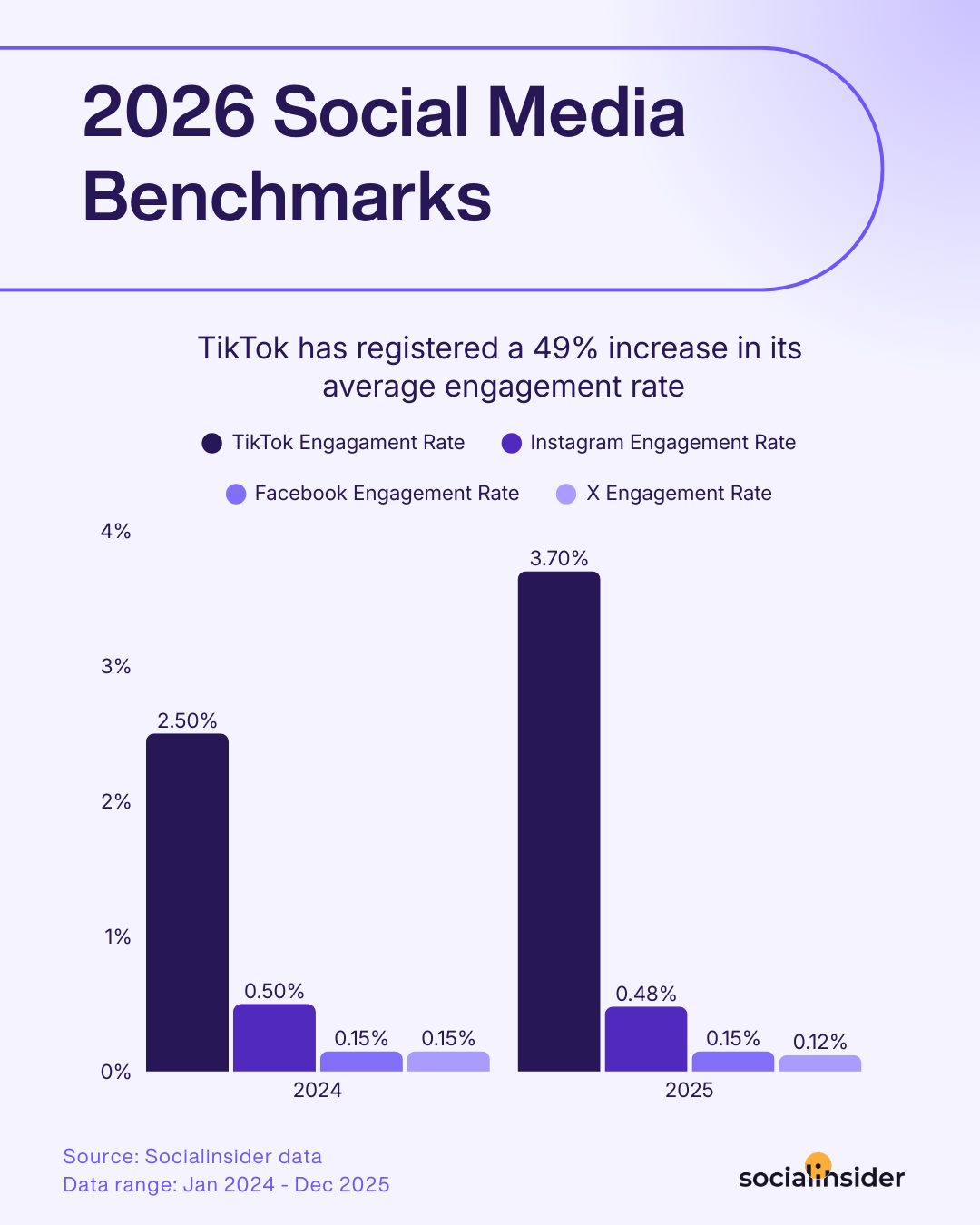
If you don't have a competitor's numbers to pull from yet, you don't need to build a benchmark from scratch. Socialinsider's social media benchmarks reports break down engagement rate, posting frequency, and other core metrics by platform and industry, so you get an instant, credible comparison point before you've even added a single competitor profile.
Step 4: Benchmark performance against your direct competitors
This is where most teams get stuck; you can't benchmark against a competitor's account the way you can your own, because you don't have backend access to their numbers.

In Socialinsider, you add competitor profiles and go straight to the Benchmarks tab to get a head-to-head comparison across the metrics that matter for your goal, plus how you stack up against the industry average. Mya's take on using competitor data the right way is worth keeping in mind here:
Competitor analysis can be really helpful for understanding what's happening in your industry, as long as you look at it through the right lens. You don't always know what's going on behind the scenes — how many resources a competitor has or what their exact goals are — so direct comparisons can be tricky. But where it really adds value is in the context it provides. You can see what topics or formats are performing well, what hasn't worked, and where there might be gaps or opportunities to try something new.
Step 5: Report and reassess on a consistent cadence
Measuring social media success isn't a one-time project; it's a rhythm. Review core metrics weekly to catch problems early, look at trends monthly to see what's actually shifting, and run a deeper quarterly review to reassess whether your primary goal, metrics, and benchmarks still make sense. Goals change as the business evolves, and your measurement approach should change with them.
Checking in with leadership: did you hit the goal?
Once you've run the framework above, there's one leadership conversation that belongs specifically to this process: going back to the goal from Step 1 and answering, plainly, whether you hit it.
Keep this check-in short and outcome-first: name the goal you set, the benchmark you were measuring against, and a plain-language verdict — ahead, behind, or on track — plus what happens next as a result. "We set out to increase demo signups from social, we're at 80% of that target with six weeks left, and we're doubling down on the format driving most of that traffic" says more in three sentences than a metrics table would in three slides.
This is deliberately narrow. If you need to build a full report for a mixed audience of executives, adapt the same data for a quarterly business review, or run the deeper stakeholder-communication process — including translating raw metrics for non-social audiences and setting up recurring reporting — that's exactly what our social media evaluation guide covers step by step. Come back here for the goal-first framework; go there when the audience or the stakes get bigger than a goal check-in.
Common mistakes in measuring social media success
Even teams with a clear framework fall into a few recurring traps when measuring success of social media. Watch for these:
- Tracking every available metric instead of the ones tied to your goal. More data isn't more clarity — it's usually just more noise to explain away.
- Chasing vanity metrics because they're easy to screenshot. Follower count and total likes look good on a slide but rarely connect to a business outcome anyone asked about.
- Judging performance by single spikes instead of trends. One viral post doesn't mean your strategy is working, and one slow week doesn't mean it's failing. Trends over time are what actually indicate direction.
- Skipping the benchmark step entirely. A metric with no historical or competitive comparison point is just a number floating with no meaning attached.
- Reporting data without translating it for the audience. A report full of platform-native metrics that leadership has to decode themselves is a report that gets skimmed, not acted on.
- Measuring once and never reassessing. Goals shift as strategy evolves. A measurement approach set up a year ago for a different goal will quietly stop being useful if nobody revisits it.
- Approving a goal without checking whether the chosen metrics actually map to it. It's easy to sign off on a report because the numbers look reasonable, without confirming they're the right numbers for the goal that was set. A metric can be accurate and still be measuring the wrong thing.
Final thoughts
How do you measure social media success? Start with the goal, not the dashboard. Choose 2-3 metrics that actually reflect that goal, set a benchmark so the numbers mean something, compare against competitors for context, and report in language leadership can act on. Revisit the whole approach on a consistent cadence, because the goal that mattered last quarter might not be the one that matters next.
If you want to skip the manual work of pulling competitor data or rebuilding reports every month, Socialinsider handles the benchmarking, auto-reporting, and own performance dashboards in one place.
FAQs on how to measure social media success
How to measure social media campaign success?
Start by defining the campaign's specific goal: awareness, engagement, leads, or conversions, then track only the metrics that support that goal. Compare results against benchmarks and past campaigns, focus on trends rather than single spikes, and evaluate what worked and what didn't once the campaign wraps.
How to measure social media marketing success across an entire strategy, not just one campaign?
Zoom out from individual posts and campaigns to your primary business goal for the quarter or year. Use the same goal-first framework — one primary objective, 2-3 tied metrics, a benchmark, competitive context, and a consistent reporting cadence — but apply it at the strategy level rather than the campaign level.
How often should you measure social media success metrics?
Review core metrics weekly to catch issues early, analyze trends monthly to see what's actually shifting, and run deeper quarterly reviews to reassess strategy, benchmarks, and whether your goal has changed.
Elena Cucu
As Content & SEO Manager at Socialinsider, Elena Cucu helps social media leaders make sense of the numbers behind their performance. Featured in TechCrunch, TNW, and ReadWrite.

Know what your competitors do — before your manager asks
Get instant social benchmarks & reports without manual work.