TikTok vs. Reels vs. Shorts: 2026 Engagement Data
TikTok vs Reels vs Shorts: 2026 data comparing engagement rate, comments per video, and views by follower size



Short-form video has completely transformed the way we connect, share, and discover content online. With TikTok, Instagram Reels, and YouTube Shorts all competing for attention, each platform brings its own unique strengths—and challenges—for brands and creators.
In this article, I’ll break down the latest engagement trends, audience insights, and performance data to help you navigate where your content and strategy will have the biggest impact.
Whether you’re focused on driving conversations, maximizing reach, or finding the right platform for your audience size, you’ll find actionable observations and honest reflections to guide your next move.
Executive summary
-
TikTok's average engagement rate fell from 3.70% in 2025 to 2.60% in 2026, while Instagram Reels held steady at 0.45% and YouTube Shorts rose slightly to 0.30%. TikTok still leads both platforms by a wide margin, even with the year-over-year decline.
-
TikTok averages 50 comments per video, compared to 20 on Instagram Reels and 10 on YouTube Shorts, making TikTok the platform most likely to generate on-platform conversation.
-
YouTube Shorts delivers the highest average views across every follower bracket.
TikTok vs Reels vs Shorts: demographics data and impact of each platform
Choosing where to invest your video budget comes down to two questions: who's actually there, and what's it worth once you show up. Below, I've broken down the current audience demographics for TikTok, Instagram Reels, and YouTube Shorts, along with the discoverability and revenue data that shows how each platform translates attention into business results.
TikTok
TikTok's advertising audience reached 1.59 billion users in early 2025, equal to 19.4% of the world's population. Its algorithm drives that scale by personalizing the "For You" page around behavior rather than who a user follows.
The platform's revenue trajectory backs up the growing ad spend: TikTok's global ad revenue is projected to reach $34.8 billion in 2026, according to WARC. TikTok Shop has become a meaningful part of that picture too, with gross merchandise value climbing sharply year over year as more brands treat the platform as a direct sales channel, not just an awareness one.
Demographically, TikTok's audience skews 55.7% male to 44.3% female, and the single largest segment is men aged 25-34, at 20.7% of the global ad audience. For brands, that's a more commercially mature audience than TikTok's "just for teens" reputation suggests, and one that's also unusually likely to convert.
Instagram Reels
Instagram Reels are Instagram's short-video format, sitting inside a platform whose advertising audience reached 1.74 billion people in early 2025, up 90.8 million (+5.5%) year over year.
That growth is a discoverability story as much as a scale one. Reels get pushed to the Explore tab and shown to non-followers, not just a brand's existing audience, which makes them Instagram's strongest format for reaching people who've never seen your account before. It's also increasingly a revenue channel in its own right: Instagram is projected to generate $42.52 billion in US ad revenue in 2026, accounting for over half of Meta's total US ad business.
Instagram's audience splits 52.7% male to 47.3% female, and the largest age group is 25-34 at 33% of the global ad audience. That combination of a slightly older, high-intent audience and strong non-follower reach makes Reels a solid pick for brands building sustained loyalty, not just chasing one-off virality.
YouTube Shorts
YouTube Shorts are YouTube's short-form format, and at scale: the feature has around 2 billion monthly logged-in users and sees an estimated 200 billion views a day.
The discoverability case here is the strongest of the three platforms, since Shorts routinely surface to viewers who've never encountered a channel before, acting as an entry point into YouTube's long-form ecosystem. That reach translates directly into purchase behavior too: in a Precise TV study, 51% of Gen Z boys and 43% of Gen Z girls said they'd bought something after watching a YouTube Shorts ad.
YouTube's global ad audience skews about 54% male to 46% female, with 25-34 as the single largest age group at roughly 21%. For brands already producing long-form YouTube content, Shorts are less a standalone channel than the mechanism that gets new viewers into that content in the first place.
TikTok vs Reels vs Shorts: 9 Differences between platforms
Given the similarities between TikTok, Instagram Reels, and YouTube Shorts in terms of the type of content published and demographics, it’s easy to put them all in the same marketing bucket.
However, TikToks, Instagram Reels and Shorts are different in many respects. The details matter, and engaged users will notice (and tax you) if you apply a one-size-fits-all strategy.
Let’s look at the subtle but important differences to help you adjust your strategy specifically for Reels or TikTok and make the best out of YouTube Shorts.
1. Platform focus
The platform focus of TikTok, Reels, and Shorts shapes user experience, content discovery, and monetization opportunities for creators.
For marketers, it influences strategic planning, content creation, and audience targeting.
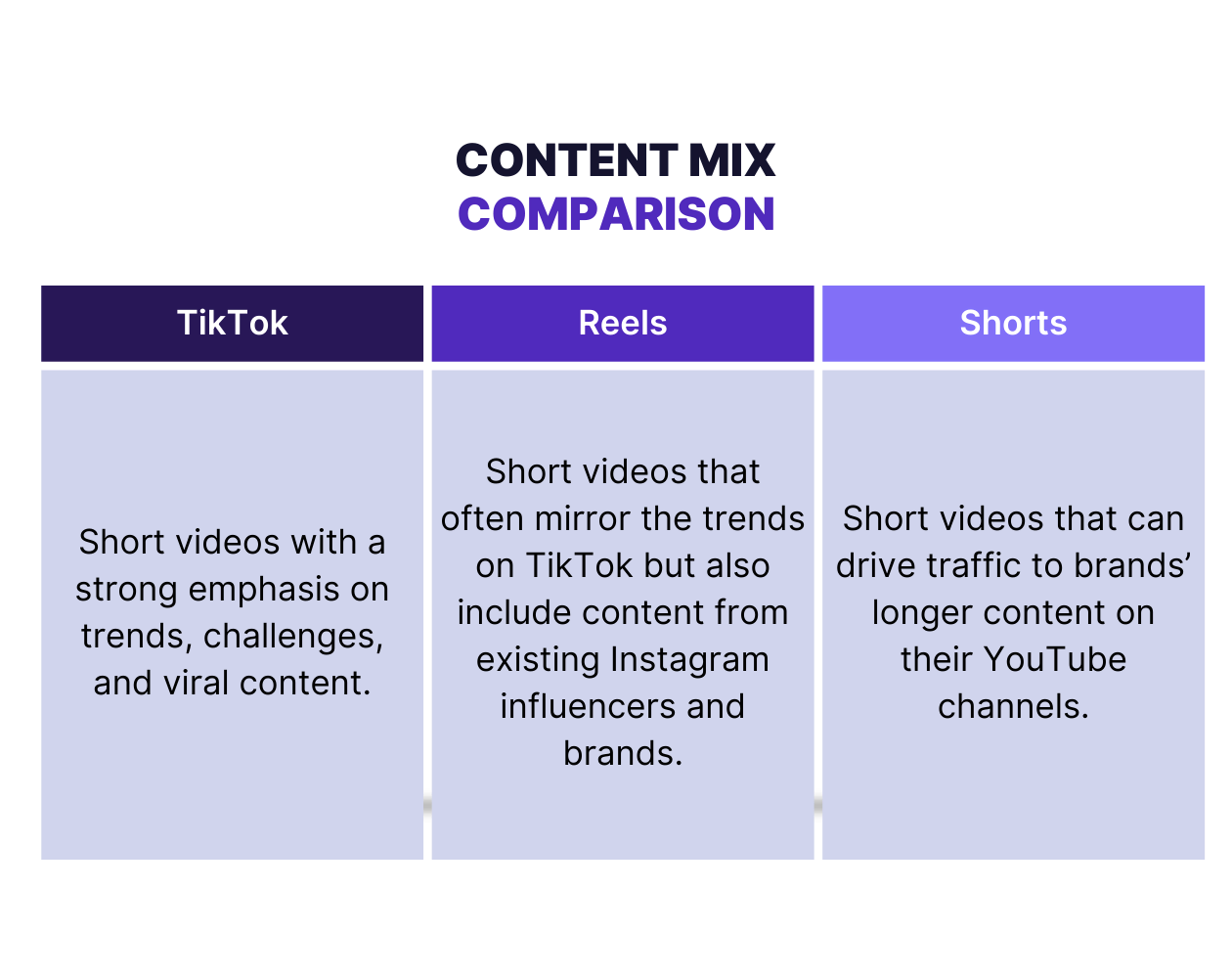
- TikTok is a standalone platform dedicated mostly to short-form content with a unique algorithm that has led to the creation of a highly engaged and creative community.
- Reels is a feature within Instagram. The difference between TikTok and Instagram Reels is that the latter is integrated into the larger Instagram environment, allowing users to create and share short videos alongside photos and other content types.
- Shorts is a feature within YouTube. Similar to Reels, YouTube Shorts is embedded within a larger platform and leverages an established user base that has access to different types of content, not just short-form videos.
TikTok’s focus on short-form videos means that the entire platform is optimized for discovering and sharing this type of content.
In contrast, the discovery mechanisms for Reels and Shorts are tied to the broader platform’s algorithms and user behavior patterns. For example, when considering TikTok vs. Reels for business, you must consider what people expect to find on each platform.
On TikTok, brands can focus entirely on creating engaging, trend-based videos. This includes participating in challenges, using popular sounds, engaging in duets, and doing stitches.
On Instagram and YouTube, brands must diversify their content strategy to maintain consistent engagement across all content types, including photos, long-form videos, live streams, etc.
2. Video length
Video length directly influences content strategy and audience engagement.
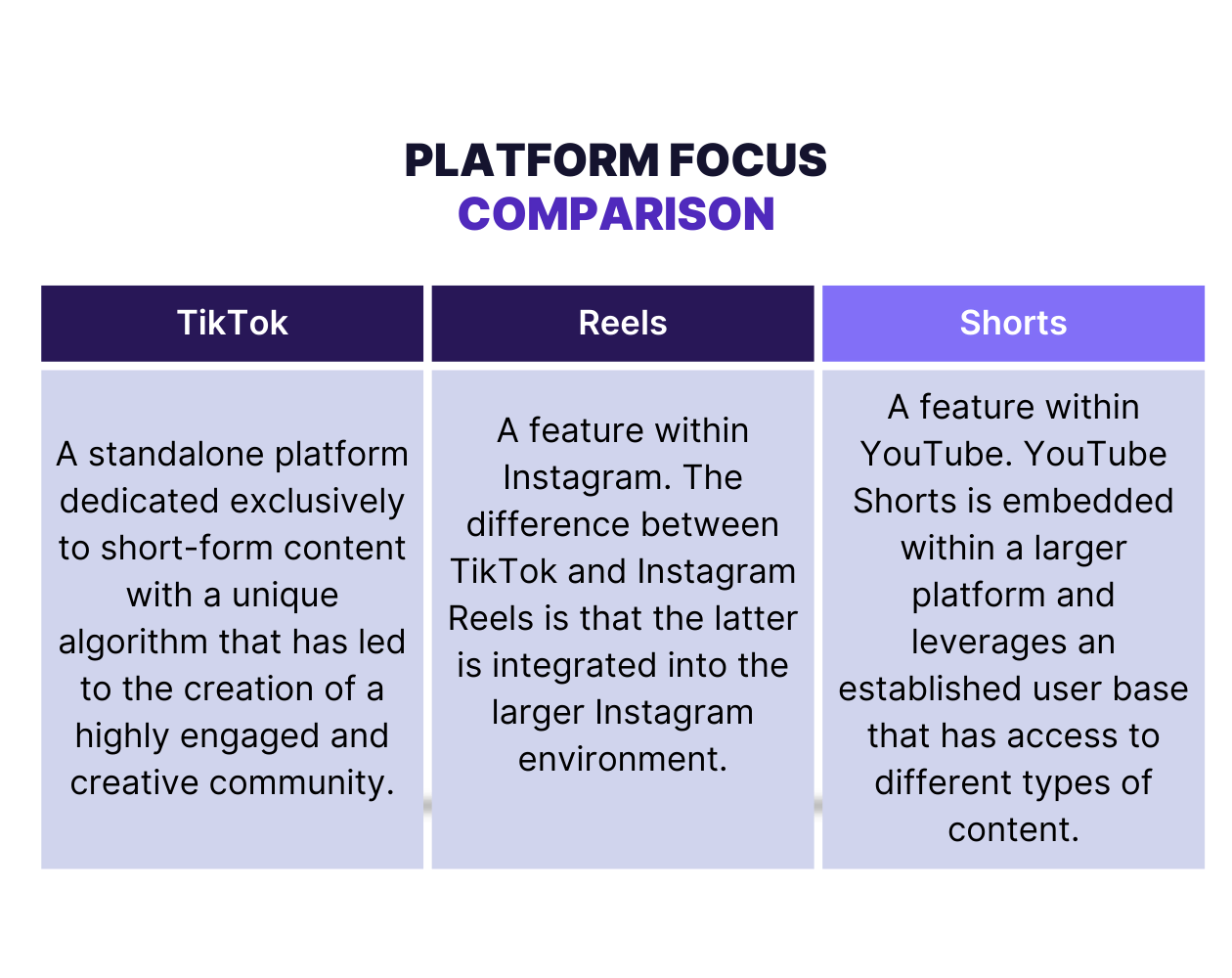
- TikTok offers more flexibility in terms of video length. Though the platform became famous for its shorter clips, videos can now range from 15 seconds to 10 minutes. The shorter video length encourages creativity and conciseness and is more appealing to a younger audience, while the longer videos give creators a chance to explore topics more in-depth, but not to the extent that platforms like YouTube allow.
- Reels allow videos from 15 to 180 seconds. For brands with a strong presence on Instagram, Reels offer an integrated approach and the chance to complete their strategy with the popular short video format.
- Shorts also allow videos from 15 to 180 seconds. They are naturally connected to longer YouTube content, making them a strategic tool for businesses aiming to draw viewers to more in-depth videos, such as product tutorials, expert interviews, webinars, etc.
When considering whether TikTok is better than YouTube Shorts for business, the answer is: it depends on your goals.
TikTok offers an advantage for short, engaging ads, while Shorts work as teasers for educational content that can nurture leads. On the other hand, Reels is suitable for cross-promotion and more complex, integrated campaigns.
3. Content mix
The content mix on the three platforms determines how brands diversify their engagement strategies across different types of posts.
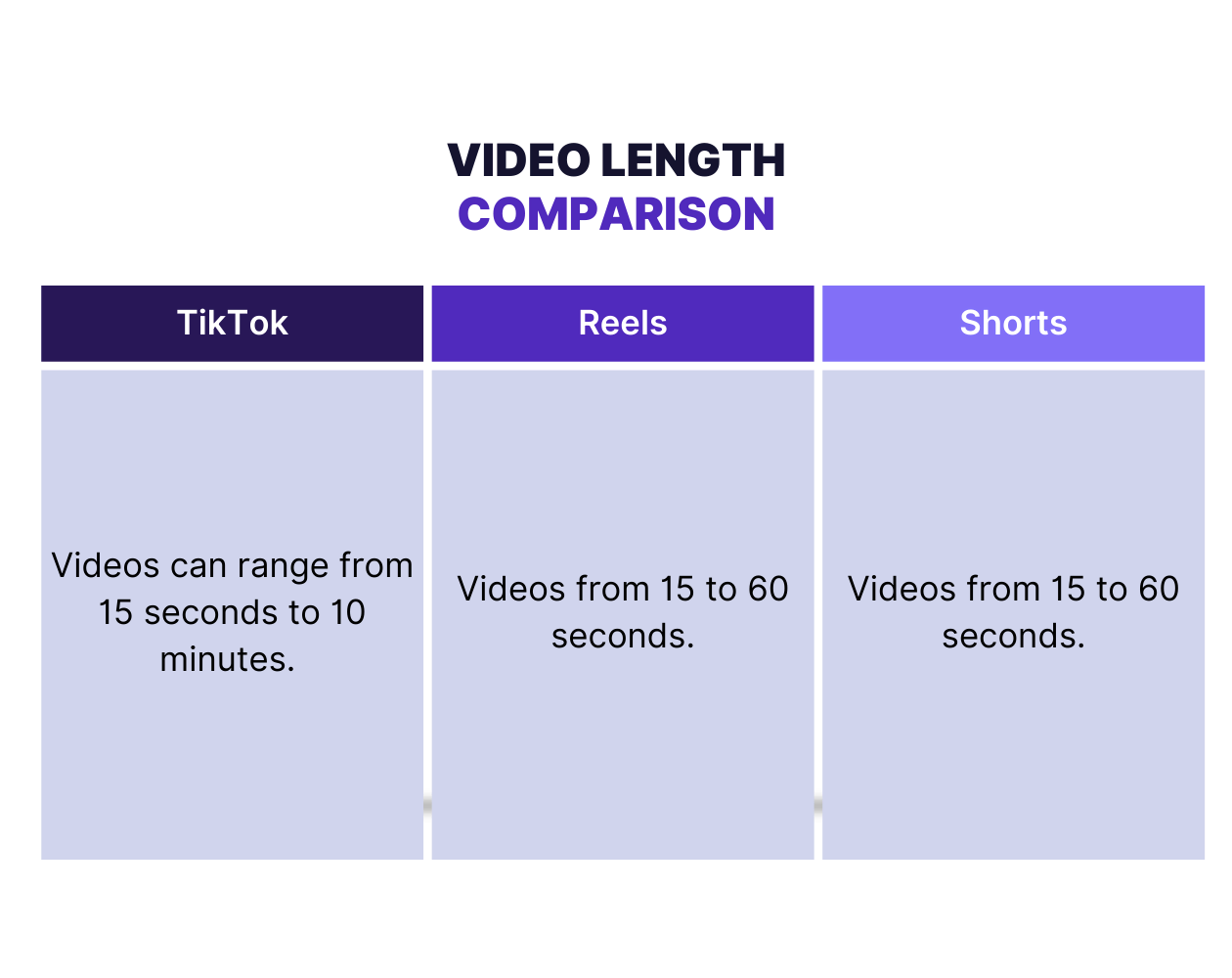
- TikTok runs primarily on trend-driven, challenge-based short video, though photo carousels exist as a secondary format for more visually-driven content.
- Reels' content mix blends that same trend participation with brand-owned storytelling, behind-the-scenes moments, and product highlights that don't need a trend to justify existing. It's less "keep up with the internet" and more "tell your own story, occasionally borrowing the internet's energy."
- Shorts' content mix leans toward the teaser and the hook: quick tips, highlight clips, and trailers whose real job is pulling a viewer toward the long-form video behind them, not existing as a finished thought on their own.
The strategic read: TikTok rewards brands that can move at the speed of culture, Reels rewards brands with an existing narrative to plug trend-awareness into, and Shorts rewards brands that already have long-form depth worth teasing. A brand with no long-form YouTube presence gets little out of Shorts's content mix no matter how well they execute it, since the format's entire logic depends on something to point toward.
4. Editing
Both TikTok and Instagram provide native tools for recording and editing videos, while YouTube Shorts offers more limited options. These features directly impact the quality and creativity of the published content.
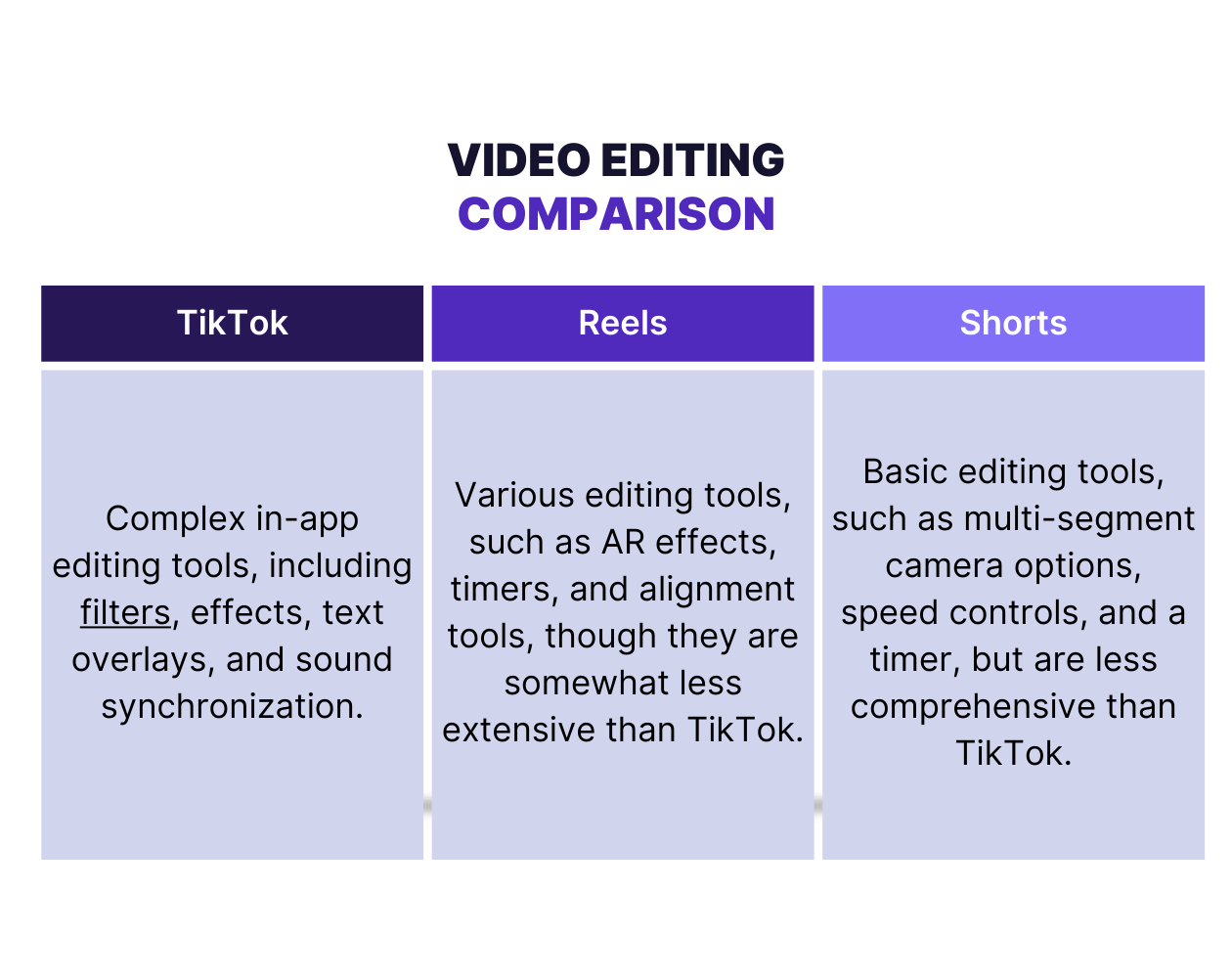
- TikTok offers complex in-app editing tools, including filters, effects, text overlays, and sound synchronization.
- Reels provide various editing tools, such as AR effects, timers, and alignment tools, though they are somewhat less extensive than TikTok.
- Shorts include basic editing tools, such as multi-segment camera options, speed controls, and a timer, but are less comprehensive than TikTok.
Of the three, TikTok is the clear winner when it comes to in-app editing features. The tools enable users to produce highly engaging content quickly without needing external editing software.
While this is appealing for independent creators, brands typically have access to more advanced resources and expertise and will most likely produce and refine videos in third-party tools before uploading them.
If you’re growing a small brand and looking to streamline creation while cutting costs, you'll enjoy TikTok’s more complex editing features.
Many creators also download the TikTok video and reuse it on other platforms, though, in this case, it’s advisable to do further editing to remove the TikTok watermark for a professional look.
When reusing videos, you’ll also want to consider differences in target audiences and whether the same engaging mechanisms work on TikTok vs. Reels vs. Shorts.
5. Target audience
Imagine trying to have a conversation, but everyone speaks a different language. That’s what happens when businesses use the same message on TikTok, Reels, and YouTube Shorts.
Each platform has a specific audience with different expectations, behaviors, and jargon.
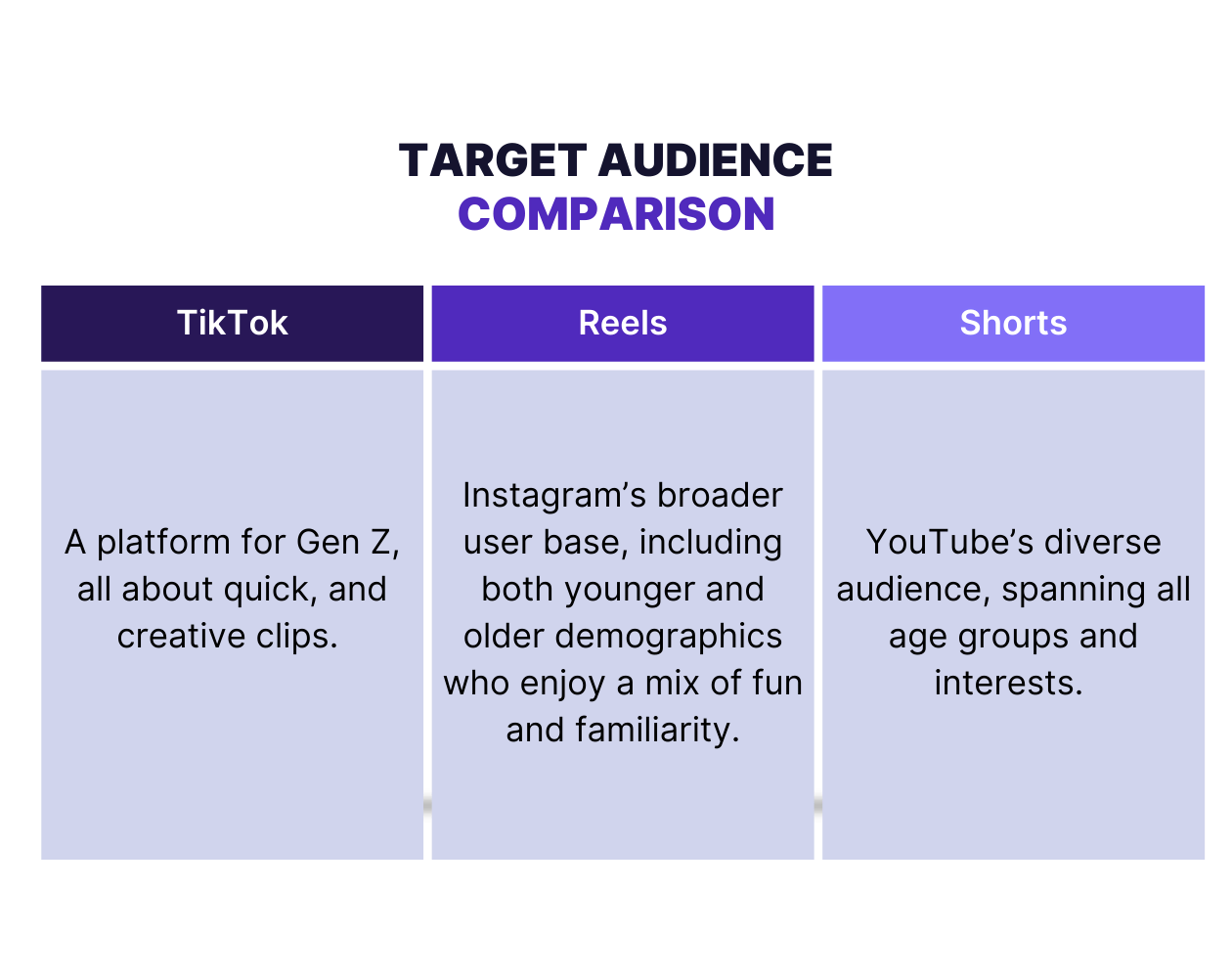
- TikTok is like the hangout for Gen Z, all about quick, creative clips (many even poking fun at older generations), though it has started to attract more diverse age groups.
- Reels appeal to Instagram’s broader user base, including both younger and older demographics who enjoy a mix of fun and familiarity.
- Shorts target YouTube’s diverse audience, spanning all age groups and interests. Given YouTube’s massive popularity, the audience is a mashup of all ages and interests.
So, how do you choose between the three? First, define your target audience and see how it matches that of the platforms. Second, understand how engaging with each demographic can help you achieve your social media marketing goals.
TikTok has a more experimental vibe, and its high engagement rates make it perfect for brands looking to innovate and connect with a tech-savvy, dynamic demographic. This audience is more likely to adopt new products and give niche offerings a chance, but also more exigent with anything commercial-related.
In contrast, the diverse demographic mix of Instagram gives social media managers the chance to develop a more varied content strategy to reach different audience segments.
Is Instagram Reels better than TikTok in this respect? The broader demographic of Reels is certainly appealing, particularly for brands that already have an established Instagram following. The same is true for YouTube Shorts, where a brand can access a huge, diverse user base.
However, there are other factors to consider. As we’ll explain in more detail below, data shows that, while catering to a narrower audience, TikTok has double the engagement rate, which is mostly due to its algorithm.
6. Algorithm
Each platform has a secret sauce: an algorithm that decides what content users see.
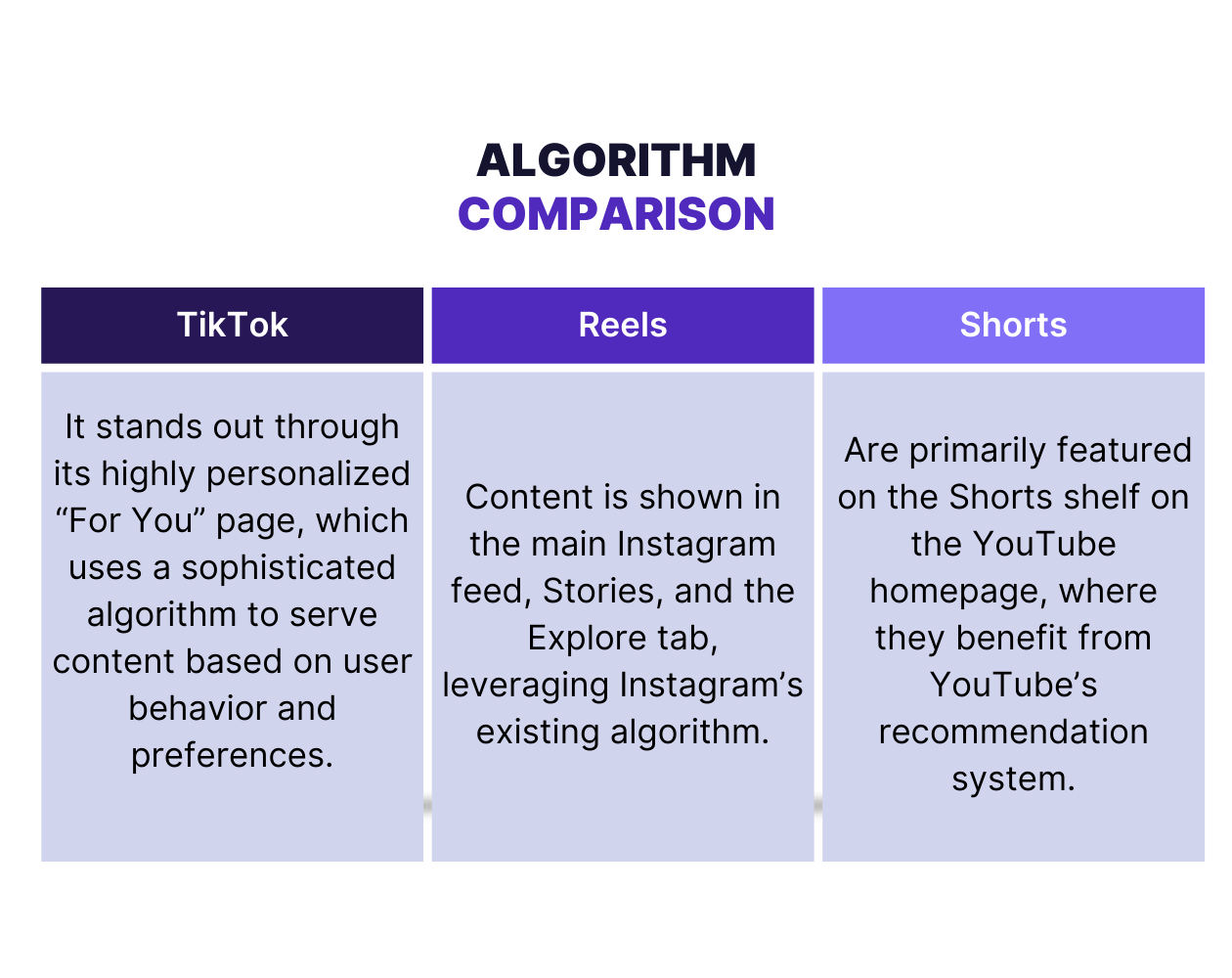
- TikTok stands out through its highly personalized “For You” page, which uses a sophisticated algorithm to serve content based on user behavior and preferences.
- Reels content is shown in the main Instagram feed, Stories, and the Explore tab, leveraging Instagram’s existing algorithm.
- Shorts are primarily featured on the Shorts shelf on the YouTube homepage, where they benefit from YouTube’s recommendation system, which promotes popular and relevant content.
TikTok’s algorithm is designed as a “mind reader,” serving personalized videos that keep users hooked. It is also known for favoring unknown, new users who sometimes go viral overnight. This means that even a new business can become popular quickly by striking the right chord with the scrolling crowds.
Compared to Reels and YouTube Shorts, TikTok definitely has the algorithmic upper hand, and its engagement rates make it tempting for any brand or creator. However, as every marketing manager knows, content strategies must take into account a variety of factors, especially when it comes to spending big bucks.
7. Advertising
Where are your advertising dollars best spent? Each platform offers distinct advantages.
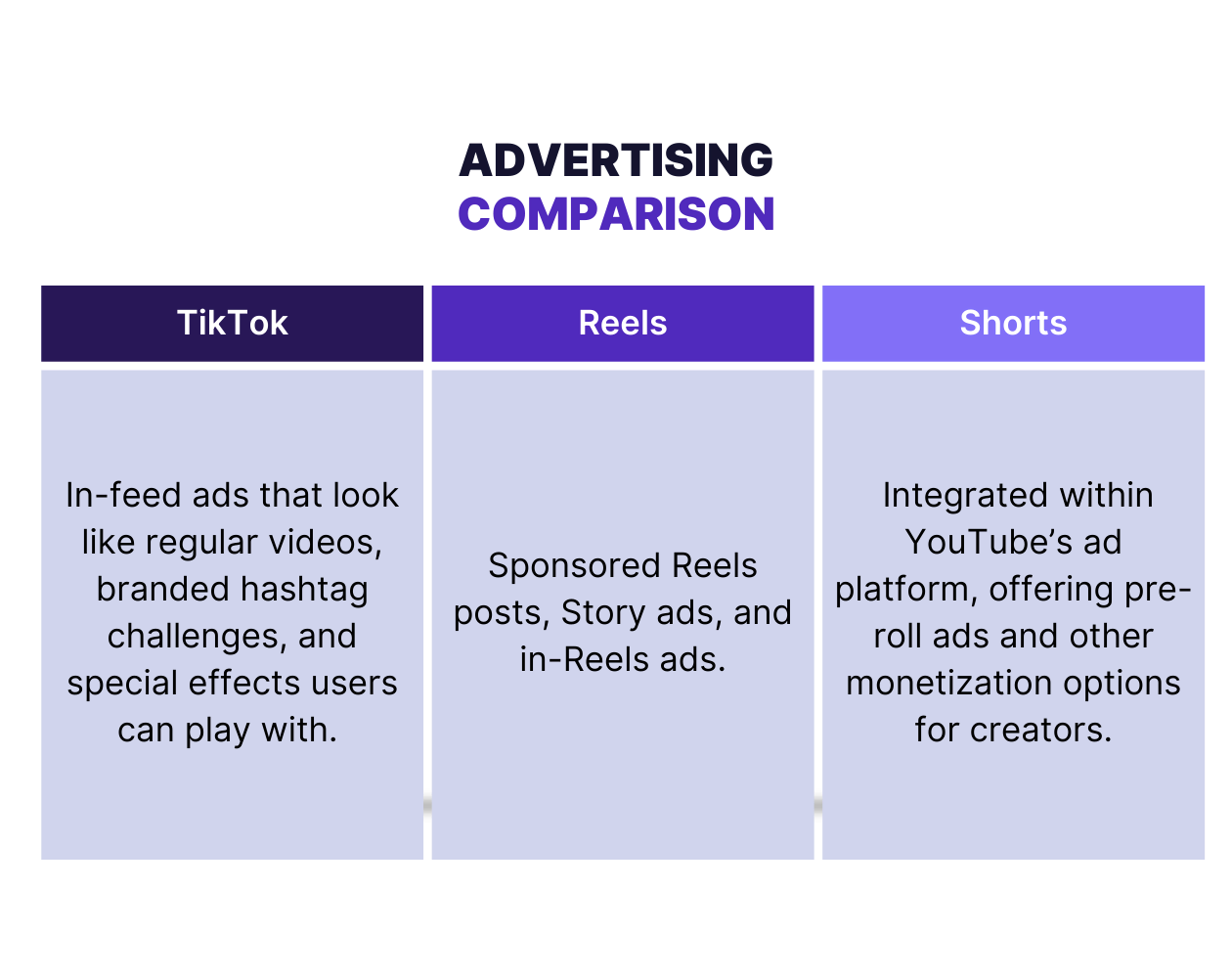
- TikTok stands out with ads that feel like part of the party, not party crashers: in-feed ads that look like regular videos, branded hashtag challenges, and special effects users can play with.
- Reels provide advertising opportunities through Instagram’s ad platform, including sponsored posts, Story ads, and in-Reels ads. The platform is designed to expand your interactions, so it is a great option if you want to create an ad campaign that flows seamlessly across different sections and leverages various content formats.
- Shorts integrate with YouTube’s ad platform, offering pre-roll ads and other monetization options for creators. YouTube’s extensive search and discovery features can boost ads to a diverse and engaged audience.
You can strategically use all three platforms to achieve goals such as enhanced brand awareness, improved conversion rate, lead generation, and better social media ROI.
Be clear about your objectives, set up your campaign target audience in detail, match content to users’ expectations on each platform, and keep an eye on social media campaign analytics. These will help you understand performance and refine your ads.
8. Music
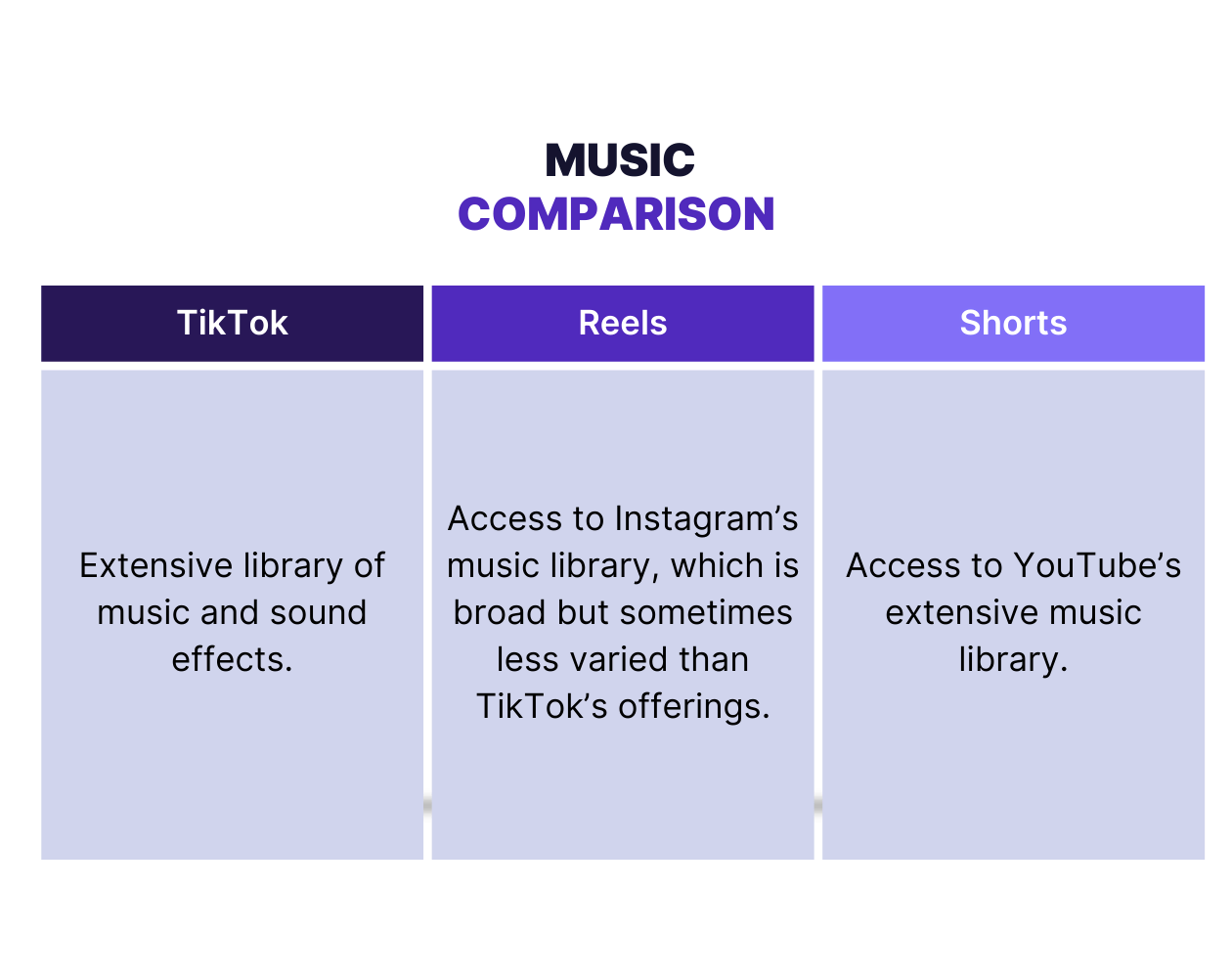
A certain sound or melody can make or break the success of your short-form content. Here’s an overview of TikTok, Reels, and Shorts music accessibility.
- TikTok provides an extensive library of music and sound effects, allowing users to create synchronized and trendy videos.
- Reels leverages access to Instagram’s music library, which is broad but sometimes less varied than TikTok’s offerings.
- Shorts gives users access to YouTube’s extensive music library, allowing creators to choose from various tracks.
In terms of audio options, TikTok definitely wins over Instagram and Shorts. TikTok has transformed how music is integrated into social media, making it very easy for users to incorporate sounds into their clips. Additionally, sounds play a central role in content discoverability, and music (even older ones) often achieves commercial success after going viral on TikTok.
When comparing YouTube Shorts vs. TikTok vs. Instagram Reels for music integration, businesses must consider the specific needs of their campaign and how effectively each platform’s music features align with their content strategy.
A dynamic B2C brand that wants to make a splash on TikTok and attract young audiences must absolutely learn how to leverage musical trends in content. A B2B business looking to drive traffic to long-form education content will do just fine with the Shorts music integration.
9. Analytics
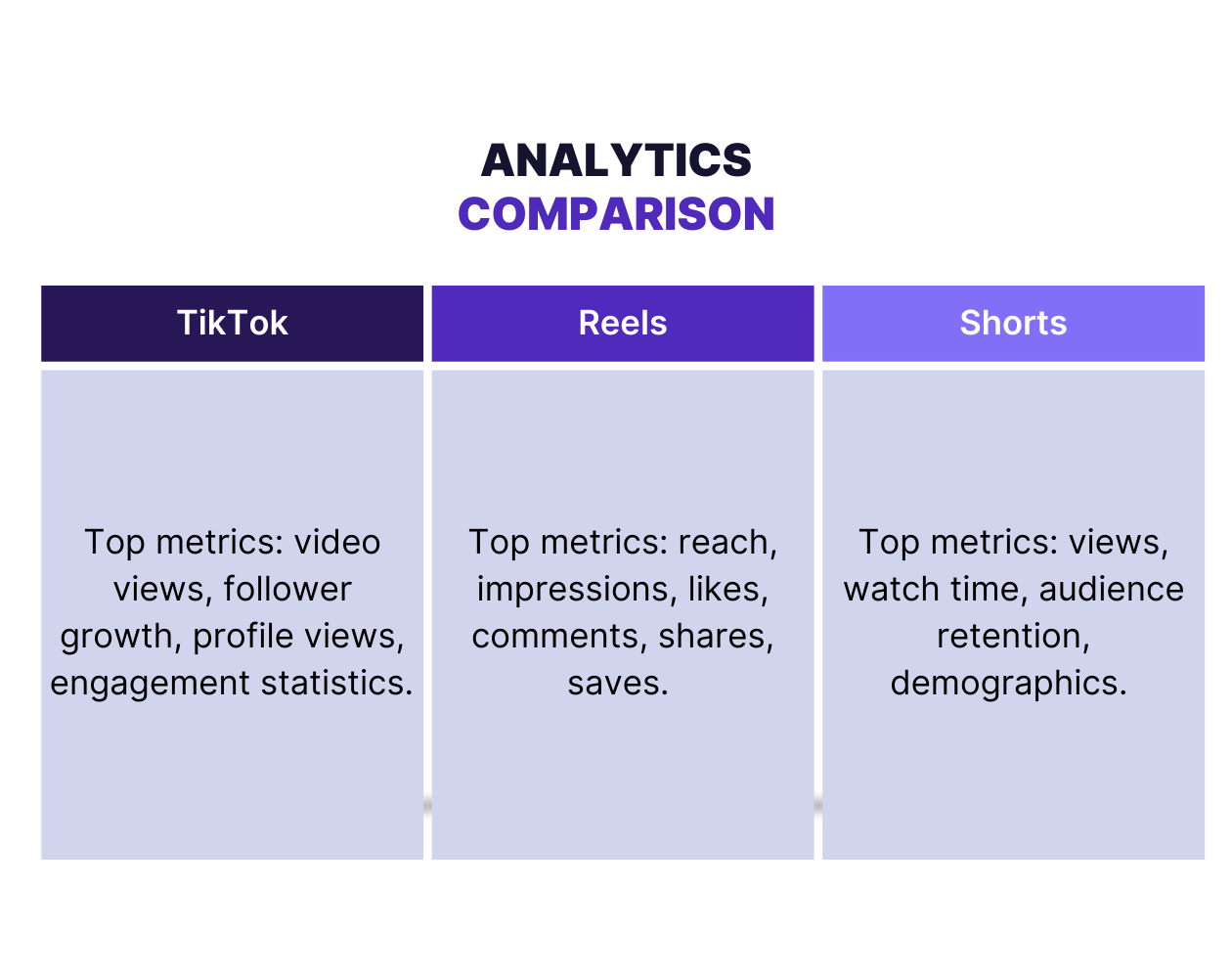
Platform analytics help businesses understand content performance and audience engagement across TikTok, Reels, and YouTube Shorts. Each social networks analytics offer unique insights that help marketing managers optimize content strategy and marketing efforts.
- TikTok provides analytics through its Business Account. Metrics: video views, follower growth, profile views, engagement statistics. You can also measure your TikTok performance using a more comprehensive analytics tool.
- Reels offer analytics through Instagram Insights, including demographic data and integrated analysis with other Instagram content. Metrics: reach, impressions, likes, comments, shares, saves.
- Shorts use YouTube’s analytics tools to provide comprehensive data that allows the analysis of both short-form and long-form content performance. Metrics: views, watch time, audience retention, demographics.
Tracking analytics across multiple platforms can quickly become confusing and time-consuming for marketing managers. Each platform has its own set of metrics and dashboards, which can lead to fragmented data and difficulty in gaining a comprehensive view of performance.
As an alternative, businesses can use a social media analytics tool like Socialinsider that centralizes data from various platforms into a single interface, providing a cohesive social media dashboard. This enables brands to see the big picture and make strategic decisions about optimizing short-form content, not just do isolated fixes.

Talking about strategic decisions, let’s look into the latest data behind TikTok, Reels, and Shorts to help you take data-driven actions on these platforms.
TikTok vs. Reels vs. Shorts: Key statistics
Numbers back up (or challenge) a lot of what shapes how each platform gets used. Here's how TikTok, Reels, and Shorts actually compare on engagement rate, average comments per video, and average views by follower bracket.
TikTok is the most engaging short-form video platform

When I'm weighing where to put video budget, engagement rate is still the number I trust most because it's the clearest signal of whether people are actually reacting to what they're watching, not just scrolling past it. And looking at 2025 and 2026 data, TikTok's lead is still real, even though I can't deny it has entered on a bumpy road a bit, registering an 8% decrease over the first two quarters of 2026, as per Socialinsider's TikTok benchmarks study.

For me, the takeaway isn't "TikTok is slipping, jump ship." A 2.60% engagement rate is still miles ahead of Reels or Shorts, and that gap is what actually matters when you're deciding where to invest. But it is a reminder that TikTok's engagement advantage isn't a fixed law of the platform. It's worth tracking quarter to quarter rather than assuming this year's numbers will look like last year's.
TikTok sparks 2x more conversations than Reels

When I think about genuine interaction on short-form video, comments are the clearest signal of an active, engaged community. They're where real conversations happen: reactions, questions, debates, the back-and-forth you don't get from a view or a like.
The data backs up what the engagement rates already suggested: TikTok holds a commanding lead in comments per video, well ahead of both Reels and Shorts.
Reels sits in the middle, at less than half of TikTok's volume but still comfortably ahead of Shorts. That gap suggests there's real conversation happening once content lands on the Explore page or taps into the right trend, even if it doesn't come close to matching TikTok's pace.
Shorts trails both, landing at half of Reels' comment volume. That tracks with what I'd expect from a format built more as a discovery feeder into long-form content than a space designed for back-and-forth in the comments.
Instagram Reels get the least views

When I look at average video views across follower brackets, one pattern jumps out immediately: YouTube Shorts delivers dramatically stronger reach at every single account size.
Another interesting part is what happens between TikTok and Instagram Reels. For the smallest accounts, TikTok actually trails Reels, not the other way around. It's only once brands cross into the mid-follower brackets that TikTok pulls ahead and keeps widening the gap, eventually posting the second-highest views of the three at the largest account sizes, well clear of Reels. And the reason for this comes down to discovery: TikTok and Shorts both push content to non-followers by default, so views keep growing even without a bigger following. Reels stays more dependent on your existing audience, so its growth is steadier, but it just can't keep pace.
Reels vs. TikTok vs. Shorts: Choosing the right platform for your brand
So, after all the data and analyses, which is the best short-form video platform in 2026? Here’s our verdict:
Engagement champion: TikTok
Looking to boost brand awareness and spark engagement?
TikTok is better than Reels and Shorts, according to the data.
Its vibrant community thrives on trends, challenges, entertaining snippets, music videos, and more. This makes it ideal for capturing youthful demographics and nurturing a highly interactive brand connection.
Strategic community building: Instagram Reels
For established brands, Instagram Reels offer a strategic space. Leverage this platform for educational content, such as product demos or behind-the-scenes glimpses.
Reels seamlessly integrate with Instagram’s existing audience, making them ideal for deepening brand loyalty and showcasing your expertise and products in a more interactive way.
However, keep innovating and don't get too comfortable, or you might get lost in the Instacrowd.
The power of discovery: YouTube Shorts
Shorts excel as a discovery tool, particularly for brands and creators already established on YouTube. Use this platform to create captivating short-form content that entices viewers to explore your longer-form videos.
YouTube’s powerful search and recommendation features are a marketer’s dream, but success isn’t guaranteed. For a solid marketing approach, explore other platforms alongside YouTube.
TikTok, Reels, and Shorts best practices
Here are a few best practices to keep in mind in your long-term short-video journey:
- Know your audience and tailor content to match their interests and each platform’s particularities.
- Grab attention in the first few seconds of the videos with a compelling intro.
- Optimize content for soundless viewing, too. Use captions and visuals to make your content compelling, even on mute.
- Tap into trending topics and hashtags for discoverability.
- Analyze social media performance and refine your strategy continuously.
- See what's working for similar brands and popular creators through competitor analysis and adapt their winning elements for your own content.
Final thoughts
Short-form video is a marketing essential, not just a trend.
With TikTok, Reels, and Shorts all offering unique advantages, a multi-platform approach is often your best bet. Start with the platform that best aligns with your target audience and brand goals, then expand using data to guide you.
Socialinsider provides analytics across TikTok, Reels, and YouTube, helping track performance and optimize strategies. Experiment with different formats, hashtags, and styles to see what resonates most.
Creativity is key, so have fun and let analytics tools handle the heavy lifting.
Methodology
The findings of this study are based on the analysis of 69M Shorts, Reels, and TikTok videos posted between January 2025 - July 2026.
TikTok’s engagement rate per post (by followers) is calculated as the sum of likes, comments, and shares on the post divided by the total number of followers that page has. The result is then multiplied by 100.
Instagram’s Reels engagement rate per post (by followers) is calculated as the sum of Reels' likes and comments divided by the total number of followers that the profile has. The result is then multiplied by 100.
YouTube Shorts’ engagement rate per post (by followers) is calculated as the sum of posts' likes and comments divided by the total number of followers that profile has. The result is then multiplied by 100.
Sabina Varga
Content marketing expert with 15 years of experience in digital marketing. I dream of beach life but love the city as a multitasking mom juggling playgrounds, books, brunches, and travels.

Know what your competitors do — before your manager asks
Get instant social benchmarks & reports without manual work.