6 Pillars of Social Media Optimization for 2026
This guide covers the 6 pillars of social media optimization: bio, content, timing, captions, engagement, accessibility, and the process needed.


Social media is not just about posting. Ask any social media manager, and they’ll tell you thousands of things to consider if you want your posts to work.
Social media optimization is what takes your brand from simply being on social media to making social media a meaningful business asset. Optimizing social media affects everything: from getting more visibility on the platform to scoring better leads and growing ROI.
In this article, I'll walk you through my six core social media optimization pillars and teach you how to optimize social media step-by-step. I'll also share with you some insights I got from Emma Sneddon, a freelance social media manager. Ready?
Key takeaways
- Social media optimization improves six areas: profile and bio, content and format, timing and frequency, captions and hashtags for social SEO, engagement and community, and accessibility, to drive visibility, discoverability, and conversion rather than engagement alone.
- A social media optimization process follows four repeatable stages: audit, benchmark against competitors, prioritize by impact and effort, and re-measure.
- An effective social media optimization tool provides competitor benchmarking without requiring account access, at least 3-6 months of historical data, pre-digested insights over raw exports.
What are the core pillars of social media optimization?
Social media optimization is the process of improving every piece of your social presence: profile, content, timing, captions, accessibility, with the purpose of moving the metrics that matter to the business: visibility, discoverability, and conversion, beyond content getting engagement just for the sake of it.
Unfortunately, there’s not just one thing you need to do to make your social media accounts bloom. Social media optimization is a series of tweaks, small and big. Changing your bio doesn't necessarily transform your account, but it makes a difference when stacked together with the right keywords in content.
When I asked her opinion on the main differences between tactical tweaks and systematic social media optimization, Emma told me:
Tactical tweaks are little things you try, for example: posting later in the day when your audience is more active, using trending audio, jumping on trends. Whereas systemic optimization is taking the time to check what's working, why it's working and building on it. This means every change is informed and you're building on knowledge about your specific audience rather than chasing quick wins.

Now let me guide you through my six main social media optimization techniques.
Profile & bio optimization
Social platforms function as search engines now, and discoverability starts with your bio.
I've seen brands go two directions here: some write detailed, clinical bios that spell out exactly what they do. Others go for a punchier, funnier one-liner that's more about personality.
Both can work, but if I had to pick a side, I'd bet on discoverability over cleverness.
Here’s my social channel optimization approach for bios and profile descriptions:
- Keyword-driven. Your main service, niche, or category should be easy to find in the bio. That helps both the algorithm and a scroller.
- Location-clear, if it matters. If you're a local business, say where you're based, in the bio or even in the profile name.
- Balanced. Informative enough to explain what you do, human enough that it doesn't read like a directory listing.
- Platform-appropriate. Short and punchy on Instagram (maybe even throw in an emoji), a more detailed and descriptive one on LinkedIn. What works on one feels thin or overdone on another.
- Consistent across channels. Same core phrasing and keywords everywhere, even if the tone and length shift platform to platform.
My tip: write your bio for the platform's audience first, then adjust for consistency across channels. You don't need identical bios, but make sure you use recognizable phrases and keywords in each.
Content & format optimization
Social media content optimization covers two things: what you post, and how you post it.
There's a whole separate conversation to be had about social media analysis and how it feeds into a content strategy long-term. For now, I want to focus on the foundational bricks of social content optimization: content pillars and format.
Content pillars are the broad, recurring topics you keep coming back to, the ones that make up the backbone of your content calendar. Optimizing them means figuring out which pillars are pulling the weight with most engagement and which ones are underperforming.

Here's where I'd push you to go one step further than just looking at your own data. To really optimize your content, bring in a content competitor analysis. Because looking at your pillars in a vacuum only tells you so much. You might see a pillar underperforming and assume it's a dead end. However, it might be that your whole niche struggles with that topic, or the opposite: everyone else is crushing it, and you're the one getting it wrong.
To quickly collect that information, you can use Socialinsider, which, through its AI-based industry content pillars, lets you analyze the content themes of your account and for competitors as well, both at a channel-level and also across multiple channels, without you sorting through post after post manually.
And if you want to go deeper into how a competitor is actually approaching a pillar, ask Socialinsider's AI assistant to break it down in more detail.
Then look at the format. Once you've flagged a losing pillar, ask whether it's the topic, the format, or the angle. Sometimes a topic is perfectly fine, it's just being delivered in the wrong format for the platform or the audience.
Some of this is obvious, like TikTok and short videos. But mixed-format channels are trickier.
Say you've been posting short videos on Instagram because that's the "best practice" everywhere you look. But your competitor insights show carousels are performing best. That's a signal to break from the general playbook and build one that fits your specific audience and content.

And by the way, Socialinsider analyzes your competitors' content, highlighting the best-performing formats by engagement and helping you find your winning one.
Timing & frequency optimization
Hot take: the best time to post is overrated.
Don't get me wrong, I didn't say it's meaningless. Posting when your audience is online makes total sense. Algorithms like early engagement, and if you’re choosing the time when your audience is most active, there is a higher chance they’ll see your content early on.
But there's no universal perfect hour that will significantly impact your social media metrics. So if you’re obsessing over whether you should post at 6 pm or 9 pm, you’re optimizing the wrong thing.
What matters for social optimization is also posting frequency.
An important note here, whatsoever: consistency beats high frequency. Because, as you already know, each platform has its own relationship between how often you post and what earns engagement.
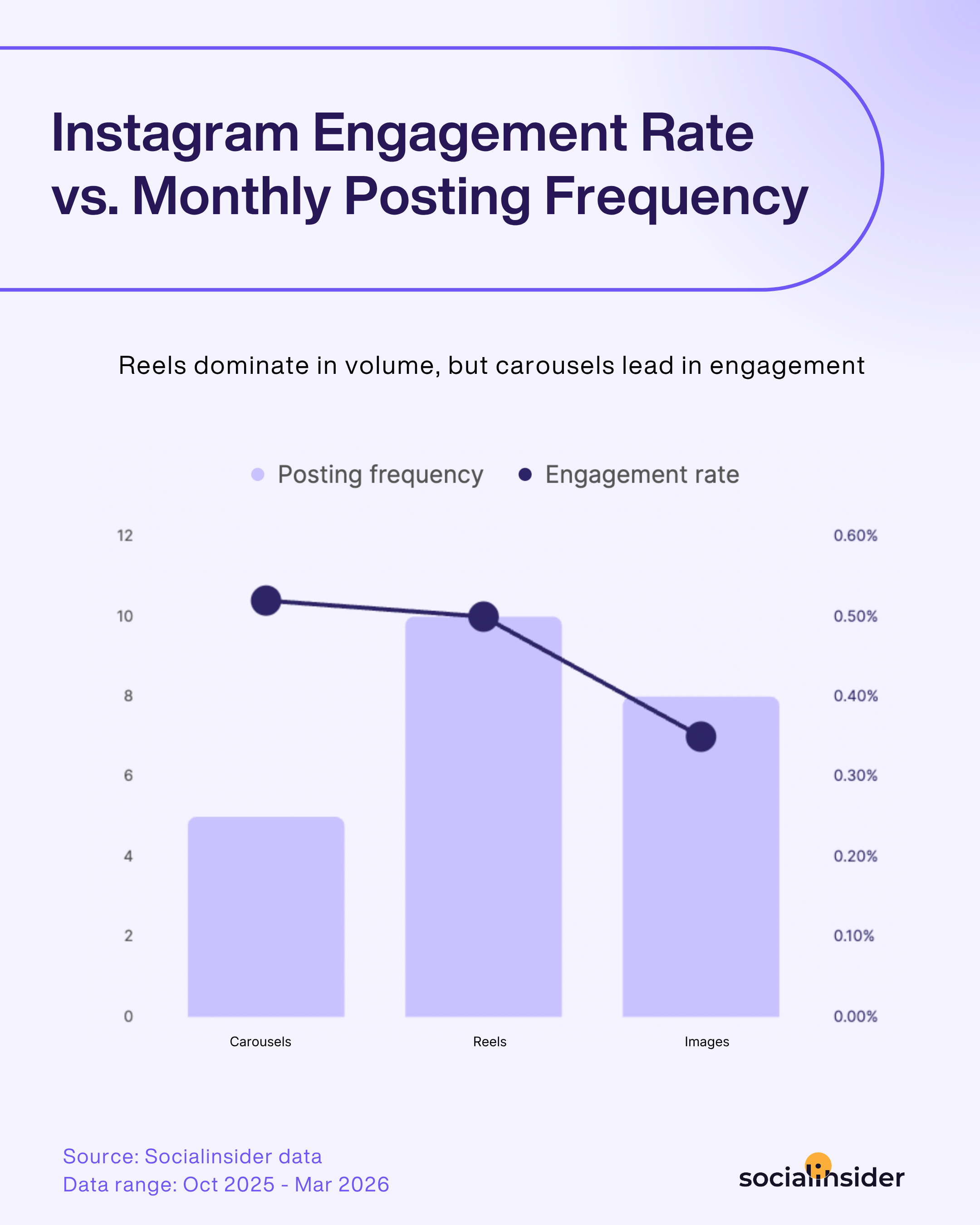
According to Socialinsider’s report, on Instagram, posting frequency varies a lot by format. Reels get pushed hardest with 10 posts a month on average, and carousels are only posted 5 times a month. Yet, carousels are beating Reels in engagement (0.52% vs. 0.50%).
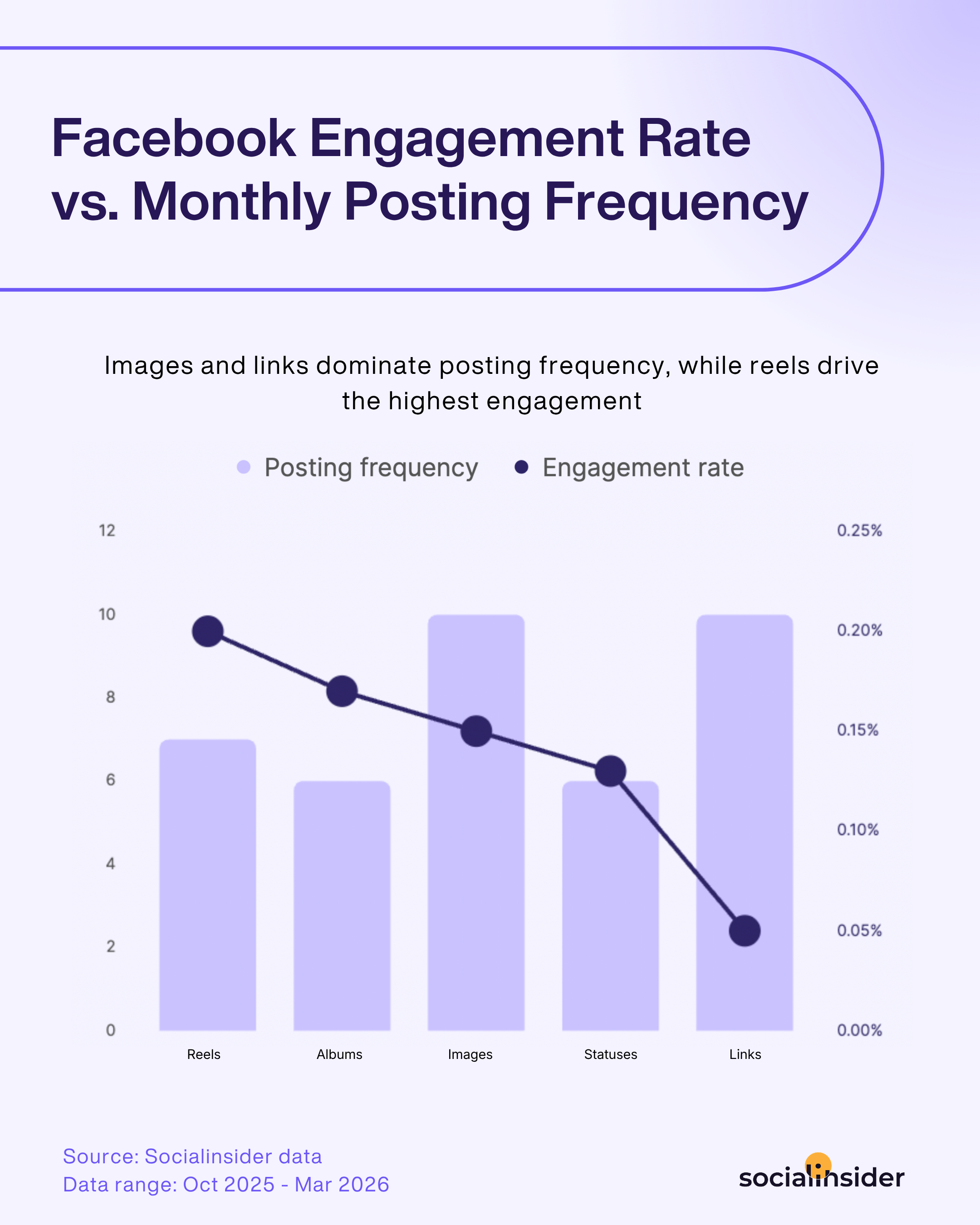
Facebook shows an even bigger gap between what gets posted and what gets results. The most posted formats are images and links, both averaging 10 posts a month, but links generate a sad 0.05% engagement rate. Reels, posted only 7 times a month, drive the most engagement at 0.20%.
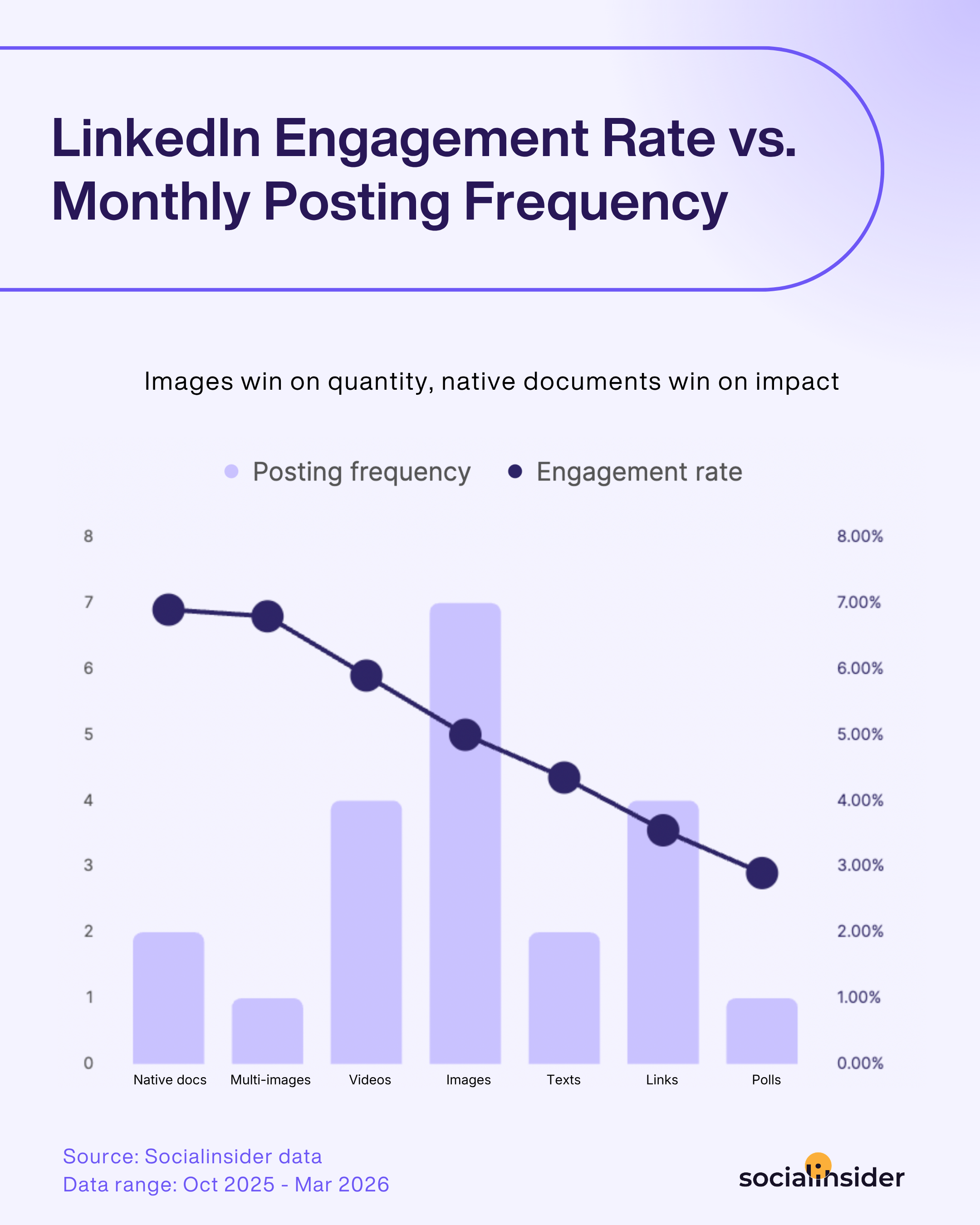
On LinkedIn, images dominate frequency at 7 posts a month but only rank fourth in engagement at 5.00%. Yet the leading engagement drivers — native documents and PDF carousels with 6.90% — are only uploaded twice a month.
There’s no universal rule of how often to post on different platforms. However, the general sentiment is that in 2026, the smarter move is to post less, but with more intention.
So your social media optimization strategy here should be to find a balanced pace you can stick to consistently, and prioritize filling in the content plan with high-engagement formats.
In my experience, 3–4 valuable and substantial posts a week is a good ratio that allows you to mix different formats and balance serious educational pillars with occasional engagement-oriented memes. But that number may differ across audiences, niches, and platforms.
Caption & hashtag optimization for social search (SEO)
SEO isn't just a website thing anymore. Social platforms function as search engines, and we should treat them as one.
When I asked Emma about her top three optimization tactics, she listed:
1.People are saving stuff more now, so making content that feels useful and saveworthy. 2. Creating native content that is clearly made for the platform works better than content that's recycled from somewhere else. 3. Incorporating social SEO by using real words and phrases your customers are using to search in hooks/captions/voiceovers.
Another hot take: hashtags are practically dead in 2026, and everyone, from Adam Mosseri to Elon Musk, is saying it about their platforms. Hashtags don't add extra reach or help the algorithm categorize your content the way they used to.
So your social optimization starts with losing the hashtag, unless you're using it as a branding tool, to tag a campaign or mark a recurring series.
Instead, replace the hashtag with a keyword woven naturally into your caption.
Just like on Google, keywords are what drive visibility on social. They tell the algorithm what your content is about, and that determines whether it gets recommended to the right person searching for that topic.
A couple of things I always do as a part of social media marketing optimization in captions:
- Search the platform itself. Type a broad term related to your topic into TikTok or Instagram search and see what autocomplete suggests. Those suggestions are real queries people are typing, which makes them a solid starting point.
- Check what's ranking. Look at the top results for that search term and note the words that show up again and again in captions and on-screen text. That repetition is a signal, not a coincidence.
- Think in questions. People search the way they'd ask a friend, "how to fix a leaky faucet" rather than just "faucet repair." Captions with similar phrasing have more chances to show up.
Engagement & community optimization
Engage with your audience" isn't a strategy, it's a given. What actually moves the needle is treating engagement as a set of levers you manage deliberately, not something you leave to whoever's monitoring the inbox.
First, response time is a ranking signal, so track it like one. Platforms weigh how fast and how consistently a brand replies to comments, especially in the first hour or two after a post goes live, so it's a ranking signal, not just good manners. That’s why I advise you to pull it into your next social media audit and cross-reference posts with fast reply times against the ones left unanswered, and see whether it correlates with performance. If it does, that's a resourcing question — does your team have the coverage to hit that window consistently across every channel you run?
Then there's the commenting you do outside your own posts. Most brands only ever show up in their own comment sections. The ones that pull ahead show up in other people's too: adjacent brands, relevant creators, people already active in the niche. Someone needs to own that as a real slice of the social media engagement strategy, not squeeze it in when there's time left over. Do it consistently and it shows the algorithm, and the market, that the brand actually shows up.
Third, treat your comment section as a standing input to the content pipeline, not just a place to respond. A question that keeps resurfacing under your posts is a content brief you didn't have to write yourself. In practice, that means:
- Turning a detailed recurring question into a piece of social media content built to answer it directly, titled after the question itself where it makes sense.
- Using "reply with a video" to convert a single comment into standalone content — it tends to outperform because it reads as responsive and transparent, not scripted.
- Keeping a running log of recurring comment themes and feeding it into content planning on a fixed cadence, rather than relying on memory.
Accessibility optimization (alt text, subtitles)
Subtitles and alt text do double duty: they make your content accessible to people watching on mute or using screen readers, and they give algorithms clean text to parse when deciding who to show your content to.
You’re probably already using both on your social media. How can you get more out of it?
With alt text, the key is to stay descriptive but concise. Your alt text should use enough detail to understand the context, both for screen readers and for the cases when the image fails to load.
- Use relevant keywords, but don't overstuff them
- Drop the "image of" or "photo of." Go straight into the description.
- Don't duplicate what's already in the caption or body text.
Subtitles also have some best practices to follow. The point of subs is to make it easy to follow the narrative even without the sound, so readability is the main factor.
If you’re adding subs directly into the video file, keep the on-screen text short (3–7 words per frame is fine) and use high-contrast, readable typography. Check that when you publish the video, the platform’s UX is not covering any text.
Some platforms, like YouTube, LinkedIn, or Instagram, can auto-generate subtitles for you. Make sure to double-check them for typos, correct naming, grammar, and timing. My personal advice is to upload an .str file with pre-made subs, especially on YouTube and LinkedIn, to make sure they match the video perfectly.
How to build a social media optimization process
Instead of running your social media through a generic list of boxes to tick, run a process that helps you find the actual weak spots and choose how to mend them.
Here's how Emma's process looks like:
For me, it's pretty much 4 steps. First I audit the account. I will look back to see if I can spot any patterns of what's working and what's not. Then I would pick one thing to test at a time, for example: format, hook style, CTA etc. I would then run content with this new change, giving it long enough to actually see if it is performing well or not. Then I decide whether or not to keep the change and what to test next.
And here's my step-by-step workflow on how to optimize social media accounts.
Audit
The first step is finding out where the weak spots actually are, and whether there are any to begin with. This is your social media evaluation, and it should cover:
- Bios and captions across every active channel
- Content pillars and how each one is performing
- Posting frequency and consistency over time
- Performance data: views, reach, average engagement rate, likes, comments
Doing this manually across five or six platforms is tedious, and it's easy to lose the thread when you're flipping between native analytics dashboards. My recommendation? Automate it with a brand analytics tool, such as Socialinsider, which does a great job at speeding up the cross-channel audit.

Socialinsider speeds up the cross-channel audit. In the Brand overview section, you can see all your social platforms gathered in one place, with core brand metrics side-by-side: follower count, posts per channel, and total engagement per channel over a given time frame.
It also breaks down your engagement trends and best-performing content pillars, so you get the full picture of your brand's content performance in one section.
You can even see the Earned Media Value split by channel to estimate the real monetary value each of your social media platforms is bringing.
If you're short on time, or need a quick summary for an executive report, the Key Insights Summary from Socialinsider's AI assistant can help you. It highlights the main trends and tips based on your brand metrics, like which channel is driving the most engagement or how to capitalize on a spike in follower growth.
Lastly, when I asked her what her top metrics to track are, Emma told me:
It depends what your current social media goals are, but if you're putting the same (or more) effort into your content but you're getting less back, that usually means something has shifted. For example, if your reach is up but sales, sign-ups, or whatever your goal is have dropped, it's time to look at your strategy.
Benchmark against competitors
Once you've got your own numbers, you need context to know if they're actually a problem. A 0.7o% engagement rate might look weak in isolation and turn out to be completely normal for your niche. That's a job for competitive benchmarking.
Benchmarking lets you compare how brands perform on social media, but not just on the level of who’s got more likes.
One of the fundamental best practices for competitor benchmarking to keep in mind when you’re optimizing social media is choosing the right metrics to benchmark against. Engagement optimization requires benchmarking engagement rates, comments, shares, and sentiment. Growth optimization needs follower count, views, and posting frequency.
But I personally like to give all of these metrics a little more meat (and Socialinsider helps with this a lot). That way, besides a sheer number to benchmark against, I also get a justification of why this metric is a good benchmark.
Here’s what I recommend tracking alongside classic performance metrics:
- Content pillar distribution versus performance. Look for content pillars that are driving the most engagement. A competitor might publish heavily on product features but get most of their traction from behind-the-scenes content. The benchmark you’re looking for here is not where the competitor is putting their efforts, but what interests the audience.
- Posting cadence relative to engagement. Volume doesn’t equal good performance. If a competitor posts less than you but consistently outperforms you on engagement rate, that's a signal their content pillars or format choices are working better for the audience.
- Follower growth rate against engagement rate. A competitor gaining followers fast while their engagement rate drops is often either a viral moment or buying reach through paid promotion. The healthy ratio between growth and engagement rate is the benchmark you need to distinguish a good strategy from a mediocre one.
- Best-performing individual posts. Ideally, take at least the top 3 best-performing posts and try to understand the pattern in format, topics, or approach. One viral post is nice, but three or four with similar structure might hint at a technique worth trying.
And what I particularly like about Socialinsider is that the platform handles competitive analysis at multiple levels: channel-level, cross-channel, and brand-level, so you can zoom in on a single platform or step back and see the full picture. And I also must mention that its AI-driven insights are especially useful here. With a quick read, you get a fast take on where you stand, and it's detailed enough to drop straight into an executive report to back up your point.

Prioritize
Once you've got a list of findings from your audit and benchmarking, you need a way to decide what to tackle first. I sort mine into two dimensions: impact and effort.
First, group all your optimization findings by how much impact you expect to get out of them:
- Must-haves: things that absolutely have to get fixed, regardless of team capacity. Broken links in bio, missing alt text, glaring gaps in your keyword strategy.
- Nice-to-haves: things that look like they're working for competitors, but probably aren't solely responsible for their results. Worth doing eventually, not worth derailing your roadmap for.
- Experiments: things you found and want to test, but have no real evidence they'll work for your account specifically.
Then, mark each finding with how much of your team’s effort each would take:
- Easy wins: quick to implement, low load on the team. Adding a location to your bio, cleaning up alt text across existing content, tightening a caption format.
- Medium: takes real time and some team bandwidth. Building out a keyword list, brainstorming a new content pillar, restructuring your content calendar.
- Heavy lift: requires your team's full attention for a stretch. Launching a new channel, kickstarting a new content format, onboarding UGC creators, or anything else that means rebuilding a piece of your strategy from scratch.
Once everything's sorted, prioritize must-haves over experiments, and let your team's capacity decide how many medium or heavy-lift items you take on at once.
My honest recommendation: unless you are a very big and very available team, don’t run more than one heavy lift at a time. Trying to launch a new channel while also overhauling your content format spreads your team rather thin.
Re-measure
This is the only way to know if the optimization worked: seeing positive movement in your metrics.
And I don't just mean the big, obvious wins like new leads. Improvement often shows up in smaller, easier-to-miss places first. After a round of optimization, check whether:
- Reach and views are trending up
- Engagement rate is improving
- Mentions or tags are growing
- Saves or shares are increasing
These smaller signals tend to show up before the bigger business outcomes do. If you only wait for leads or sales to move, you might miss early proof that something is working.
Social media optimization tools: what social media leaders actually need
Optimizing social media boils down to one thing: knowing what to change because the data told you so.
When it comes to social media optimization tools, the perfect tool isn't the one claiming to optimize social media for you. The right tool automates the data collection behind those decisions, allowing you to focus on analysis and interpretation.
So if you’re looking for a tool to help build your social media optimization strategies, make sure it includes:
- Competitive benchmarking without account access. You need to see how competitors are performing and put your own numbers in context. But since it’s unlikely that competitors will send you their login credentials, the tool has to be able to derive enough info from public sources.
- Enough historical data to spot real trends. Both competitor monitoring and your own performance tracking need distance. A tool that only shows you the last few weeks won't tell you if a change worked. Look for at least 3 to 6 months of historical data, so you can tell the difference between a real shift and normal week-to-week noise.
- Insights over raw exports. Cross-platform data for one brand is already a lot to process. Add competitors into the mix, and it turns into a genuinely overwhelming spreadsheet. Tools that pre-digest what the numbers mean save you real time.
- A way to measure value, not just volume. This means brand performance metrics like share of voice and engagement rate, not just raw likes and follower counts. For example, Socialinsider shows you the Earned Media Value of social media accounts — how much ad money it could cost to get the same organic result.

Wink wink: all of this, and a bit more, is what Socialinsider is built around. If you haven't tried it yet, the first 14 days are on us.
Final thoughts
But in a data-driven marketing team, the optimization process is a loop: re-measure feeds straight back into audit, and each cycle either confirms your hypothesis or reshapes the next one.
Socialinsider is here to support that process, with reliable social media analytics and detailed competitor benchmarking. Give it a try with a 14-day free trial.
FAQs on social media optimization
What is social media optimization?
Social media optimization is the process of improving your social media strategy for wider visibility, higher engagement, or better conversions through various techniques. That includes enriching content with keywords, adjusting posting timing and frequency, and reworking content strategy.
Why does social media optimization matter for social media leaders in 2026?
Social media optimization is one of the most direct ways to improve your results and justify budget allocations. Better performance means improved social media ROI across platforms, whether through higher traffic, increased visibility, or better conversion rates, which makes for an easier case in front of stakeholders.
How often should you optimize your profiles and content?
Social media optimization is an ongoing process. I recommend running a sanity check every month to catch anything obviously off, and hold a full-scale audit and implementation plan once a quarter. That gives changes enough time to show results before a new round of fixes.
Kseniia Volodina
Content marketer with a background in journalism; digital nomad, and tech geek. In love with blogs, storytelling, strategies, and old-school Instagram. If it can be written, I probably wrote it.
Know what your competitors do — before your manager asks
Get instant social benchmarks & reports without manual work.