How to Build a Social Media Content Strategy: 10 Steps and Tips Included
Learn how to build a social media content strategy in 10 steps — content pillars, formats, calendar, and how to report performance.


A killer social media content strategy is the backbone of every successful brand's presence online. It's not just about showing up; it's about having a purposeful plan that connects with your audience, sparks engagement, and drives results.
From scroll-stopping videos and bold infographics to authentic stories and shareable memes, the right types of social media content can set your brand apart in an overcrowded feed. But knowing how to create content on social media that truly resonates takes more than guesswork — it's about blending creativity with data. And this is exactly what I'll guide you through with this article, showing you the frameworks and steps to build a solid content strategy, and how to keep measuring and adjusting it once it's live.
Key takeaways
- A content strategy is the execution layer, not the whole plan. It answers what to post, when, and why — distinct from your broader social media strategy, which decides which platforms to be on and how to split your budget across them.
- Competitors are free research. A quick read on what's working in their content — before you commit to a pillar or format — helps confirm your choices aren't out of step with what's actually resonating in your category.
- Leadership updates need a different altitude than your own planning. Translate format and pillar breakdowns into what changed and why it matters, rather than handing over a raw metrics table.
- AI earns its place at multiple stages, not just content creation. Ideation and captions are the obvious uses, but it's just as useful for testing formats, interpreting performance, and surfacing the metric correlations that back up a leadership update.
How does a social media content strategy differ from the broader social media strategy?
A social media content strategy is a tailored plan for creating, curating, and publishing content on social media platforms to achieve specific goals, such as boosting engagement, driving traffic, or building brand awareness. A social content strategy, at its core, is about consistency and intention — knowing what you're posting and why, not reacting post by post.
This is distinct from a broader social media strategy, which decides which platforms you're on, how you split resources and budget across them, and how social supports the wider business.
Content frameworks worth knowing: the 7 C's and the 5/5/5 rule
Two frameworks are worth having in your back pocket before you build out the steps below — they're useful mental checklists for keeping your content mix intentional.
The 7 C's of social media content:
- Content — valuable, relevant material that supports your goals, across a mix of formats and types.
- Community — building relationships with followers, not just broadcasting at them.
- Conversation — two-way engagement: responding to comments, asking questions, joining discussions.
- Consistency — a regular posting schedule and a coherent voice and visual identity.
- Collaboration — partnering with influencers, customers, and complementary brands for fresh perspectives and reach.
- Conversion — turning engagement into measurable outcomes through CTAs and attribution.
- Curation — sharing content from other sources to complement your own and position your brand as a resource.
The 5/5/5 rule helps you diversify deliberately: 5 content formats (video, image, carousel, text, live), 5 content types (educational, entertaining, inspirational, promotional, conversational), and 5 content pillars (the core themes you organize everything around). Together, these prevent content fatigue and make sure you're reaching different segments of your audience rather than repeating the same post in different clothes.
How to create a content strategy for social media in 10 steps
Step 1: Set content-specific goals tied to your broader strategy
Your content goals should trace directly back to the objectives set in your broader social media strategy — if that guide's Step 1 set "increase social-driven website traffic by 30% in six months" as the objective, your content-level goal becomes something like "publish two educational carousels weekly to drive link clicks." This is where a lot of content strategy for social media marketing goes wrong: goals set in isolation, disconnected from what the business is actually trying to achieve.
Keep them SMART: specific, measurable, achievable, relevant, time-bound. "Boost Instagram engagement rate by 10% in Q2" is a content goal you can actually plan against. "Post more" isn't.
Step 2: Create your social media personas
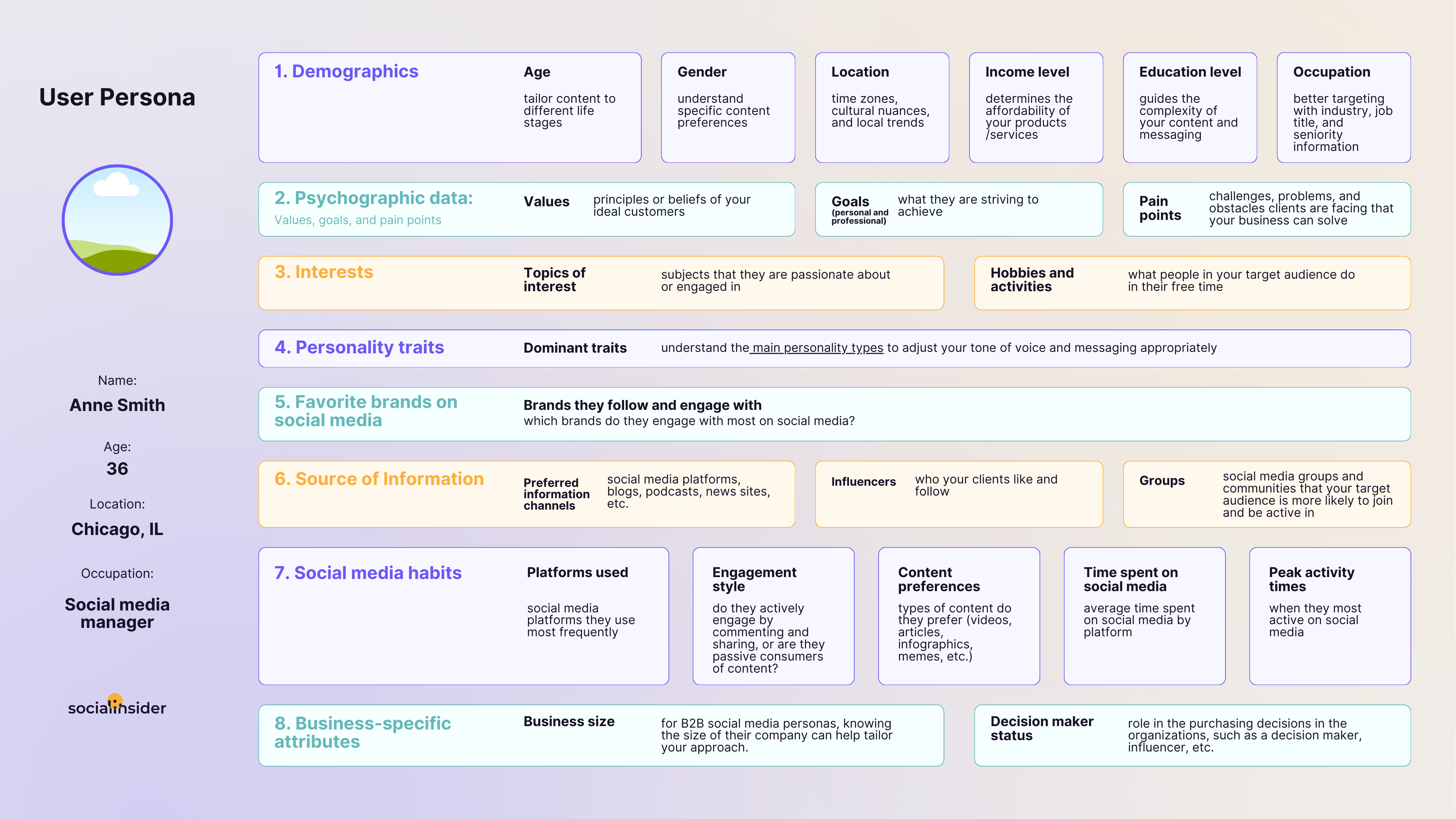
Your broader social media strategy covers the deeper audience research — demographics, pain points, platform behavior. This step is about turning that research into something you can actually write content for: a persona.
My recommendation is to build one persona per major audience segment, and note for each: their content preferences (educational vs. entertaining, long-form vs. quick-hit), the tone that resonates (formal, casual, irreverent), and the specific problems your content should be solving for them.
If you serve genuinely different segments on different platforms — say, practitioners on TikTok and decision-makers on LinkedIn — it's worth building a separate persona for each rather than writing one generic profile and hoping it stretches.
Here's a template to guide you.
Step 3: Define your content pillars
Content pillars are the core topics your brand consistently posts about — the foundation everything else in this guide builds on. They should reflect your brand identity, address audience needs, and drive meaningful engagement.
And by the way, I have to tell you that Socialinsider offers AI-generated content pillars built from industry data, so you can see which themes are already working without categorizing posts manually.

If those generic categories don't quite fit your brand, the Query Builder lets you create custom, branded content pillars instead — useful when your themes don't map cleanly onto the standard industry set.

Step 4: Match content formats to each platform
Once your pillars are set, decide how to package them per platform. What works as a carousel on Instagram doesn't necessarily translate to Facebook, and vice versa.
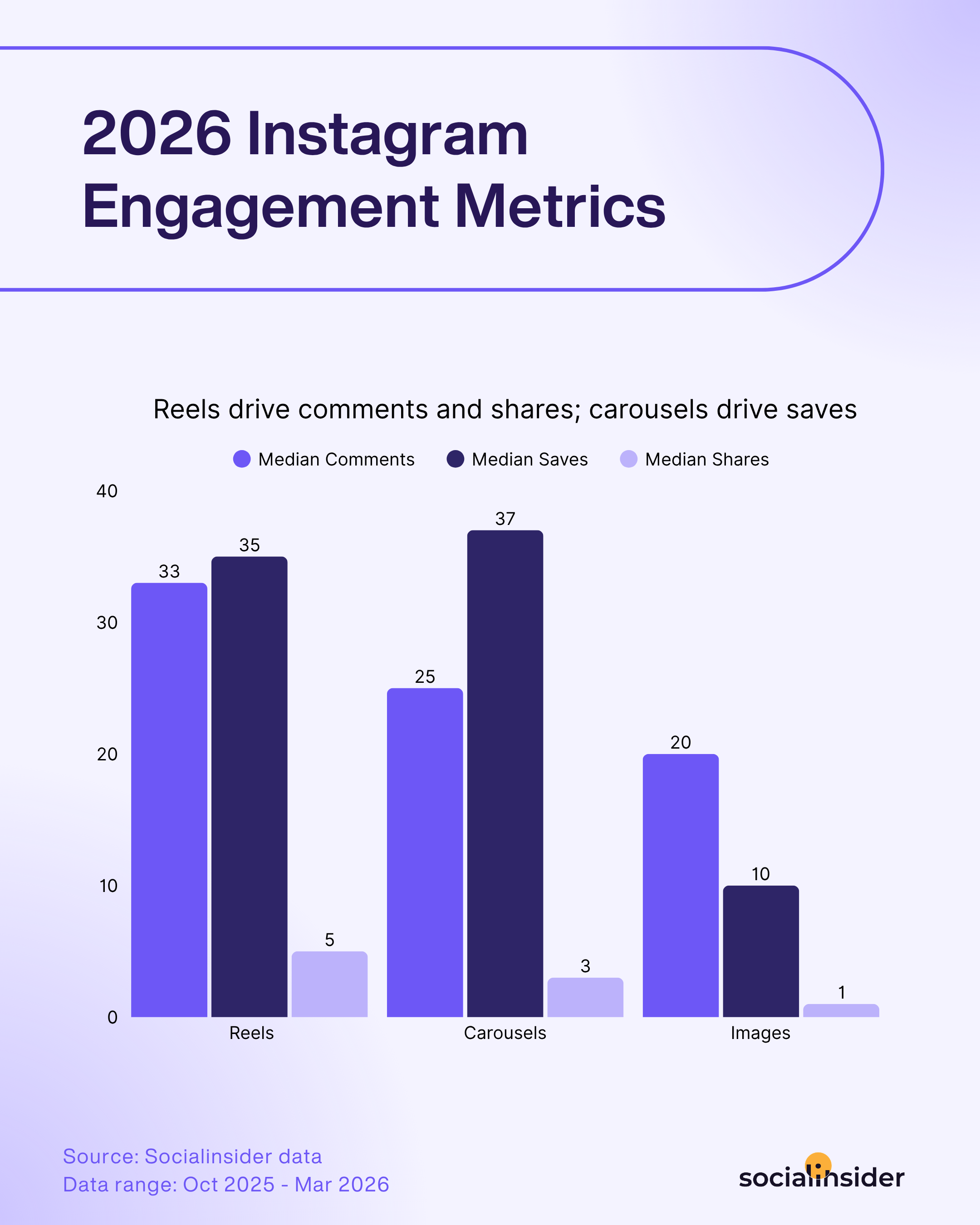
Platform benchmark data is useful at this stage. Socialinsider's social media benchmarks reports show which content formats work best across all major platforms, so I recommend checking them before committing production resources to a format.
Step 5: Run a content-specific competitor read
At this stage, I just want a quick look at what's working for competitors — content types, themes, and formats getting the strongest response — enough to sharpen my own pillar and format choices. No content strategy for social media exists in a vacuum; competitors are effectively running free experiments you can learn from.
Here, the goal is simpler: confirm my format and pillar choices aren't out of step with what's actually resonating in the category.

Step 6: Create a content calendar
A content calendar maps the what, where, and when of your content strategy — platforms, formats, captions, and timing, all in one place. Planning ahead means no scrambling for ideas at the last minute.
Define your posting schedule based on audience preferences and your resources — for instance, 3-5 weekly Instagram posts including a Reel, 2-3 thoughtful LinkedIn posts, and 1-2 trend-focused TikTok videos.
Plan content themes by day to keep variety predictable: for example, I like Tuesdays for product highlights, Thursdays for behind-the-scenes, and Fridays for user-generated content or customer stories.
Fill in the details for each entry — date/time, platform, format, caption with hashtags and CTAs, and which goal the post supports.
Stay flexible. Leave room for spontaneous posts reacting to trends or breaking news — a calendar should guide you, not box you in.
Step 7: Publish and manage distribution
Publishing is where the plan becomes real content in front of real people. Timing, format, and platform choice all matter here.
Manual posting works well for real-time updates or capitalizing on a trending moment — reacting to breaking news or covering a live event benefits from the control and immediacy of posting in the moment.
Scheduling tools streamline everything else, letting you set posts to go live during peak engagement hours and maintain a consistent rhythm without juggling multiple platforms manually.
Step 8: Encourage conversations and community management
Social media is a two-way street — consistent interaction builds the trust and loyalty that turns passive followers into an active community. I've found the content engagement strategies below cost little beyond consistency, and they're often what separates a brand that's just posting from one that's actually building a community.
Share user-generated content. UGC is social proof in its most authentic form. Create a branded hashtag, invite followers to share their experience, and reward strong UGC with shoutouts or features.
Respond promptly. Reply to comments genuinely, answer DMs and inquiries within 24 hours, and acknowledge mentions and tags.
Encourage discussion actively. Ask questions in captions, run Instagram Story polls, or host live Q&As — these tactics humanize your brand and give your audience a reason to stick around.
Step 9: Use paid promotion to extend your top-performing content
Paid promotion, at the content level, is about giving your best organic content a bigger audience — not building a full paid strategy from scratch (that's covered in the budget and paid-mix step of your broader social media strategy).
Boosted posts extend the life of content that's already proving itself organically — if a carousel is over-performing on likes and shares, boosting it gets that same content in front of a wider audience instead of letting it fade after 48 hours.
Video ads work well across TikTok, Instagram, and Facebook specifically, when built with strong storytelling and the key benefit surfaced in the first few seconds.
Influencer partnerships extend content reach through borrowed trust — pick partners whose audience and values genuinely align rather than partnering for reach alone.
Step 10: Measure content performance and optimize your mix
This is where planning and creativity come full circle. Tracking the right social media metrics tells you not just how well your content aligns with your goals, but exactly what to do more of next.
I lean on Socialinsider to make this concrete: a breakdown of post types by engagement — native documents, text posts, multi-image posts, video — shows me exactly which formats are clicking with my audience right now.

For example, if carousels consistently pull the highest engagement on Instagram, followed by Reels, that's a clear signal to double down on that mix while giving underperforming formats like images a more limited, deliberate test run.
Personally, I treat this step as an ongoing loop, not a one-time report: as new formats emerge or the audience shifts, I fold what's working back into the content pillars so the strategy keeps evolving with real performance data instead of running on assumptions from six months ago.
How to report to leadership on content performance?
Format and pillar breakdowns are the right level of detail for your own planning, but they're usually too granular for a leadership update. Translate them into what changed and why it matters: "we shifted 20% of production toward product-tips carousels after they consistently outperformed our other formats, and engagement on that pillar is up X%" lands better than a list of formats and their engagement rates. Save the full post-type breakdown for the working session with your content team, not the update to whoever you report to.
For this, Socialinsider's AI Assistant can help build the narrative faster — asking it to surface correlations, like whether a pillar shift lines up with a change in reach or profile visits, saves you from manually cross-referencing charts just to confirm the story you're about to tell is actually backed by the data.

How to use AI for content creation and optimization
AI has become a practical part of my content-building process, specifically at these stages:
- Ideation. Instead of staring at a blank page, I use AI to generate post ideas, hooks, and content briefs in minutes — asking for ten LinkedIn post angles on a given topic and refining from there rather than starting from zero.
- Caption and format variation. I'd generate multiple caption tones or lengths for the same post to fit different platforms without rewriting from scratch each time.
- Format and timing testing. I rely on tools like Socialinsider to use my own performance data to recommend optimal posting times and flag which formats are quietly outperforming my usual mix.
- Performance interpretation. I ask natural-language questions — "which content pillar drove the most engagement last quarter" — instead of manually digging through dashboards, and fold the answer straight back into Step 3's pillar decisions.
Final thoughts
The most common way a content strategy quietly falls apart isn't a bad pillar or a wrong format bet — it's handing the whole process to a team member and never revisiting the pillar or format decisions yourself.
A strategy that runs entirely on delegated judgment, with no periodic check against the actual data, tends to drift off course slowly — not because the team did anything wrong, but because nobody was checking whether the original assumptions still held.
The fix is the same discipline this whole guide is built around: be intentional with what you publish, not just consistent.
Elena Cucu
Content & SEO Manager @ Socialinsider with 8 years of experience in marketing. I like to describe myself as a social butterfly with a curious mind, passionate about dancing and psychology.

Know what your competitors do — before your manager asks
Get instant social benchmarks & reports without manual work.