Instagram B2B Marketing: Strategies, Examples & How to Measure It
An expert-backed guide to B2B marketing on Instagram: content strategies, real brand examples, and how to measure what's actually working.


If you're here, you already know Instagram isn't just for travel bloggers and fancy coffee shops. It's a real powerhouse for B2B marketing too.
Instagram B2B marketing means using Reels, carousels, Stories, and a well-optimized profile to build credibility with decision-makers, not just broadcast the product. The question is which content pillars to focus on and how to actually connect with a B2B audience on the platform.
To answer that, I reached out to four social media experts:
- Tom Miner – ex-head of social at Crocs and managing partner at Gold Miner Media
- Claudeane Daisley — social media consultant and founder of B Frank Creative
- Annie-Mai Hodge — founder of Girl Power Marketing
- Georgia Gonzalez — social media manager at Penn State Outreach
Key takeaways
- A successful B2B Instagram content strategy segments content by business goal and audience need, follows a content pillar framework like educate, relate, and communicate, and matches each format, carousels, Reels, or Stories, to the specific job that content needs to do.
- The five most effective B2B Instagram marketing strategies are employee advocacy, influencer partnerships anchored in thought leadership, brand humanization, active community engagement, and cause marketing tied to genuine brand values.
- Instagram and LinkedIn serve different stages of B2B buying, LinkedIn captures active, in-market demand while Instagram builds the pre-existing trust that shortens how long that demand takes to convert, which makes the two channels complementary rather than competing.
Why should B2B businesses leverage Instagram marketing?
You don't want to be stuck on LinkedIn when your target audience also scrolls through Instagram. Here are my five reasons and perspectives on why I see Instagram marketing for B2B companies as being worth it.
- Get access to a large audience base: According to Statista, Instagram now has over 3 billion monthly active users, and more than 30% are over the age of 35, putting a meaningful share of senior leaders and department heads on the platform, not just younger consumer audiences. Many of these users are decision-makers, industry professionals, and potential partners, making it a great place for visibility.
- Reach specific target audiences: With Instagram's advanced targeting options (ads, interests, locations), B2B companies can zero in on niche segments, from healthcare executives to SaaS founders.
- Create a highly visual impact: Complex solutions or abstract services can be broken down into digestible visuals (carousels, infographics, or short videos) that make your message clearer and more memorable. Here's an example from our very own Instagram page.

- Showcase social proof creatively: Testimonials, case studies, awards, and client stories can come to life through Reels, highlight covers, or branded graphics.
- Aids in recruitment and employer branding: Instagram is a powerful platform to highlight culture, values, and employee stories. This helps attract top talent and build trust with future hires who want to see the people behind the brand.
Instagram vs. LinkedIn for B2B: do you need both?
If your team is already running LinkedIn, it's a fair question: why add Instagram on top of it?
The honest answer is that they serve different parts of the buying journey. LinkedIn tends to be where B2B buyers expect direct, professional content and where decision-makers actively network. Instagram is where the same buyers spend time outside "work mode," and where a brand can build familiarity and trust before someone is actively evaluating vendors. A buyer who's followed your Instagram for months, seeing your team, your culture, your product in action, arrives at the LinkedIn or sales conversation already primed to trust you.
Instagram also does something LinkedIn structurally can't: it makes abstract, complex B2B offerings visual and digestible in a way a text-heavy LinkedIn post rarely can.
Takeaway: this isn't LinkedIn versus Instagram. It's LinkedIn for the direct professional conversation, and Instagram for the trust-building that happens before that conversation starts.
What does the setup of an effective B2B Instagram account look like?
Every element in your profile should be professional yet approachable. Here are the things you need to focus on:
Focus on profile elements
- A clear, recognizable handle that matches your brand name
- Profile picture (usually your logo) that's sharp and legible
- A concise bio that describes your business/offerings
- Story highlights that showcase culture, product, and resources
Utilize the contact button and lead capture techniques
Being easy to reach is non-negotiable for businesses.
Sure, people can slide into your DMs with the 'Message' button, but the 'Contact' button takes it up a notch. One tap and they can email or call you right away.
Here's how to set it up:
- Tap 'Edit profile'
- Find 'Contact options'
- Enter your business email and/or phone number.
- Toggle on 'Display Contact Info' so it shows on your profile.
- Tap 'Done' and check your profile.
I also recommend turning your link in bio into a real lead capture tool. Don't just drop one link and call it a day. Use tools like Linktree to offer multiple options: book a demo, download a whitepaper, read a data report, or sign up for the community group.
Maintain visual consistency
Claudeane, founder of B Frank Creative, mentions this as one of the most important things when it comes to setting up your B2B profile.
She says;
Credibility is most important for B2B brands. One way to be a credible brand is by being consistent. This means having a clear bio and consistent branding for your Instagram content.
What does this visual consistency look like?
- Branded color palette: Stick to 2-3 brand colors across posts, stories, and highlights so your feed feels cohesive.
- Typography rules: Use the same fonts or text styles in graphics and carousels to create a recognizable look.
- Content templates: Create reusable templates for carousels, quotes, or data posts to keep a uniform style.
Understand content consumption patterns in the B2B context
Memes work great on Instagram. So do short, punchy reels that boost reach.
But applying this without considering context can easily backfire.
Annie-Mai Hodge, founder of Girl Power Marketing, recommends the same:
B2B audiences consume content on Instagram with intent. Unlike B2C, where anyone could be a customer, B2B is about building trust and expertise over time. It's not about constant hard selling. Rather, it's content that balances expertise with relatability, creating trust, loyalty, and long-term credibility. Often the real impact comes from the quiet actions: people saving posts, sharing them with colleagues, or simply watching until the timing is right.

What are the components of a successful B2B Instagram content strategy?
Ever wondered why some B2B brands make it big on Instagram while the rest just make it work?
One way to ensure you're in the earlier group is to create the right content strategy for Instagram. Here's what the experts recommend.
Segment content strategically
I have seen B2B brands segment content based on three things:
- Business goals: whether the priority is awareness, thought leadership, lead generation, or employer branding.
- Audience needs: what decision-makers actually look for: education, industry insights, problem-solving tips, or even lighter, relatable content to break through the seriousness.
- Performance data: analyzing past engagement to see which themes audiences respond to better.
Focus on content pillars that drive B2B engagement
You don't want your content calendar to be filled with haywire themes. Pick a few content pillars and keep experimenting with them.
Particulalrly, the way I approach is logging in into the Socialinsider dashboard and see which are the most engaging pillars for my brand.

Additionally, I take a sneak peek at my competitors' content pillars and corresponding engagement to see what's working in my industry.
To give you another perspective, here's Annie-Mai's process while picking content pillars for the B2B brands she works for.
As someone who works predominantly in B2B, I coined a framework called ERC: educate, relate, and communicate. It gives B2B teams an easy structure for content pillars that keeps things simple while still leaving room to adapt and evolve. Educating is all about showing your expertise, whether that's your product, your brand story, or your why, and it really speaks to your ideal customer. Relate covers the human side of things, allowing you to create content that's funny, reactive, or topical to build on that brand awareness and make your brand feel approachable. Communicate is exactly what it sounds like: using social monitoring and listening to build stronger connections.
If you're still confused, consider working with these four pillars:
- Industry insights and thought leadership: Share insights or data people won't get from anywhere else. It could be research or surveys you conducted, or data from your own tool/business.
Here's an example of how we approach this for our Instagram page.

- Company culture and team spotlights: Share fun parts about your teammates or what you do together as a company. Make people want to work for you.
From our client calls, we found many B2B companies prioritizing this pillar to humanize the brand and attract top talent.
- Product demonstrations and use cases: Show pride in your product. Talk about features, use cases, and what's new in your product.
- Client success stories and testimonials: Feature happy customers and why they love your product. Make it interesting by utilizing storytelling techniques.
Choose content formats that fit the theme
Claudeane has an affinity towards carousels and Reels when it comes to picking content formats for B2B.
She explains:
Carousels and Reels are the most effective formats for B2B companies, not just because the data supports it, but they align with how B2B buyers consume information. Buyers want information through step-by-step, digestible, easy-to-save formats. Using carousels allows brands to create mini whitepapers with the most important information consumed in seconds. Reels succeed in humanizing the brand. Think 20-second Reels of executives sharing a leadership tip, career advice, or behind-the-scenes sales meeting, that's far more valuable than a product shot any day.

Here's a quick reference for matching the format to the job at hand.
- Carousel posts for complex information. Think it's difficult to explain a concept or framework in one single infographic? Why not turn it into a carousel?
- Reels for increased reach and discovery. Want to get more people to know about and follow your brand? With strong hooks and strategic content, Reels make that possible.
- Stories for real-time engagement. Engage your audience by sharing quick updates, behind-the-scenes moments, polls, or Q&As that invite instant interaction.
How to use Instagram for B2B: top 5 Instagram B2B marketing strategies
Here are five instagram b2b marketing strategies that proven brands follow.
1. Run employee advocacy programs
Employee advocacy turns your team into your most authentic marketing channel, often outperforming polished brand campaigns in both reach and trust.
Georgia Gonzalez, social media manager at Penn State Outreach, explains why employee advocacy works so well for B2B Instagram strategy —
Employee advocacy plays a significant role on Instagram because it adds authenticity and reach that a brand account alone can't always achieve. When employees or interns share content, it feels more personal, and it naturally taps into networks that may not already be following the main brand page. For example, friends, family, and peers love to see someone they know doing great things, and that pride naturally translates into more reach and stronger engagement. It makes the content feel more personal, while also expanding its impact far beyond the brand's core following.
At Penn State Outreach, they call this "content for students by students." Those posts elevated their pages, while also highlighting programs and opportunities across the university that students might not have otherwise known about.

But how do you encourage employee advocacy?
Georgia shared how she worked with her intern, Sadie, and the three ways she empowered her to create authentic content:
- Give ownership, not just tasks. Sadie wasn't told what to post. She was trusted to pitch her own POV-style Reels and write captions in her own voice. ("Hey, it's Sadie" became a hit.)
- Make it easy. If some employees find it troubling to create content from scratch, send templates or formats they can use to add their own voice and knowledge.
- Celebrate and credit contributions. When employees and interns see their work recognized publicly, it builds pride and encourages them to keep advocating for the brand.
2. Partner with influencers
Partnering with other creators and influencers on Instagram is a great way to:
- Reach a wider audience
- Ride on their credibility
- Build relationships with people your customers trust
The strongest partnerships tend to sit inside a recurring content series rather than a one-off feature, since a series gives the collaboration a natural, non-forced reason to keep showing up in someone's feed.
Here are three best practices when it comes to B2B influencer marketing for Instagram:
- Find the right influencers. It could be tempting to go for well-known names, but sometimes, it may make more sense to partner with a micro influencer, like a UX lead, SaaS consultant, or data analyst whose word carries weight in their circle.
And here's another example from yours truly (from our Socialinsider account, of course).

- Anchor to thought leadership, not product plugs. Instead of 'here's a tool I use,' think 'here's how I solve this problem,' with your brand naturally fitting into the solution.
- Measure the right signals. Don't chase likes. Look at saves, shares, and DM mentions. That's where the quiet but high-value B2B conversations happen.
3. Humanize your brand
Take these two posts:
Post 1: An employee records a Reel from her desk, laughing about how she once had 200 tabs open while running her first social media audit. She shares three quick tips she wishes she had known back then.
Post 2: A carousel titled 'Tips for Running Your Audit' filled with generic stock photos, no real examples, no story, and zero human touch.
Which one would you relate to? The first post, right?
That's the power of humanizing your brand.
Tom Miner, managing partner at Gold Miner Media, suggests two ways to humanize your brand:
To humanize a brand on Instagram, two things matter most: understand your audience's needs and showcase your personality. When brands successfully infuse personality into their content, consumers are far more likely to see them as trusted, genuine sources rather than advertisers.

Here are three examples to inspire you:
- Show your team having fun, or let your employees take over content creation for a day.
- Feature customer pictures or videos in your testimonials and success stories.
- Share humorous or playful content that aligns with your brand personality.
4. Find ways to engage your community
We all want a lot of likes on our posts and Reels. But you know what the real game-changer is?
Comments. That's where the real conversations happen. Comments show your content sparked enough curiosity, emotion, or connection for someone to stop scrolling and type something.
One way brands encourage comments is by hosting mini-contests, asking the audience engaging questions on Stories, or using captions to encourage conversation.
And another recommendation that I have is to reply thoughtfully and ask follow-up questions to keep the conversation going.
You can even spotlight the best comments in Stories or create carousel posts out of community answers.
5. Engage in cause marketing and showcase your brand values
People love being associated with brands that give something back to their community.
Choose causes that genuinely align with your mission rather than whatever's trending, and give them consistent visibility rather than a single one-off post.
You can even highlight sustainable practices you follow or the movements you stand up for. This shows you more than just a business trying to sell something.
How to measure and improve your B2B Instagram strategy
Before we dive into the different categories of metrics, Tom talks about how to actually prioritize metrics for your brand.
He said:
The term 'social media strategy' gets tossed around like candy at a parade, but I actually think we're missing the point nine times out of ten because we're not tying our social presence back to larger business objectives. For instance, if your brand sells functional but unexciting products and your customers don't use social media to make purchasing decisions in the space, then you might decide the best use of social media is to increase the chances that people have heard of you. To track this, you'd want to know how many people your social content is reaching over time and how engaging your messaging is. This would lead to prioritizing awareness metrics such as views and reach alongside engagement as the primary KPIs.
At the end, he also mentioned that sometimes you just want to think of it like a funnel: awareness at the top, conversion in the middle, and loyalty at the bottom. And align your social media KPIs with where your brand needs to make the biggest impact.
To help you make a decision, here are the important metrics divided into three categories.
Brand awareness
- Reach and views analysis: Is your content reaching people? Are your Reel views increasing?
I check this data on Socialinsider, both the raw number and the evolution graph, to see if there's steady growth over time.

If I find any dips, I dig deeper. I look at what content was published during that period, which formats underperformed, and whether algorithm or posting changes might have played a role.

- Follower growth: What is your percentage growth in the last month? Is your graph steadily increasing?
I also go to Socialinsider to check which posts caused huge upticks and dips. It's as simple as clicking the point in the graph and finding content that I need to prioritize or avoid.

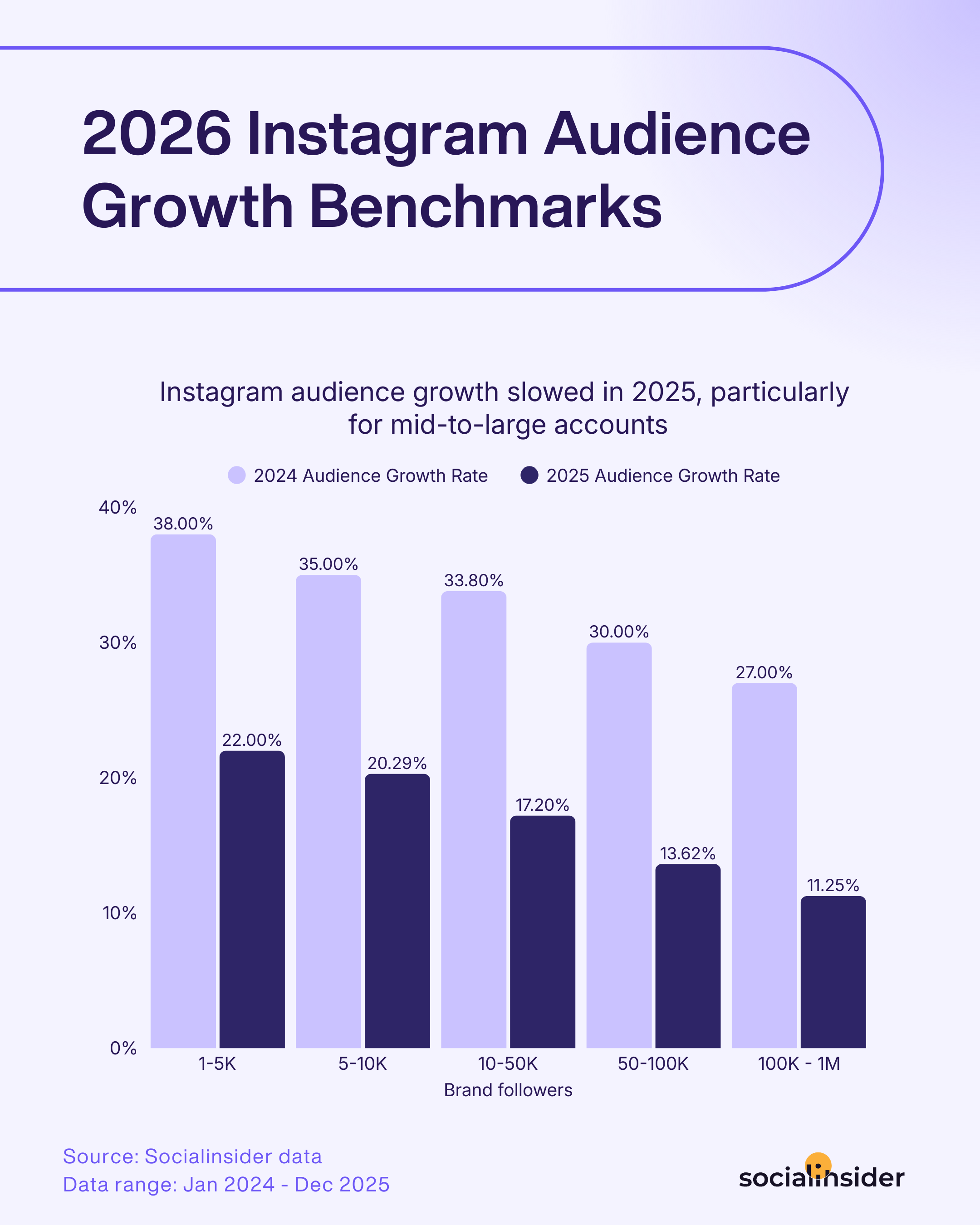
If you're unsure whether your follower growth rate is satisfactory, I recommend checking Socialinsider's latest Instagram benchmarks report to compare your growth with similar-sized accounts.
Brand engagement
- Engagement rates: Find your engagement rate. You can even go in-depth and look at engagement rate by followers, reach, and impressions.

- Post types by engagement: Do carousels perform better than Reels? This will help understand audience preferences.

- Most engaging posts: What kind of posts get a lot of attention from your audience? Are those the content pillars you're prioritizing? This gives you an idea of how to shape your Instagram strategy.

And another thing that I like about Socialinsider is that beyond having my top posts displayed by engagement, I can also customize the view and have them displayed by different metrics, such as views, comments, and more. This is particularly useful to understand what type of content is best for different goals, further shaping your strategy.

- Best-performing content pillars: Which themes are resonating with your audience? Is there any theme that you think should be working well but isn't? That's a clear sign that you need to experiment with content variables and see if that brings any change.
- Comments, saves, and shares: Likes are great. But sometimes you need to check if your audience is actually interested enough to comment or share the post.

Tom talks about shares as an important metric beyond likes and followers. He says:
Shares are a key metric for tracking how engaging or sticky your message is. If you can resonate with your audience and inspire them to share your content with their team or network, you know you're on the right track. Brands grow fastest when people talk about them, and shares are a key engagement signal for brands to track behind the scenes.
Lead generation and conversions
- Story swipe-up/link sticker performance: Tracking how many users tap your story links shows whether your content motivates action, like visiting a landing page or booking a demo.
- Whitepapers download attribution and measurement: Measuring how many downloads come directly from Instagram helps prove ROI and shows the platform's role in moving prospects down the funnel.
Georgia recommends using UTMs for calculating conversions from Instagram.
Evaluating Instagram's impact on leads or conversions starts with defining what a conversion means. For Penn State Outreach, that could be an event registration, a program inquiry, or a course sign-up. To track that impact, I rely heavily on UTM tracking. Each platform, and specifically Instagram, gets its own unique link. On the back end of our sites, this lets us see exactly where our audience is coming from and which channel is delivering the strongest ROI. Instagram metrics like link-in-bio clicks, website taps, and story sticker taps give me a quick view of intent, but the UTMs connect those actions to real outcomes.
Top 3 b2b instagram marketing examples
Need some inspiration? Check out these 3 brands on Instagram for marketing ideas for B2B.
ClickUp
ClickUp's Instagram profile has over 375K+ followers, and many of their Reels clock over 7K views.

Upon analyzing their content, I found they lean more towards relatability and humor. They also mix this with influencer-generated content, tidbits on milestones reached, and team showcases.
Instead of directly discussing their features and use cases, they partner with creators or customers to demonstrate how they use ClickUp.
Key takeaways:
- Lead with relatability and humor: ClickUp proves that even in B2B, content that entertains and resonates emotionally travels further than product-heavy posts.
- Let others tell your story: By partnering with creators and customers, they showcase real use cases in a more authentic, less 'salesy' way.
Monday.com
The brand's Instagram leans on the same bold, colorful visual identity that defines its product and ads everywhere else, so the feed is instantly recognizable even scrolling past quickly, a genuine advantage for a category (work management software) that's otherwise easy to visually confuse with competitors.
Their content also blends humor and product use cases rather than picking one lane. A quick, relatable "team chaos before monday.com" bit sits comfortably next to a straightforward feature callout, and the consistent visual branding is what makes the tonal range feel cohesive instead of scattered.

Key takeaways:
- A distinct, consistent visual identity lets you mix tones (humor, product, culture) without the feed feeling disjointed, since the visual consistency is doing the work of tying it together.
- Category-crowded software products benefit disproportionately from strong branding on Instagram, since it's often the fastest way to be recognizable in a scroll full of visually similar competitors.
Shopify
Shopify's Instagram is a masterclass in community-driven storytelling. With 2.5M followers, their content thrives on creators and customers, making the feed feel less like a brand broadcast and more like a celebration of entrepreneurs.
What I love most is how they co-create with their customers. By spotlighting success stories, Shopify sends a powerful message: your wins are our wins.

They also keep users in the loop with a monthly update series that breaks down what's new on the platform. It's a smart way to educate while ensuring merchants never miss features that could help them grow.
Key takeaways:
- Turn customers into creators: By showcasing real entrepreneurs and their stories, Shopify builds trust and proves the platform's impact.
- Educate with consistency: Talk about your product features, but also show what's new. This makes users realize that you're constantly adding something new to the product and making it better.
Final thoughts
When I think about using Instagram for b2b marketing, one thing stands out: the brands winning here are the ones that mix creativity with credibility.
ClickUp leans into humor, monday.com nails a distinct, recognizable visual identity, and Shopify turns customer stories into community fuel. The common thread? They use Instagram to connect, not just broadcast.
I like that B2B teams now see Instagram as a place to be relatable, showcase expertise, and spark conversations that lead to real business results.
Of course, none of this matters if you're not measuring the impact. That's where Socialinsider comes in. It helps you track, benchmark, and optimize your Instagram performance. To see what all it helps you with, sign up for a 14-day free trial.
FAQs on Instagram B2B marketing
How do you make the case for Instagram budget when leadership sees LinkedIn as the priority channel?
Bring attribution evidence, not just engagement numbers. Track whether closed deals or sales conversations had prior exposure to your Instagram content, even through a quick prospect survey, and frame Instagram's role as shortening the sales cycle rather than replacing LinkedIn's direct-response function.
What are some common B2B Instagram mistakes and how to avoid them?
Common B2B Instagram mistakes include over-promotion: constantly selling instead of educating or engaging, and generic commenting, which feels robotic and kills authenticity. Other red flags? Inconsistent branding, ignoring analytics, and posting without a clear content strategy. To avoid them, balance educational with human content, personalize engagement, keep your visuals consistent, and track performance so you can adapt quickly.
Elena Cucu
As Content & SEO Manager at Socialinsider, Elena Cucu helps social media leaders make sense of the numbers behind their performance. Featured in TechCrunch, TNW, and ReadWrite.

Know what your competitors do — before your manager asks
Get instant social benchmarks & reports without manual work.