AI-Driven Insights: How to Turn Social Data Into Strategic Decisions
Most teams collect data, but few act on it. Learn the 5 types of AI-driven insights that move strategy — and how to present them to leadership.

AI-driven insights turn raw data into decisions you can actually use. If you have ever stared at a dashboard full of social media metrics and still wondered what to do next, you already know what a very common challenge data analysis is for marketers. AI-driven insights exist to close that gap by explaining what changed, why it matters, and what the next step should be.
In this guide, I'll walk you through different ways you can use AI to interpret your performance data and share with you some tips from Carolyn Cohen, Global Content Strategist at Lockton. Ready to dive in?
Key takeaways
-
AI-driven insights help marketers turn overwhelming amounts of data into faster, more informed decisions by revealing meaningful patterns, reducing manual analysis, and providing evidence for strategic actions.
-
The most impactful AI-driven insights combine content performance, audience behavior, competitive positioning, trend detection, and business impact to guide smarter marketing decisions and measurable growth.
-
An insight-driven culture is built by linking every insight to a specific decision, validating the findings, assigning ownership, and measuring the resulting business impact.
Why you should use AI-driven insights in your strategy?
AI-driven insights are extremely valuable these days because marketing teams do not usually lack data. They lack time, context, and a reliable way to turn numbers into decisions. When the workflow is crowded, AI-driven insights help teams move faster without losing the story behind the data.
When you are shaping a social media strategy, AI-driven marketing insights can keep the team focused on decisions instead of dashboards.
Before jumping into deeper waters, here's my perspective on where AI-driven insights are most helpful, and why you shouldn't hesitate to leverage them:
- Speed and scale: AI makes analysis faster, and speed matters when reporting cycles are getting shorter. But speed is not just about saving time - it also means spotting a shift while there is still time to react. If a post format starts losing traction, AI can flag the change before it's too late and the monthly report lands on a manager’s desk. That gives a team a chance to adjust the next content batch instead of explaining a missed opportunity later.
- Fewer potential human errors: AI is especially useful when your team is still pulling screenshots, copying metrics into slides, or stitching together exports from multiple platforms. Also, AI is extremely good at noticing weak signals across large data sets, especially when the pattern is hard to see in a weekly spreadsheet. Because human reviewers often notice the obvious winner. AI can also point to the quieter pattern underneath.
Here's Carolyn's perspective on that as well:
I think where AI shines is when it has a large pool of data. If you ask AI to analyze a lot of data that comes from a source you trust and are confident about, the opportunities are really endless. Those insights can make a significant difference, because it's simply impossible for a human to do that level of analysis within the same time constraint.
- More confident decisions: Faster decisions are useful only when the insight is tied to a real choice. Should the team increase posting frequency, rework a creative angle, or shift budget to a stronger format? AI can surface the evidence, but the strategist still chooses the action.
And Caroline agrees as well:
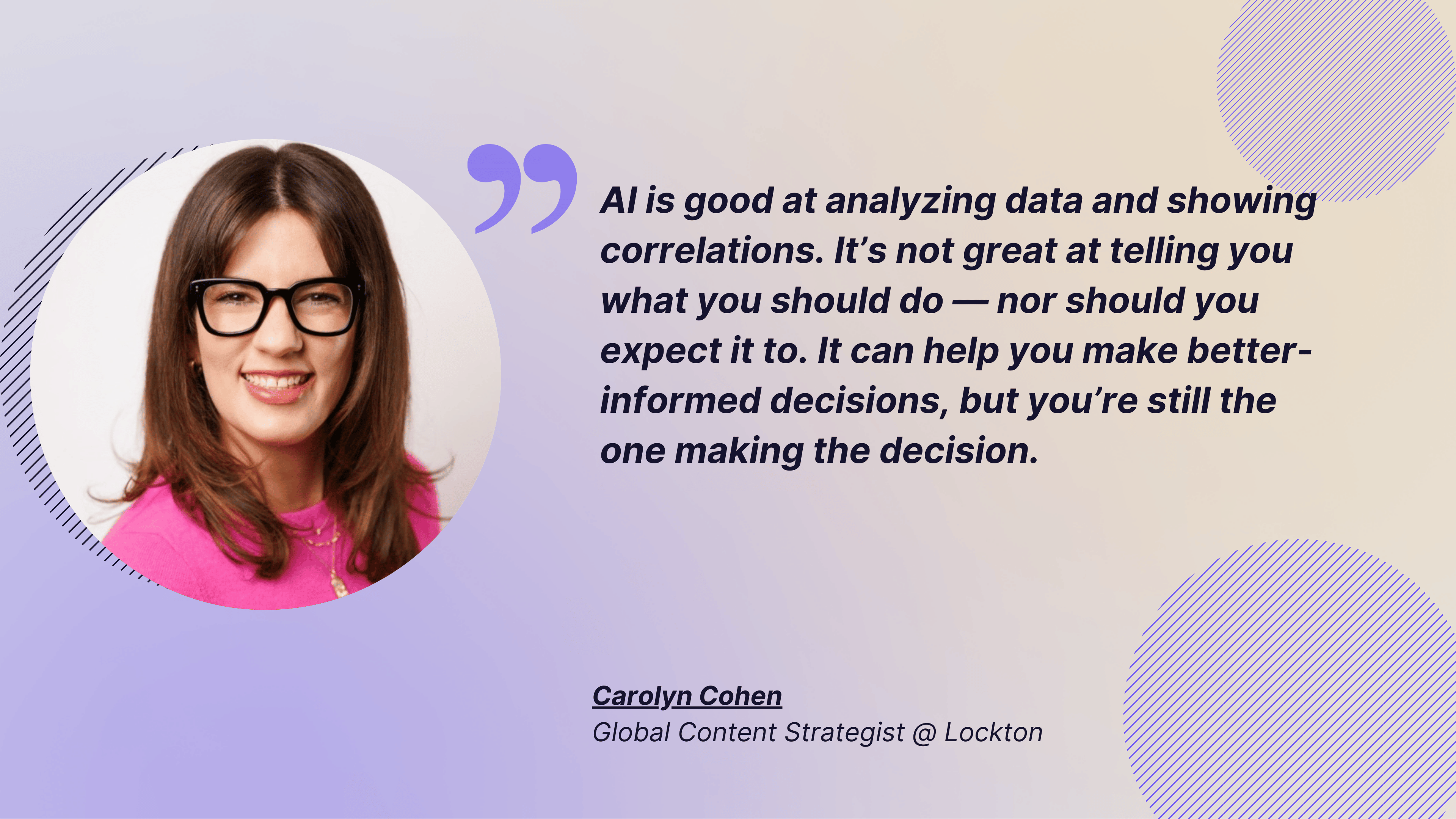
AI is good at analyzing data and showing correlations. It’s not great at telling you what you should do — nor should you expect it to. It can help you make better-informed decisions, but you’re still the one making the decision.
What are the 5 types of AI-driven insights that actually move strategy?
The most useful AI-driven insights fall into five buckets: content performance, audience behavior, competitive positioning, trend and opportunity signals, and business impact. Each type answers a different question, and the best teams use them together instead of treating AI as one vague summary layer.
Content performance insights
Content performance insights tell you what to repeat, what to stop, and what to test next. They are especially useful when a team has many posts but no clean way to see which theme actually drives engagement.
A great helper for this is Socialinsider’s AI-based content pillars analysis feature.
A brand can publish the most posts in one pillar, yet another pillar can drive more engagement. That is exactly where content pillars become more useful than a simple top-post list. The insight is not just “post more.” The insight is “post more of the theme that actually earns attention.”

This cross-channel view shows whether a pillar wins everywhere or only on one platform. That matters because a theme that works on Instagram may play differently on TikTok or LinkedIn.
Audience behavior insights
Audience behavior insights show how people respond, not just how often they react. Running an AI-driven consumer insights analysis can help you understand what users value, where they hesitate, and what makes the experience easier to trust.
In practice, these insights come from comments, shares, saves, replies, click patterns, and repeated engagement. A social media team that only counts likes misses the difference between passive approval and meaningful interest.
This is also where AI can support user experience work. If response patterns show that a specific format gets thoughtful replies, that format deserves more space in the calendar.
Competitive positioning insights
Competitive positioning insights help you understand where your brand stands in the market and where a competitor’s content is working better than yours.

The value of leveraging AI-based competitive insights is seeing and understanding which themes, formats, or cadence choices create an advantage, rather than simply copying them.

For example, if one competitor wins with educational content and another wins with product proof, the market is telling you where your own positioning needs to be sharper.
Trend and opportunity insights
Trend and opportunity insights help teams catch movement early, before a format or topic becomes crowded. This is where AI-driven market insights and forecasting are especially useful, because the question is not only what happened, but what is likely to matter next.
Pro tip: by connecting Socialinsider's MCP to your AI Assistant, you easily run trend analysis and forecasts, based on your live Socialinsider performance data, like in the example below.

Business impact insights
Business impact insights connect social performance to outcomes leadership cares about, such as growth, retention, efficiency, or revenue. That is where AI-driven performance insights become decision tools rather than reporting tools.
A strong business impact insight answers a simple question: what changed in the business because the content changed?
For example, for social teams, that might mean a clearer conversion path, stronger customer retention, or repeated engagement.
All in all, I would say that when you tie an insight to a KPI, the conversation changes. The team stops asking whether a post looked good and starts asking whether the post improved the business.
How to build a culture that acts on insights, not just collects them?
A strong insight culture starts with one rule: an insight only matters if someone can name the decision attached to it. Data and AI insights are useful when they lead to action, not when they sit in a dashboard and that's it.
The most effective teams use a simple framework:
- Start with the question: Ask what decision needs to be made before asking AI to summarize anything. A vague prompt produces a vague answer.
- Check the source and scope: A trusted source matters more than a flashy output. Carolyn Cohen’s point is still the right one: large, reliable data sets create the best conditions for useful AI interpretation.
- Translate the output into business language: A good insight should sound like something a manager, creator, or analyst can use immediately.
- Validate before you act: If the result looks surprising, check a second metric, a different time window, or a manual sample.
- Assign ownership and review the result: Insights become culture when a named person takes the next step and checks the outcome in the next reporting cycle.
Final thoughts
AI-driven insights work best when they shorten the distance between data and action. They are not a replacement for strategy, and they are not a shortcut around judgment.
If you want a next step, start with one report, one question, and one validation habit. Ask AI to summarize the pattern, compare the answer with a manual check, and turn the result into a single action for the next campaign. That is how AI driven insights become a process instead of a buzzword.
FAQs on AI-driven insights
How accurate is performance measurement with AI?
Performance measurement with AI is accurate when the data source is trustworthy and the metric definitions are consistent.
How can AI-driven insights improve campaign decisions?
AI-driven insights improve campaign decisions by showing which creative, timing, audience segment, or content pillar is performing best. Campaign teams can use that signal to move budget, adjust hooks, or rework underperforming assets faster.
Elena Cucu
As Content & SEO Manager at Socialinsider, Elena Cucu helps social media leaders make sense of the numbers behind their performance. Featured in TechCrunch, TNW, and ReadWrite.

Know what your competitors do — before your manager asks
Get instant social benchmarks & reports without manual work.


