A Data-Backed Social Media Strategy Framework (Built for Getting It Approved)
Learn how to build a social media strategy that ties to business goals — objectives, platform mix, budget, and measurement, step by step.

If you're posting consistently, trying new platforms, and still not seeing the results you expected, you're not alone, and it's probably not a content problem. More often, it's a strategy that never got past the "post more, hope for the best" stage.
This guide walks you through exactly that: a social media strategy framework built around 7 steps, grounded in conversations with social media strategists and Socialinsider customers who've built strategies that actually hold up.
Key takeaways
-
A social media strategy is the business-level plan, not the content plan. It decides which platforms you're on, how you split budget and resources, and how social supports the wider business — distinct from your content strategy, which decides what you actually publish.
-
Key changes in social media in 2026: a search-first, video-led, multi-voice landscape demands a strategy built around discoverability, passive engagement metrics, and authentic creator, customer, and employee content.
-
The 7-step framework covers objectives, audience research, an audit, strategic competitor benchmarking, platform and resource allocation, your organic/paid balance, and a measurement and reporting rhythm.
-
AI's role at the strategy level is about planning and reporting, not content production — trend research, performance interpretation, and faster stakeholder reporting.
Social media strategy template
A repeatable social media strategy template removes guesswork and gives your team a clear starting point every time you plan or refresh your strategy. Instead of developing a social media strategy from scratch each time, for every review cycle, you can rely on a framework that consistently connects goals, audience insights, platform allocation, and measurement.
It works whether you're creating a social media strategy for the first time or updating an existing one. Use it as a starting point, adapt it to your business goals, and create a plan that's easier to execute and maintain.
What is a social media strategy?
A social media strategy is a documented plan that explains how your brand will use social platforms to support business goals. It helps answer questions like:
- Who are we trying to reach on social media?
- Which platforms should we focus on and why?
- How do we split our resources and budget across them?
- Which metrics define success for our efforts?
- How do organic and paid social work together?
- How will we measure, report, and improve performance over time?
This is distinct from a social media content strategy, which picks up once these decisions are made, deciding what to actually publish, on what pillar, in what format, and how often. Think of strategy as deciding where resources go and why, and content strategy as deciding what gets made and how it performs.
Key changes in social media in 2026 and how they impact your strategy
Let's accept it. Social media is not the same as it was five years ago. Audience preferences have changed, algorithms have changed, and so have brands' marketing priorities. All of this impacts the way you build your social media strategy.
Transition from social networks to search engines
Social feeds now behave like search engines. 'For You' style recommendations dominate discovery, and people actively search inside social platforms every day. In fact, according to a recent study conducted by EMarketer, 46% of Gen Z and 35% of millennials prefer using social media over traditional search engines. TikTok is leading this shift: 64% of Gen Z now use it to research products, compare prices, and check authenticity before buying.
How this impacts your strategy: platform selection should weigh discoverability as a criterion, not just where your audience already follows you. And your measurement approach should account for social content as a long-tail discovery channel, not just a short-term engagement play.
Engagement is shifting from active to passive
According to our Socialinsider 2026 benchmarks report, average comments per post dropped by 24% on TikTok and 16% on Instagram - a clear shift toward more passive interaction.
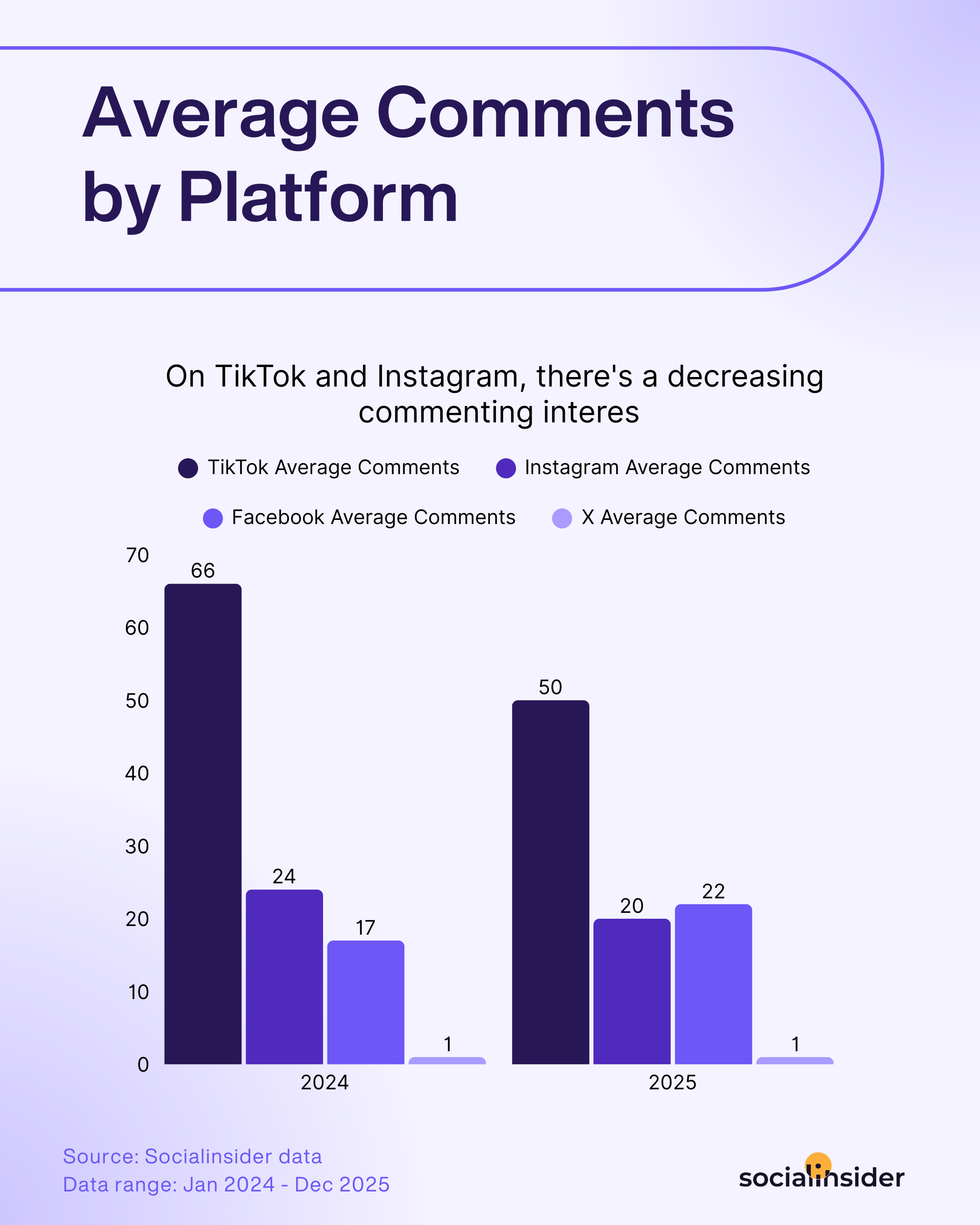
People still spend hours consuming content daily, yet comment and publicly interact less. 84% of social sharing now happens through private channels like DMs and messaging apps.
How this impacts your strategy: the KPIs you set in need to account for these changes and indivdual engagement drivers such as comments deserve to analyzed as well, in contrast with the overall engagement number, or your measurement migh miss understanding where you're falling short and what has improved.
Short-form video has become the primary discovery format
Short-form video has reshaped discovery. TikTok set the pace, and Instagram, YouTube, and LinkedIn now all actively prioritize video in their feeds. Our Socialinsider 2026 Instagram benchmarks show Reels generating the highest conversations and comments, influencing discovery as well.
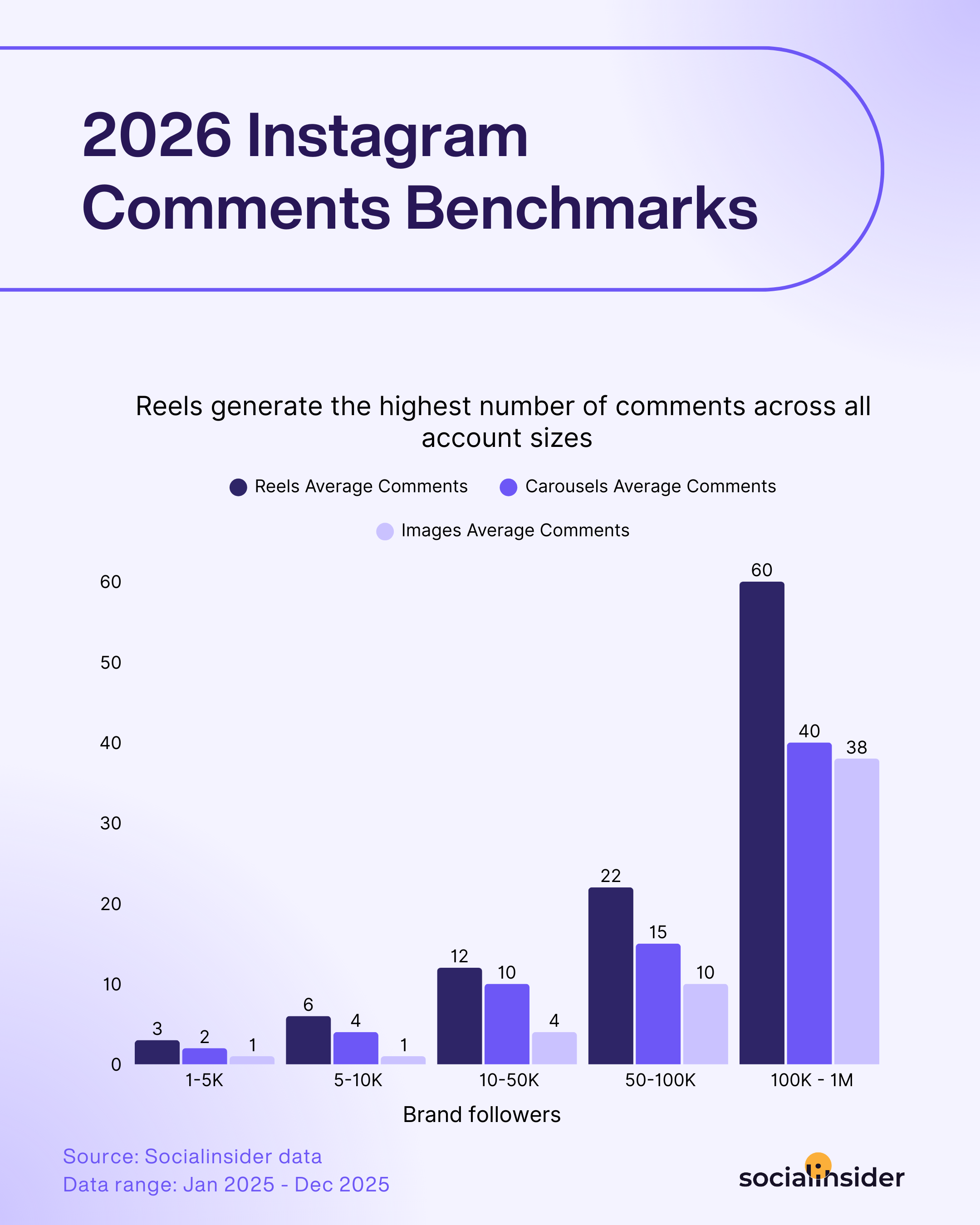
How this impacts your strategy: factor video production capacity into your resource allocation; a platform mix that leans on video-first networks without the resourcing to sustain it will underperform regardless of how sound the rest of the strategy is.
Emphasis on creator, customer, and employee-generated content
Social media is shifting from brand-only publishing to a multi-voice model powered by creators, customers, and employees. People trust stories from customers or employees more than a brand talking about itself, and companies with active employee advocacy programs see 2x higher brand trust and increased organic reach.
How this impacts your strategy: build a structured employee advocacy program and treat creator partnerships as an ongoing distribution channel worth budgeting for, not a one-off campaign line item.
The 7-step framework for building a social media strategy
Here's a step-by-step process recommended by social media leaders to create an effective social media brand strategy.
Step 1: Set social media objectives that align with your business goals
Every strong social media strategy starts with clarity on what the business is trying to achieve. Before thinking about content or platforms, identify the company's top priorities: revenue, lead generation, brand awareness, or customer retention. Social media should support these outcomes, not operate as a separate effort.
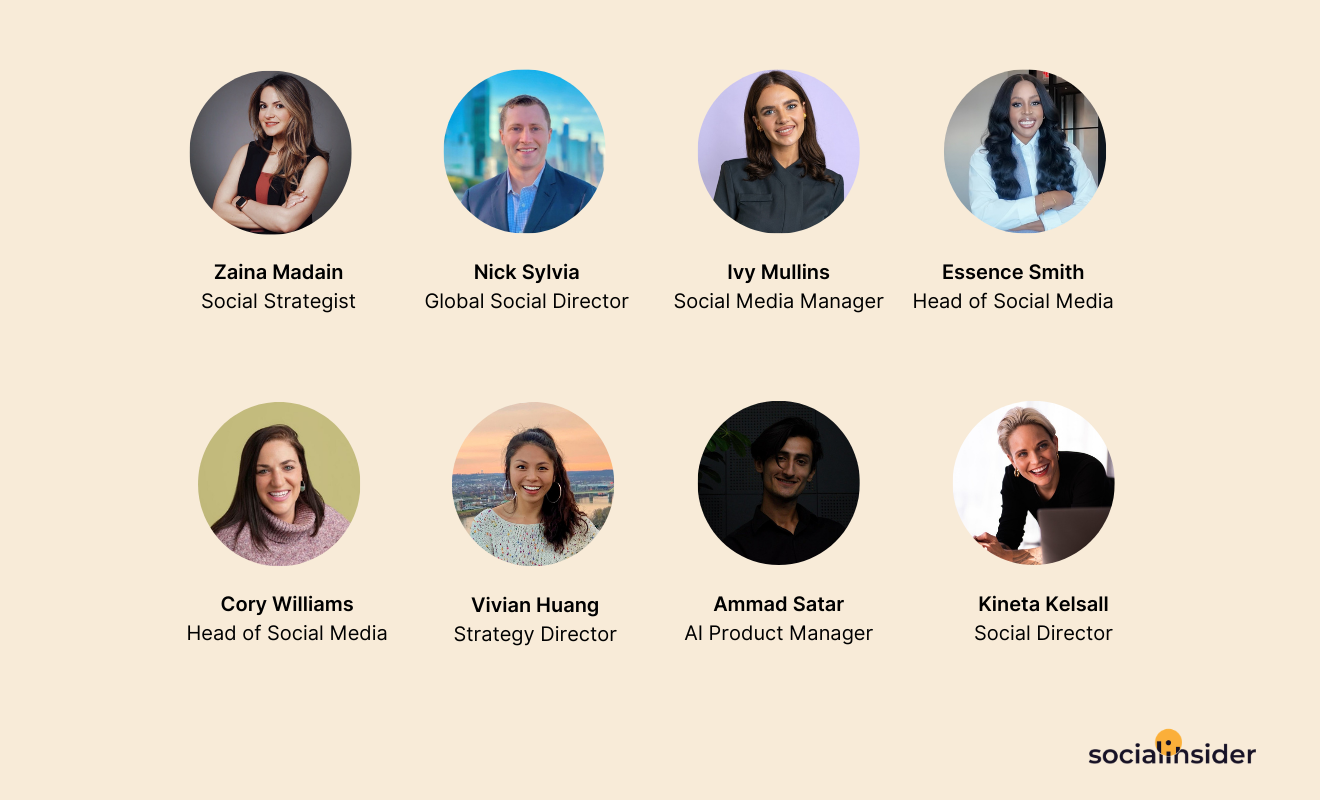
Cory Williams, Head of Social Media & Influencer Marketing at Handshake, recommends doing the same:
My typical social media strategy process begins with an analysis of the brand's current position, target audience, and overall business goals.
Take a SaaS company that wants to increase demo signups by 25% this year. That business goal can translate into two focused social objectives: increasing website traffic from social media, and generating qualified leads through social content and campaigns. Using the SMART framework, this might become "increase social-driven website traffic by 30% in six months."
Once objectives are clear, attach the right KPIs. In this case: link clicks, website sessions, demo signups, and conversion rate from social traffic.
Kineta Kelsall, Founder & Director, School of Social, talks about how she collaborates cross-functionally to gather data:
This step involves collaborating with various teams beyond just social, e.g., analytics, CRM, search, creative, and influencer marketing, to gather as much existing data as possible. I also identify and consult key stakeholders to understand brand performance across all digital channels.
This cross-functional step is easy to skip when you're under time pressure, but it's what keeps your objectives from getting overridden later. If sales, product, and leadership haven't weighed in before you lock your KPIs, you risk building a strategy around metrics nobody outside social actually cares about, which will only make the reporting conversation much harder than it needs to be.
Step 2: Research your target audience and their behavior on different platforms
Who are you actually creating content for?
When you know what your audience cares about and how they behave across platforms, every downstream decision: platform mix, resourcing, content direction, gets easier.
This doesn't mean you're personally building out research decks. Your job is deciding what questions actually need answering and directing whoever runs the research toward them:
- What are we trying to learn, and why does it matter for the platform mix decision? Research without a decision attached to it is just interesting trivia.
Social media strategy should be approached like any other type of strategy, and that starts with research. Research needs to be centered around the target audience, understanding audience profiles, user behaviors, and drivers, and their affinities to uncover how your brand can be relatable for them. — Vivian Huang, Strategy Director at Monks
- Does the platform-behavior data hold up? Socialinsider's cross-platform view is useful here for a quick sanity check: if the research says your audience prefers Reels but the platform data shows carousels quietly outperforming, that's worth resolving before it shapes the resourcing decision.
- Is internal data enough, or do we need outside research? If your own data is thin, industry reports and studies fill the gap, but flag that limitation in the strategy itself rather than treating a generic report as brand-specific truth.
For the deeper work of turning this research into content-ready personas: tone, content preferences, the specific problems your content should solve for each segment; that's covered in the persona-building step of our content strategy guide.
Step 3: Audit your current social media presence
A social media audit helps you understand what is working, what is underperforming, and where time and resources may be going to waste. I like to treat this step as a reset moment because it brings clarity and prevents repeating the same mistakes.
Essence Smith, Head of Social Media at Ascendion, suggests the same:
Next, I conduct a social media audit to assess the brand's current presence, including follower count, engagement rates, and competitor analysis. This helps identify strengths, weaknesses, and opportunities for improvement.
Focus the audit on four key areas, and note that the first one is exactly the kind of profile-by-profile check worth delegating, while the last is the decision that stays with you:
- Review all existing profiles: branding consistency, bios, links, visuals, and whether each platform still aligns with your audience and goals. This is detailed, repetitive work; hand it to whoever manages the day-to-day accounts and review the summary rather than every profile yourself.
- Analyze performance metrics: reach, engagement, follower growth, traffic, and conversions, to identify patterns and trends. Socialinsider pulls this into one dashboard so you're reviewing a consolidated view rather than five separate platform exports.

- Assess content and messaging at a high level: top-performing posts, posting frequency, and brand voice consistency, without going as deep as a full content audit (that's covered step by step in the content strategy guide).
- Decide what to keep, improve, or remove. This is the call that actually belongs to you; the first three areas just feed you what you need to make it. Cutting a platform or reallocating effort based on the audit is a strategy decision, not a task to hand off.
Step 4: Analyze competitors at the strategic level
Picture this: you open your feed and see a competitor's post everywhere — thousands of views, strong engagement, people tagging colleagues in the comments. Meanwhile, your content barely reached your own followers. Moments like this are frustrating, yet they're full of clues about what's resonating with your shared audience and where you can differentiate.
Ivy Mullins, Social Media Manager at Born Social, explains why this matters:
Beyond internal performance, studying competitors is essential. This involves evaluating their content strategies, strengths, weaknesses, and engagement tactics. By understanding what competitors are doing well (and where they're falling short), you can spot opportunities to differentiate your brand and outshine others in the industry.
At the strategy level, you mainly need the headline read: how does your overall performance compare, and where's the biggest gap or opportunity? Socialinsider gets you there quickly at this altitude; its benchmarking view puts your engagement, growth, and posting frequency side by side with competitors', without needing access to their accounts, so you get the headline gap before deciding whether it's worth a deeper dive.

For the full 6-step process: competitor selection, performance benchmarking, audience overlap, and turning findings into action, see our dedicated guide on how to do a social media competitive analysis. If you want to go deeper into what specifically they're publishing, content competitor analysis covers that layer.
Step 5: Choose your platform mix and allocate resources
One of the most common mistakes I see is trying to be everywhere at once, especially with a limited budget. Managing too many platforms usually leads to inconsistent posting and diluted results. A smarter approach is choosing the channels that best match your audience, goals, and resources, rather than defaulting to all of them.
Once you've matched platforms to your goals and audience, allocate resources deliberately rather than spreading effort evenly. Personally, I use the 50/30/20 rule:
- 50% of resources to your primary platform: where your audience is most active and you expect the highest ROI.
- 30% to your secondary platform: a channel reaching a different audience segment or serving a complementary purpose.
- 20% to experimental platforms: emerging channels or smaller audience segments worth testing without major commitment.
Also define the role of each platform explicitly: awareness, lead generation, community building, or customer support, so your social media channels strategy has a clear rationale behind every resourcing decision.
Step 6: Set your organic and paid balance and budget approach
Organic and paid social should work together across your social media marketing channels, not operate as separate strategies. Deciding how much of your budget supports paid amplification, and for which platforms and goals, is a strategy-level decision that shapes everything downstream in content and campaign planning.
Ammad Sattar, Digital Advertising Expert, describes how this plays out in practice:
After developing a content calendar, I implement data-driven advertising strategies and continually monitor performance metrics. I make real-time adjustments to optimize engagement, conversion rates, and ROI, ensuring the strategy remains flexible and results-driven.
A few principles for setting this balance:
- Match paid investment to platform role. A platform you've designated for lead generation likely needs more paid support than one purely for community building.
- Set a floor for testing. Reserve a portion of paid budget for testing new formats, audiences, or platforms, separate from budget supporting proven campaigns.
- Revisit the split regularly. As platforms and their algorithms shift, an organic/paid balance that made sense two quarters ago may no longer be optimal.
For the content-level execution of paid promotion — boosting specific posts, video ad creative, influencer partnership execution — that's covered in the content strategy guide.
How to pitch your strategy for budget and buy-in
Everything in Steps 5 and 6 assumes you have the resources to act on it, but getting that budget and platform commitment approved is often its own project. Whether you call it a social media strategy proposal or a shorter strategy brief, a few things make the pitch land better:
- Lead with the business objective from Step 1, not the platform request. "We need budget for TikTok" is a much harder sell than "we need budget to hit the demo-signup goal, and TikTok is where the data says that audience actually is."
- Bring the audit and competitor read as evidence, not context. Step 3 and Step 4 aren't just planning inputs — they're your proof points. "Competitors are capturing engagement we're not" is a stronger argument than a general request for more resources.
- Ask for a defined test window, not an open-ended commitment. Leadership finds it easier to approve budget for a 90-day test with clear success metrics than an indefinite investment, and it gives you a natural checkpoint to either expand or redirect the budget.
- Show the cost of not acting. If a competitor is already capturing the audience you're both targeting, quantify what continued inaction costs, not just what action would gain.
Getting the pitch approved is what makes Steps 5 and 6 actually executable, rather than a plan that looks good on paper and never gets funded.
Step 7: Set your measurement, reporting cadence, and review rhythm
A social media strategy is never finished. The brands that grow consistently treat strategic planning for social media as an ongoing learning process, turning data into regular insights and continuous improvement rather than a document written once a year.
- Track the right performance metrics: reach, engagement, traffic, conversions, and social media ROI, based on the objectives set in Step 1. Focus on trends and patterns instead of single-post performance to understand long-term progress.
- Build a consistent reporting workflow. Set a cadence for weekly, monthly, and quarterly reviews. Automated reporting tools like Socialinsider can help streamline this and save time.

- Set a review rhythm for the strategy itself, not just performance. Revisit your objectives, platform mix, and budget allocation on a quarterly or biannual basis, not just the content performance within them.
Make sure you have regular reporting and content performance analysis to inform adjustments to your strategy. Always be willing to test and learn! — Nick Sylvia, Director, Global Social Media at Mastercard
How AI fits into strategy-level planning?
AI's role at the strategy level is different from its role in content production (covered in the content strategy guide). Here, it's about planning and reporting faster, not creating faster.
For market and audience trend research. AI can scan social conversations, hashtags, and search behavior to surface rising themes at a category level — useful input for Step 5's platform decisions and Step 1's objective-setting, before content teams get into execution.
For analytics and reporting. Tools like Socialinsider can analyze performance across platforms, highlight trends, and benchmark results without manual spreadsheet work, turning hours of reporting prep into a fast, repeatable process for your Step 7 review rhythm.
For interpreting data at the strategic level. Instead of manually digging through dashboards, Socialinsider's AI Assistant lets you ask natural-language questions about cross-platform performance — how your accounts compare to competitors, or how performance shifted quarter over quarter — which is exactly the kind of question a strategy review needs answered quickly.
How long does it take for a social media strategy to work
Social media is a long-term growth channel where results build through consistency and audience trust. Progress usually happens in stages:
- 0-3 months: Research and testing phase. Experiment with formats, posting times, and messaging. Focus on learning audience preferences and building a consistent publishing rhythm. Track early signals such as reach and engagement.
- 3-6 months: Early traction. Reach becomes more consistent and engagement starts improving. Clear patterns begin to emerge around top-performing content and platforms.
- 6-12 months: Compounding growth. Brand recognition strengthens, social-driven traffic becomes steady, and business impact becomes easier to measure.
These timelines can vary based on industry, available resources, posting consistency, content quality, and whether paid promotion supports organic efforts.
Quick social media strategy tips: don't skip the audit just because it feels slower than jumping straight to posting; revisit your platform mix every two quarters, not just when something's visibly broken; and treat your KPIs from Step 1 as the filter for every new platform or format request that comes your way.
Final thoughts
Building a social media strategy is half of the work. The strategy only works when it moves from document to daily practice. Start small: pick your core platforms, define your resource allocation, and set up a simple reporting rhythm.
Test one new idea every quarter and keep what performs. Share results with your team and use the insights to plan the next cycle. Over time, these repeatable actions are what separate a successful social media strategy from one that just looks good on paper: building momentum, stronger audience trust, and clearer business impact. There's no single trick to how to master social media; it's this cycle of developing, testing, and revisiting a strategy, repeated consistently, that gets you there.
If you need help getting insights from your strategy or making sense of your cross-platform data, subscribe to Socialinsider's free 14-day trial.
FAQs on social media strategy
How often should you update your social media strategy?
Most teams review and update their social media strategy every 6 to 12 months, with lighter quarterly check-ins to track progress and adjust tactics based on performance, platform changes, and business priorities. Social media evolves quickly, so the strategy should remain flexible and open to ongoing optimization.
How can I measure the success of my social media strategy?
Success depends on your objectives. Common metrics include reach, engagement, follower growth, website traffic, leads, conversions, and ROI. Tracking trends over time and connecting social performance to business outcomes provides a clearer view of how your strategy contributes to growth.
Is a posting strategy the same as a social media strategy?
No. A social media posting strategy — cadence, timing, which platform gets what content — is one piece of execution that sits inside your broader social media strategy. The strategy itself covers the business-level decisions (objectives, platform mix, budget) that a posting schedule alone doesn't address.
How do you analyze whether a social media strategy is working?
A social media strategy analysis means checking your actual results against the objectives and KPIs set in Step 1 — not just whether individual posts performed well. Look at trends over your defined reporting cadence (Step 7), compare against the benchmarks set during your audit (Step 3), and revisit whether your platform mix and budget allocation are still delivering the return you expected
Elena Cucu
Content & SEO Manager @ Socialinsider with 8 years of experience in marketing. I like to describe myself as a social butterfly with a curious mind, passionate about dancing and psychology.

Know what your competitors do — before your manager asks
Get instant social benchmarks & reports without manual work.