TikTok for B2B: The Modern Playbook for Marketers
Unlock the potential of TikTok for B2B marketing. Learn effective techniques to engage prospects and elevate your brand in the digital world.


TikTok isn’t just for consumer brands anymore.
And if you work in B2B social media marketing, you’ve probably already noticed that.
It’s easy to assume the platform is the shift.
In reality, the shift is in how people want to learn. Short, informal video has become the quickest way to grasp what a company does, who it serves, and why it matters.
That’s where TikTok fits into B2B: not as a trend-driven channel, but as a practical tool for education, visibility, and early-stage trust.
In this article, I'll guide you, together with Josefine Östvik, a social media marketing freelancer, on how B2B teams can use TikTok intentionally, from building a TikTok marketing strategy to creating content that supports real business outcomes, not just views.
Key takeaways
-
Why can't B2B brands ignore TikTok anymore? B2B buyers are already using TikTok to learn, compare, and form opinions long before they ever land on your website, whether your brand is there or not.
-
How to build your B2B TikTok content strategy? The smartest B2B TikTok strategies focus less on trends and more on deeply understanding the audience, picking one clear goal, and showing up consistently with content that actually helps.
-
How to track your TikTok B2B marketing success? TikTok starts working in B2B when you start measuring how attention turns into intent, and intent turns into real pipeline influence.
-
Challenges of B2B marketing on TikTok: B2B marketing on TikTok is hard not because the platform doesn’t work, but because it forces brands to move faster, loosen control, and rethink how influence is measured.
Why can't B2B brands ignore TikTok anymore?
Because the B2B buyer journey no longer starts where most B2B brands think it does.
According to a report conducted by Brafton, over 60% of companies already include TikTok in their social media strategy, which signals a broader shift in how brands are approaching visibility and education.
But what makes TikTok especially relevant for B2B is who is actually using it and how they use it.
Industry research shows that roughly two-thirds of company decision-makers on TikTok say they use the platform to discover or learn about business products, software, or services. This means it’s an early-stage evaluation, happening long before a website visit or a demo request.
At the same time, TikTok’s audience has expanded well beyond Gen Z.
According to Brixon, professionals aged 25-44 (a core B2B buying group) are actively engaging with informative, experience-driven content that helps them understand problems, workflows, and solutions quickly.
The takeaway for B2B brands is simple: TikTok isn’t replacing traditional channels, but it’s influencing decisions before those channels come into play.
Brands that show up early with clear, useful content build familiarity and trust, while those that stay absent leave that space open for competitors to define the conversation first.
Here's Josefine's perspective as well:
The way people consume media has fundamentally changed, and platform roles are evolving with it. TikTok has become one of the main channels for search, discovery and opinion-forming, particularly for younger generations. It is no longer a platform for entertainment only.
TikTok is where culture is shaped, brands are built and narratives are formed. News organisations and employers are already using it to reach audiences who are disengaging from traditional channels.
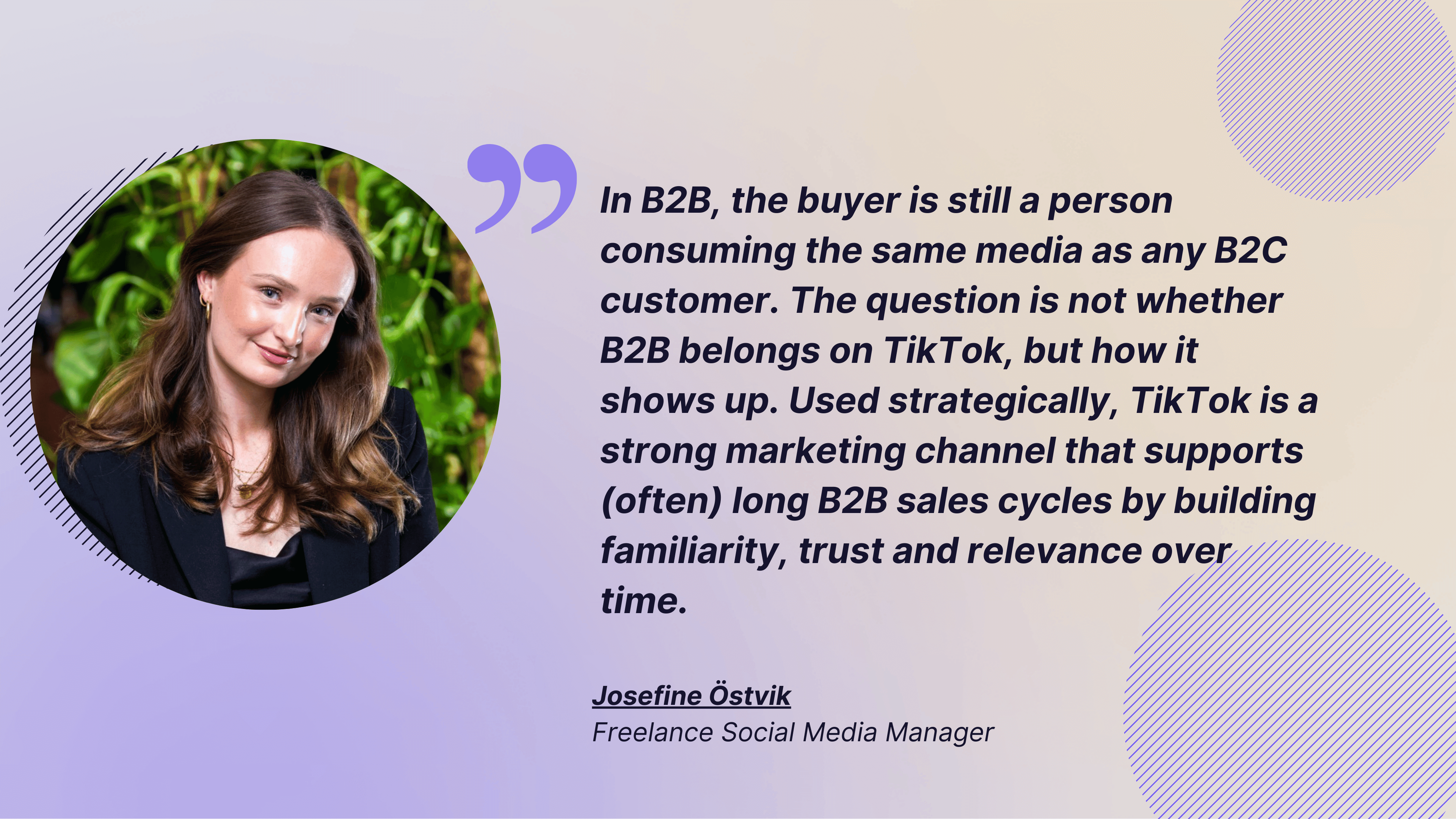
In B2B, the buyer is still a person consuming the same media as any B2C customer. The question is not whether B2B belongs on TikTok, but how it shows up. Used strategically, TikTok is a strong marketing channel that supports (often) long B2B sales cycles by building familiarity, trust and relevance over time.
How to build your B2B TikTok content strategy?
If there’s one constant with TikTok B2B marketing, it’s that there’s no one-size-fits-all formula.
But there is a smart way to approach it.
So let me break down the social media best practices that will help you build a strategy focused on attention, trust, and momentum:
Define your target audience on TikTok
You first need to be clear on who you’re actually creating content for.
But to define your social media target audience on TikTok, you need more than demographic data.
A proper social media audience analysis can help you understand what your audience is actually watching, reacting to, and sharing. And why. That insight is what turns random posts into relevant content.
In B2B, the people watching are still just people. They’re decision-makers, operators, founders, or specialists looking for ideas, clarity, or a fresh perspective, not sales pitches.
The clearer you are on their challenges, motivations, and day-to-day reality, the easier it becomes to create content that feels relevant and worth engaging with.
In short, a well-defined target audience helps you decide:
- What topics to focus on;
- Which tone feels natural;
- What formats make sense (educational, behind-the-scenes, POVs, storytelling)
Get this right, and every piece of content becomes easier to plan.
Here are a few tips from Josefine:
Start with the ICP. If you haven’t already, define who they are, what they care about and why you exist for them on social media. Define: business goal, social goal, platform goal. Each layer should clearly support the next. TikTok should have a defined role rather than being expected to do everything.
For most B2B brands, TikTok’s role might be reach and discovery through keyword-driven and interest-based content. This allows brands to appear where people are actively searching for tools, services and industry insight.
From there, build clear content pillars that support this platform goal, such as education, behind-the-scenes, proof of expertise or social validation.
Set measurable objectives
From experience, I can tell you that to make TikTok B2B marketing pay off, the channel needs a clear purpose.
That purpose should be reflected in measurable social media KPIs, not vague goals such as “get more views.”
The objective you choose needs to tie directly to a business outcome and a signal you can track consistently.
Here’s how the three most common social media goals usually show up in practice:
Brand awareness (reach the right people, repeatedly)
The aim is relevant reach and frequency within your category.
Here's how I measure it: through targeted reach, view-through rate, follower growth quality, and repeat exposure signals (returning viewers, saves, shares).
If awareness is the goal, your content should be built for clarity, speed, and consistency.
Thought leadership (earn credibility, not applause)
This is about shaping how your market explains problems and where your company sits in that conversation.
Track quality engagement over raw likes: saves, shares, longer watch time, comments that indicate understanding (“this is exactly our issue”), and inbound prompts (“can you cover X?”).
If thought leadership is the goal, my advice is to prioritize POVs, frameworks, and opinionated takes that people can reference.
Lead generation (create demand with a path to action)
TikTok rarely closes deals directly in B2B, but it can create high-intent interest when the next step is frictionless.
Here's how I approach it: I measure link CTR, profile visits → clicks, demo/content sign-ups, inbound messages, and assisted conversions (TikTok as the first touch or repeat touch).
If lead gen is the goal, you’ll need clear CTAs, strong “why now” hooks, and a destination that converts.
This being said, the key is choosing one primary objective per content stream (or per quarter) so your team isn’t judging awareness content by lead-gen metrics, or vice versa.
When your social media goals are defined this way, TikTok becomes easier to optimize and far easier to defend internally, trust me.
Establish relevant B2B content pillars
Lastly, among the most overlooked TikTok tips is this: long-term performance comes from repeating the right topics, not constantly reinventing them.
And that’s what setting your content pillars for social media gives you: a few clear lanes you can stay in without forcing ideas or chasing every trend.
Clearly, your social media content strategy becomes much easier once those lanes are set. You’re no longer asking “what should we post?” You’re finally choosing which pillar this fits into and whether it moves the needle.
Well-performing B2B content on TikTok
In B2B, the people watching your TikToks aren’t always the ones signing the contract.
But they are often the ones using the product day to day. And that influence matters.
As Katie Parkes from Apollo.io once said to me when I interviewed her for chatting about how effective social media is, you’re usually speaking to platform users, not final decision makers… but those users still shape what gets adopted, recommended, and pushed internally.
That’s why these pillars work so well: you don’t need to do all of them. You just need a few you can repeat consistently.
- Educational content (tutorials, explainers, industry insights)
This is where you earn attention first.
Share what you know, simplify what’s confusing, or explain how things actually work in your industry.
Canva is a great example for that.
They post quick, step-by-step videos that show exactly how to use their features, making the value instantly clear without overexplaining.
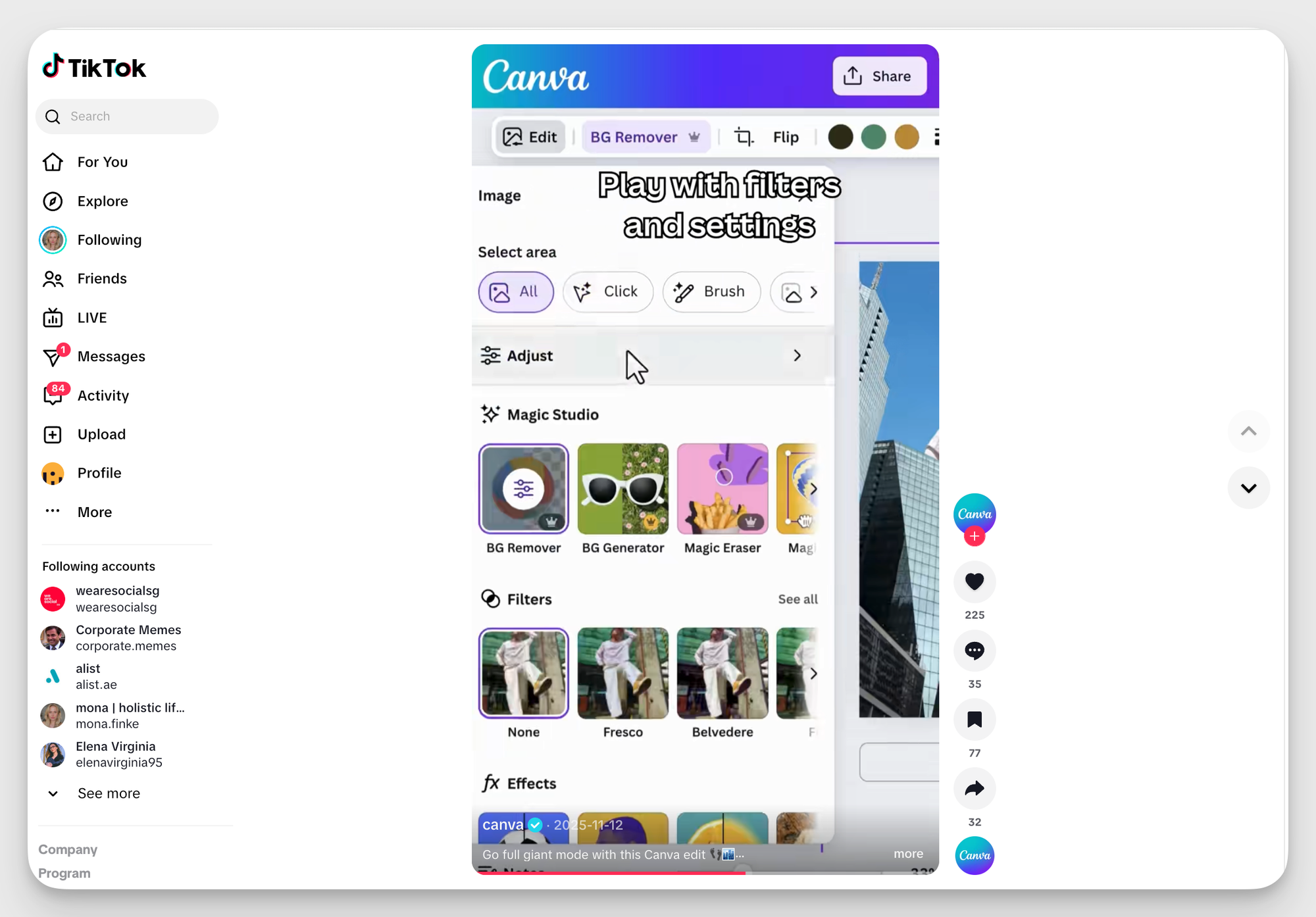
Keep it tight and practical: you’re giving people a reason to trust you, not a full course.
- Behind-the-scenes and company culture
Show how decisions get made, how work really happens, or what your team is dealing with day to day.
This kind of social media content humanizes your brand and builds familiarity fast.
The Attention Seeker agency is a strong example of B2B behind-the-scenes and culture content on TikTok.
They turn everyday agency life (client calls, office moments, team dynamics, internal chaos) into quick, relatable skits that feel entertaining first, but still show how their work actually runs day to day.
- Thought leadership and trend commentary
Use this when you have a point of view.
Comment on shifts you’re seeing, call out bad advice, or add context others are missing. Strong opinions, backed by experience, tend to travel.
LinkedIn is a solid example of thought leadership and trend commentary on TikTok.
They post POV-driven clips that comment on where work is heading, what’s changing in careers, and what people should pay attention to. This way, they’re offering context and perspective instead of just chasing trends.
- Product demonstrations and real use cases
Show where your product fits in real workflows, what problem it removes, or what changes after it’s in place.
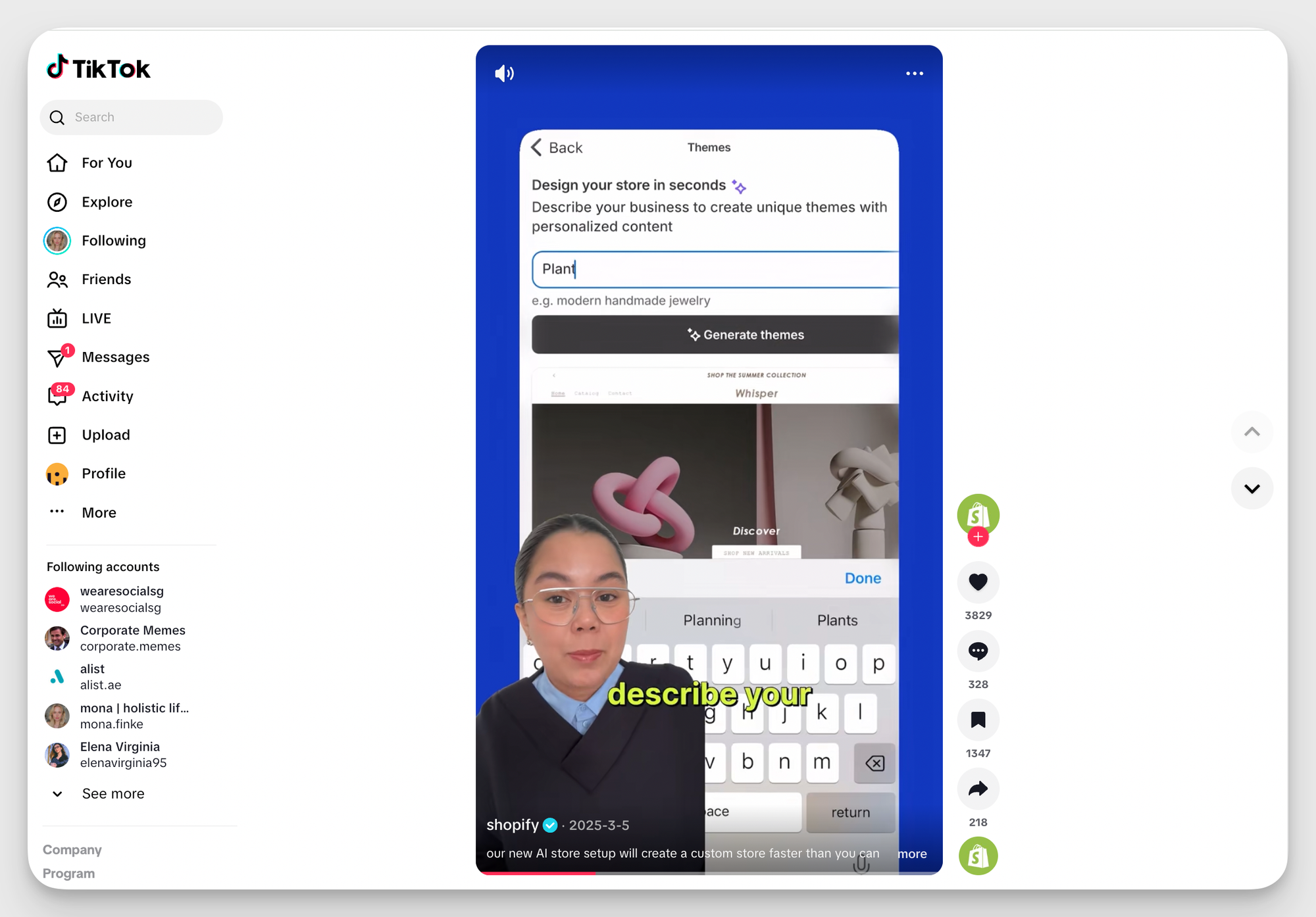
If you ask me, I think Shopify is a great example of product demos and real use cases on TikTok.
Instead of listing features, they show the product in action so viewers instantly understand what it helps you do, how it fits into your workflow, and how much time/effort it saves, without the video turning into a sales pitch.
- Customer success stories and testimonials
Focus on specifics.
Social media content grounded in outcomes and constraints is far more credible than generic praise.
Essentially, repetition is a feature here. It’s how your audience learns what you’re about and why they should keep paying attention.
Personally, I think Zendesk nails testimonial-style content by turning customer wins into mini stories.
Instead of generic praise, they show a real situation and let the outcome speak for itself: smoother service, faster support, better experience. Clear, specific, believable.
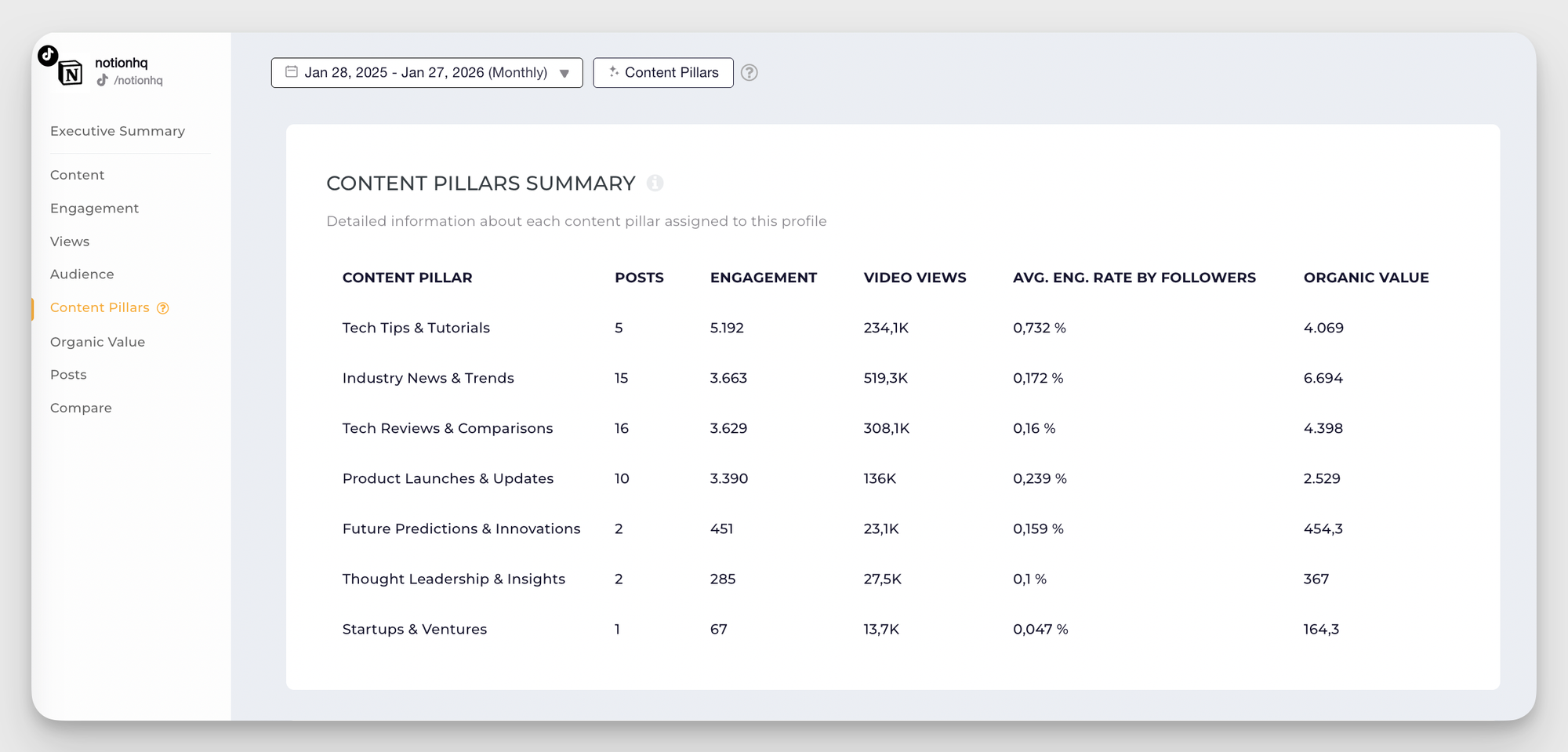
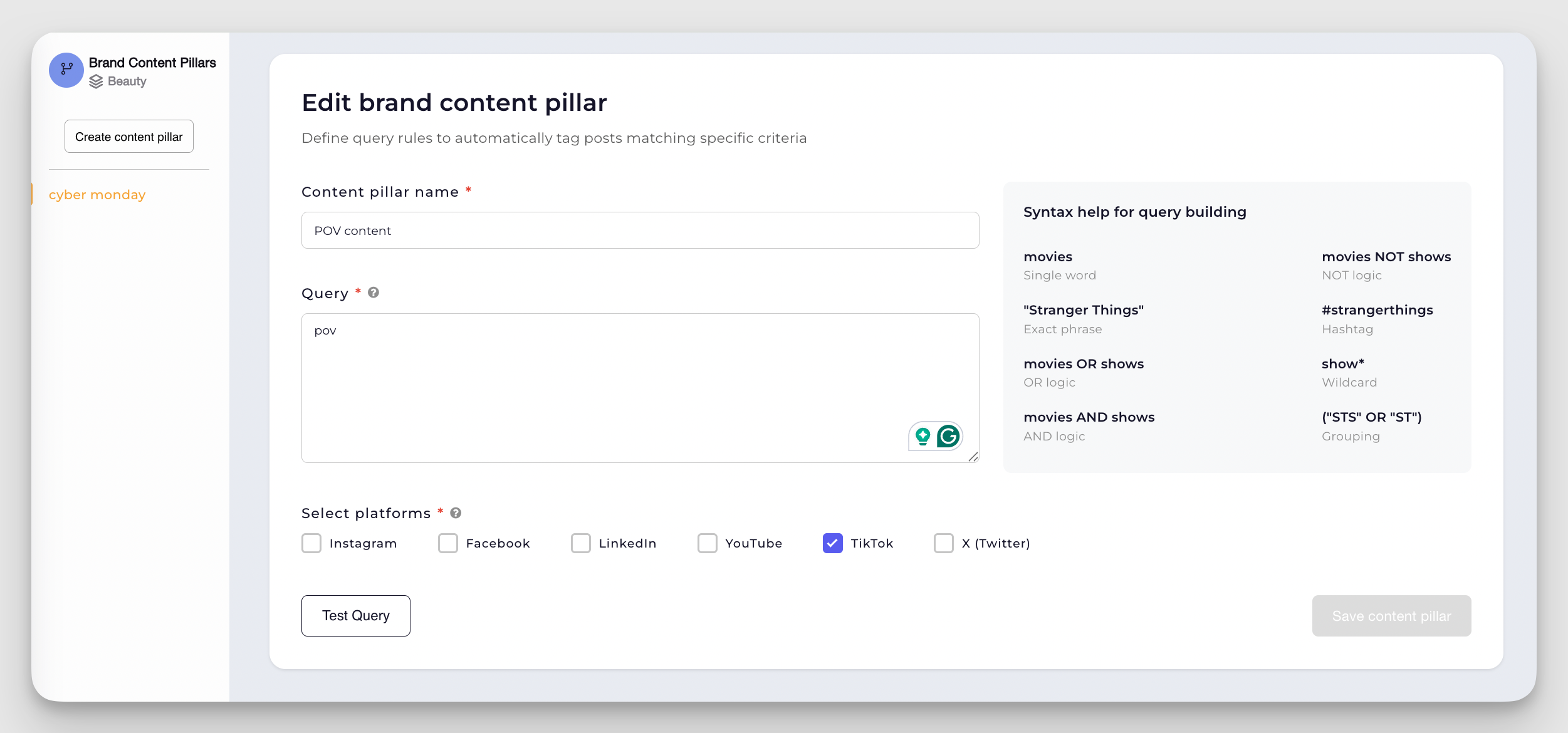
Additionally, you can use the query builder to create your own custom, branded content pillars that reflect your unique strategy using the Query Builder.
How to track your TikTok B2B marketing success?
At some point, TikTok stops being an experiment and starts needing answers. What’s working, what isn’t, and why.
The problem is that most of the visible social media metrics don’t map cleanly to B2B impact. A video can look “successful” and still do nothing for the business (or quietly influence deals weeks later).
In this section, I’ll show you how to read TikTok performance through a B2B lens. This way, you’re measuring contribution to the funnel, and not just focusing on surface-level social media data collection.
When I asked her the same question, Josefine told me:
Success depends on the objective, but for B2B the priority is not just reach, it is who you are reaching.
Key indicators include: traffic source (search, FYP, followers), performance of keyword-optimised content, engagement and comments from ICP-relevant accounts, audience demographics and follower quality.
TikTok can be a reach engine, but B2B reporting should focus on qualified reach rather than volume alone. Search-driven views and relevant engagement help demonstrate that the right audience is being reached.
Key metrics that matter
What you track depends on where TikTok sits in your B2B growth model and how mature your channel is.
But in practice, TikTok metrics fall into three layers:
- Top of the funnel → attention and relevance
- Middle of the funnel → intent and consideration
- Bottom of the funnel → revenue and long-term value
So let’s walk through the key metrics for each stage and how to interpret them beyond surface-level performance.
I’ll use examples from our Socialinsider dashboard as a reference point for how advanced social media analysis should look like.
For top of the funnel
Views and reach
They indicate whether your content is earning attention from the people you actually want to reach.
And then you have:
- Video views
A baseline visibility metric. Useful for spotting trends, format fatigue, or breakout topics, but not a success metric on its own.
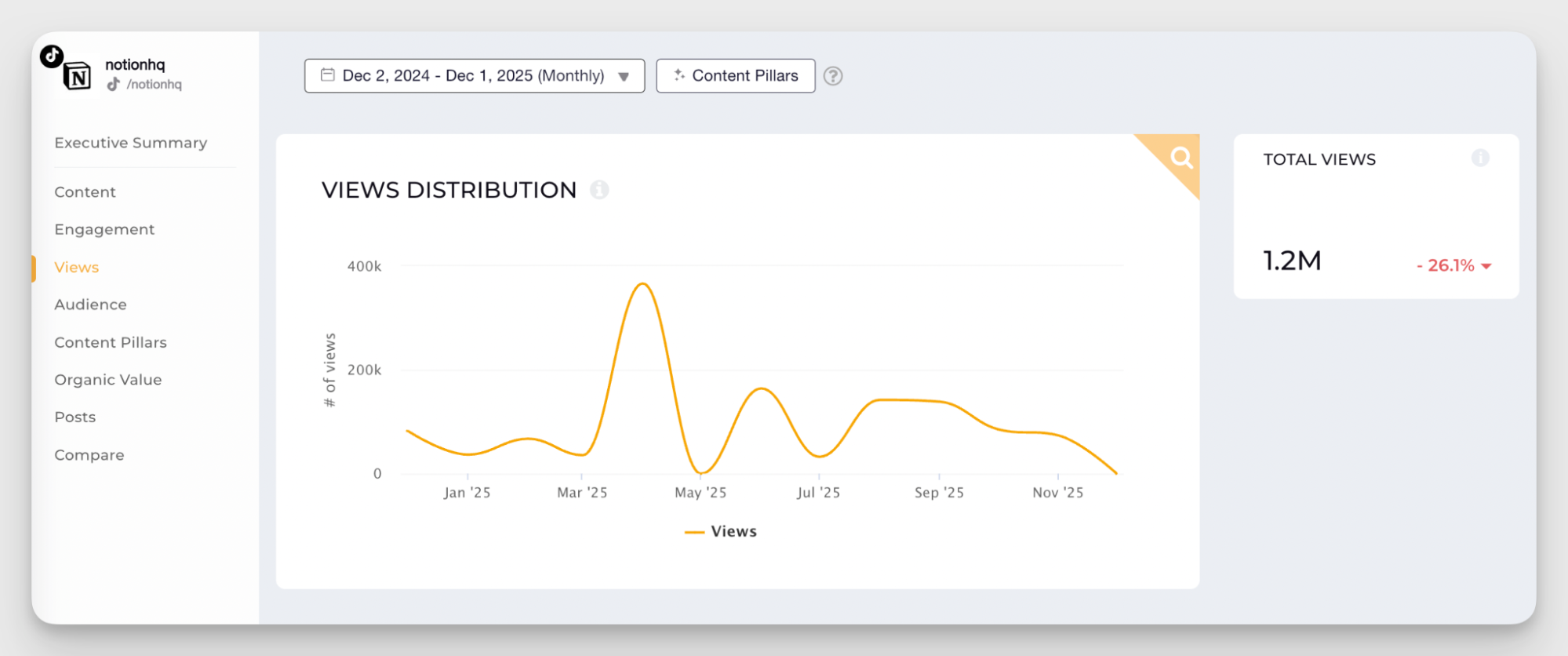
In the example below, the Notion brand reached 1.2M total video views in one year, with performance driven by a few clear spikes. However, toward the end of the period, views decline, resulting in an overall -26.1% drop.
This indicates that while some videos performed strongly, the view momentum wasn’t sustained consistently over time.
- Video completion rate
One of the strongest indicators of content quality on TikTok.
For B2B, aim for 50%+. High completion tells both the algorithm and your audience that the message is worth sticking around for.
- Average watch time
Especially important for educational or insight-led B2B content. Strong watch time signals relevance even when viewers don’t finish the video.
- Followers and follower growth
A long-term indicator of whether your content consistently attracts the right audience. In B2B, slow and steady growth is often healthier than viral spikes.
For consistency, I'll keep the same brand example throughout the article to highlight how different data points can be interpreted and correlated.
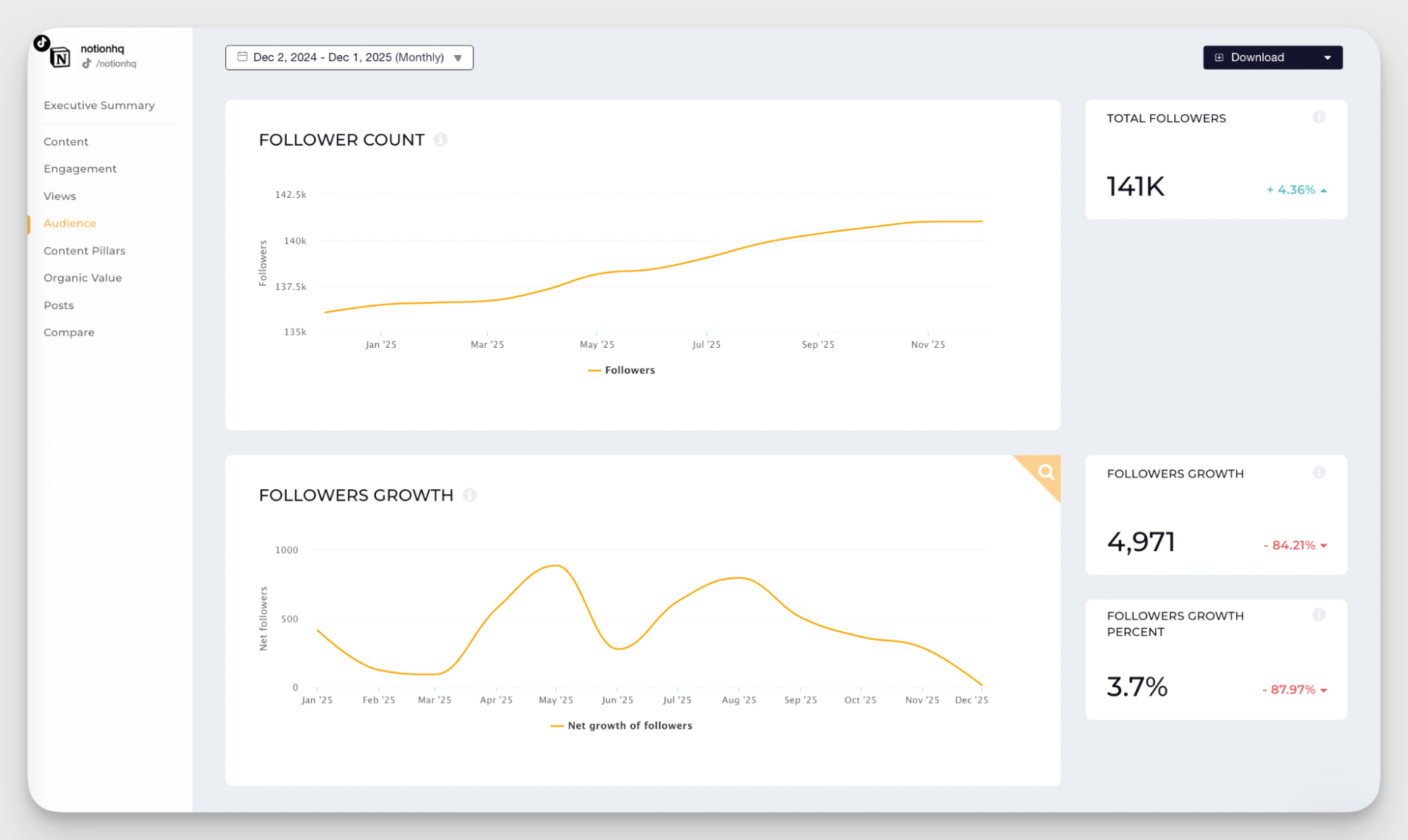
In the screenshot below, the follower count for Notion grew steadily to 141K total followers (+4.36%), showing continued audience growth.
However, the followers growth dashboard shows a sharp slowdown in net new followers (-84.21%), suggesting that recent content is less effective at converting viewers into followers.
Engagement
These signals show whether viewers find your content worth interacting with:
- Engagement rate by views
A key quality metric. It normalizes engagement against reach and helps you compare content fairly.
According to the engagement dashboard for Notion, the average engagement rate by views is 1.8%, down 46.08% over a period of one year.
This shows that even when videos were viewed, users interacted with them less frequently, pointing to more passive consumption of content.
- Likes and comments
Likes indicate quick approval. Comments matter more for B2B. They show thinking, questions, and conversation.
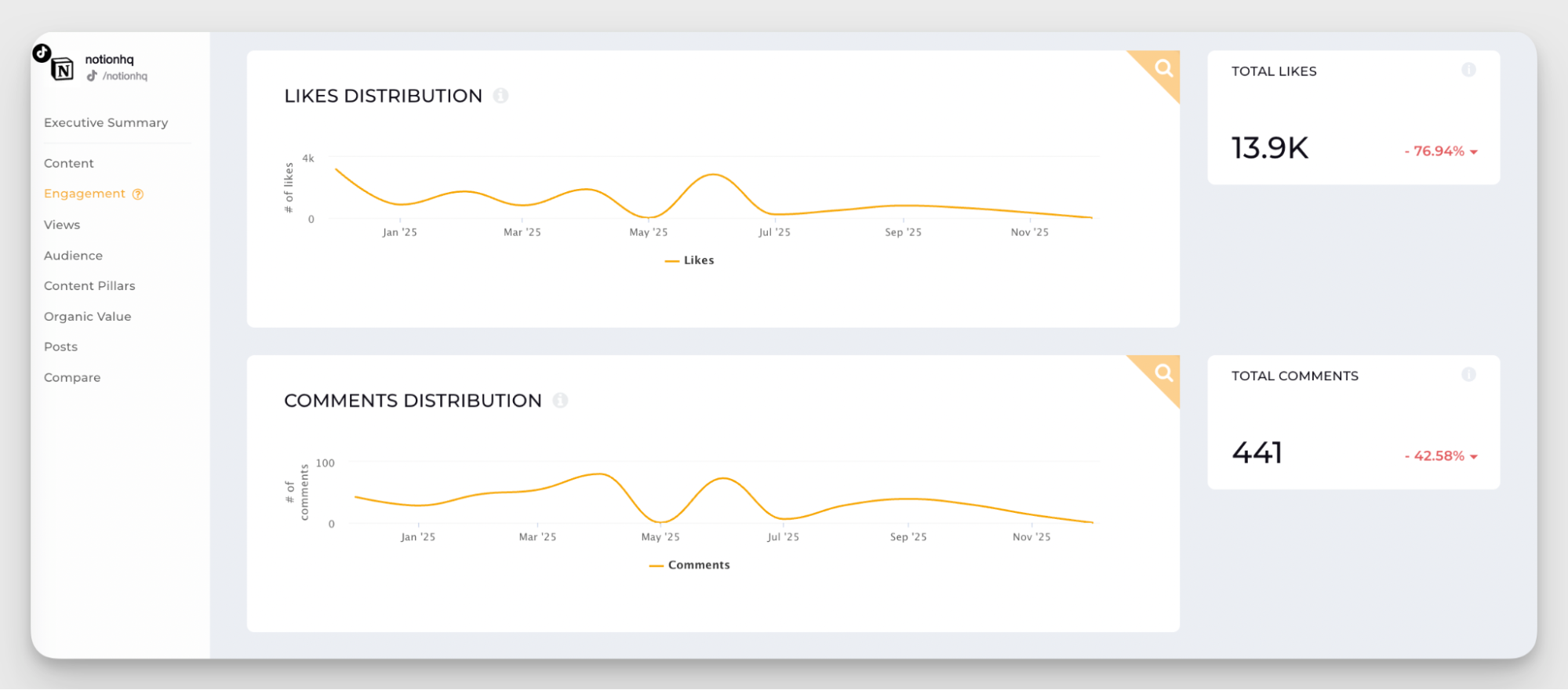
The Likes & Comments dashboard for Notion’s TikTok account shows 13.9K total likes (-76.94%) and 441 total comments (-42.58%).
This shows that engagement peaked earlier in the year and declined steadily afterward, indicating reduced interaction per post rather than a one-off drop.
- Shares and saves
High-value engagement signals. Shares often mean internal distribution (teams, peers, decision-makers). Saves suggest content worth revisiting or referencing later.
For middle of the funnel
This stage is about isolating signals that sit between exposure and conversion.
And for me, there are two questions that come to mind in this phase: can content trigger intentional exits from the platform, and does that traffic hold up once it lands in owned channels?
The metrics below focus on those two behaviors—off-platform action and on-site follow-through—without pretending TikTok is a direct-response channel.
Bio link click-through rate
My personal opinion is that, in B2B, bio CTR acts as a directional signal rather than a conversion metric.
When paired with UTMs, it reveals which content themes can overcome TikTok’s native containment and drive intentional off-platform behavior.
Pattern consistency matters more than spikes.
Website visits from TikTok traffic
TikTok sessions indicate whether exposure translates into active consideration.
Evaluated alongside visit quality and recency, this traffic helps position TikTok within a multi-touch journey, often upstream of search, email, or sales engagement rather than competing with them.
For bottom of the funnel
At this level, TikTok analytics stop being about interpretation and start being about accountability.
The question here is how it shows up in revenue, deal quality, and long-term customer value.
The metrics below focus on four areas: conversion capture, revenue influence, customer advocacy, and long-term efficiency.
Lead generation metrics
These metrics assess whether TikTok exposure converts into identifiable demand.
- Lead form submissions attributed to TikTok
Measures direct demand capture from TikTok-native or on-site forms, helping isolate content and formats that trigger high-intent actions.
- Demo requests or consultation bookings from TikTok traffic
A strong signal of buying readiness, particularly valuable in high-consideration B2B motions.
- Newsletter signups or gated content downloads
Indicates early pipeline creation where immediate sales aren’t expected but intent is explicit.
Sales-influenced metrics
Here, TikTok is evaluated as a revenue contributor across a multi-touch journey, not just a last-click channel.
- Revenue attributed to TikTok (direct and assisted conversions)
Captures both immediate and influence-based revenue impact through attribution models.
- Average deal size from TikTok-sourced leads
Helps assess lead quality and whether TikTok attracts the right segment, not just more volume.
Customer advocacy indicators
These metrics reflect post-conversion behavior and brand alignment, not performance marketing efficiency.
- User-generated content from customers mentioning your brand
Signals organic advocacy and brand resonance after purchase.
- Customer testimonial video performance
Measures credibility and social proof generated by real customers within the platform.
Long-term value metrics
This layer determines whether TikTok scales sustainably as a B2B channel.
- Customer acquisition cost (CAC) for TikTok channel
Evaluates efficiency once TikTok moves beyond experimentation into repeatable growth.
- Lifetime value (LTV) of TikTok-acquired customers vs. other channels
Benchmarks TikTok’s downstream value against established acquisition sources.
Benchmarks that help build a competitive advantage
Even with all the right metrics in hand, many experts, including myself, will tell you that raw performance numbers don’t say much on their own. And they’re right.
The way I personally see it is that, on their own, they only tell you what you did, not whether it was good, bad, or just average for your category.
Benchmarking is what turns those numbers into something usable.
Overall performance metrics benchmarking
Here, you pressure-test one of the most common assumptions in TikTok strategy: that posting more leads to better results.
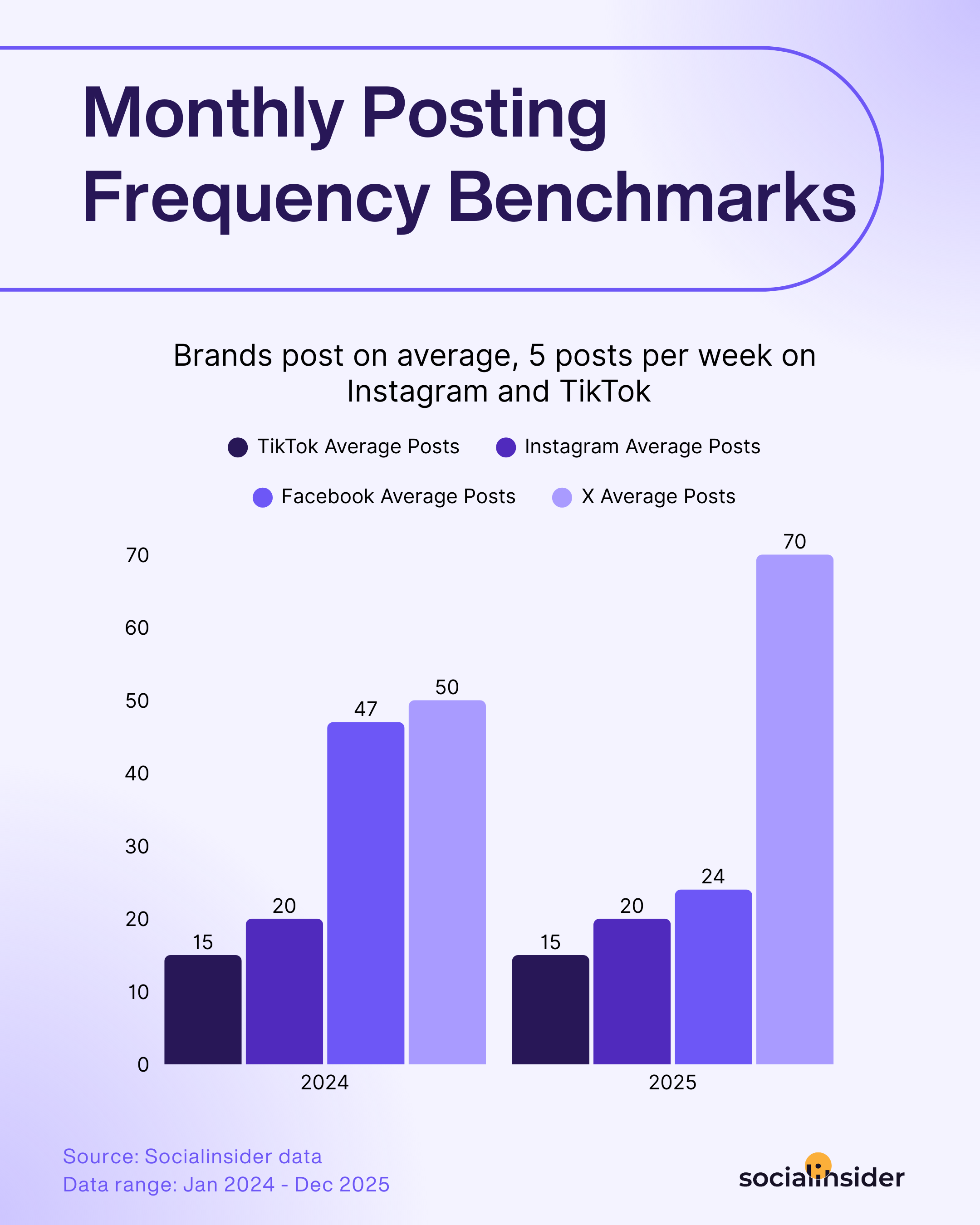
Competitive benchmarking lets you compare posting frequency against outcomes across similar accounts. When you line those two up, patterns emerge quickly.
Brands with comparable positioning and volume often deliver very different engagement and reach, which makes it easier to separate output from effectiveness.
This is the kind of insight a competitive analysis report should surface early, before teams default to “post more” as a strategy.
For experienced teams, this shifts the focus away from cadence optimization and toward content efficiency: which competitors turn fewer posts into more impact, and why.
Content strategy analysis and gap identification
Content pillar analysis lets you compare investment versus performance across competitors.
When you line those up, imbalances stand out quickly: some brands overproduce low-yield formats, while others achieve stronger results with a narrower, more intentional mix.
From my perspective, this analysis surfaces three signals that matter:
- which content pillars reliably outperform in the category
- where engagement declines despite sustained output
- which high-performing themes are underrepresented or absent
This helps teams reallocate effort toward proven demand signals, avoid saturated formats, and enter underexploited themes with a higher probability of impact.
Examples of B2B brands winning on TikTok
Now that you’ve learned how to build your content strategy and how to gather and interpret social media analytics, let’s look at real examples of B2B companies using TikTok, and, more importantly, why their content works:
Semrush
A single, recognizable brand face driving consistency
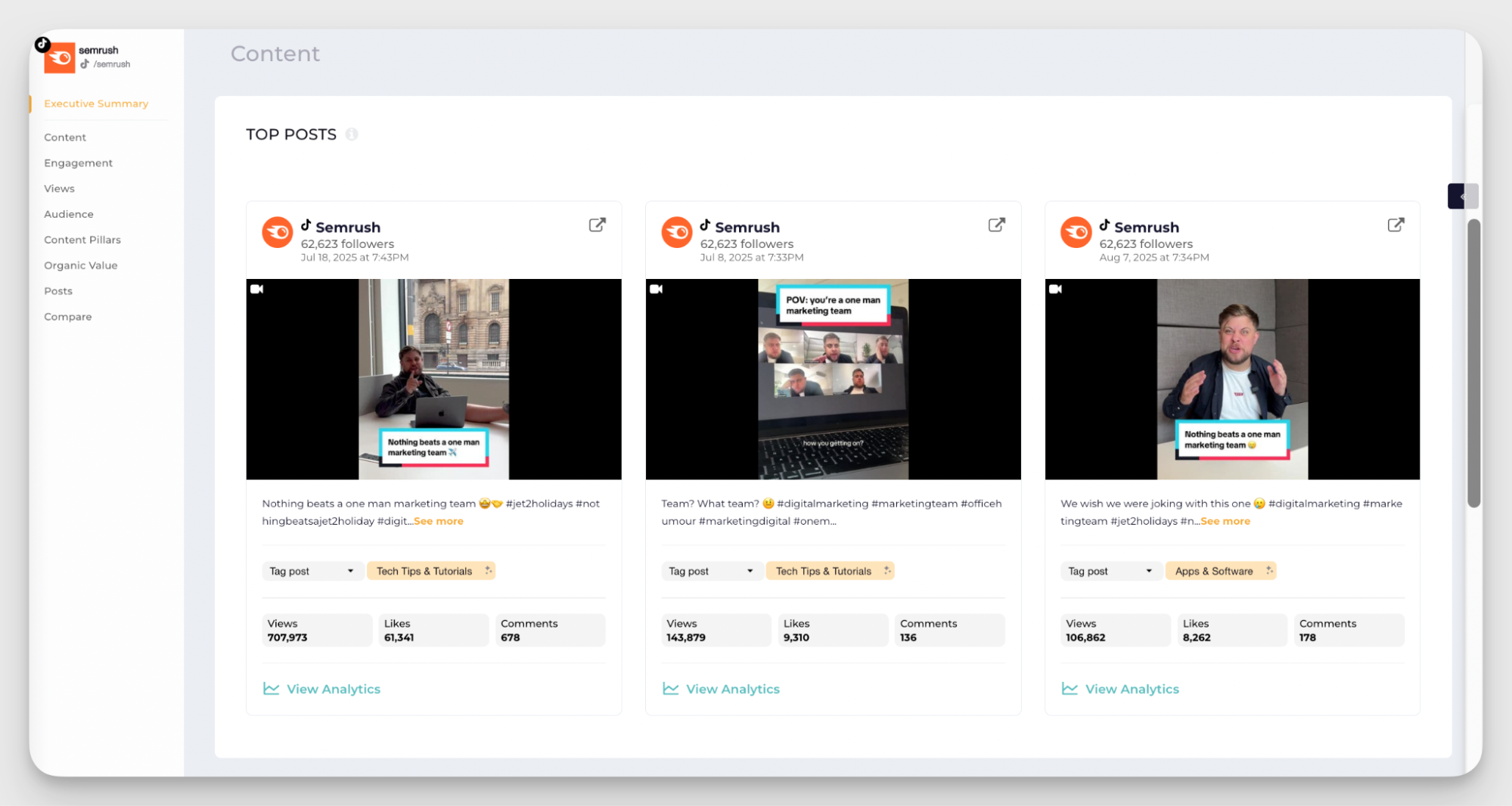
Semrush’s top-performing TikTok posts consistently feature the same internal person—their social media manager—front and center.
Instead of overproduced visuals, the content focuses on relatable, first-person storytelling tied to real marketing experiences (example: “one-person marketing team” scenarios).
From an social media content analysis perspective:
- These posts dominate Top Posts by views and engagement
- The same format repeats successfully across multiple uploads
- Performance clusters around Tech Tips & Tutorials and light humor
Why this works:
Semrush uses analytics to double down on what resonates: a human face, a clear POV, and repeatable storytelling. This proves that personal familiarity outperforms polished branding in B2B TikTok.
Clickup
Product updates disguised as workplace entertainment
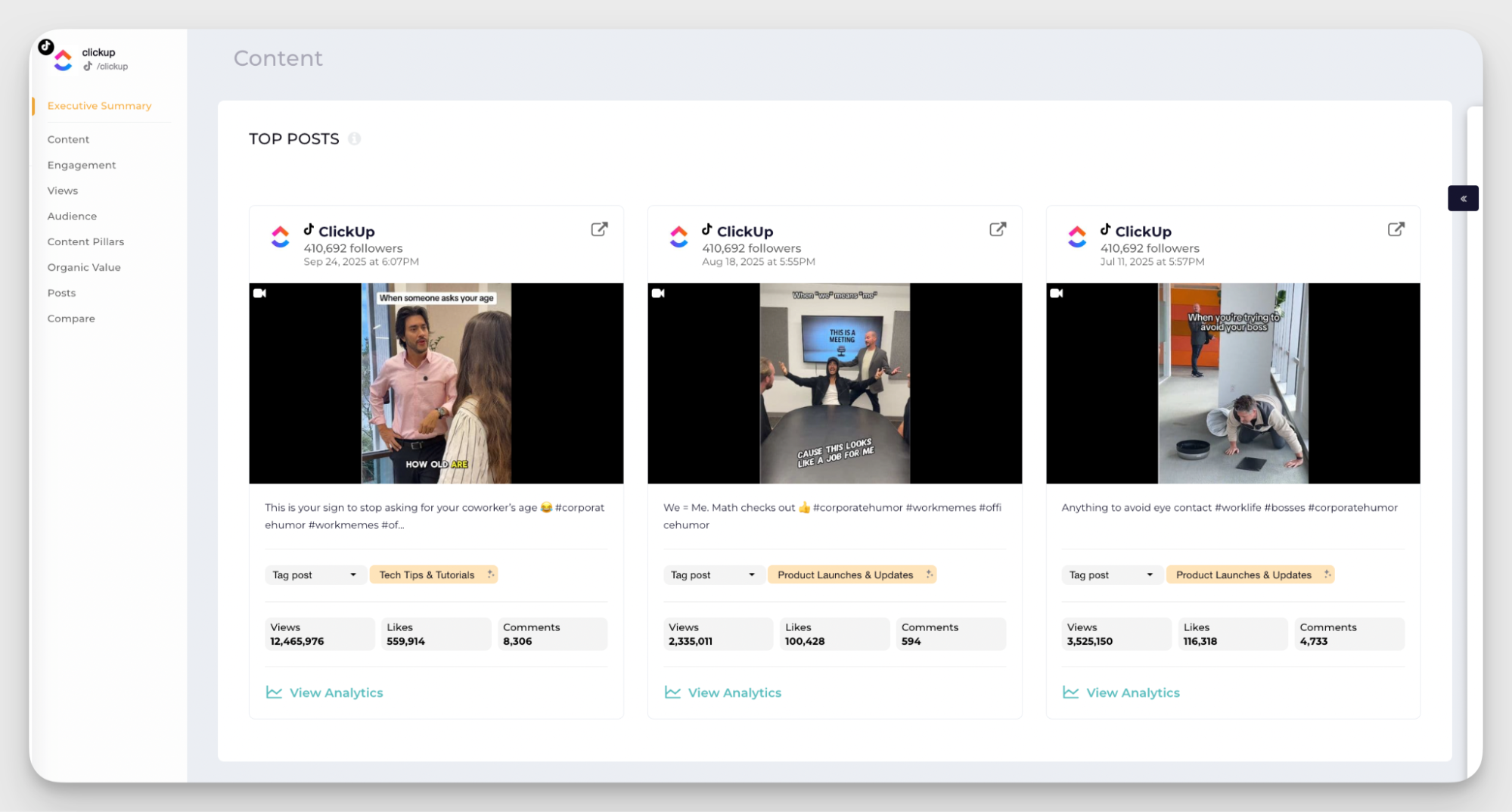
ClickUp’s top-performing TikTok posts consistently fall under the Product Launches & Updates content pillar. The difference is how those updates are delivered.
Instead of explaining features, ClickUp:
- Shows everyday workplace problems
- Introduces the product update as the solution
- Uses short, repeatable office skits
From the analytics:
- Product update posts dominate Top Posts
- The same formats repeat across high-view videos
- Humor-driven scenarios generate stronger engagement than direct product explanations
Why this works:
ClickUp uses performance data to validate that context beats explanation. By embedding product updates inside familiar work situations, they make product content easy to watch, easy to understand, and easy to repeat.
Notion
Lifestyle-led content anchored in real use cases
Notion’s top TikTok posts lean heavily into environment, mood, and everyday workflows rather than explicit product promotion. Office aesthetics, calm setups, and subtle storytelling dominate their best-performing content.
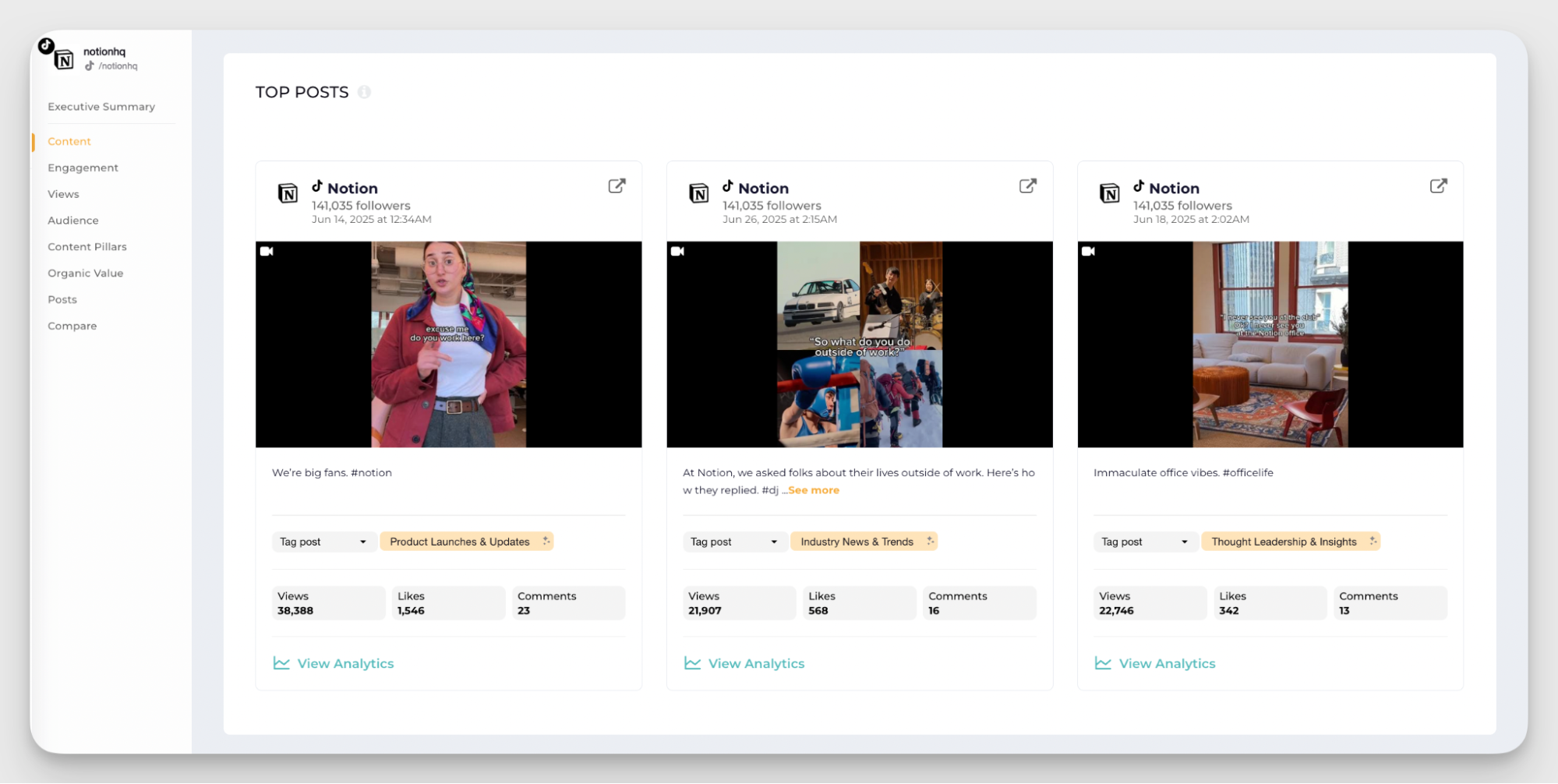
Analytics reveal:
- Strong performance across Thought Leadership & Insights
- Consistently high views with minimal on-screen selling
- Visual consistency across top posts
Why this works:
Notion uses TikTok to sell a way of working, not just a tool. Their analytics show that aspirational, use-case-driven content keeps attention and reinforces brand positioning without direct persuasion.
A clear pattern emerging across top-performing B2B brands on TikTok?
They humanize the brand, anchor content in a clear pillar, and repeat a recognizable format. Plus, they’re not chasing trends randomly. They’re building familiarity, trust, and authority.
Challenges of B2B marketing on TikTok
As much as TikTok opens new creative doors for B2B brands, it also exposes the realities behind the hype.
Longer sales cycles, multiple decision-makers, and higher expectations around credibility don’t disappear just because the platform is fast-moving and informal.
These are some key challenges B2B teams need to navigate when turning TikTok into a serious marketing channel:
To this Josefine added:
The biggest challenge is tone. TikTok often rewards “click-baity” content which often sits outside traditional B2B brand guideline. Rather than avoiding risk, brands should define it. A clear risk framework agreed with legal and leadership helps set boundaries for creative freedom.
Another challenge is benchmarking correctly. B2B brands should not compare themselves to creators or B2C brands operating under different constraints
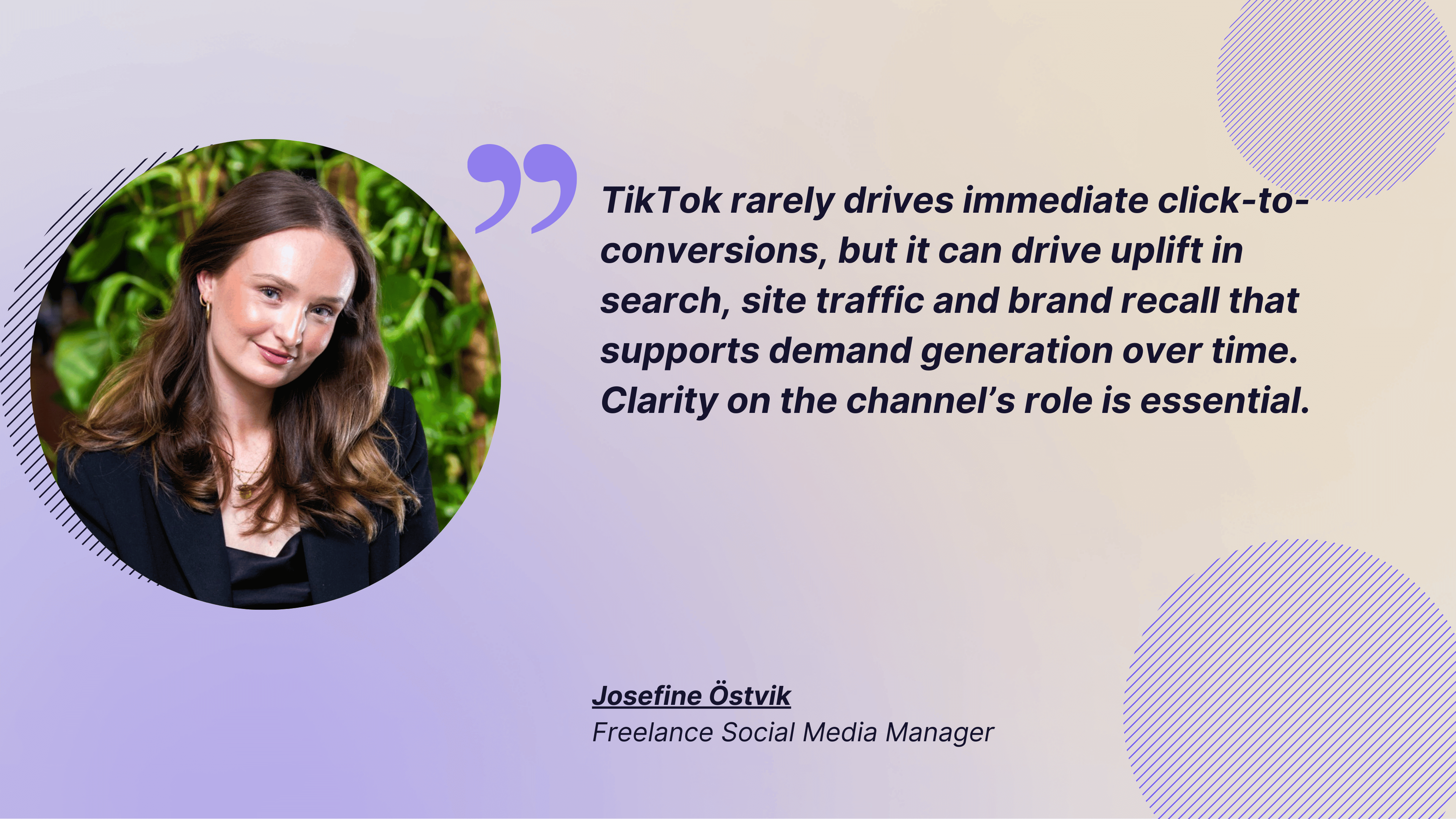
Finally, many brands struggle with expectations. TikTok rarely drives immediate click-to-conversions, but it can drive uplift in search, site traffic and brand recall that supports demand generation over time. Clarity on the channel’s role is essential.
Humanizing a brand without losing professionalism
TikTok thrives on authenticity. It rewards brands that feel human, approachable, and real. Which is exactly where many B2B companies start to hesitate.
The tension is obvious:How do you show personality without becoming too casual?How do you stay entertaining without weakening credibility?
The answer isn’t to chase trends blindly or turn your account into a comedy feed. It’s about translating expertise into a format that feels natural on the platform.
That might mean featuring real employees instead of polished spokespeople, sharing behind-the-scenes moments, or breaking down complex topics through short, story-driven videos.
The challenge lies in finding a tone that feels human but still intentional, one that reflects your brand values, respects your audience, and reinforces trust rather than undermining it.
Managing brand compliance and approvals
Speed is TikTok’s currency. And that’s often at odds with how B2B organizations operate.
Legal reviews, compliance checks, product sign-offs, leadership approvals… for many teams, content can’t go live without passing through multiple layers.
On a platform where trends peak and fade in days, that friction can quickly make TikTok feel unworkable.
The solution isn’t to remove guardrails, but to rethink them.
Instead of reviewing every caption or frame, teams need systems that enable faster decision-making while still protecting the brand.
That usually means:
- clear content guidelines rather than case-by-case approvals
- a shared definition of what “on brand” looks like on TikTok
- internal education on how the platform works and why tone matters
Attribution modelling: From TikTok engagement to lead generation
This is where most B2B brands on TikTok struggle: proving impact.
B2B buying journeys are long, complex, and rarely linear. TikTok is almost never the final touchpoint before a deal closes, which makes traditional last-click attribution misleading at best. And dismissive at worst.
That doesn’t mean TikTok isn’t contributing. More often, it influences earlier and mid-funnel stages, such as:
- brand awareness
- consideration
- brand recall
- thought leadership
- social proof
The real challenge is building an attribution model that reflects how decisions are actually made.
That might involve tracking branded search lift, reviewing CRM notes, monitoring sales conversations that reference TikTok content, or identifying influencer-assisted leads.
TikTok may not always close the deal. But it can shape the conversation long before one happens. And in B2B, that influence often matters more than a single click.
Final thoughts
If there’s one thing I’ve learned watching B2B brands on TikTok, it’s this: the platform rewards clarity. You can’t hide behind positioning decks or polished messaging. You either explain what you do in a way real people care about, or you get ignored.
And while TikTok won’t replace your core channels, it will show whether your thinking holds up early, before buyers ever visit your site or talk to sales. Used intentionally, it becomes less about content and more about how clearly you understand your own value.
So don’t ask whether TikTok “fits” your brand. Ask whether you’re ready to show how you think. Start there. Measure what matters. Repeat what works.
Anda Radulescu
Content writer & copywriter with a 5-year track record in digital marketing. Equal parts keen observer & committed go-getter. A proud cat mom with a passion for music & exploring the world.

Know what your competitors do — before your manager asks
Get instant social benchmarks & reports without manual work.
You might also like





Improve your social media strategy with Socialinsider!
Use in-depth data to measure your social accounts’ performance, analyze competitors, and gain insights to improve your strategy.