How to Find Social Media Trends: 5 Methods to Spot What's Trending Early
Learn how to find social media trends early with 5 proven methods, the right tools, and a repeatable system to track trends as a team.

Have you ever wondered how some brands always seem to know what's currently trending on social media before anyone else catches on? As someone who spends a lot of time exploring the ever-changing world of social media, I've realized that knowing how to identify trends isn't about having better instincts; it's about having a better process.
In this article, I'll walk you through what actually counts as a trend, the types worth monitoring, and five methods to find what's trending before it peaks, plus some tips from Eve Gaciarz, assistant director of communication at Yale MacMillan Center, on how she tracks social trends for her own brand.
Key takeaways
- Viral moments, micro-trends, and lasting shifts each behave differently, and knowing which one you're looking at determines how fast you need to move.
- Trends worth monitoring fall into three buckets:platform-specific, industry-specific, and audience behavior shifts, and each requires a different kind of watching.
- The 5 methods that consistently surface trends early combine platform-native signals, competitor activity, social listening, your own performance data, and cultural/cross-platform signals.
- A repeatable system beats one-off trend hunting. The brands that are best at this treat trend-spotting as an ongoing habit with defined owners and cadence, not something someone does when they remember to.
What counts as a social media trend, and what doesn't
Before you can get good at finding trends, you need a clear read on what you're actually looking for. Not every spike in your feed is a trend, and treating them all the same is how brands end up chasing noise.
- Viral moments are the biggest and shortest-lived. Think of a meme format or a specific bit that dominates feeds for 48-72 hours — the "Roman Empire" question, the "Barbenheimer" wave. The window to participate is narrow, and showing up late usually looks forced.
- Micro-trends last weeks to months. A specific TikTok audio, an aesthetic style, a format creators are experimenting with — "Get Ready With Me," "office siren," "girl dinner." There's more runway here, but you still need to move with some urgency. Eve describes this category well:
Micro-trends are more participation-based and often rooted in aesthetics, formats, or hype. People join micro-trends to feel part of a community or shared experience (think Labubu unboxings). These can come with high engagement, especially if a creator of a specific niche builds a following or online identity around that specific micro-trend.
- Lasting trends aren't viral at all in the traditional sense; they're shifts in how people consume content and what they expect from brands, playing out over six months or longer. Short-form video is the obvious example: it didn't disappear after a few weeks, it changed content strategy permanently.
What types of trends should you be monitoring?
"What's trending in social media" is too broad a question to act on directly. It helps to break trends into three categories, since each one requires a different kind of watching.
Platform-specific trends (TikTok sounds, LinkedIn formats, Instagram aesthetics)
Every platform has its own trend language, and viral trends on social media rarely transfer cleanly from one network to another. A TikTok sound doesn't mean anything on LinkedIn. A LinkedIn document-style carousel doesn't translate to TikTok.
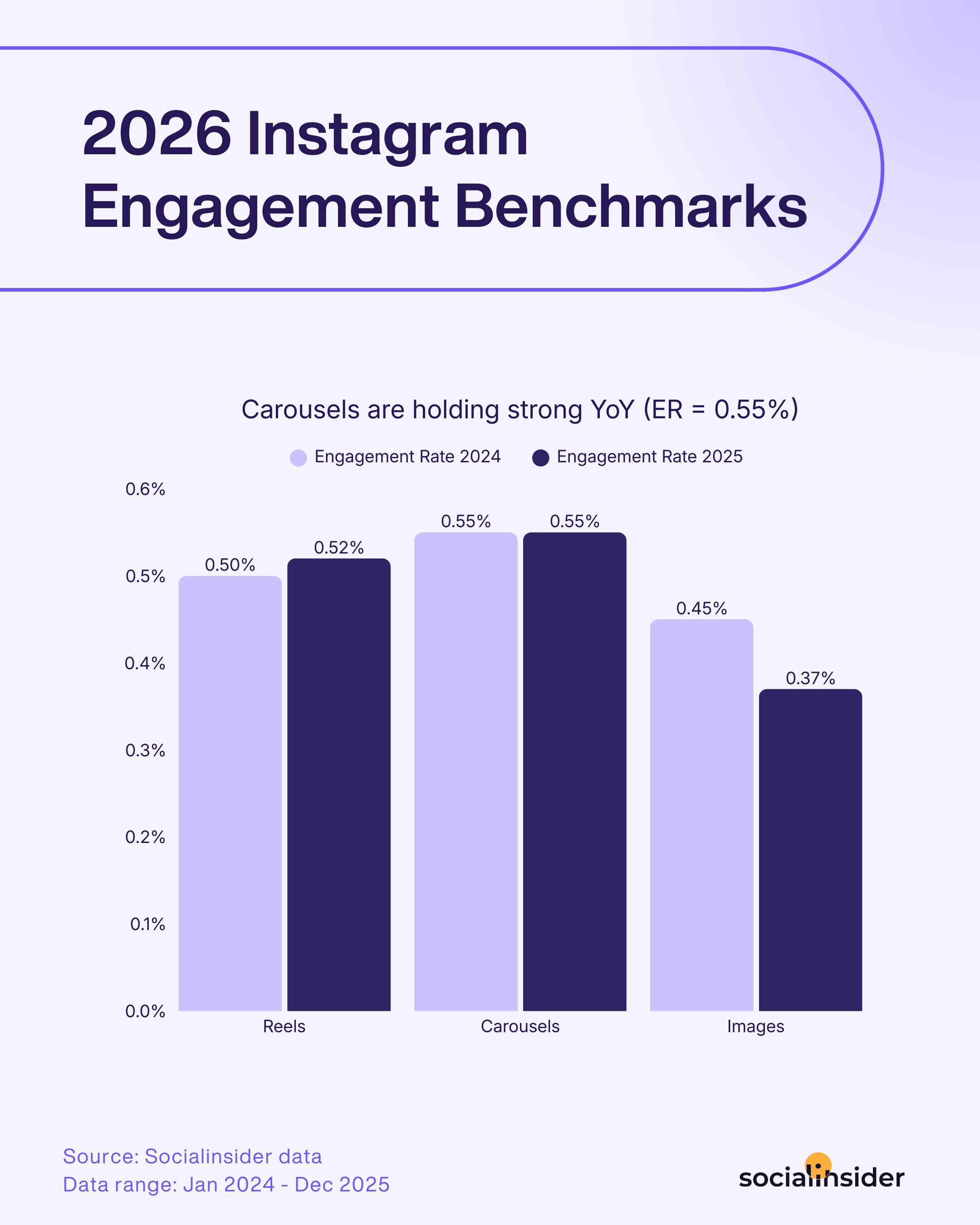
Looking at Socialinsider's Instagram benchmarks report, for example, carousels are actually generating higher engagement rates than Reels and static images right now — which runs counter to the assumption that Reels dominate by default.
On LinkedIn, multi-image posts and native documents currently lead engagement over single images, video, polls, and text posts.
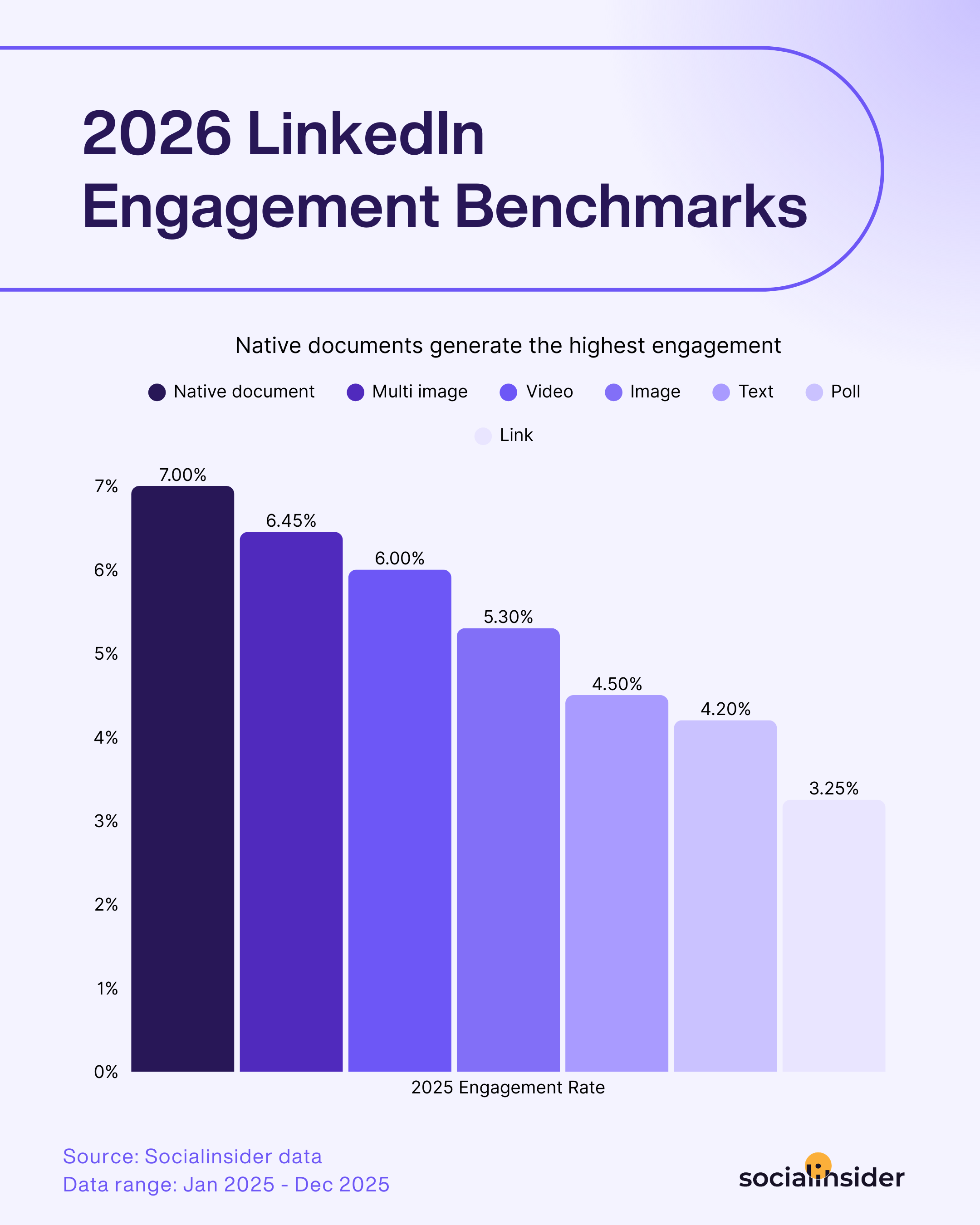
PS: Format trends aren't static. Check performance quarterly, both for your own content and across industry benchmarks, since what wins on a platform shifts as algorithms and user behavior change.
Industry-specific trends
A trending topic in beauty is often irrelevant if you're in B2B software, and trends can hit differently across audience segments even within the same industry. Generic "trending now" lists only get you so far when your audience is narrow.
Instead, watch for:
- Which topics are generating more discussion than usual in your space
- What questions keep coming up from your audience
- Which formats your industry peers are experimenting with, and how those are performing
Eve's filter for this is a good one to borrow:
Focus on trends that are relevant to your niche and audience. Jumping on every trend can dilute your message, but when a trend aligns with your industry and amplifies your perspective, it's worth participating.

Audience behavior shifts
This is the category most brands miss entirely, because it's not a sound or a hashtag; it's a change in how your audience actually engages. Maybe comments are becoming a stronger signal than likes across your industry. Maybe your audience is spending noticeably more time on long-form video than the quick-hit content that used to work. Maybe questions in your comments section are shifting from product questions to values-based ones.
These shifts don't show up on a trending sounds page. You catch them by watching your own engagement patterns over time and noticing when the type of interaction — not just the volume — starts to change.
5 methods to discover social media trends early
Knowing what to look for is one thing. Knowing how to track trends before they're obvious to everyone else is another. Here are the five methods I've seen work consistently.
Monitor platform-native trend indicators
Every platform surfaces its own trend signals if you know where to look. TikTok's Creative Center "Trending" section shows sounds and hashtags gaining momentum, and flags whether something's still rising or already peaking. YouTube Studio's "Research" tab shows what your audience is actively searching for; often a leading indicator of a topic trend before it shows up anywhere else. X's trending topics module surfaces real-time conversation spikes.
The limitation is that native tools only show your own account's data; they won't tell you what's trending for a competitor or across your industry.
Track competitor content adoption patterns
Your competitors are essentially running experiments for you. When you compare accounts in the same space side by side, patterns emerge fast; one brand might post more frequently without translating that into better engagement, while another gets outsized results from a format they've barely touched.


When I looked at Costco's top-performing content pillars, for example, using Socialinsider, I could see that content featuring electronic reviews consistently ranked among the best performers. When multiple competitors in the same category see success with a similar theme, that's a much stronger signal than any single post doing well — it usually means you're looking at an actual industry-wide shift, not a one-off.
Listen to social conversations and community signals
Social listening tells you what people are discussing, even when it's not directed at you. Start with keyword alerts on your brand name, products, and key people, then expand to industry terms and topics central to your niche. Watch for volume changes — a sudden spike in conversation around a specific idea often precedes a broader trend.
Sentiment matters just as much as volume. A topic generating a lot of conversation with sentiment turning negative is a trend worth avoiding, not joining. A previously neutral topic trending more positive is a much stronger signal of genuine momentum worth watching.
Use your own performance data as an early signal
Sometimes there's a gap between what you publish most and what actually performs best, and that gap is exactly where trend insight hides.
For example, when I looked at Costco's Instagram content mix, I could see the majority of posts they publish are Reels, but when sorted by engagement, carousels pulled ahead significantly.

A less-used format quietly outperforming the dominant one in your own data is one of the clearest early trend signals available, and it's sitting in your analytics right now, before it ever shows up on a trending page.

This is where Socialinsider makes the signal easier to catch: it breaks down engagement by content format automatically, so you don't have to manually sort posts to spot which format is quietly winning. Additionally, its top posts view surfaces your best-performing content in seconds, making it quick to see exactly what your audience is responding to most right now, without digging through weeks of data by hand.

Follow cultural and cross-platform signals
Trend forecasters, industry analysts, and niche influencers often spot shifts before they hit mainstream awareness. Be selective about who you follow; track record matters more than hot takes. Industry newsletters, podcasts, and niche communities often surface relevant trends faster than general social media news.
Eve's approach mirrors this:
I follow social media blogs and LinkedIn top voices to stay informed, but I also prioritize consuming content directly. Putting yourself in the shoes of the consumer is essential, and the best way to do that is by actively scrolling, watching, and engaging.
How to track when competitors start jumping on a trend (and how Socialinsider helps)
One of the hardest parts of trend-spotting isn't finding a trend — it's knowing the moment a competitor starts adopting it, so you can decide whether to move fast or sit it out. Checking competitor accounts manually, one at a time, means you're always a step behind.
This is where Socialinsider fits directly into the process. Because it lets you analyze any public competitor account without needing access granted to it, you can add every competitor you track into one view and watch for adoption patterns as they happen, rather than stumbling onto them days later.
A few specific ways this plays out in practice:
- Content pillar tracking across competitors. If several competitors suddenly start posting more around a theme they previously ignored, that's an early adoption signal worth acting on.
- AI Key Insights Summary. Socialinsider automatically flags notable shifts in a competitor's performance or content mix for a given period, which cuts down the time between "something changed" and "here's what changed."

- Posting frequency and format shifts. A competitor suddenly increasing their posting cadence around a new format is often the first visible sign they've spotted a trend before announcing anything about it.
Watching this consistently — rather than checking in occasionally — is what separates brands that catch a trend in its early-adoption phase from brands that notice only once it's already saturated.
What tools to use to find social media trends
Methods matter, but you need the right tools to execute them efficiently. Three categories cover most of what you'll need.
- Platform-native analytics are your first stop for understanding your own audience and content: TikTok's Creative Center, Instagram Insights, LinkedIn Analytics, YouTube Studio, and X Analytics. Each shows a slice of what's trending, but only within your own account.
- Social media analytics platforms — this is where a proper social media trend tracker comes in, aggregating data across your accounts, competitors, and industry into one place instead of forcing you to check five separate native dashboards. Socialinsider's analytics cover this layer directly: content pillar analysis at the account, brand, or industry level; competitive benchmarking so you can separate a brand-specific win from a genuine market shift; AI-driven insights that catch patterns manual review would miss; and historical data that helps you tell a viral moment apart from a lasting change, so you're not mistaking a seasonal spike for an actual trend.
- Social listening tools like Brandwatch, Sprout Social, Mention, and Talkwalker monitor conversations across platforms, forums, and news sites — tracking sentiment shifts, brand and competitor mentions, and emerging conversations before they hit your own feed.
Common mistakes when hunting for trends
A few recurring mistakes undercut even a solid trend-spotting process:
- Chasing every trend. Not every sound or meme deserves your attention; a few well-executed trend pieces beat a dozen rushed ones.
- Ignoring where your audience actually is. A trend can be huge on TikTok and completely irrelevant if your audience lives on LinkedIn.
- Showing up late or generic. Jumping in after a trend has peaked, or posting something indistinguishable from everyone else's version, does more harm than skipping it.
- Relying on one signal instead of combining methods. A single native dashboard or one influencer's take isn't enough to confirm something is actually trending versus just visible to you.
- Treating trend-spotting as occasional rather than ongoing. The brands that consistently catch trends early have a running process, not a one-off check when someone remembers to look.
Eve's take on one specific version of this mistake:
One common mistake is assuming every sound with an upward arrow will go viral. It's also important to read the comments and assess how repeatable the trend is. Look at the comments and shares, and that will give you an idea of audience sentiment. If people genuinely enjoy the content and it's easy to recreate (like the owl impersonation trend happening right now), it's worth monitoring.
Another major mistake is hyperfixating on trends as your primary content strategy. That time is often better spent creating higher-quality, community-building, or value-driven content that actually supports engagement and sales.
How to build a repeatable trend-spotting system for your team
Finding trends once isn't the hard part; doing it consistently, as a team, without it falling on one person's memory, is. A repeatable system needs three things:
- A defined cadence. Check platform-native indicators and social listening weekly. Review your own performance data for early signals every two weeks. Run a deeper competitive and industry scan monthly. Trends move at different speeds, so a single check-in frequency for everything misses either the fast-moving viral moments or the slower industry shifts.
- A clear owner per method. Someone owns social listening, someone owns competitive tracking, someone owns performance data review. Spreading five methods across zero defined owners is how trend-spotting quietly stops happening after the first few weeks.
- A shared log. A simple running document or tagged system where anyone on the team can flag "this looks like it might be trending" keeps hypotheses from Method 5 flowing into validation against Methods 1-4, instead of living in someone's head or a Slack message that gets lost.
Trend-spotting works the same way social trends in business generally do. The brands that stay ahead treat it as infrastructure, not inspiration. Once you've found a trend worth pursuing, the next step is deciding whether it's actually worth your resources and how to execute it well — which is exactly what we cover in our guide on trend analysis on social media.
Final thoughts
Finding social media trends early comes down to knowing what actually counts as a trend, watching the right categories, and running five methods consistently instead of relying on instinct. Pair that with a system your whole team can execute — not just one person checking a dashboard occasionally — and you go from reacting to trends late to spotting them while there's still room to act.
Start your free Socialinsider trial to track competitor adoption patterns and performance signals in one place, instead of checking platforms one at a time.
FAQs about finding social media trends
How to identify trends before they peak?
Combine your own performance data, competitor activity, social listening, platform-native indicators, and cultural signals rather than relying on any single source. A trend confirmed across multiple methods is far more reliable than one spotted through just one channel.
How to find trending topics on social media?
Check platform-native trend indicators (TikTok's Creative Center, YouTube's Research tab, X's trending topics), monitor competitor content adoption, and set up social listening alerts around your industry's key terms, then cross-reference what surfaces against your own audience's engagement patterns.
How to track trends across multiple platforms at once?
Native analytics only show your own account, so tracking trends across platforms usually requires a dedicated social media trend tracker or analytics platform that aggregates data across networks and competitors into a single view.
What is currently trending on social media?
This changes constantly and varies heavily by platform and industry, which is exactly why a repeatable discovery process matters more than any static list of "what's trending now."

Elena Cucu
As Content & SEO Manager at Socialinsider, Elena Cucu helps social media leaders make sense of the numbers behind their performance. Featured in TechCrunch, TNW, and ReadWrite.

Know what your competitors do — before your manager asks
Get instant social benchmarks & reports without manual work.