TikTok Best Practices That Separate Scroll-Bys From Standout Content
Learn TikTok best practices for KPI frameworks, benchmarking, leadership reporting, and the structural mistakes holding brands back.

At some point, “post consistently, hook viewers fast, follow trends” stopped being useful advice.
Most social media teams already know the TikTok basics.
The harder part is turning that activity into something you can defend in a strategy meeting, and repeat next quarter.
If you ask me, I’d say strong TikTok marketing is as much about KPI frameworks, experimentation, team workflows, benchmarking, and reporting as it is about the content itself. That’s why in this guide I’m going to cover a couple of strategic TikTok best practices that actually make TikTok work as a business channel.
Key takeaways
- Sustainable TikTok performance depends on setting goal-based KPI frameworks before posting, benchmarking results against industry and competitor data rather than past performance alone, and balancing organic content experimentation with a deliberate paid-organic mix.
- Effective TikTok reporting for leadership translates platform metrics into business language and organizes results into three layers: business impact, channel health, and content performance, rather than a standalone list of platform statistics.
- The most common TikTok strategy failures stem from unclear ownership of community response, no feedback loop between reporting and content planning, and copy-pasting content strategies from other platforms without adapting to TikTok's distinct audience behavior.
5 Strategic TikTok best practices for brands aiming to nail TikTok marketing
Yes, good TikTok content can earn you a spike in views. But a good social media platform strategy tells you whether those views mattered, and what to do next.
The strongest brands are building a system around clear objectives, clear benchmarks, room to experiment, faster workflows, and a well-balanced organic-paid mix.
And while best practices for TikTok engagement can help individual posts perform, getting these five strategic foundations right is what turns that brand performance into sustainable results.
#1 Set a clear goal and KPI framework before you post
One of the easiest ways to make TikTok look successful is to decide what success means after you’ve seen the numbers.
A post gets 700K views? Great, TikTok is an awareness channel. Another generates 400 comments? Now we’re building community. A third drives 50 sales? Suddenly it’s a commerce channel.
That’s backwards.
Your social media goals should determine which TikTok metrics matter before the content goes live.
I like to think about this in three broad buckets: awareness, community, and commerce.
Your strategy can contribute to all three, but giving each campaign or content pillar a primary job makes performance much easier to evaluate and much harder to misinterpret.
Awareness
If awareness is the goal, don’t reduce it to “more eyeballs.”
You want to know how far your content traveled, whether people actually paid attention, and whether that attention grew your audience.
- Views
Views are the obvious place to start, but they’re also where teams can get distracted fastest.
A big view count tells you distribution happened. It doesn’t tell you whether that attention was valuable.
As Sam Oliver, a freelance social media strategist, puts it:
It's also easy to become obsessed with view counts. Views are useful, but they're only one part of the picture. Success should always be measured against your objectives. A video with 20,000 views that generates ten qualified enquiries is far more valuable than one with a million views that generates nothing for the business.
Personally, I track views alongside the rest of my TikTok metrics in Socialinsider, since pulling raw view counts from the app one video at a time makes it nearly impossible to spot trends across a content pillar.

- Reach
Reach tells you how many unique accounts your content reached, which makes it particularly useful when you want to understand audience expansion rather than repeat consumption.
I'd look at it alongside views, but never interchange the two.
If views are climbing much faster than reach, for example, existing viewers may simply be consuming or rewatching more of your content. That can be valuable, but it tells a very different story from breaking into new audiences.
This is one of the easier gaps to catch when views and reach sit side by side on the same dashboard in Socialinsider, rather than in two separate exports you have to line up manually.
- Follower growth rate
Total followers show the size of your audience; net-new followers show how many you actually gained after accounting for unfollows.
Follower growth rate puts that change in context by showing how quickly your audience grew relative to its starting size.
More importantly, trace growth spikes back to specific posts. If certain videos consistently turn viewers into followers, you've found content people want more of. Personally, I use Socialinsider to overlay follower growth against my posting history, which makes those spikes easy to trace back to the exact video that caused them.

- Video completion rate vs. average watch time
Completion rate shows the percentage of viewers who made it to the end, while average watch time tells you how long, on average, your video held attention.
This metric is especially valuable when comparing videos of different lengths. A longer video might have a lower completion rate but still command significantly more attention overall.
For awareness, that’s the difference between content that was served and content that was actually consumed.
Distribution gets you in front of people; attention makes that distribution worth something.
Community
Community requires a different scorecard.
Here, I’m less interested in how many people TikTok delivered the content to and more interested in what those people did once they found it.
- Engagement rate
Engagement rate gives you the broadest read on how actively people interact with your content.
Track likes, comments, shares, and saves against either views or reach, just keep the denominator consistent so your comparisons actually mean something. Socialinsider calculates this automatically and keeps the formula consistent across every profile you track, which matters once you're comparing engagement rate across more than a handful of accounts or competitors.

More importantly, look beneath the percentage. Two posts can have the same engagement rate while creating completely different audience behaviors.
- Comments per post, and sentiment/response rate
A high comment count looks good, but volume alone can hide what’s actually happening.
Track comments per post to see which content consistently starts conversations, then add sentiment to understand whether those conversations are positive, negative, or somewhere in between.
And don’t measure only the audience’s side. Response rate and response time show whether your brand is actually participating in the community it’s trying to build.
- Shares and saves specifically
Likes are easy to give.
Shares and saves ask a little more from the viewer. And that’s exactly why I’d watch them separately.

Shares tell you your content felt worth passing on; saves suggest it was worth coming back to. Both give you a stronger read on the value people attach to your content than likes alone.
As Sam Oliver puts it:
Social media is meant to be social! Treating TikTok like an advert or a simple distribution platform is one of the biggest mistakes brands make. People scroll straight past obvious advertising, so the priority should be creating content people genuinely want to watch first. The marketing comes second.

- Rewatches vs. loop rate
These sound similar, but they tell you slightly different things.
Rewatches indicate that someone chose to watch your content again, while loop rate helps you understand how often a video cycles into another viewing.
However, I wouldn’t reduce either to an algorithm trick.
If people repeatedly consume a piece of content, there’s usually something worth investigating: the payoff, pacing, information density, entertainment value, or even an ending that naturally pulls them back to the beginning.
- Share of voice vs. competitors
Your community metrics can be improving while competitors are capturing the conversation faster.
That’s why I’d add share of voice to the picture.
It puts your performance in context by showing how much of the conversation around your category, topics, or brand space belongs to you versus competitors.
Because growing engagement is good; becoming a brand people increasingly talk about in your niche is better.
Commerce
When commerce is the goal, attention becomes the starting point, not the result.
The question shifts from “Did people watch?” to “Did watching move them closer to buying?”
- Click-through rate to bio link / product page
CTR shows how effectively your content moves viewers from TikTok to the next step, whether that’s a bio link, product page, or landing page.
A video can hold attention beautifully and still have a weak CTR.
And here's the insight behind that case: the content worked, but the offer, CTA, or transition to the next step may not have.
- Conversion rate on TikTok Shop or landing pages
Clicks show interest; conversions show follow-through.
Track how many visitors complete the intended action, whether that’s purchasing through TikTok Shop, submitting a lead form, or converting on a landing page.
- Cost per click vs. cost per acquisition
If paid media is part of the mix, these tell you two very different things.
CPC shows what you’re paying to generate a visit; CPA shows what you’re paying to generate the actual outcome.
Cheap clicks can look efficient right up until none of them convert.
Keep both in view, but judge performance against the metric closest to your business goal.
- Video views-to-purchase or views-to-signup ratio
This is where you connect TikTok’s biggest number with the outcome you actually wanted.
Instead of reporting 600K views and 1K sign-ups as separate wins, look at how efficiently those views turned into action.
It makes it much easier to compare which videos, creators, or formats generate attention that actually goes somewhere.
- Revenue attributed to TikTok as a channel
Eventually, commerce reporting has to reach the number the business cares about: how much revenue can we attribute to TikTok?
Attribution won’t always be perfectly clean, especially across longer or multi-touch journeys.
But tracking TikTok-attributed revenue gives all the metrics above a destination and stops strong engagement from being mistaken for strong commercial performance.
#2 Build a repeatable content strategy, not a content calendar
A full calendar can create a comforting sense that your social media content strategy is sorted. But knowing what you’ll publish every Tuesday for the next two months isn’t the same as knowing why you’re making it.
For a successful TikTok content strategy, I’d build around a small set of content pillars tied directly to the goals you set above.
If community is the priority, for example, some content pillars for social media might be designed to spark conversation; others might build expertise and earn saves. Each pillar has a job, but the execution stays flexible.
And I'm going to emphasize a bit the idea of flexibility, because some of the most useful TikTok content strategy best practices come from what you learn after publishing.
Treat hooks, presenters, formats, lengths, and angles as variables you can test within your pillars.
Over time, you’re building evidence around what deserves to become repeatable.
As Sam Oliver puts it:
Many brands give up too early. They post consistently for a few weeks, don't see instant results and conclude that TikTok doesn't work. The best approach is to treat TikTok as a series of experiments. Test different hooks, formats, presenters and topics, then use the data to double down on what consistently performs best.
A calendar tells you what goes live next. A strategy should help you make the next piece better.
#3 Benchmark against your industry and competitors, not just your own past
It’s easy to look at last quarter, see engagement is up 10%, and call it progress.
But if comparable brands grew 20% over the same period, that result suddenly looks very different.
That’s why I wouldn’t benchmark TikTok performance against your own account alone.
Your historical data shows how you’re changing; industry and competitor benchmarks show where that change actually puts you.
And the comparison needs to be fair. Account size, industry, and even posting frequency can change what “good” looks like considerably.
In this sense, Socialinsider’s TikTok benchmarks are useful because they give you that wider context across key social media metrics, including engagement, views, posting frequency, and follower growth.
Here’s what our latest data tells us.
Engagement
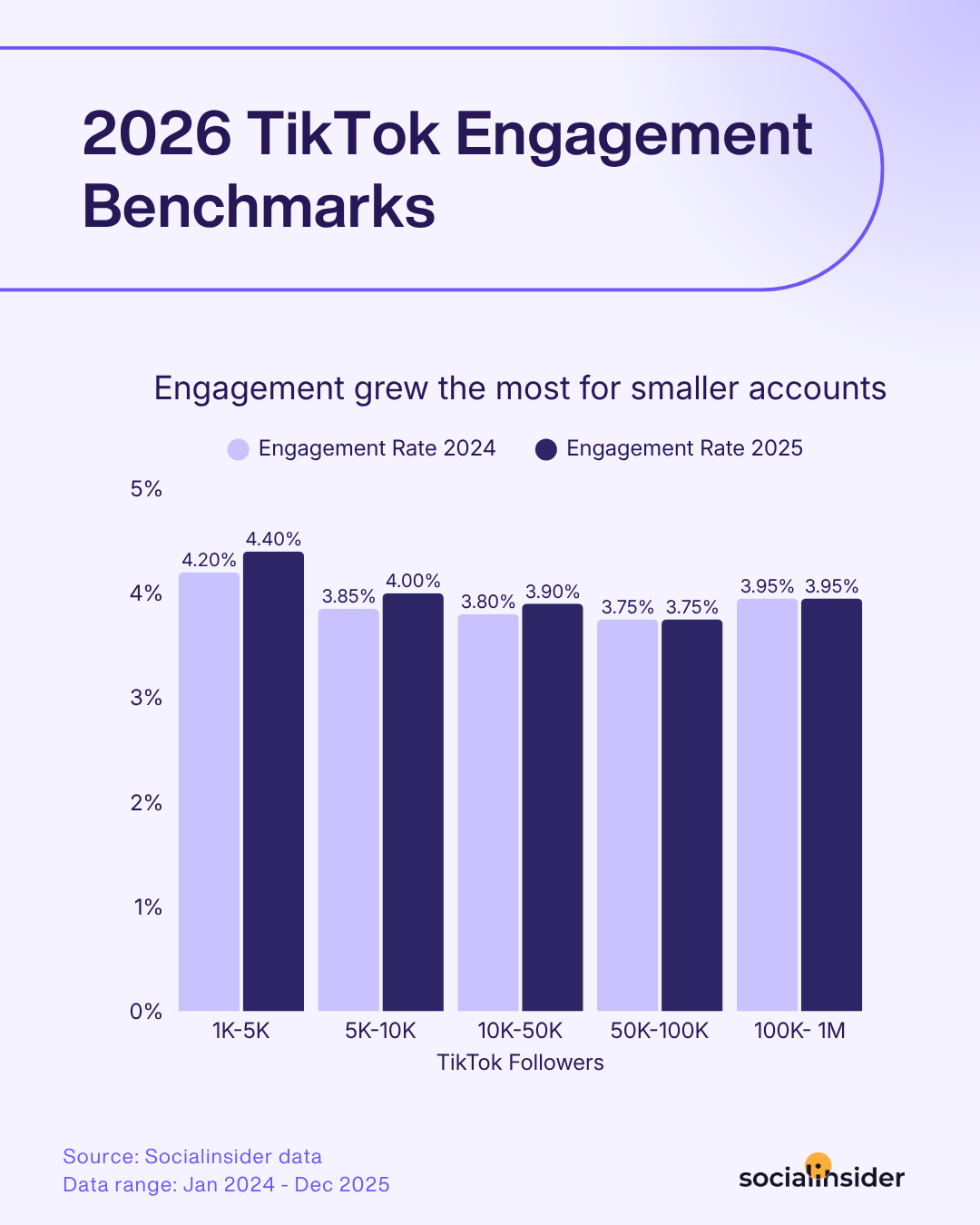
The interesting finding here is that bigger doesn’t automatically mean more engaged.
In 2025, accounts with 1K–5K followers recorded the highest engagement rate by views at 4.40%, compared with 4.00% for 5K–10K, 3.90% for 10K–50K, and 3.75% for 50K–100K accounts.
So, as your audience grows, don’t assume engagement should scale with it.
The benchmark suggests the opposite challenge: you have to keep earning relevance as you get bigger.
Views
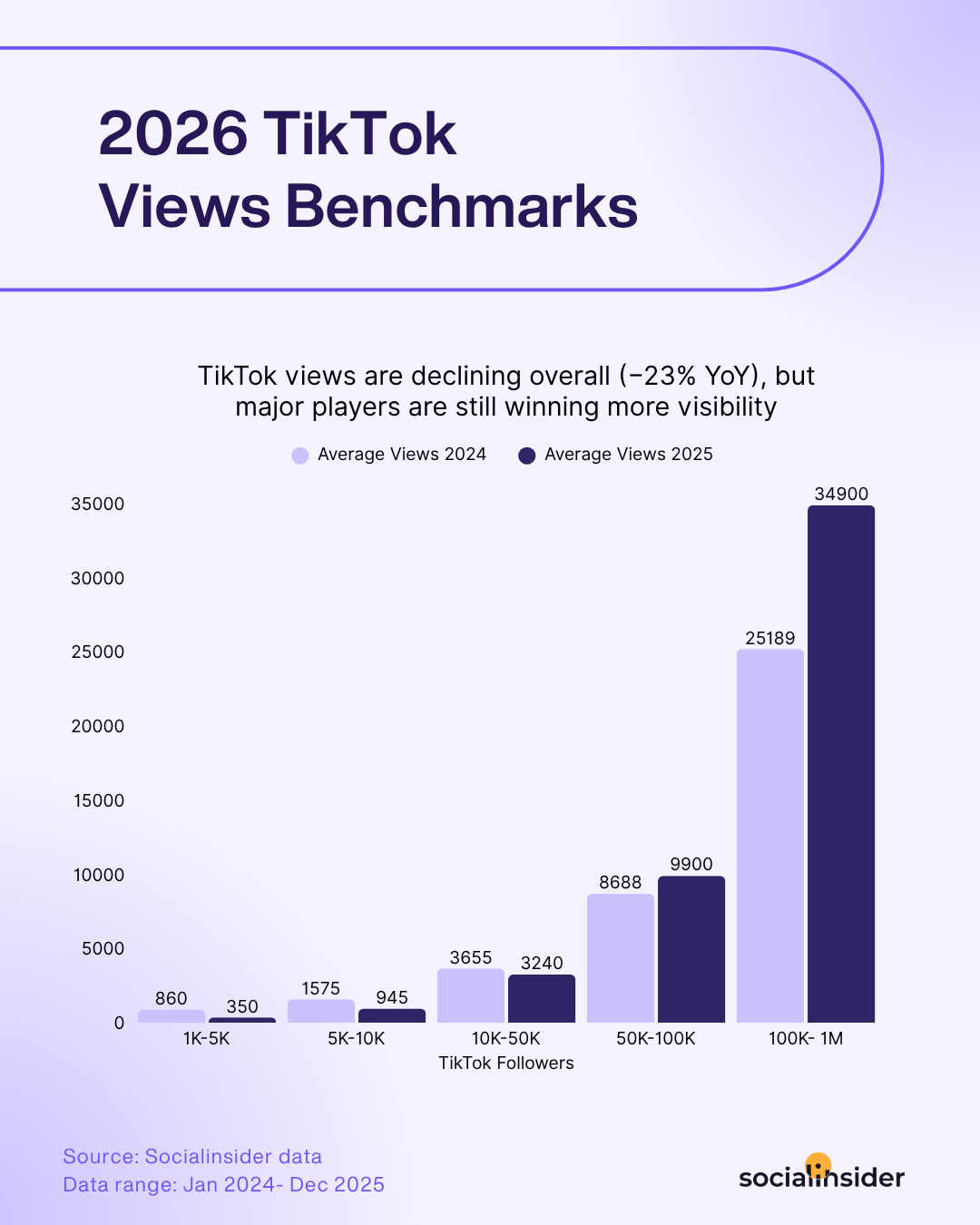
Overall, TikTok views declined 23% YoY, but larger accounts actually gained visibility.
Accounts with 100K–1M followers jumped from an average 25K views per post in 2024 to 35K in 2025, while the smallest 1K–5K accounts fell from 860 to 350.
That’s exactly why a platform-wide average can be misleading. Your account-size benchmark gives you a far more realistic comparison point.
Posting frequency
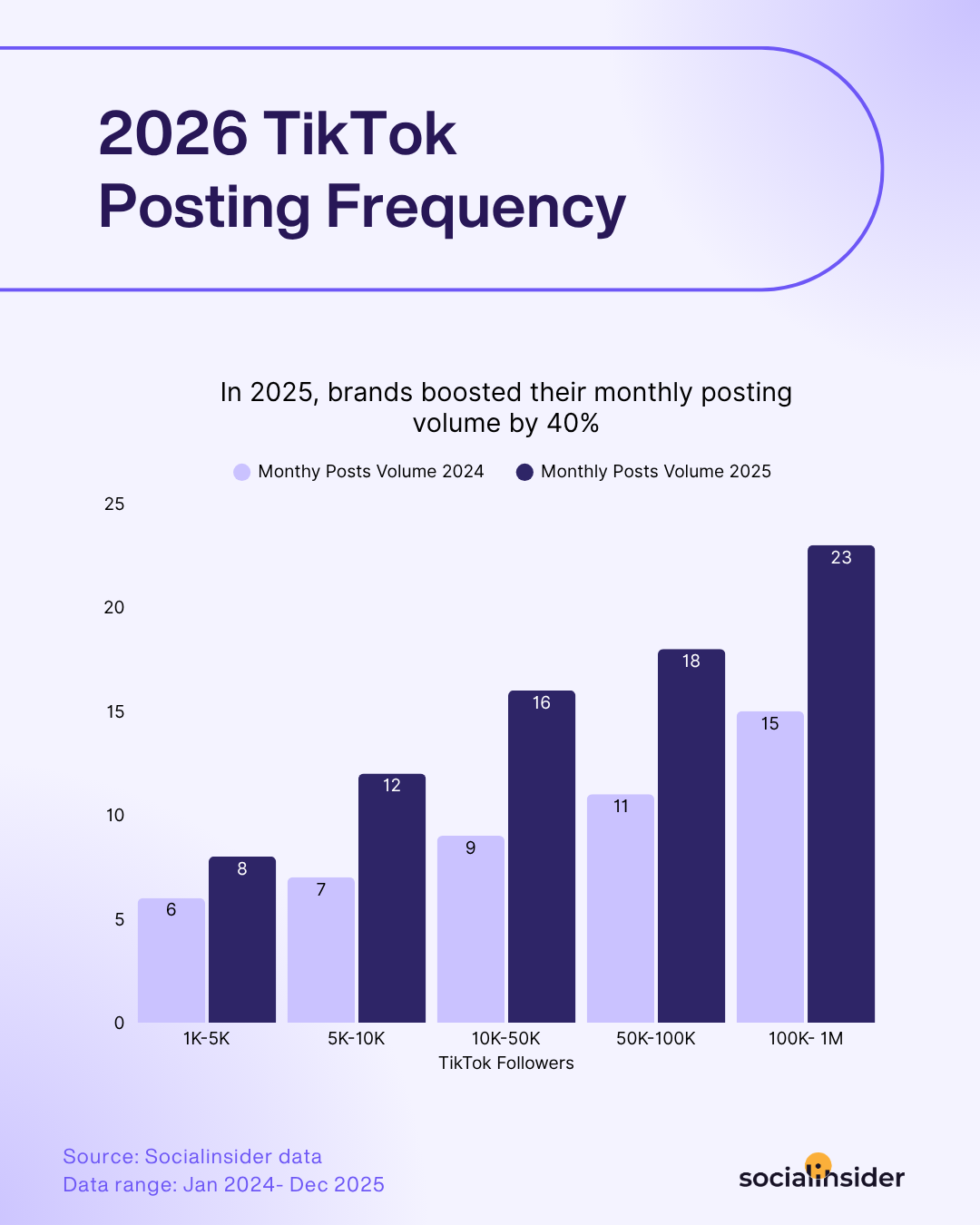
Brands are publishing considerably more: average posting frequency increased 40% across account sizes from 2024 to 2025. The smallest accounts moved from six to eight posts per month, while 100K–1M accounts went from 15 to 23.
I wouldn’t read that as “post 23 times a month.” Use it as a competitive context.
If your category is publishing at twice your cadence, that’s worth knowing, but increasing volume only makes sense if your team can maintain the quality and experimentation behind it.
Follower growth
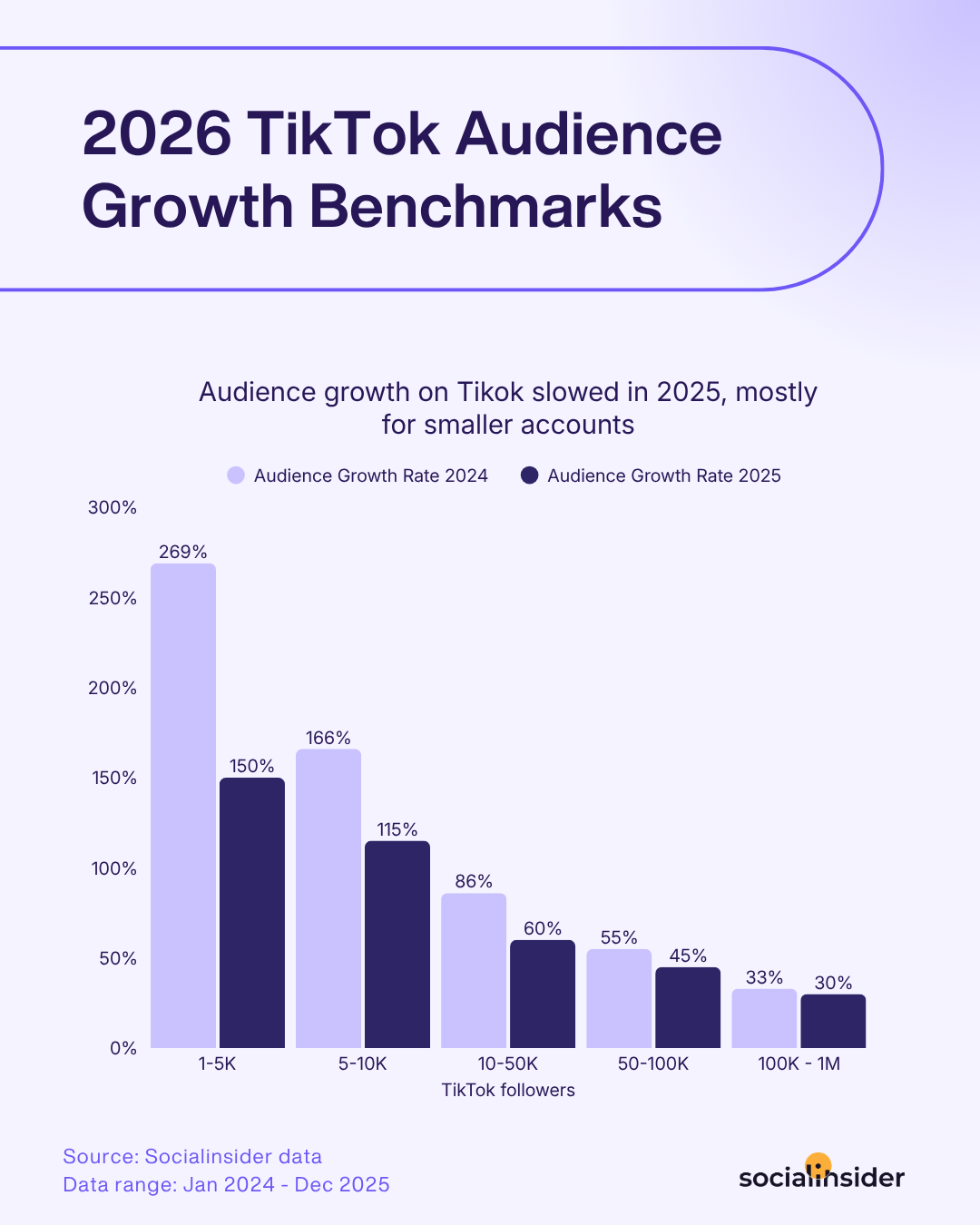
This is perhaps the best example of why benchmarking matters.
Audience growth slowed across every account-size bracket in the study. For 1K–5K accounts, growth dropped from 269% in 2024 to 150% in 2025; even 100K–1M accounts slipped from 33% to 30%.
So if your follower growth slowed, the useful question isn’t simply “What did we do wrong?” First ask whether you’re losing ground relative to the market.
Socialinsider found an overall 33% decline in audience growth, with smaller accounts hit hardest.
Context can completely change how you read your own numbers.
#4 Establish team workflows and approval processes that don't kill speed
TikTok moves quickly, and your team needs to be able to move with it.
I’ve seen good ideas lose their edge simply because they spent five days bouncing between marketing, brand, legal, and whoever else needed to approve them.
Map the brief-to-publish pipeline and be clear about what genuinely needs approval at each stage.
Give the team brand voice guardrails upfront: what you can say, what you can’t, and where there’s room to improvise, so every caption or comment doesn’t become a new discussion.
I’d also assign clear ownership after the video goes live. Someone needs to own the comments, know which conversations the brand should join, and have enough autonomy to respond while those conversations are still happening.
The goal is a workflow that gives people enough structure to protect the brand and enough freedom to still sound like they belong on TikTok.
#5 Decide your paid vs. organic mix
Once you have enough content in the mix, the paid-organic decision becomes much easier to make. You have real performance to work with: which ideas hold attention, which creators connect, and which messages actually move people.
That’s one reason organic TikTok growth matters beyond follower numbers. It gives you creative signals you can use to decide where extra distribution is worth paying for.
On the other hand, TikTok’s native Spark Ads can give strong brand or authorized creator posts that extra runway while keeping the original engagement attached.
What I’d amplify depends on the goal: strong watch time and reach can make sense for awareness, while clicks and conversions are much more convincing signals for commerce.
Keep the results separate in reporting, though.
Once spend enters the picture, you need to know whether the creative works organically, works efficiently with paid distribution, or has the strength to do both.
TikTok reporting best practices when presenting results to leadership
TikTok executive reporting can work for your social team, but it won’t necessarily work in a leadership meeting.
Once you’re presenting upwards, the story behind the numbers matters just as much as the numbers themselves.
So, what should that look like in practice?
Here are the top social media reporting best practices I’d use to make TikTok performance meaningful to people who don’t spend their day inside the platform.
Translate metrics into business language
Leadership rarely needs another rundown of social media metrics.
They need to understand what those brand metrics say about the value TikTok is creating. That means translating engagement, awareness, and audience growth into language that makes social media evaluation easier at a business level.
This is one useful example of how to use Socialinsider in reporting.
Its Earned Media Value feature assigns a monetary value to organic social performance, giving leadership a more familiar way to read the impact of activity that doesn’t have a direct revenue figure attached.
As the example above shows, Socialinsider also breaks that value down across engagement, awareness impact, and audience growth.

So rather than presenting 124K engagements or 9M awareness interactions in isolation, you can show how each contributed to the estimated total earned media value.
The point is to give them a business layer that makes their significance easier to understand outside the social team.
Build the dashboard around the audience, not the platform
That usually comes down to three layers:
The same TikTok results need to tell a different story depending on who’s in the room.
Your social team may want the granular detail; leadership usually wants to know what changed, why it matters, and what you’re going to do about it.
So, I’d build the dashboard backwards from those questions rather than around whatever metrics TikTok happens to provide. The aim is to give leadership a clear line from business impact to channel health to the content actually driving performance.
This is where a top social media analytics tool like Socialinsider becomes useful: it can bring those layers into one reporting view, so you can move from the bigger performance story down to individual content pillars without losing the context along the way.
Essentially, I’d structure that story in three layers:
- A top-line business impact section
Lead with the outcome TikTok is expected to influence: revenue, leads, conversions, brand lift, TikTok ROI, or another business KPI from the framework you set earlier.
This gives leadership the answer they’re looking for first: What is TikTok contributing to the business? The platform metrics can provide the explanation underneath.
- A channel health section
Next, show whether TikTok itself is moving in the right direction.
Audience growth rate, social media engagement rate, and share of voice versus competitors give you a concise read on the health of the channel without drowning the report in individual metrics.
I’d include trends and benchmarks here too. A 4% engagement rate becomes much more meaningful when leadership can see whether it’s improving and how it compares with the market.
- A content performance section
This is where I’d move away from the usual “top five posts” slide.
Leadership doesn’t need a tour of everything you published; they need to know which parts of the content strategy are producing results and why.
Content pillars make that conversation much more useful.
In the example below, you can see that each pillar is evaluated across post volume, engagement, average engagement rate, and earned media value.

For example, you can immediately see that for Everlane, Streetwear & Urban Fashion, for example, generated 73K engagements and a 12% average engagement rate across 14 posts.
That gives the dashboard somewhere to go next: which pillars deserve more investment, which need reworking, and what should the team test next?
Report on TikTok performance compared to other brand channels
TikTok performance becomes much easier to judge once you put it next to the rest of your social ecosystem.
TikTok analytics might show healthy engagement or strong views, but leadership also needs to know how that performance compares with the channels competing for the same time and budget.
That’s why cross-platform analytics should be part of both your reporting and your TikTok audit best practices.
Bring your social media data collection into one view and compare metrics such as content volume, engagement, audience growth, and views across platforms.
The Socialinsider example below shows why this context matters.

Back to the Everlane example, we can see that over the past year, the brand published far fewer TikTok posts than Instagram during the period shown: 87 versus 381, yet TikTok generated more views: 9M versus 8M.
The dashboard also surfaces the bigger story behind those numbers, including TikTok’s stronger follower growth and engagement per post.
That gives leadership something far more useful than a standalone TikTok performance report: a view of where each channel is pulling its weight and where resources may be better spent.
Common structural mistakes teams make
You can follow every list of TikTok marketing best practices and still underperform if the way your team operates behind the account is working against you.
In this case, I’d look beyond individual videos.
Some of the most expensive TikTok mistakes happen in the gaps between publishing, community management, reporting, and the next creative brief.
- No one owns community response
You publish, comments start coming in, and then… nothing. Or worse, five people are technically responsible, which usually means no one really is.
Strong TikTok engagement best practices need ownership after the post goes live.
Decide who responds, what they can handle without approval, what gets escalated, and how quickly the team should be entering relevant conversations.
Comments are also useful creative input. Questions, objections, recurring jokes, and requests can all tell you what the audience wants next.
If nobody owns that feedback, you’re leaving both engagement and content ideas sitting in the comment section.
- No feedback loop between reporting and content planning
Your monthly social media report shouldn’t be where insights go to die.
The point of TikTok analytics best practices is to make the next round of content smarter.
If one opening consistently holds attention longer, test the pattern again. If viewers keep dropping at a particular point, find out why. If a topic repeatedly earns saves, there’s probably more territory to explore there.
I’d bring those findings directly into the next planning session.
Reporting should leave the team with hypotheses to test, not simply a record of what happened last month.
- Copy-pasting the content strategy from another platform
Cross-platform social media marketing can definitely save time. But copy-pasting the thinking behind it is where things start to fall apart.
TikTok has its own audience behaviors, creative language, discovery patterns, and expectations.
Something that performs on Instagram or YouTube can absolutely work here too, but I’d still ask why it belongs on TikTok and what needs to change for the platform.
As Sam Oliver puts it:
The biggest mistake is looking at top-of-funnel metrics like views in isolation. A million views doesn't automatically mean a piece of content was successful.
That applies to strategy as much as reporting.
If you bring content across from another platform and judge success on views alone, you miss whether it’s actually creating the response TikTok is supposed to deliver for the business.
Look at how much content was genuinely developed around TikTok versus simply redistributed there, then compare what each group actually contributed to your goals.
Repurpose the asset when it makes sense. Reconsider the strategy every time.
Final thoughts
TikTok has never been particularly good at rewarding certainty.
What worked brilliantly last quarter can flatten out next month, and the post you almost didn’t publish can end up teaching you more than the one everyone approved.
That’s why the TikTok best practices I’d keep closest aren’t rules about how to post. They’re habits around how you make decisions.
Know what you’re trying to achieve. Pay attention to the signals behind the headline numbers. Keep enough flexibility to act on what you learn. And make sure those learnings actually reach the next brief.
Because the real advantage on TikTok is building a team that knows when the playbook needs rewriting.

Anda Radulescu
Anda Radulescu is a SaaS content writer and copywriter with 5+ years in digital marketing, turning social media data into practical ideas for Instagram, LinkedIn, and beyond

Know what your competitors do — before your manager asks
Get instant social benchmarks & reports without manual work.