TikTok Content Strategy: 7 Insights On How To Create A Solid Presence on the Platform
Discover how to create a winning TikTok content strategy, with data-backed insights and best practices for TikTok marketing.

Millions of videos compete for attention on TikTok every day. Yet only a handful generate the reach and engagement every brand dreams of.
What separates viral content from posts that disappear unnoticed?
A smart TikTok content strategy.
Keep reading to learn the proven TikTok marketing techniques that can help you attract more engagement and maximize every upload - courtesy of Malene Hold, senior social media manager at MCoBeauty, and Mark Shpungin, social media strategist.
Key takeaways
- What is unique about TikTok compared to other social platforms? Unlike follower-based platforms, TikTok prioritizes content discovery through its algorithm, making authentic, relatable content more important than audience size or polished production.
- How to create an effective TikTok content strategy? An effective TikTok strategy combines a clear niche and brand voice, consistent content pillars, competitor insights, planned publishing, and ongoing performance optimization.
- How is TikTok content now surfacing in Google search results? TikTok videos increasingly appear in Google search results, making TikTok SEO—through keywords in captions, speech, on-screen text, and hashtags—essential for long-term discoverability.
What is unique about TikTok compared to other social platforms?
The biggest difference between TikTok and most social platforms is that people don't open the app to follow creators. They open it to consume content.
That might sound obvious, but it has completely changed what succeeds online.
On platforms like Instagram, users often decide whose content they want to see. On TikTok, the For You Page makes that decision for them. This means that every video has the chance to reach a wider audience, regardless of who posted it.
Metrics like watch time, completion rate, comments, shares, saves, and rewatches help determine whether a video should be shown to more users.
This is one of the reasons authenticity performs so well on the platform.
Brands often assume that better production quality leads to better results.
In reality, TikTok users tend to respond more strongly to content that feels relevant, relatable, and genuine. Because when content resonates, the algorithm does the rest.
How to create an effective TikTok content strategy?
If you're throwing TikTok content at the wall and hoping something sticks, you're not alone.
But the creators and brands seeing the best results aren't relying on chance. They're following a strategy.
From understanding your audience to creating content with a clear purpose, these TikTok tips will show you how to get more engagement on TikTok and build momentum with every post.
#1 Define your niche and brand voice for TikTok specifically
One of the biggest mistakes people make on TikTok is trying to be everything to everyone.
You might post educational content one day, jump on a random trend the next, and then share a behind-the-scenes video the day after. While variety can be valuable, inconsistency makes it harder for people to understand why they should follow you.
Before creating TikTok content, ask yourself: what do I want to be known for?
Your niche is the specific topic or area you consistently create content around. It doesn't have to be ultra-narrow, but it should be clear enough that someone can instantly understand what they'll get from your account.
Whether it's fitness, personal finance, skincare, productivity, or other, clarity helps attract the right TikTok target audience.
Just as important is your brand voice.
TikTok has its own culture, and content that performs well here often feels more personal, authentic, and conversational than content on other platforms. The way you speak to your audience should feel natural and recognizable across every video.
Think about your favorite creators. Chances are, you can recognize their content within seconds, mainly because they have a consistent personality, perspective, and style.
The most effective TikTok brand voices simply amplify who you already are. If you're naturally funny, lean into humor. If you're analytical, focus on breaking down complex ideas. If you're a great storyteller, make that your signature.
When your niche and voice work together, every piece of content reinforces your brand. Your audience knows what to expect, the algorithm gains a clearer understanding of who to show your content to, and growth becomes much easier to sustain.
Here's also what Malene had to add about this:
Commit to a simple philosophy of understanding who your audience is, what resonates with them. Identify your specific niche and really understand its its languages, its behaviors.
#2 Map 3–4 content pillars that balance entertainment, education, and brand identity
Scroll through any TikTok account that's growing consistently and you'll notice a pattern: the content feels varied, but never random.
One video might break down an industry trend. The next shares an unpopular opinion. A third pulls back the curtain on the business itself. Different topics, different formats, yet they all feel connected.
That connection rarely happens by accident.
A handful of well-defined content pillars for social media gives your audience multiple reasons to engage with your account.
The strongest social media platform strategy makes room for all of them.
- Educational content earns attention by teaching something useful
- Entertaining content broadens reach and keeps your feed from becoming predictable
- Brand-led content introduces the people, values, and ideas behind the account, creating familiarity over time
Together, those pillars create a feed that feels complete.
A founder might alternate between lessons learned while building a company, reactions to industry news, customer stories, and moments from day-to-day operations. A fitness creator could mix training advice, workout experiments, client transformations, and personal routines.
The specifics change, but the principle remains remarkably consistent: audiences respond to depth far more than repetition.
And TikTok moves quickly. Interests shift. Trends come and go.
Content pillars provide enough structure to stay recognizable without making your content feel formulaic.
They also make planning dramatically easier. Instead of searching for new ideas every time you open the app, you're drawing from a set of themes that already resonate with your audience.
Here's Malene's takeaway as well:
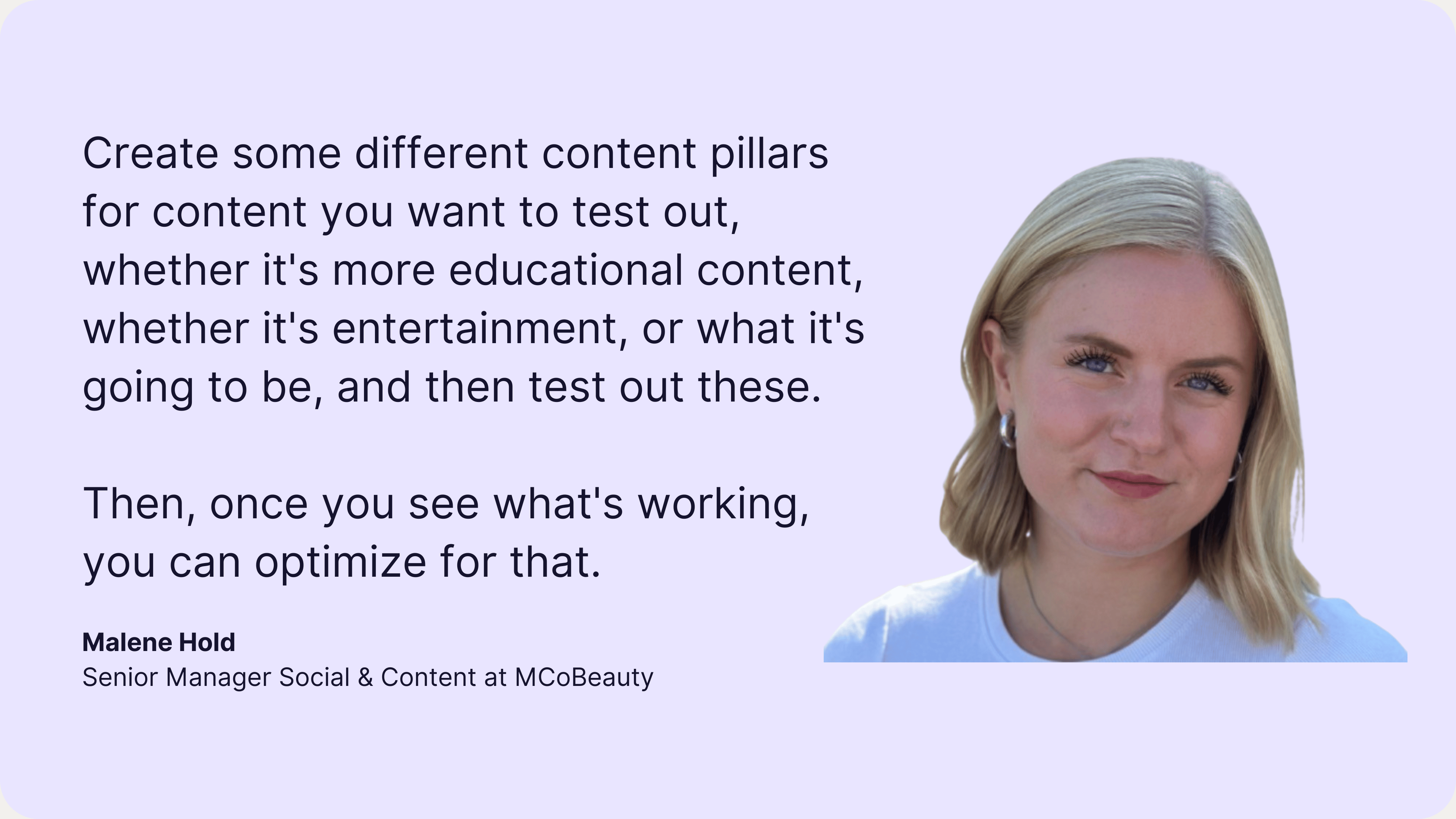
Create some different content pillars for content you want to test out, whether it's more educational content, whether it's entertainment, or what it's going to be, and then test out these. Then, once you see what's working, you can optimize for that.
#3 Research competitors to identify threats and opportunities for your audience
Your audience is constantly telling brands what they want.
The challenge is that they're not always telling you directly.
Looking at your own performance reveals part of that picture. Looking at your competitors, however, reveals the rest.
That's why competitor research remains one of the most effective ways to strengthen a TikTok content strategy. It helps validate assumptions, uncover emerging trends, and identify content opportunities before they become obvious to everyone else in your market.
When conducting a TikTok competitor analysis, I usually start at the highest level possible: content pillars.
One post may perform exceptionally well because of timing, a creator collaboration, or a viral trend. Content pillars reveal broader audience interests because they aggregate performance across dozens of posts.
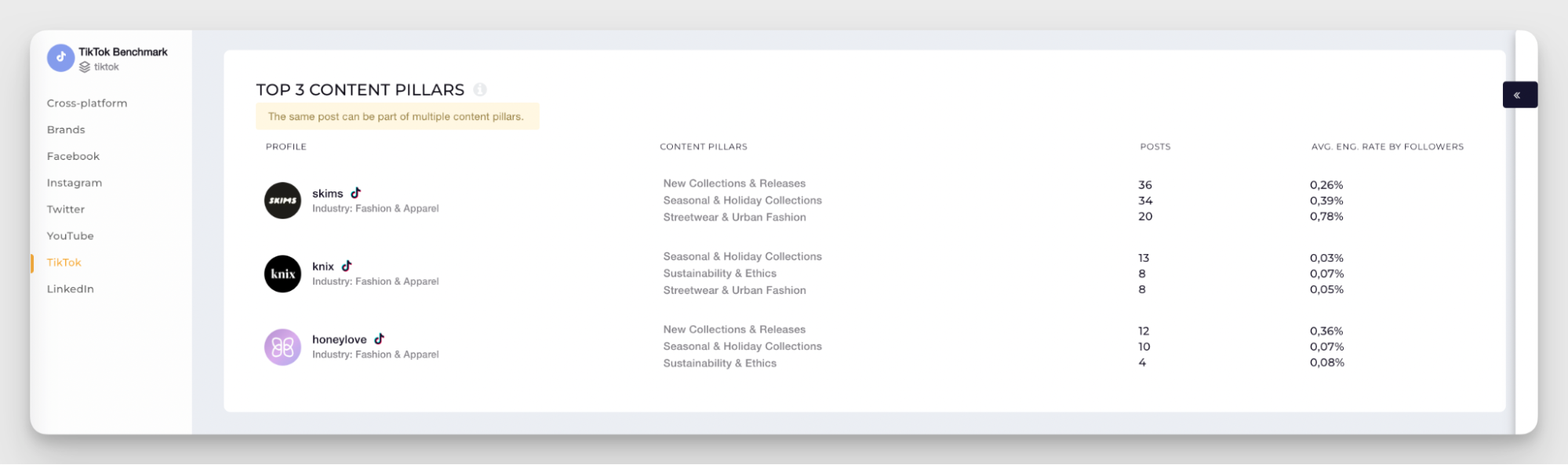
In this example, SKIMS, Knix, and Honeylove all invest heavily in similar content pillars, including New Collections & Releases and Seasonal & Holiday Collections. Yet the engagement generated by those themes differs significantly from one brand to another.
For competitors, that gap is often more valuable than the content pillar itself.
When one brand consistently outperforms others while covering the same topics, there's usually something worth investigating. Whether that's creative execution, storytelling, talent partnerships, production style, or messaging.
This approach is one of the best practices for benchmarking social media competitors because it focuses on audience response rather than assumptions.
Once a high-performing pillar stands out, the next step is understanding which specific videos are driving those results.
Socialinsider makes that process considerably easier by connecting pillar-level insights with individual post performance.
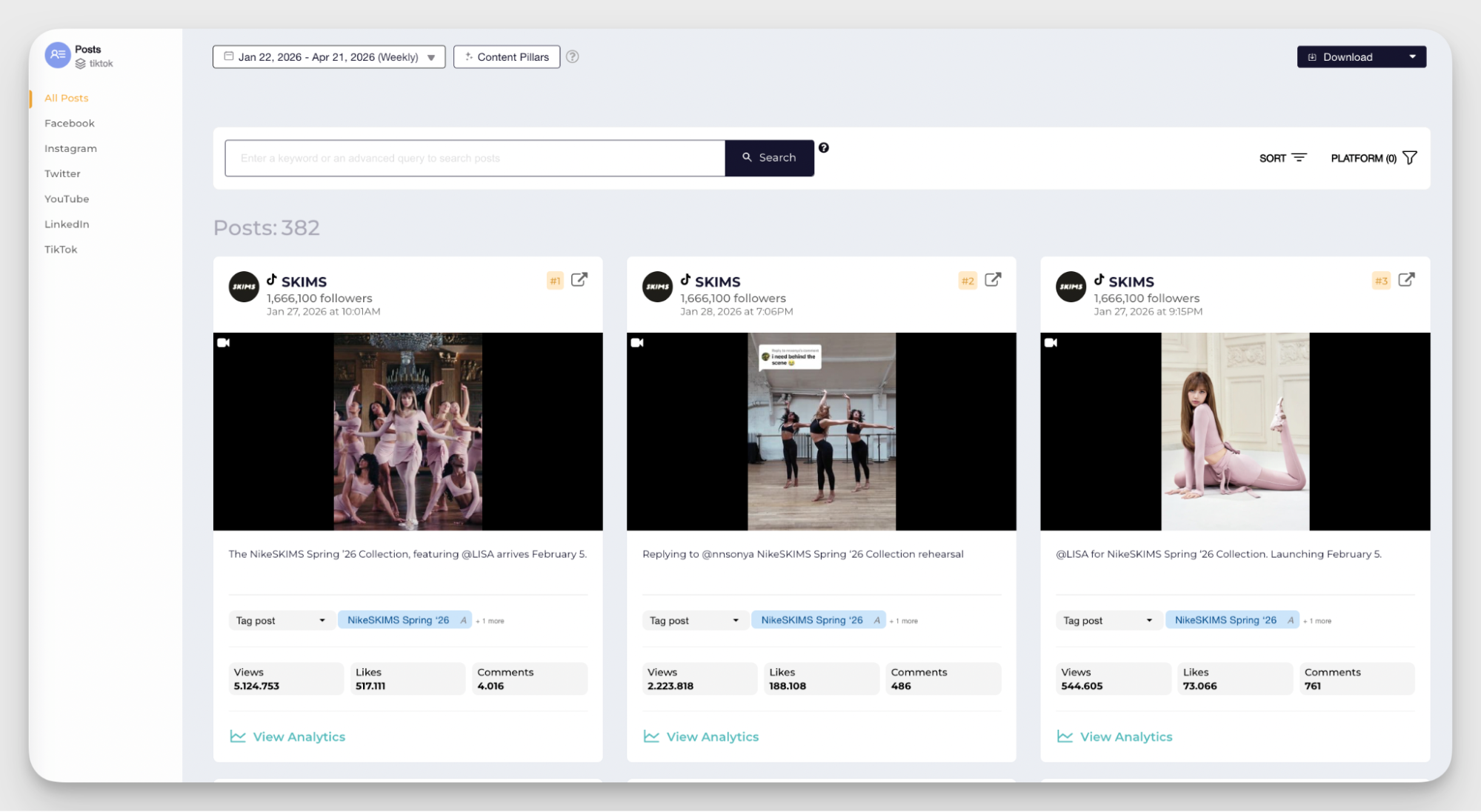
So instead of manually scrolling through hundreds of TikTok videos, you can filter content by pillar, surface the strongest-performing posts, and examine the creative patterns behind them. Certain hooks, visual styles, formats, or narratives often emerge surprisingly quickly.
This way, social media analytics become far more actionable than simply knowing a competitor received more engagement.
#4 Plan your TikTok content calendar
After you've identified your content pillars and analyzed what competitors are doing, the next challenge is turning those insights into a publishing system.
Without a plan, most brands default to whatever feels urgent that week: a product launch, a trend everyone's talking about, a campaign deadline that's suddenly approaching.
The result is usually an inconsistent mix of content that makes it difficult to spot patterns, replicate wins, or build momentum over time.
A content calendar creates visibility.
You can see whether you're over-relying on promotional content, neglecting a high-performing pillar, or leaving enough room to react when a relevant trend appears.
What a realistic posting cadence looks like
According to Socialinsider's TikTok benchmark data, brands increased their monthly posting volume by roughly 40% year-over-year, with larger accounts publishing more than 20 videos per month on average.
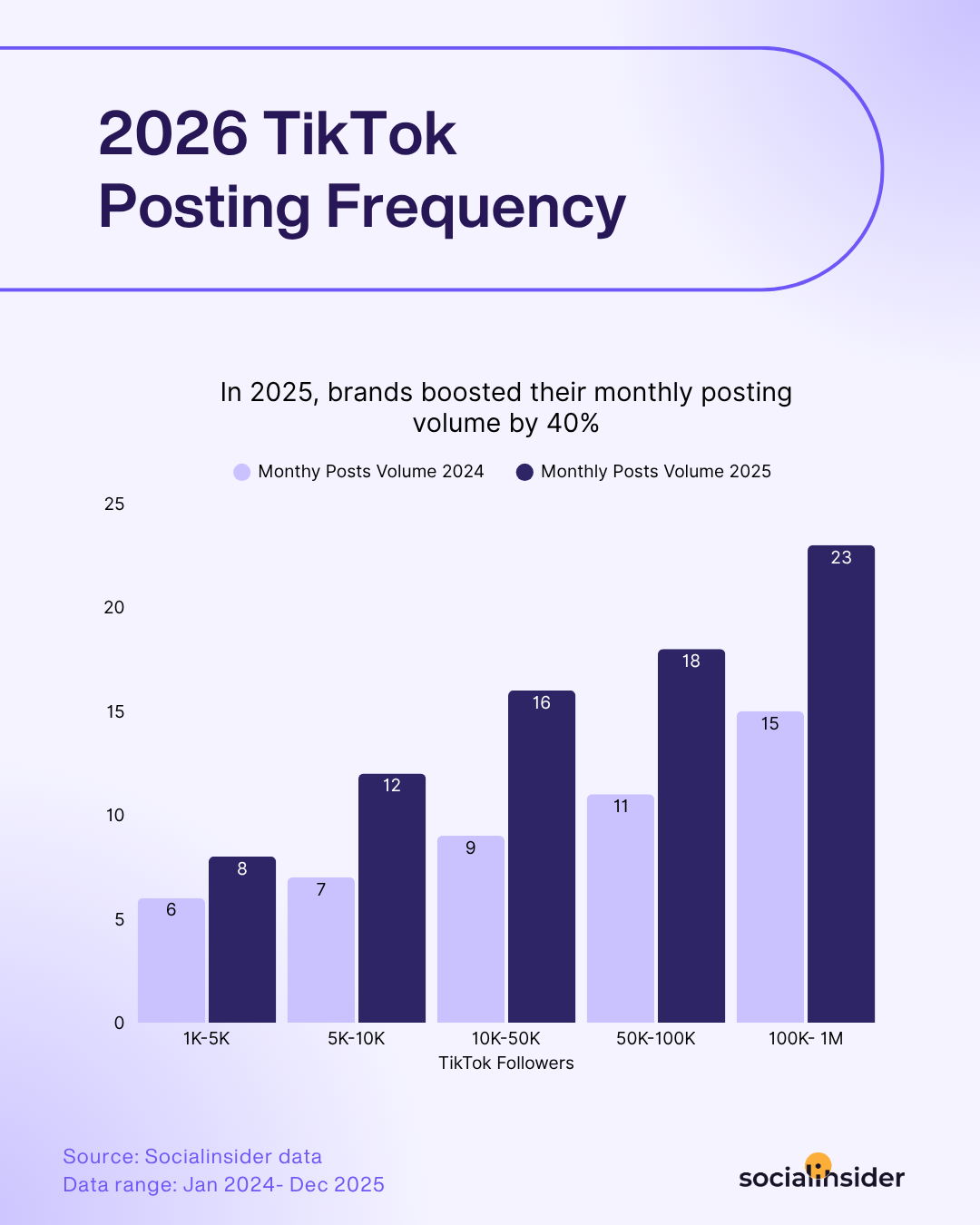
However, that doesn't mean you need to publish every day.
For most brands, three to five posts per week provides enough volume to test ideas, identify patterns, and stay visible without overwhelming the content team.
It's also frequent enough to generate meaningful performance data rather than drawing conclusions from a handful of videos each month.
The benchmark isn't a rule. It's a useful reference point. If your competitors are publishing four times a week and you're publishing four times a month, you're competing under very different conditions.
Balance evergreen content with trend-reactive content
A calendar filled entirely with trends has a short shelf life.
A calendar filled entirely with evergreen content usually feels disconnected from the platform.
The strongest TikTok video ideas leave room for both.
Some videos should answer questions you'll still be hearing six months from now. Others should capitalize on conversations happening this week.
One builds long-term value. The other expands reach.
A useful rule I can share with you is planning most of your content in advance while keeping a few publishing slots open each week. Trends move too quickly to schedule a month ahead, but they shouldn't completely dictate your content strategy either.
Most successful TikTok formats
When a format survives years of algorithm updates, changing trends, and shifting audience behavior, it's usually tapping into something deeper than a temporary platform preference.
These are some of the formats that continue to perform across industries:
- Tutorials and how-to content
- Reaction and Stitch videos
- Behind-the-scenes and brand authenticity content
- Duets, Q&As, and comment-reply videos for community building
BONUS: Best TikTok video lengths
For years, conventional wisdom suggested keeping TikTok videos as short as possible.
The data tells a more nuanced story.
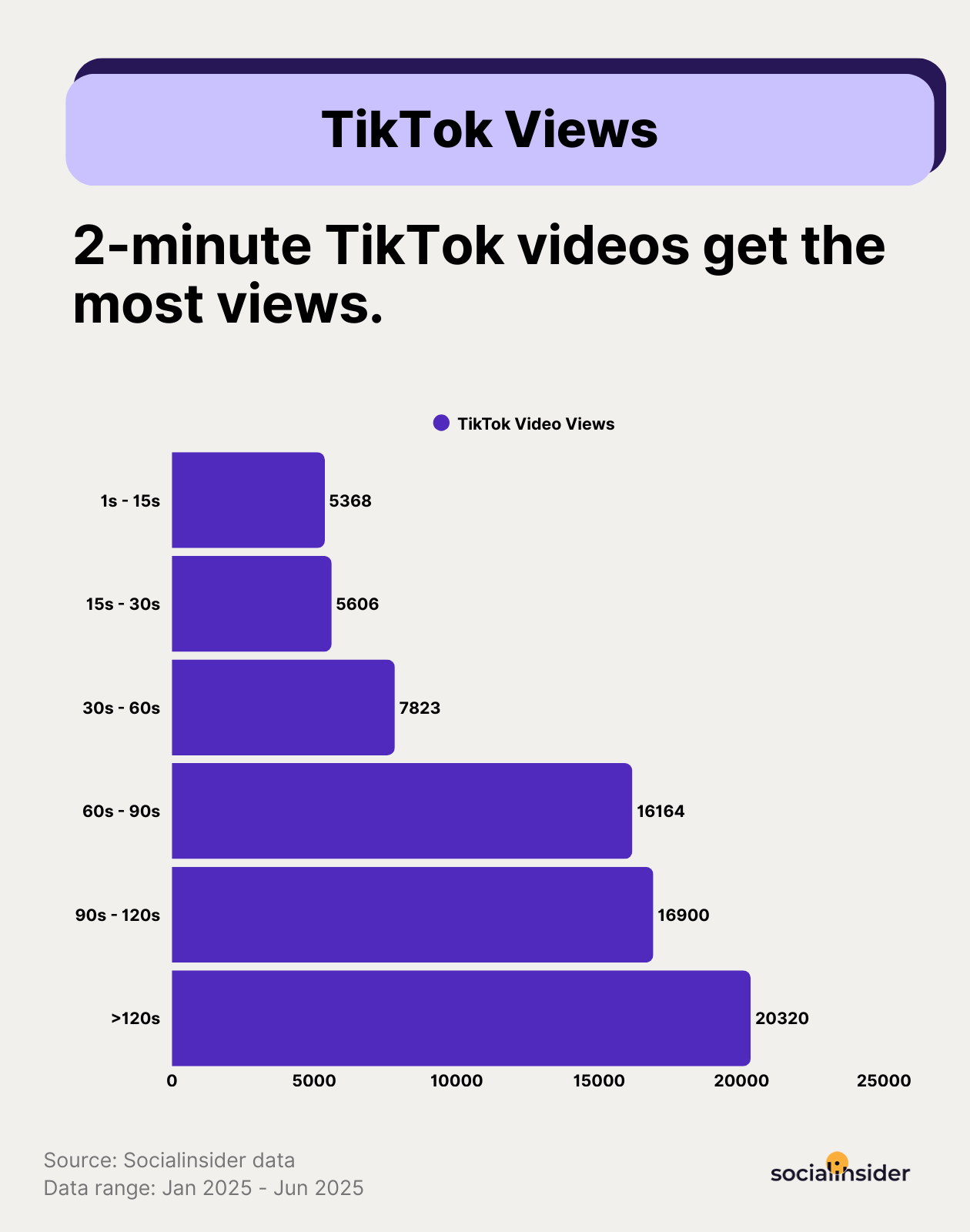
According to Socialinsider’s video research, videos longer than 90 seconds generate substantially more views than shorter formats, while videos exceeding two minutes achieve the highest average view counts.
#5 Measure and adapt your TikTok content based on performance data
The final piece of the puzzle when learning how to create good TikTok content is measuring performance and refining your strategy based on what the data reveals.
Certain topics generate more engagement. Some videos get shared repeatedly. Others attract views but fail to spark any meaningful audience response.
The key is knowing which signals to pay attention to. And how to turn them into better content decisions.
While TikTok's native analytics can provide a useful starting point, many marketers use dedicated TikTok analytics tools like Socialinsider to simplify social media data collection and identify performance trends faster.
When reviewing your results, focus on these TikTok metrics:
Engagement
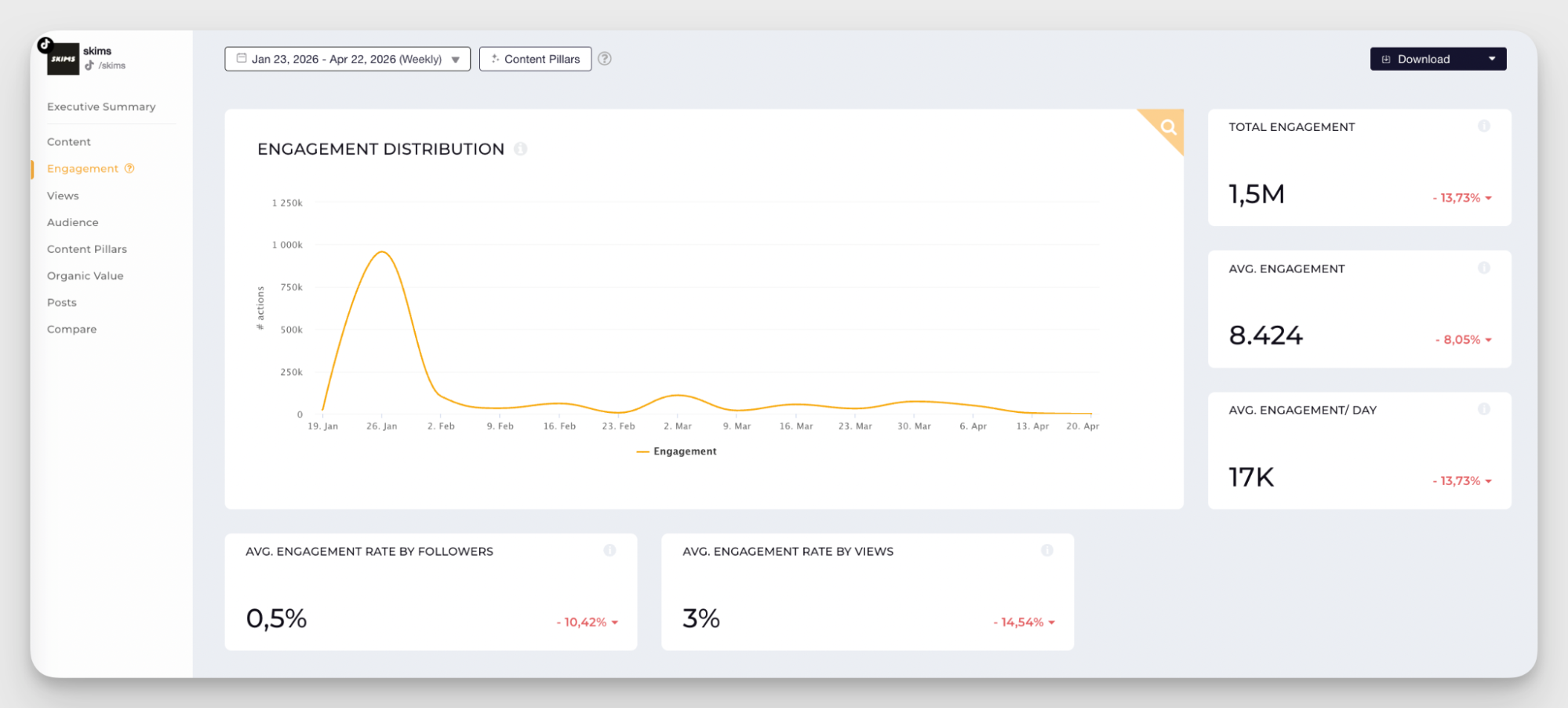
Engagement is often the quickest way to understand whether a piece of content connected with your audience.
Rather than looking at individual posts in isolation, compare engagement levels across content pillars, formats, and topics.
You may discover that educational content consistently outperforms trend-driven videos, or that behind-the-scenes content generates stronger audience participation than promotional posts.
Comments, shares and saves
Comments can uncover recurring questions, objections, and discussion topics worth exploring further. If viewers keep asking for more details, you've likely found a subject with untapped content potential.
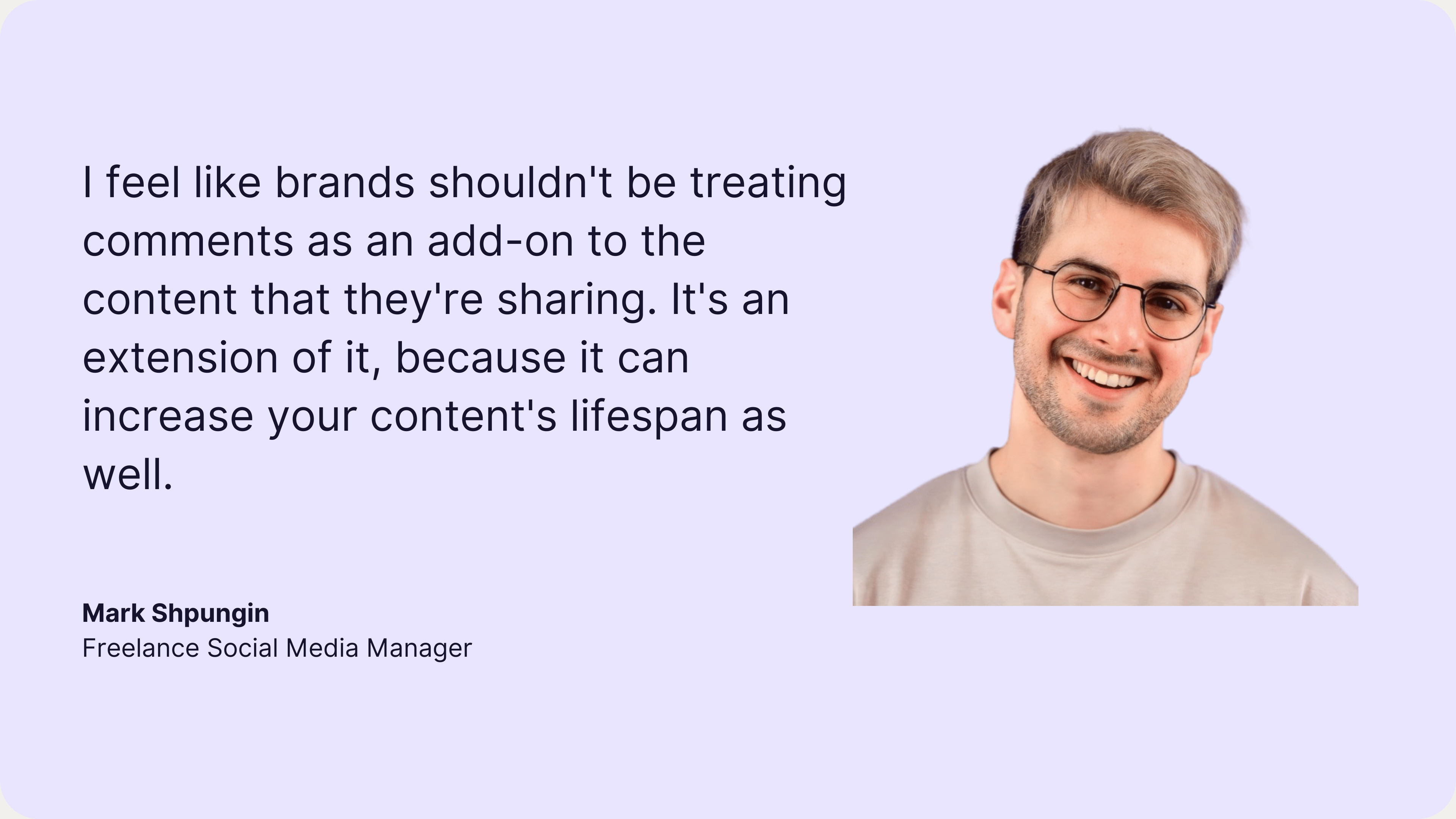
Here's an interesting insight Mark had as well:
I feel like brands shouldn't be treating comments as an add-on to the content that they're sharing. It's an extension of it, because it can increase your content's lifespan as well.
Shares are one of the strongest indicators that content resonated. People share videos that teach them something useful, reflect their opinions, or feel relevant enough to pass along to others.
Saves often signal long-term value. Tutorials, frameworks, checklists, and educational videos tend to perform particularly well because viewers want to revisit them later.
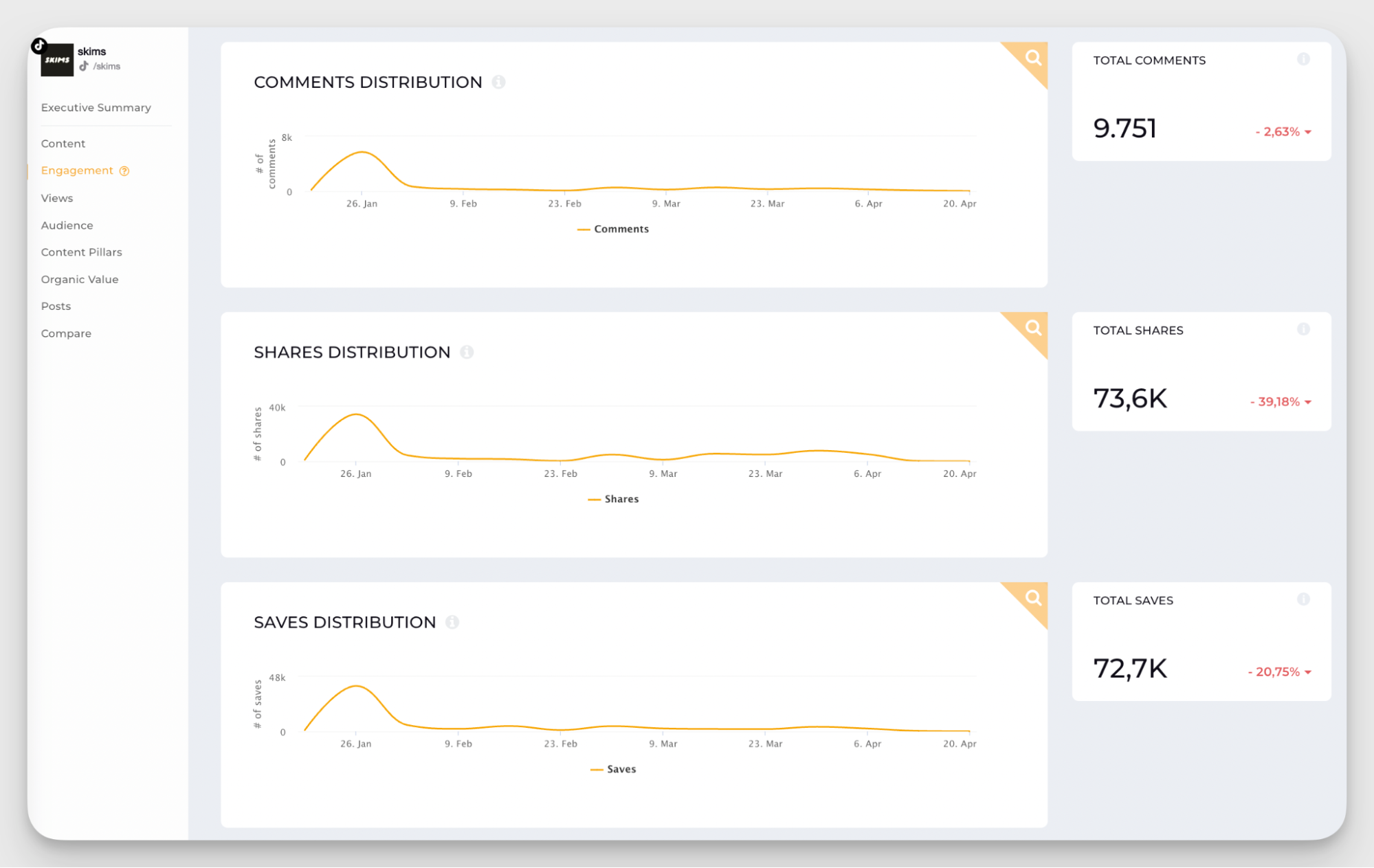
Together, these metrics provide some of the most actionable TikTok virality insights because they reveal how audiences interact with content after watching it.
Views
Views help measure distribution and reach.
When a video significantly outperforms your average view count, it's worth investigating what contributed to that result. The hook, topic, format, timing, or creative execution may have played a role.
That said, views become far more meaningful when analyzed alongside engagement, shares, and saves.
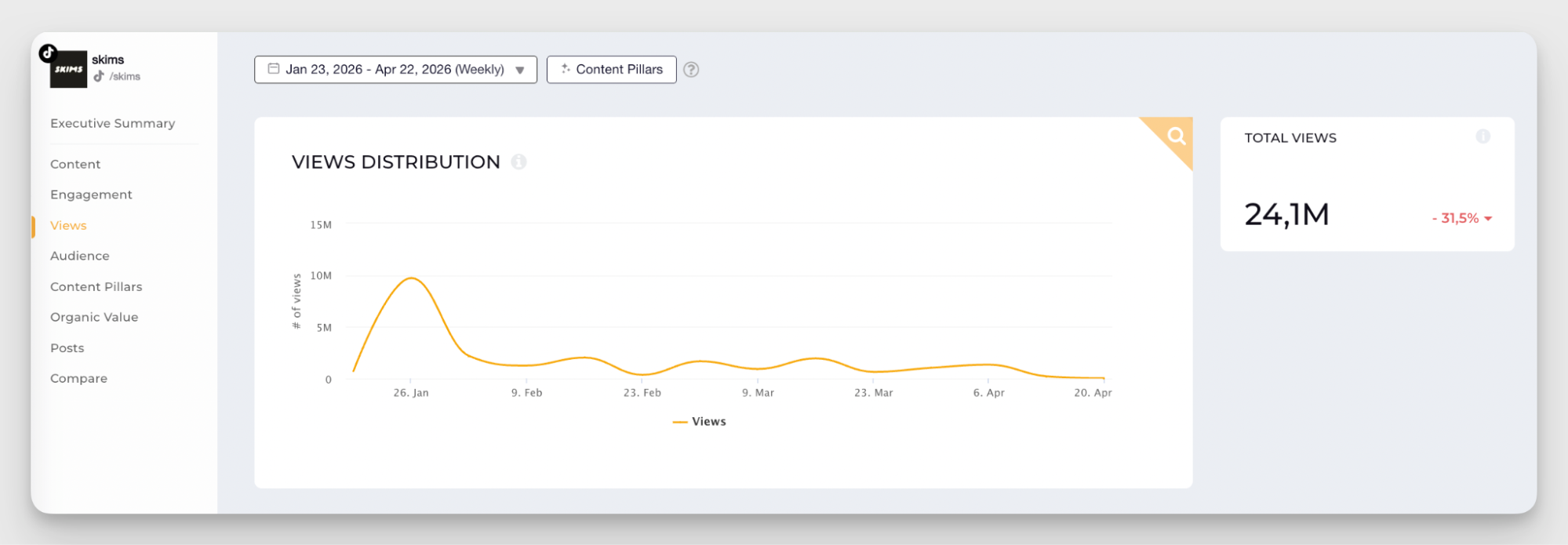
A video that attracts attention but generates little interaction tells a very different story than one that inspires viewers to engage.
Understanding those relationships is a critical part of learning how to analyze TikTok video performance effectively.
Because, essentially, the goal is to identify patterns you can replicate.
The more consistently you review your performance data, the easier it becomes to refine your TikTok content creation, invest in content that resonates, and make informed decisions based on real audience behavior.
How is TikTok content now surfacing in Google search results?
A few years ago, if you wanted to rank on Google, you'd publish a blog post.
Today, a TikTok video can appear for the very same search query.
That's a major shift. And one many creators and brands still haven't fully adapted to.
Think about the last time you searched for something like "best skincare" or "how to style wide-leg jeans." Alongside traditional articles, there's a good chance you were shown TikTok content offering quick, visual answers.
As search habits evolve, Google is increasingly treating TikTok as a valuable source of information, recommendations, and tutorials.
What does that mean for you? Your videos now have the potential to attract traffic and visibility long after they've left the For You Page.
The key is making sure both TikTok and Google understand exactly what your content is about.
This is where social media optimization comes into play. The clearer your topic signals, the easier it is for search engines and platform algorithms to connect your content with the right audience.
To strengthen your TikTok SEO, I recommend placing keywords strategically throughout your content:
- Captions: write descriptive captions that clearly explain the video's topic instead of relying on vague one-liners
- Spoken words: mention your primary keyword naturally within the video, ideally in the opening seconds
- On-screen text: use titles, subtitles, and text overlays to reinforce the main topic
- Hashtags: choose relevant hashtags that support the content rather than adding every trending tag you can find
When your captions, audio, text overlays, and hashtags all support the same topic, you're sending stronger signals to both TikTok and Google. This improves your chances of appearing when users are actively searching for answers.
Malene also emphasized this:
What you're writing in your caption and on your video matters for the search engine, because it kind of has become Gen Z's version of Google, and they'll use that to search for new restaurants, or if they're traveling, or the best workout places, or whatever they need.
Final thoughts
At the end of the day, a successful TikTok content strategy has less to do with finding the perfect trend and more to do with understanding your audience.
Every post leaves behind a trail of clues about what people care about, what captures their attention, and what they're willing to engage with.
The real advantage comes from knowing how to spot those patterns. And what to do with them.

Anda Radulescu
Anda Radulescu is a SaaS content writer and copywriter with 5+ years in digital marketing, turning social media data into practical ideas for Instagram, LinkedIn, and beyond

Know what your competitors do — before your manager asks
Get instant social benchmarks & reports without manual work.