How to Increase TikTok Engagement: 12 Data-Backed Tips
Learn how to increase TikTok engagement with strategies backed by 2026 benchmark data from 2M+ posts and expert insights
If there's one thing all TikTokers agree with, it's this — Brands that win understand how to create content people want to react to, share, or join in on.
Duolingo turned its mascot into a chaotic creator and pulled in more than six million followers. Chipotle did something similar with its #GuacDance challenge, sparking hundreds of thousands of user-generated videos and pushing reach into viral territory.
These wins came from understanding the platform — and increasingly, from understanding the data behind what's working right now, per Socialinsider's 2026 benchmarks report, based on an analysis of more than 2 million TikTok posts.
To help you improve your own TikTok metrics, I talked to Nefise Tasdelen, founder of Social Island UK. Here's how to boost engagement on TikTok with real-life examples, expert insights, and the latest benchmark data.
Key takeaways
-
In 2026, TikTok's average engagement rate rose 9% year over year to 4.20%, comments and shares grew 3% and 13% respectively, and brands increased posting frequency by 40% across every account size — meaning more competition for attention inside a faster-moving feed.
-
The strongest TikTok content strategies combine a three-second hook, human-led storytelling, a recognizable visual style, and content pillars verified by performance data rather than assumption.
-
Engagement on TikTok grows fastest through low-friction micro-challenges, duet-friendly formats, intentional posting times backed by audience data, conversation-driving CTAs, niche-adapted trending sounds, and episodic content that gives viewers a reason to return.
-
Sustainable TikTok engagement growth depends on tracking watch time, comment-to-view ratio, and shares/saves, benchmarking competitors' content and comment sections for gaps, and running structured A/B tests to validate what to scale.
How to calculate engagement rate on TikTok?
Calculating engagement on TikTok helps you understand how well your content connects with viewers — whether people are reacting, commenting, sharing, or following after watching your videos.
TikTok engagement rate formula:
Engagement rate per post = (likes + comments + shares) ÷ views × 100
For example, a video with 12,000 views, 800 likes, 120 comments, and 80 shares has an engagement rate of: (800 + 120 + 80) ÷ 12,000 × 100 = 8.3%.
You can also pull this automatically with an analytics tool like Socialinsider, which calculates it for you and benchmarks it against industry averages by account size.

What is a good engagement rate on TikTok?
A good engagement rate on TikTok is generally higher than on other social platforms because TikTok’s algorithm favors interaction and discovery.
Nefise talked about what she considers a good rate on TikTok —
For me, a good engagement rate on TikTok isn’t a fixed number. It’s highly contextual. It depends on factors like your niche, account size, and the type of content you publish. That said, anything above 5% is generally considered solid.
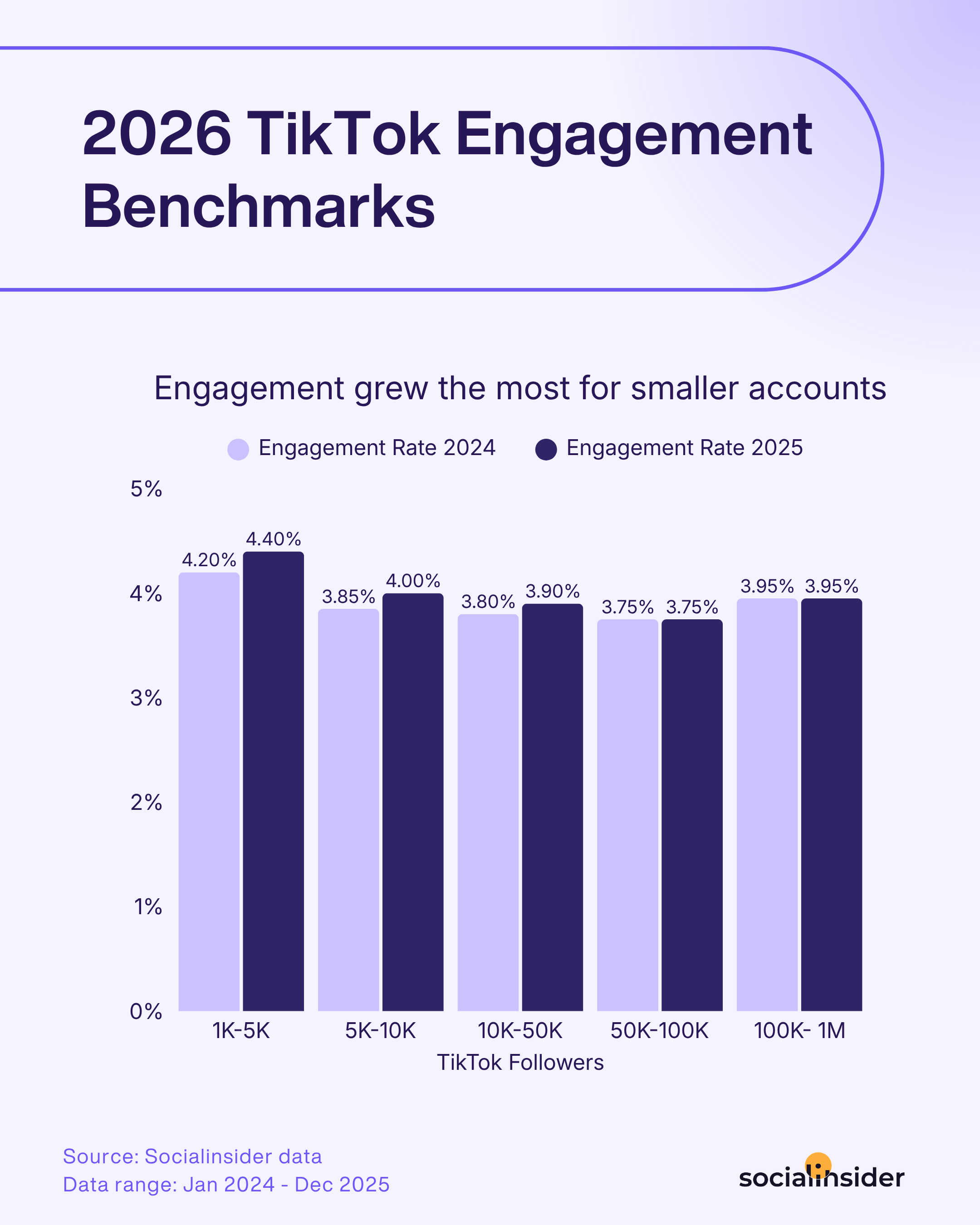
Socialinsider's TikTok benchmarks data — drawn from more than 2M posts across over 214,000 profiles — backs this up directly. The platform-wide engagement rate by views is 4.20%, a 9% increase year over year, but it breaks down very differently by account size:
Smaller accounts consistently lead — climbing from 4.20% to 4.40% — largely because they're closer to their audience, faster to react to trends, and less slowed down by internal approvals. Past the 50K-follower mark, engagement plateaus: bigger audiences don't automatically mean higher engagement, relevance does. As you scale, content has to work harder to feel just as native and worth reacting to.
Nefise also said that instead of looking at just the absolute number, also consider how the engagement graph has changed over time. She said:
I focus on patterns over time, not one-off spikes. Consistently growing engagement shows that your audience is becoming more invested, whereas a single viral post is better used as a learning opportunity.”
What changed on TikTok this year — and why it affects your strategy?
Beyond engagement rate, Socialinsider's data shows the other interaction types moving in different directions, which changes which tactics are worth prioritizing this year:
- Likes are up 9% YoY across every account size — a steady, easy signal of reach, but not necessarily depth.
- Comments are up 3% overall, with accounts above 100K seeing an 11% jump — a sign that more brands are creating content that invites participation, not just passive viewing.
- Shares are up 13% YoY, with the largest accounts seeing a 44% increase — shares are becoming the strongest "this is worth someone else's time" signal on the platform.
- Views are down 23% YoY for smaller accounts, while larger accounts are still gaining visibility — meaning reach is getting harder to win at the bottom of the follower ladder, which makes relevance-driven tactics (sharp hooks, niche specificity) more important than ever for smaller brands.
- Posting frequency is up 40% on average across every account size — brands are publishing more, but the ones seeing results are pairing that volume with structure, not posting randomly more often.
12 ways to boost engagement on TikTok
Whether you're recording an engagement rate of 6% or 3.5%, the tactics below are organized the way a social media leader actually thinks about the problem: what you make, how it travels, and what you learn from it afterward.
Content strategies: make people want to react
1. Hook viewers in the first three seconds.
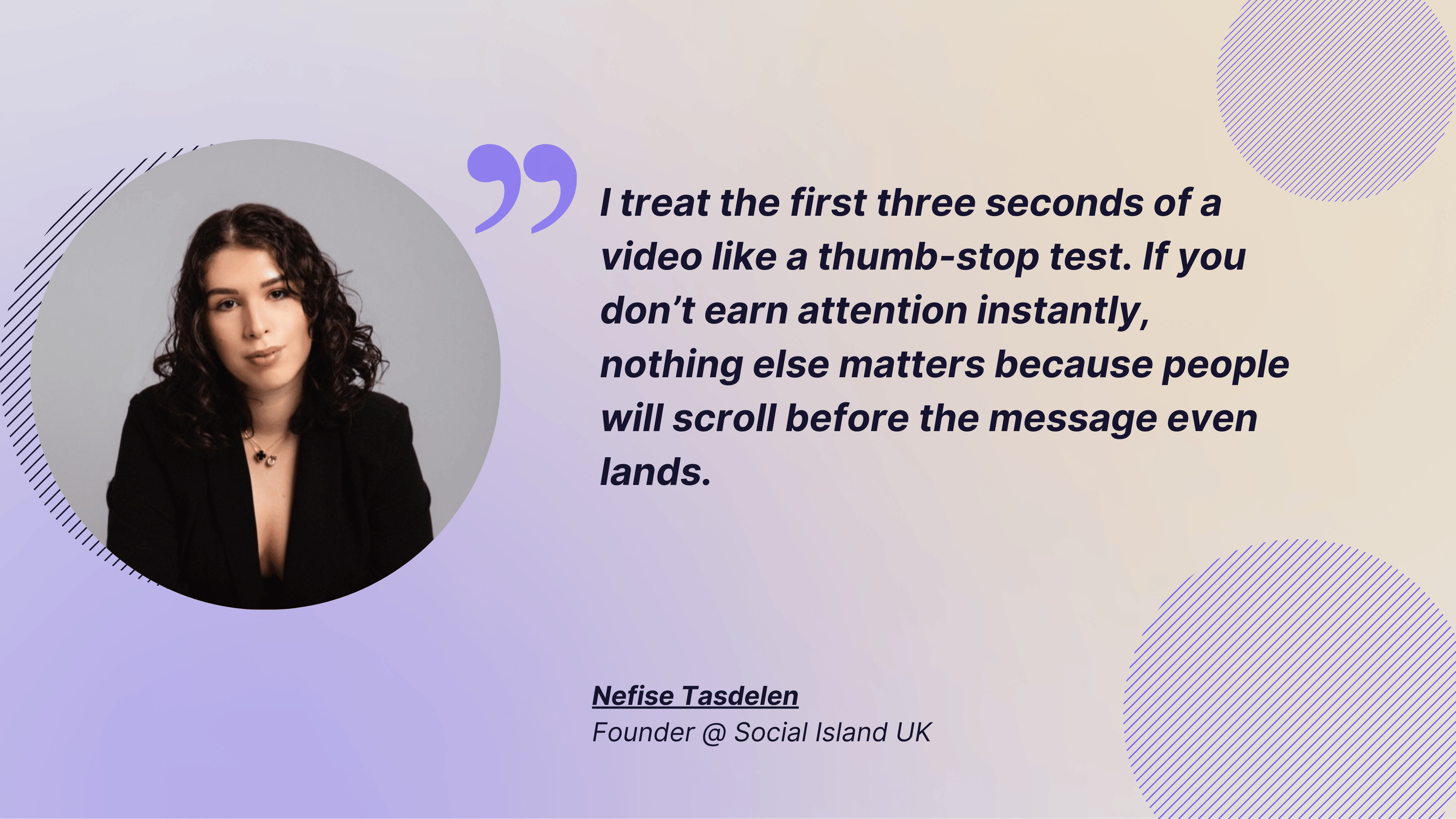
Nefise treats this like a thumb-stop test — if you don't earn attention instantly, nothing else matters, because people will scroll before the message lands.
I treat the first three seconds of a video like a thumb-stop test. If you don't earn attention instantly, nothing else matters because people will scroll before the message even lands.
So how do you build a hook that actually holds? Open with something bold, a direct callout to the viewer, or a visual that grabs attention immediately. Formats that build curiosity — quick challenges, "I tried this for X days" videos, surprising shots, sharp questions, or mild controversy — tend to perform well because they spark emotion or anticipation right away.
Here's the part most brands get wrong, according to Nefise:
I avoid introducing myself or the brand early on. Viewers don't care who's delivering the message. They care about what the message can do for them. That's why I separate the hook from the rest of the content. We build the body and the CTA first, then brainstorm 10 hook variations and test which one works best. Most brands get hooks wrong by making them self-focused, like "We're excited to share" or "Hi, my name is…" These don't create urgency or value. Instead of saying "Today we'll share tips on TikTok engagement," a stronger hook would be: "If your TikTok views are stuck under 500, it's probably because of this one mistake you're not noticing."
2. Humanize your videos
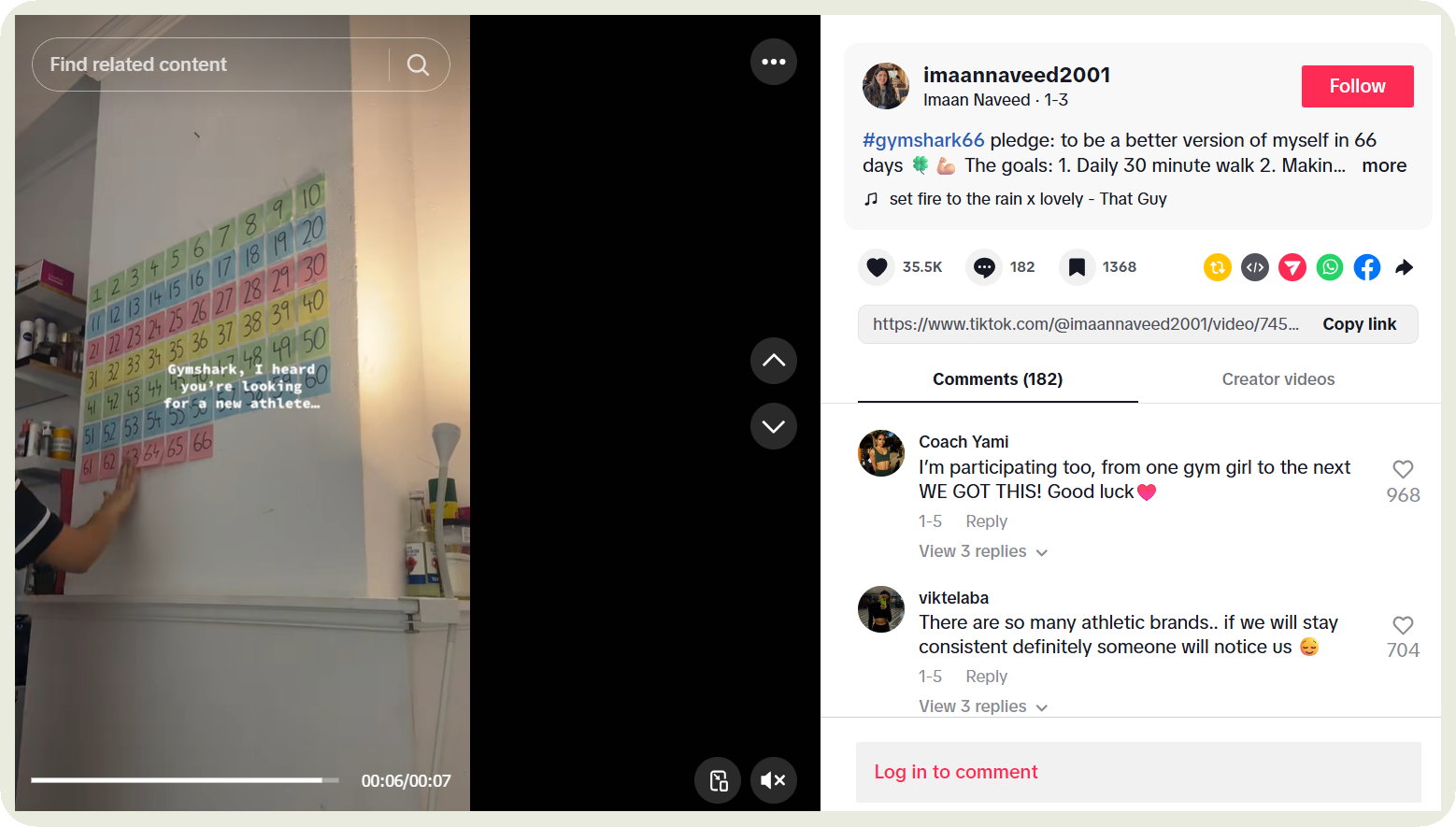
Ask yourself: what kind of videos instantly build a connection with you? Most of the time, it's a brand sharing something personal or showing the humans behind the organization. Even TikTok's algorithm favors content that feels personal and relatable — videos with real people naturally create that connection.
Use this to your advantage: show real reactions, relatable stories, or behind-the-scenes moments that only a human can deliver. This is also exactly why employee-generated content has become a default strategy for many brands on TikTok rather than a nice-to-have — it's a built-in source of the human-first content the algorithm already favors.
Fabletics' TikTok presence leans on this heavily, using real people over polished brand messaging.
Build a recognizable style and stick with it
You know that feeling when you're scrolling and instantly recognize a creator's video before their name even pops up? That's the power of a distinct style, and it's something every brand should aim for. If your videos look like everyone else's, people won't remember you — your personality, sense of humor, and visual identity are what make your content feel alive.
4. Focus on the content pillars that actually performvand verify them with data
Most brands think they know their best-performing pillars, but without data, it's a guess at best. Maybe educational posts quietly drive the highest saves. Maybe behind-the-scenes content outperforms product promos. Or maybe your audience loves humor, but you rarely post it.
Here's how Nefise approaches building pillars:
I build content pillars at the intersection of performance data, audience behavior, and long-term sustainability — both for the creator and the brand. I double down on pillars that consistently drive meaningful engagement, such as comments, saves, shares, and DMs, because those signals usually indicate deeper audience interest and conversation. I also prioritize pillars that feel natural to create and align with the long-term goals of the brand or creator.
Tracking which pillars actually drive engagement doesn't have to mean hours of manual review — Socialinsider automates this analysis directly.

One important caveat: don't copy a competitor's pillar just because it performs well for them.
Content pillars only work when they genuinely fit your brand. Some brands naturally use humor and it feels seamless. Ryanair is a great example of this. On the other hand, some brands try to force humor or jump on TikTok trends even though it never matched their tone. The content ends up feeling unnatural or even backfires, and they risk getting called out because it doesn't feel authentic. The best content pillars are the ones you can sustain long term, feel excited to show up for, and that resonate with your audience.
Distribution strategies: get people to participate, not just watch
5. Run a micro-challenge with zero friction.
TikTok users love joining challenges — they're fun, low-effort, and give people a sense of accomplishment. When you launch a simple challenge, you remove friction: people can film a video in seconds, add your hashtag, and feel like part of something bigger. Give people a format they can copy without overthinking it, and once the hashtag gains momentum, TikTok pushes the challenge into more For You feeds.
6. Use duet-friendly formats to leverage community participation
Duets work because users love adding their voice to a conversation that's already happening. This strategy is best when you want engagement that feels personal and reactive — the key is giving people a prompt that naturally fits a duet format, like "show me your version" or "try this challenge with me."
Beauty creators often post half of a transition and invite followers to complete the other half; fitness creators do the same with partner workouts where viewers fill in the missing moves.
Make sure your setup is actually duet-friendly: leave visual space, use a trending sound, and keep instructions clear. Once you get a few strong duets, pin or stitch them to spotlight participation — this motivates more people to jump in and keeps the engagement rolling.
7. Post with intention, not just more often.
Brands increased TikTok posting frequency by 40% on average across every account size in 2025, which makes timing matter more, not less — you're now competing for attention inside a noisier feed than a year ago.
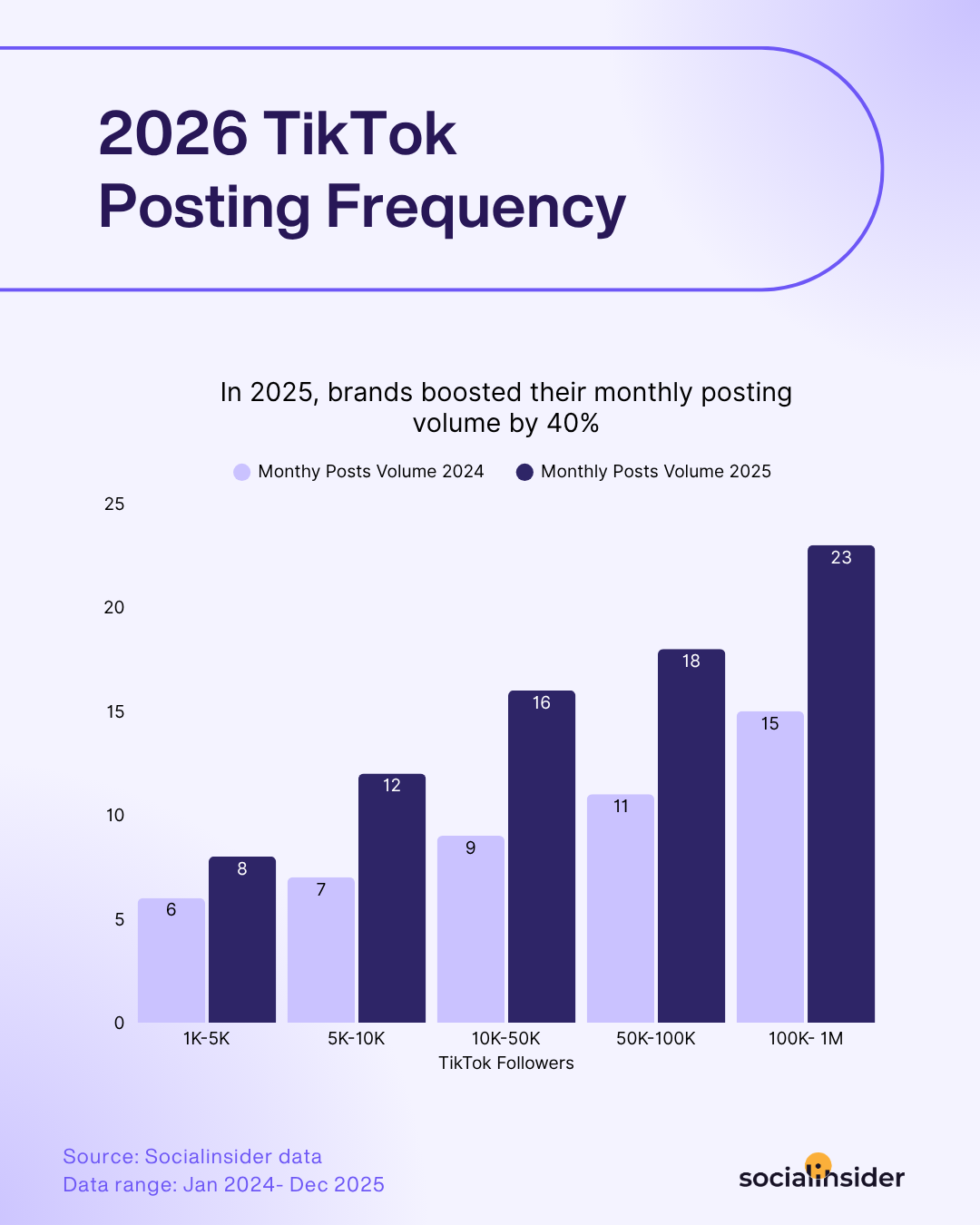
To find your own best time to post, you have two real options. Check your native analytics to see when your audience is most active — look for patterns in your high-performing posts and note the time slots where views spike fastest. Or use an analytics tool like Socialinsider, which pulls your historical performance and tells you the best times to post for your specific audience, rather than a generic platform average.

From there, A/B test different posting windows the same way you'd test a hook or caption, to see which ones consistently deliver stronger engagement.
8. End videos with conversation prompts, not generic CTAs
Comments are a strong ranking signal on TikTok, and they're up 3% year over year platform-wide — with an 11% jump specifically for accounts above 100K followers. But "drop a comment below" rarely works on its own. The trick is tying your question directly to what the viewer just watched, and lowering the barrier to respond:
- Tie the question to your story: if your video shows a transformation, ask "Would you have done it this way or differently?"
- Ask low-friction questions: simple choices like "Which one would you pick?" lower the barrier to commenting — Headspace's TikTok content uses this well.
- Spark mini-debates: polarizing but harmless questions get people talking without feeling forced.
- Invite viewers to share their own story: people love being seen and heard, especially when the topic feels relatable.
Nefise's framing is worth keeping in mind here:
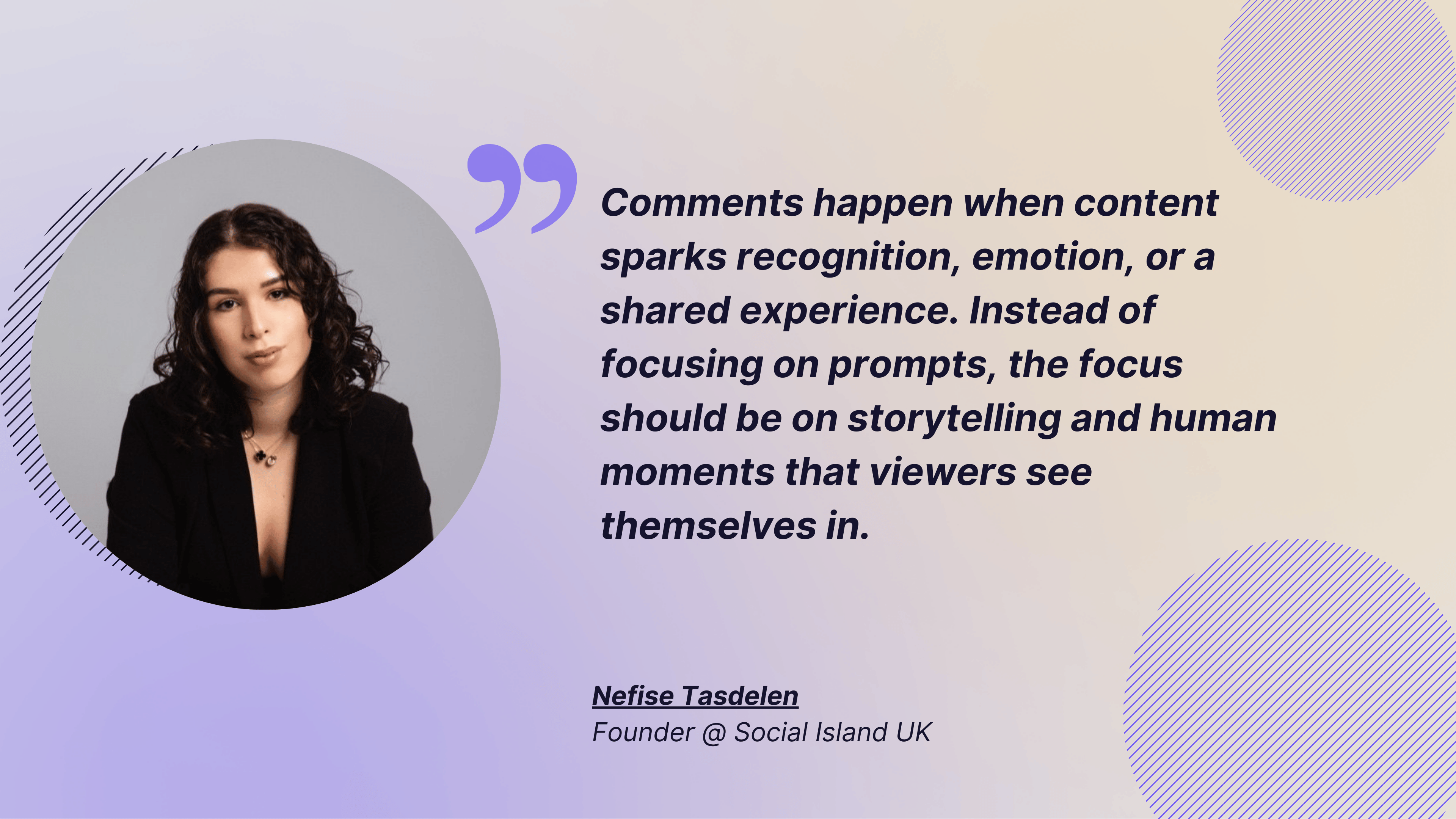
Comments happen when content sparks recognition, emotion, or a shared experience. Instead of focusing on prompts, the focus should be on storytelling and human moments that viewers see themselves in. Simple lines like "Tell me I'm not the only one who deals with this" or "This is the part that stresses me out the most. What's yours?" turn engagement into conversation. Moments of truth also drive responses, such as "I used to think this made me bad at X, until I realized it actually helped me get through it," or shared-experience hooks like "Be honest, do you do this too?"
9. Use trending sounds, but make them work for your niche
Trending sounds give you instant visibility, but the real win comes from making them your own. Instead of copying a trending sound or format as-is, layer it with niche-specific messaging, visuals, or humor — you get the reach benefit of the familiar trend and the retention benefit of your own angle.
This also boosts discoverability beyond the obvious: TikTok's sound-based feeds and challenge pages often surface videos built on popular audio, which means your content gets extra reach without the pressure of inventing a brand-new format from scratch.
10. Build episodic content people come back for
Some brands create content that makes you want to follow them and wait for the next video — usually because they've built a recurring character, a running joke, a weekly segment, or a signature storytelling style. That repetition turns your account into a mini-universe your audience wants to revisit.
This can look like a weekly series (e.g., "Usecase Wednesday"), a multi-part breakdown ("Part 1: Why your marketing strategy fails"), or a recognizable setup repeated in every video — same location, character, or opening line.
If you want an example, I would say Slack's TikTok content uses this kind of recognizable format well.
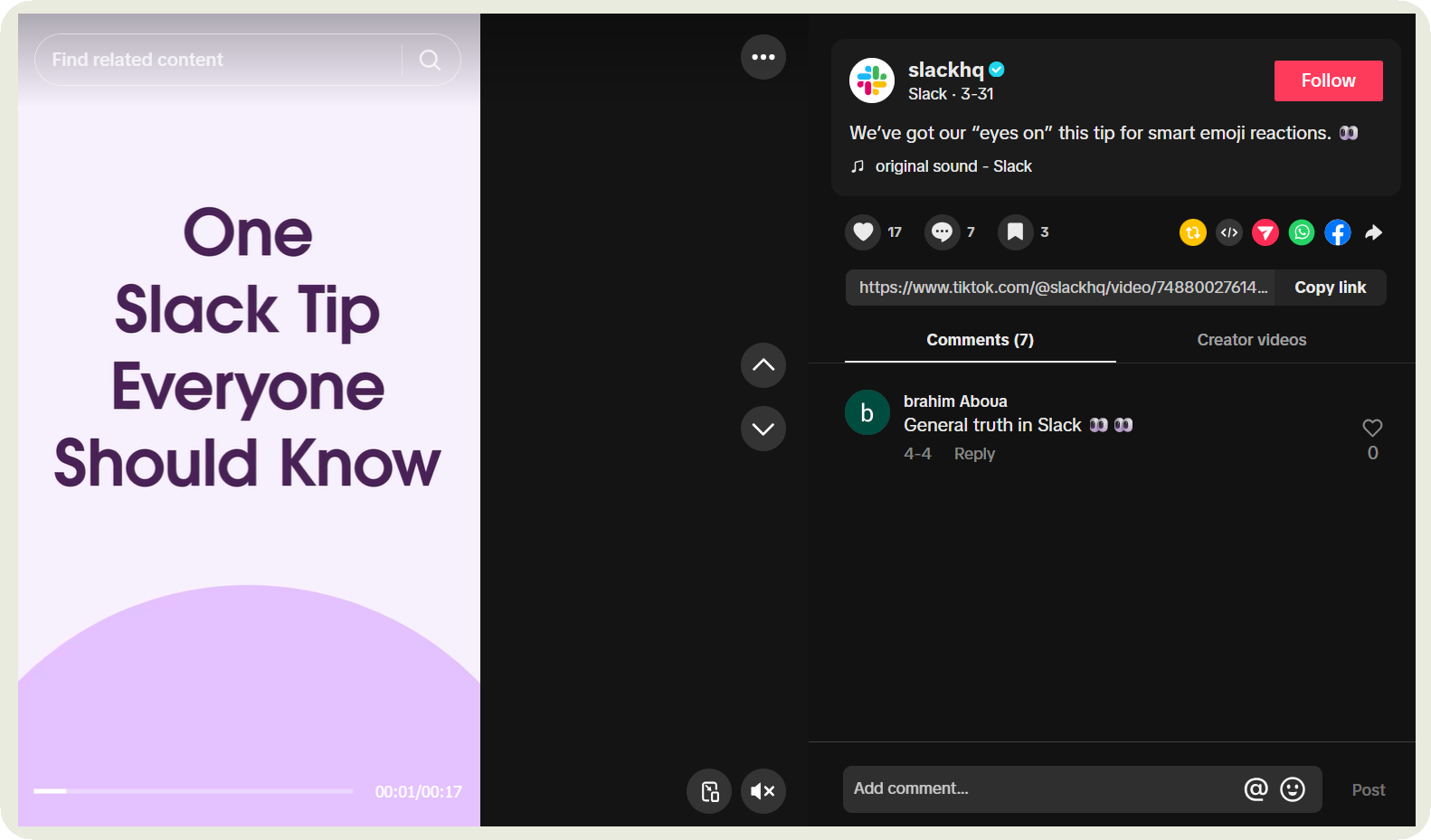
Episodic content also fuels anticipation on its own: ending a video with "Comment if you want Part 2" spikes comments and gives viewers a concrete reason to return.
Analytics and optimization strategies: learn what's actually working
11. Track the metrics that explain why, not just what
I would say three categories of metrics matter most here, and each tells you something different:
- Watch time and retention: if viewers drop off in the first three seconds, your hook needs work. If they watch to the end, that's a signal to double down on that format or topic. Nefise pays close attention to exactly where people drop off:
I analyze what was said or shown in that moment, then rearrange the content and repost it as an A/B test to see whether that brings improvement.
- Comment-to-view ratio: a high ratio means your content is sparking emotion, opinions, or conversation — these are cues to create more in that direction.
As Nefise puts it:
High views with low comments usually mean the content was entertaining but not impactful. Traffic sources matter too. If a video starts getting pushed through search, I lean into SEO-friendly content to increase long-term discoverability.
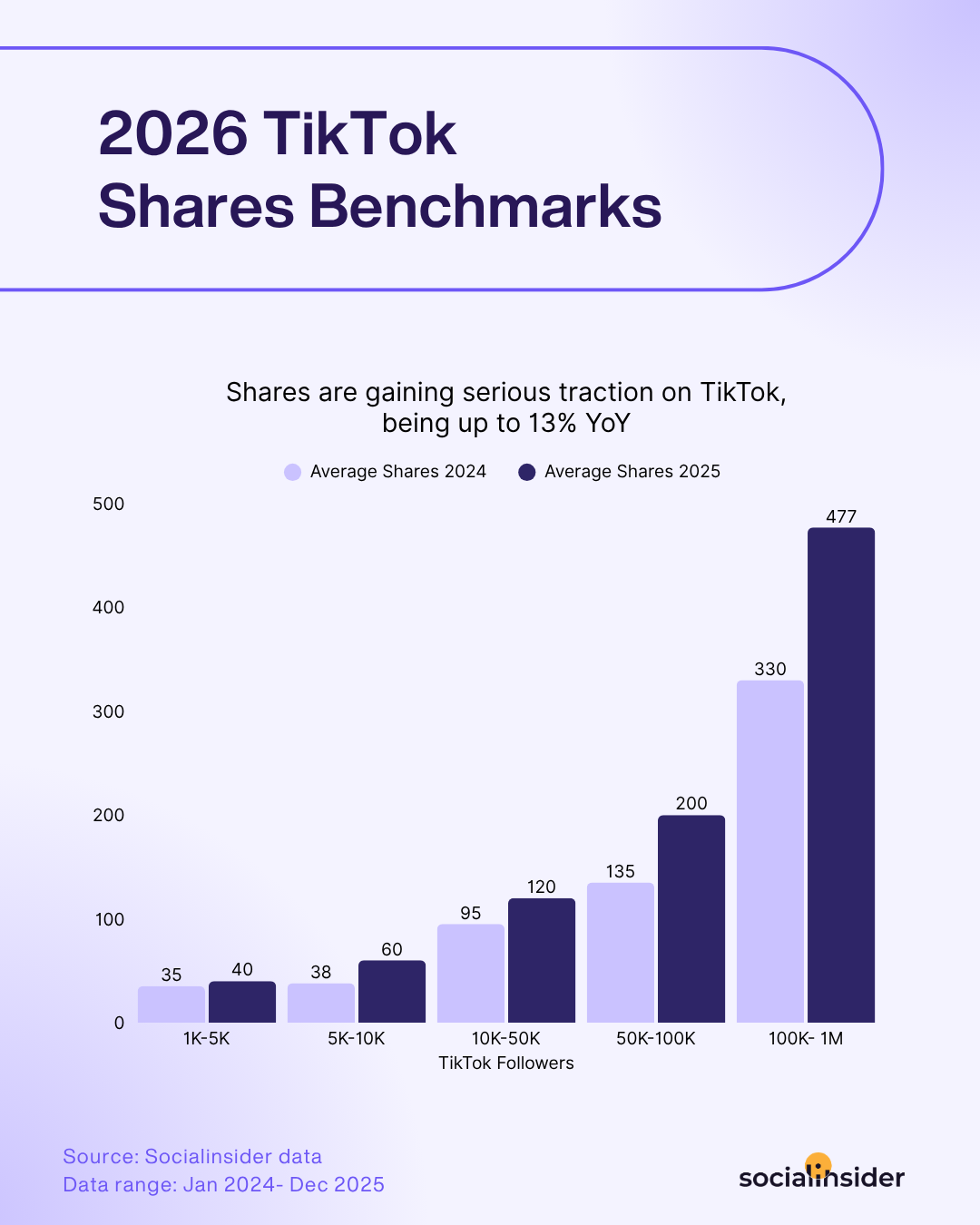
- Shares and saves: these are "high-intent" engagements, and they're rising fast — up 13% year over year platform-wide, and a striking 44% for the largest accounts. When these metrics spike, you're delivering value that travels.
12. Compare performance against competitors and close the loop with A/B testing
Instead of experimenting with every move from scratch, look at what's already working in your space. Once you've identified a direction worth testing, close the loop with structured A/B testing: change one variable at a time — hook, caption, length, on-screen text — and keep everything else consistent.
A real example from one of Nefise's client engagements shows how this plays out in practice:
In a recent A/B testing experiment for a brand, our goal was to understand how audiences react to different video structures. We started with an initial video built around a strong hook, followed by the body and a clear CTA. While this version underperformed on TikTok, it performed very well on YouTube Shorts and Instagram.
Using audience retention graphs, we analyzed exactly where viewers dropped off. Based on those insights, we A/B tested the same video with two new hooks and rearranged sections of the body to address retention dips. Each time we identified a drop, we adjusted the content at that specific moment to make the video more engaging and sustainable.
From that process, we created two additional versions of the video and A/B tested them again. Both performed significantly better, with the version featuring a humorous car-related hook delivering the strongest results overall.
The lesson holds regardless of platform: you won't know which direction to scale until you've compared versions side by side and let the retention data — not instinct — decide.
Final thoughts
Boosting engagement on TikTok comes down to understanding what your audience responds to, building a style that feels like you, and using TikTok's tools with intention — especially as brands post more often and compete inside a noisier feed than a year ago.
If you want to track engagement, identify your top-performing videos, and monitor the metrics that matter, try Socialinsider. Start your 14-day free trial and get the data you need.

Nidhi Parikh
Having worked with several brands in the social media space, Nidhi writes about all things social. With 13K followers on LinkedIn, she's always up for a chat about books or her next travel plan

Know what your competitors do — before your manager asks
Get instant social benchmarks & reports without manual work.