Organic TikTok Growth: What Actually Works in 2026
Tired of one-hit videos? These organic TikTok growth strategies help brands build compounding reach — not just occasional spikes.


If you've spent any time researching organic TikTok growth, you've probably come across the same advice everywhere: post more, use more hashtags, follow more trends.
Consistently growing accounts, though, don't really follow that playbook.
Growth tends to follow recognizable patterns: recurring content themes, audience preferences, and formats that earn attention again and again.
Between audience insights, content analysis tools, and performance data, TikTok marketing has become far less reliant on instinct alone.
So in this guide, I'll dive into the organic TikTok growth strategies that help brands uncover what resonates, refine their content strategy, and build momentum that lasts.
Key takeaways
- A compounding TikTok strategy combines evergreen content, recurring series, and data-driven content pillars to consistently grow reach, engagement, and conversions over time.
- The most effective organic TikTok growth strategies focus on proven audience demand, consistent brand identity, community participation, and iterative optimization rather than relying solely on trends or posting frequency.
What are the principles behind TikTok’s algorithm, and how to make it work in your favor?
TikTok itself gives us a much simpler clue than most theories suggest: it pays close attention to how people interact with content.
Some videos make you stop and watch until the end. Some are so useful or entertaining that you watch them twice. Others get sent straight into the group chat. Those behaviors tell TikTok that a piece of content deserves more attention.
That's why watch time remains one of the most important ranking signals. Completion rate often matters more than view count because it reflects genuine interest rather than a passive scroll-by.
Replays can be just as revealing. Educational content, tutorials, and storytelling formats consistently benefit from that second view — it's worth tracking separately if those formats are part of your content mix.
Then there are shares and comments: the signals that show people felt compelled to act after watching. Shares extend reach off-platform; comments keep content surfacing in feeds longer.
For brands investing in organic TikTok marketing, these social media metrics offer a practical lens for evaluating performance. A video that generates fewer views but earns strong watch time, repeat views, and shares often tells you more — and does more for distribution — than one that briefly spikes and disappears.
Why is audience research essential for continuous TikTok growth?
The easiest way to stall your TikTok growth is to keep creating content based on assumptions.
A video performs well, so you double down on the format. A trend gains traction, so you jump on it.
The problem, however, is that individual posts only tell part of the story.
Growing on TikTok sustainably comes from understanding the patterns behind your audience's behavior.
For this, TikTok Studio is a great place to start with TikTok analytics. Over time, it starts to reveal what your audience consistently gravitates toward — rather than what happened to work once.
I also use TikTok Creative Center when researching a niche. It helps surface emerging conversations, creators, keywords, and content formats, making it easier to understand where audience interest is moving.
And while both can help you understand your audience better, the next step is connecting those insights to your own content.
In this sense, one of the most effective audience engagement strategies is analyzing your content pillars for social media. With Socialinsider's Content Pillars analysis feature, I can see how different themes contribute to engagement, views, and overall performance.

Without that view, every post competes for attention individually.
Once content is grouped into pillars, patterns become much easier to spot. And so do the topics that deserve a bigger role in your TikTok growth strategy.
How to build a TikTok content strategy that compounds over time?
Knowing what your TikTok target audience responds to is only half the job.
The harder part is deciding what deserves more of your time, what needs a different approach, and how those decisions fit into a larger TikTok marketing campaign.
I'll walk you through the framework I use to make those decisions, and one that can help you understand how to grow on TikTok organically with more confidence.
#1. Map your content pillars to business objectives
One of the biggest shifts in my own social media platform strategy came when I stopped expecting every post to deliver the same outcome.
Some videos are there to introduce your brand to new audiences. Others exist to build credibility or spark conversations. A few are meant to drive conversions.
When every piece of social media content has a different job, it makes sense to measure them differently, too.
A framework I often come back to is 50% discovery, 30% value, and 20% conversion:
- 50% discovery = content designed to maximize reach and attract new audiences
- 30% value = educational, entertaining, or community-driven content that keeps people engaged
- 20% conversion = content that highlights products, services, customer stories, or other business outcomes.
It creates a healthy balance between attracting new people, nurturing the audience you already have, and supporting business goals.
Once those objectives are clear, the metrics become much easier to interpret:
Follower growth and views
For discovery content, I focus on follower growth and views.
If those numbers keep moving in the right direction, I know the content is expanding my reach.

Engagement
For value-driven content, engagement tells a much better story.
Comments, shares, and saves show that people found the content worth interacting with.
Earned media value
Finally, I like to look beyond platform metrics and measure the actual social media value my content generates. In other words, how much business value is my organic TikTok strategy creating?
That's where Socialinsider's Organic Value feature comes in handy.

It combines awareness, engagement, and audience growth into a single measurement, making it easier to understand the impact of your organic efforts without having to piece together multiple reports.
These TikTok metrics also make it easier to decide what happens next.
If a content format consistently delivers the outcome it was designed for, I'll keep refining it with new hooks or fresh angles.
If the data stays flat after several iterations, it's usually a sign to test a different approach instead of forcing the format to work.
#2. Mix evergreen with trending content
Another thing I always keep in mind is striking the right balance between evergreen and trend-driven content.
I usually aim for a 60/40 split: 60% evergreen content and 40% trends.
Evergreen posts—think tutorials, FAQs, or educational videos—continue to bring in viewers long after they're published. Trends help you join conversations that already have momentum and introduce your content to new audiences.
If your goal is to grow on TikTok, let trends extend your reach, but rely on evergreen content to build a strategy that lasts.
#3. Create series-based content
If a content format is working, don't be afraid to turn it into a series.
Series give people a reason to come back because they know there's more to expect. They're also a simple way to test different angles around the same topic without starting from scratch every time.
I usually pay close attention to follower growth while running a series.
If people consistently choose to follow after watching one episode, it's a good sign you've created something they want to see more of.
If you're not sure how to calculate follower growth, tracking it alongside your series performance makes it much easier to understand whether the format is actually building your audience or simply generating views.
#4. Create a balanced posting strategy
Consistency matters, but consistency doesn't mean posting as often as possible. A schedule is only sustainable if you can maintain quality alongside it.
I recommend finding a cadence you can stick to, then adjusting it based on performance instead of pressure.
If you're unsure where to start, Socialinsider’s Social Media Benchmarks for TikTok are a useful reference point.
As the benchmark below shows, brands have increased their posting frequency across every follower tier over the past year.
That doesn't mean you should immediately publish more. It simply highlights how competitive the platform has become and why consistency matters.
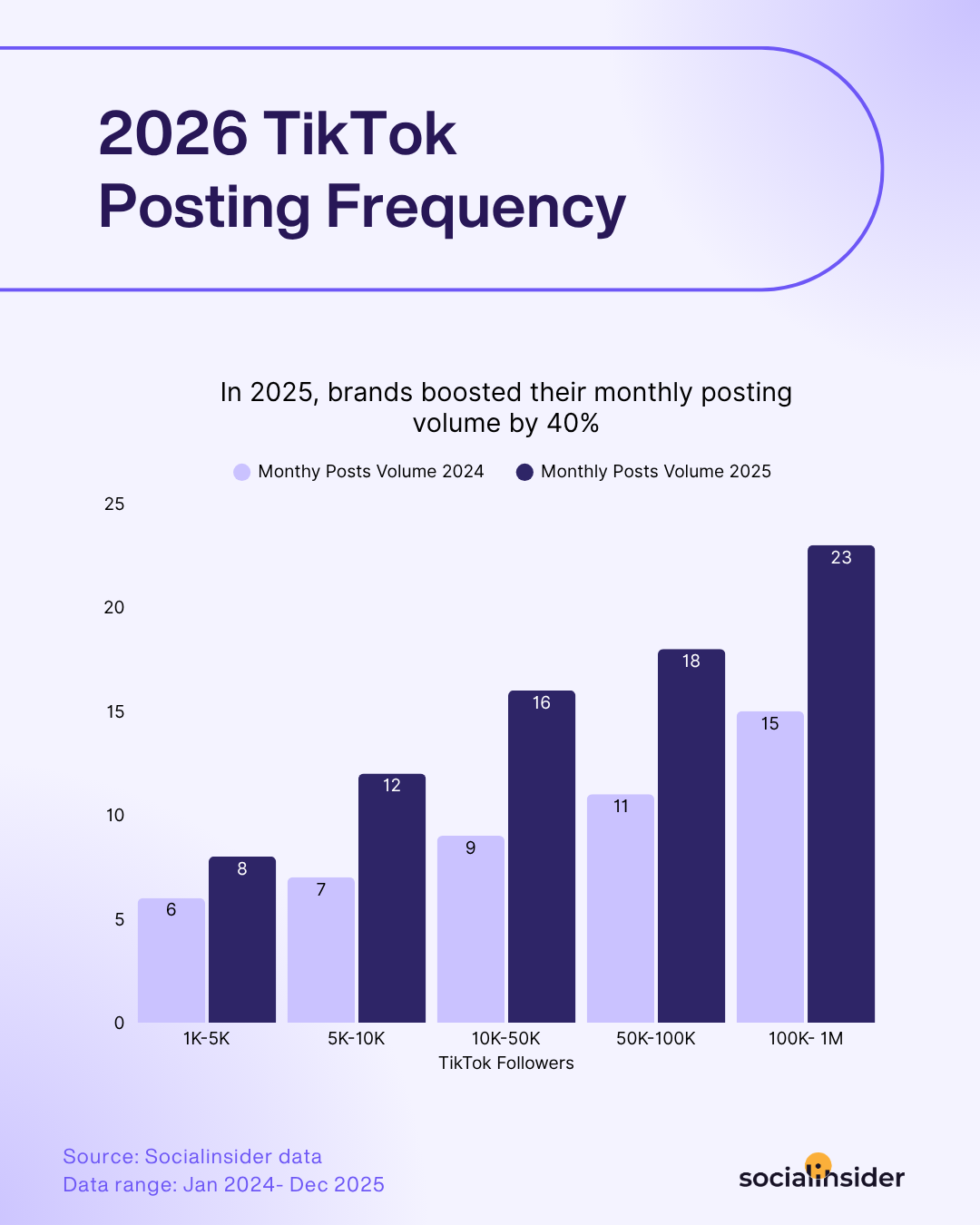
Use those benchmarks as context, not a target.
The right posting frequency is one you can sustain while continuing to experiment, maintain quality, and publish content your audience actually wants to see.
Strategic tactics to leverage for effective organic TikTok growth
At this point, you have the strategy. Now it's time to put it into practice.
These are the social media growth strategies I come back to over and over again, from finding content ideas with proven demand to building recognizable formats people want to see again.
They're simple to apply, but they've made a noticeable difference in how to become successful on TikTok consistently.
Make content people already want
I’d say the hardest part of content creation usually isn't publishing, but deciding what deserves to be created in the first place.
That's where social media content analysis comes in.
I look for recurring patterns in my niche: which formats keep resurfacing? Which storytelling styles consistently earn engagement? Which topics refuse to disappear?
Socialinsider makes that process much faster. I usually sort posts by engagement in the Posts view to surface the highest performers and look for what they have in common.
By now, I'm collecting proof that a format already resonates with the audience and thinking about how my brand can contribute something new to that conversation.

So if a format consistently performs well across my niche, it's worth asking how I can adapt that concept to my own brand instead of starting from scratch.
#2. Build a recognizable style
One exercise I like to do is scroll through an account without looking at the username. Surprisingly often, I can tell who's behind the video after two or three seconds.
And it usually isn't because of a logo or brand colors. It's the combination of familiar elements: the way the video opens, how the story unfolds, the editing pace, the recurring characters, or even the type of humor.
Individually, those choices don't seem particularly important. Repeated over dozens of videos, they become part of your brand.
So when a new format performs well, I don't immediately move on to the next idea. I ask myself what deserves another iteration.
Maybe it's the format. Maybe it's the hook. Maybe it's simply a topic your audience clearly enjoys hearing about.
Those small decisions compound over time.
Repeating the right elements is what makes your brand recognizable.
Create hashtag challenges
A fast way to extend your reach on TikTok is to give your audience something they can participate in.
That's what makes hashtag challenges so effective.
Every person who joins in creates another touchpoint for your brand, introducing your content to their own audience and creating momentum that's difficult to achieve with brand-published content alone.
The challenge, of course, is coming up with an idea people actually want to recreate.
From what I've seen, I could say the highest-participation challenges are almost always the simplest ones — easy to recreate, easy to put a personal spin on. Start by identifying formats or behaviors already spreading organically in your niche, then give your community a reason to add to them. The simpler the concept, the easier it is for people to put their own spin on it, and the further it can travel.
Encourage employees and brand advocates to become organic creators
Ultimately, people connect with people far more naturally than they do with logos.
That's why I like treating employees and brand advocates as an extension of the brand's TikTok presence rather than a separate initiative.
Every creator brings a different voice, audience, and perspective, which helps your content reach people your brand account might never reach on its own. It also extends your reach into audiences your brand account would never reach on its own — without any additional ad spend.
Lastly, it also creates more opportunities for conversations, comments, and shares across multiple accounts, making it easier to get more engagement on TikTok without expecting every interaction to happen on your brand profile.
The best results come when people are encouraged to create in their own style. Authenticity is much harder to manufacture than it is to support.
Final thoughts
There's a temptation to treat every post as a fresh start.
The accounts that grow consistently do the opposite. Every video leaves behind signals about what your audience actually values — what made them stop, watch again, share, or follow. The more you return to those signals before planning your next move, the less your strategy depends on luck.
That's what separates a TikTok presence that compounds from one that just stays busy.
Anda Radulescu
Anda Radulescu is a SaaS content writer and copywriter with 5+ years in digital marketing, turning social media data into practical ideas for Instagram, LinkedIn, and beyond

Know what your competitors do — before your manager asks
Get instant social benchmarks & reports without manual work.