10 Social Media Intelligence Tools Reviewed
Compare 10 social media intelligence tools for competitive benchmarking, consumer insights, and listening, with pricing and best-fit use cases
Building a coherent picture of a brand's online performance is something I've spent a lot of time working on. What I've learned is that raw data alone doesn't get you far without the right structure around it. Social media intelligence is what gives that data context and makes it actionable.
Choosing the tool that provides that structure is harder than it looks. A Socialinsider survey found that 70.2% of marketers choose a social media tool based on its features, 52.2% based on price, and 34.3% based on its integrations. Features clearly win, but a long feature list is also the easiest thing to be misled by. Two platforms can both claim "competitive intelligence" and deliver completely different depth once you try to use it.
So this guide covers the tools I've researched and tested firsthand (or at least tried to, based on what was aiavlable for testing), organized by the type of intelligence they actually deliver. I also cover what to look for when choosing between them, with features, pricing, and integrations weighed the way they matter in practice.
Let's jump in!
Key takeaways
- Performance and competitive intelligence tools like Socialinsider and Dash Social measure a brand's social media performance across platforms and benchmark it against competitors and industry standards, helping heads of social back strategy decisions with comparative data.
- Consumer and audience intelligence tools like Brandwatch, Meltwater, Pulsar, and Talkwalker analyze conversations about brands, competitors, and industries across social media, news, forums, and reviews to show what the market thinks and who is driving the conversation.
- Lightweight monitoring and signal-to-lead tools like Brand24 and CommunityTracker track brand mentions in real time and turn relevant conversations into alerts or sales leads, with faster setup and lower pricing than enterprise listening platforms.
- Influencer and campaign intelligence tools like Traackr and CreatorIQ help brands discover creators, manage influencer campaigns, and measure whether creator investments generate returns.
Essential differences between social media monitoring, listening, and intelligence
I don't know about you, but I oftten hear monitoring, listening, and intelligence often used interchangeably, although they not the same thing (at least that's how I se it). To me, each represents a different depth of understanding:
- Monitoring tells you a competitor just launched a campaign.
- Listening tells you how the audience is responding to it.
- Intelligence tells you what you can learn and apply in your own content strategy.
Social media monitoring is the most basic of the three and reactive by nature. It tracks direct mentions, brand tags, and comments in real time, and tells you what people are saying about your brand.
Social media listening goes a layer deeper. Instead of just tracking mentions, it captures broader conversations around topics, hashtags, and sentiment trends over time. Listening tells you why people are talking and how they feel about your brand, your competitors, and your industry as a whole.
Social media intelligence is the decision layer. It combines listening data with performance and competitive data across platforms, competitors, and audience segments, and uses the resulting patterns, trends, and benchmarks to decide what to do next.
Most teams do some version of monitoring. Fewer do consistent listening. But intelligence is the true strategic differentiator, because it's the layer that turns social media analysis into decisions you can defend in front of leadership.
The tools in this guide approach intelligence from different starting points. Performance and competitive intelligence platforms start from how brands perform. Consumer and audience intelligence platforms start from what the market is saying. Monitoring and influencer tools feed specific signals into the bigger picture.
What should you pay attention to when researching social media intelligence tools?
Since features are the top deciding factor for most marketers, it's worth being precise about which ones actually matter. The first instinct is to compare feature lists. I know. And Tat first you might think the longer, the better, right? But my years spent in marketing have tahught that's rarely the best strategy. Some tools look comprehensive until you try to build a competitor report at scale, or pull data in a format your leadership team can actually use.
Based on what I've tested, these are the capabilities to look for:
- Channel and source coverage: Most brands aren't active on a single platform, and your tool shouldn't be either. I always check which channels a tool actually covers versus which ones it technically supports, because there's often a gap. For listening-based tools, also check coverage beyond social (news, forums, reviews, broadcast), since that's where much of the consumer conversation happens. Look for consistent, comparable data across every channel your audience uses, so your cross-platform analysis reflects the full picture.
- Historical data depth: Intelligence depends on context, and context depends on history. A tool that only shows the last few months can't tell you whether a dip is seasonal, structural, or a one-off. I check how far back the data goes, for both your own accounts and your competitors'.
- Competitive benchmarking: Knowing how your own content performs is a starting point. Knowing how it performs relative to competitors is a strategic edge. Look for tools that let you track competitor metrics side by side and measure social media performance against industry benchmarks over time, without needing access to the competitors' accounts.
- Audience and sentiment depth: Basic tools label mentions as positive, negative, or neutral. Stronger ones show who is driving a conversation, which communities are involved, and how narratives shift over time. If your strategic questions are about audiences rather than your own performance, this is the criterion that separates the tools.
- AI-powered insights: Many tools now claim AI integration and analysis, but this feature varies a lot in practice. Some include genuinely useful AI pattern recognition, while others apply the label to something closer to basic automation. When I test this, I look at whether the AI outputs are specific enough to act on, or just a summary of what you could already see in the data yourself.
- Reporting built for stakeholders: If you report to leadership or multiple stakeholders, you'll quickly feel the limits of rigid reporting formats. The ability to build reports around specific KPIs, schedule them, and present them under your own branding removes a lot of friction and keeps outputs consistent across teams and accounts.
- Integrations with your marketing stack: A tool that works in isolation creates more work, not less. Check how easily social data moves into the rest of your stack: BI and dashboarding tools like Looker Studio, CRMs, collaboration tools, and increasingly AI assistants via connectors. This is what makes cross-channel reporting manageable at scale.
- Pricing model and total cost: Price is the second most common deciding factor, but the starting price rarely tells the full story. Watch for add-ons sold separately (listening is a common one), annual minimum contracts, and pricing tied to data volume or seats. Check whether you can test the tool with a free trial or only through a sales-led demo.
With these criteria in mind, let's look closer at the tools, grouped by the type of intelligence they deliver.
How I evaluated the tools on this list?
Every tool on this list was judged against the same questions, so the comparison reflects how each one performs in practice rather than what its feature page promises.
For each platform, I looked at:
- Hands-on use: Where a free trial or demo account was available, I ran the same tasks in each tool: setting up a brand and a set of competitors (if the tool allowed, obviously) building a basic report, and checking how quickly the platform surfaced something I could act on.
- Coverage in practice: Which channels and sources each tool actually returned data for, not just which ones it lists.
- Depth of intelligence: Whether the output went beyond numbers and mentions to explain patterns, compare against competitors, or show who was driving a conversation.
- Cost transparency: Published pricing, add-ons sold separately, contract terms, and whether you can try the tool before committing.
- Real user feedback: Verified reviews on G2 and customer feedback, focusing on recurring strengths and recurring complaints rather than one-off opinions.
Best social media intelligence tools on the market right now
In my experience, not every tool that claims to offer social media intelligence actually delivers it. Some stop at scheduling and basic social media analytics. Others offer competitive data but only for one or two platforms or with limited historical data.
I've gone through a range of options and selected ten tools that do this well, each for a different purpose. They're grouped by the type of intelligence they deliver, so you can go straight to the category that matches the decisions your team needs to make.
Performance and competitive intelligence tools
Performance and competitive intelligence tools answer the most common strategic question on social: how are we doing compared to everyone else? These platforms measure your own performance across channels, benchmark it against competitors and industry standards, and help you identify content trends across your category. They build the data foundation that informs strategy, rather than just reporting on what already happened.
This category is the best fit for heads of social and brand teams who need to justify strategy to leadership with comparative data. Here are the two strongest options:
1. Socialinsider
Socialinsider is a social media analytics and competitive intelligence platform built for teams that need structured, comparative data across channels. Here's what it covers:
- Cross-platform performance analysis
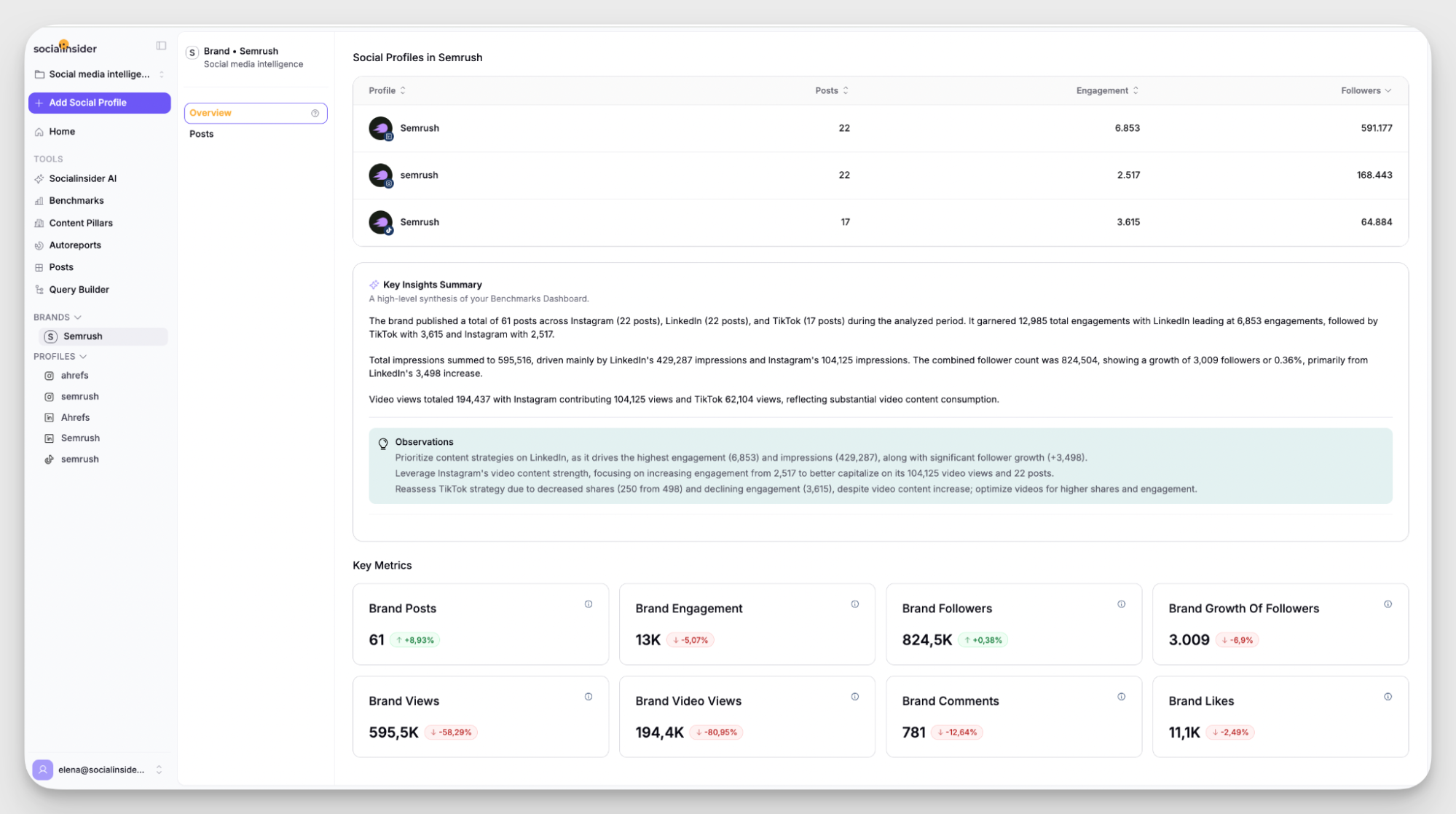
I'll be honest with you, platform coverage is one of the first things I look at when researching a tool, because gaps here can really hurt your strategy. Socialinsider covers LinkedIn and TikTok alongside the more standard platforms, which matters for both B2B and B2C teams. It gives you an overall brand-level summary alongside channel-specific metrics, so you can see where growth or engagement is coming from without running separate reports for each platform.
As Chris from Axel Springer put it: "Socialinsider is great for us as it deals with LinkedIn, which is fantastic. We can do a quick kind of import of the channels that we're looking at and then get a nice deck out that we can just immediately work with."
- Competitive benchmarking with historical context
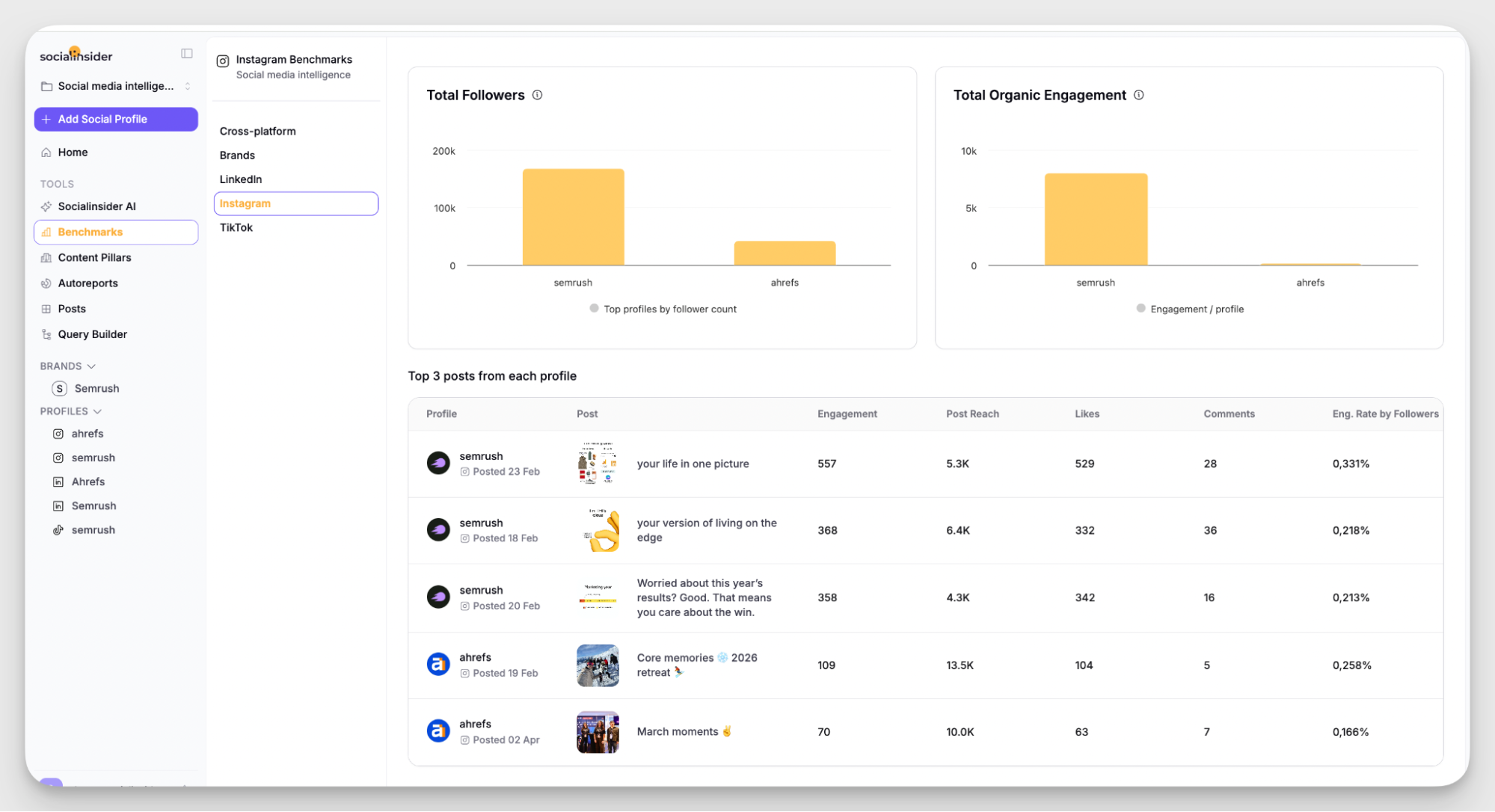
Competitive analysis in Socialinsider works at several levels: channel-specific, cross-platform, or consolidated at the brand level. You can compare follower growth, engagement rates, post frequency, and top-performing content side by side, and see which brand is pulling ahead and where the gaps are. The historical data is what turns this into intelligence. You can tell whether a competitor's spike is a one-off campaign or a sustained strategy shift, and whether your own dip is seasonal or structural.
Alfonso from Noxsport highlighted how the tool helps with competitive analysis: "One of the things I liked from Socialinsider was the combined reporting and comparing with the benchmark that you have in the reports with your competitors."
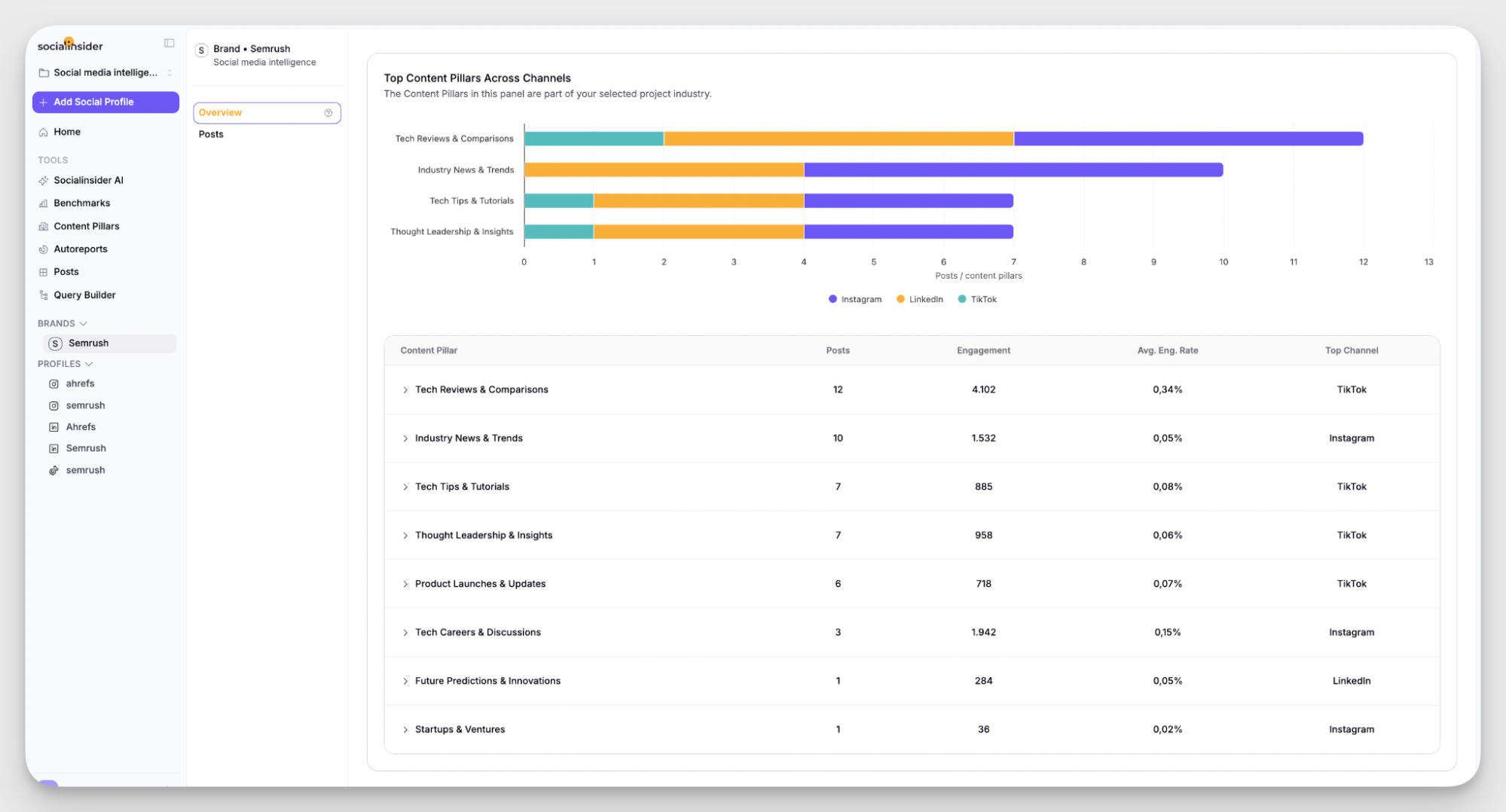
- AI-based content pillars analysis
Socialinsider maps competitors' content against industry-level content pillars. It categorizes posts automatically and shows which themes generate the most engagement, on which channels. Not that you asked, but I'm going to tell you anyway, I see this as one of the most effective features available in a social media analytics tool, because, it helps you quickly identify what type of content you should keep and drop. Instead of manually tagging hundreds of posts, you get a structured view of what's working across your category. For more specific tracking, the Query Builder lets you define your own pillars by combining keywords and hashtags, which is useful for branded content or campaign themes. To me this is one of the most effective strategy helper.
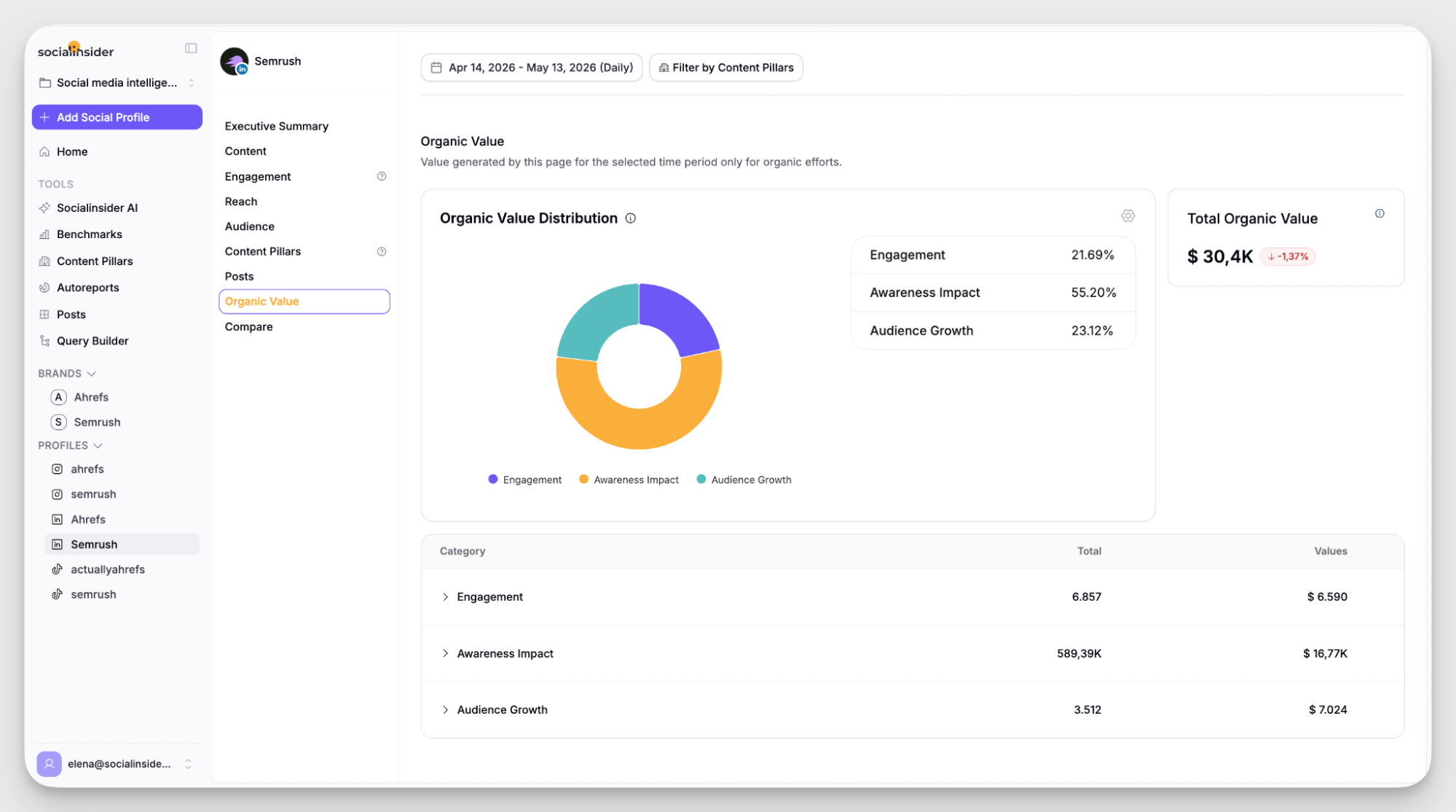
- Earned media value
Unpacking all my favorites, this is another feature that's very close to my heart. Socialinsider's earned media value feature translates social activity into an estimated monetary equivalent, broken down by engagement, awareness impact, and audience growth. It's especially useful when you need to prove the value of organic social to stakeholders who need more than engagement numbers to understand ROI. Isn't it cool?
- AI assistant and integrations
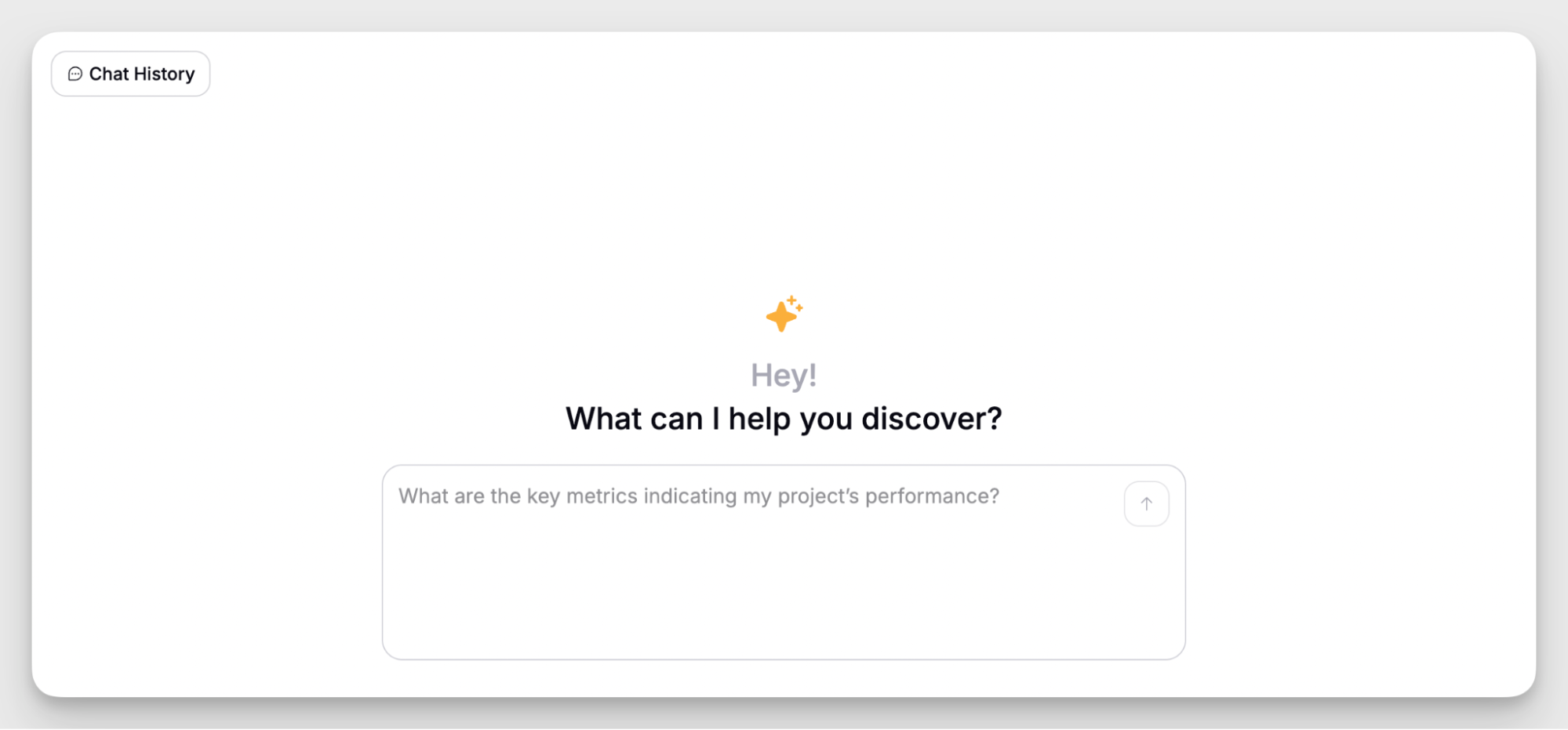
Socialinsider AI works as an in-platform assistant. You ask it questions about your project data and get fast answers on trends, content performance, or metric shifts without digging through reports. For teams working in broader analytics setups, Socialinsider also connects to Looker Studio, for live dashboards alongside other marketing channels, and to AI assistants like Claude and ChatGPT through its MCP connector. That lets you combine social data with inputs from your other connected tools in a single analysis.
- Automated reports
Reports can be scheduled and exported automatically, so in-house teams and agencies can deliver consistent performance reports without rebuilding them each cycle.
Anna from Greentarget shared her experience: "It was pretty intuitive and easy to learn — easy to get set up and running."

Takeaway: Socialinsider is the strongest choice when your core intelligence need is benchmarking brand performance against competitors across platforms, with enough historical depth to separate trends from noise.
Limitations: It focuses on performance and competitive data from social accounts. It isn't a listening tool for tracking brand mentions across news, forums, or the wider web. Teams that need that layer typically pair it with one of the consumer intelligence platforms below.
Pricing: Socialinsider offers a 14-day free trial. Paid plans start at $99/month and scale with the number of profiles and features needed, so it works for both smaller teams and larger agencies.
Best for: Heads of social and brand teams who need cross-platform competitive benchmarks and historical context to back strategy decisions in front of leadership.
Reviews: "I really like that Socialinsider allows me to easily download data from different profiles and compare them. It's much faster than doing it by hand. The user interface is user-friendly and the user experience is great. The support is nice and helpful. I also found the initial setup to be very easy." - Peter K
2. Dash Social
Dash Social is a social media management platform whose intelligence layer centers on prediction. Vision AI estimates how photos and videos are likely to perform before you post them, and built-in benchmarking tracks results against competitors.
The platform's main features include:
- Vision AI, which predicts how visual content is likely to perform before publishing
- Competitive benchmarking and cross-channel campaign measurement
- Social listening and trend monitoring for keywords, topics, competitors, and sentiment
- Creator and influencer management tools, including UGC workflows and rights requests
- Content planning, publishing, and community management across major social channels, plus link-in-bio features

Takeaway: I would say Dash Social works best for teams whose priority is predicting and improving content performance within one management platform. Its competitive intelligence is less deep than a dedicated benchmarking tool's.
Limitations: The influencer module requires creators to already be signed up to Dash Social to access their metrics.
Pricing: Dash Social's plans start at around $999/month for the Engage tier. Instead of a free trial, it offers demos, which give you a guided walkthrough but less chance to test the platform hands-on before committing.
Best for: Brand teams that want performance intelligence built directly into their content planning and publishing workflow.
Reviews: "I use Dash Social for tracking campaign performance across owned, earned, and paid social media content. I appreciate that it eliminates manual report creation by automating social performance reporting. I like the creator and influencer management tool as it streamlines partnership campaigns. The initial setup was fast." - Eduardo M
Consumer and audience intelligence tools
Consumer and audience intelligence platforms start from the opposite direction. Instead of measuring how brands perform, they analyze what the market is saying: conversations about your brand, competitors, and industry across social media, news, forums, reviews, and broadcast. The strongest tools here go beyond sentiment to show who is driving a conversation and how narratives shift over time.
This category is the best fit for insights, brand, and communications teams running market research, brand tracking, or reputation work at scale. Expect enterprise pricing and a learning curve. Here are four solid options, each with a different specialty.
3. Brandwatch
Brandwatch is a consumer intelligence platform. It monitors consumer conversations about brands across social media, news, broadcast, forums, and search, and pairs that with publishing, engagement, influencer campaigns, and executive reporting in one suite. Research depth is the main reason enterprise insights teams choose it.
Brandwatch's main features:
- Consumer Research, the core product, gathers relevant posts and conversations, sorts them into categories like feedback, complaints, and opinions, and uses AI to surface insights.
- Historical data going back to 2010, which Brandwatch puts at 1.7 trillion conversations.
- Coverage of over 100 million media and digital sources across 196 countries and 69 languages, combining Brandwatch's social data with Cision's traditional media infrastructure.
- A social media management module for publishing, audience engagement, performance measurement, and competitor benchmarking.
- APIs for accessing listening data, uploading custom data, and pulling aggregated statistics.

Takeaway: Brandwatch is the deepest consumer research option on this list, but it pays off only if you have analysts who can run it.
Limitations: The biggest constraint is skill, not features. Analysts who can get full value from the platform are hard to find, and without them it can feel more like an expensive data warehouse than a decision engine.
Pricing: Enterprise pricing is quote-based and modular. You choose Consumer Intelligence, Social Media Management, or the full suite, and a smaller Essentials plan for small businesses is listed at $108 per month.
Best for: Enterprise brands and agencies that need deep consumer research with years of historical conversation data.
Reviews: "What I like most about Brownwashed Customer Intelligence is that it is a tool that allows you to integrate and connect accounts to expand a conversation and obtain a greater amount of data. Thanks to this, with the programming of queries, I can obtain information on this specific topic and, at the same time, generate reports, create brands, etc." - Verified User in Marketing & Advertising
4. Meltwater
Another big name in the industry, Meltwater, is a media intelligence and social listening platform for monitoring news coverage, tracking brand mentions, analyzing competitor activity, and measuring the impact of PR and marketing campaigns. Brandwatch starts from consumer research; Meltwater starts from earned media.
Meltwater's main features:
- Media monitoring across online news, 15+ social channels (including major Asian platforms), TV and radio, print, blogs and forums, and review sites.
- Social listening with influencer identification, brand-level sentiment and predictive analytics, and AI agents that help build and manage Boolean searches.
- Mira Companion, an AI assistant inside the listening workflow that turns raw conversation data into insight in seconds.
- AI visibility tracking (GenAI Lens), media relations, consumer intelligence, and influencer marketing through Klear.
- Reporting designed so leadership can quickly understand and act on listening results.

Takeaway: Meltwater makes the most sense when social intelligence needs to sit alongside PR and media monitoring.
Limitations: Reviews of alternatives commonly cite opaque pricing, 12-month minimum contracts, and a steep learning curve as the main reasons teams switch. Social-first teams may also end up paying for media coverage they don't use.
Pricing: Meltwater doesn't publish list prices. Pricing depends on users, source volume, modules, geographic coverage, and contract length. There's no free trial, only guided demos with the sales team.
Best for: PR and communications teams that need social listening and traditional media monitoring under one contract.
Reviews: "I like having a quick way to see where the brand is being mentioned and what people are talking about. The search tools make it easier to follow relevant coverage without having to check different sources individually." - Jay W
5. Pulsar
Pulsar is a social media, narrative, and audience intelligence platform, and I would say its main differentiator is segmentation. It can break down the audience taking part in any conversation by affinity and interest. I see it as the most strategic tool in this category for a specific case: teams planning campaigns around specific communities.
Pulsar's main features:
- Pulsar TRAC for social listening and audience segmentation, Pulsar CORE for owned-channel performance and benchmarking, Narratives AI for tracking public opinion trends, and Crisis Oracle for brand crisis monitoring
- Ingestion of public conversation across 45+ source types, with mapping of the communities behind it
- Narratives AI, which groups the beliefs shaping public opinion instead of simply counting keywords.
- A direct in-platform integration between Pulsar TRAC and Audiense Insights for community segmentation.

Takeaway: Pulsar is the right pick when your strategic question is about audiences and narratives; it's overkill for brand-mention tracking alone.
Limitations: Source access varies by contract, and some datasets carry extra cost or platform-specific restrictions. Pulsar also doesn't do scheduling or publishing, so it won't replace a management tool.
Pricing: Pulsar doesn't publish pricing. Plans are subscription-based and tiered by users, features, data volume, and access to advanced analytics
Best for: Insights and strategy teams that need to understand who is driving a conversation, not just what is being said.
Reviews: "I love having everything in one place, from social mentions to tracking mentions across a specific topic, a brand category, or even individual brand mentions. I also like the flexibility the dashboards provide: I can track mentions within a specific search and monitor SOV between brands. The platform’s UI/UX definitely has a learning curve, but once you get familiar with it and use it consistently, it becomes pretty straightforward." - Gabi T
6. Talkwalker
Talkwalker is a social listening and media monitoring platform best known for visual listening and analytics: detecting brand logos and imagery in content where the brand is never named. It tracks conversations across a wide range of sources, not just social media, and goes deeper than most listening tools in source coverage and analytical complexity.
The platform's main features include:
- Visual listening that picks up logos and brand imagery in photos and videos
- Social listening across a large source set, including social networks, news, blogs, forums, reviews, and broadcast media
- Brand monitoring, competitor benchmarking, and trend analysis
- Sentiment and emotion analysis, with advanced filtering to break conversation data down at a granular level
- Reporting and dashboards with export options and customization

Takeaway: Talkwalker stands out when brand visibility in images and video matters as much as what people write.
Limitations: It's not the easiest product to set up or manage at the start. Because it's a complex platform, it takes time to get comfortable. Factor that in if your team doesn't have dedicated time to configure and maintain a listening setup.
Best for: Marketing, PR, and insights teams that need visual listening and coverage well beyond social networks.
Pricing: Talkwalker asks buyers to book a demo instead of publishing pricing, which points to quote-based, enterprise-tier pricing.
Reviews: "I really like how Talkwalker provides insights we couldn’t access in the past. The data and content are not only useful but also genuinely interesting to explore. It goes far beyond just measuring digital conversations and, compared to similar products, it feels like the frontrunner. The team has also been excellent—very engaged during onboarding and training, making the implementation process smooth and collaborative." - Jennifer D
Lightweight monitoring and signal-to-lead tools
Not every team needs an enterprise listening suite. Lightweight monitoring tools track brand mentions and conversations in real time and alert you when something needs attention. Some now go a step further and turn relevant conversations into actionable signals, such as sales leads. They trade analytical depth for speed, simpler setup, and accessible pricing.
This category is the best fit for smaller teams, PR and community functions that need fast alerts, and B2B teams looking to act on buying signals. Let's look at two options
7. Brand24
Brand24 is a social listening and media monitoring tool that tracks brand, competitor, and keyword mentions in real time. It's a more accessible entry point than the consumer intelligence platforms above, with public pricing, a self-serve trial, and AI features that summarize conversation data without an analyst's help.
Brand24's main features:
- Mention tracking across Facebook, Instagram, X, TikTok, YouTube, LinkedIn, Reddit, news, blogs, reviews, podcasts, newsletters, and more
- AI sentiment analysis on every plan, with higher tiers adding AI event detection, an AI brand assistant, AI insights, and AI topic analysis
- Real-time alerts and spike detection for fast reaction to reputation issues
- Shareable dashboards and customizable reports
- An optional AI Visibility add-on that tracks how the brand appears in AI-generated answers

Takeaway: Brand24 is the most accessible way to get broad, real-time listening with AI summaries, as long as you watch the keyword limits.
Best for: Smaller marketing, PR, and agency teams that want broad, real-time brand monitoring with transparent pricing and a quick setup.
Limitations: Plans cap the number of keywords and mentions you can track, so broader monitoring means moving up tiers quickly. Some features cost extra: API access is an additional $149, and AI Visibility is a $99/month add-on. Competitive analysis is built around mention volume and share of voice rather than performance benchmarking.
Pricing: Plans range from $199/month to $1,499+/month on annual billing, with a 14-day free trial and no credit card required.
8. CommunityTracker
CommunityTracker is a social intelligence platform built for lead generation from social discussions. Unlike most monitoring tools, which stop at surfacing mentions and reporting on them, CommunityTracker takes that signal a step further by turning a relevant post into a saved lead you can follow up on over email or LinkedIn.
CommunityTracker's main features:
- Mention tracking across Reddit, LinkedIn, X, and other communities
- Lead capture directly from posts, with contact enrichment for email, phone, and LinkedIn outreach
- Intent scoring and sentiment analysis on discussions
- Share-of-voice and competitor visibility across 10+ channels
- Slack alerts and integrations with n8n, HubSpot, Make.com, and Zapier

Takeaway: CommunityTracker is the most direct route from social conversation to pipeline, but it serves sales intelligence rather than brand strategy.
Limitations: The platform is built around lead generation, so it's not a replacement for brand-level listening or performance analytics.
Pricing: A free trial is available. Pro is $99/month and Advanced is $199/month, with API access on both paid tiers.
Best for: B2B sales and marketing teams that want to turn social conversations into qualified leads.
Reviews: Community Tracker AI saves me time by putting everything in one place, which is especially helpful when I'm doing outreach from social signals. I appreciate that I can save a good post as a lead and check if there's an email available. - Verified User
Campaign tracking & influencer marketing tools
Last category in my list, influencer and campaign tracking tools are less about monitoring what's being said, and more about understanding who's saying it, what impact their content has, and whether your creator investments are generating returns.
If influencer programs are part of your social strategy, these platforms are worth your attention:
9.Traackr
Traackr is an influencer marketing platform built for teams running creator programs at scale, with a focus on performance measurement and investment optimization.

Traackr's main features:
- Creator discovery and search, with filtering by topic, audience size, reach, resonance, and relevance
- Campaign organization and workflow management for coordinating programs across multiple creators
- Performance measurement and reporting to track what's driving results
- Budget and spend optimization tools
- Global program support for large, multi-region teams
Takeaway: Traackr is the stronger pick when the priority is proving and optimizing the return on influencer investment.
Limitations: Filtering within campaigns and across the creator community is less flexible than it could be, so narrowing down large creator lists or campaign data can still take manual work. Traackr is also focused on influencer programs, so it won't cover broader brand listening or organic performance benchmarking.
Pricing: Traackr doesn't publish pricing on its site and directs prospects to schedule a call.
Best for: Teams running creator programs at scale that need to measure performance and optimize influencer spend.
Reviews: "Traackr provides a comprehensive solution for influencer marketing analytics, offering tools for brand benchmarking, creator lifecycle management, and cross-channel campaign tracking. It centralizes data into standardized metrics, enabling accurate evaluation of market visibility and competitive positioning." - Verified User in Marketing & Advertising
10. CreatorIQ
CreatorIQ is a creator marketing platform oriented toward enterprise influencer programs. Where Traackr leans into performance intelligence and investment analytics, CreatorIQ covers more ground on workflow automation, platform customization, and social commerce.
The platform's main features:
- Creator discovery and recruitment, with influencer scoring and audience analysis
- Campaign management, collaboration, and approval workflows
- Reporting and dashboards for campaign analytics and KPI tracking
- UGC management, influencer whitelisting, and compensation tools
- E-commerce integration and social commerce support

Takeaway: CreatorIQ suits enterprise teams that want creator operations and social commerce in one system, more than pure performance analysis.
Limitations: Creator discovery doesn't always surface every relevant creator, so some creators active on Instagram may be missing from search results and need to be found manually. With no free trial and enterprise-level pricing, it's also a bigger commitment to evaluate than most tools on this list.
Pricing: There is no free version or trial, and pricing is available only on request.
Best for: Enterprise brands that need end-to-end creator workflows, from discovery and approvals to UGC and social commerce.
Reviews: "I love CreatorIQ's great tools for finding and vetting creators. The reporting stats are also a big plus for me. They provide really insightful reports that are generated automatically, which I love. The website and tools are really easy to navigate, which makes the experience smooth. The platform gives me really good quick look stats at things like engagement that are pretty difficult to find elsewhere or calculate through native platforms. I also just love the creator landing pages where you can see everything at a quick glance. The initial setup was really easy, and the CreatorIQ staff were very helpful." - Jeremy M
Final thoughts
The right social media intelligence tool depends on what your team needs, whether that's competitive benchmarking, real-time listening, or influencer tracking.
Most of the tools here serve different use cases, and in my experience, it's rare for a tool to cover everything comprehensively (even if the feature list says so). Prioritize the features that matter most to you and that have the biggest impact on your decision-making. Test the tools before committing, either with a free trial or by asking for a demo.
If social media analytics and competitive intelligence are what you're primarily after, Socialinsider offers a 14-day free trial that lets you test all the features discussed above, applied to your own brand and niche.
FAQs on social media intelligence tools
What is a social media intelligence tool?
A social media intelligence tool is a platform that collects, organizes, and analyzes data from social media channels to help teams make informed decisions. That can include tracking your own brand performance, monitoring competitors, identifying content trends, measuring audience sentiment, or benchmarking against industry standards. The defining characteristic is that the data gets turned into something structured and actionable, not just a feed of raw numbers or mentions.
How much do social media intelligence tools cost?
Pricing ranges widely. Lighter tools start around $99 to $600 per month, while analytics platforms like Socialinsider start at €74 per month. Enterprise consumer intelligence and influencer platforms, such as Brandwatch, Meltwater, Pulsar, Traackr, and CreatorIQ, typically use custom annual contracts. Always check for add-ons and minimum contract terms, since the starting price rarely reflects the full cost.
What data sources do social media intelligence tools use?
It depends on the type of tool. Performance and competitive intelligence platforms pull public data from social accounts on platforms like Instagram, TikTok, LinkedIn, Facebook, X, and YouTube. Listening and consumer intelligence platforms go wider, adding news, blogs, forums, reviews, podcasts, and sometimes broadcast media.
Can social media intelligence tools track competitors without access to their accounts?
Yes, for public data. Tools like Socialinsider analyze any public account's posts, engagement, and growth without needing a login, which is what makes competitor benchmarking possible. Private metrics such as reach, impressions, or demographics are only available for accounts you own or manage.
What's the difference between a social media intelligence tool and a social listening tool?
A social listening tool tracks and analyzes conversations about brands, topics, and industries. A social media intelligence tool uses that kind of data, often alongside performance and competitive data, to guide strategic decisions. Many listening platforms now offer intelligence features, but the distinction is in the output: listening explains what people think, intelligence tells you what to do about it.

Nidhi Parikh
Having worked with several brands in the social media space, Nidhi writes about all things social. With 13K followers on LinkedIn, she's always up for a chat about books or her next travel plan

Know what your competitors do — before your manager asks
Get instant social benchmarks & reports without manual work.