Social Media Checklist: Daily, Weekly, Monthly & Quarterly Tasks for Strategy, Planning, and Audits
A practical social media checklist covering daily, weekly, monthly, and quarterly tasks, plus setup and an audit checklist.

A social media checklist keeps recurring work from slipping through the cracks. It gives you a repeatable system for publishing, responding, reviewing, and improving, so your team can move faster without guessing what matters most.
The tricky part is that this work happens on different clocks. Some tasks need daily attention, others only make sense once a quarter, and a few only come up when something unplanned hits.
In this guide, I'm gonna walk you through a complete social media marketing checklist, built around daily, weekly, monthly, and quarterly tasks, plus a few moments that don't fit neatly into a calendar, such as campaign launches, for example. Are you ready to dive in?
Key takeaways
- Daily social media work centers on monitoring engagement, responding to comments and DMs, and checking quick performance signals before the day ends.
- Weekly tasks shift toward reviewing performance metrics, planning upcoming content, and aligning the team on priorities.
- Monthly reviews focus on analyzing overall performance, adjusting strategy, and revisiting content themes and goals.
- Quarterly cycles bring a deeper audit of profiles, a full analytics review, and a reset of objectives for the next quarter.
What is a social media checklist (and what it's not)
A social media checklist is a recurring list of tasks that keeps your day-to-day social media management consistent: posting, responding, monitoring, and reporting, organized by how often each task needs to happen.
It's easy to confuse this with a few related things, so here's the quick distinction:
- A social media strategy is the bigger picture: your goals, audience, and positioning. You set it once and revisit it periodically.
- A social media content strategy is about what you post and why: themes, formats, and content pillars.
- A social media audit is a deep, point-in-time diagnostic of how your profiles and content are actually performing.
A checklist for social media marketing sits underneath all three. It's the operational layer that makes sure the strategy actually gets executed, week after week, without anyone having to hold it all in their head.
Why you need a structured social media approach
Have you ever left negative feedback for a brand, and they responded three days later? Frustrating, right? A solid social media management checklist helps you avoid being that brand.
Here's what a checklist actually protects you from:
- Tasks going unnoticed. Whether it's research for content ideas or reviewing KPIs to optimize your social media strategy, a checklist tells you what to do and when to do it.
- Team misalignment. If more than one person touches your brand's accounts, a checklist keeps everyone working from the same playbook.
- Reactive management. Without one, you're constantly putting out fires: a last-minute post, a missed campaign deadline, an untracked mention. A checklist puts you back in the driver's seat.
Before you start: foundational setup checklist
Before you can run a daily or weekly checklist, a few things need to be locked down first. Skip this step, and you'll end up organizing tasks around a strategy that doesn't really exist yet.
- Define your audience. Who are you actually trying to reach? Age range, interests, and where they spend time online shape almost every decision that follows.
- Choose your platforms deliberately. You don't need to be everywhere. Pick the platforms where your audience already spends time, and where you can realistically sustain a consistent posting cadence.
- Set clear goals and KPIs. Decide upfront what success looks like: awareness, engagement, leads, or something else. Otherwise you're just tracking social media metrics for the sake of it.
- Document your brand voice and guidelines. Tone, visual style, and response protocols should live somewhere your whole team can reference, not just in one person's head.
- Assign ownership. Every task above needs a name attached to it: who publishes, who responds, and who approves before anything goes out.
Here is a quick social media checklist template you can use to better organize the work within the team.
A quick gut check: if a team member left tomorrow, could someone else pick up the account cold? If the answer's no, this is the gap to close before anything else.
Social media daily checklist
A daily checklist should help your team monitor, respond, publish, and catch problems before they become expensive. It is the shortest cadence, but it carries the most urgency.
The daily version should focus on responsiveness and quality control. That means checking comments, direct messages, mentions, scheduled posts, and any live issues that need escalation. It also means reviewing what happened in the last 24 hours so you can make small adjustments fast instead of waiting for the monthly report.
My advice? Start with community management because that is usually the most visible daily task. People notice quick replies, but they also notice silence.
A practical routine looks like this:
- Reply to comments on priority posts.
- Answer direct messages and customer questions.
- Acknowledge positive feedback.
- Escalate complaints that need support or product input.
- Review user-generated content that may be worth sharing.
Additionally, mention tracking helps you see what people say when they are not talking directly to you.
- Branded hashtags.
- Tagged posts.
- Untagged brand mentions.
- Industry hashtags.
- Sentiment shifts in praise, complaints, and questions.
A branded mention can quickly become a service issue, a community win, or a content idea. If you spot the pattern early, you can respond in the right tone instead of reacting after the conversation has already moved on.
Social media weekly checklist
A weekly checklist helps your team plan ahead, reduce surprise work, and keep publishing aligned with business priorities. It is the cadence where strategy becomes a schedule.
Weekly work should answer three questions: What are we posting next, why are we posting it, and who needs to know about it? If those answers are clear, the team can move faster and spend less time in approvals or last-minute edits.
Now, let me detail a bit on these:
Content calendar creation: The weekly plan is strongest when each post has a reason to exist.
Use this weekly social media management checklist:
- Map posts to business goals.
- Balance educational, promotional, and community content.
- Match content formats to each platform.
- Align with launches, promotions, and seasonal moments.
- Confirm who owns each post.
Content scheduling: Scheduling is more than placing posts on a calendar. It is the last chance to catch avoidable mistakes before the post goes live.
Check:
- Platform format and size.
- Copy length and line breaks.
- Tagging accuracy.
- Link destination.
- Call to action clarity.
- Post timing against audience activity.
Team communication and alignment: A weekly team update keeps everyone moving in the same direction. It is especially valuable when one person writes, another designs, and another approves.
Use the weekly meeting to confirm:
- What is going live this week.
- Which posts need comment support.
- Which topics are time sensitive.
- Which requests might disrupt the schedule.
- What trends or news should change the plan.
Ad campaign monitoring and adjusting: If paid social is part of the plan, weekly review is the right place to keep it healthy. Ads change quickly, and small issues can waste budget if no one checks them.
Review:
- Reach, clicks, and cost per result.
- Which audience segments are responding.
- Which creatives are fading.
- Whether the call to action is clear.
- Whether A/B tests are actually producing useful differences.
Monthly social media checklist
A monthly checklist should tell you whether the account is improving, flat, or drifting away from its goals. This is the cadence for analysis, reporting, and adjustment.
Monthly work is where patterns become visible. You are no longer asking whether a single post performed well. You are asking which content types, platforms, and themes are actually earning the team’s time.
Now, a closer look at each of these.
Review performance and build reports: The monthly review should combine quantitative and qualitative data. Numbers show what happened, but comments, shares, and reposts explain why it happened.
A useful report should include:

PS: With Socialinsider you can quickly view engagement rate data by different metrics, such as followers, reach, or impressions, for you to easily be able to get the type of data that you need, without wasting time on manual calculations and spreadsheets.
- Reach or views.
- Click-through rate.
- Follower growth.

- Top posts and top formats.
- Notes on audience reactions.
- Recommendations for the next month.
Analyze patterns in content performance: Monthly analysis should show which themes and formats deserve more attention. If the team does not compare content types side by side, strong posts can get lost in the noise.
Look for:
- The posts that earned the most engagement.

- The formats that generated the most engagement.
- The content pillars that drove the best reactions.

For the monthly performance checklist, a tool such as Socialinsider is extremely helpful, since it enables surfacing your top posts, engagement by content format, and your most engaging content pillars in one view instead of pulling it together manually from each platform.
Oversee customer service metrics: Social support belongs in the monthly checklist because it tells you whether the audience feels heard. It also helps teams spot recurring issues before they become reputation problems.
Track:
- Average response time.
- Common question types.
- Resolution rate.
- Complaint themes.
- Positive feedback trends.
- Product feedback worth sharing internally.
Map content decisions to performance: Monthly review should turn insights into the next round of planning. If the performance data does not affect the calendar, then the review is just a summary.
Use the findings to:
- Amplify successful content themes.
- Rework weak content themes.
- Shift platform priorities if needed.
- Adjust posting frequency and timing.
- Update the next month’s testing plan.
Turn insights into a content plan: A monthly social media checklist should end with a short planning decision. The goal is not to collect insight and walk away. The goal is to know what changes next.
Plan for:
- New content briefs based on audience questions.
- Updated creative angles for evergreen topics.
- A clearer testing plan for the next month.
- Stronger handoffs between social, support, and product.
- Better resource allocation for the formats that win.
To sum up, that is the heart of a strong monthly process: review, decide, and move.
Social media quarterly & strategic checklist
A quarterly checklist is where the team steps back and resets the system. It should check platform fit, audience shifts, competitive position, budget logic, and bigger strategic bets.
Quarterly work is not about repeating the monthly report on a larger scale. It is about asking whether the current social plan still makes sense. If the answer is no, this is the right cadence to adjust it.
Here's a short piece of advice that I have for you: quarterly planning should be more opinionated than monthly planning. By this point, you should know which platforms deserve more effort and which ones need a smaller role.
Now, a deep dive int each:
Platform specific strategy review: Not every platform deserves the same approach. What works on Instagram may fall flat on LinkedIn. Use this review to reshape platform-specific content plans based on what actually performed.
Use the quarterly review to ask:
- Which platform is most efficient for awareness?
- Which platform is strongest for engagement?
- Which platform supports leads or traffic best?
- Which platform deserves more creative attention?
- Which channel needs a lighter or more focused role?
Analyze content pillars across platforms: Content pillars can look very different depending on the platform. A quarterly checklist should show whether the same theme performs equally well everywhere, or whether each channel needs a different angle.
Review:
- The best-performing pillar by platform.
- The weakest pillar by platform.
- Whether certain topics need new formats.
- Whether the audience expects different depth on different channels.
- Whether some pillars are overused.
Brand consistency audit across platforms: A quarterly brand audit keeps the account recognizable everywhere. It is the right time to check whether visuals, tone, bio fields, and links still match the brand.
Review:
- Profile photos, bios, and descriptions.
- Link destinations.
- Tone of voice.
- Visual style and color use.
- Campaign naming and messaging consistency.
- Accuracy of profile details.
Major trend analysis and forecasting: Quarterly trend review should help the team decide what to test next, not chase every new feature. The best checklist treats trends as opportunities, not obligations.
Ask:
- Which formats gained traction this quarter?
- Which platform features deserve a test?
- Which trends fit the audience and the brand?
- Which changes should be watched, but not adopted immediately?
- Which content habits should be retired?
Budget review and allocation planning: Quarterly budget review should follow performance, not habit. If one platform delivers stronger results at a lower cost, that platform deserves a serious look.
Review:
- Paid social ROI by platform.
- Cost per result.
- Budget allocation versus performance.
- Which formats deserve more investment.
- Which campaigns should be scaled back.
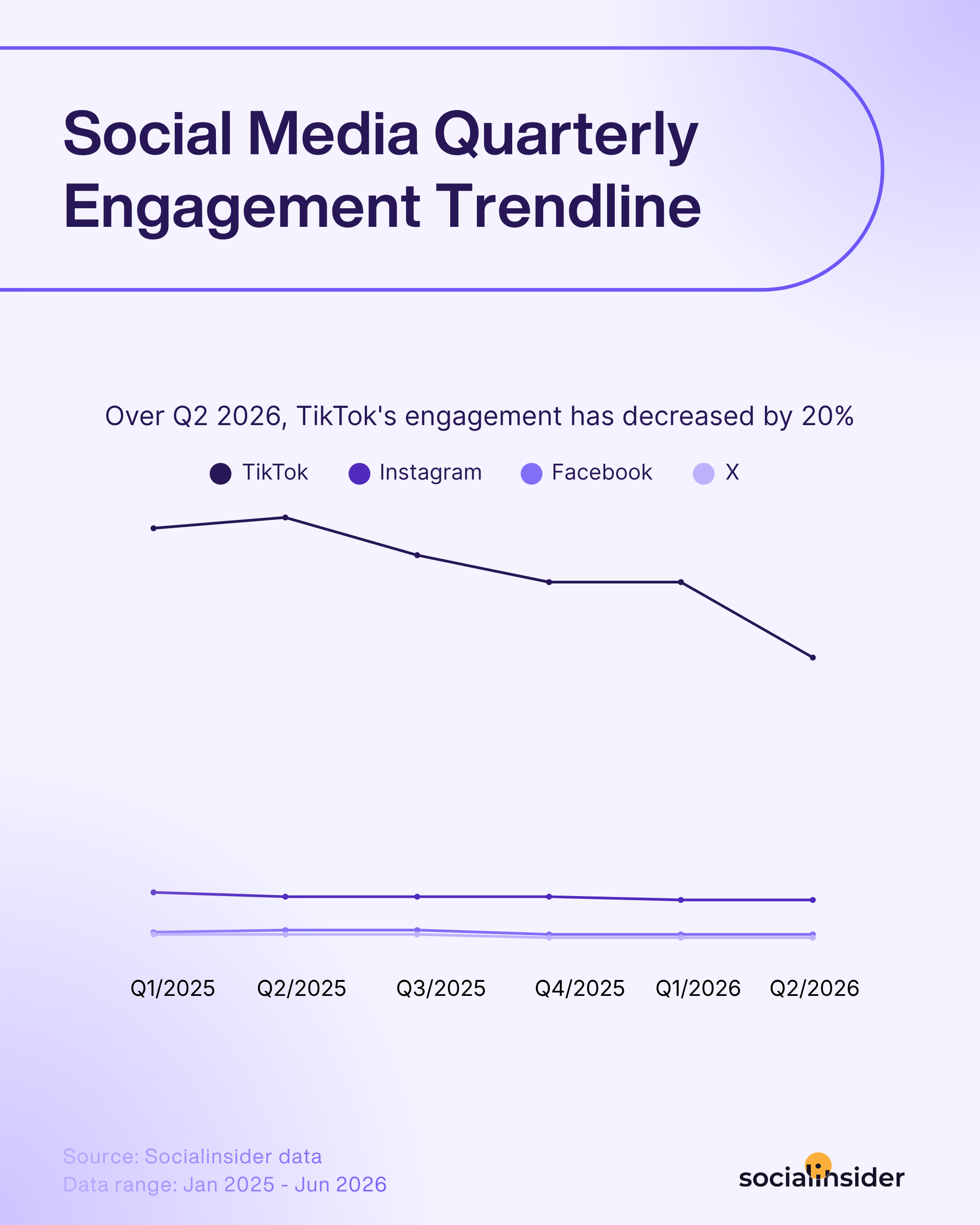
Comprehensive competitive analysis and social media benchmarks: Competitive analysis is one of the clearest reasons to use a quarterly checklist. It tells you where the market is moving and how much ground your team still has to cover.
Use this review to compare:
- Engagement rate.
- Follower growth.
- Posting frequency.
- Content mix.
- Share of voice.
- Top-performing topics.
And here's a tip I have for you: Socialinsider lets you run this analysis across channels at once, so you can compare your performance against multiple competitors on Instagram, Facebook, and YouTube, and more, side by side, instead of pulling separate reports for each network and trying to line them up manually.

Industry analysis with benchmark reports: Industry benchmarks keep the team from chasing the wrong target. A 2% engagement rate can be solid in one category and weak in another, which is why quarterly reviews should always add context.
Use benchmark reports to answer:
- How does the brand compare with industry peers?
- Is performance above or below the category average?
- Which platforms are strongest for the industry?
- Which metrics should guide the next quarter?
And for this, Socialinsider's social media benchmarks reports are extremely helpful.
Quick social media audit checklist
A quick social media audit should catch the obvious problems fast. It is a light review, not a full diagnostic, and it is most useful when the team needs a practical snapshot before a deeper audit.
Use this quick audit to check:
- Profile name, bio, and profile image.
- Link in bio and destination pages.
- Visual consistency across the feed.
- Recent post mix and format balance.
- Engagement quality in comments and replies.
- Branding consistency across platforms.
- Missing tags, mentions, or captions.
- Obvious gaps versus competitors.
This is the fast version of a deeper process. For the full audit process, see our social media audit guide. The full version should look at performance patterns, account setup, audience fit, competitor gaps, and content quality in more detail.
A quick audit is especially useful before a launch, before a reporting cycle, or before a leadership review. It helps the team see whether the account still looks current, credible, and easy to understand.
Bonus: campaign launch checklist
A launch checklist keeps one-off campaigns from colliding with recurring work. It should cover prep, launch day, and post-launch follow-up so the team does not miss the follow-through after the first burst of attention.
Launch work needs a different rhythm from ongoing publishing. A campaign can have a single focus, a hard deadline, and several moving parts, so the checklist should be more structured than the daily or weekly list.
Pre launch: Confirm the campaign goal and KPI, the audience and platform fit, creative assets and copy, links and tracking codes, approval status, an escalation owner, and the posting schedule across channels.
This is also the moment to check whether the campaign needs different versions for different platforms. A single asset can often be adapted, but it should not be blindly copied everywhere.
Launch day: Focus on control and speed.
- Confirm all posts are live.
- Monitor comments and direct messages.
- Check link performance.
- Watch for early reactions.
- Respond to questions quickly.
- Escalate issues if messaging needs to change.
A launch can create a lot of noise in a short period. The checklist keeps the team calm and stops small errors from spreading.
Post launch: Capture the follow-up work that many teams forget.
- Review initial performance.
- Compare the launch with the KPI target.
- Collect comments, questions, and reactions.
- Note what to reuse next time.
- Document what should change before the next campaign.
Common social media checklist mistakes to avoid
The biggest checklist mistakes are usually operational, not strategic. Most teams do not fail because they lack ideas. They fail because the process is unclear, the cadence is messy, or the work is too repetitive to stay useful.
Avoid these common problems:
- Reviewing performance without deciding what changes next.
- Building reports without explaining the business impact.
- Confusing strategy work with recurring checklist work.
The most expensive mistake is usually a missing owner. If a comment escalates, a link breaks, or a post needs a fast correction, someone has to be responsible. A checklist without ownership is just a list.
Another common mistake is overloading the daily list with monthly work. A daily social media checklist should keep the account healthy, not replace reporting or strategy review. If the team tries to do everything every day, the system becomes too heavy to follow.
Final thoughts
A social media checklist works best when it feels like an operating system, not a task dump. The daily list keeps the account responsive, the weekly list keeps the plan organized, the monthly list turns performance into insight, and the quarterly list resets the strategy with context.
If you want the checklist to stay useful, keep it simple enough to follow and specific enough to trust. When the process is clear, the team spends less time scrambling and more time improving what matters. That is the real value of a good social media checklist: better decisions, fewer missed steps, and a workflow that can grow with the team.
FAQs on social media checklist
What should be in a social media audit checklist?
At minimum: profile accuracy, visual consistency, content mix, engagement trends, competitive positioning, and response times. For a full audit, go deeper into content pillar performance and channel-by-channel ROI.
How often should a social media audit checklist be updated?
A social media audit checklist should be updated at least quarterly, and more often if the brand launches new campaigns, changes platforms, or changes team ownership. Monthly updates can help with small workflow fixes, but quarterly review is the right cadence for deeper audit items such as competitive gaps, content themes, and brand consistency.

Elena Cucu
As Content & SEO Manager at Socialinsider, Elena Cucu helps social media leaders make sense of the numbers behind their performance. Featured in TechCrunch, TNW, and ReadWrite.

Know what your competitors do — before your manager asks
Get instant social benchmarks & reports without manual work.