Data Analysis with AI: A Practical Guide for Social Media & Marketing Teams
Transform your approach to data analysis with AI. Discover tools and strategies that enable you to extract meaningful insights and drive impactful results.

I'll be honest,for a long time, I thought the hard part of social media was collecting the data. It's not. It's figuring out what it's actually telling you.
AI has made that part significantly easier. Not because it thinks for you, but because it cuts through the noise fast enough that you can spend your energy on decisions instead of spreadsheets.
In this guide, I'll walk you through how to use AI for data analysis in a way that's practical, not overwhelming, and how to make the output actually useful for your strategy.
Key teakeaways
- AI-powered marketing analysis combines pattern recognition, predictive modeling, natural language querying, and anomaly detection to uncover insights, forecast outcomes, simplify data access, and flag unusual performance changes.
- Without AI, social media analysis can be slow, incomplete, and inconsistent because humans struggle to identify meaningful patterns across large, complex datasets quickly enough to drive timely decisions.
- AI transforms raw social media data into actions through a five-step process: data ingestion, cleaning and structuring, pattern detection, insight generation, and recommendation creation.
Why can social media data analysis break down without AI?
Working in marketing for quite some years now, I know that when your manager asks for a performance report, you need to take a deep breath and start digging through what seems like an endless stream of data, from platform dashboards and exported CSVs to third-party reports, and competitor benchmarks. And the bottleneck is always the same: getting from raw numbers to a decision fast enough to make the scale turn in your favor.
If you were to ask me what I consider the top three limitations of manual data analysis, without a doubt, I'd point to these:
- It's slow. Cross-referencing performance across platforms, time periods, and content types takes hours, and by the time the picture is clear, the moment to act on it has often passed.
- It's incomplete. Human pattern recognition works well on small datasets but starts missing signals the moment the volume grows. A drop in engagement on one platform while another spikes, a competitor quietly shifting their content mix, a format underperforming in one audience segment but thriving in another — these are exactly the kinds of patterns that can get lost in manual review.
- It's inconsistent. Analysis quality varies depending on who's doing it, how much time they have, and what they already believe the data will say.
However, I can't stress enough the importance of understanding that AI doesn't eliminate the need for human judgment; it eliminates the parts that were never a good use of human judgment in the first place. The sorting, the pattern-matching, the anomaly-spotting, the summarizing. When those steps are handled automatically, the analyst's job shifts from processing data to interpreting it, which is where the real strategic value lives.
How does the AI analysis process look from raw data to actionable outputs
Understanding how AI actually moves through data helps you use it more intentionally and spot where human input still matters. The process isn't magic. It follows a logical sequence that, once you understand it, makes the output much easier to trust and act on.
Step 1: Data ingestion
AI analysis starts with pulling in data from multiple sources: your social media platforms, competitor profiles, historical performance exports, and any third-party benchmarks you're tracking. The quality of everything that follows depends entirely on what goes in at this stage. Incomplete, inconsistently tagged, or poorly structured data produces confident-sounding insights that are quietly wrong. A short data audit before connecting your sources to any AI-powered data analysis platform saves a lot of correcting later.
Step 2: Cleaning and structuring
Raw social data is messy. Metrics are named differently across platforms, time periods don't always align, and outliers from one-off campaigns can skew averages. AI data solutions handle much of this automatically, normalizing formats, flagging inconsistencies, and structuring the dataset so it's comparable across channels and time periods.
Step 3: Pattern recognition and signal detection
This is where AI for data analysis earns its place. Once the data is clean and structured, AI scans across it at a scale and speed no analyst could match manually, identifying what's trending up, what's declining, what's behaving unexpectedly, and what correlations exist between variables like posting frequency, format, timing, and engagement outcomes.
Step 4: Insight generation
Raw patterns become AI data insights at this stage. Rather than surfacing a table of numbers, a good AI data analyzer translates findings into plain-language summaries: which content pillar is driving the most engagement this quarter, which platform is underperforming relative to your benchmarks, which competitor has shifted their strategy in the last 30 days. This is the step that turns an analysis into something you can actually bring to a strategy conversation.

Step 5: Recommendation and action
The final step is where AI and data analysis connect to real decisions. The best AI analysis tools don't just describe what happened; they suggest what to do next. Adjust your posting cadence on this platform. Double down on this content format. Investigate this anomaly before it becomes a trend. The human's job at this point is to evaluate those recommendations against the context the AI doesn't have — brand priorities, upcoming campaigns, stakeholder constraints — and decide what to act on.
Setting up your data AI analysis stack: tools, inputs, and outputs
From what I've seen, I would say that the most common mistake teams make when building an AI data analysis setup isn't choosing the wrong tools — it's building a fragmented stack where data sits in silos and nothing talks to anything else. Before looking at specific tools to analyze data, it helps to think in terms of three layers: what goes in, what processes it, and what comes out.
Inputs: what data you feed in
The quality of your AI analysis is only as good as the data behind it. For social media and marketing teams, useful inputs typically include:
- Your own performance data: post-level metrics across all platforms, historical engagement trends, content format performance, follower growth over time.
- Competitor data: benchmarks, content mix, posting frequency, engagement rates from brands you're tracking.
- Audience data: behavioral patterns, segment-level engagement, platform-specific activity windows.
- Campaign data: performance by campaign, format, objective, and time period.
The more consistently this data is structured and tagged, the more useful your AI data analyzer becomes.
The AI layer: what processes it
This is where your choice of data analysis platform matters most. A good platform for data analysis doesn't just store and display your data; it actively works on it. What to look for:
- Cross-channel data unification so you're not analyzing platforms in isolation;
- AI-generated summaries and recommendations, not just raw metric displays;
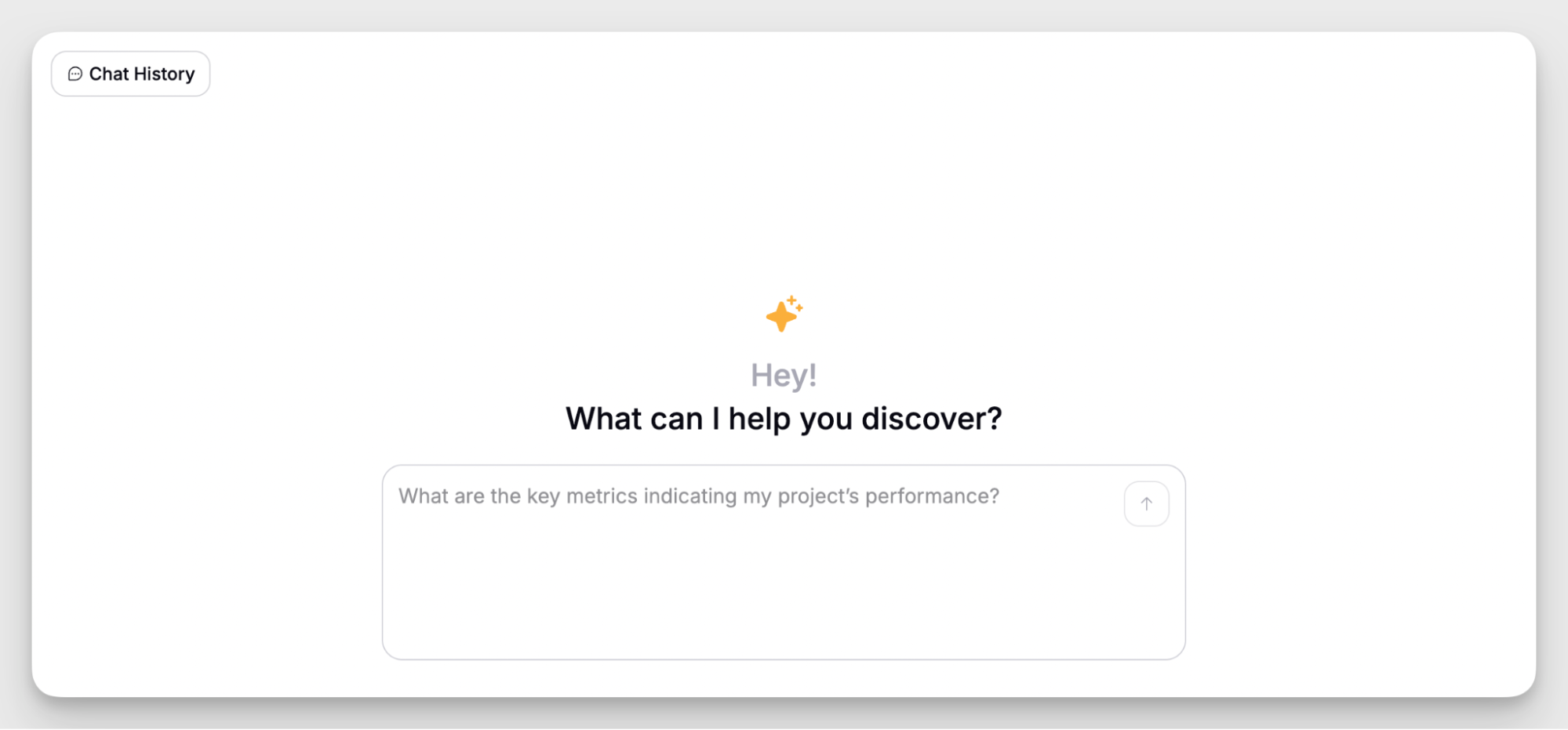
- Natural language querying so anyone on the team can ask questions without needing to build reports;
- Anomaly detection that monitors performance continuously in the background;
- Competitive benchmarking built into the same environment as your own data.
Outputs: what you get out
The output layer is where analysis becomes action. From a well-configured AI data analysis stack, your team should be able to produce:
- Executive summaries ready for leadership without manual report-building;
- Content recommendations backed by performance data rather than instinct;

- Competitive positioning snapshots updated in real time;
- Anomaly alerts that surface before issues compound;
- Forward-looking forecasts to inform quarterly planning.
Where Socialinsider fits in
Socialinsider, for example, is built around exactly this three-layer logic. On the input side, it pulls in performance data across Instagram, TikTok, LinkedIn, Facebook, and YouTube — including competitor profiles — so your entire dataset lives in one place rather than scattered across platform dashboards and exports.
The AI layer is where it earns its place as a data analysis AI tool for social teams specifically. Socialinsider's AI Assistant lets you query your data in plain language, getting direct answers to the questions you're actually asking rather than navigating dashboards to find them. The platform also generates AI-powered executive summaries at both the brand and competitive level, translating raw benchmarks into plain-language insights your team can act on immediately.

Content pillar analysis adds another layer, automatically categorizing your posts and your competitors' posts by theme so you can see what's driving performance without manually tagging anything.

On the output side, the combination of automated reporting, AI-generated summaries, and competitive benchmarks means your team spends significantly less time building reports and significantly more time using them.
How does AI facilitate cross-channel data analysis?
Most social media teams analyze platforms one at a time. You check Instagram performance, then LinkedIn, then TikTok, each in its own dashboard, each with its own metrics format, each telling a partial story. The problem isn't that the data isn't there. It's that the connections between platforms never get made, and those connections are often where the most useful insights live.
Cross-channel data analysis with AI changes this by treating your entire social presence as one dataset rather than a collection of separate ones.
Why siloed analysis leads to bad decisions
When you analyze platforms in isolation, you optimize for each one independently — and sometimes in ways that contradict each other. You might double down on posting frequency on Instagram because engagement looks healthy, without noticing that your LinkedIn audience is responding far better to the same content type with half the posting volume. Or you might conclude that a content pillar isn't working based on its TikTok performance, when the same pillar is actually your strongest driver on Facebook.
Siloed analysis also makes it harder to allocate time and resources intelligently. If you don't know which platform is genuinely moving the needle for your specific goals — reach, engagement, follower growth, or conversion — you're distributing effort based on assumption rather than evidence.
What AI makes possible across channels
AI data solutions built for cross-channel analysis don't just display metrics side by side, they actively look for relationships between them. This includes:
- Performance comparison by content type across platforms: understanding whether a format that works on one channel transfers to another, and where the drop-off happens.
- Unified audience behavior patterns: identifying when your audience is most active across platforms simultaneously, rather than optimizing posting times per platform independently.
- Cross-channel content pillar performance: seeing which themes resonate broadly versus which are platform-specific, so you build a content mix that serves your full presence rather than just individual channels.
- Competitive benchmarking across platforms: tracking how competitors distribute their effort and content across channels, and spotting gaps in their strategy you can move into.
The reporting advantage
Beyond strategy, cross-channel analysis with AI transforms how you report. Instead of assembling separate platform reports and trying to tell a coherent story across them, AI data insights tools generate unified views that show overall brand performance in one place, with the platform-level detail available when you need to go deeper.
For social media leaders presenting to stakeholders, this is one of the most immediate practical wins. A single, AI-generated executive summary that covers cross-channel performance, competitive position, and key recommendations takes minutes to produce rather than hours, and tells a cleaner story than five separate platform exports ever could.

Data analysis use cases: real scenarios for social teams
Understanding AI data analysis in theory is one thing. Knowing how to reach for it in the specific situations you actually face week to week is what makes it useful. Here are the scenarios I've seen social media and marketing teams run into most often, and how AI-powered data analysis can change the way you handle them.
When your engagement drops and you don't know why
This is one of the most common and frustrating situations in social media management. Numbers are down, but the platform dashboard doesn't tell you whether it's a content problem, a timing problem, an algorithm change, or something a competitor is doing differently.
AI analysis tools cut through this quickly. Instead of manually comparing week-over-week performance across formats, platforms, and content types, you can query your data directly — "what changed in my engagement over the last 30 days and where?" — and get a breakdown that points to the likely cause rather than just confirming the symptom. Anomaly detection adds another layer here: if the drop started on a specific date, AI can flag what else changed at that moment, whether that's a shift in posting frequency, a format change, or a spike in competitor activity.
When you need to report to leadership fast
Reporting is one of the biggest time drains for social media teams, and one of the highest-ROI applications of AI data solutions. Building a report that tells a coherent cross-channel story — performance against goals, competitive position, key wins and areas to address — used to mean hours of exporting, formatting, and writing.
With an AI-powered data analysis platform like Socialinsider, that same report is generated automatically. The AI pulls your performance data, benchmarks it against competitors, and produces a plain-language executive summary that's ready to share without manual assembly. For social media leaders who report upward regularly, this alone justifies the investment in AI data insights tools; it turns a half-day task into a fifteen-minute review.
When you're planning next quarter's content
Quarterly content planning without data tends to default to repeating what felt like it worked, adjusted for what's trending right now. AI for data analysis makes this process significantly more rigorous without making it significantly more time-consuming.
Before planning begins, you can use AI to analyze data from the previous quarter across three dimensions: what content pillars drove the most engagement, which formats performed best by platform, and how your content mix compared to competitors who outperformed you. That analysis gives you a concrete starting point — double down here, pull back there, test this format on this platform — rather than a blank page. Predictive AI tools add a forward-looking layer, using your historical patterns to forecast which content directions are most likely to perform in the coming period.
When a competitor suddenly outperforms you
Competitive shifts on social happen fast, and they're easy to miss until the gap has already opened. A competitor quietly doubles their posting frequency on TikTok. A brand you've been benchmarking against suddenly spikes in engagement after changing their content mix. A new player in your category gains ten thousand followers in a month.
AI that analyzes data continuously, rather than in periodic manual reviews, catches these shifts as they happen. With Socialinsider's competitive benchmarking and AI assistant, you can go from "I noticed a competitor is outperforming us" to "here's exactly what changed in their strategy and what we should consider doing differently" in a single session, without spending hours pulling and comparing data manually.
When you're trying to prove the value of social to stakeholders
This is arguably the highest-stakes use case for AI and data analysis in social media teams. Demonstrating ROI to stakeholders who don't live in social media dashboards requires translating performance data into business language, and doing it consistently, not just when you have time to build a compelling deck.
AI-powered data analysis platforms make this possible at scale. Instead of manually connecting engagement metrics to business outcomes, AI data analyzer tools surface the correlations and package them into formats non-technical stakeholders can actually engage with.
Final thoughts
Don't try to implement AI across your entire analysis process at once. Pick the single biggest friction point in your current workflow; for most social teams that's either reporting or competitive benchmarking, and solve that one thing first. Measure the difference, then layer in the next workflow.
The goal isn't to hand your analysis over to AI. It's to spend your time on the parts that actually require your judgment, and let AI handle everything that doesn't.
Socialinsider's 14-day free trial gives you access to the full AI analysis toolkit: cross-channel benchmarking, AI assistant, content pillar analysis, and automated reporting, across your own data and your competitors'.

Kseniia Volodina
With a background in journalism, Kseniia Volodina writes about social media analytics, audience research, and competitive data for teams that want strategy, not guesswork.

Know what your competitors do — before your manager asks
Get instant social benchmarks & reports without manual work.