How to Do a Social Media Competitive Analysis in 6 Steps
Get our free social media competitor analysis template, plus a 6-step framework to benchmark performance and spot content gaps.


If you're running a social media competitor analysis, you already know it's stopped being about tracking follower counts. Done right, it's the process of comparing your performance, positioning, and audience against competitors to see exactly where you stand and where the real opportunities are. And that's exactly what this guide will walk you through: a 6-step framework on how to get competitor data without needing account access, and a free template to make the process repeatable.
Alongside the framework, I've also included insights from Haley Correll, senior director of Content and Channel Strategy at American Red Cross, on how competitive analysis has changed in practice, to help you better shape your competitive reports. Let's dive in!
Key takeaways
- The 6-step framework covers competitor selection, performance benchmarking, a quick content read, audience overlap, industry benchmarking, and turning findings into action.
- Two tool categories cover most of what you need: a platform like Socialinsider for performance and benchmarking, plus a social listening tool for sentiment and mentions beyond what competitors post themselves.
- The biggest mistake isn't a tooling problem — it's copying instead of interpreting. Replicating a competitor's post rarely works, since your audience and positioning are different; the value is in understanding why something performed, not checklisting what to copy.
What is a social media competitive analysis supposed to uncover?
A social media competitive analysis is the process of studying your competitors' performance, positioning, and audience to understand where you stand and where the opportunities are.
It answers questions like: who's winning attention in your space, how does your engagement compare, and where is there room for you to differentiate.
This is distinct from a content competitor analysis, which goes deep into the content itself — hooks, formats, pillars, visual identity. Think of competitive analysis as the wider lens (performance, audience, positioning) and content analysis as the zoom-in (what specifically is working and why). You'll usually need both, but they answer different questions, and this guide focuses on the wider lens.
Haley shared why this matters more than it used to:
Competitive analysis used to be a reporting exercise. It was something you included in monthly reports for leadership or stakeholders. Today, it has evolved into strategic intelligence. What's changed is the focus. It's no longer about comparing follower counts or surface-level engagement. It's about understanding why content performs.

A few reasons this matters more in 2026 specifically: platforms now function as search engines, so competitors are fighting for discoverability, not just attention. Execution speed has become a growth lever; brands like Duolingo and Netflix win by testing and doubling down fast, and social media competitor audits are how you spot those patterns before you're reacting late instead of leading.
And content lifespan has gotten unpredictable, with posts resurfacing through recommendations days after publishing, which makes point-in-time snapshots less useful than ongoing tracking.

The 6-step framework for analyzing competitors on social media
Here's exactly how to analyze competitors on social media, step by step.
Step 1: Identify and select the right competitors to track
Before you analyze anything, you need the right competitors in your list. I try to zero in on accounts that fight for the same attention as my brand does, categorized into:
- Direct competitors: Brands offering the same product or service.
- Indirect competitors: Brands solving the same problem in a different way.
- Content competitors: Accounts competing for the same attention, even if they don't sell the same thing — media pages, niche communities, educational accounts.
- Creator competitors: Individual creators who often understand hooks, storytelling, and audience engagement better than many brands.
To find them: search your core keywords directly on Instagram, LinkedIn, TikTok, or YouTube and note which accounts show up repeatedly. Search Google for "top [your niche] brands" or "best [your category] tools." Check who your audience already follows and tags. And look at high-engagement posts in your niche, then track who created them. That's often your real competition in the feed.
If you're stepping into a new social media leadership role, this step carries extra weight. You're not just picking competitors, you're building the strategic map your entire team will work from. Check what your predecessor tracked, but treat it as a starting point, not a given.
Step 2: Benchmark performance metrics (engagement rate, follower growth, posting frequency)
Once your competitor set is locked, start with the core performance numbers. Engagement rate, follower growth, and posting frequency are your baseline three. Avoid the temptation to track every available metric before you've established these.
Posting frequency deserves specific attention here, since it directly explains a lot of the gap you'll see in the other two. Look at how many times a competitor posts per week or day, whether there are gaps in their cadence, and whether they post in bursts or a steady rhythm. High-performing accounts usually follow a clear, repeatable cadence rather than posting randomly, and a sudden posting spike is often the first visible sign a competitor has spotted something working and is doubling down on it.
Haley's filter for which metrics actually matter here:
The metrics that actually matter are engagement per impression, especially saves and shares. When someone saves a post or shares it, that's a clear signal the content has real value. On the other hand, metrics like total follower count or one-off viral posts are often overrated. They look impressive, but they don't reflect consistency.
Step 3: Get a high-level read on competitor content
At this stage, you just need a quick read on what's driving a competitor's numbers, not a full teardown. Look at their content mix (video vs. static, recurring series vs. one-offs), their general tone (educational, emotional, promotional), and whether one or two content pillars are clearly carrying most of their engagement.

This high-level pass is enough to inform the benchmarking and gap analysis later in this framework. If you want to go deeper, breaking down specific hooks, formats, and visual branding, that's exactly what our dedicated guide on how to do a content competitor analysis walks through step by step.
Step 4: Analyze audience overlap and demographics
This step answers a question performance metrics alone can't: are you actually competing for the same people? Two brands can post similar content and pull from entirely different audiences, which changes what a competitor's success actually means for you.
Look at:
- Audience overlap: how much of a competitor's audience also follows you, or follows other brands in your set. Heavy overlap means you're directly competing for the same attention; low overlap might mean you're adjacent rather than head-to-head.
- Demographic composition: age, gender, location, and active hours for each competitor's audience. A competitor with strong engagement numbers matters a lot more if their audience demographic matches the one you're trying to reach, and a lot less if it doesn't.
- Where the audience actually engages: some competitors have broad reach but concentrated engagement in a narrow segment of their following. That's a different signal than evenly distributed engagement across their audience.
A large, high-engagement competitor whose audience barely overlaps with yours is a far weaker benchmark than a smaller competitor whose audience looks a lot like the one you're trying to grow.
Step 5: Benchmark against industry and competitor averages
A number without context tells you very little. Once you have competitor-specific data, layer in industry averages so you know whether a gap is competitor-specific or true across your whole category.
Check your follower-to-engagement ratio against both your direct competitors and the broader industry average; a large audience with engagement below the industry norm usually signals weaker content or a passive following, regardless of what any single competitor is doing. Socialinsider's benchmark reports break this down by platform and industry, so you're not left guessing whether a metric is actually a red flag or just normal for your category.
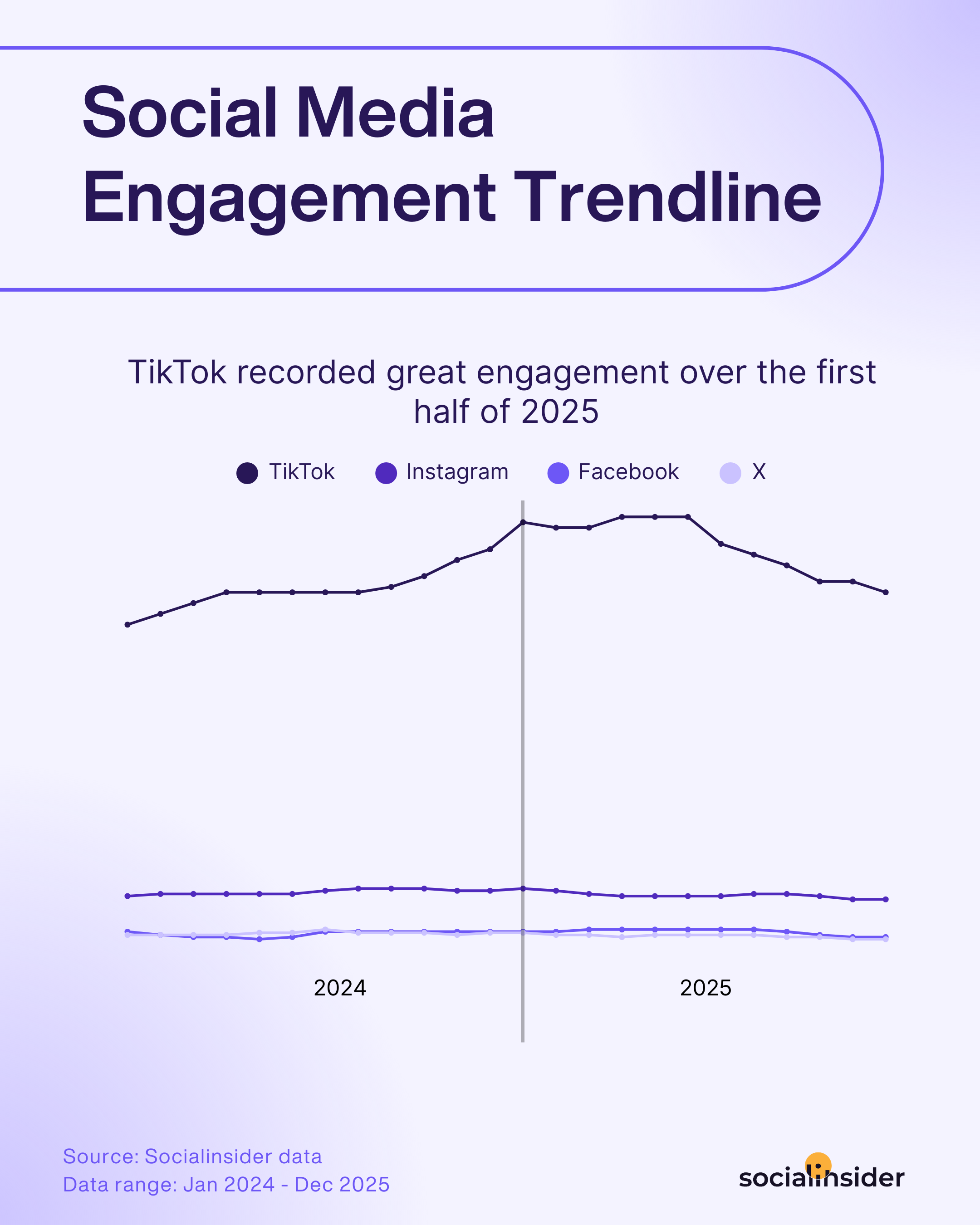
For social media leaders, this is often the step that ends up in front of a CMO or VP. When leadership asks "how are we doing compared to competitors," raw follower counts won't cut it, and neither will a vague "engagement is up." Being able to walk in with benchmarked, industry-contextualized data is what separates a leader who shapes strategy from one who just reports numbers.
Step 6: Turn findings into action — content gaps, positioning, opportunities
This is how competitive analysis becomes an actual advantage instead of a report nobody acts on.
- Analyze topics. Map what everyone in the industry talks about and identify where coverage clusters versus where it's thin — that's your visibility into saturated areas and open gaps.
- Look at format. Are competitors avoiding certain formats — educational series, long-form content, creator-led posts? Format gaps are often easier to win than topic gaps.
- Check comments and mentions. What are people asking that no one is answering? If the same questions keep surfacing and nobody's addressing them, that's a clear opening.
Once you've spotted the gaps, translate them into decisions: double down on the content pillars and formats consistently working, fix where your own strategy is falling short, and treat this as a recurring cycle rather than a one-time exercise. Each round of analysis should sharpen the next.
How to get competitor data?
Why native analytics can't show you competitor data
Here's the wall every team eventually hits: native platform analytics — Instagram Insights, TikTok's dashboard, LinkedIn Analytics — only show data for accounts you manage. There's no toggle inside any of these platforms that lets you pull a competitor's engagement rate, audience demographics, or posting history, because that data simply isn't exposed to accounts you don't own or manage.
This is the exact gap that turns competitive analysis into a manual, incomplete guessing game for most teams — scrolling a competitor's feed and eyeballing engagement instead of actually measuring it.
Using Socialinsider to analyze any public account across platforms, without requiring access
Socialinsider solves this directly: it lets you analyze any public social account, including competitors', across platforms, without needing to be added or granted access. Here's how I use it to run this exact framework:
- Add competitor profiles. Go to Projects, click "Add Social Profiles," and enter the competitor's account link or name.
- Go to the Benchmarks section in the Tools menu and customize the dashboard with the metrics that matter for your analysis — this is where Steps 2 and 5 above happen in practice.
- Click into individual profiles to check content format distribution, format by reach, top-performing content, and content pillars — your Step 3 high-level content read.
- Use the AI Assistant to ask specific questions directly against the competitive data you've pulled together.

Nobody wants to spend weeks manually jumping between profiles and stitching numbers into a spreadsheet. Consolidating this into one dashboard is what makes running the full 6-step framework realistic on a recurring basis, rather than something that only happens once a quarter when someone finally has the time.
Social media competitive analysis template
To make this process easier to apply, here's a practical social media competitor analysis template you can use with your team.
What's included and how to use it
Instead of starting from scratch, the template walks through every step in this framework: identifying competitors, benchmarking performance, doing a quick content read, checking audience overlap, comparing against industry averages, and logging action items from your findings. Use it as a living document: rerun it on a set cadence (monthly or quarterly, depending on your resources) rather than filling it out once and letting it go stale.
Tools overview for social media competitive analysis
You don't need a dozen tools to run this framework well. Two categories cover most of what matters.
Socialinsider: performance and benchmarking
For the performance, benchmarking, and audience layers of this framework (Steps 2, 4, and 5), Socialinsider is built specifically for social media competitive analytics, cross-platform benchmarking, content pillar breakdowns, and the ability to analyze any public competitor account without needing access to it.
A social listening tool: sentiment and mentions
For a fuller read on sentiment and brand mentions beyond what's happening directly on competitor profiles, a social listening tool (Brandwatch, Mention, Talkwalker) adds the conversation layer, tracking what's being said about a competitor across platforms, forums, and news, not just what they're posting themselves.
For a full comparison of competitive intelligence tools beyond social media, see our competitive analysis tools guide.
Common competitive analysis mistakes
- Copying competitors blindly. What works for a competitor may not work for you; their audience, positioning, and voice are different. Understand why something worked, then adapt that insight to your own strategy.
Haley put it directly:
The biggest mistake I see is brands copying instead of interpreting. Competitive analysis should reveal patterns and opportunities, not become a checklist of things to copy. When you approach it that way, you're always a step behind.
- Tracking vanity metrics. Follower counts and likes look impressive but rarely tell the full story. Prioritize comments, shares, saves, and engagement rate instead.
- Ignoring smaller competitors. Some of the best insights come from smaller or emerging accounts that experiment faster and discover what works before larger brands catch on.
- Skipping the audience overlap check. A competitor's high engagement means far less if their audience doesn't actually resemble the one you're trying to reach.
- Treating it as a one-time audit. A social media competitor audit done once a year is already stale by the time you act on it. This works best as an ongoing cycle, not a periodic scramble.
Final thoughts
Competitive analysis works when it leads to action. Run through the 6 steps, get competitor data through a tool built for it rather than manual guesswork, and use the template to make the process repeatable instead of a one-off scramble. Once you've got a solid read on where you stand, that's your cue to go deeper — pairing this framework with a full content competitor analysis to understand exactly why the top performers in your space are winning.
To make the entire process easier, subscribe to Socialinsider's 14-day free trial and try the tool for your brand.
FAQs about social media competitive analysis
How to analyze competitors on social media without their account access?
Native platform analytics only show data for accounts you manage. To analyze a competitor's performance, audience, and content, you need a dedicated tool built to pull data from public profiles — Socialinsider does this across Instagram, TikTok, LinkedIn, Facebook, X, and YouTube.
How often should you run a social media competitor audit?
Monthly for core performance metrics, and a deeper quarterly review covering audience overlap and industry benchmarking. Trends and competitor strategies shift fast enough that an annual audit is usually stale before you act on it.
What's the difference between social media competitive analysis and content competitor analysis?
Competitive analysis is the broader lens: performance, positioning, and audience overlap across your competitive set. Content competitor analysis zooms into the content itself: hooks, formats, pillars, and visual identity. Most teams need both, but they answer different questions.
Nidhi Parikh
Nidhi Parikh is SaaS writer that believes scrolling through social media is research for work. When not working, find her binge watching the latest series or reading anything she can get her hands on.

Know what your competitors do — before your manager asks
Get instant social benchmarks & reports without manual work.