Top Social Media Marketing Challenges: Stories and Tips from 20+ Experts
What social media marketing challenges do marketers face every day on the job? Discover stories and insights shared by over 20 industry experts.

What does a social media manager do, besides scrolling on their phone all day?
Between juggling a brand’s social media strategy and just about every task related to social media marketing, managers of social media accounts wear a lot of hats and have their hands full at all times.
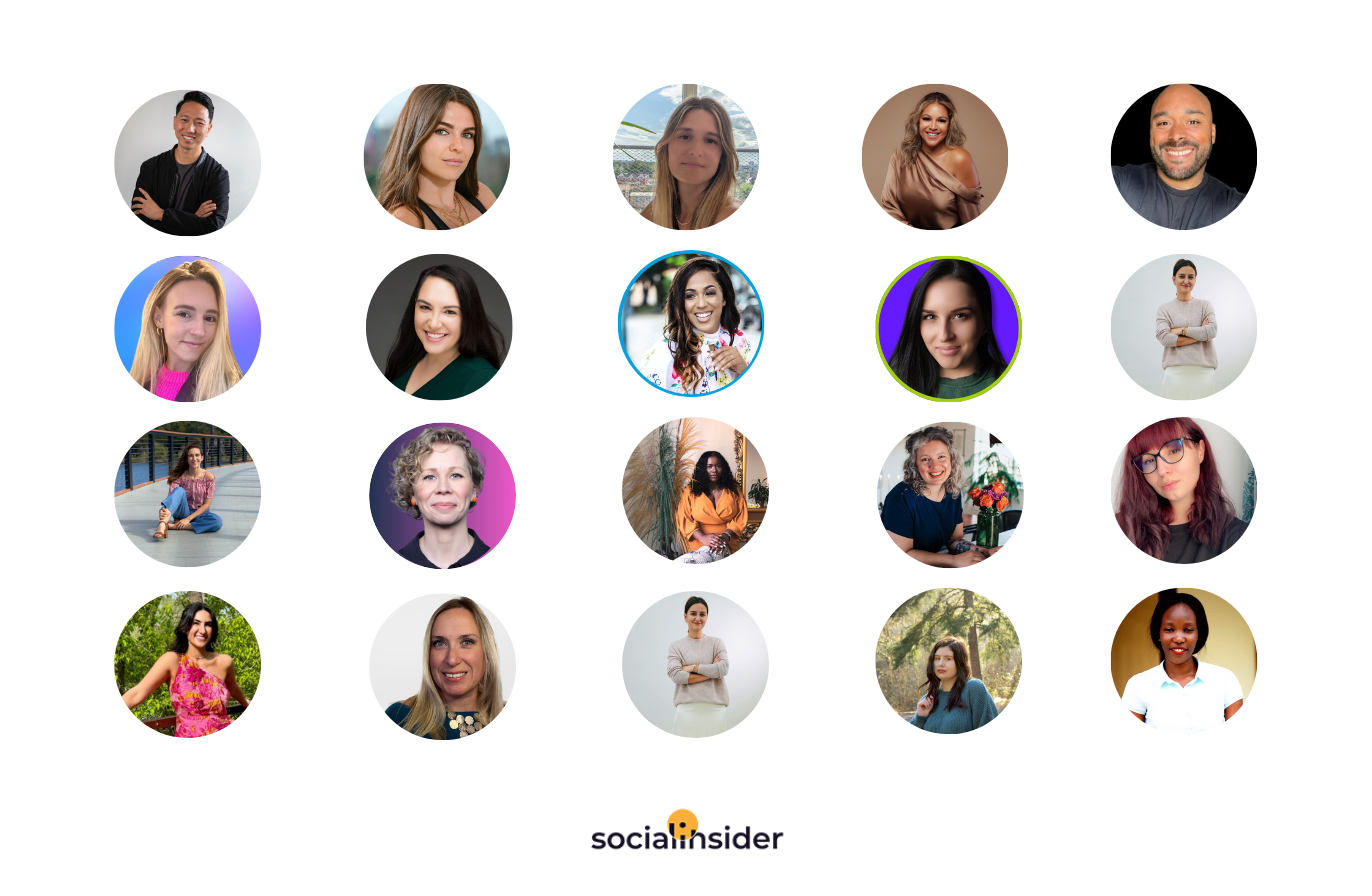
So what is the biggest challenge that most social media managers have? Well, that depends on who you’re asking—so we asked over 20 social media experts to share their stories with us. In this article, I’ll be covering the main social media marketing challenges and pain points marketers experience in their day-to-day jobs.
So, let’s turn on that empathy switch and explore some of the most common social media challenges for marketers:
Content fatigue
One of the important tasks that falls under a social media manager’s responsibility is content creation. Given that video dominates social platforms these days, creating content is not usually limited to copy, but also includes other types of social media content such as videos, infographics, and carousels.
All of these take hours, if not days, to complete and take up a lot of creative energy. You can imagine that this is a lot to undertake for a single person, and not all that sustainable in the long run.
That’s why a lot of social media managers list content fatigue under their top marketing challenges. Being expected to constantly create original content that’s able to somehow stand out from the sea of content already shared every day is frustrating and puts many social media managers on a path to burnout.
On the other hand, audiences always expect fresh, non-repetitive content on a regular basis, so the pressure to continue to surprise and entertain them is making social media marketers frequently run out of creative bandwidth.
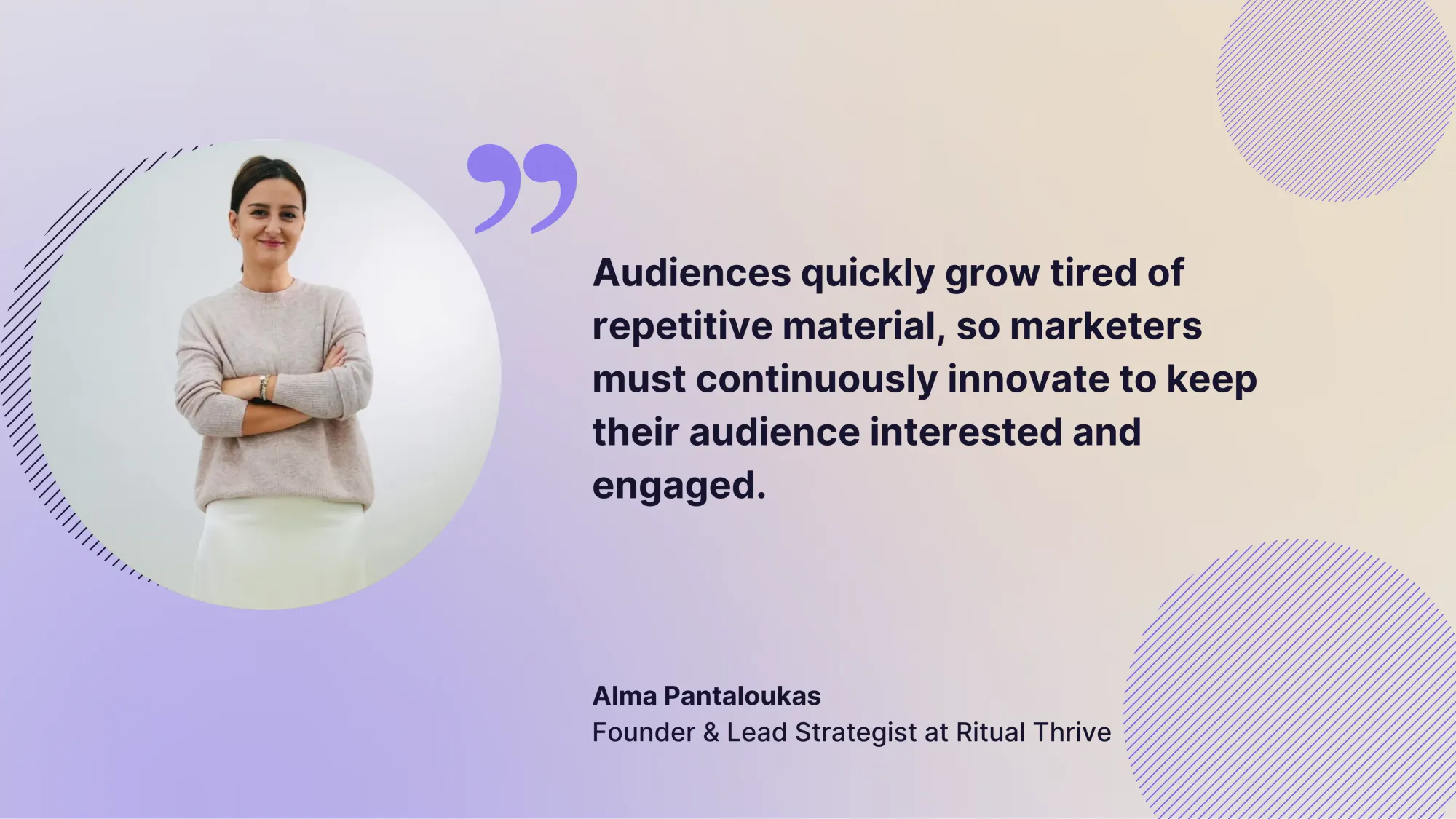
Audiences quickly grow tired of repetitive material, so marketers must continuously innovate to keep their audience interested and engaged. - Alma Pantaloukas, Founder + Lead Strategist @ Ritual Thrive
Tips to overcome this challenge:
- Original research and reports—One way to combat content fatigue is to create content based on original research on your customers and user base. Not only does this ensure you never run out of content ideas, but it also helps you offer unmatched value to your audience, therefore outperforming your competitors.
- Incorporate new content pillars for social media—Carry out some research to figure out what new content pillars you could be writing content around. Exploring new topics can help you get out of a creative slump.
- Create company-culture videos instead of following trends—You don’t always need to look to the outside to get ideas for content creation; your own company culture can serve as inspiration. So, instead of adding to the sea of memes that exists on social media, create company-culture videos that help your audience get to know your company values and the human element behind it.
- Collaborate with SMEs (Subject Matter Experts)—Consider reaching out to SMEs in your niche and industry to develop new content in collaboration with them. Not only is this a valuable learning opportunity for you, but it’s also a great way to significantly expand your brand’s reach on social media.
Lack of trust from upper management
When asked what are some challenges to overcome in social media, many marketers point to a lack of trust and support from the executive team.
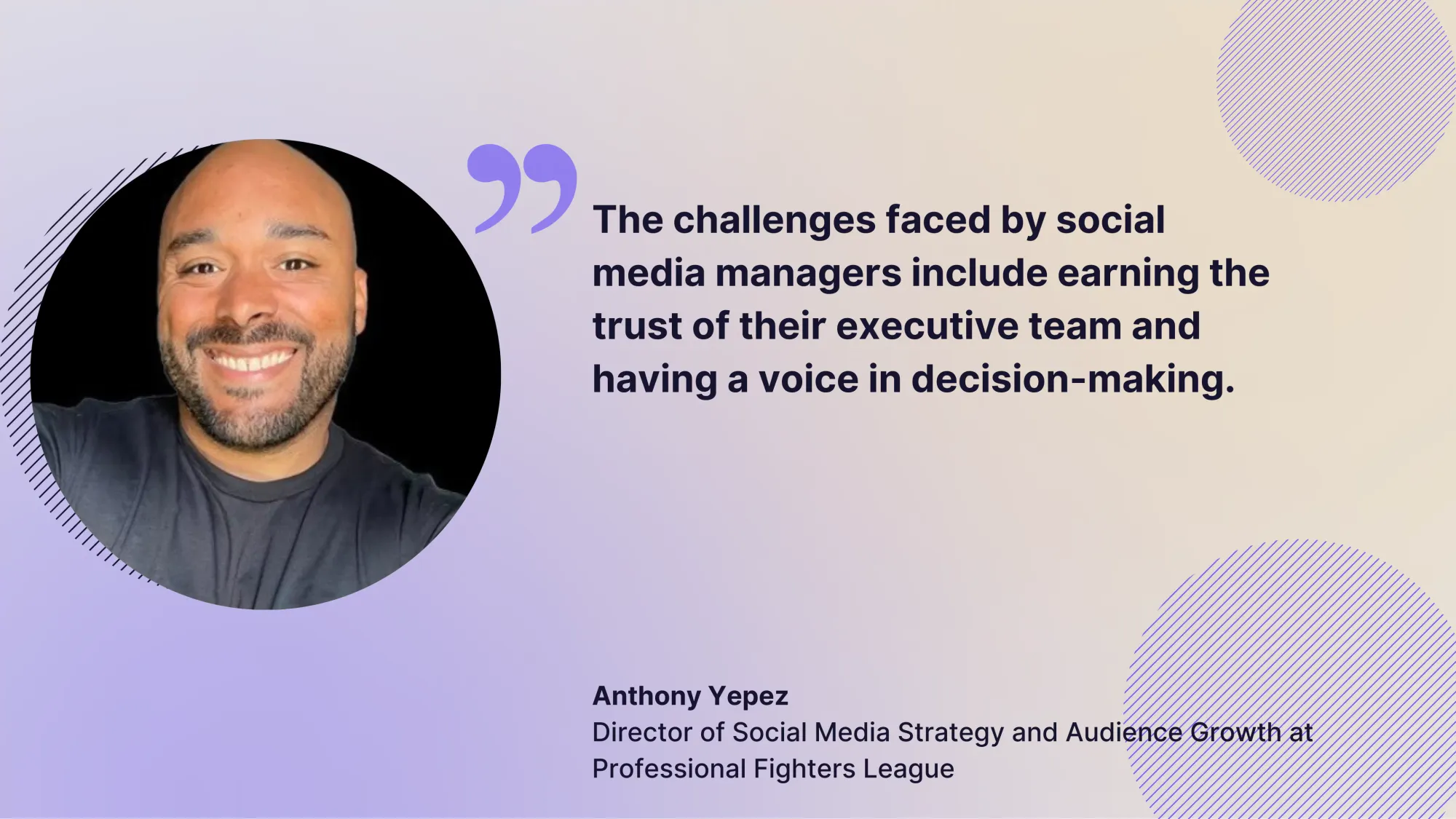
The challenges faced by social media managers include earning the trust of their executive team and having a voice in decision-making. — Anthony Yepez, Director of Social Media Strategy and Audience Growth at Professional Fighters League
Although the role of social media manager has been around for a while, many are faced with challenges when it comes to earning the trust of the executive team and being taken seriously.
Despite having first-hand experience with managing social media, including strategy, community management, and content creation, social media managers are often left out of the decision-making process.
That’s either because the executive team doesn’t trust that the social department can do a good job, or they simply don’t understand the social media ROI. And the question of how to account for social media marketing ROI is particularly challenging in itself.
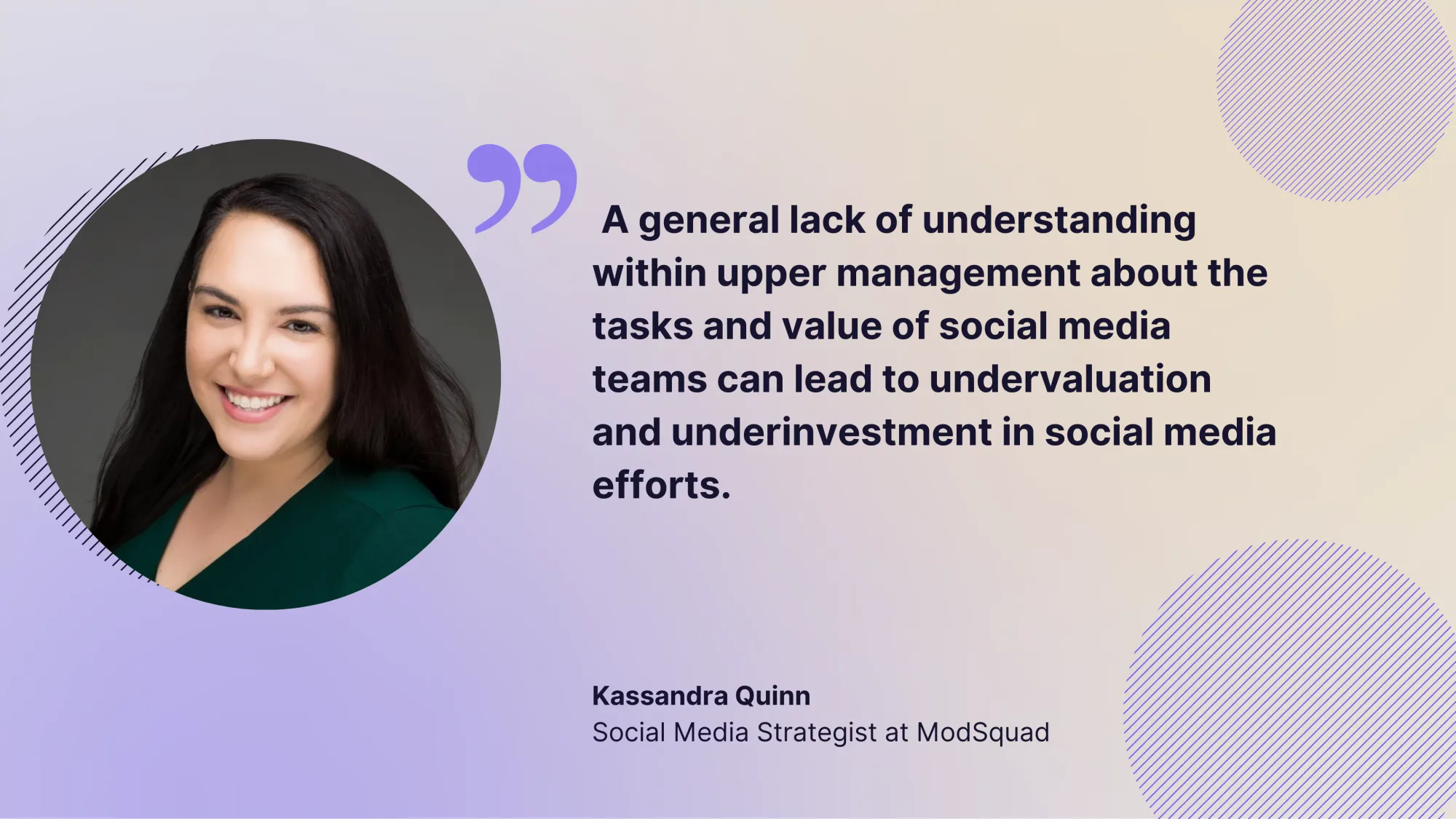
A general lack of understanding within upper management about the tasks and value of social media teams can lead to undervaluation and underinvestment in social media efforts. — Kassandra Quinn, Social Media Strategist @ ModSquad
The lack of trust from higher-ups leaves social media managers feeling unheard, and in some cases, it even makes them lose confidence in their own abilities. Some find themselves in a position to make a business case for social media, which in itself is frustrating and time-consuming.
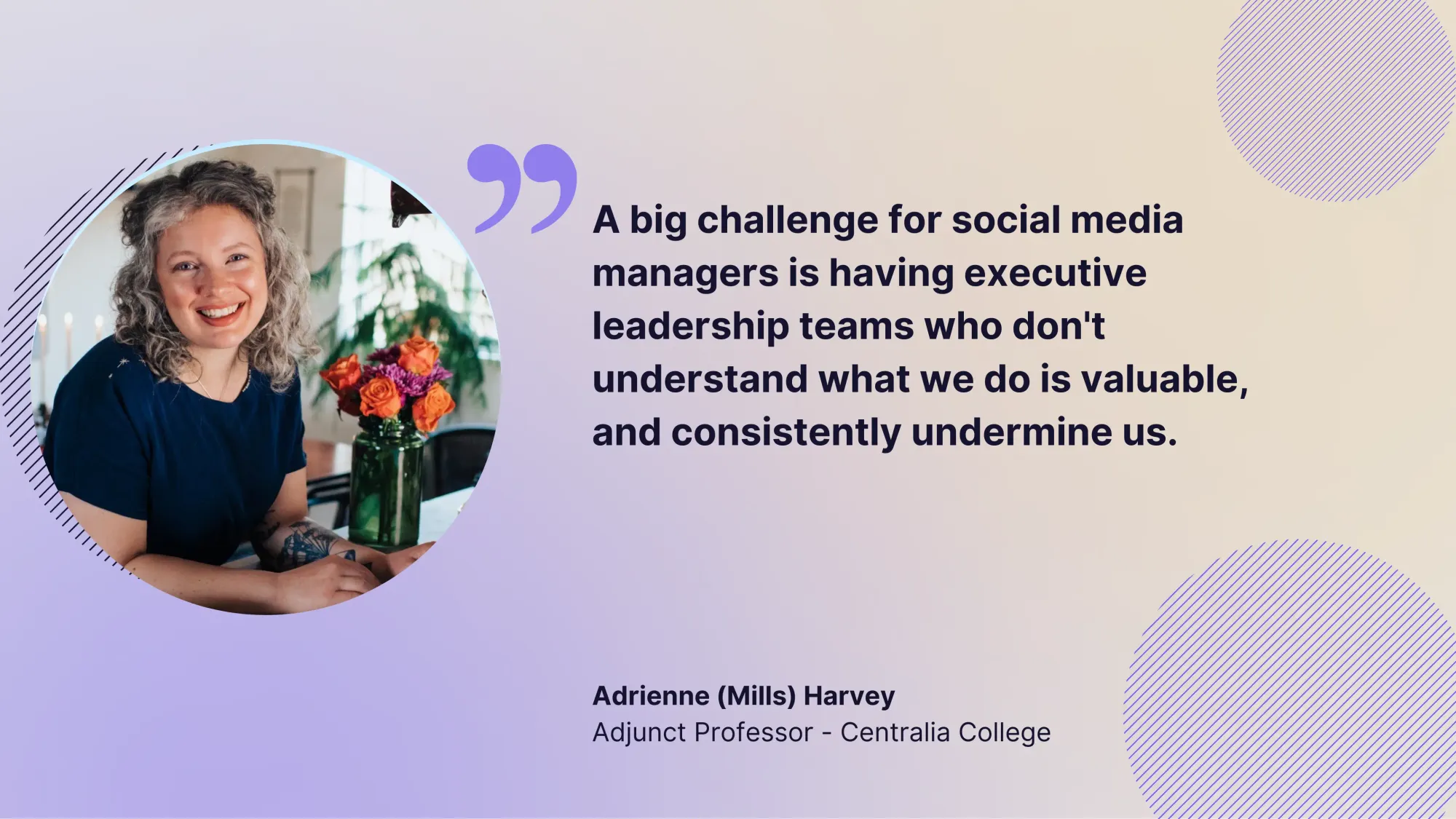
A big challenge for social media managers is having executive leadership teams who don’t understand what we do is valuable, and consistently undermine us. — Adrienne (Mills) Harvey, Adjunct Professor @ Centralia College
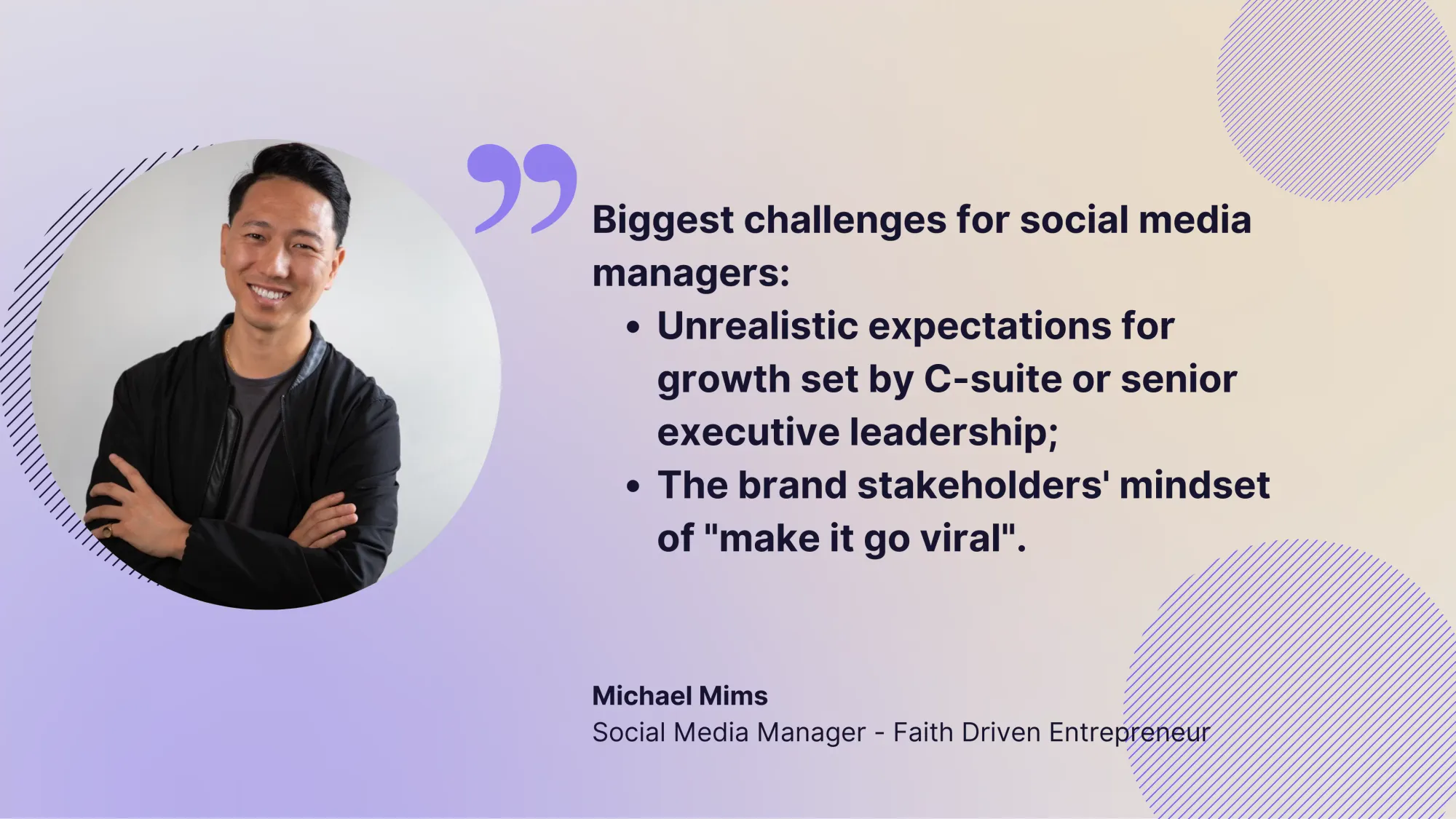
Biggest challenges for social media managers: unrealistic expectations for growth set by C-suite or senior executive leadership and the brand stakeholders’ mindset of “make it go viral”. — Michael Mims, Social Media Manager & Faith Driven Entrepreneur
Tips to overcome this challenge:
- Create comprehensive social media dashboards—Numbers never lie, so the best way to show C-level executives the value of social media work is to create custom social media dashboards that cover a wide mix of metrics: engagement, follower growth, competitor analysis, sentiment analysis, reach, impressions, and social media ROI.
- Create metrics documentation for the upper management team—Take it one step further and educate upper management on what each metric means and what role it plays in the broader social media performance picture.
- Prove how social media goals align with business goals—When you’re making the case for the value of social media, speak the language of upper management. Focus on key metrics they care about (e.g., traffic, leads, conversions, customer support response time on social media), connecting the dots between your strategy and the overall business plan.
- Collaborate with other teams—Set up workflows with the marketing, product, and support teams where you can exchange ideas on how to help the business grow across all channels.
Limited budgets
It’s not unheard of that social media managers go to the trouble of creating multi-channel social media strategies, unique influencer marketing campaigns, and paid ads, only to fail to obtain the budget necessary for the content to ever go live.
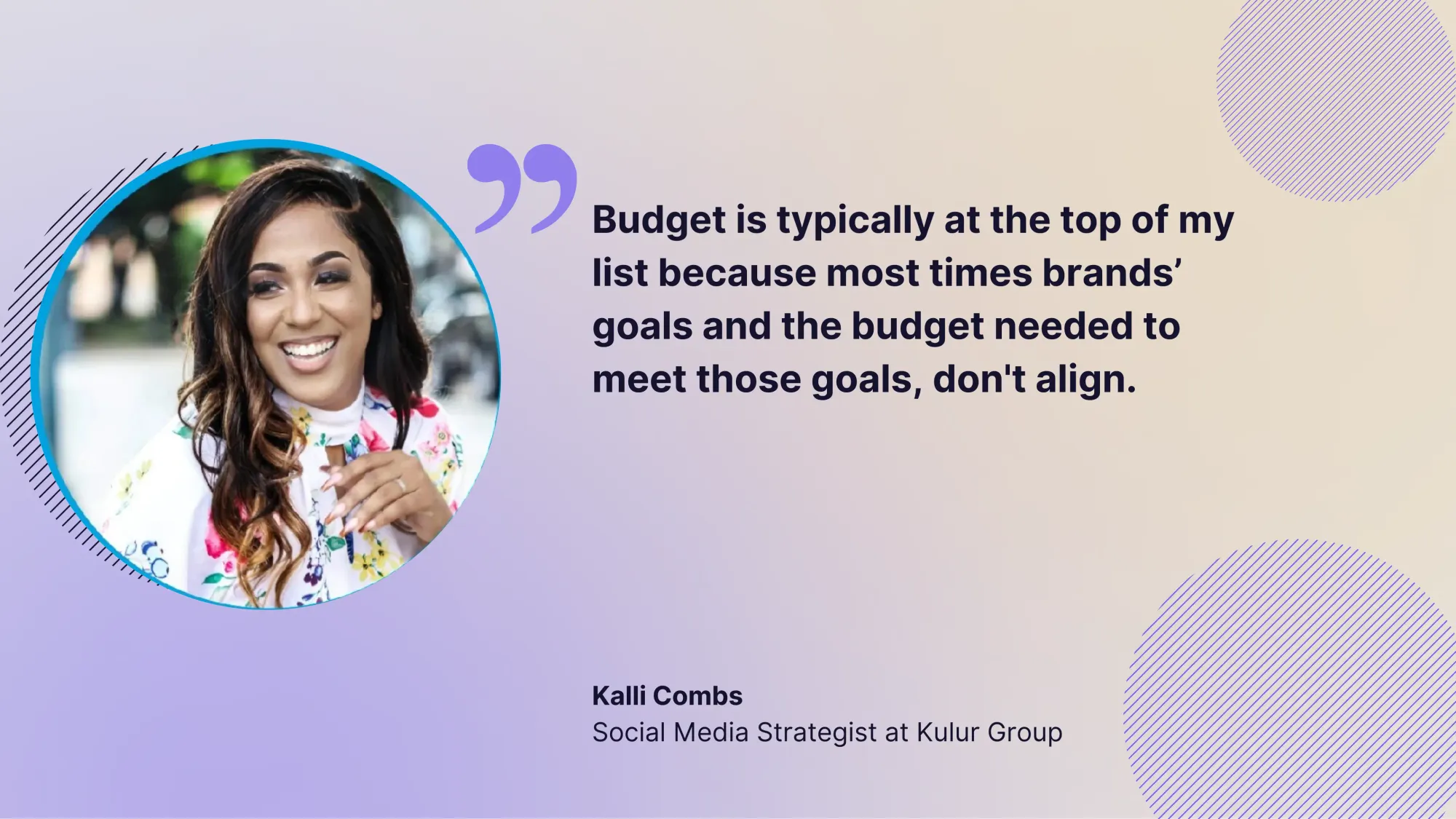
Budget is typically at the top of my list because most times brands’ goals and the budget needed to meet those goals, don’t align. SMM are typically a team of one because of the lack of budget. — Kalli Combs, Social Media Strategist @ Kulur Group
Given the decline of organic reach, brands really need to step up their game to achieve the results they want. Competing against industry giants who spend thousands of dollars on paid advertising makes it tough to succeed on a limited budget.
Budget limitations are one of the most common social media marketing problems, and they don’t just affect paid advertising. They are also a main reason why a single individual is a social media manager, social media strategist, videographer, community manager, and more, all at once.
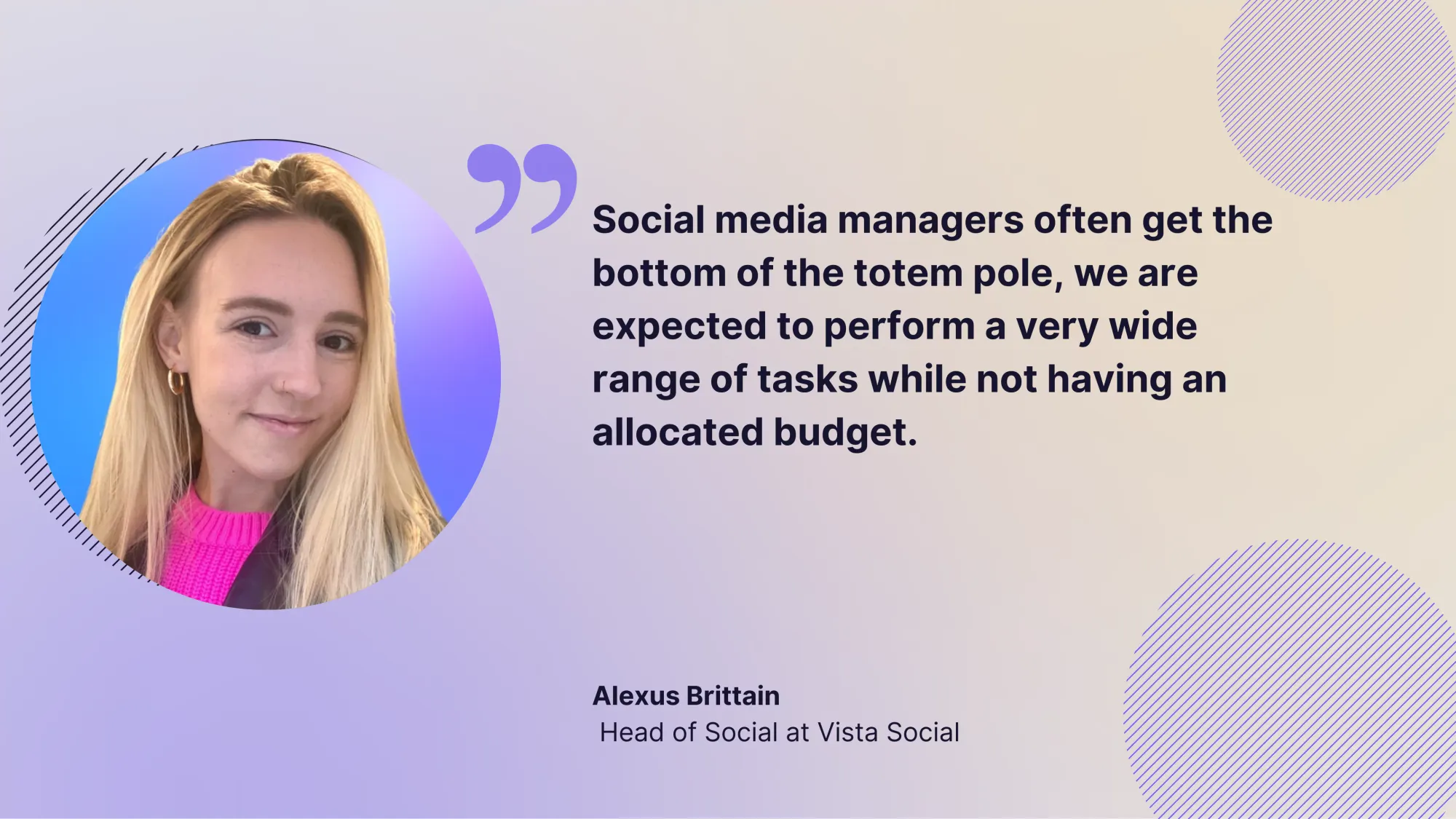
Social media managers often get the bottom of the totem pole, we are expected to perform a very wide range of tasks while not having an allocated budget — Alexus Brittain, Head of Social @ Vista Social
Many teams are way too small for the amount of work that they are assigned, because the executive team doesn’t see the value in hiring more people.
At the end of the day, limited budgets make it almost impossible for social media professionals to do their job right and meet social media goals, which results in a lot of frustration and friction between the social team and upper management.
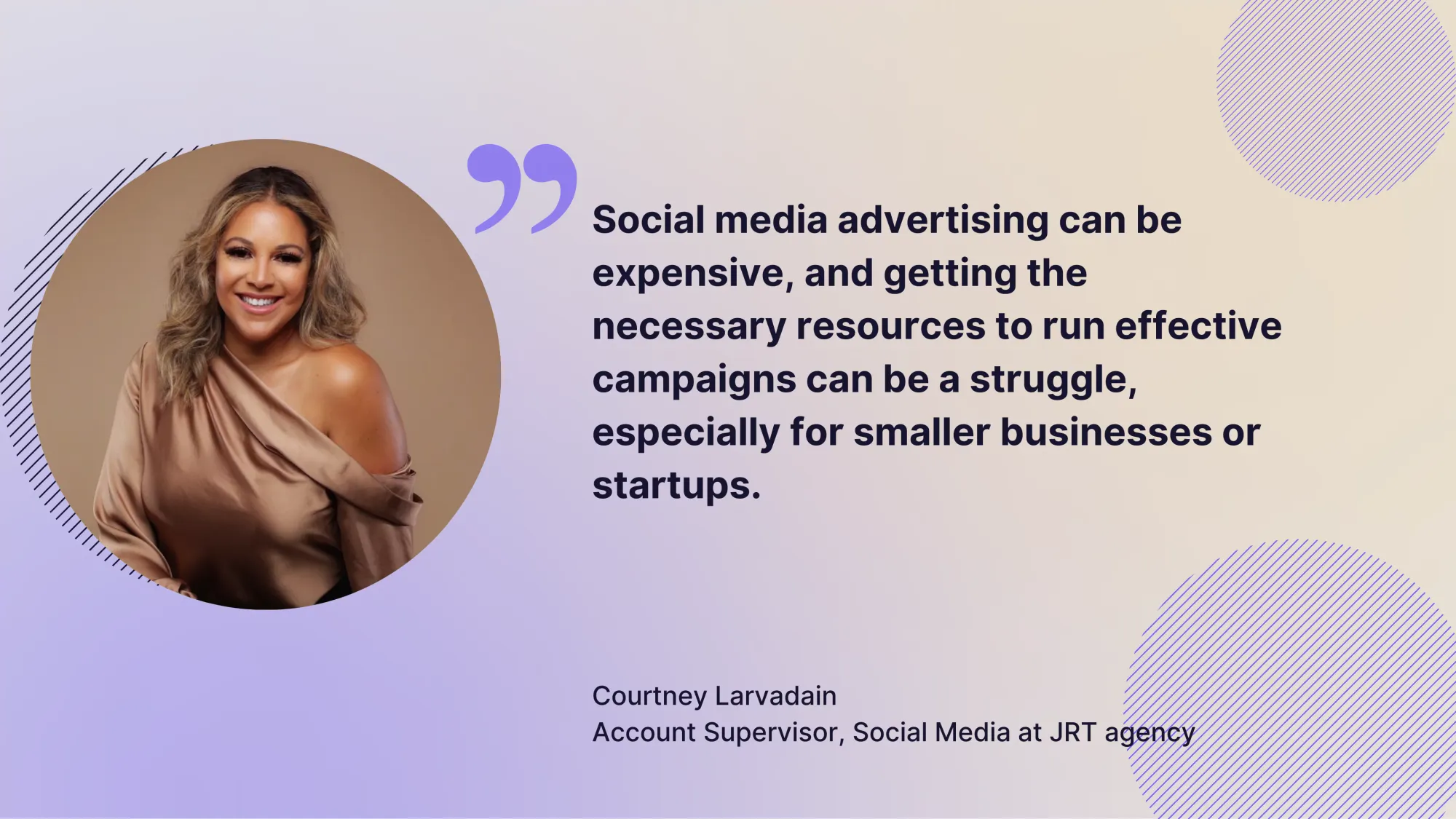
Social media advertising can be expensive, and getting the necessary resources to run effective campaigns can be a struggle, especially for smaller businesses or startups. — Courtney Larvadain, Account Supervisor, Social Media the JRT agency
Tips to overcome this challenge:
- Ask for a one-time budget increase—The best way for upper management to understand the benefits of investing in social media is by showing them that it makes a difference. Ask for a small amount of money in order to do an experiment. Boost a few posts, or get in touch with an influencer to help promote a specific campaign, document the performance of this experiment by tracking social media analytics and doing a thorough campaign analysis, then present the results to the executive team.
- Advocate for the value of outsourcing some social media work—If you’re a team of one and you often find yourself doing the work of several people, consider asking upper management to start outsourcing some tasks related to social media work, such as video editing, creation, and design.
- Back your social media results with analytics—Give C-level executives a reason to invest in social media by proving your current results with analytics data. Upper management is interested in tracking follower growth vs their competitors and TAM (total addressable market) in a specific region, as well as reach, impressions, and engagement, so make sure your reports cover all these numbers.
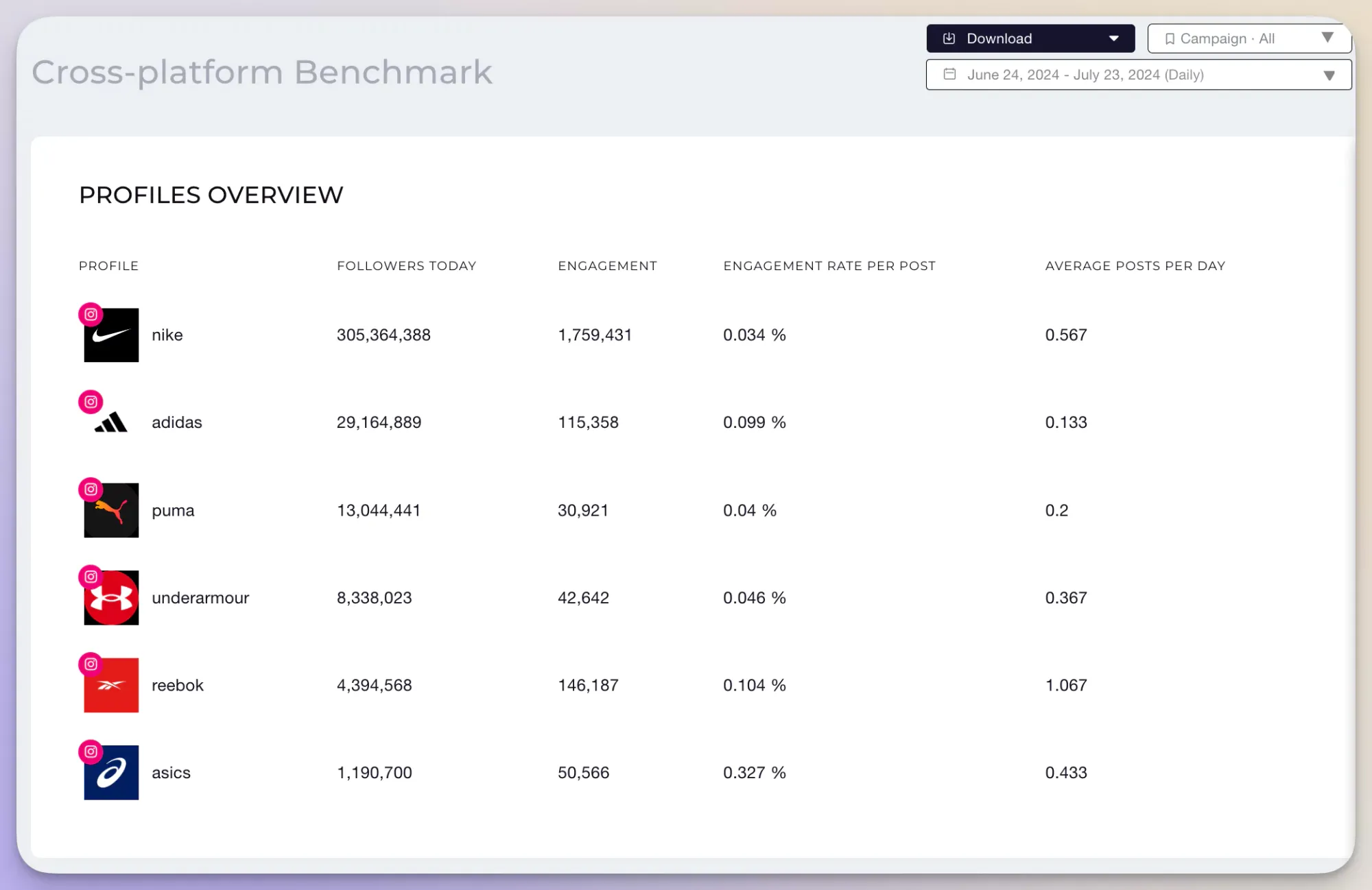
Overcome social media challenges with real-time data from Socialinsider!
Monitor cross-channel performance, analyze key metrics, and see how you stack up against your competitors at any moment.
Start a 14-day FREE TRIALFinding the right tools
Trying to choose the right marketing tools feels like speed-dating with dashboards. Everyone promises “end-to-end insights.” Everyone says they’re “the only tool you need.” Meanwhile, social media managers are stuck duct-taping three platforms together just to answer one question from leadership.
And when platforms like TikTok and LinkedIn exploded in importance, most social media analytics tools were caught flat-footed. Data gaps everywhere. Missing metrics. Delayed reporting. You know the drill.
Socialinsider built its reputation by covering exactly those blind spots. TikTok profile analytics? There. TikTok competitor benchmarking? Also there. LinkedIn analytics that actually go deep? Finally, a thing. Instead of juggling screenshots and spreadsheets, everything lands in one place—clear, comparable, and ready for strategy, not survival.
The right tools aren’t about shiny features. They’re about removing friction from your day. And for teams drowning in multi-tab madness, this kind of centralized visibility is oxygen.
Tips to overcome this challenge:
- Audit your current tool stack and remove anything that creates more work than it saves. When you tie social media metrics to business outcomes, it’s much easier to determine which tools give you the visibility you need without jumping through hoops, and which don’t.
- Consolidate workflows around a single, central source of truth—It’s hard to have a bird’s eye view of your social media performance when your eyes are scattered across all the social platforms you’re present on. But when you bring all the data in a single dashboard, and you see everything side by side (and Socialinsider can definitely help with this!), the picture becomes much clearer.
Time-consuming, manual social media reporting
Manual reporting is the silent killer of creativity. Nobody talks about it because it sounds boring, but it eats hours of your life and melts your brain in slow motion. Bethany, Social Media Manager at Listing Leads, said their viral-content research alone “was taking us a lot of time,” sometimes swallowing hours every single day. Not posting. Not strategizing. Just… digging.
Gabriel, Marketing Manager at Inteligencia Audiencia, had the same uphill climb. Before Socialinsider, competitive checks meant opening individual profiles one by one, like it was 2014 (the company was operating “without any report, without any calculations, and without any strategy”). Click, scroll, copy, paste, repeat. Every week. For every competitor. Multiply that by platforms, and the math gets sad quickly.
Automated reporting flips that entire workflow on its head. With Socialinsider, those daily searches turn into a dashboard refresh. Viral posts surface automatically. Competitor wins rise to the top without you stalking anyone’s feed. Monthly reports stop being handcrafted artisanal PDFs and become repeatable, scheduled exports.
Suddenly, hours come back to you. Strategy comes back to you. And the job stops feeling like a never-ending scavenger hunt.
Tips to overcome this challenge:
- Automate recurring reports to eliminate manual data pulling—That’s the moment you stop losing half your week to CTRL-C, CTRL-V purgatory. The data just shows up, clean and ready, and you finally get to spend your mornings thinking rather than hunting.
- Use dashboards to surface viral posts and competitor shifts instantly—Instead of scrolling through feeds like it’s your side job, the insights rise to the top on their own. You see what’s blowing up, who’s surging, all without doing the detective work. It feels unfair, in the best way.
- Standardize monthly reporting templates so nothing is built from scratch again—There’s no worse feeling than opening a blank doc on reporting week. A template kills that dread. Same structure, same flow, every time; you just drop in the data and adjust the story. It turns what used to be a full-day slog into something closer to a routine pit stop.
Data silos
Data silos are the quiet chaos inside most companies. Marketing has one set of numbers. Social has another. The data strategy team guards their dashboards like a dragon protecting gold, not because they want to, but because giving access to everyone is a logistical nightmare.
Guilherme’s (Data Strategy Team at Terra Networks / Telefónica Brazil) situation paints the exact picture: he needed to ensure other teams could access reliable social data without giving them full platform permissions (“we tend to work a lot by allowing people to use data without having to resort to give them access directly to the platform… They might just want to check some big numbers… and it’s our job to consolidate those views for different teams”). It wasn’t a trust issue; it was an efficiency crisis.
Socialinsider essentially becomes the shared living room for social data. No more “Can you export that for me?” messages. No more back-and-forth over which metric is “the real one.” Everyone looks at the same dashboards, the same benchmarks, the same insights, without touching native platforms at all.
This centralization does more than remove friction. It builds internal trust because people finally believe the numbers they’re seeing. And when data becomes accessible instead of territorial? Decision-making speeds up across the whole company.
Tips to overcome this challenge:
- Centralize social data in a shared platform accessible to all relevant teams—This alone dissolves half the friction inside a company. When everyone can peek at the same dashboards, the entire workflow suddenly breathes. People stop waiting for “the numbers guy” to pull a report, and decisions stop bottlenecking.
- Replace scattered spreadsheets with unified dashboards—Spreadsheets have their charm, sure, but not when you’re juggling eight versions of the same report across four teams. A unified dashboard means there’s no guessing, no outdated tabs, no “wait, who updated this last?” panic. Everything refreshes automatically, everything matches, and your brain stops leaking energy on file management instead of actual strategy.
- Define one “official source of truth” for all social performance metrics—This sounds corporate, but it’s actually a sanity-saver. When a company agrees on a single, definitive place where performance is tracked, arguments disappear. No more people showing up with contradictory numbers pulled from who-knows-where. One source. One story. One version of reality everyone can align around. It’s shockingly calming.
One-person social media team
For many marketers, poor resource allocation is a very difficult challenge to overcome in their day-to-day jobs. Besides money, executive teams often hesitate to spare any staff or time to help the social media team achieve its goals.
One of the most common results of this poor resource management is that social media managers are a team of one. They are tasked with the work of several people, and what’s worse, they are often denied access to important assets such as social media analytics tools for measuring performance in real time and getting crucial competitive insights.
Therefore, strategizing, performing brand audits, and getting valuable social media benchmarks becomes very difficult.
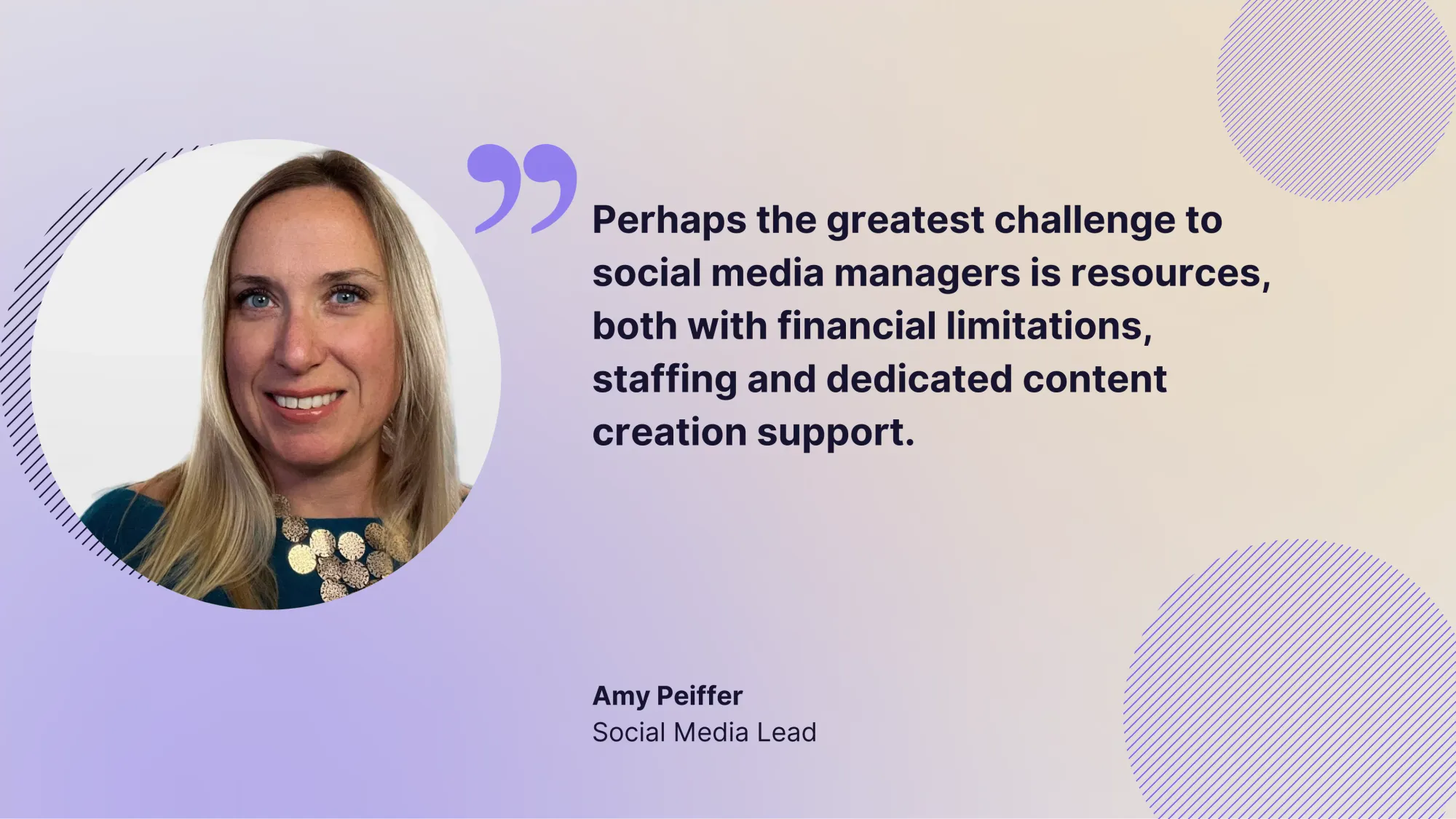
Perhaps the greatest challenge to social media managers is resources, both with financial limitations, staffing and dedicated content creation support. Many large businesses and organizations still see social media as “free” advertising and fail to understand the time investment of social media success in brand building, so managing expectations is always a struggle as well. — Amy Peiffer, Social Media Lead
Small and large companies alike fail to see social media as a priority channel, or they simply consider it free advertising, and don’t understand the need to invest any resources into its development.
What’s more, social media managers are expected to hit the ground running, despite the fact that very few resources are often invested in their onboarding and training process. All of this makes poor resource allocation one of the biggest social media pain points.
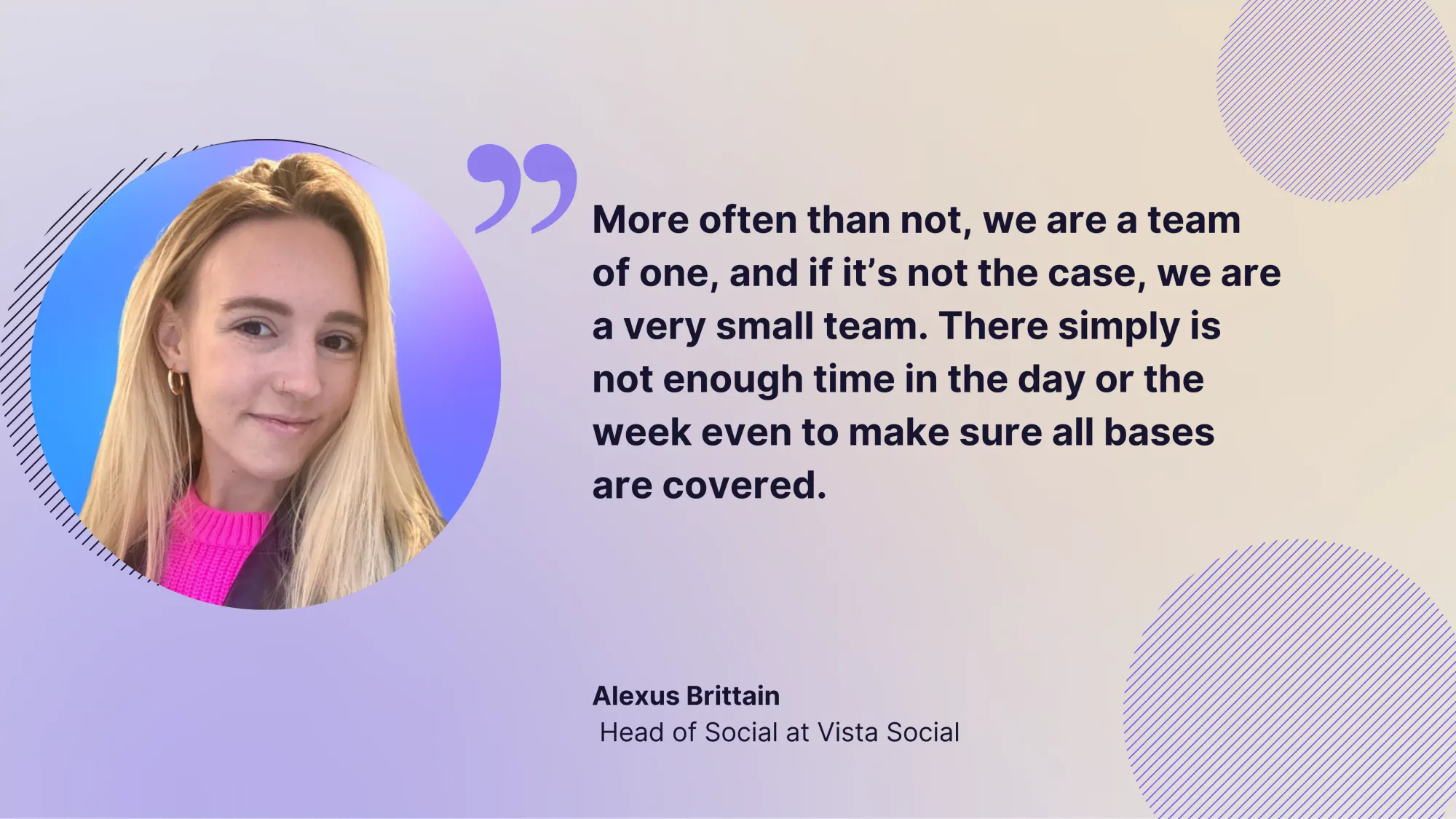
More often than not we are a team of one. If that’s not the case, we are a very small team, and there simply is not enough time in the day or the week even to make sure all bases are covered. — Alexus Brittain, Head of Social @ Vista Social
Tips to overcome this challenge:
- Search for affordable tools—Be on constant lookout for new tools that can help enhance and simplify your work, and choose those that offer the best value for money.
- Explain the need for investment in social media—Once you’ve explored the limitations of social media marketing with no resource investment, it’s time to speak up and explain why some money, time, and effort are needed in order to take social media to the next level. Prioritize key tools and resources such as social media analytics and social listening tools, recording equipment (if you’re creating video content), and so on.
Lack of standardized procedures
On any given Tuesday, a social media manager’s to-do list looks like the junk drawer everyone avoids opening. Everything feels urgent. Nothing is actually prioritized. And the absence of clear workflows? That’s where chaos settles in and gets comfortable.
Agencies feel this pain in stereo.
Many agencies do not have procedures in place in order to actually make social media work as a service for their agency. — Michelle Locke, Digital Media Coordinator
Michelle wasn’t exaggerating. Most teams operate on instinct, not systems. And when things go sideways (especially legally), the lack of defined playbooks becomes painfully obvious. Mariya nailed it:
Many lack playbooks and internal processes to navigate difficult external conversations, especially those requiring immediate, legally compliant responses. — Mariya Spektor, Social Media @ SocialChain
This is exactly where Socialinsider quietly becomes the adult in the room. Instead of digging for numbers across seven platforms or guessing which competitor post is suddenly outperforming, Socialinsider builds the structure for you. Competitive benchmarking becomes automatic, not a rabbit hole that steals your morning. Reporting turns into a repeatable workflow instead of a fresh nightmare every month.
Agustin, Director of Audience Development at Impremedia, was literally “flying blind” before he gave Socialinsider a try (“We have zero idea about our competitors... we were blind.”); now he finally sees where his brand stands, who is actually winning in the market, and what strategic levers matter. That shift, from instinct to clarity, is what standardized procedures feel like when they’re backed by data you can trust.
The real win? Social teams get to reclaim their time and focus on work that isn’t purely reactive. Upper management makes cleaner decisions. And the inbox panic slowly fades.
Tips to overcome this challenge:
- Schedule regular meetings to discuss priorities—Business goals change as companies grow and achieve more milestones (or competitors launch big campaigns overnight), so your social media priorities will also change, sometimes quarterly or even monthly. So make sure to schedule frequent check-ins with upper management to figure out what your top priorities are, and what tasks can be delegated or postponed until further notice.
- Keep a daily/weekly/monthly to-do list of your tasks—Create a list or spreadsheet outlining your recurring tasks to keep yourself accountable and track progress on each one of them. Whenever possible, mention deadlines, bottlenecks, or any other dependencies. Make sure to also note down what was delayed, postponed, or removed entirely from your to-do list and why.
Constant pressure to innovate
Building and maintaining an engaged audience requires ongoing effort and innovative strategies. The need to produce a constant stream of fresh and engaging content can be difficult for certain niches. — Summer Browne, Marketing Executive @ Alphatec Engineering
Navigating the ups and downs of social media can feel pretty exciting, particularly for young social media managers at the start of their careers. Social media is a highly dynamic field, and there’s always something new to experiment with—a new trend, a new channel, a new approach to social media strategy.
However, after a while, social media marketing challenges start piling up, and the constant pressure to innovate starts weighing down on social media professionals, who find it hard to keep coming up with new ways to keep their audiences interested, engaged, and ever-growing.
It’s not just about content, though. Continuously chasing trends on social media is the biggest challenge and downright exhausting for some social media managers.
They are constantly pressured to seek new horizons, jump on any new social media trends, and expand the brand’s social media presence to every newly-launched platform, although that doesn’t always make sense for the brand from a strategy perspective.
The surge in content creation coupled with the pressure to innovate, often leaves Social Media Managers grappling with inadequate resources, talent, and budget. — Mariya Spektor, Social Media @ SocialChain
Tips to overcome this challenge:
- Make data-driven decisions—Rely on constant social media analysis to understand what’s working and what’s not. Market research can reveal crucial competitive intelligence, which you can use to decide whether it’s a good idea to jump on a new trend or platform. When asked, present this data to upper management so they too can understand your strategy.
- Stay true to your brand values—No matter what choices you end up making, make sure they align with your social media branding strategy. What’s more, you can leverage your own company values and culture to produce evergreen behind-the-scenes content for social media.
- Create an ownable format that outperforms the rest—Identify the one content format that performs significantly better than the rest or that people associate your brand with the most. To give a real-life example, think of Duolingo’s owl mascot TikToks.
Pressure of being (and staying) on top
Some brands just want “good performance.” Others? They want the crown. Alfonso, Marketing Manager at Noxsport, told us directly: “We have the goal to be the paddle brand with more followers and the best engagement in the industry.” That’s not a KPI—that’s a mission. And missions come with a different kind of pressure.
When your target is industry dominance, every metric feels personal. Every competitor’s win stings a little. Every platform shift feels like someone just moved the finish line again. Social managers working under these expectations aren’t just posting; they’re constantly scanning the horizon for threats, opportunities, and sudden algorithm curveballs.
This is where competitive intelligence stops being “nice to have” and becomes the entire playbook. Socialinsider gives you that 360° radar: who’s posting more, who’s engaging better, who suddenly doubled their reach last week, and why. It’s not about paranoia, it’s about strategy. Staying on top requires knowing what the top even looks like at all times.
And once you can see the whole battlefield? The pressure gets a little lighter. You’re no longer guessing, you’re leading!
Tips to overcome this challenge:
- Keep an eye on your competitors—Use Socialinsider to benchmark your performance against your competitors or industry peers to see where you’re standing. You can even set up automatic alerts so that when they launch a new campaign and their engagement spikes through the roof, you’ll be the first to know.
- Review industry benchmarks regularly to spot shifts before leadership does—Your average engagement rate is 3.5%, but what does this mean? Are you above or below your industry? This is crucial information that could turn the tables in your favor in the next meeting.
- Identify the formats where your brand wins and double down ruthlessly—You know your social media performance is great, but do you know why? Is it because you post daily? Is it because you’ve started posting carousels instead of single images? Is it because you’ve joined a trend or used a trendy sound? Or is it because you’ve made educational posts a core content pillar of your strategy? You can’t do more of what works if you don’t know what works.
Balancing leads/sales and community management
Balancing sales pressure with actual community-building is like trying to host a dinner party while someone keeps shouting “So what’s the ROI?!” from the kitchen. Yes, leadership wants leads. They want conversions. They want to know which post is paying rent. But if social becomes a nonstop sales megaphone, audiences scatter—fast.
Executives default social media metrics to numbers that feel familiar: traffic, conversions, lead gen, and revenue influence. Social managers, meanwhile, are desperately trying to protect engagement, sentiment, retention, and brand credibility—all the invisible threads that actually create sales. And when leadership pushes back on creativity in favor of “more sales-forward posting,” Dejaih’s frustration hits home: it kills experimentation and suffocates long-term strategy.
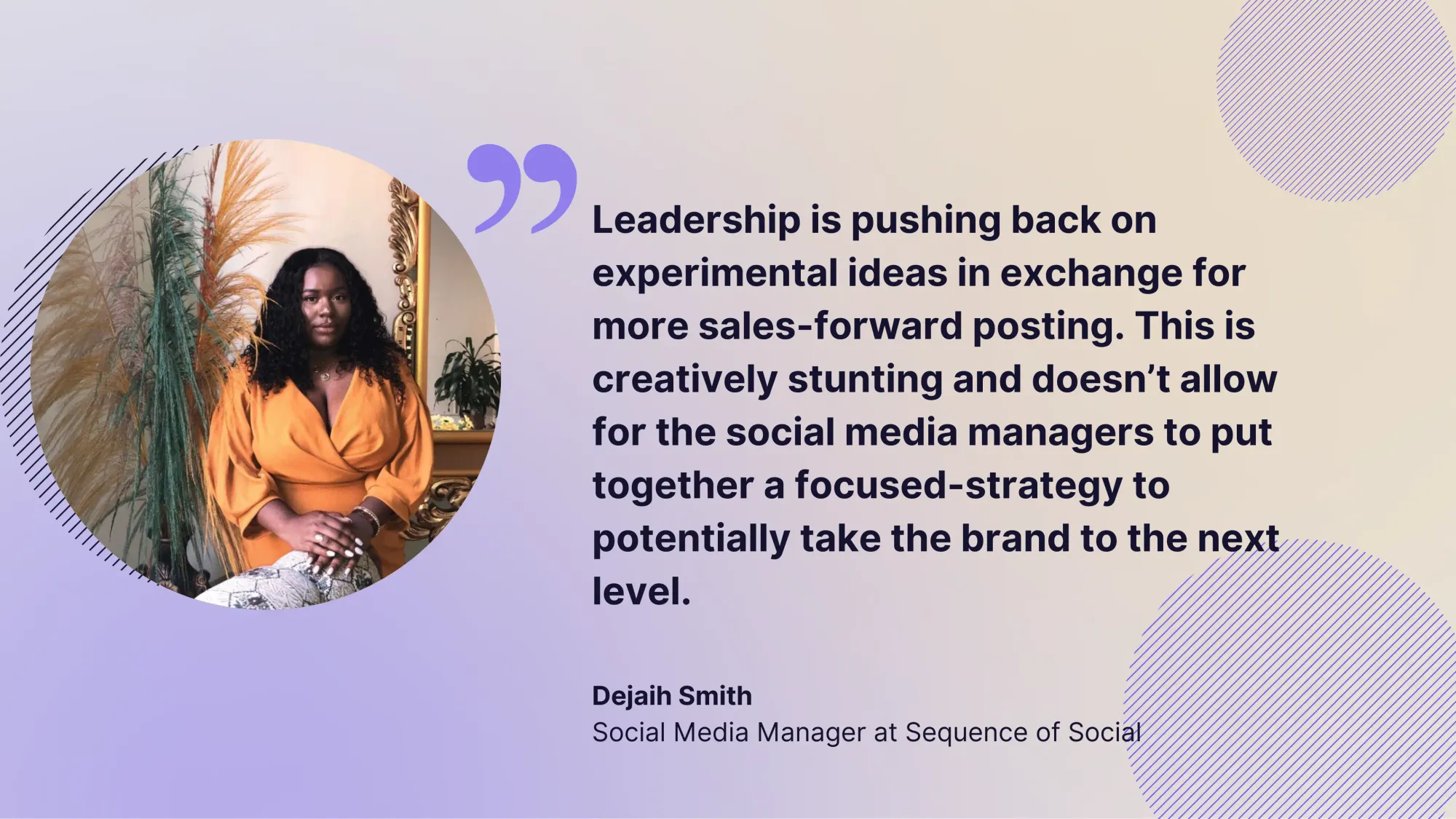
Leadership is pushing back on experimental ideas in exchange for more sales-forward posting. This is creatively stunting and doesn’t allow for social media managers to put together a focused-strategy to potentially take the brand to the next level. — Dejaih Smith, Social Media Manager @ Sequence of Social
Here’s where data becomes your unexpected peace treaty. With Socialinsider’s Organic Value feature, you can finally translate social activity into metrics executives recognize as real business impact. Not vibes. Not “awareness.” Actual comparable value. Suddenly, engagement doesn’t look fluffy, it looks like money saved and reach earned.
So instead of choosing between sales and community, you can prove how both feed each other. Zero-click posts keep people engaged. Occasional CTAs send warm traffic downstream. Community insights shape smarter product and sales conversations. And you get to operate like someone who understands the whole ecosystem, not just one loud KPI.
With the right data, leadership stops fighting you and starts trusting the strategy. And that pressure to “sell harder” shifts into a healthier rhythm: create value, build loyalty, drive action when it matters.
Tips to overcome this challenge:
- Use social media for demand generation—The trick is to find a sweet spot between a sales-driven approach and building a community based on offering values and having meaningful interactions. Prioritize zero-click content and limit the number of URLs shared per week to 1. Only direct your users to important brand events such as webinars or product launches.
- Take feedback from your community—Set up a feedback loop by asking your community about their needs, preferences, and experiences. This will likely contribute to brand loyalty, and it helps you and your sales team refine the sales strategy to match the needs of your present and future clients.
- Create a closed social media community —To bring your community closer, the best course of action is to create a safe space where they can share insights, network, and learn new tactics. This is also an opportunity for you to share behind-the-scenes content that will definitely humanize your brand.
Pressure to deliver fast results (aka “make it viral”)
In their day-to-day job, social media managers have to deal with a lot of interference from the executive team or from clients.
This type of interference doesn’t just lead to micromanagement, it can also create unrealistic expectations when it comes to social media performance. Not knowing the inner workings of platform algorithms, many expect social media managers to simply produce one viral post after another.
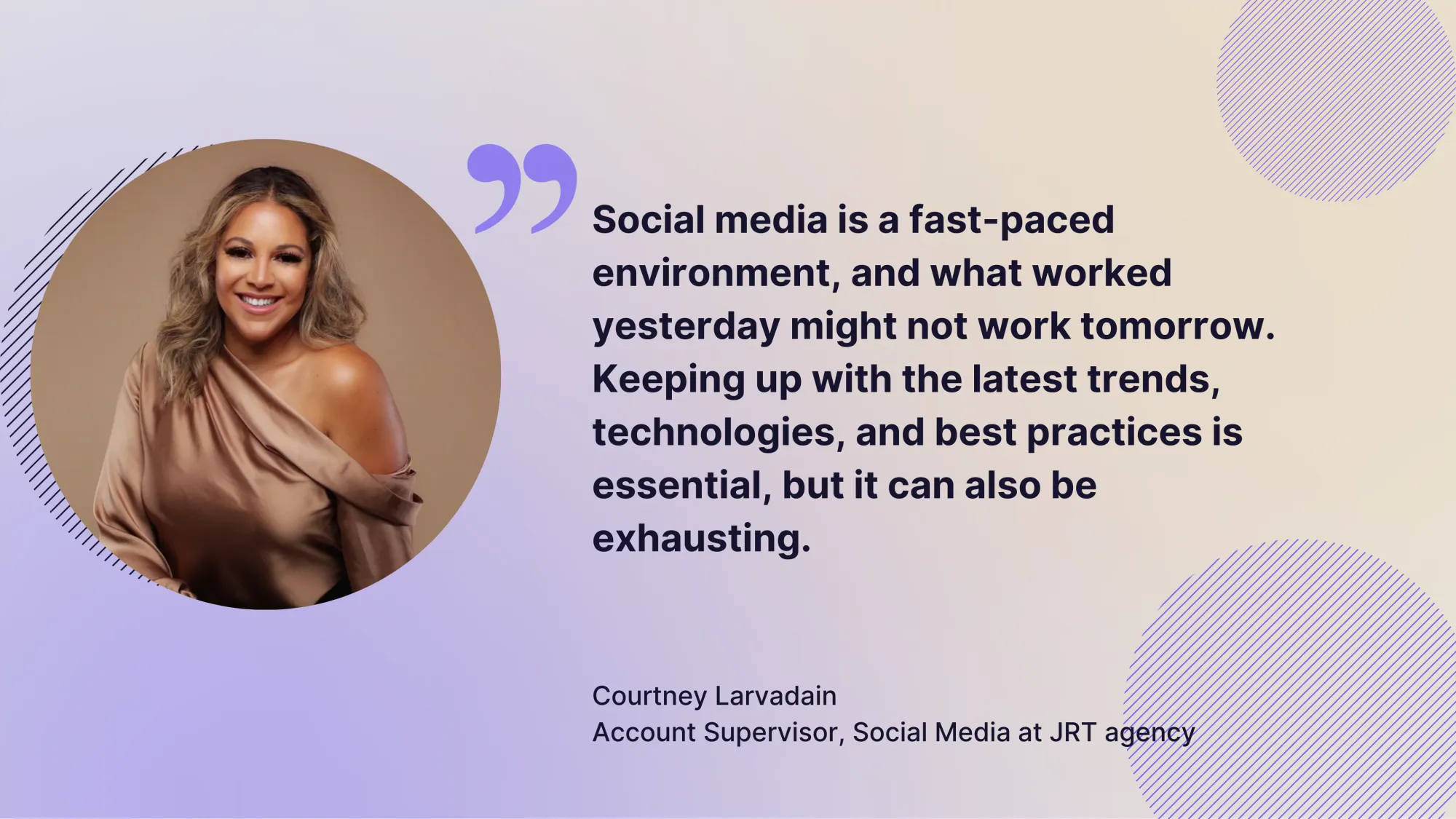
Social media is a fast-paced environment, and what worked yesterday might not work tomorrow. Keeping up with the latest trends, technologies, and best practices is essential, but it can also be exhausting. – Courtney Larvadain, Account Supervisor
The pressure to deliver fast results is a major headache for marketers, who know that virality is a game of chance and that good results take time. Constantly building brand awareness, engaging with the community, and sharing valuable content are what ultimately create social media success stories, not a series of viral TikToks.
So, if you were to ask any social media manager, “What is the biggest challenge that most social media managers have?”, their answer would most likely be unrealistic expectations and the lack of understanding when it comes to virality vs a steady, committed approach to a slow-paced, product-led growth.
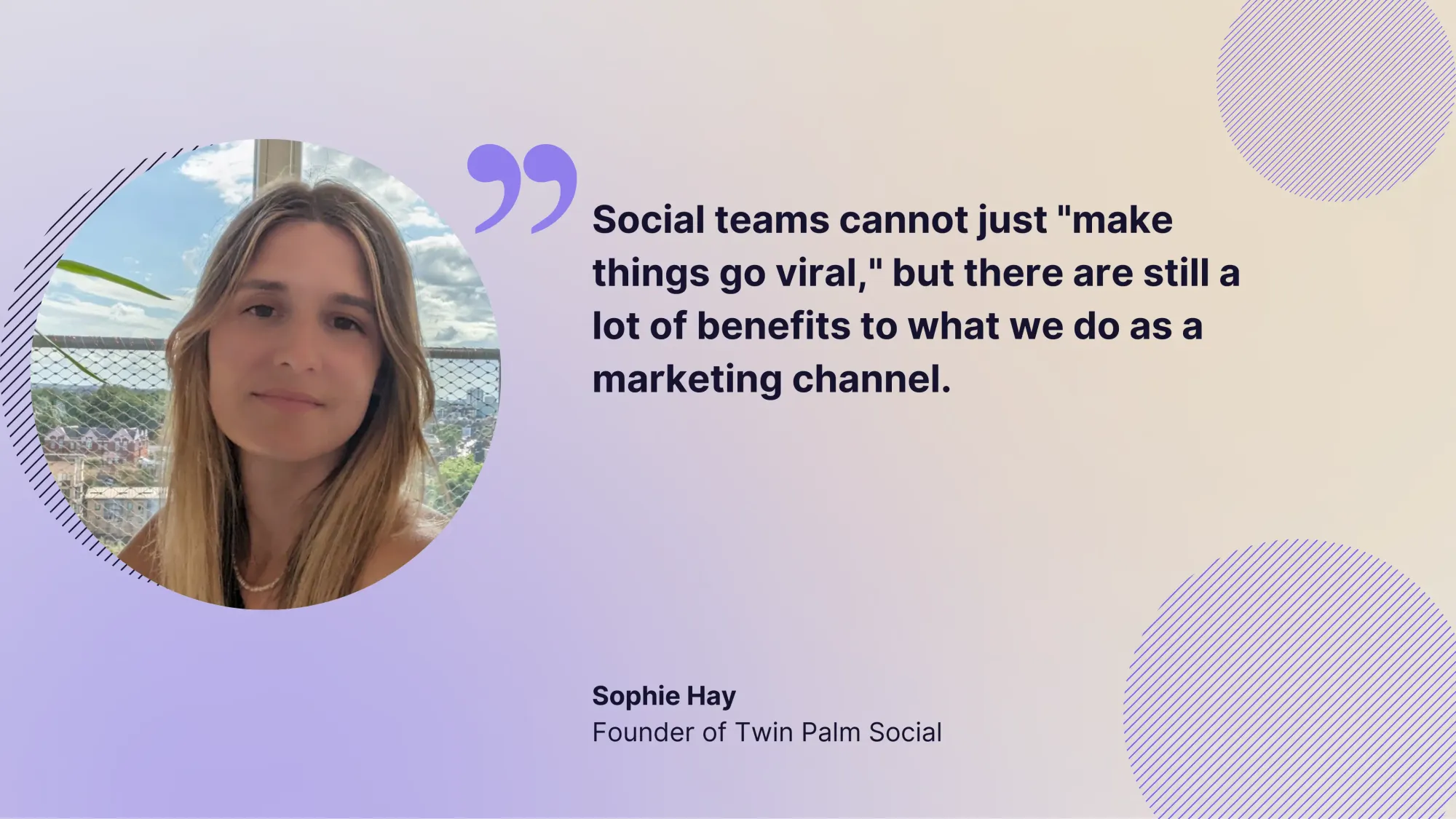
Social teams cannot just “make things go viral,” but there are still a lot of benefits to what we do as a marketing channel. — Sophie Hay, Founder of Twin Palm Social
Tips to overcome this challenge:
- Insist on the value of quality over quantity—Most people in upper management argue that a higher output of social media posts will keep their brand at the top of people’s minds. However, a steady flow of low-quality, repetitive posts will not do your business any good. Viral posts might increase your visibility and social media engagement, but these changes are usually short-lived and don’t impact the overall standing of your brand online.
- Leverage social listening to find out what people really want—The trick to creating great (and potentially viral) content is discovering what people want and what they absolutely hate. You can do that with social listening. As you uncover more and more insights about your audience’s preferences, keep refining your content to meet their demands. Even if you don’t achieve virality, you still maximize the odds of increasing social media reach and engagement rates.
Frequent algorithm changes
One of the most talked-about challenges of social media marketing is how often algorithms change and how difficult it is to keep up with all the frequent updates.
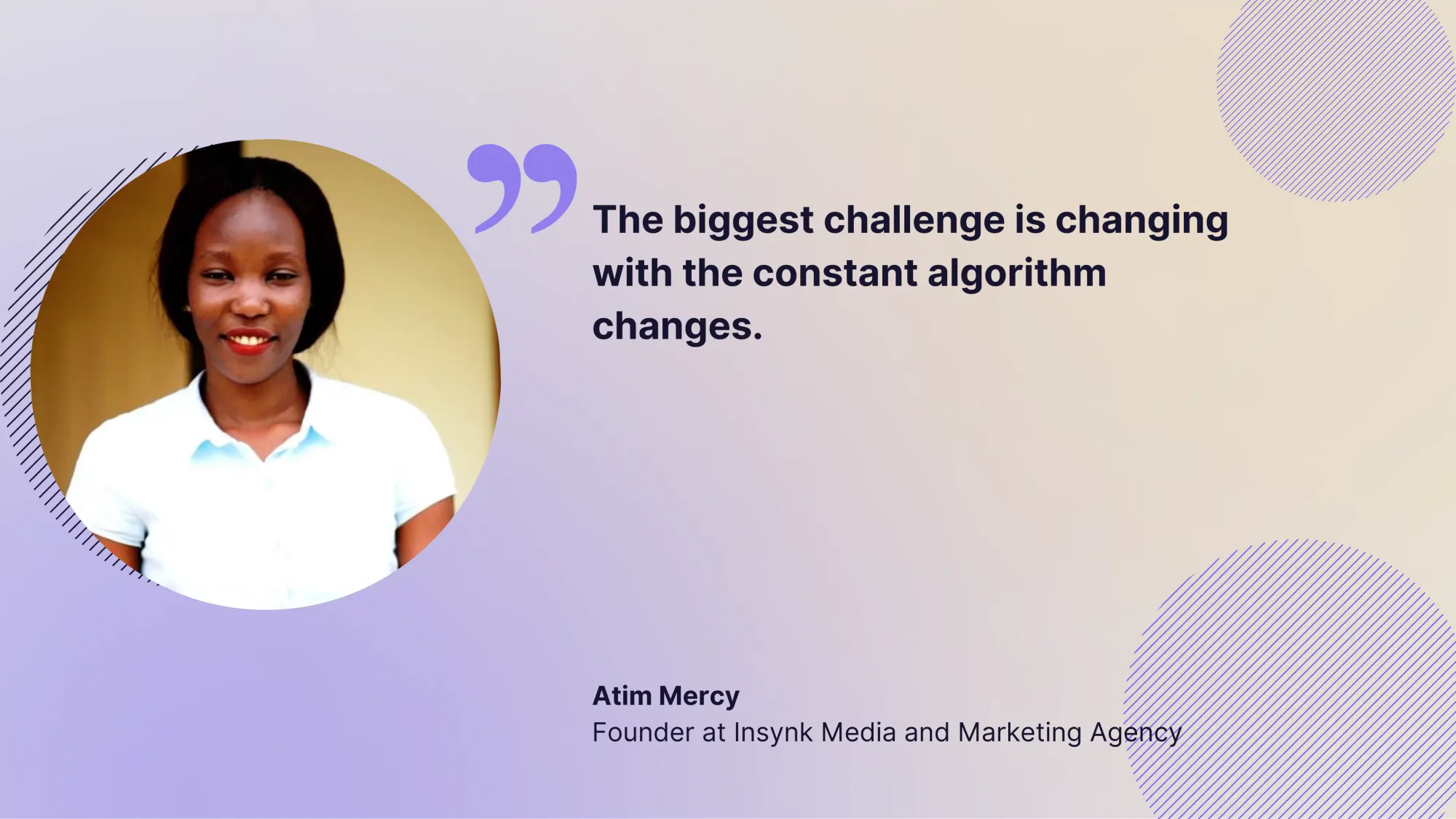
The biggest challenge is changing with the constant algorithm changes — Atim Mercy, Communications and Content Strategist
Frequent changes to social media network algorithms have a direct impact on content performance, and social media managers are left picking up the pieces, as it were, having to constantly adjust their strategies to match what the new algorithms demand.
Social media platforms are constantly updating their algorithms, which can significantly impact organic reach and engagement. It means we have to constantly adapt our strategies to ensure our content remains visible to our audience. — Courtney Larvadain, Account Supervisor
Due to this rollercoaster of algorithm changes, marketers are forced to keep learning and unlearning what they know about social media channels, which hinders their ability to create solid strategies that help brands grow.
Algorithm changes are like unpredictable weather, suddenly shifting and requiring quick adjustments to keep things on track. — Raluca Toma, Partnerships Manager at SocialBee
Tips to overcome this challenge:
- Rely heavily on social media measurement insights—In the face of constant change, your most reliable ally is data. Check your brand’s performance and that of your competitor for sudden spikes or drops to identify changes in the algorithm even before they’re officially announced.
- Stay informed—Set up multiple sources of information about algorithm changes and start implementing changes in your strategy based on the news that you receive. Follow official channels and join relevant communities to be among the first to find out what’s new on a particular social media channel.
Crisis management and legal compliance issues
One of the digital marketing challenges not many social media managers are prepared for is how to deal with crises and legal compliance issues. It’s understandable; legal issues are one of the least pretty aspects of social media marketing, and nobody wants to address them unless they really have to.
However, crises occur, and social media managers are usually the first line of defense. They are the ones on the receiving end of hateful DMs, or even lawsuit threats in extreme cases. They are the ones who have to come up with a diplomatic, legal team-approved response in order to put out fires that would otherwise damage the brand’s reputation.
The lack of standardized procedures is one of the biggest marketing pain points, and it is particularly dangerous when it comes to legal situations that require instant action.
When things go south (and they sometimes do), a social media manager needs to handle crises with poise. They must manage negative feedback, PR issues, and any social media mishaps, turning potential disasters into opportunities for growth. — Vanjela (Nela) Bellovoda , Social Media Strategist
Tips to overcome this challenge:
- Create a fast-line communication group with the upper management and legal—Legal crises need urgent action, so your best course of action is to essentially have upper management and the legal team on speed dial. Whether that means setting up a WhatsApp group or some other instant chat communication workflow, at the end of the day, this will help you speed up legal approval and get quick feedback on pressing matters.
- Ask for training on how to handle legal issues—If this type of training is not part of your onboarding process, consider asking upper management to offer training on crisis management and legal procedures. Ideally, if your company has a legal team, ask them to advise you on legal situations and set up a response flowchart for you to follow whenever a crisis arises.
- Be calm, clear, and kind—When dealing with people who are upset, it’s important to show calmness and understanding so as not to escalate the conflict any further. If you think replying to an angry DM with the same tone will make them change their mind, you’re wrong.
Poor communication between departments
If you were to ask anyone outside the social media world, “Which of the following is a challenge associated with the use of social media marketing?” and give them a couple of options, the one answer they would probably never go for is: poor communication between departments.
That’s because not many people realize the impact poor communication has on a social media manager’s workflow and state of mind. Effective collaboration is crucial in any company, big or small. When departments fail to communicate properly, it leads to mishaps and misunderstandings.
Marketers often find themselves in situations where they need to coordinate with the development team, sales department, legal, upper management, etc. If any one of these people is unclear as to what their own responsibilities are, or they keep deprioritizing the social media manager’s request in favor of other tasks, then progress stalls.
Having to work around a website bug or a confusing legal situation is tedious and exhausting for anyone working in social media.
It all comes down to a lack of the right support, inside and outside an organization. While most social media managers have earned (through experience) a degree in scrappiness, we need support to properly do our job. — Ashley Foster, Senior Social Media Manager
Tips to overcome this challenge:
- Be proactive—Whenever you receive a new task, first evaluate it to see if you’ll need any assistance completing it. If so, reach out to the other teams for their help or input before starting.
- Use collaborative tools for instant communication—In other words, make it easy for people to talk to you. Team members might be more likely to respond to a quick chat to help with your issue than engage in a 2-hour meeting when a problem has already escalated.
Constant need to be online
Social media management often feels like a full-time job. Not a 40-hour per week job, mind you, more like 24/7. Because a good portion of all social media tasks can be done on a mobile phone, it’s sometimes difficult for marketers to switch off at the end of the workday.
A challenge is the conception of social media always being “on”, so you feel like you can never get a full break. — Mitra Mehvar, Social Media Manager at Buffer
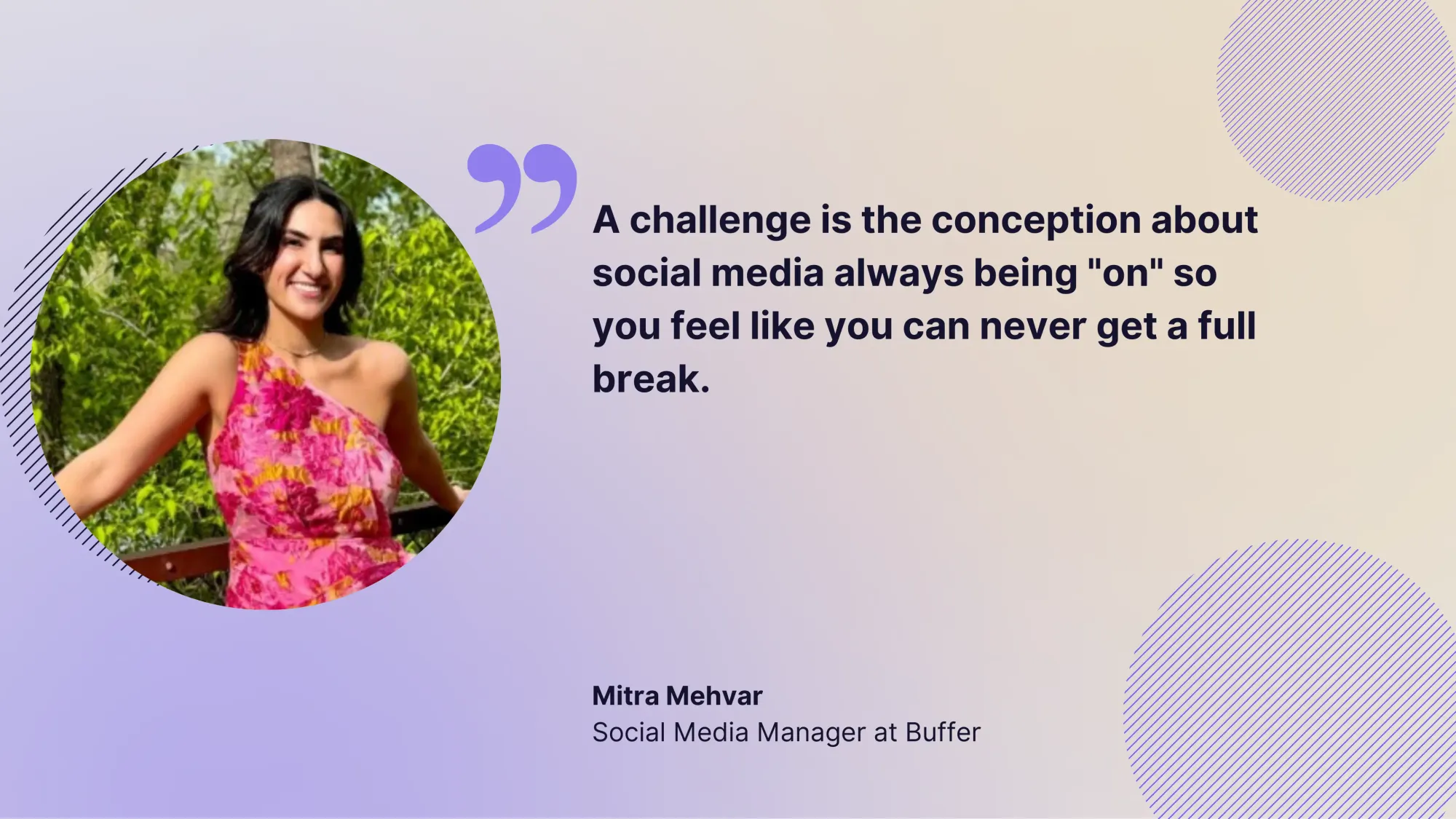
The constant need to be online is one of social media’s biggest challenges to overcome. That not only results in a very poor work-life balance, but it can also affect people’s mental health and eventually lead to burnout.
It’s particularly challenging for social media professionals at the start of their careers to take breaks when they need to because they’re eager to perform well and prove their worth.
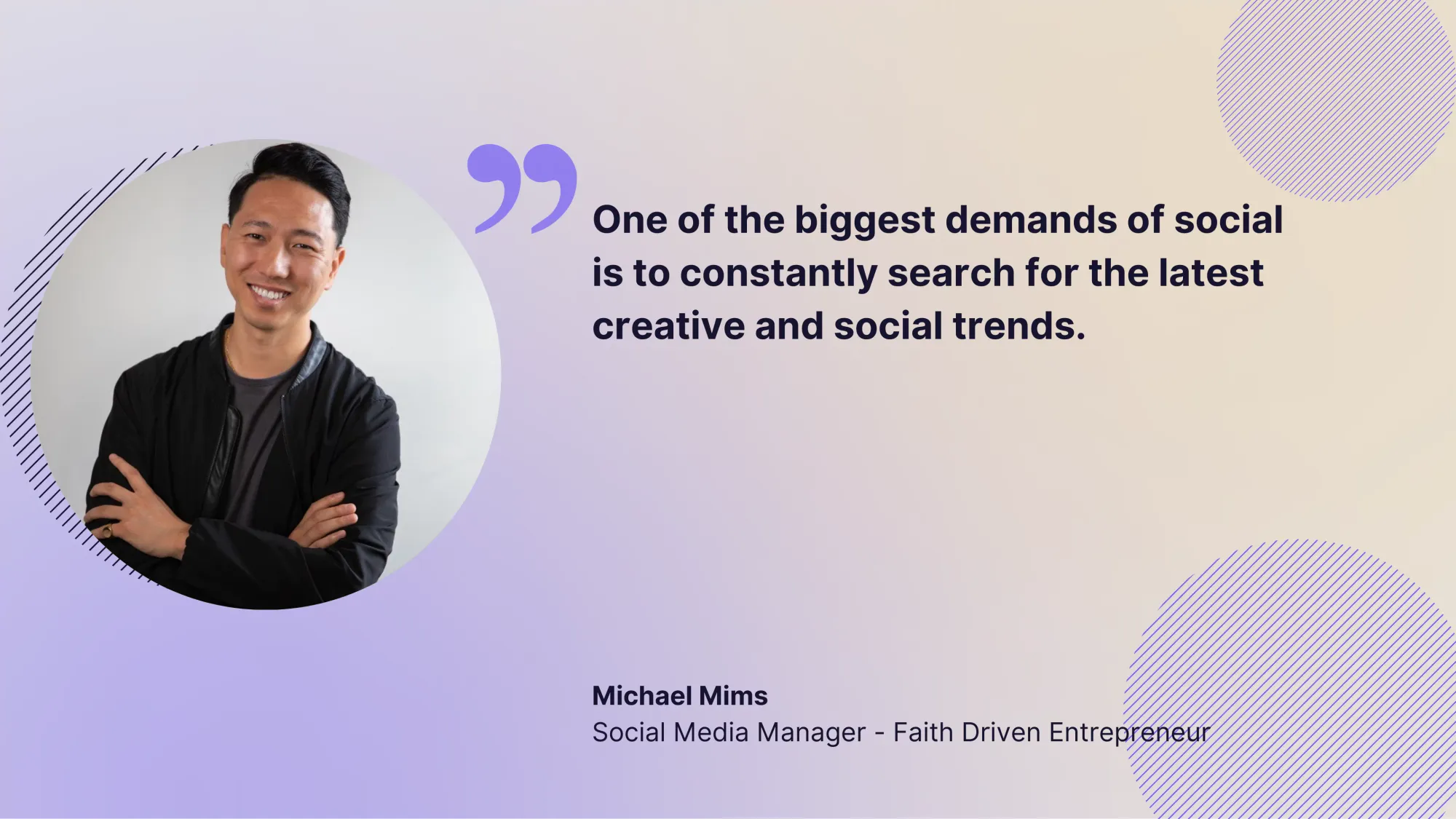
One of the biggest demands of social is to constantly search for the latest creative and social trends. — Michael Mims, Social Media Manager & Faith Driven Entrepreneur
Tips to overcome this challenge:
- Limit your social media usage—It’s difficult to put a hard stop to social media usage because, in many ways, it’s extremely convenient to keep working wherever you are: on the bus during your commute, at home during the weekend. However, for the sake of your mental health, you should implement breaks and separate personal social media browsing from work-related social media browsing.
- Set clear boundaries—Limit notifications to only be delivered between certain hours and leverage scheduling tools to eliminate the need to post manually outside of work hours. Once in a while, consider undergoing a digital detox for a couple of days, during the weekend or on vacation, and take this opportunity to disconnect from all devices and immerse yourself exclusively in offline activities.
Final thoughts
Navigating the many challenges of marketing and social media is not easy for social media managers. They need to arm themselves with as much patience, understanding and knowledge as they possibly can to maximize their chances of succeeding in this field.
When asked what are the challenges of social media marketing, many social media managers point to a severe lack of resources, poor communication and content fatigue, among others. They feel like these challenges in digital marketing often stunt their progress and don’t allow them to progress in their career as fast as they would like to.
That’s not to say that social media is known only for its challenges. It’s competitive and at times chaotic, sure, but it’s also riddled with opportunities for growth.
FAQs about social media marketing challenges
What are some threats that social media marketing faces?
Social media marketing is facing a variety of threats including but not limited to:
- One-person social media teams
- Being creative and thinking out-of-the-box ideas
- Proving the ROI of social to the leadership
- Constant need to be online
- Social crisis management
- Keeping up with trends
- Budget limitations
What are pain points in marketing?
Pain points in marketing describe issues encountered by marketers in their day-to-day job, which most commonly include content creation fatigue, low (organic) engagement rates and negative feedback or comments.
Elena Cucu
Content & SEO Manager @ Socialinsider with 8 years of experience in marketing. I like to describe myself as a social butterfly with a curious mind, passionate about dancing and psychology.

Analyze your competitors in seconds
Track & analyze your competitors and get top social media metrics and more!
You might also like






Improve your social media strategy with Socialinsider!
Use in-depth data to measure your social accounts’ performance, analyze competitors, and gain insights to improve your strategy.