Developing a LinkedIn Growth Strategy: A Data-Backed Framework and Best Practices
Learn how to develop an effective LinkedIn growth strategy using our data-backed framework and experts' revealed best practices.
LinkedIn is one of the best-performing social media channels, especially for B2B. But LinkedIn marketing can be tricky. With so many brands, both big and small, now trying to build their presence on the platform, it’s more difficult than ever to stand out.
Add to that the pressure of the ever-changing LinkedIn algorithm, and it’s easy to feel overwhelmed and feel like nothing adds up.
In this article, I’ll walk you through a step-by-step framework to help you build and improve your LinkedIn growth strategy, all based on data, insights and tips from LinkedIn expert Mihaela Radu and 2026 Socialinsider benchmarks. Less guesswork, more practical, proven best practices.
Key takeaways
-
Why LinkedIn is a powerhouse in the B2B marketing world? LinkedIn is a leading B2B marketing channel because it combines professional targeting, high-intent audiences, and content-driven discovery that directly supports trust-building and lead generation.
-
How to create an effective LinkedIn growth strategy? An effective LinkedIn growth strategy starts with a clear performance audit, data-backed goals aligned with benchmarks, and continuous optimization of content, format, and posting frequency based on engagement insights.
-
LinkedIn marketing tips to accelerate your growth: To accelerate LinkedIn growth, prioritize native, value-driven content over promotional links, focus on high-performing content pillars, and leverage employee advocacy to expand reach and engagement organically.
Why is LinkedIn a powerhouse in the B2B marketing world?
LinkedIn is where business actually happens, making it the most valuable channel for B2B marketers who want to reach the people who matter most.
I’ve seen a post recently that proves exactly that. A B2B marketer admitted that despite the hate the platform has been getting lately for various reasons, she had been able to find a few new clients rather quickly through a post and some community support.
The numbers back that story up. 4 out of 5 people on LinkedIn drive business decisions, and 82% of B2B marketers report their greatest success on LinkedIn compared to any other social channel, according to Hubspot. A Content Marketing Institute's 2025 report found that 76% of B2B marketers name LinkedIn as one of the three most effective channels for publishing thought leadership content. Plus, in a previous report, 85% of B2B marketers said LinkedIn offered the best value of any social platform.
Here's why LinkedIn consistently stands out as the platform of choice for B2B marketers:
- Professional intent by design. People come to LinkedIn with a work mindset. They're actively looking for industry knowledge, career growth, and business opportunities. That makes them far more receptive to professional content than audiences on entertainment-first platforms.
- Unmatched professional targeting. No other platform lets you reach people based on job title, seniority, industry, company size, and skills all at once. That allows B2B marketers to efficiently reach decision-makers.
- Direct line to all the buyer personas. In B2B, purchase decisions rarely come from one person. LinkedIn gives you access to the full range of stakeholders, from end users to C-suite decision-makers.
- Content culture that rewards substance. Long-form posts, data-backed insights, and honest professional takes tend to perform well on LinkedIn. If you have something genuinely useful to say, this platform favors it.
- The home of thought leadership. LinkedIn is where professional credibility is built and recognized. It's the platform your audience checks to see if you know what you're talking about.
While every brand's experience is different, the platform's fundamentals consistently work in favor of B2B marketers. If you’re one of them, let’s dig into how to create a LinkedIn growth strategy that works.
Adding to this, Mihaela Radu, LinkedIn marketing expert, said:
Audiences engage more with people than with logos, which is why employee voices have become such a powerful growth driver. The companies creating the most impact are not forcing advocacy programs or distributing scripted posts. They are supporting employees who already have valuable perspectives, expertise, and curiosity to share consistently. When valuable content, authentic engagement, and employee visibility work together, LinkedIn becomes more than a social platform. It becomes a long-term relationship and demand-generation channel.
How to create an effective LinkedIn growth strategy
A successful LinkedIn growth strategy starts with understanding where you currently stand, setting realistic social media goals based on benchmarks, and then making deliberate decisions about content, frequency, and format. Here's how to build that foundation step by step.
Start with an audit
Before you change anything about your LinkedIn strategy, you need to know what's working on your page right now.
A LinkedIn audit gives you that baseline, telling you which content is pulling its weight, where your audience is growing or stalling, and what your engagement patterns look like over time. Without it, you're making decisions in the dark.
When you're running your audit, focus on these three core metrics:
Followers
Your follower count is a starting point, but the raw number alone doesn't tell you much. What matters more is the trend: is your audience growing steadily, spiking around certain content, or flatlining?
Look at growth rate over time, not just totals. A consistent upward curve means that your content is attracting new people. A plateau or downward curve, on the other hand, is a sign that something in your approach needs rethinking.
Here’s an example of Socialinsider's follower count dashboard showing audience growth trend over a three-month period.
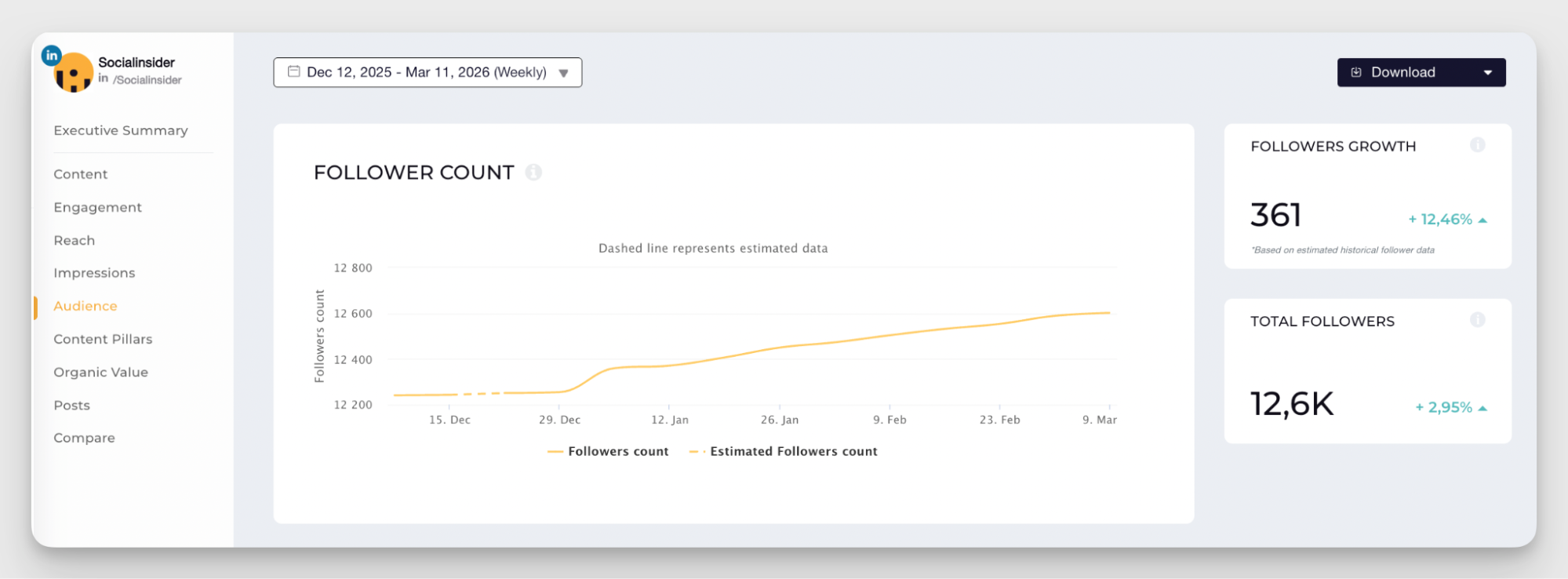
When you track follower growth in social media analytics tools like Socialinsider, you can see both the actual count and estimated historical data side by side, which makes it easier to spot turning points, like when a particular campaign or content type started moving the needle.
Engagement rate
Follower growth reflects reach, while engagement rate tells you about resonance. Are people actually interacting with what you share, or are they scrolling past? Pay attention to how engagement fluctuates week over week. Spikes often correspond to specific post types or topics that hit harder than usual.
Continuing our example, Socialinsider breaks engagement down in several useful ways: total engagement with and without clicks, average engagement per day, and engagement rate by followers, reach, and impressions.
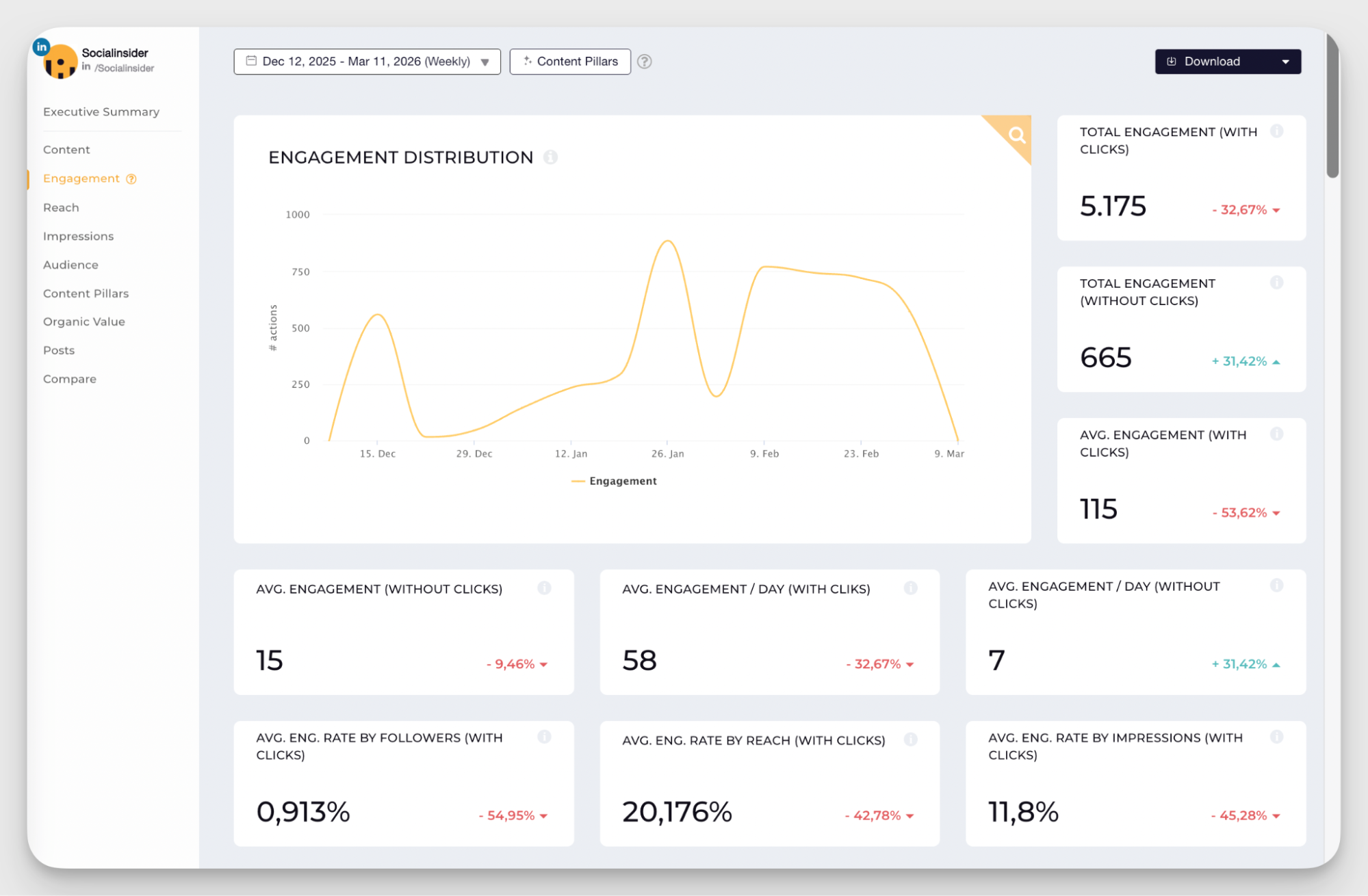
That granularity matters because you can optimize your LinkedIn strategy for different purposes. If you're building brand awareness, reach-based engagement tells a different story than follower-based engagement. If you’re looking to improve conversions, you’ll want to focus on clicks.
Impressions
Impressions show you how far your content is traveling, beyond your followers, into the broader LinkedIn feed. A steady growth in impressions suggests the LinkedIn algorithm is distributing your content more widely, which is a strong indicator that your posting cadence and content quality are working.
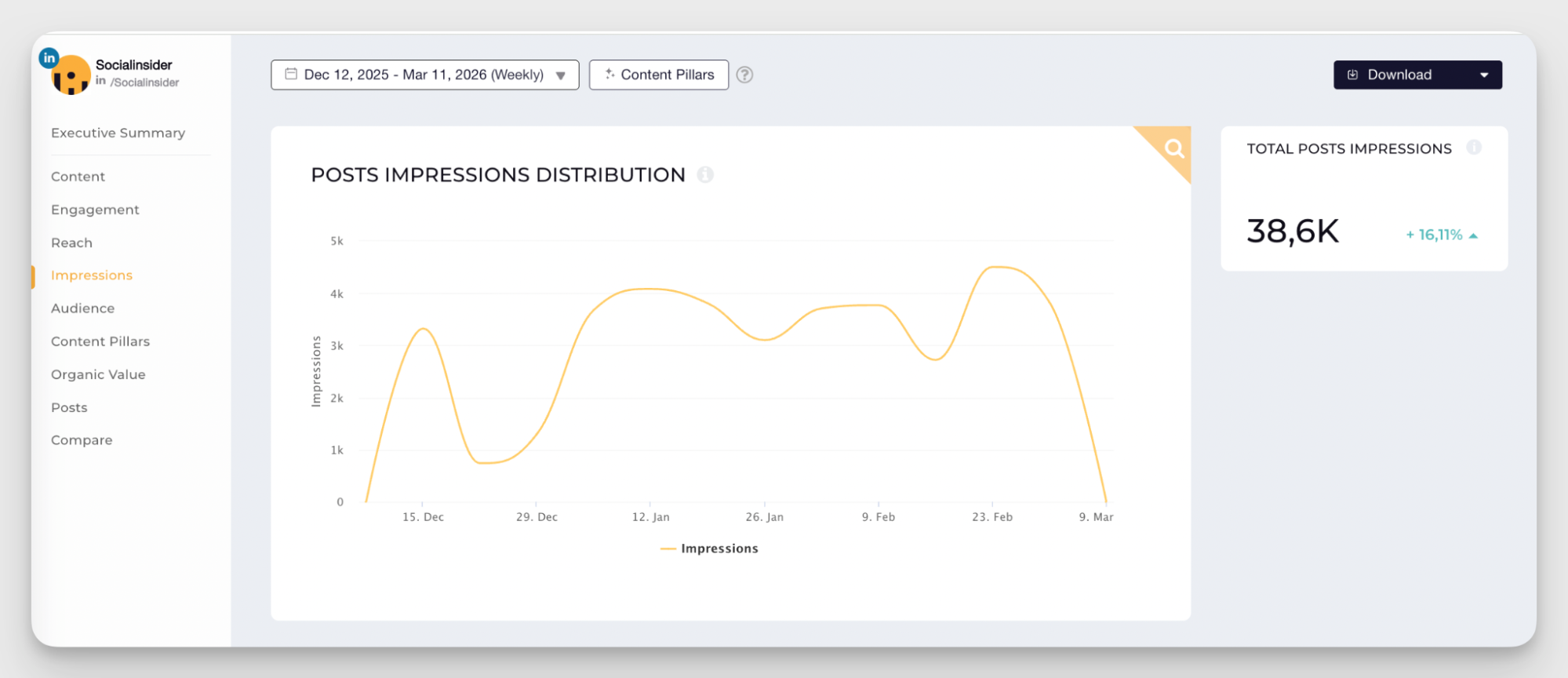
When impressions and engagement move in the same direction, that's a healthy sign. When impressions climb but engagement drops, it usually means you're reaching more people but not the right ones, or that you need to create more compelling content.
To this, Mihaela also added:
An effective LinkedIn strategy starts with understanding the audience before creating content. Companies need clarity on who they want to attract, what challenges matter to that audience, and how they want to position themselves in industry conversations. From there, strong content pillars create consistency without making the brand repetitive. Research shows companies using structured content pillars achieve +28% reach and +15% engagement because they align storytelling with audience needs.
Employee activation also plays an important role, but authenticity matters. Instead of controlling employee voices, companies should support employees who are already active and help them develop their own presence naturally. The goal is not short-term reach. It is long-term credibility, consistency, and trust.
If you're starting from zero
The framework above assumes you have a baseline to audit. But what if you're starting fresh — either with a brand new LinkedIn page or one that has been dormant long enough that its historical data tells you very little about what's actually possible?
Starting from zero on LinkedIn is more common than it sounds, especially for social media leaders stepping into a new role or organizations that have deprioritized the platform for years. The challenge isn't just building an audience. It's building credibility, establishing a content rhythm, and generating enough early signal to start making data-driven decisions — all at the same time, without the safety net of a performance history.
A few things are worth knowing before you start.
- Your first 90 days are about establishing a baseline, not hitting targets. Without historical data, you have nothing to benchmark against. The goal in the early phase is to post consistently enough across different formats and topics to start generating signal. What gets engagement? What gets ignored? What format does your audience respond to? Those answers are what you'll build your actual strategy on.
- Use competitor data as your external baseline. When you don't have your own history to reference, competitive analysis fills the gap. Look at how competitors of a similar size are performing on LinkedIn — their posting frequency, their top content pillars, their engagement rates — and use that as your initial reference point for what's realistic. Socialinsider makes this straightforward by letting you track competitor LinkedIn performance over time, even before you have meaningful data of your own.
- Activate employee voices early. For a new or dormant page, organic reach is almost entirely dependent on the LinkedIn algorithm choosing to distribute your content. One of the fastest ways to accelerate that in the early stage is employee advocacy. Even a handful of employees engaging with your first posts meaningfully can significantly extend initial reach and signal to the algorithm that the content is worth distributing.
- Set process goals before performance goals. In the first quarter, it's more useful to track whether you're publishing consistently, testing multiple formats, and building engagement habits than to obsess over follower growth. The numbers will follow the process — but only if the process is solid first.
Define your growth objectives
Once you have your baseline, the next step is deciding where you want to go.
Be specific. Goals like "grow our LinkedIn presence" don't give you anything to measure or optimize. Instead, tie your business and marketing objectives to social media metrics.
A few examples of what specific LinkedIn growth objectives look like:
- Grow your follower count by a set percentage over the next quarter
- Increase the average engagement rate per post compared to your current one
- Reduce the gap between your top-performing and average posts
- Increase click-through rate on posts that link to products or landing pages
- Build monthly engagement on a specific content pillar
The more concrete your targets, the easier it becomes to spot when something is working and when it's time to adjust. From there, benchmarks give you the context to know whether your targets are realistic.
LinkedIn benchmarks for correct goal setting
Setting goals without context won't work well. Before you decide what "good" looks like for your page, check where you stand against LinkedIn benchmarks for accounts your size.
What's a realistic follower growth rate for a page with your audience? What engagement rate should you be aiming for, given your format mix?
Let’s look at the most recent data from Socialinsider.
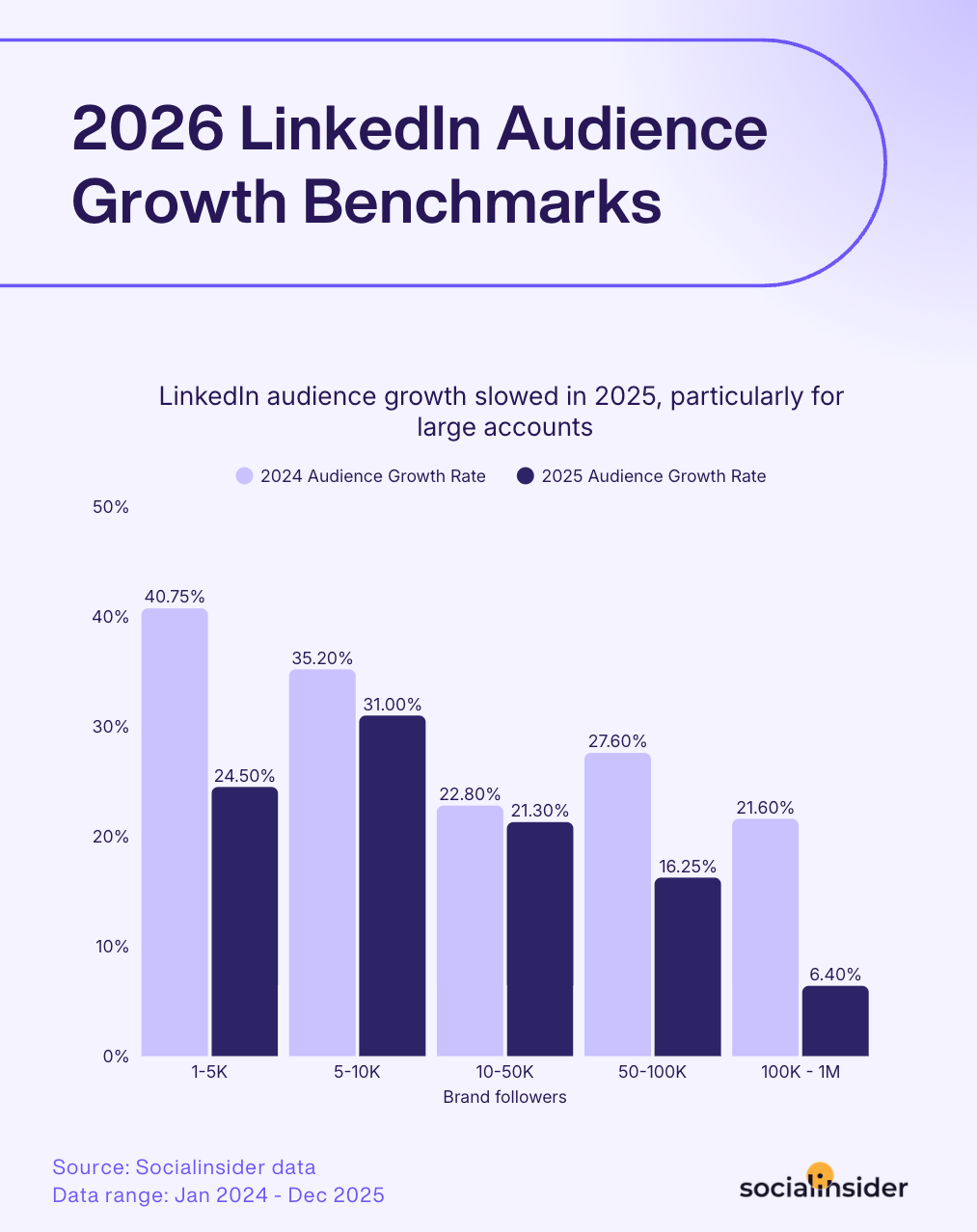
According to Socialinsider’s 2026 LinkedIn Benchmarks, audience growth on LinkedIn slowed across the board in 2025 compared to 2024, and this was particularly noticeable for larger accounts.
Smaller pages held up better, with growth rates staying relatively strong. If you're managing a newer page, that's actually encouraging context for your goal-setting.
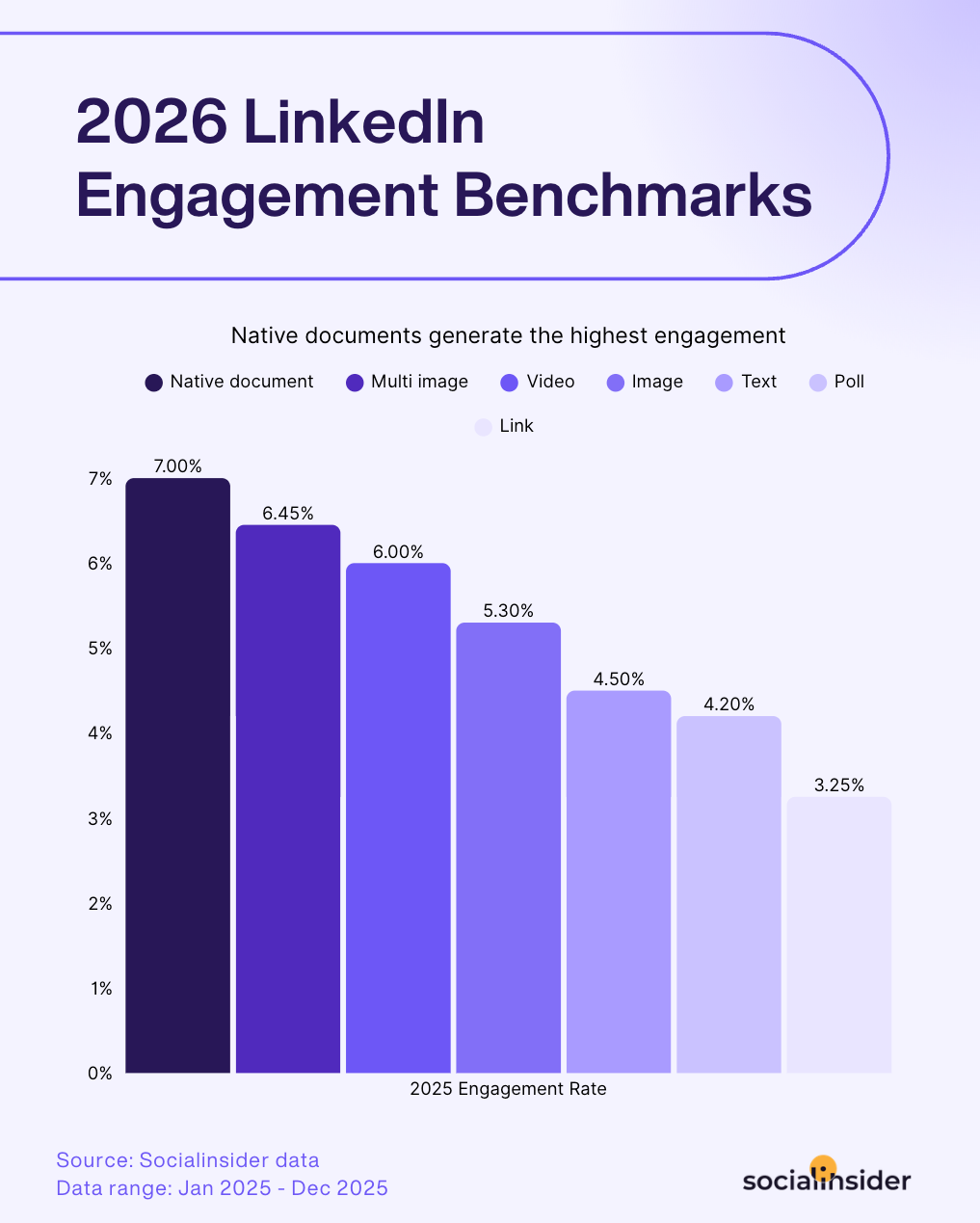
On the engagement side, Socialinsider's 2026 benchmark data shows that native documents consistently generate the highest engagement rates, followed closely by multi-image posts and video. Text-only posts and link shares sit at the lower end. This is worth factoring into your goals if your current mix is heavy on link posts.
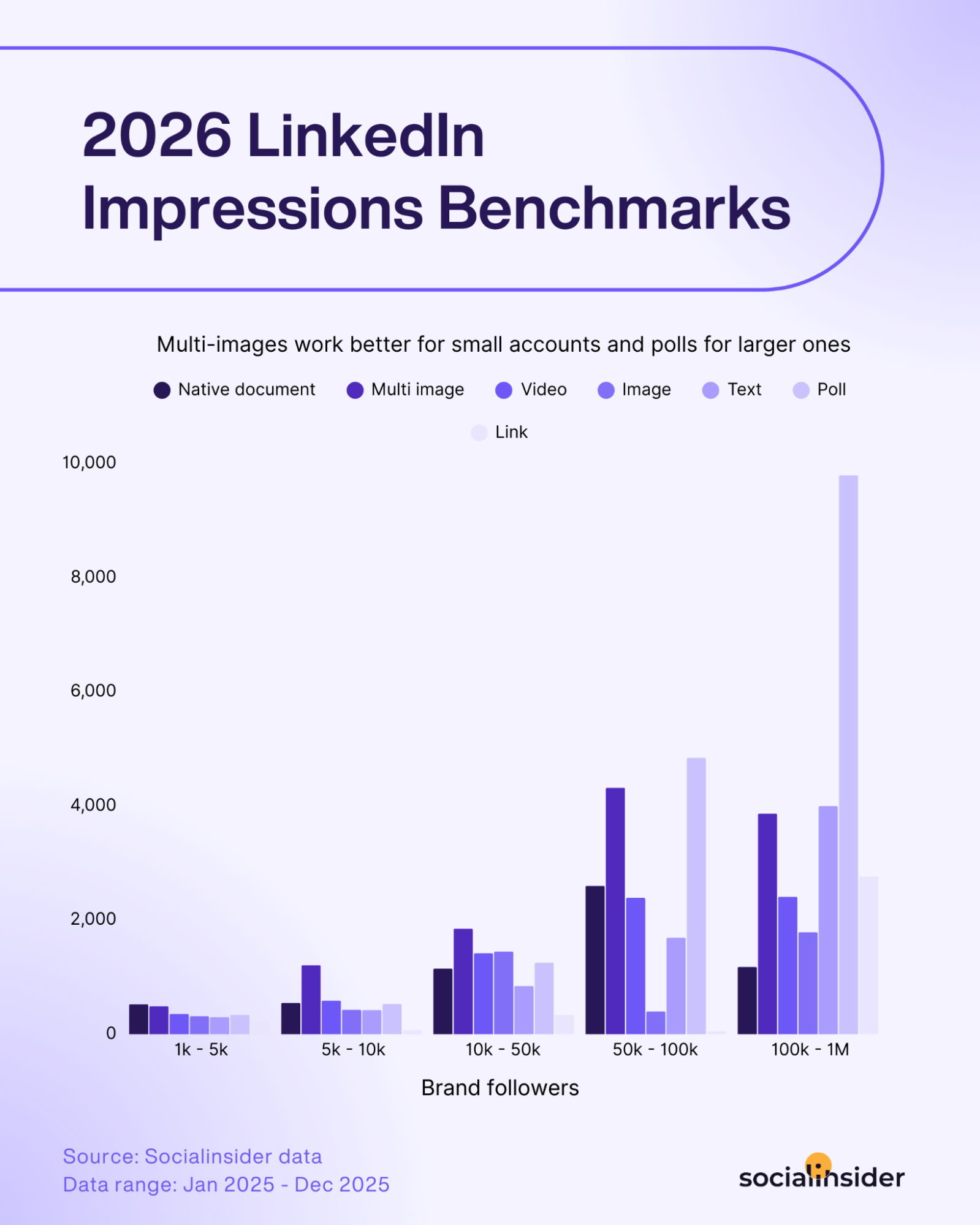
Impressions benchmarks add another layer to the picture. The most recent Socialinsider data shows that the best-performing format for impressions varies by audience size. Multi-image posts tend to perform well for smaller pages, while polls generate significantly more impressions for the largest accounts.
I find this data very valuable as a content strategist who’s always looking for ways to set realistic goals and to analyze LinkedIn performance in context.
Optimize your strategy to match the platform's algorithm
With the rise of AI slop and people’s frustration with low-quality posts, LinkedIn's algorithm in 2026 has shifted to evaluate content quality and place more weight on depth, originality, and niche authority.
Generic posts, especially those that feel templated or recycled, get less distribution. A single well-developed post on a topic you genuinely know will almost always outperform three shallow posts that could have been written by anyone.
The algorithm is also sensitive to engagement in the first hour after publishing, so timing and audience relevance matter more than ever.
Double down on your most engaging content pillars
Content pillars are the thematic categories your content falls into, and not all of them perform equally for your audience.
Socialinsider's Content Pillars summary gives you a full performance breakdown by topic category: posts, engagement, views, average engagement rate by followers, and organic value, all in one table.
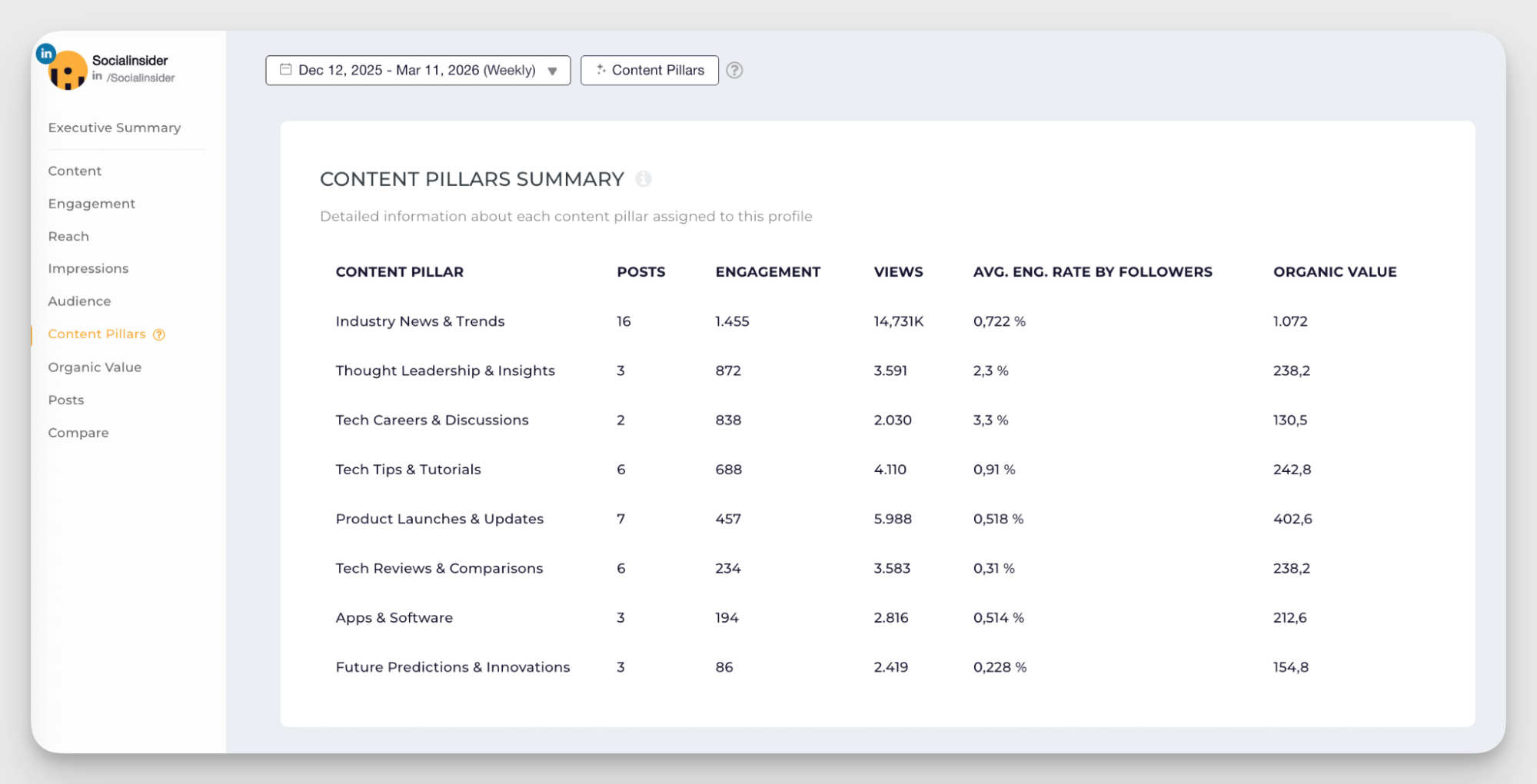
Patterns become obvious fast. Some pillars generate high engagement but modest reach. Others pull strong impressions but low interaction. Understanding that split helps you decide whether to double down on what's already working or invest more in pillars with untapped potential.
The goal isn't to post about everything. It's to own a few topics your audience consistently comes to you for. That's what builds authority.
Here's an interesting insight form Mihaela:
Practitioners should also remember that engagement is part of the strategy itself. Thoughtful comments, participation in industry discussions, and employee interaction often build more trust than direct outreach. On LinkedIn, strong business relationships usually start through visibility and conversations before they become sales opportunities.
Choose a balanced posting frequency
Posting too infrequently means you lose momentum. Posting too often without enough substance behind each post dilutes your authority and can hurt your engagement rate.
The right frequency depends on your team's capacity and content quality, but benchmarks give you a useful reference point.
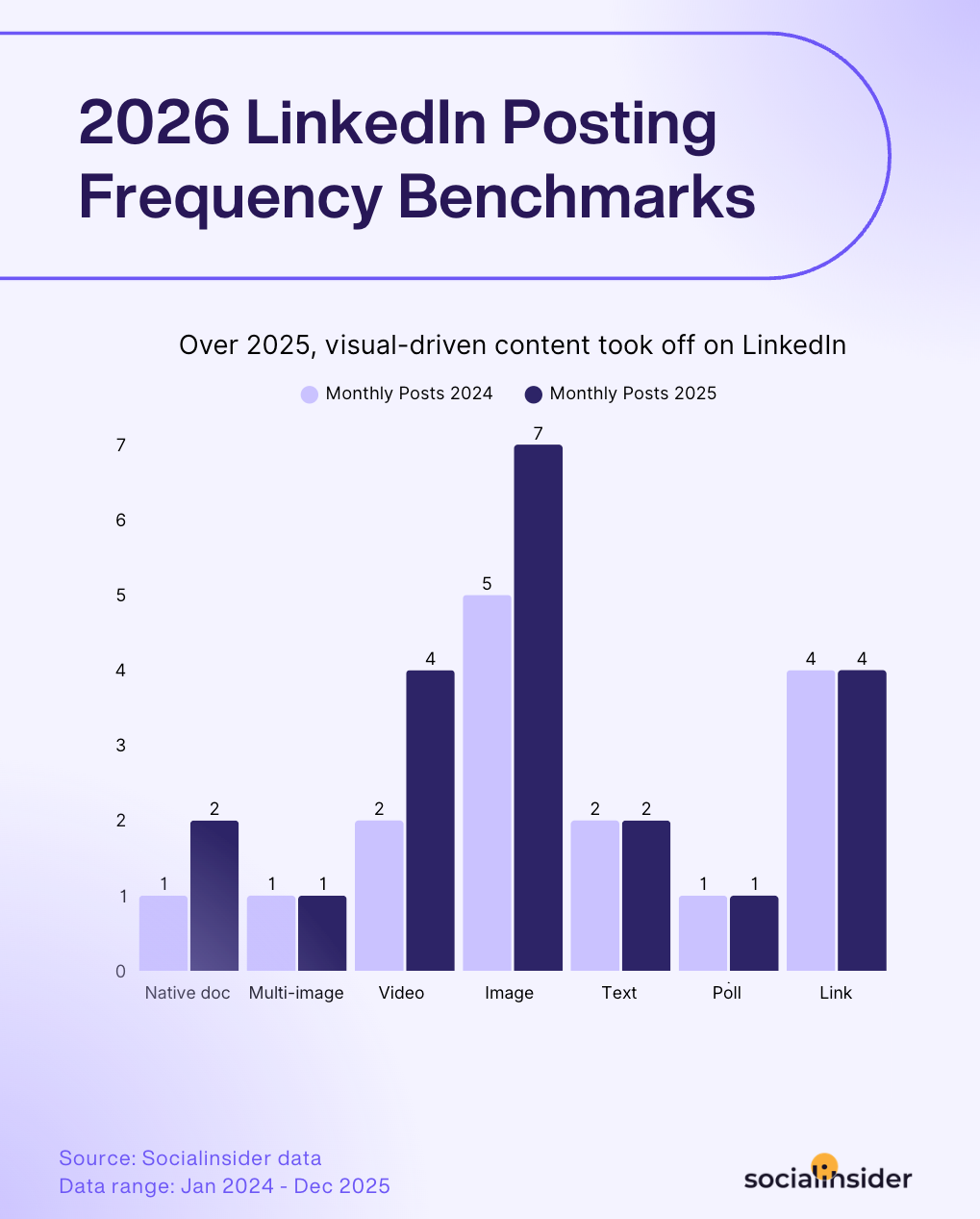
Socialinsider's 2026 posting frequency data shows that visual-driven content, particularly images, saw a meaningful increase in posting volume from 2024 to 2025, while native documents and multi-image posts also grew.
If you're trying to build a sustainable LinkedIn growth rhythm, think about diversifying your format calendar rather than defaulting to whatever's easiest to produce.
Check your analytics and adapt based on what's working
A LinkedIn growth strategy isn't something you set and forget. Building in a regular review of your LinkedIn analytics is what separates brands that plateau from those that keep growing.
For example, our LinkedIn metrics below show that not all post formats perform equally on the platform.
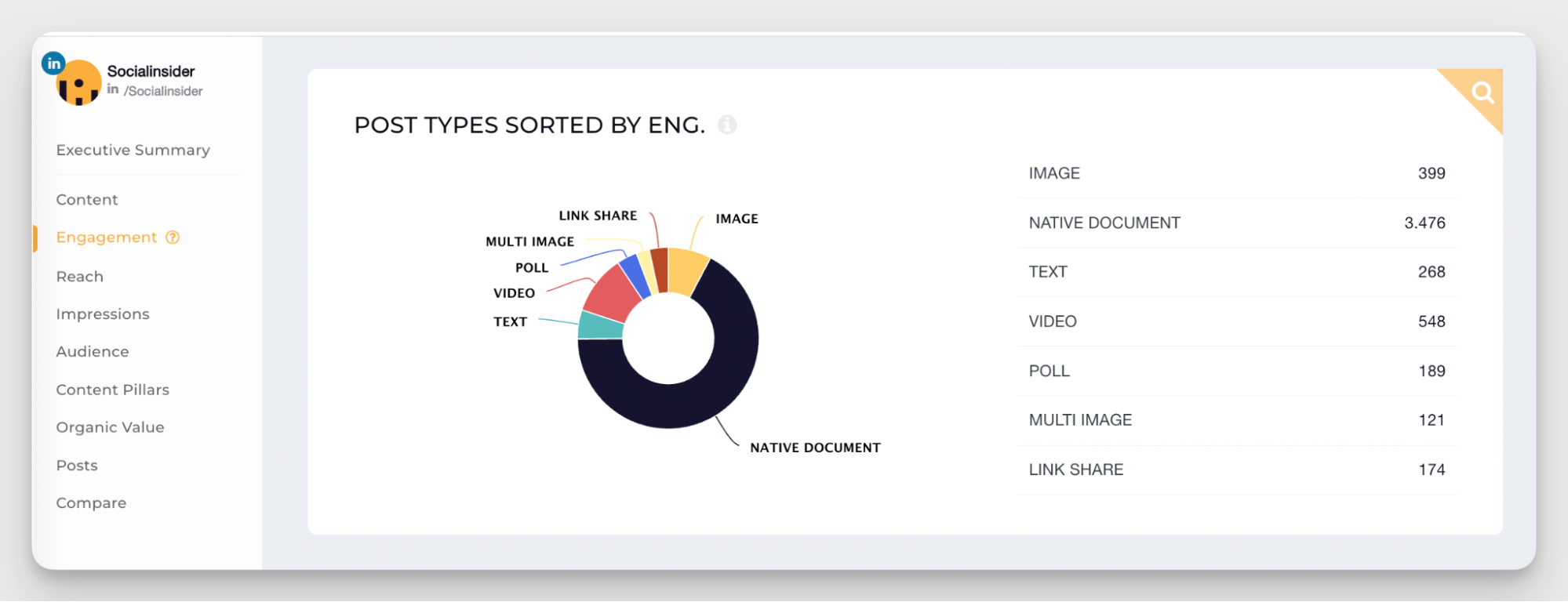
Native documents account for a large share of total engagement compared to every other format. That kind of analysis doesn't mean you should post nothing but carousels, but it does mean that you should continue to produce them, while also trying to optimize video and image posts, which come in second.
LinkedIn marketing tips to accelerate your growth
Below are practical, specific, LinkedIn best practices, grounded in how the platform behaves right now, to help you take your social media content strategy beyond the fundamentals.
Leverage more native content and fewer links
The temptation to include links in your posts is high. But one of the most consistent findings in LinkedIn data is that content kept within the platform outperforms content that tries to pull people away.
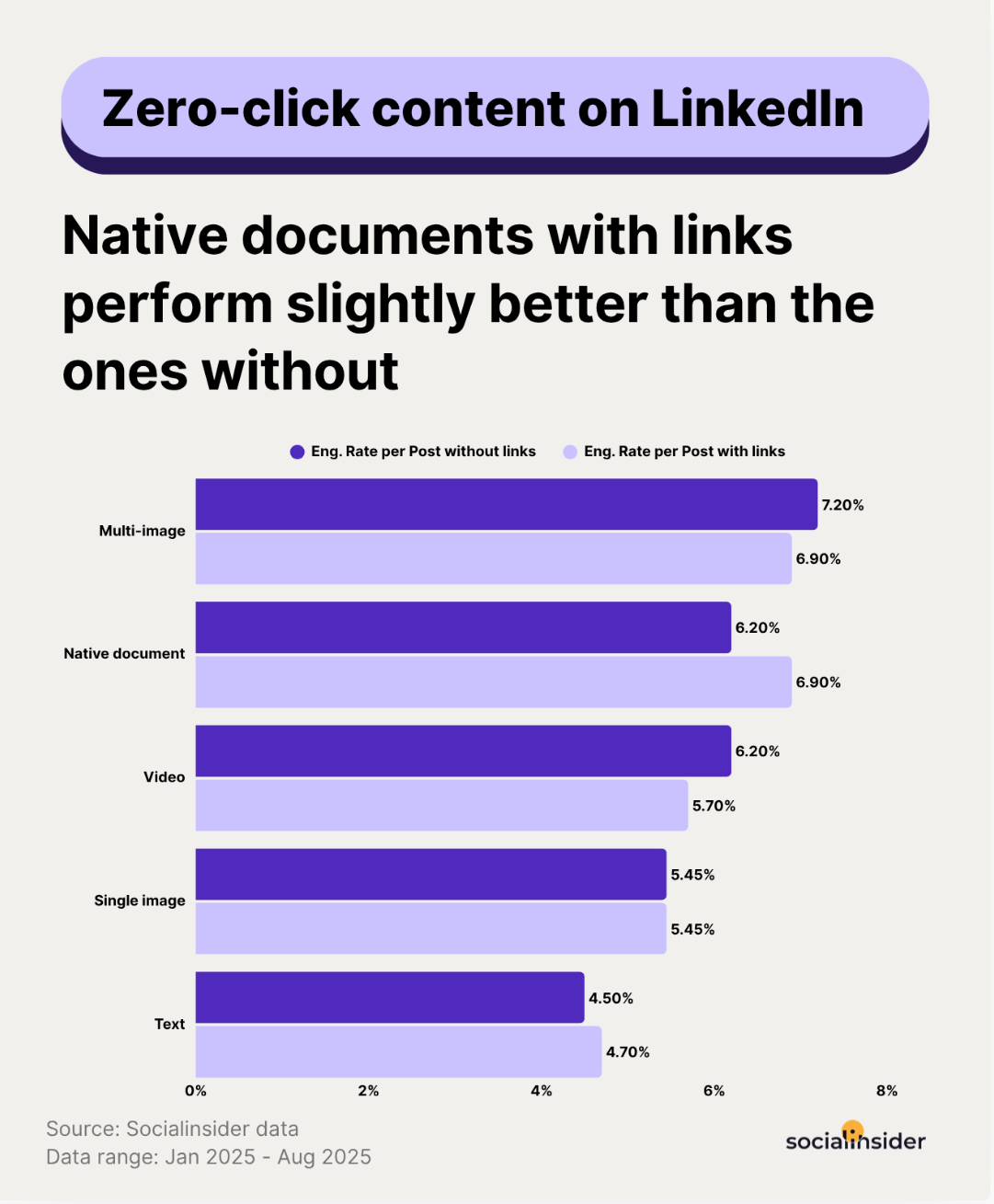
Socialinsider's zero-click content data shows that multi-image posts without external links generate noticeably higher engagement than their link-included counterparts. The pattern holds across most formats: video, single image, and text posts all show similar tendencies.
The one interesting exception is native documents, where posts that include a link perform roughly on par with with those without. That makes sense: a well-structured document already keeps people engaged within the post itself, so adding a link doesn't seem to carry the same penalty.
Here's what a more native-first content approach looks like in practice:
- Upload presentations and reports directly as PDFs rather than linking out to them
- Repurpose blog content into carousel-style native documents instead of sharing the URL
- Share data, frameworks, or key takeaways as multi-image posts rather than directing people to read the full piece elsewhere
- When a link is necessary, test putting it in the comments and see how it affects your reach
Mihaela also confirmed this:
Native formats like images, videos, and documents continue to perform better than external links because LinkedIn prioritizes content that keeps users on the platform. Consistency also matters more than intensity. A sustainable publishing rhythm combined with active engagement creates stronger long-term visibility than occasional bursts of activity.
Focus less on promotion and more on offering value
The pages that grow fastest are the ones that make their audience smarter and more informed. Promotional content has its place, but if it dominates your feed, your audience will tune out fast.
Think about what your target audience is struggling with. What questions are they asking? What decisions are troubling them? What would help them do their job better? Those are the posts that get saved, shared, and commented on.
Reframe your content calendar so that for every promotional post, you plan at least two or three that offer something useful with no strings attached, such as:
- A breakdown of an industry trend with your team's take on it
- A behind-the-scenes look at how you approach a common challenge
- Original data, research, and insights
- A contrarian (but informed) opinion on a hot topic
- Practical tips or frameworks that people can apply immediately
This creates thought leadership, which, as the Content Marketing Institute data shows, is one of the primary reasons B2B buyers engage with brands on LinkedIn in the first place.
Here's Mihaela's perspective as well:
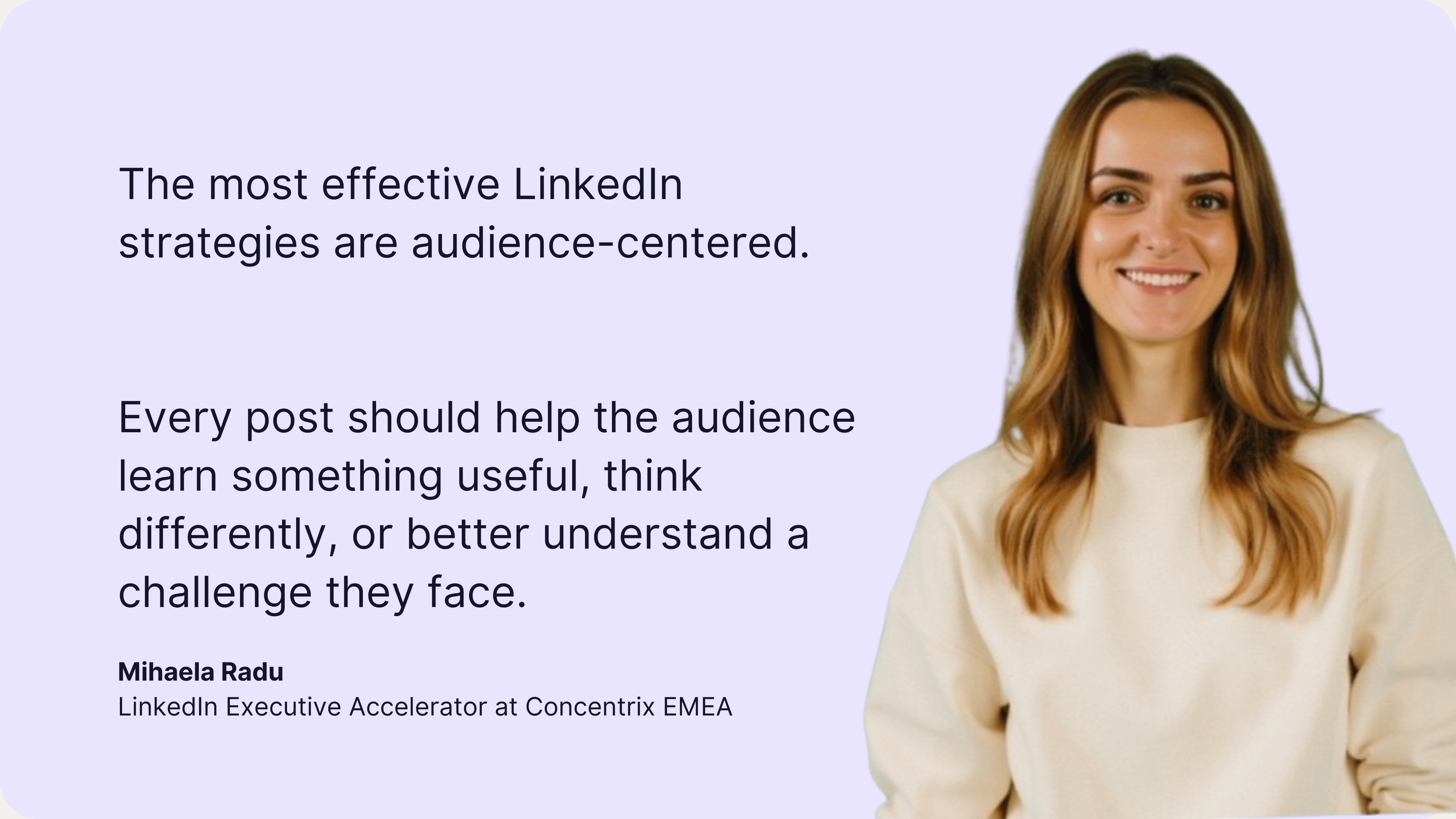
The most effective LinkedIn strategies are audience-centered. Every post should help the audience learn something useful, think differently, or better understand a challenge they face. Educational and insight-driven content also tends to create stronger long-term engagement, with guides and practical posts being saved significantly more often than promotional updates.
Develop an employee advocacy program for extended visibility
Employee advocacy is one of the most efficient and underused social media tactics for LinkedIn growth. When your employees share, comment on, or reshare company posts, that content gets exposed to entirely new professional networks that your page would struggle to reach on its own.
A few things that tend to make employee advocacy stick:
- Give people content worth sharing. If the post is genuinely interesting or useful, employees are far more likely to engage with it voluntarily.
- Brief your team on why it matters. People engage more when they understand the impact. An internal update showing how employee shares have extended reach or driven traffic can go a long way.
- Encourage personal perspectives, not copy-paste captions. When an employee adds their own comment before resharing, the post performs significantly better as it’s more credible.
- Recognize and celebrate participation. Shoutouts in internal channels or even just a thank-you message make people feel like contributors rather than a distribution channel.
- Start small and build momentum. You don't need the whole company involved from day one. A core group of engaged advocates can generate meaningful extended visibility.
Final thoughts
The biggest mistake social media managers make on LinkedIn is chasing trends based on whims rather than social media analysis.
LinkedIn is a goldmine for B2B when used properly. Make sure you audit your presence, set realistic goals based on historic data collection and benchmarks, and optimize your growth strategy using advanced LinkedIn analytics.
If you’d like to get insights like the ones presented in this article, but applied to your own brand, try Socialinsider for free for 14 days.

Sabina Varga
Sabina Varga is a B2B content strategist with 15 years in digital marketing, helping brands turn social media data into stories that connect and strategies that grow.

Know what your competitors do — before your manager asks
Get instant social benchmarks & reports without manual work.