Key Steps and Strategies For Running An Effective LinkedIn Company Page Audit
A step-by-step LinkedIn audit process: checklist, profile, audience, content, and how to measure your earned media value for your company page.

Posting consistently on LinkedIn and still seeing nothing move is one of the most common frustrations I hear from social teams. The question underneath that frustration is always the same: what's missing and how can things be improved?
A LinkedIn audit is how you get that answer. Not by guessing, not by hoping next month's numbers look better on their own, but by actually sitting down and looking at your page, your content, and your audience with fresh eyes and a clear framework.
Now, let me walk you through the process of running one, starting with a checklist you can use every time.
Key takeaways
- A LinkedIn company page audit checklist covers four categories: profile and branding, content and engagement, audience, performance and ROI.
- Running a LinkedIn audit follows five steps: define your business goal for LinkedIn, audit your company page profile, audit your audience demographics, audit your content performance and pillars, and measure the earned media value of your activity.
LinkedIn company page audit checklist
Here's a quick-reference checklist you can run through every time you do a LinkedIn audit, whether that's a new client, a quick internal review, or a sanity check before a big campaign. The sections below walk through each item in detail, but this table is what I'd hand you if you just needed a fast pass.
Profile & branding
- Profile photo (logo) is current, high-resolution, and correctly sized
- Banner image is on-brand, includes a CTA or value statement, and is up to date
- Tagline (120 characters) is filled in and uses relevant keywords
- About section is complete, keyword-optimized, and the first 156 characters work as a standalone preview
- Custom CTA button is set and links to the right destination
- Company details are accurate (industry, size, website, founded date)
- Specialties section includes relevant keywords for LinkedIn search
Content & engagement
- Identified top 3 performing content pillars
- Identified lowest-performing content types or themes
- Checked posting frequency, consistent cadence vs. gaps
- Reviewed content mix (formats: text, image, video, document, polls)
- Evaluated comment quality and response rate
Audience
- Reviewed follower demographics (job function, seniority, industry)
- Confirmed audience composition matches your ICP
- Checked follower growth trend over the last 90 days
Performance & ROI
- Tracked key metrics: reach, impressions, engagement rate, follower growth, CTR
- Measured Organic Value of campaigns
- Compared current period vs. previous period

How to run a LinkedIn audit: a step by step process
Step 1: Define what you want LinkedIn to do for your business
This is the step most people rush through, or skip entirely, because it feels like housekeeping before the "real" audit begins. But in my experience, it's actually where most LinkedIn audits go wrong.
If you don't define what LinkedIn is supposed to achieve for your business before you start pulling data, you end up optimizing for the wrong things.
So before anything else, answer this question honestly: what do we actually need LinkedIn to do for us right now?
Here's how the answer should shape your audit:
Most brands are working toward more than one of these at once, which is fine. But pick a primary goal before you start, and let it determine which numbers carry the most weight in your audit. Every recommendation you make at the end should tie back to it.
Step 2: Audit your LinkedIn company page profile
An incomplete company page simply doesn't look professional, and it's one of the most directly controllable parts of your LinkedIn presence. Before anything else, check these elements:
- Profile photo (logo)
- Banner image
- Tagline
- About section and LinkedIn SEO
- Custom CTA button
- Company details (industry, size, website, founded date)
- Specialties field
Here's how Jameka Christy, social media strategist, approaches a LinkedIn audit, for example:
Whenever I do a social media audit, I usually start by looking at the basics, making sure all of the profiles are set up correctly, branded consistently, and fully optimized.
Then I'll dig into the content itself: what's been posted, how often, and what type of content performs best. I also look at the audience, who's following, how engaged they are, and whether that matches the target customer the business wants to reach. From there, I'll compare what's working versus what's not, and I'll pull together clear recommendations for how to improve moving forward.
Step 3: Audit your audience demographics
I want to say something that might be uncomfortable: a growing follower count doesn't mean your LinkedIn strategy is working.
I know that sounds counterintuitive. More followers feels like progress. But if those followers aren't the people you're trying to reach, if they're the wrong seniority level, the wrong industry, the wrong job function, then every engagement metric you're looking at is slightly misleading. High engagement from the wrong audience is still the wrong result.
This is why the audience demographics step matters so much, and why I'd encourage you not to rush through it.
What to actually look at:
LinkedIn's native analytics give you a breakdown of your followers by job function, seniority level, industry, company size, and geography. Go through each of these and compare them honestly against your ICP.
Here's what I look for specifically:
- Job function and seniority. For most B2B brands, this is the most telling dimension. Are you reaching the people who actually make buying decisions, or are you building an audience of practitioners who rarely have budget authority?
- Industry concentration. Is your audience clustered in the verticals you sell into, or have you accidentally built a following in adjacent industries that look relevant but aren't?
- Geography. If you're a regional business or targeting specific markets, check whether your audience distribution reflects that.
Document any mismatches you find. They're often the root cause of engagement rates that look fine on paper but don't translate into pipeline or business outcomes.
What the data is actually telling you:
Once you have the demographics picture, use it to diagnose rather than just describe. A few patterns I see regularly:
- High follower count, low engagement rate: your content isn't resonating with the audience you've built, or the audience isn't the right fit to begin with. Either way, something needs to change upstream.
- Strong engagement, slow follower growth: you're retaining and activating the right people, but your content isn't reaching beyond your existing followers. Time to look at format, reach strategy, and whether you're using LinkedIn's distribution levers well.
- Good demographics, low seniority: your content is hitting practitioners but not decision-makers. This usually means shifting toward more strategic, business-level content, less "how to do X" and more "why X matters for your business."
- Follower growth trend: beyond demographics, check the direction of your follower growth over the last 90 days. Consistent growth during a period of active posting is a good sign. Flat or declining growth despite consistent posting is a signal that your content isn't being distributed beyond your existing audience, which means it's time to look at format mix, posting cadence, and topic relevance.

Step 4: Audit your content performance and content pillars
This is my favourite step, because I think it's where the real strategic clarity comes from.
Most teams evaluate their LinkedIn content post by post: this one did well, that one flopped, let's do more of the first kind. And while that's not wrong, it's incomplete. What you actually want to understand isn't which individual posts performed, it's which formats and themes consistently drive engagement. Because themes are what you can build a repeatable strategy around. Individual posts aren't.
I'd suggest going through this step in three stages: format analysis first, then content pillars, then a deep dive into your best-performing posts. Each layer adds a different kind of clarity, and they build on each other.
Start with a post format analysis
Understanding which content types your audience responds to is the quickest way to improve performance, because you can change formats faster than you can overhaul your content strategy.
This is where Socialinsider makes a step that's usually tedious genuinely fast. Instead of manually exporting CSVs and cross-referencing post types in a spreadsheet, you can see your format performance broken down automatically inside the platform.

For reference, Socialinsider's 2026 LinkedIn benchmark study shows native documents leading at a 7.00% average engagement rate, with multi-image posts close behind and video in third.
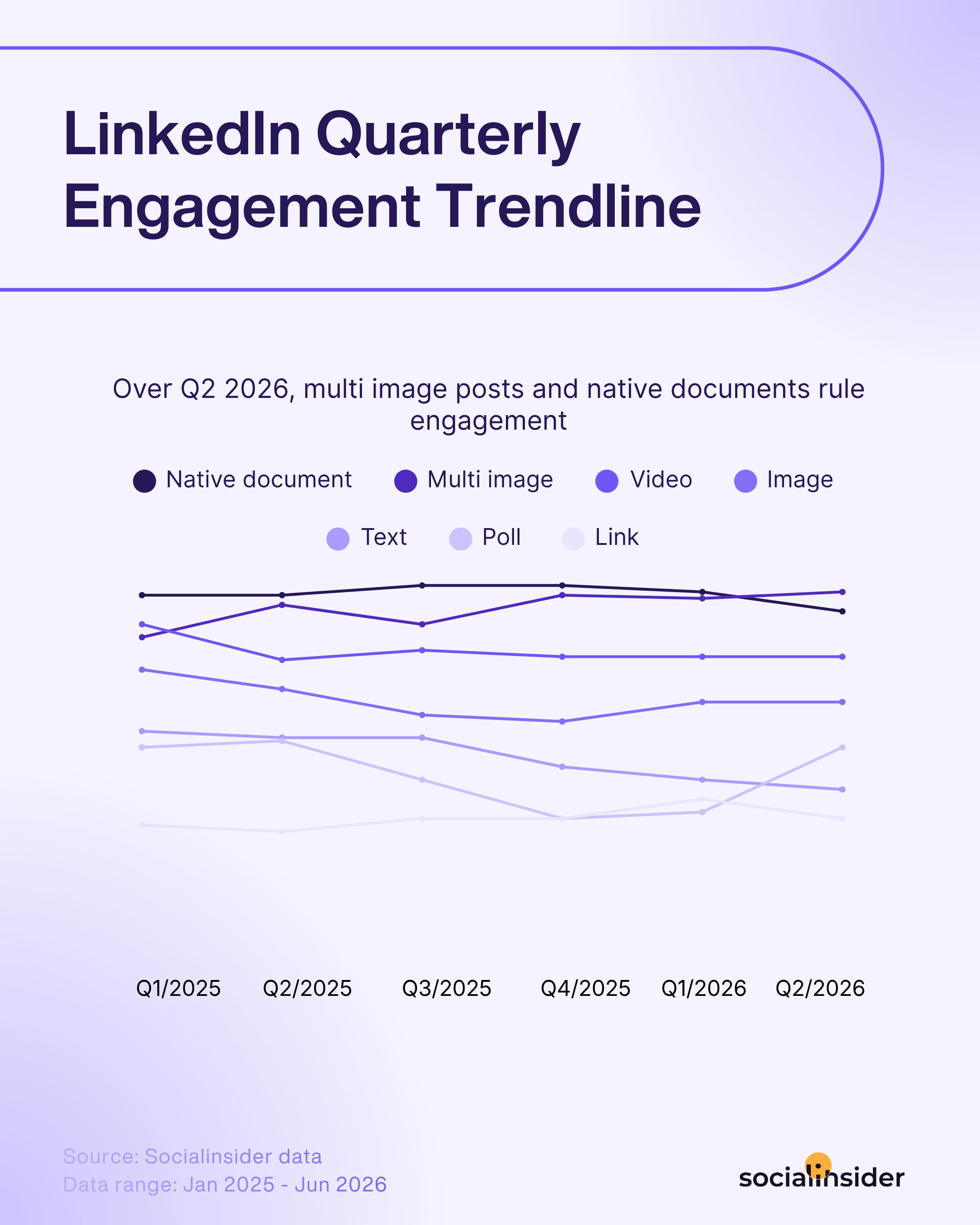
If your own format mix is still weighted toward single images or link posts, that's a strong signal of where to shift first, before you even get into your own page's specific numbers.
Run a content pillars analysis
Format tells you how your content lands. Pillars tell you what your audience actually cares about.
Content pillars are the foundational themes your brand posts around. Instead of evaluating posts one by one, pillar analysis groups them by topic so you can see which themes are consistently driving engagement at a strategic level. It's a different way of reading your content data, and in my experience, a far more useful one for making real decisions about where to invest.
This is where Socialinsider's Content Pillars feature does the heavy lifting. Here's how to analyze content pillars in Socialinsider:
- Add your LinkedIn profile to Socialinsider
- Click on the accunt introduced in the left-hand menu
- Navigate to the Content Pillars tab
From here, you'll have access to two types of content pillar analysis: AI-generated Industry Pillars, built automatically based on your industry to give you a benchmark for what content themes are resonating broadly across your sector, and Brand Pillars, custom themes you define to match your specific strategy, campaigns, or product areas, manually created through the Query Builder.

Deep dive into your best-performing posts
Now that you know which formats and pillars are winning, go one level deeper and look at your actual top posts, not to celebrate them, but to reverse-engineer them.

Pull your top posts by engagement rate from the last 90 days. Before you start looking for patterns, make sure you're working with the right data. For each post, you want to have:
- Impressions: how many people saw the post. This tells you about reach, not resonance.
- Engagement rate: the percentage of people who interacted with the post relative to its reach. This is your primary quality signal, and it's the metric I'd sort by first.
- Likes, comments, and shares: separately, because they tell different stories. Likes are passive. Comments signal that a post made someone think. Shares signal that someone trusted it enough to put their name on it.
- Clicks and CTR: essential if driving traffic was part of the goal for that post. A post with a high engagement rate but near-zero clicks is doing something different than a post that's actively pulling people off LinkedIn.
Once you have that picture for each post, then ask:
- What's the hook? The first one to two lines of a LinkedIn post determine whether anyone reads past them. Look at what your top posts open with. Is there a pattern, a question, a counterintuitive statement, a specific number, a personal observation? If there is, that's a format worth replicating deliberately, not just accidentally.
- What's the comment quality like? Likes are passive. Comments tell you whether a post actually made people think or feel something. Scroll through the comments on your top posts and read them. Are people sharing their own experiences? Asking follow-up questions? Tagging colleagues? That kind of engagement is a much stronger signal of content resonance than a high like count.
- What did you do differently? Sometimes a post outperforms because of the topic, but sometimes it's the format, the timing, the visual, or the way it was phrased. Try to identify at least one specific thing about each top post that you can carry forward deliberately.
Step 5: Measure the earned media value of our LinkedIn activity
There's a conversation I've had more times than I can count with social media managers, some version of: "I know our LinkedIn content is working, but I can't get leadership to take it seriously."
And when I ask what numbers they're bringing to that conversation, it's usually engagement rate and impressions. Which are meaningful metrics, to us. To a CMO or CFO deciding where to allocate budget, they're abstractions. What leadership wants to know is whether LinkedIn is worth the investment. And the only way to answer that in a language they respond to is with a number that connects to money.
That's what earned media value does.
Socialinsider's earned media value feature translates your unpaid LinkedIn activity into a monetary equivalent, specifically, what it would have cost to achieve the same reach, engagement, and clicks through paid LinkedIn campaigns.
It's not a vanity metric. It's a business case metric. When you can say "our organic LinkedIn content delivered €14,000 in equivalent ad value last quarter," that lands in a budget conversation in a way that "our engagement rate was 3.2%" simply doesn't. It also gives you a way to track the efficiency of your organic strategy over time, and to make smarter decisions about where paid amplification actually adds value versus where organic is already doing the job.
How to measure organic value in Socialinsider:
- Add your LinkedIn page to the Socialinsider dashboard
- In the Home section, go to Settings and click Earned Media Value Configuration
- Select LinkedIn as the platform and click Configure Value
- Assign a monetary value to each metric, reach, engagement, clicks, based on your industry benchmarks or your typical CPM/CPC rates
- From the left-hand menu, navigate to your LinkedIn profile, then click on Earned Media Value
You'll see the total calculated Organic Value for the selected period, broken down by metric so you can see exactly where the value is coming from.

How this compares to an automated audit tool
There are tools now that let you paste in a LinkedIn URL and get back an automated score in a few hours. If you just need a quick health check, that's a reasonable place to start, and there's nothing wrong with using one as a first pass.
But an automated score has a real limitation: it doesn't know your goal. It can tell you your About section is missing keywords or your posting cadence is inconsistent, the kind of thing any checklist can catch. What it can't tell you is whether your audience actually matches your ICP, whether your top-performing content pillar is one you should be doubling down on given where your business is headed, or what your organic activity is actually worth in dollars against your specific paid benchmarks.
That context, your goal, your competitive set, your ICP, is exactly what Step 1 of this process is built around, and it's the part a generic scoring tool has no way to account for. Use an automated tool for a fast surface-level check if you want one. Use the process above when the answer needs to hold up in a budget conversation.
Final thoughts
Running a LinkedIn audit isn't just a box to tick, it's a way to make sure the time and effort you're putting into the platform actually pay off. By stepping back and looking at your goals, your content pillars, your audience, and your content you get a clearer picture of what's working and what needs a tweak.
Think of it as hitting refresh on your strategy: you drop what doesn't serve you, double down on what does, and walk away with a LinkedIn presence that feels intentional and effective. And the best part? With the right tools, it doesn't have to be complicated, it just has to be consistent.
FAQs on LinkedIn audit
What is a LinkedIn audit?
A LinkedIn audit is a structured review of your company page, content strategy, and performance data, done with the goal of figuring out what's working, what isn't, and what needs to change. The word "structured" matters here: casually checking which post did well this week is monitoring, not an audit. An audit means stepping back from the day-to-day and looking at the whole picture at once.
What is the best LinkedIn audit tool?
For basic data, LinkedIn's native analytics is a free starting point. For anything more structured, content pillar analysis, earned media value calculation, cross-channel measurement, Socialinsider is the tool I'd recommend. It's purpose-built for this type of analysis and covers all the areas where native analytics fall short.
How often should you run a LinkedIn audit?
Quarterly is the minimum, and monthly is better if you're actively posting and running campaigns. The more regularly you do it, the less overwhelming it becomes each time: a quarterly audit where nothing has drifted too far off course takes a couple of hours, while a LinkedIn audit you've been putting off for a year is a much bigger lift.

Elena Cucu
As Content & SEO Manager at Socialinsider, Elena Cucu helps social media leaders make sense of the numbers behind their performance. Featured in TechCrunch, TNW, and ReadWrite.

Know what your competitors do — before your manager asks
Get instant social benchmarks & reports without manual work.