How to Improve Social Media Marketing: A 4-Pillar Framework
Learn how to improve social media marketing by diagnosing goal, platform, content, and distribution mismatches with data-backed fixes


If you’re responsible for social media marketing, you probably know the frustration of posting consistently but seeing engagement, reach, or conversions fall short of expectations.
When teams try to figure out how to improve social media marketing, the first instinct is usually to change the content. Try a new hook, test a different format, or publish more video. But content isn’t always the problem.
That's why in this guide, I’ll walk you through four common mismatches that can lead to underperforming social media marketing, how to identify the problem, and how to choose the right fix.
Key takeaways
- Underperforming social media marketing usually stems from a mismatch between goal, platform, content, or distribution rather than from the content alone.
- Each mismatch leaves a distinct signal in the data, such as rising reach without business impact, a channel trailing its own benchmark, declining engagement on the same formats, or strong content that underperforms due to timing, so a quick analysis against these four patterns points to the actual pillar at fault.
- Improvement efforts stall when teams react to a single week of data, change goals, platforms, and content all at once, drop the diagnostic framework once performance recovers, or keep an underperforming platform or pillar due to sunk-cost thinking.
When trying to improve social media marketing, it’s tempting to blame weak performance on the content alone. But underperforming social media marketing can result from a mismatch between your business goal, platform, content, or distribution.
Goal-mismatch
A goal mismatch happens when the metric you’re tracking is no longer connected to what the business needs. For example, your social media goals may focus on reach, while the business needs more sign-ups or qualified leads, or you're chasing follower growth when retention is the main priority.
Platform-mismatch
A platform mismatch happens when your effort is concentrated on a channel that no longer delivers the strongest results.
The channel might still get consistent posting and attention. Still, the return on that effort has fallen behind what a different platform, or that same platform's past performance, would suggest is possible.
This often stays hidden because the social media optimization behind where time and budget go rarely gets re-examined once a channel becomes the default choice.
Content-mismatch
A content mismatch is when your content isn't earning the results it should. Sometimes a content pillar was never the right fit for your audience to begin with, and sometimes a format that used to perform simply stops working as tastes or algorithms shift. Either way, the pillar keeps getting produced out of habit.
Distribution/timing-mismatch
A distribution or timing mismatch is when good content underperforms because of when or how it's published.
The content itself can be well made and genuinely relevant to your audience. Still, if it goes out at the wrong time, gets caught in a delayed social media workflow, or only reaches people on one platform, the results won't reflect the quality of what was actually made.
How to tell which pillar you're dealing with?
Each mismatch leaves its own signal in your data, so a quick social media analysis against the four patterns below is how you improve social media marketing outcomes without wasting effort on the wrong pillar.
Signals for a goal-mismatch
- Reach, impressions, likes, or follower growth are increasing, but the business outcome tied to your social media goals isn’t improving.
- Your team can’t clearly identify the main metric it is expected to influence during the current planning or reporting period.
- Reporting keeps shifting toward whichever metric looks strongest instead of tracking a consistent target.
- Leadership keeps asking what social media delivered for the business, but the answer remains vague. I’d take that seriously if I were you; it's usually the clearest sign something's off.
Signals for a platform-mismatch
- One platform repeatedly falls below its past performance or the industry benchmark, even after your team has posted consistently over several reporting periods.
Take Magic Spoon Cereal as an example. Its TikTok follower count and follower-growth rate sit well below its Instagram figures, even though both channels receive regular posting effort. Instagram accounts for the large majority of both, with TikTok making up a much smaller share.

If you compare the result with Socialinsider's TikTok follower growth benchmark, you'd notice that growth has slowed across every account-size bracket from 2024 to 2025, steepest for smaller accounts.
Magic Spoon's TikTok following sits at around 52K, in the 50K-100K bracket, where a typical account grew 45% in 2025, but its own TikTok growth was 10.11%, less than a quarter of that benchmark.
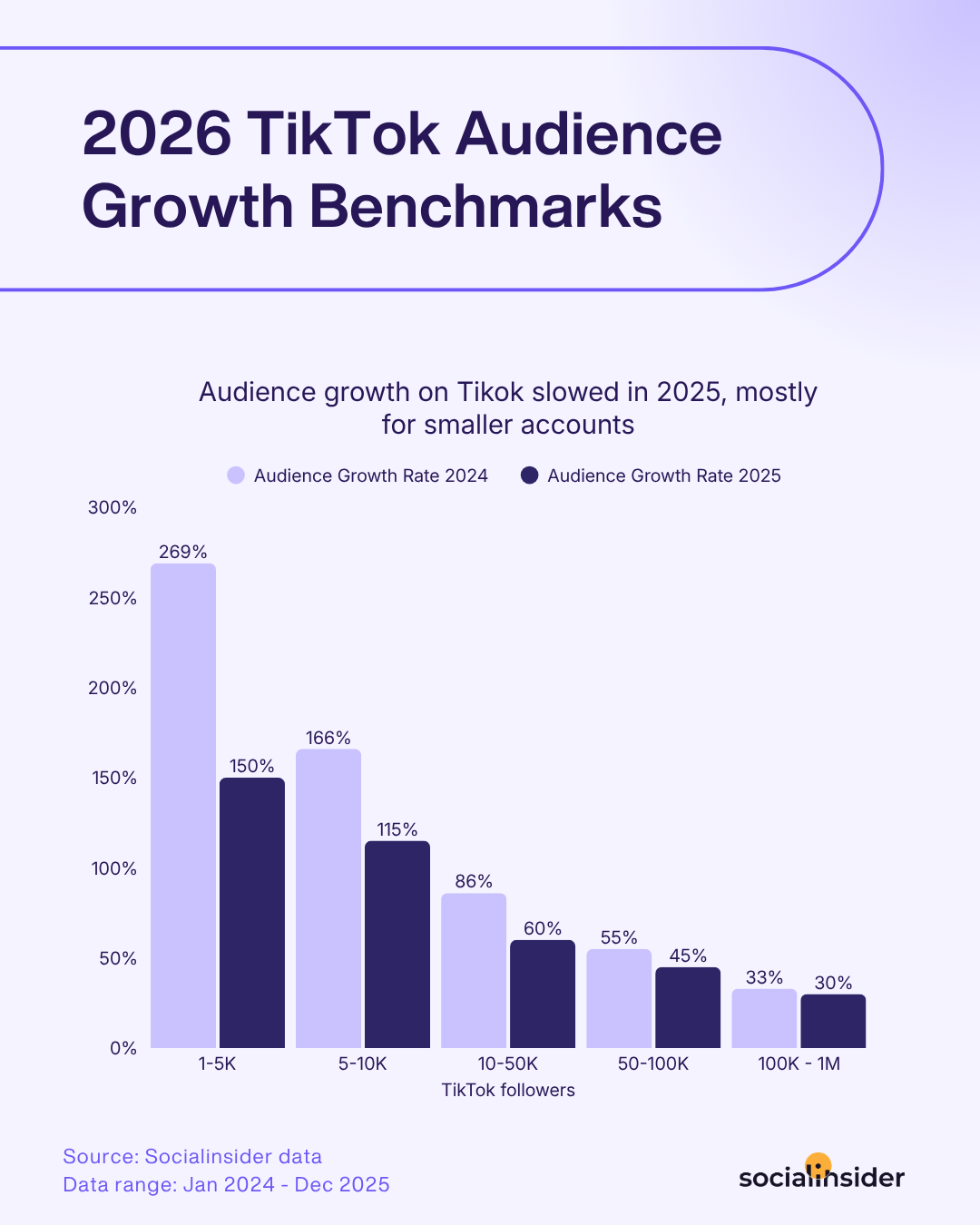
If it were simply slowing down along with the rest of the platform, its number should sit closer to 45%. Instead, it's a fraction of that, pointing to Magic Spoon's TikTok presence, not the platform getting harder for every brand.
That is why it is useful to check your account against relevant social media analytics and benchmark data with tools like Socialinsider instead of judging the channel purely against itself.
- Your team continues to devote the same amount of time and budget to the channel, even though brand performance has changed.
- The channel remains part of your strategy because it has always been there, not because current brand metrics show that it still deserves the same level of investment.
- A platform-by-platform comparison reveals a poor return on effort. Meaning your team may spend 40% of its time on one channel, while that channel contributes only 5% of the overall results.
Signals for a content-mismatch
- Your publishing frequency remains consistent, but engagement or completion rates continue to decline for the same formats, topics, or content types.
- Most of your results come from a small group of formats or content pillars, while the rest consistently generate little reach or interaction.
Signals for a distribution/timing-mismatch
This mismatch happens when a specific post underperforms even though the content pillar it belongs to has done well for you before or when your competitor is getting stronger results from a similar pillar and format.
Take this Instagram benchmark comparison of leading content pillars across three brands as an example. Look specifically at the Dining & Culinary Experiences pillar.

Seven Sunday Cereal recorded a 1.04% average engagement rate for the pillar, compared with 0.22% for Ghost Lifestyle Cereals and 0.01% for Magic Spoon Cereal.
Even though the three brands were creating similar types of content around the pillar, the difference in results suggests that content quality may not be the only issue. Audience behavior, execution, timing, distribution, and the approval process could also be contributing to the gap.
- Another signal is when a well-produced post receives very little reach during its first hour or day compared with the account’s usual early performance. That may point to a distribution or publishing-window issue.
How to fix your pillars' mismatch?
Each mismatch calls for a different response. If you want to improve social media marketing, start by identifying which pillar is underperforming instead of overhauling your entire social media strategy all at once. The sections below explain why each mismatch happens and what you can do to address it.
Fixing a goal-mismatch
A goal mismatch can influence the other three problems. When a team is measuring the wrong outcome, it may also make poor decisions about its platform mix, content, and distribution. Here’s why that happens and what you can do about it.
Why goal-mismatch happens
Most teams often set their social media goals during an annual planning cycle and then leave them unchanged for too long. Business priorities do not always follow that same schedule. Leadership may shift focus, budgets may change, or a new initiative may become more important before the next formal goal review.
When that happens, the social media metrics tied to the original goal can continue moving without reflecting what the business currently cares about.
Solution
- Set a review cadence that matches how quickly your business priorities change. For many teams, a quarterly review is a useful starting point, but faster-moving campaigns may need more frequent check-ins.
- Connect the social media goal to a specific business outcome, such as sign-ups, qualified leads, revenue, or retention, instead of relying only on reach or follower growth.
- Involve the person responsible for that business outcome when setting or changing the goal, ideally with a short social media proposal laying out what's changing and why.
Once the goal reflects what the business needs, you can make more informed decisions about which metrics to track and which changes to make.
Fixing a platform-mismatch
A platform mismatch concerns where your team is investing its time and budget. A channel that made sense when your strategy was created may no longer produce the same return as audience behavior, platform features, or organic distribution change.
Why platform-mismatch happens
Your original platform mix may have been based on sound reasoning, but the conditions around it can change. Audiences move between networks, platforms introduce new features, and changes to distribution can affect how easily your content reaches people without paid support.
Solution
I’d suggest rebalancing your channel mix as one of the practical marketing techniques for social media. Shift your time and budget gradually instead of abandoning the platform immediately.
Start by moving a defined portion of your resources to a stronger-performing channel, then review the results after an agreed testing period. A social media evaluation can help you decide whether the new allocation is improving your return on effort before you make a larger change.
Fixing a content-mismatch
Sometimes content might actually be the problem, but hold up before you retire a pillar or rebuild your entire content strategy; I need you to understand why the mismatch may have developed in the first place.
Why content-mismatch happens
- A format becomes predictable through overuse: Imagine that behind-the-scenes team-culture posts have been one of your strongest content pillars for a year.
After publishing the same style repeatedly, your audience may recognize the structure before the post has made its point. The topic may still interest them, but the delivery no longer gives them much reason to stop and engage.
- Platform preferences and distribution conditions change: You may build your content calendar around a format that performs well, such as short talking-head videos. If the platform later changes how it distributes or surfaces different formats, that same style may reach fewer people even when the underlying topic remains relevant.
- Audience preferences change over time: What your followers wanted from your brand a year ago may not be what they respond to now. If a content pillar doesn’t evolve with those changes, the distance between what you publish and what your audience wants can continue to grow.
Solution
Before you scrap the pillar, I suggest you to:
- Refresh it by keeping the core topic but testing a new angle, format, hook, or level of depth.
- Publish the refreshed version consistently enough to create a meaningful comparison.
- Compare its engagement or completion rate with the original version using the metric that matters for that content type.
- Then retire or reduce the pillar only if the refreshed version still falls short after a fair test.
Fixing a distribution-mismatch
Good content can underperform for reasons related to when, where, or how it is published. If you’ve already checked the goal, platform, and content, review the timing and delivery conditions before assuming the post itself failed.
Why distribution/timing-mismatch happens
- Posting schedules become outdated. Your team may set publishing times based on when your audience was most active in the past and then keep using that schedule without reviewing it.
Audience routines change, people join from new time zones, and platform usage patterns evolve. However, the original cadence can remain in place simply because nobody checks if it still reflects current behavior.
- Approval workflows reduce the available publishing window. Content may be planned for a specific moment, but every additional review step increases the chance that it will go live late. A short delay will not always affect performance, but it can matter when the content depends on a timely event, trend, launch, or audience behavior.
Solution
- Shorten the gap between approval and publication. This is a process improvement, not necessarily a content change, because the post may have been suitable but delayed by internal workflow.
- Check if a pillar performing well on one platform is being kept there instead of being adapted for another. Cross-platform comparisons using data-driven marketing can show if a strong topic is genuinely platform-specific or simply has not been tested elsewhere.
How to prove a fix worked?
A fix is not confirmed just because performance feels better. A useful social media tip is to track the primary metric connected to the mismatch you diagnosed using your social media analytics tools, rather than relying on your entire dashboard.
If you're setting this kind of tracking up for the first time, here's how to use Socialinsider to pull the specific metric.
Remember to give it more than one posting cycle. A single good week doesn't confirm a fix any more than a single bad week confirmed the original problem.
- Check if the primary metric remains stable across several reporting periods instead of spiking once.
- Compare the result with the same baseline, benchmark, or content group you used during the diagnosis.
- Keep the metric under focused review until the improvement is consistent.
- Then fold the result back into regular reporting only after the change has held over time.
Mistakes that quietly stall improvement efforts
Even a correct diagnosis can be undone by poor execution or habits that allow the same problem to return.
Your team may identify the right mismatch but still fail to improve because you reacted too quickly, changed too many variables, or did not assign anyone to monitor the result. Here are the mistakes that can undo good diagnostic work.
Diagnosis mistakes
Under time pressure, you can look at the latest numbers and react immediately. But reviewing only one week of social media data makes it difficult to tell the difference between a genuine performance problem and a normal fluctuation.
Compare several reporting periods and look for a consistent direction across similar posts, platforms, or content groups. Without that context, your team may move budget, change your platform mix, or abandon a content pillar because of a temporary dip that would have corrected itself.
Scope mistakes
Changing the goal, platform mix, and content pillars in the same reporting cycle may feel like a thorough response, but it makes the outcome difficult to interpret.
If performance improves, you won’t know which change produced the result; if performance declines, you also won't know which decision created the problem. This makes it harder to measure social media success consistently.
A shared brand strategy framework can help limit this confusion by giving the team a common plan for prioritizing and testing changes. Isolating the most likely problem first also makes it easier to repeat a successful decision later.
Process mistakes
Some teams often use a diagnostic framework during a visible performance crisis and then stop using it once the numbers recover. Without someone responsible for revisiting the diagnosis, checking the agreed metric, and reporting the outcome, the original problem can gradually return without anyone noticing.
Assign someone and set a recurring review date before implementing the fix. A recurring social media audit can also help your team revisit the diagnosis before the same problem becomes serious again.
This review doesn't need to become another large audit; it can be a short check to confirm that the original signal has not reappeared.
Organizational mistakes
A platform or content pillar may remain in the strategy because your team has already invested significant time, money, or effort in it. That is a form of sunk-cost thinking: past investment influences the decision even when current performance no longer supports the same level of commitment.
A regular brand audit makes this easier to challenge because your team reviews performance on a schedule rather than waiting for someone to question the results.
The goal isn’t to remove every underperforming platform or pillar immediately; it is to make sure each one still has a clear role and earns its place in the strategy.
Final thoughts
If there’s one thing I want you to take from this guide, it’s that content isn’t always the issue. Sometimes creating content that actually works means fixing the platform, goal, or the way the content is being distributed first.
When you’re trying to figure out how to improve marketing on social media, start with the diagnosis before reaching for a complete overhaul. Check the pattern, isolate the most likely mismatch, make one focused change, and give it enough time to produce meaningful evidence.
Want to see which pillar your own numbers point to? Try Socialinsider free for 14 days and get the benchmark data to back up the diagnosis.
Gift Ilevbare
Gift Ilevbare is a freelance writer and social media strategist for B2B SaaS and B2C brands.

Know what your competitors do — before your manager asks
Get instant social benchmarks & reports without manual work.


