Social Media Tips Based on Data: How To Actually Move Performance
Social media tips that fit the platform, support the goal, and give you a clear way to measure progress, instead of generic advice.


Most social media tips are generic enough to apply to any account, which is exactly why they don't move any single number for yours.
I built this list around one rule: every tip here is specific to one platform: Instagram, TikTok, LinkedIn, or X, because advice that ignores platform mechanics isn't really a tip; it's a guess.
Here's what I mean by that: TikTok's algorithm rewards watch time, so a hook-first video that earns a full watch-through wins there. Instagram increasingly rewards saves and shares over pure watch time, so that same hook-first video can perform fine on TikTok and still underperform on Instagram — what it needs there is a reason to save it, not just a reason to keep watching. Same goal, different platform, completely different move required.
So I've split everything by platform first, then by job: content, growth, and workflow. Read it start to finish, or jump straight to the platform you're focused on — either way, there's something here worth taking away.
Key takeaways
-
The most effective growth tips right now involve building content briefs around actual platform search terms rather than hashtags, and collaborating with creators whose audience overlaps with yours in interest without already following you.
-
The data tips that matter most here are picking one metric in advance to prove whether a tip actually worked, and checking the result against competitors' performance instead of just your own account's past numbers.
-
The highest-leverage workflow tips for lean teams are automating recurring performance reporting, building a 4–5 theme content pillar system, and reviewing last month's top and bottom performers before planning the next content calendar.
Platform-specific tips and strategies
I'll say this upfront: most "social media tips" content treats platforms as interchangeable. They aren't, and treating them that way is probably the single biggest reason generic tips lists underperform.
Each platform's algorithm rewards a different behavior, so a strategy that moves the needle on Instagram can be neutral or actively counterproductive on Facebook.
Instagram tips
- Make carousels a core part of your strategy, not an occasional format. As per Socialinsider's Instagram benchmarks, carousels are the best-performing Instagram format overall — each swipe counts as an added interaction, giving the algorithm a stronger signal that people are spending time with the post than a single-image or single-video post would. My advice is to save single-image posts for quick announcements, and default to carousels instead, even if it's a shorter one.
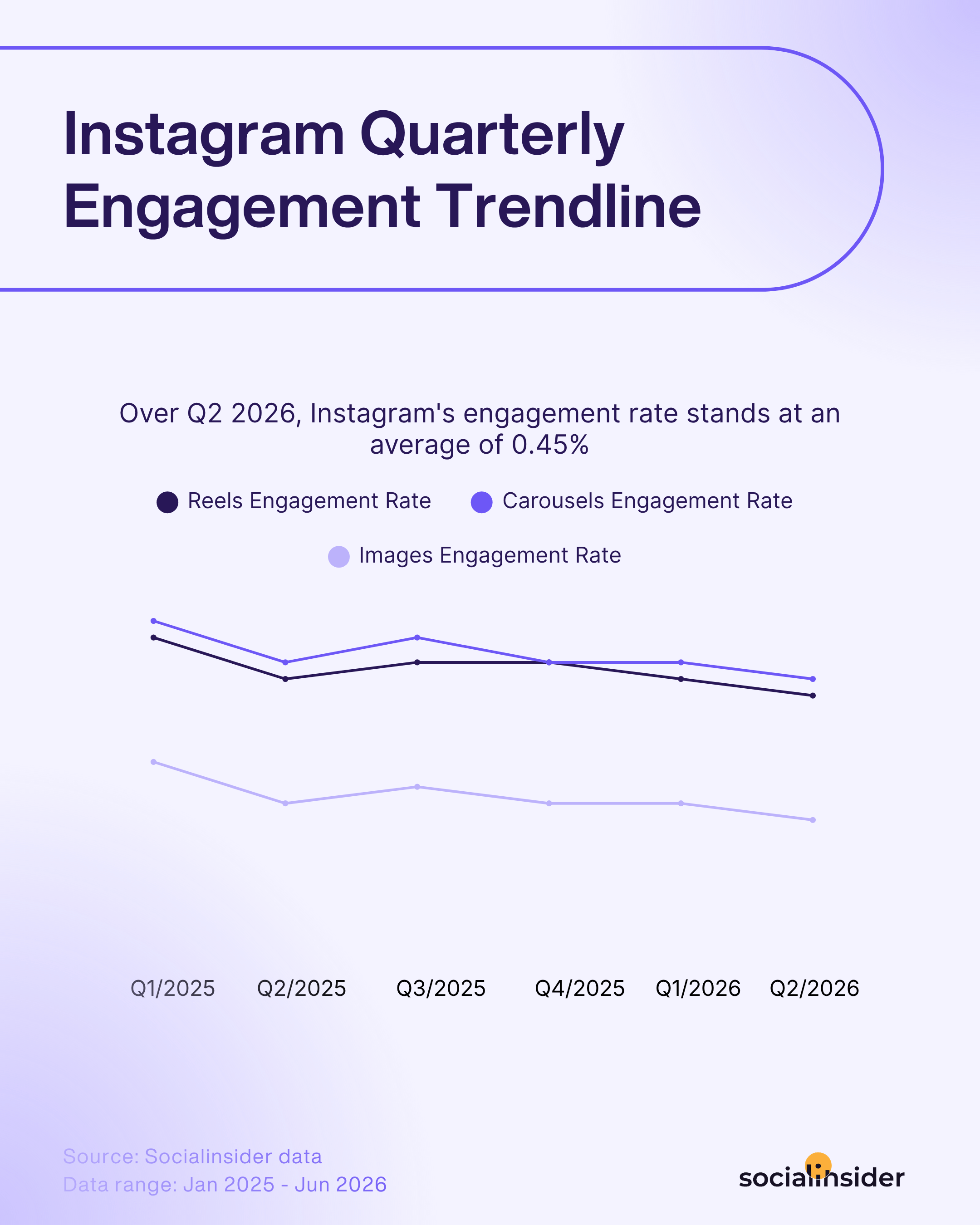
- Discover your ideal Reels length through testing. According to Socialinsider's latest Reels length research, the best -performing Reels are those between 45–60 seconds. And if you think about it, it makes total sense. That middle ground tends to hold attention long enough to drive completion, saves, and shares, without running long enough to lose viewers before the payoff. However, every brand is different, so you should not limit every Reel to this length, but rather test several options and let the data speak.

TikTok tips
- Mine your comments for your next videos instead of just moderating them. Recurring questions, disagreements, and requests in your comments are audience-submitted content briefs. Turn the most repeated question into a dedicated video, or reply to a sharp comment on camera — TikTok's reply-to-comment video format rewards this natively, and it gives you content that already has a proven audience before you even post it.
- Check your traffic source breakdown before deciding what to create next. If Search share is climbing on a specific video, that topic has proven demand; build your next few pieces of content directly around the exact phrase people searched to find it. If For You share is strong but completion is weak, the topic worked, and the execution didn't; remake it with a tighter edit rather than abandoning the topic.
- Turn a high-comment video into a short series. A video with unusually high comment volume relative to its views usually means people have follow-up questions the original didn't answer. Treat that as a direct brief for a Part 2, not just a sign the original topic performed well.
LinkedIn tips
- Split your effort between the company page and employee advocacy. Company page posts are better for announcements and top-of-funnel brand awareness. Employee posts, especially from people in customer-facing or leadership roles, consistently outperform company page posts on reach and engagement, because LinkedIn's algorithm favors personal profiles over brand pages.
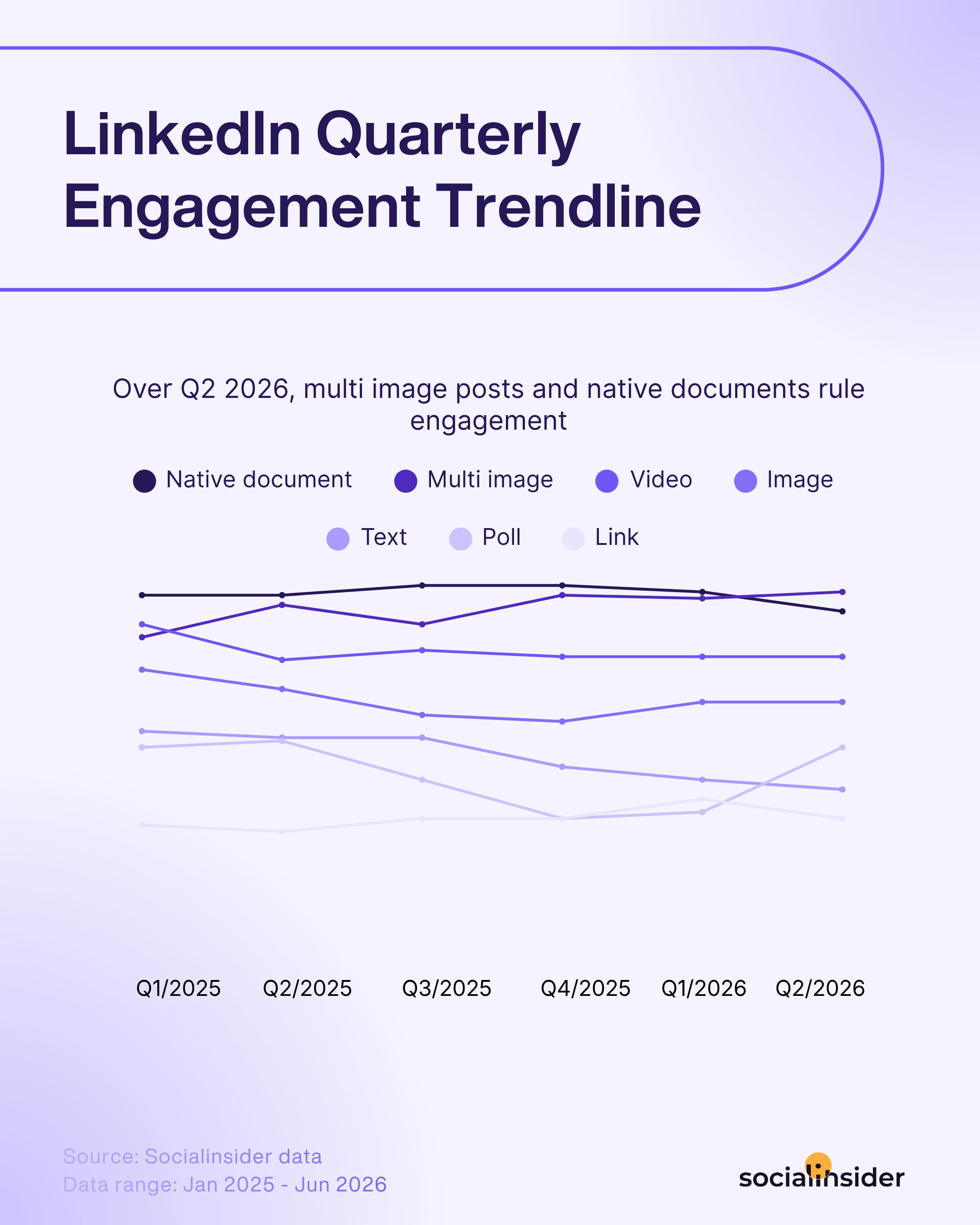
- Put native documents, multi-image posts, and videos at the center of your LinkedIn strategy. These three formats carry storytelling better than any other on LinkedIn, and storytelling is what the audience actually wants there — an inspiring account of how something happened, or a helpful resource that walks people through overcoming a specific challenge. Defaulting to one format limits you to one way of telling that story; rotating across all three keeps the format itself from becoming the ceiling on what you can say.
X tips
- Use threads (the format, not the app) for anything that needs context. A single post with a strong first line, followed by supporting posts, tends to outperform one dense post trying to fit everything in.
- Post more often than feels comfortable — X rewards volume differently than other platforms. According to Socialinsider's social media benchmarks report, brands on X went from posting an average of 50 times a month in 2024 to 70 times a month in 2025, a 40% jump, and that pace increase tracks with how the platform actually works: X is built for real-time, always-on presence, and posting infrequently means missing conversations rather than just posting less. Treat X less like a content calendar and more like an ongoing conversation you need to keep showing up for.
What does the data say about different content formats across platforms?
When it comes to offering social media tips, I always prefer turning to data instead of guessing. So, in a nutshell, here are some benchmarks I think you need to know before adapting your social strategy to what the internet says is trending right now.
How to decide whether a new format is worth testing?
A new format is worth testing when it solves a real problem, not when it is simply new. Ask whether the format could improve reach, retention, engagement, or conversion before you invest time in it.
The easiest filter is this: does the format fit the audience’s behavior on that platform? If people browse quickly, test short content. If they save and revisit, test structured content. If they comment heavily, test opinion-led posts or prompts.
Here is a simple test-readiness checklist:
- The format matches the platform’s native behavior.
- The team can produce it consistently.
- You know which metric will define success.
- You have enough time to test it properly.
- The format fits the brand’s message, not just the trend cycle.
If you answer yes to most of those, test it. If not, park it for later and keep your focus on the formats that already show promise.
Content tips to improve engagement
Coming up with something new every week gets exhausting, and there's always that quiet hope that this one finally goes viral.
That pressure is exactly what makes people ditch a topic the moment it underperforms once, when the idea was usually fine, but it just needed a different treatment.
These tips are about squeezing more out of what you've already got, instead of starting from zero every week.
Test structure, not just topic
Here's something I run into constantly: most teams A/B test what they post — this topic vs. that topic — but almost never test how they post it.
But my advice would be to do things a bit different. Try holding the topic constant and testing structure instead: a question-first caption vs. a statement-first caption, a single strong visual vs. a carousel, a 15-second video vs. a 45-second one.
In my experience, structure tests tend to produce clearer, more repeatable learnings than topic tests, because you're isolating one variable.
Plan the system, not just the single post
Most repurposing happens backward: a team creates one piece of content, then tries to squeeze it into other formats after the fact, and it usually comes out feeling like leftovers.
My advice? Flip the order instead; scope the core idea alongside its downstream formats from the start. A LinkedIn thought-leadership post can be planned from day one to also become a set of Instagram carousel slides and a TikTok script, each rebuilt for how that platform's audience actually consumes content, not just resized to fit.
Growth and discoverability tips to increase your reach
Discoverability is not just about being found. It is about being found by the right people, with enough context to make them care.
Build content around platform search intent
Platforms function as search engines now, and most brand accounts are still optimizing for the wrong layer, treating hashtags as the discovery lever when the real signal is the actual words in captions, alt text, and on-screen text.
Here's how I do it: I pull autocomplete suggestions and top search results for my core topics directly from TikTok and Instagram search, and build the content around those exact phrases before a single caption gets written. It's the same discipline as search strategy elsewhere, just applied to platforms instead of Google.
Co-post and collaborate deliberately
Collaborations work because they borrow trust and distribution at the same time. When two creators or brands share the same post, both audiences get exposed to the content without forcing a cold introduction.
This works especially well for launches, educational explainers, and audience crossover campaigns. A co-post or joint live session gives you a built-in reason to reach beyond your own feed.
If you want better reach, choose collaborators based on audience overlap, not just follower count. A smaller partner with a highly relevant audience can outperform a much larger account with weak alignment.
Data and optimization tips to prove what's actually working
This is the section I think most "social media tips" articles skip entirely, despite being the one that actually separates a tip that sounds good from one that's working.
Know which metric actually validates each tactic
Not every metric matters for every tactic. A hook change should be judged on watch time, not follower growth. A hashtag change should be judged on reach from non-followers, not on total engagement.
My advice: before you run a strategy, decide the one metric that will tell you whether it worked, otherwise you'll end up eyeballing a dashboard and calling it a win because a number went up for unrelated reasons.
Benchmark the tactic against competitors, not just against your own past performance
A strategy can lift your numbers and still leave you behind where the market is moving.
Comparing your Reels performance to your own account last quarter tells you if you improved. Comparing it to your closest competitors tells you if you're actually winning attention in your category, which is usually the number your leadership actually cares about.
This is where competitive benchmarking earns its place as a tactic rather than a once-a-quarter report: pull competitor data before you test a tactic, and again after, so you know whether you moved relative to the market, not just relative to yourself.
Here's roughly what that looks like in Socialinsider:
- Add your closest competitors' profiles
- Filter down to the specific format or content type you want to analyze


- Set a baseline
- Choose what you'll test and a timeframe
- Re-pull the same comparison after the test window closes
Workflow tips for lean social teams
Most advice on scaling social assumes you can hire your way out of a busy season. Most heads of social I talk to can't. So here are my tips for doing more with the team you already have.
- Batch reporting instead of rebuilding it weekly. If pulling performance data for a leadership update takes half a day every week, that's half a day you're not spending on strategy or content. Automating recurring reports, even basic ones, buys back time that compounds over a quarter. Socialinsider's automated report generation is built for exactly this: set the report up once, and it pulls the numbers for you on a schedule instead of you rebuilding the same deck from scratch every week.

- Build a lightweight content pillar system before you build a full calendar. Knowing your 4–5 recurring content themes makes both creation and delegation faster, because anyone on the team can slot a new idea into an existing pillar instead of starting from a blank page each time.
- Review what worked before planning what's next. A 15-minute look at last month's top and bottom performers before planning next month's calendar will tell you more than an hour of open-ended brainstorming. Let the data narrow the options before the team starts generating ideas.
Final Thoughts
The best social media tips are not the flashiest ones. They are the ones that fit the platform, support the goal, and give you a clear way to measure progress.
Elena Cucu
Content & SEO Manager @ Socialinsider with 8 years of experience in marketing. I like to describe myself as a social butterfly with a curious mind, passionate about dancing and psychology.

Know what your competitors do — before your manager asks
Get instant social benchmarks & reports without manual work.