How to Win Over Your TikTok Target Audience: A Guide Featuring Experts’ Insights
Learn about TikTok's target audience characteristics and strategies to optimize your content, enhance engagement and drive growth for your brand.

I’ll be blunt.
Most TikTok advice is useless because it skips the part that decides everything: who the content is built for.
A lot of accounts get decent views and still get nowhere: wrong followers, dead comments, low saves, no repeat viewers.
That happens when the TikTok target audience is too broad, too imaginary, or borrowed from someone else’s niche.
In this article, together with Malene Priebe Hold, social media manager at MCoBeauty, I’ll help you define your TikTok’s audience, sharpen your social media target audience strategy, and show you how to use social media audience analysis to create content TikTok can actually match with the right users.
This way, the people you want actually see it and come back for more.
Key takeaways
- TikTok’s specificity: discovery-first feed vs. follower-based platforms: On TikTok, it doesn’t matter who follows you—what matters is whether the algorithm understands who your content is for.
- How to define your TikTok audience? A strong TikTok audience definition goes beyond demographics and focuses on psychographics—what people care about, react to, and return for.
- How to reach your target audience on TikTok? You can reach your target audience on TikTok by creating clear, engaging content, reinforcing it with SEO and engagement, adjusting based on performance data, and scaling what works through ads and relevant creators.
TikTok’s specificity: discovery-first feed vs. follower-based platforms
It’s no news that TikTok plays by different rules than most social platforms.
On follower-based platforms like Instagram, content mostly circulates inside your existing network. Reach grows outward from followers, which means distribution is limited by who already knows you.
TikTok flips that logic. The For You page is discovery-first, designed to test content with new users from the very start, especially when an account is small.
That testing phase is why TikTok can feel unpredictable. It’s also why it can outperform every other platform once your targeting is clear.
When TikTok understands who your content is for, it doesn’t need a follower base to scale distribution.
That shift is especially important given who’s actually on the platform today.
TikTok isn’t just Gen Z anymore.
Malene also emphasized this:
We were actually surprised by the age demographics. There’s a common perception that TikTok's audience is mostly Gen Z or even younger, but in reality, the age group tends to skew a bit older—often including people in their 30s or 40s. This is an important distinction, as many assume on this platform, there are primarily Gen Z, simply because they’re more visible as content creators.
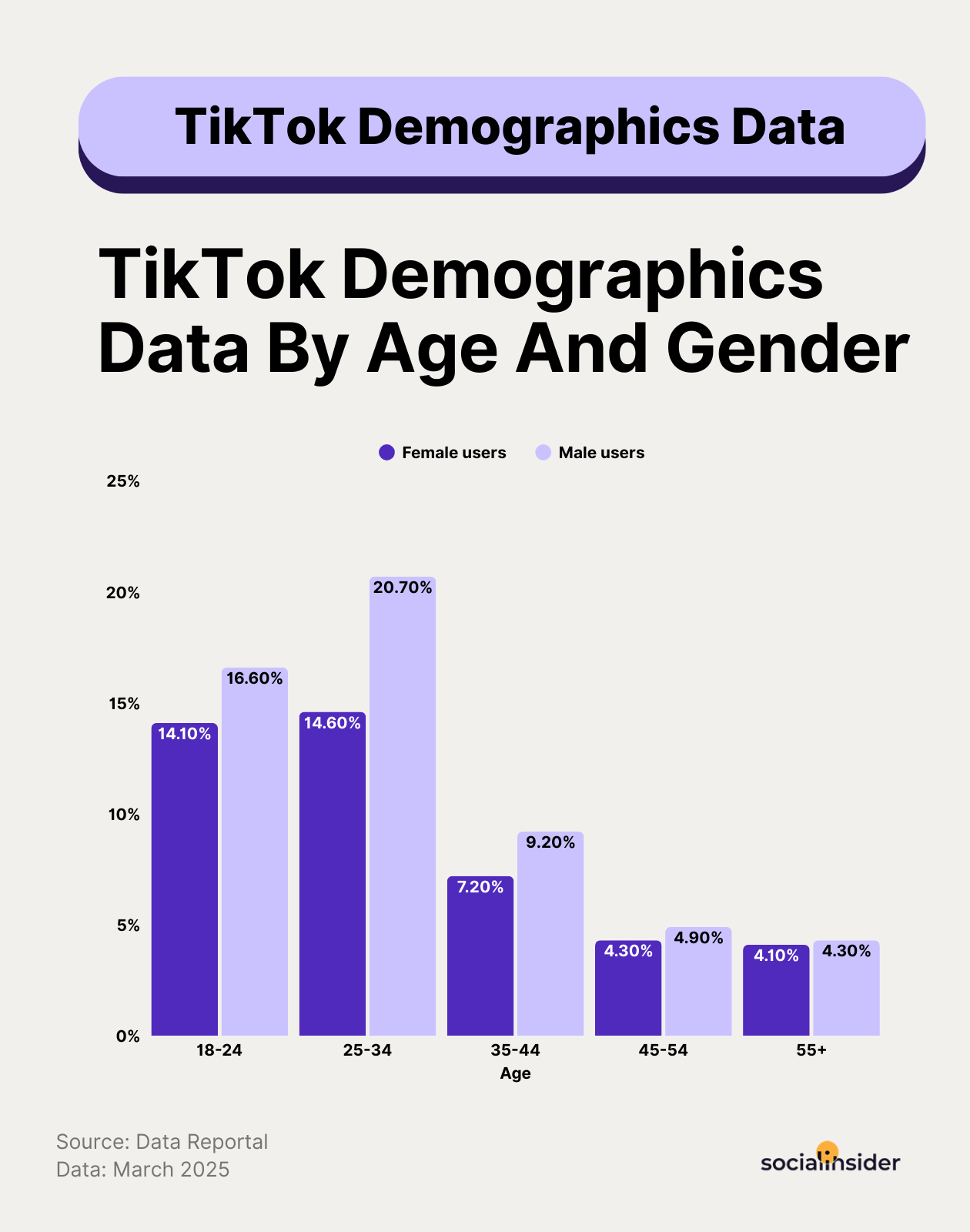
As shown in the chart above, the platform has a strong concentration in the 18–34 age range, with 25–34 standing out as the largest segment. That group is one of the most valuable audiences for brands focused on purchase intent, repeat buying, and lifestyle-driven spending, not just passive views.
This is where TikTok’s role in marketing changes. It’s moved well beyond pure awareness.
It’s one of the fastest paths from discovery → consideration → purchase, largely because of how content is consumed.
The format builds trust quickly (through face-to-camera videos, product-in-use clips, reviews, and real reactions) and creates demand without relying on hard selling.
As a result, users:
- shop what they see
- search for products mentioned in videos
- copy routines, setups, and recommendations
That behavior is why TikTok content often drives:
- higher-intent traffic (people clicking because interest is already there)
- faster decision-making (they’ve seen the product work in context)
- impulse-friendly purchases, especially in accessories, beauty, fashion, and tech
All of this is governed by one system: the TikTok algorithm.
Unlike follower-based feeds, the TikTok algorithm is built to match content to people, not accounts to audiences. Each video is tested with a small, relevant group first. What happens there decides everything.
Distribution is shaped by signals like:
- watch time and completion rate
- rewatches
- shares and saves
- comments
- topic signals from captions, on-screen text, audio, and viewer behavior
When those signals align, TikTok widens distribution. When they don’t, the video stalls regardless of how nice it looks.
If you want a deeper breakdown of how this system works and how to use it strategically, this guide on the TikTok algorithm explains it in detail.
TLDR? TikTok is a discovery machine. When your audience and content signals are clear, reach becomes consistent and leads to real traction, not just views.
How to define your TikTok audience?
TikTok pushes your videos to the most relevant viewers based on signals. Your job is to be crystal clear about who those viewers are.
The fastest way to get clear on your audience is to separate demographics from psychographics.
And that’s the core of social media market research.
Not the corporate ‘persona’ kind, but the useful kind: spotting who’s already engaging with content like yours, what they actually care about, and what keeps them coming back.
Here's what Malene also had to say about this:
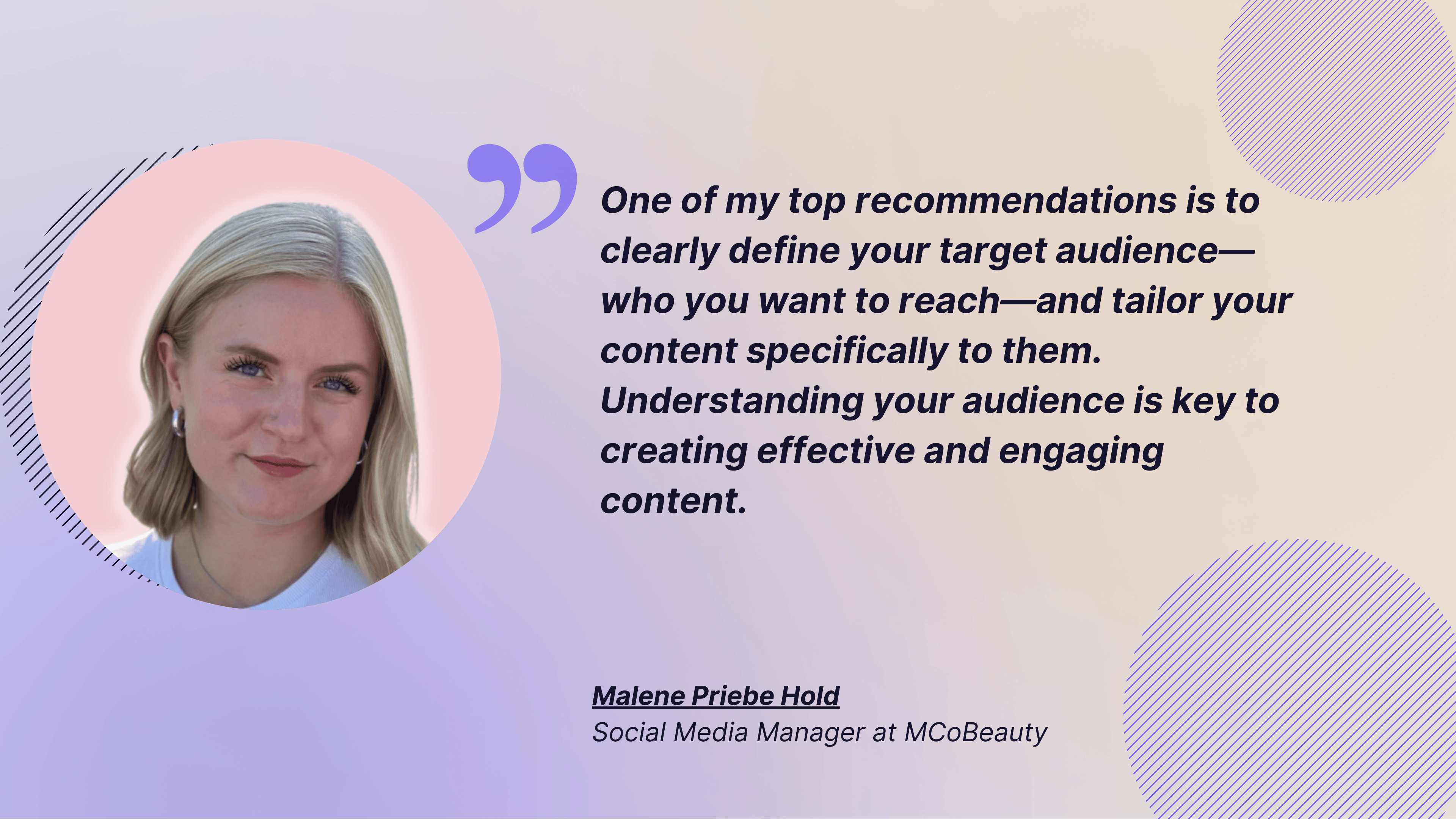
One of my top recommendations is to clearly define your target audience—who you want to reach—and tailor your content specifically to them. Understanding your audience is key to creating effective and engaging content.
That being said, a strong TikTok audience definition has two layers:
Demographics = who they are
This is the easy part. It’s the basic profile:
- age range
- location / language
- job or lifestyle stage
- device habits (heavy TikTok users or casual scrollers)
Demographics help you narrow the field. But they don’t explain attention.
Psychographics = what makes them care
Psychographics are what decide whether someone stops scrolling and watches:
- what they’re trying to achieve
- what annoys them
- what they’re proud of
- what they don’t want to look like online
- what they value (status, simplicity, quality, price, aesthetics, convenience)
This is what shapes your hooks, angles, tone, and even the kind of comments you attract.
A quick way to make it real
A useful audience definition looks like this:
- Demographics: 25–35, working professionals, Europe/US
- Psychographics: wants clean, premium-looking accessories, hates overhyped trend content, cares about value, buys when something feels intentional
That second line is the real targeting. It tells you what to say, how to say it, and what kind of content people will actually come back for.
How to reach your target audience on TikTok?
So now that you know who you want to talk to, let’s see how to get to your TikTok target market.
In this section, I’ll share the TikTok tips I use to reach a clear target audience for TikTok by creating content the platform knows how to distribute.
1. Create authentic, entertaining, and valuable content
Reaching your target audience on TikTok starts with social media content that feels real and earns attention on its own.
The algorithm can amplify distribution, but it won’t fix unclear value.
If people don’t enjoy, learn, or relate to what they’re watching, the signals stop there.
And the strongest-performing accounts usually get three things right: format, balance, and pacing.
Leverage best-performing content formats
TikTok doesn’t measure effort the way creators do. It responds to how viewers react.
That’s why educational and entertaining formats consistently perform better than everything else.
From experience, I can tell you that educational videos work when they answer one clear question or explain one useful thing. Entertaining videos work when they feel natural and familiar, not engineered for engagement.
Both formats win for the same reason: the viewer leaves with something, whether it’s context, clarity, or a reaction worth remembering.
Mix trending and brand-specific content
Tiktok trends might help you with discovery, but brand-specific content builds recognition. Relying on only one limits growth.
Trending sounds or formats can introduce your videos to new viewers, while brand-led content teaches TikTok who should see you again.
Over time, that balance helps the algorithm associate your account with a clear topic and audience instead of random spikes.
Malene also stated:
A few years ago, having a TikTok content strategy was largely about copying trends—simply jumping on what was popular could help you go viral and quickly gain followers. However, the platform has evolved, and it’s no longer effective to just chase every short-lived trend. Now, brands need to focus more on building their identity and community. While participating in weekly micro-trends might give you a temporary boost in views, these rarely contribute to meaningful long-term brand value or community growth. It's more strategic to evaluate which larger, enduring trends truly align with your brand and products.
If you find yourself struggling to make a trend relevant, it may not be the right fit. Ultimately, it’s about choosing opportunities that authentically resonate with your brand and audience.
Test different video lengths and optimize based on performance
I often get asked if video length directly affects how TikTok tests and scales your content.
And yes, it does.
As per Socialinsider's TikTok length research, longer videos (especially around the 90–120 second range) tend to generate higher average views when retention holds.
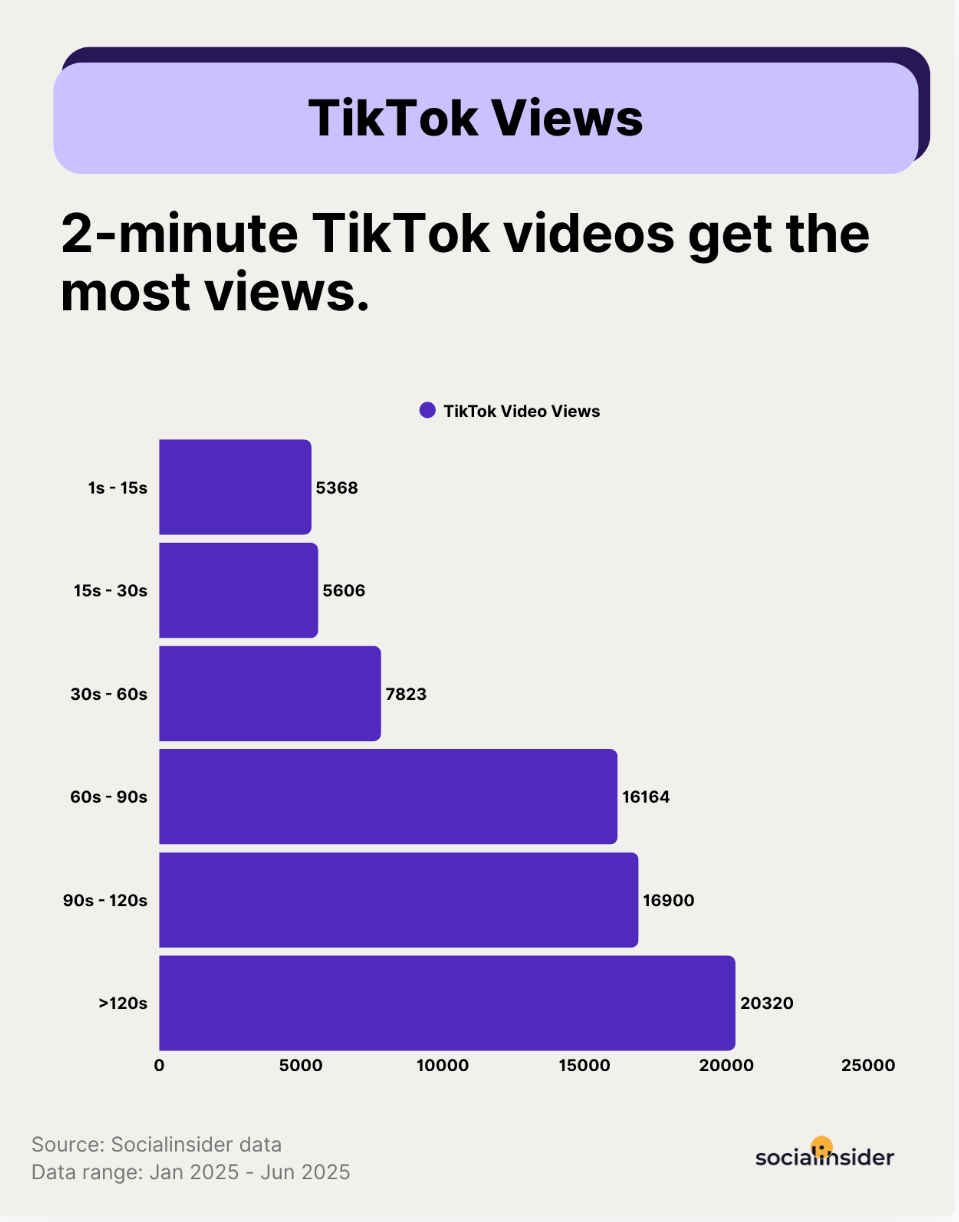
However, that doesn’t mean every video should be long. It means you should test length intentionally. Short videos are easier to sample, while longer ones give TikTok more data on watch time, rewatches, and completion.
The goal isn’t to hit a ‘perfect’ duration, but to find the length where your audience stays engaged the longest.
2. Leverage SEO principles
This is the part most people underestimate.
TikTok isn’t just pushing videos anymore. It’s indexing them.
And personally, I treat every post as something that should be understandable with or without the feed. If TikTok had to describe your video to someone else, could it do it accurately?
That’s what social media optimization is really about: giving the system enough context to place your content in the right conversations.
Use keywords in captions and voiceovers for better targeting
I don’t rely on captions alone. I say the topic out loud, usually early, and I reinforce it with on-screen text. TikTok listens first, then reads.
The key is phrasing things the way people actually search, not the way brands like to label things. If someone would type it into search, it belongs in your video.
This is less about optimization tricks and more about being explicit. Ambiguity slows distribution.
Integrate hashtags strategically by mixing niche and broad hashtags
I use hashtags as a support system, not a reach tactic.
A couple of broader hashtags tell TikTok the general space I’m operating in. A few tighter ones tell it who to test the video with first. That early match matters more than scale.
If hashtags don’t add clarity, I leave them out. When they do, they reinforce everything else I’ve already signaled through speech, text, and structure.
The algorithm needs alignment.
3. Engage with your target audience
On TikTok, how people interact with your content helps decide who sees the next video.
That’s why you shouldn’t treat social media engagement as a result or something you ‘wait for,’ but as an input, as something you design for.
Have a comment-first strategy
This might sound odd, but I build videos with comments in mind before I ever think about views.
That means leaving space for opinion, prompting reactions without asking questions outright, or stating something that invites agreement or pushback.
A handful of on-topic comments does more for targeting than dozens of generic ones. Comments tell TikTok who the video resonates with. If the right people are talking, the right people get shown the next video.
Talk about how engagement signals boost your reach
Every interaction is a signal. But, of course, not all signals are equal.
Comments, saves, and rewatches carry more weight than likes because they show intent.
I personally think that when those signals come from a consistent audience type, distribution tightens instead of scattering. That’s how reach becomes predictable instead of random.
Leverage duets, stitches, and replies to create conversations
Duets, stitches, and reply-to-comment videos are how you turn engagement into content.
They let you respond publicly, clarify a point, or build on something your audience already cares about. More importantly, they keep the same people in the loop.
TikTok recognizes the connection and often re-serves the video to viewers who engaged before.
4. Change strategies based on performance data
Once content is live, intuition stops being useful.
That’s why decisions should come from social media data collection.
Take it from me: brands that grow consistently adjust faster. And they do that by tracking the right social media metrics inside professional social media analytics tools.
The screenshots below are taken from the Socialinsider dashboard and show how performance data can highlight what’s working, what’s declining, and where strategy needs to shift.
If you want to learn how to interpret social media analytics, this is the level you should be looking at. Not surface-level numbers, but patterns over time.
Key metrics to track:
- Views evolution
Views are the first signal of distribution health.
They show how often TikTok chooses to test and scale your content.
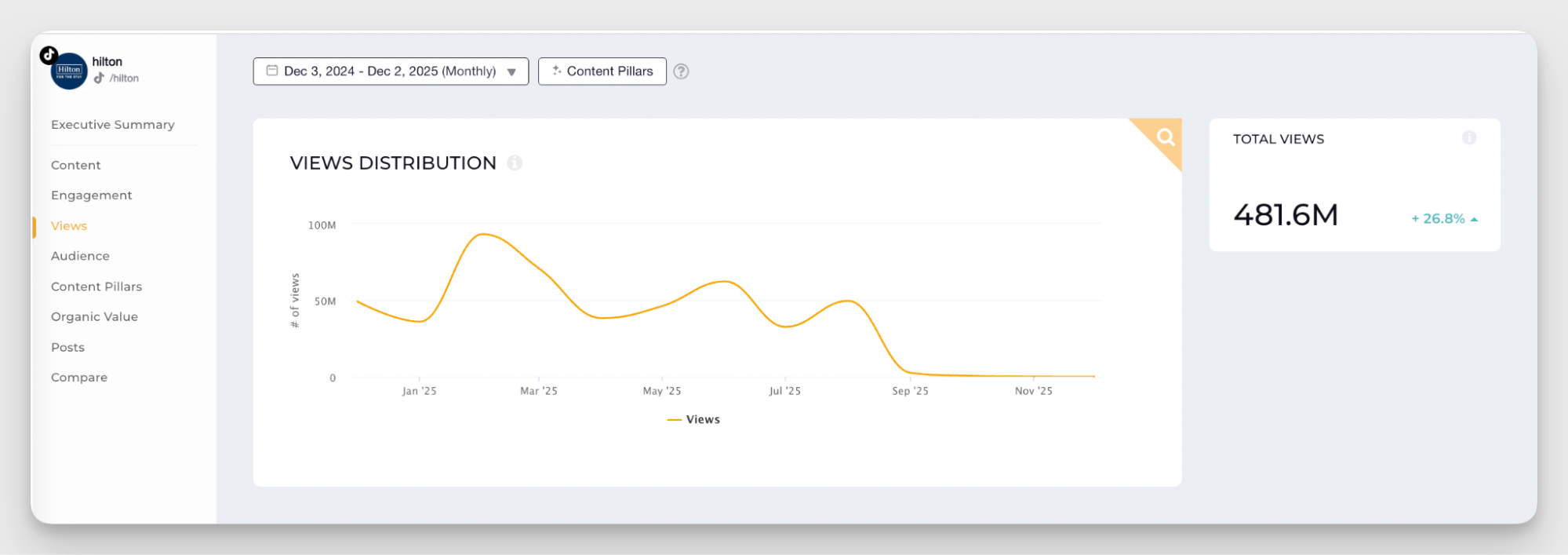
In Hilton’s case, for example, the views graph shows a noticeable dip between September and November 2025. That doesn’t automatically mean the content was bad, but it does signal that something changed: format, pacing, topics, or audience alignment.
This is where video metrics become diagnostic, not just descriptive.
- Follower growth
This is a key input for refining a long-term social media content strategy.
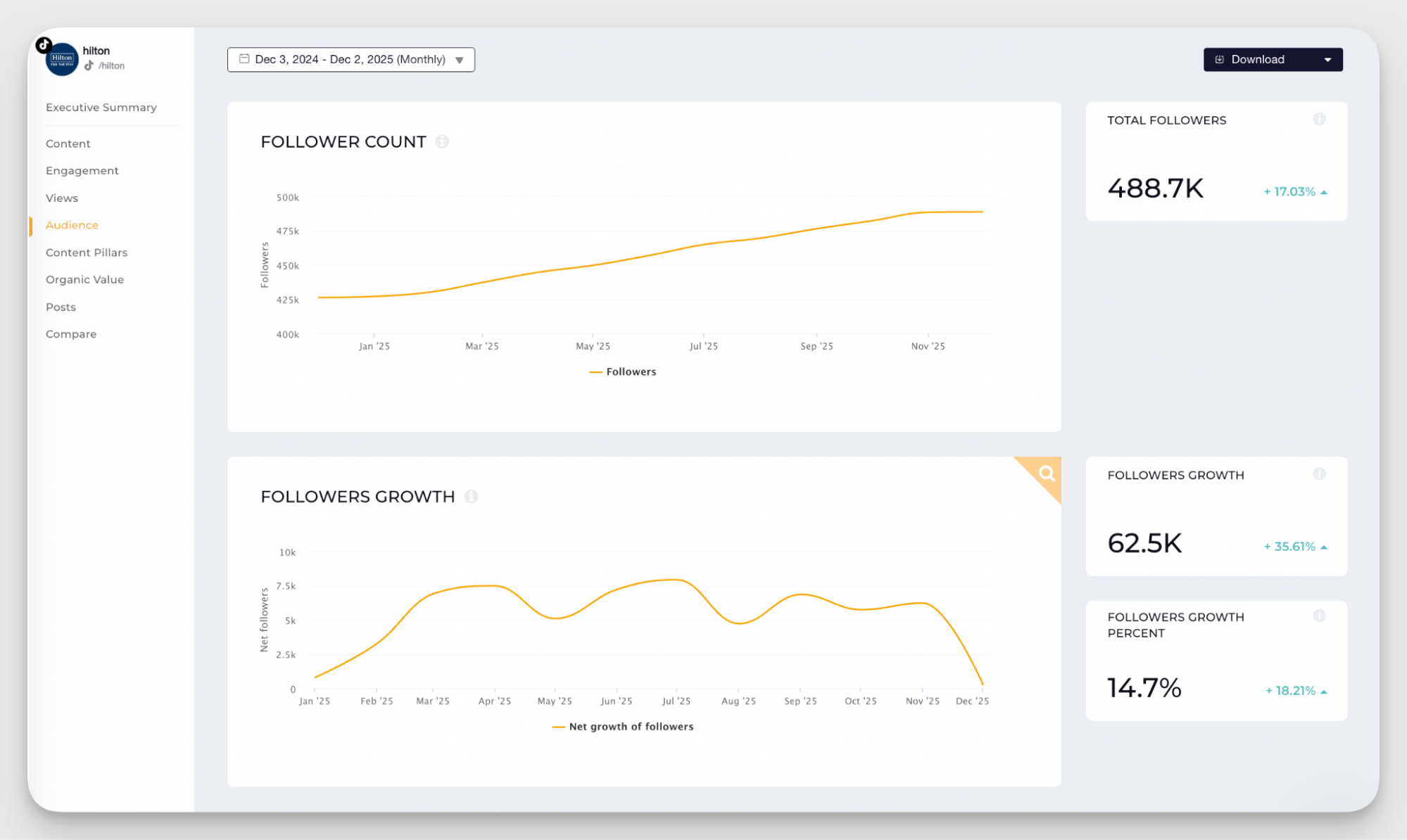
Follower growth helps confirm whether views are attracting the right audience.
And despite lower views in certain periods, follower count can still grow steadily.
That gap often means fewer viral spikes, but stronger relevance for the people who did see the content. Reading this correctly prevents overcorrecting too early.
- Engagement rate
This is where TikTok analytics help separate reach problems from resonance problems.
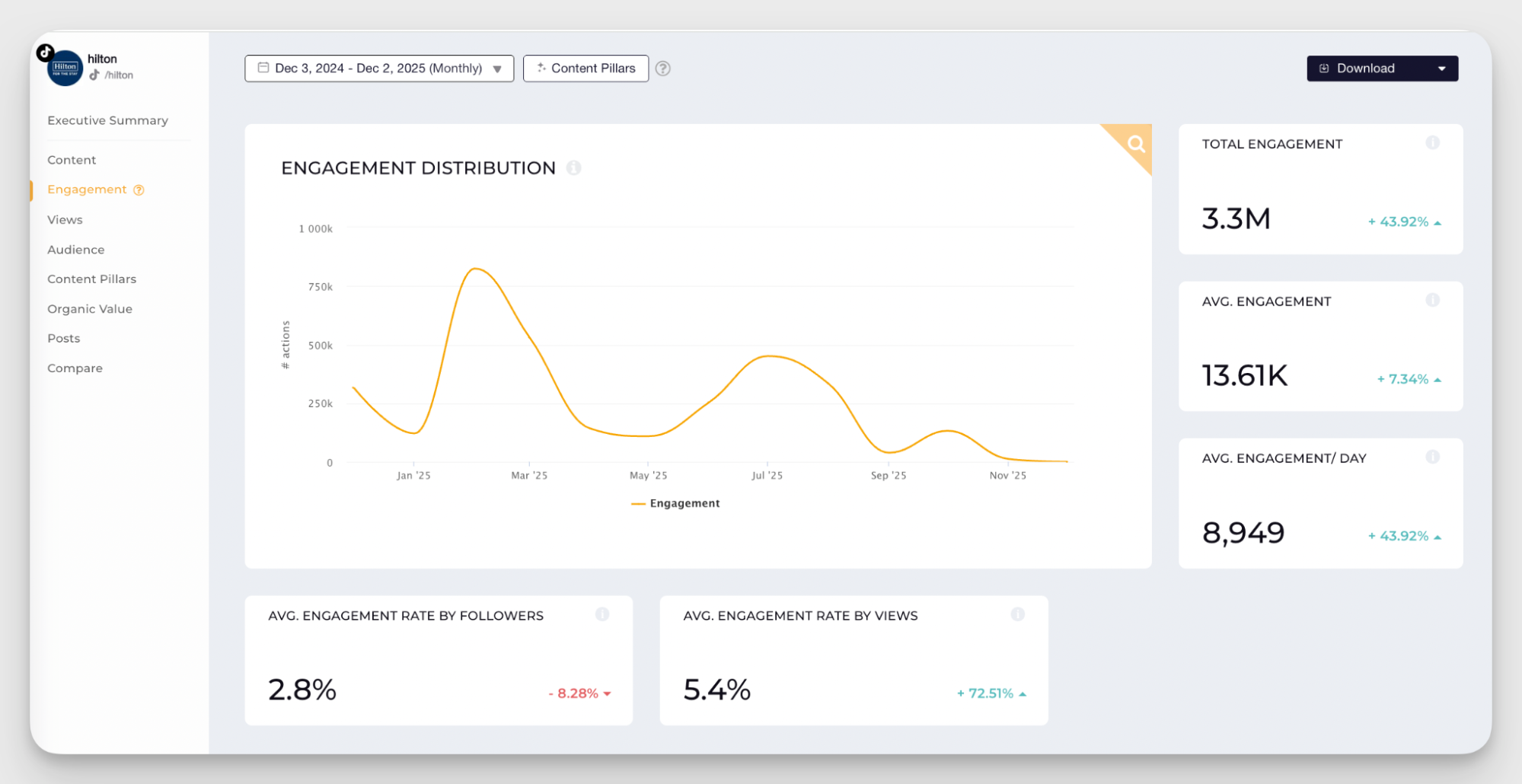
Going back to the Hilton example for a bit, when running an engagement analysis, I noticed that the interactions started to decline around September. For the brand, that’s a red flag worth investigating
A drop in engagement usually means content is still being shown, but it’s no longer prompting action.
Here's Malene's view as well about engagement tracking:
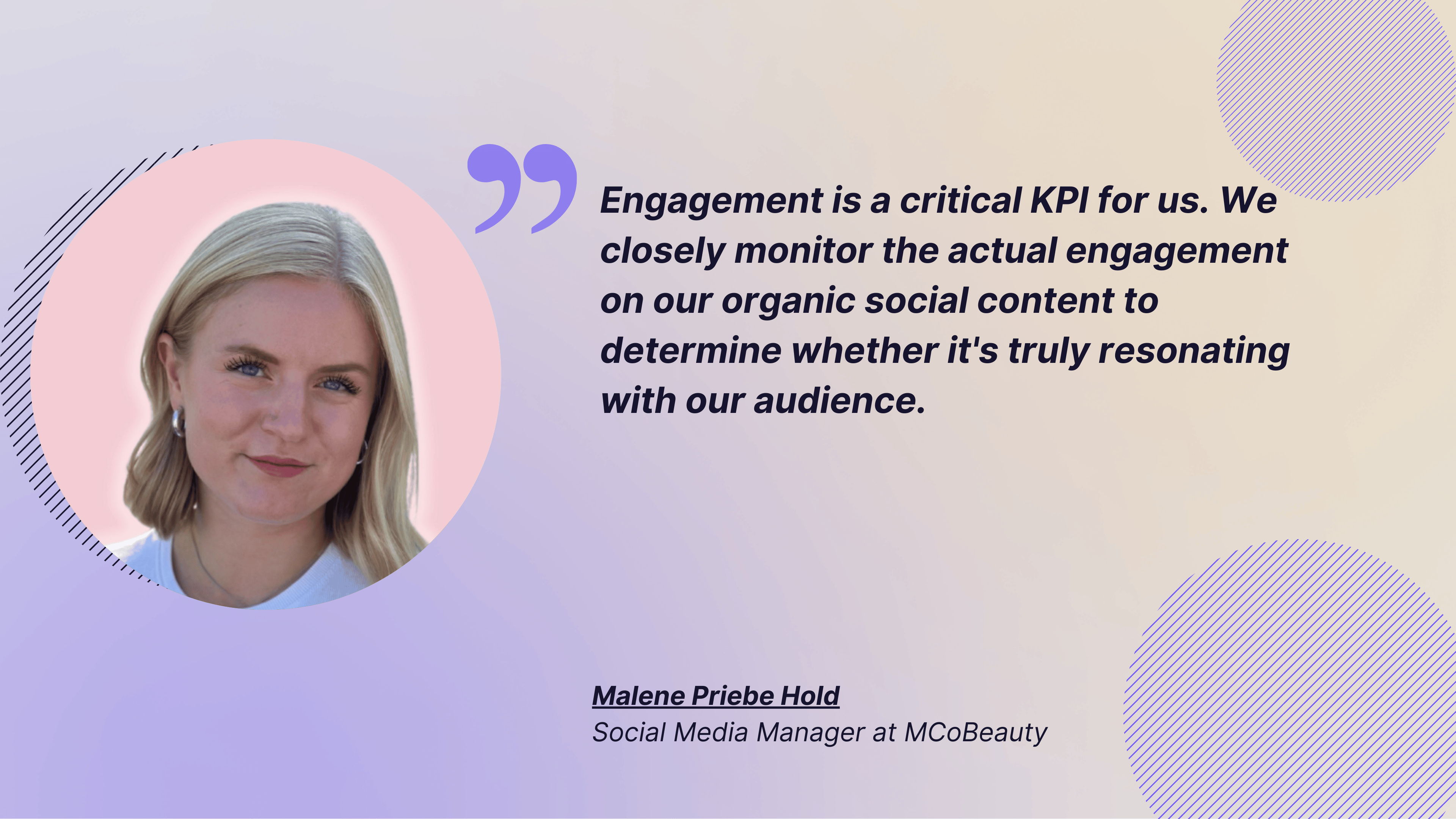
Engagement is a critical KPI for us. It’s become clear that follower count isn’t nearly as important. We closely monitor the actual engagement on our organic social content to determine whether it's truly resonating with our audience.
- Shares
Shares are one of the strongest quality signals on TikTok.
Malene also mentions:
A metric that has become increasingly important for us is the number of shares—how often people are actively sharing our content. With audiences becoming more passive in the way they consume content, shares offer valuable insight into what truly resonates. Tracking this helps us better understand what’s working and what isn’t.
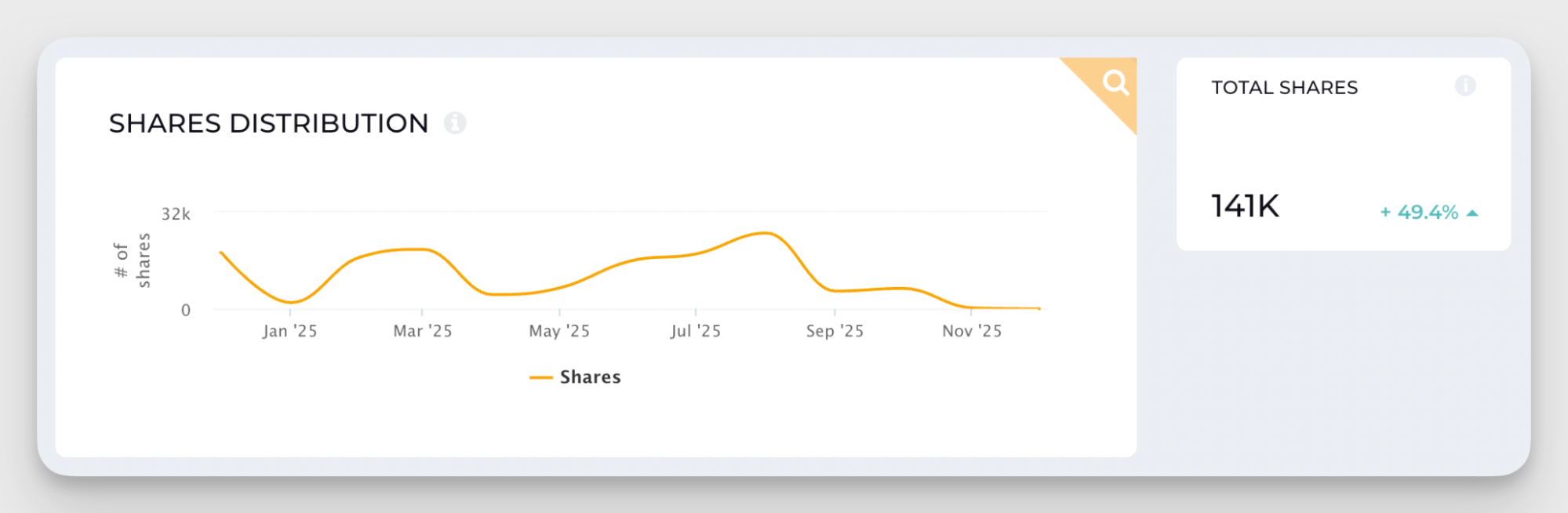
The repeated drop in shares starting from September I just mentioned earlier reinforces the engagement trend in Hilton's case.
When people stop sharing, content may still look fine, but it’s no longer compelling enough to pass along.
From a social media best practices standpoint, this usually calls for revisiting hooks, storytelling depth, or topical relevance.
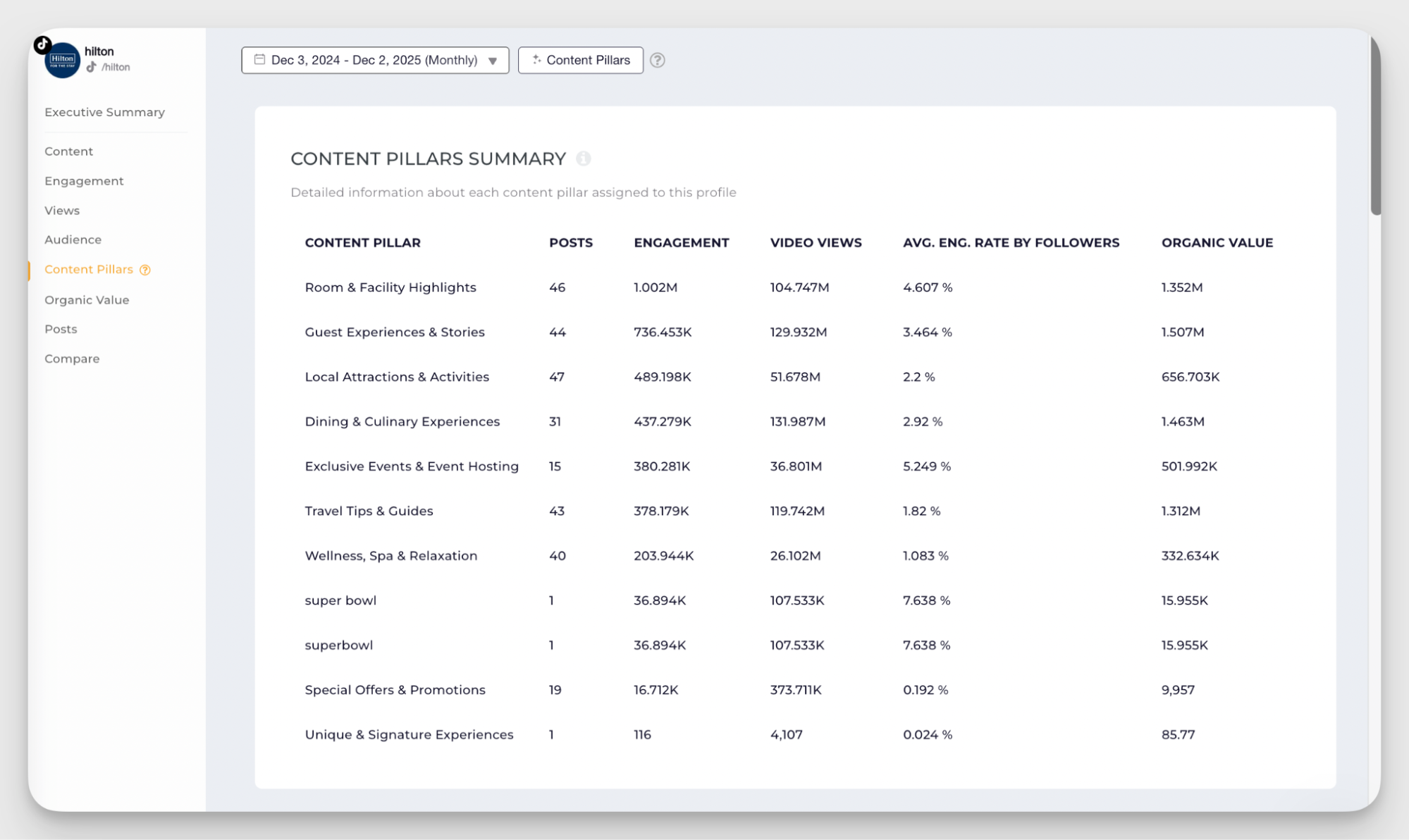
- Most engaging content pillars
Once you spot changes in views, engagement, or shares, the next step is figuring out where those shifts are coming from.
This is how content pillars for social media move from planning tools to decision-making tools. And how brands uncover missed opportunities instead of guessing what to post next.
By looking at performance per pillar, brands can see which themes consistently drive engagement and which ones consume effort without delivering results.
When a pillar with fewer posts generates stronger engagement, it points to underused potential. When a heavily published pillar underperforms, it signals saturation or weak audience interest.
- Best performing posts
Last but not least, it makes sense to look closer at the individual posts driving that performance. Top-performing videos reveal how engagement is earned, not just that it happens.
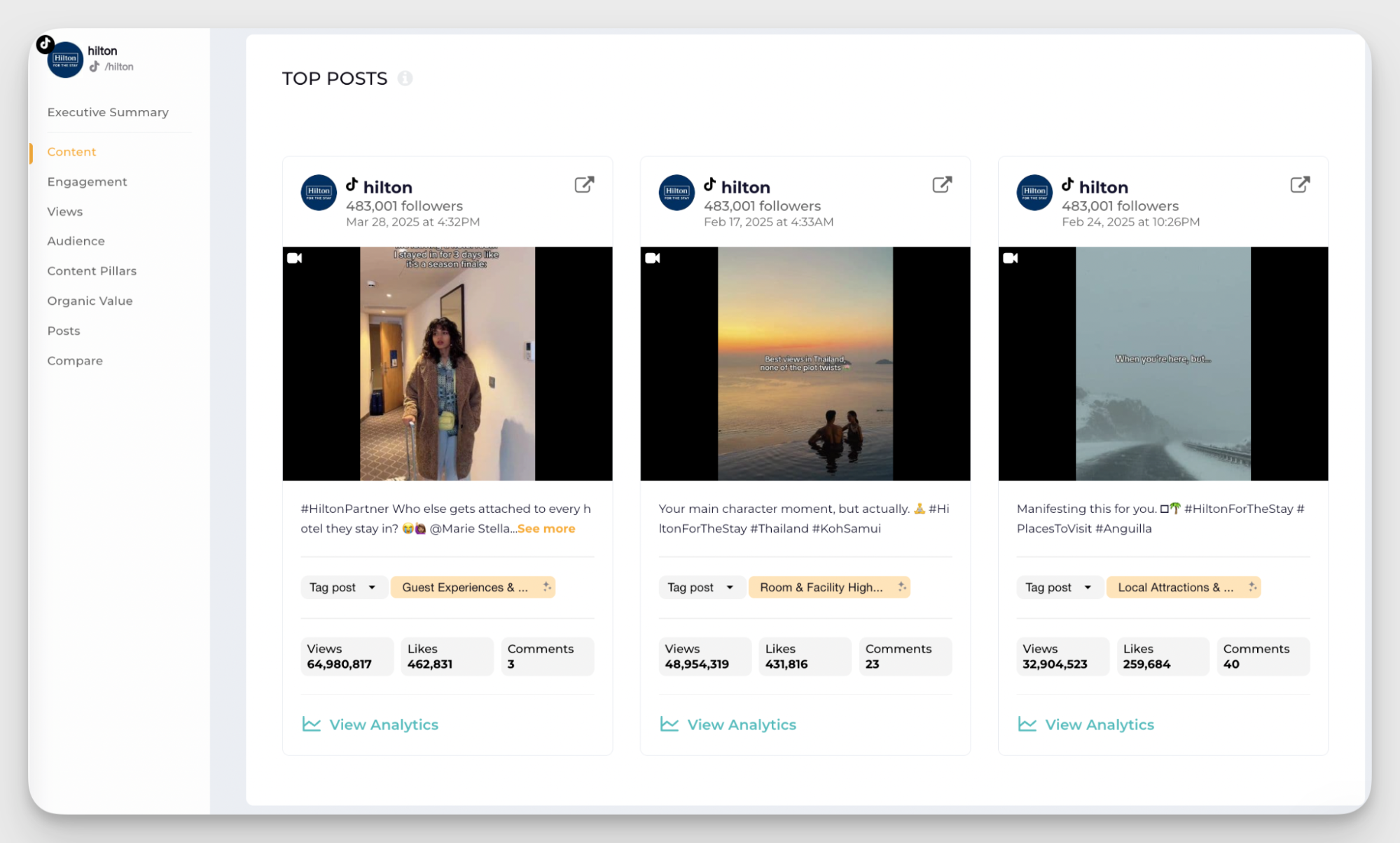
Once again, reviewing Hilton’s strongest posts helps surface repeatable patterns: specific destinations, visual choices, pacing, or narrative angles that consistently resonate.
These patterns are rarely accidental.
Thus, through careful social media content analysis, strong one-off results can be translated into formats worth repeating, reducing guesswork and bringing more intention into future content decisions.
Taken together, this data shows when strategy needs adjusting and where to look first. Brands that rely on proper social media analytics let performance point them in the right direction.
5. Bring ads into the mix and test their effectiveness
At some point, organic reach stops giving you clear answers.
You might see views, saves, even sales, but it’s hard to tell whether that’s strong targeting or the algorithm being generous that week.
This is where ads become useful. As part of a broader set of social media tactics, I use paid media to validate assumptions and answer one thing quickly: is this content reaching the right audience, or just floating in the feed?
When I asked Malene what's her take on ads on TikTok, she said:
We take an always-on approach, boosting organic content that performs well. For example, we closely analyze which posts generate follower growth and high engagement, and then invest additional budget behind those to reach a wider audience. We apply this strategy not just for ongoing content, but also for larger campaigns when we want to extend our reach even further.
Ultimately, it’s about consistently reviewing performance—identifying content that truly resonates with our audience organically, and then amplifying it. We’ve seen significant growth by taking this approach.
Run ads tests by trying TikTok's ad targeting options
This is where TikTok’s targeting actually becomes useful.
By testing demographics, interests, and behaviors, you can see how different audience segments respond to the same message.
When one group watches longer, comments more, or saves more, you’ve learned something actionable not just for ads, but for organic content too.
Try out Spark Ads
You’re taking a post that already performs and placing it in front of a controlled audience, without breaking the native experience. Same comments, same social proof, same tone. Just more precise distribution.
If engagement quality holds under paid reach, that’s a strong signal your targeting is right. If it drops, it tells you exactly what needs adjusting.
6. Collaborate with micro-influencers in your niche
If ads help you test reach, micro-influencers help you build trust.
I look at collaborations as an extension of audience alignment. Micro-influencers already have the attention you want. And more importantly, they’ve earned it in a way TikTok recognizes.
The most effective partnerships place you inside an existing conversation, where it already makes sense. That’s why follower count matters less than fit.
Lastly, here's how Malene approaches influencer marketing on TikTok:
Even if certain influencers have millions of followers, they may not necessarily deliver strong results for your brand. What truly matters is finding creators with a highly engaged audience who can integrate your brand authentically into their content.
In the end, it all comes down to testing and learning. When we identify creators who are a great fit and generate positive outcomes, we continue to collaborate with them to foster deeper brand loyalty.
Final thoughts
After working with TikTok content for a while, the biggest mistake I keep seeing is misplaced focus. People obsess over posting times, hooks, and trends, while avoiding the harder decision of choosing who the content is actually for.
Where most accounts go wrong isn’t reach, but discipline. They change direction too quickly, chase every format that performs once, and never stay with an idea long enough for TikTok or their audience to understand it.
So if there’s one question worth asking before you post, it’s this: would this matter to the person I’m trying to reach? If the answer is yes, the rest tends to follow.
Anda Radulescu
Content writer & copywriter with a 5-year track record in digital marketing. Equal parts keen observer & committed go-getter. A proud cat mom with a passion for music & exploring the world.

Analyze your competitors in seconds
Track & analyze your competitors and get top social media metrics and more!
You might also like

Improve your social media strategy with Socialinsider!
Use in-depth data to measure your social accounts’ performance, analyze competitors, and gain insights to improve your strategy.