How to Build a Winning TikTok Marketing Campaign in Just 5 Steps
Learn how to create a winning TikTok marketing campaign with our detailed guide. From key steps to campaign examples, here's everything you need to know.

I hate to break it to you, but if you want to know how to build a TikTok marketing campaign that delivers real growth, you need more than trends and viral luck.
Leading brands use TikTok marketing to reach high-intent audiences, build relevance, and create demand at scale.
And unlike many social media campaigns, TikTok rewards strong creative strategy, cultural awareness, and timely execution over large budgets alone.
That creates a rare opportunity for brands of any size to compete, grow quickly, and own valuable market attention. Which means you have a real chance too.
In this A-Z guide, I’ll show you how to build a TikTok marketing campaign that strengthens awareness, increases engagement, and delivers measurable business results, and I'll also give you some insights that Georgia Gonzalez, social media manager at Penn State, has shared with me in a short chat we've had.
So let’s dive in.
Key takeaways
- What are the main campaign types where TikTok is used? TikTok campaigns typically fall into awareness, conversion, UGC, and influencer categories, each designed to drive a specific outcome from visibility to revenue and trust-building.
- How to create an effective TikTok marketing campaign? An effective TikTok campaign aligns a clearly defined niche audience with the right format, strategic content, real-time optimization, and performance-driven reporting.
- Common TikTok campaign mistakes to avoid: The biggest TikTok mistakes are ignoring platform-specific behavior, delaying performance tracking, and prioritizing polished production over authentic, engaging content.
What are the main campaign types where TikTok is used?
One of the biggest advantages of TikTok is how many social media goals it can support when used strategically.
Some TikTok campaigns are designed to maximize visibility, while others focus on sales, credibility, or community-driven growth. The key is knowing which campaign type matches the result you want to achieve.
Here's Georgia'a take on this:
I think TikTok works best for campaigns focused on storytelling, awareness, and building community. People go to TikTok to feel something — whether that’s being entertained, inspired, educated, or just feeling connected — so campaigns that feel authentic and native to the platform usually perform the best. The biggest thing is making sure the content feels like TikTok content first and marketing second.
Below are the main ways brands use TikTok to grow:
Awareness campaigns
I usually recommend this type of campaign type when the priority is market entry, product launches, repositioning, or maintaining share of attention in a crowded category.
On TikTok, awareness is rarely created through direct promotion alone. It comes from consistent exposure, distinctive creative, and content people are willing to watch and share.
The goal here is to build familiarity at scale so that when purchase intent appears later, your brand is already recognized and considered.
That is why strong awareness campaigns should be evaluated through trend data over time rather than one-off viral moments.
Main metrics to track
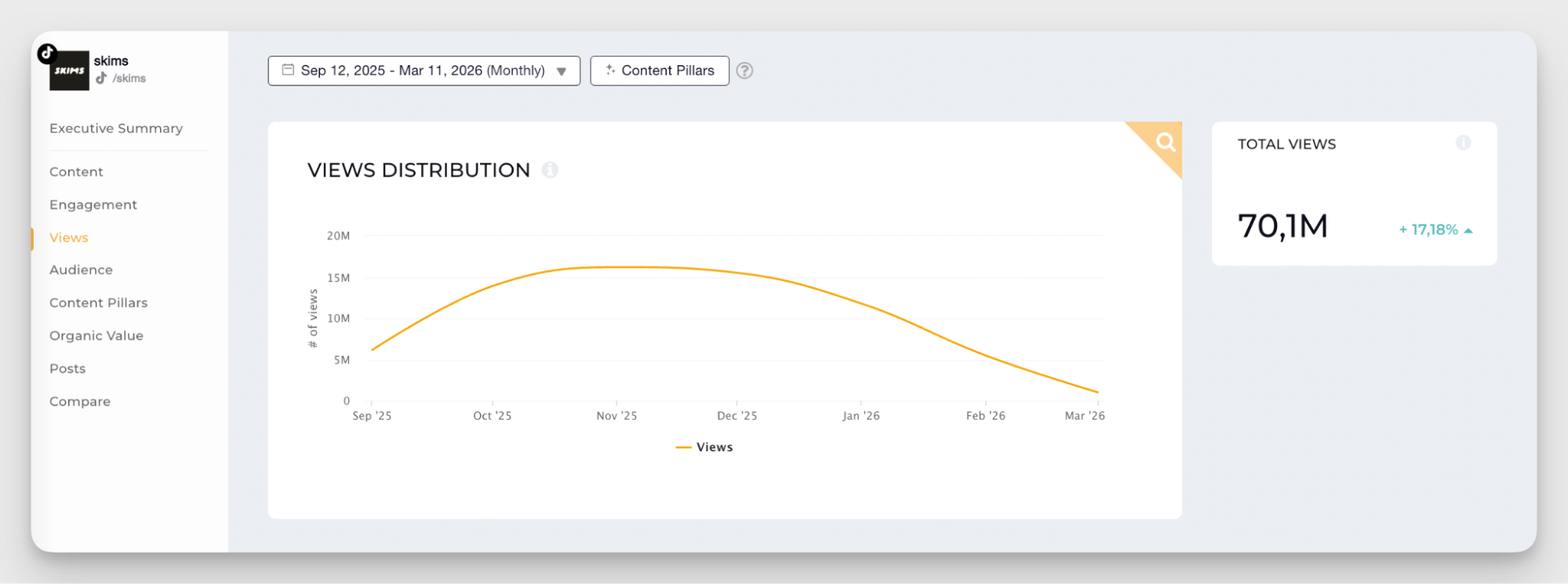
- Views: TikTok views are the first indicator of how effectively your content is reaching new audiences. When tracked over time, they can also reveal which creative angles, posting patterns, or content formats are consistently generating broader distribution.
- Followers growth: On the other hand, follower growth adds a deeper layer of insight because it shows whether that visibility is turning into ongoing brand interest. Strong reach with no audience growth may signal temporary attention, while rising followers often indicate stronger brand resonance and future remarketing potential.
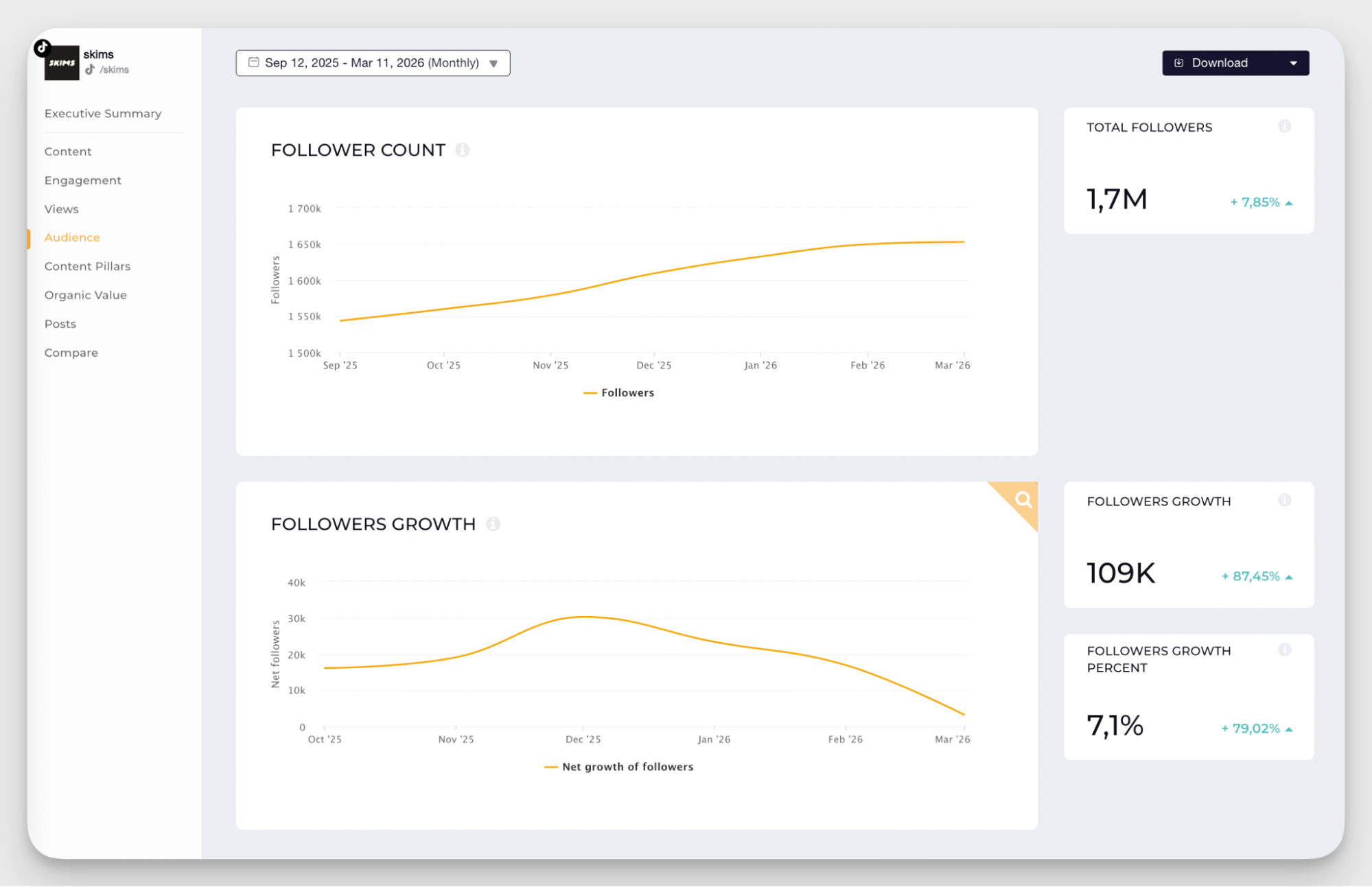
A useful example can be seen by analyzing Skims through the Socialinsider dashboard.
Total views highlight periods of stronger exposure, while follower count and follower growth help confirm whether that increased reach translated into lasting audience expansion.
Looking at both metrics together provides a far more accurate picture of awareness performance than relying on views alone.
Conversion campaigns
Conversion campaigns matter when visibility alone is no longer enough and the priority shifts to generating tangible business results.
This is where TikTok moves from an awareness channel to a revenue driver.
Whether the objective is purchases, qualified leads, bookings, or sign-ups, the strongest campaigns guide users smoothly from interest to action through the right creative, offer, and landing experience.
What often gets overlooked is that conversions rarely happen because of one element alone.
Strong results usually come from a sequence: content captures attention, engagement builds trust, traffic signals intent, and sales confirm performance.
That is why I always look beyond surface metrics and assess how each stage supports the next.
Main metrics to track
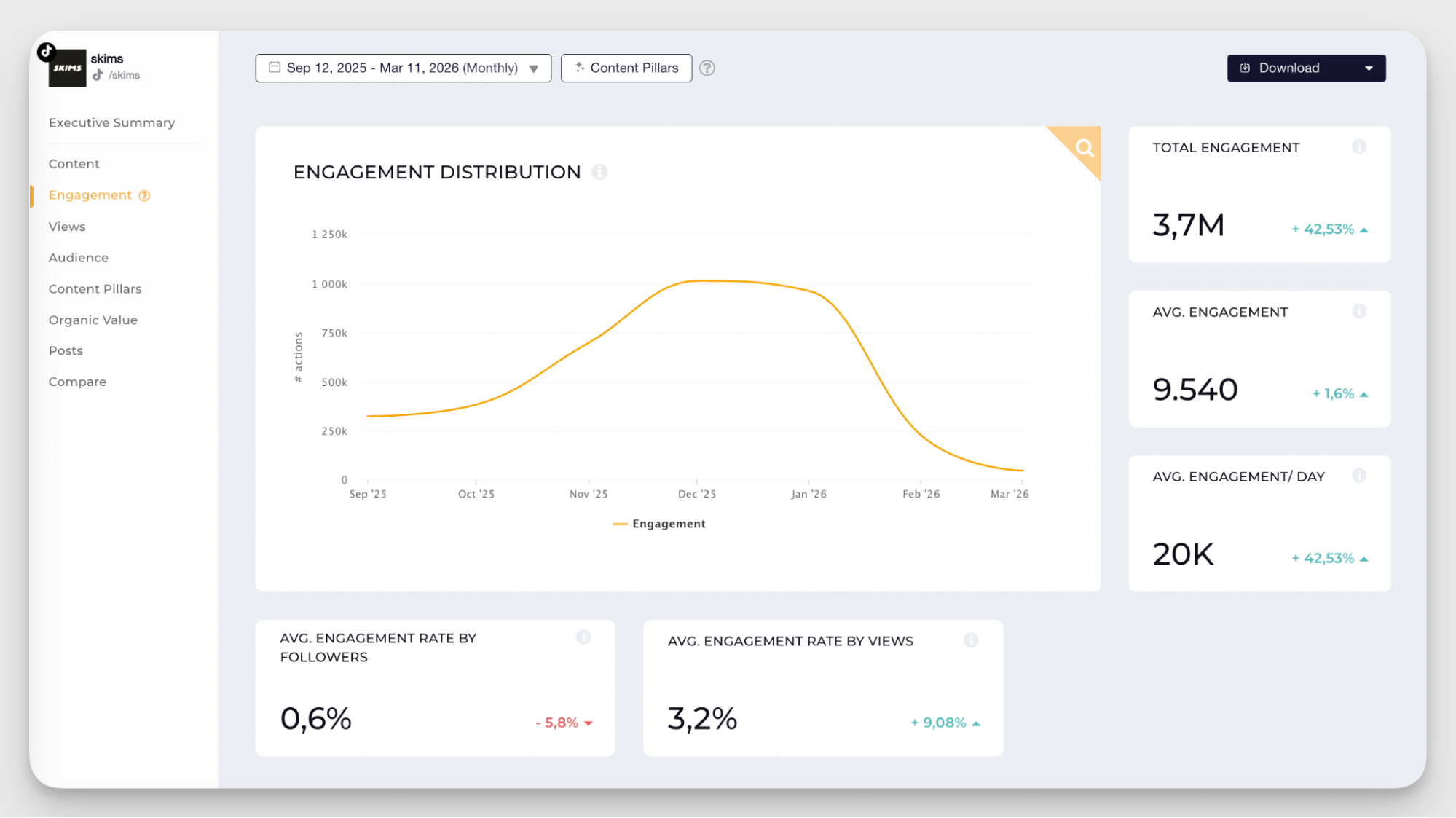
- Engagement: Social media engagement is often the earliest signal that your campaign has the right message and creative direction. Likes, comments, shares, and saves show that users are responding rather than scrolling past.
As seen in the Socialinsider dashboard using Skims data, engagement trends over time can help identify when content themes or campaign periods are generating the strongest audience response. Those insights are valuable because stronger engagement often supports lower acquisition costs and better downstream performance.
Here's Georgia's perspective on this as well:
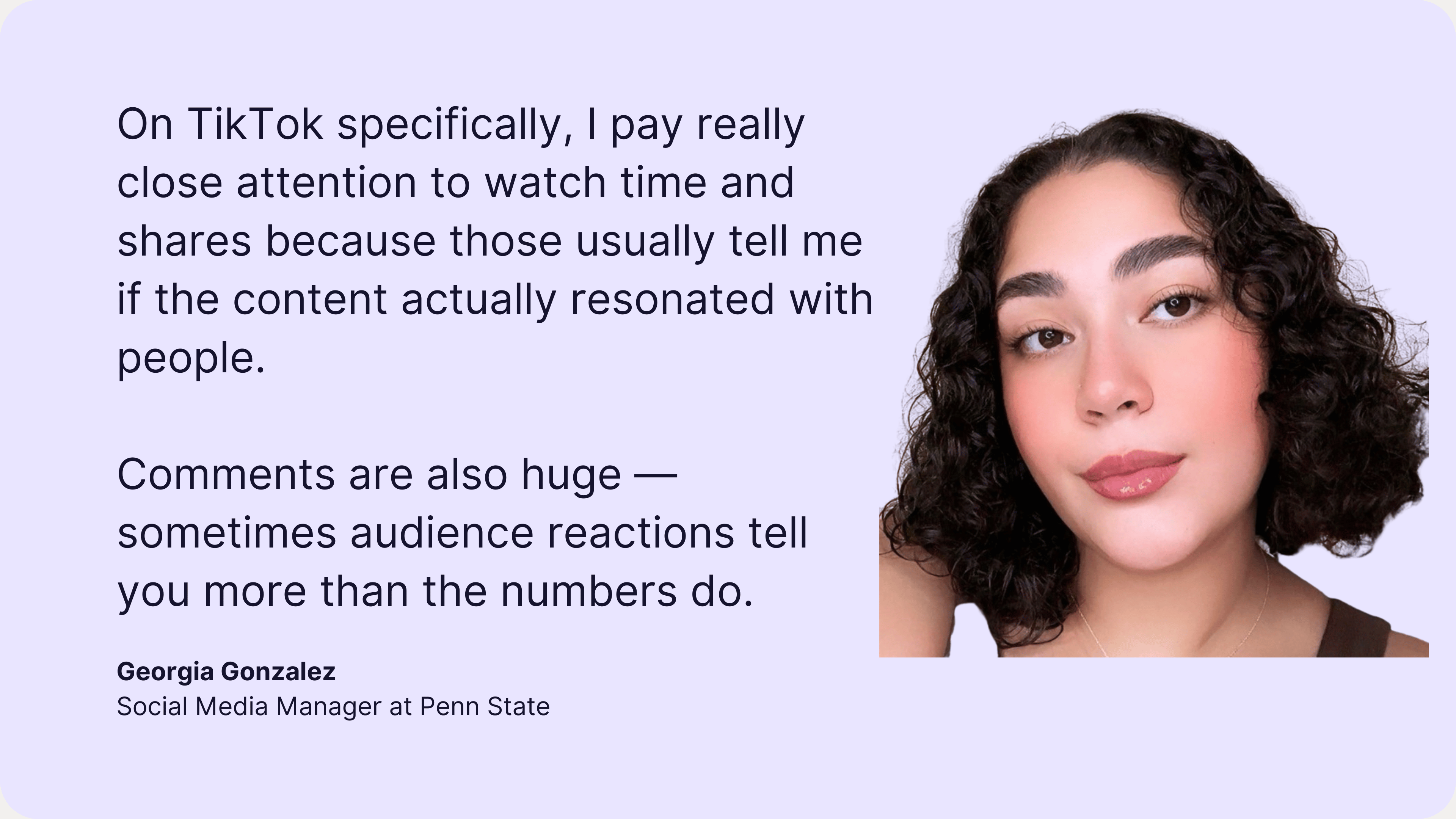
On TikTok specifically, I pay really close attention to watch time and shares because those usually tell me if the content actually resonated with people. Comments are also huge — sometimes audience reactions tell you more than the numbers do.
- Traffic: Traffic shows whether that interest is strong enough to move users beyond TikTok and into your funnel. Clicks to product pages, landing pages, or lead forms indicate that awareness is turning into active consideration.
- Sales: Sales are where campaign performance becomes commercially meaningful. Purchases, booked demos, completed forms, or subscriptions reveal whether the campaign is generating real return rather than just activity.
UGC campaigns
UGC campaigns encourage customers and creators to feature your brand in their own content.
In my experience, few strategies build trust faster because audiences often respond more positively to peer recommendations than polished advertising.
While creator-led content tends to blend more naturally into the feed, it also makes potential customers see real people using the product, sharing results, or recommending it publicly.
Main metrics to track
Brand mentions show whether your UGC campaign is creating visible conversation around your brand. These can include tagged videos, hashtag mentions, captions, comments, creator shoutouts, or organic references to your product.
Besides how many mentions you get, the important part is also what those mentions say.
I’d look at whether people are recommending the product, asking questions, comparing it to alternatives, showing real use cases, or repeating the same positive themes.
That tells you whether the campaign is simply generating noise or actually building trust and demand.
Influencer campaigns
TikTok influencer marketing campaigns are typically the strongest choice when brand trust and purchase consideration need to grow at the same time.
Rather than introducing your message cold to new audiences, you place it through creators who already have credibility, attention, and an established relationship with the people you want to reach.
That is why TikTok influencer marketing can be particularly effective for product launches, competitive categories, and brands looking to accelerate growth efficiently.
Main metrics to track
- Followers growth: Follower growth helps measure whether the campaign is building lasting interest in your brand. When viewers discover you through creators and choose to follow, it usually signals stronger long-term potential than reach alone.
- Engagement: Engagement shows how well the partnership is resonating with the audience. Likes, comments, shares, saves, and comment sentiment can reveal whether the creator-brand fit feels credible and relevant.
- Sales: Sales are essential for understanding direct commercial impact. Purchases, sign-ups, bookings, or tracked conversions show whether creator attention is translating into revenue.
- CLV: Customer lifetime value is where deeper profitability becomes clear. Some creators bring in customers who reorder more often, spend more over time, or stay loyal longer. Those partnerships are often more valuable than campaigns judged only on immediate sales.
Personally, when I evaluate influencer performance, I look beyond short-term spikes. The best TikTok marketing campaigns attract the right customers, convert efficiently, and continue generating value long after the initial post goes live.
How to create an effective TikTok marketing campaign?
Knowing the type of campaign you want to run is only the starting point.
In this section, I’ll show you how to increase TikTok followers and how to get more engagement on TikTok through the right strategy, content, and execution.
#1. Establish your niche target audience
One of the biggest mistakes brands make on TikTok is targeting broad demographics and assuming that is enough.
Saying your TikTok target audience is Gen Z, for example, offers very little strategic direction. Gen Z is not a single mindset or behavior group. It is made up of countless communities, interests, aesthetics, and online identities.
So what tends to perform better on TikTok is targeting subcultures rather than age brackets alone.
I would look at the specific spaces where your ideal customer already spends attention: fitness communities, skincare enthusiasts, streetwear audiences, book lovers, finance creators, gaming niches, wellness circles, productivity communities, and countless others.
Each subculture has its own language, humor, references, content style, and expectations.
Understanding those nuances helps you create campaigns that feel relevant instead of generic. It also improves creator selection, messaging, and creative direction because you are speaking to a community with shared interests.
The more clearly you define the niche audience behind your campaign, the easier it becomes to grow visibility, attract the right followers, and generate stronger engagement from people who are genuinely likely to care.
#2. Choose your campaign format: organic, paid, influencer, or hybrid
After identifying who you want to reach, the next decision is how you want the campaign to reach them.
The format you choose will shape budget efficiency, speed of results, creative direction, and measurement.
This is why I treat campaign format as a strategic decision.
Organic campaigns are useful when the focus is building momentum, testing messaging, and learning what content earns attention naturally. They can reveal which ideas deserve further investment before spend is committed.
Paid campaigns are better suited to situations where scale, traffic, or conversions need to happen within a defined timeframe. They offer greater control over audience targeting, delivery, and budget pacing.
Influencer campaigns are particularly effective when the challenge is earning trust quickly or entering specific communities with relevance. The right creator can shorten the path between discovery and consideration.
Hybrid campaigns combine multiple strengths and are often the most efficient route. Organic content can surface winning ideas, creators can add credibility, and paid media can amplify what is already working.
On this note, I’m often asked when it makes sense to boost organic content instead of launching standalone ads.
My view is simple: boost content that is already outperforming your average benchmarks.
Strong watch time, engagement, shares, or saves usually indicate the market is responding well.
Standalone ads are the stronger option when you need creative built around a clear objective such as product launch support, lead generation, retargeting, or sales growth.
Essentially, the best format is the one that matches your immediate objective, available resources, and speed requirements. Start there, then scale what proves itself.
#3 Create a content strategic plan
This is where many campaigns lose efficiency.
I came across brands that often produce content in volume without connecting each asset to a clear campaign goal.
In practice, awareness campaigns need different creative priorities than conversion, UGC, or influencer-led campaigns.
So I always recommend structuring content around purpose first.
Awareness content should maximize retention and shareability. Conversion content should reduce hesitation and drive action. UGC-focused campaigns should create participation opportunities. Influencer campaigns should give creators room to communicate naturally while still aligning with the brief.
And to build that plan effectively, I’d focus on two priorities: identifying the content themes that already resonate with your audience, and applying TikTok-specific creative best practices that improve performance.
Start from your most engaging content pillars
One of the smartest places to begin is with the themes that already generate strong audience response.
Your past performance often reveals what your audience wants more clearly than assumptions ever will. These recurring themes become your content pillars for social media.
As shown in the Socialinsider analysis of Skims, engagement varies significantly by pillar.
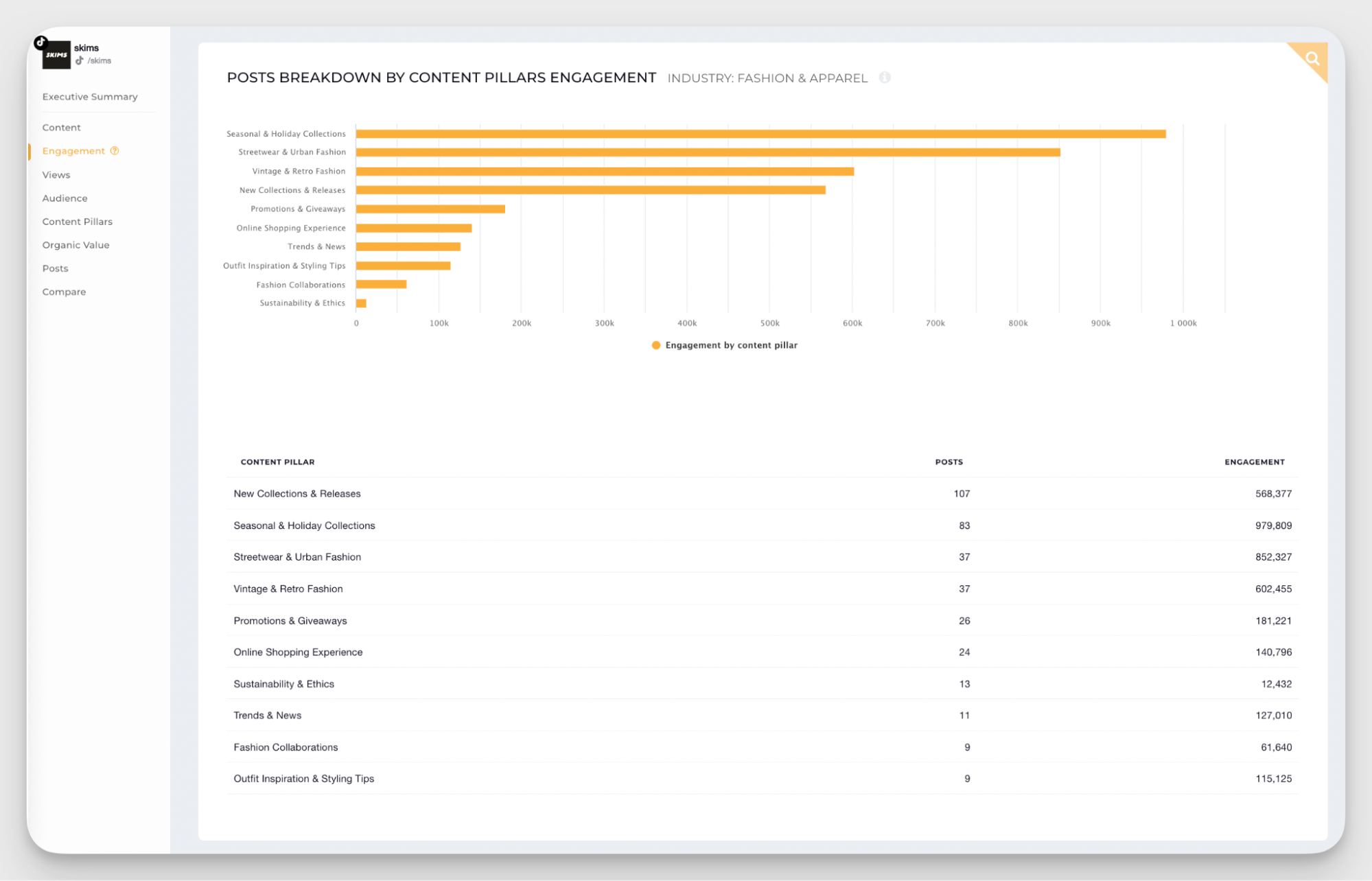
Categories such as seasonal collections, streetwear, and vintage-inspired content outperform lower-interest themes. That kind of data is valuable because it shows where audience attention naturally concentrates.
I’d use this insight to prioritize creative production around proven pillars first, then test adjacent themes second.
Starting from what already works usually creates faster momentum than building from scratch.
Leverage TikTok content best practices
Strong ideas can still underperform when execution fails to capture attention or guide viewers toward action.
On TikTok, creative mechanics often determine whether content is watched, ignored, or shared.
The first priority is the hook.
Viewers decide quickly whether to keep watching, so the opening seconds need to create immediate interest.
I’d usually test hooks built around curiosity, a bold statement, a clear benefit, or a problem the audience wants solved. Slow introductions rarely give content the momentum it needs.
The next priority is the CTA.
Many brands either ignore calls to action completely or make them feel too aggressive.
The most effective CTAs feel like a natural continuation of the video. Asking viewers to explore a product, comment their opinion, follow for more, or visit a link should feel relevant to the content they just watched.
And let’s not forget about video length.
Video length should also be treated strategically.
Socialinsider data shows that longer videos can generate strong engagement when they maintain viewer interest, with 2-minute videos performing particularly well in some cases.
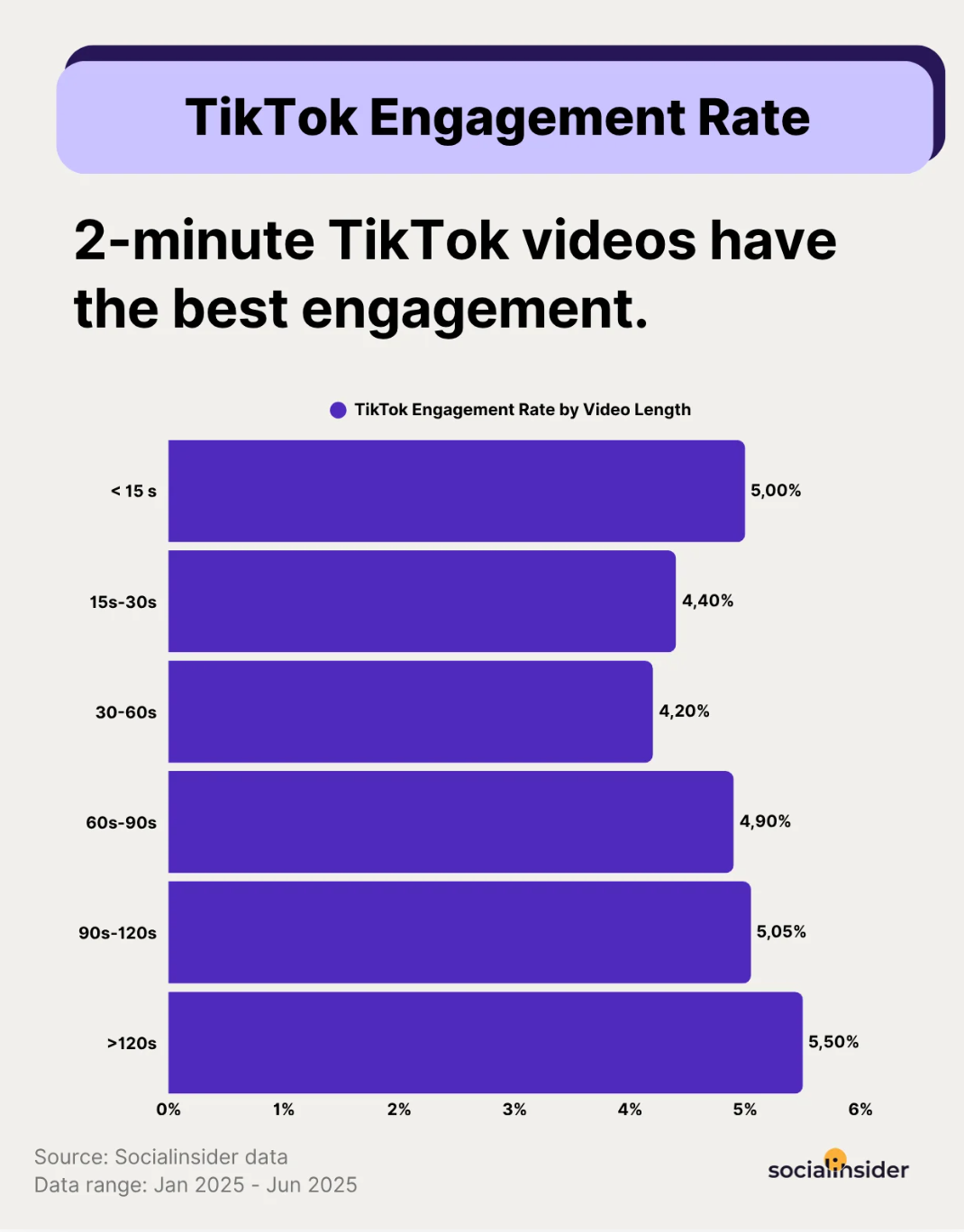
That is an important reminder that retention matters more than arbitrary duration.
But keep in mind it’s best to match length to intent.
Quick trend-led or awareness content may benefit from brevity, while tutorials, storytelling, product demonstrations, and educational videos often perform better with more room to develop the message.
Afterall, the strongest format is the one that keeps viewers engaged until the end.
#4. Launch, monitor, and optimize your TikTok campaign in real time
Once your campaign goes live, the focus shifts from planning to active performance management.
TikTok moves quickly, which means early signals can tell you what deserves more budget, what needs refinement, and what should be stopped before spend is wasted.
I usually break this stage into two priorities: managing audience interaction as momentum builds, and optimizing campaign assets based on live performance data.
Engagement management: how to respond to comments and UGC during a campaign
Audience interaction is one of the first areas to manage closely once content starts gaining traction. Comments often reveal buying intent, objections, product questions, or which parts of the message are resonating most strongly.
I recommend responding quickly to questions around pricing, product use, delivery, or availability while interest is still high. Fast, useful replies can remove friction and help convert attention into action.
User-generated content also becomes valuable during this stage.
When people create reviews, reactions, stitches, or videos featuring your brand, that momentum can be amplified. I’d identify strong UGC early, then repost it, engage with it, or turn it into additional campaign content while attention is still building.
Mid-campaign optimization: when to pivot content, or cut underperformers
While engagement is being managed externally, campaign performance also needs to be managed internally.
This is where ongoing social media optimization becomes essential.
I’d consider pivoting content when watch time drops early, engagement remains weak, click-through rates underperform, or comments suggest confusion around the offer.
Often, stronger hooks, clearer messaging, improved pacing, or revised targeting can lift results quickly.
I’d cut underperformers when multiple indicators stay weak after reasonable testing. Keeping spend tied to low-performing creatives usually delays better outcomes elsewhere. Reallocating budget toward stronger assets, better audiences, or top-performing creators is often the more profitable decision.
The brands that win on TikTok treat launch as the beginning of the work, not the end. They manage audience momentum and optimize performance while the campaign is still live.
#5. Report on your TikTok campaign’s performance
Knowing how to analyse TikTok video performance is what turns campaign activity into useful decision-making.
Strong reporting should explain which content moved the needle, which audiences responded best, and where results translated into business value.
That is the difference between collecting data and using it strategically.
There are several ways campaign measurement can be approached, but I usually focus on two areas:
Campaign-specific content pillar performance analysis
One of the biggest reporting issues I see is brands reviewing all account activity together.
When campaign posts sit beside evergreen content, creator partnerships, and unrelated uploads, it becomes difficult to know what actually worked.
Good social media content analysis starts with cleaner segmentation.
Using Socialinsider’s Query Builder, campaign-specific branded content pillars can be created to group posts tied to one initiative through keywords, hashtags, campaign names, or custom identifiers.
This allows you to review only the assets connected to that campaign.
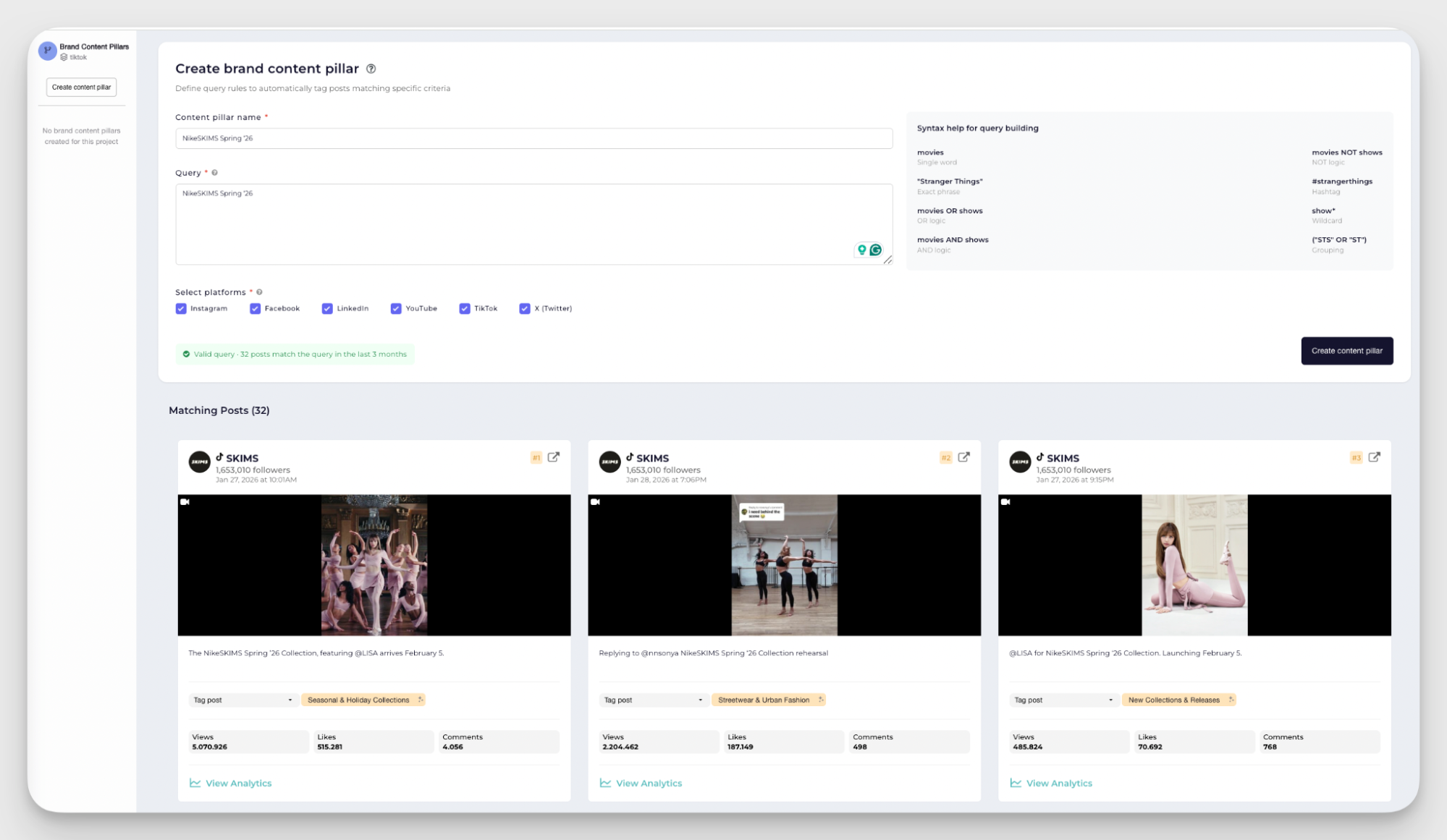
Once the pillar is created, you can measure results such as engagement, post volume, follower impact, and top-performing creatives inside that dedicated campaign group.
That makes Tiktok analytics significantly more actionable because you are evaluating performance in the right context.
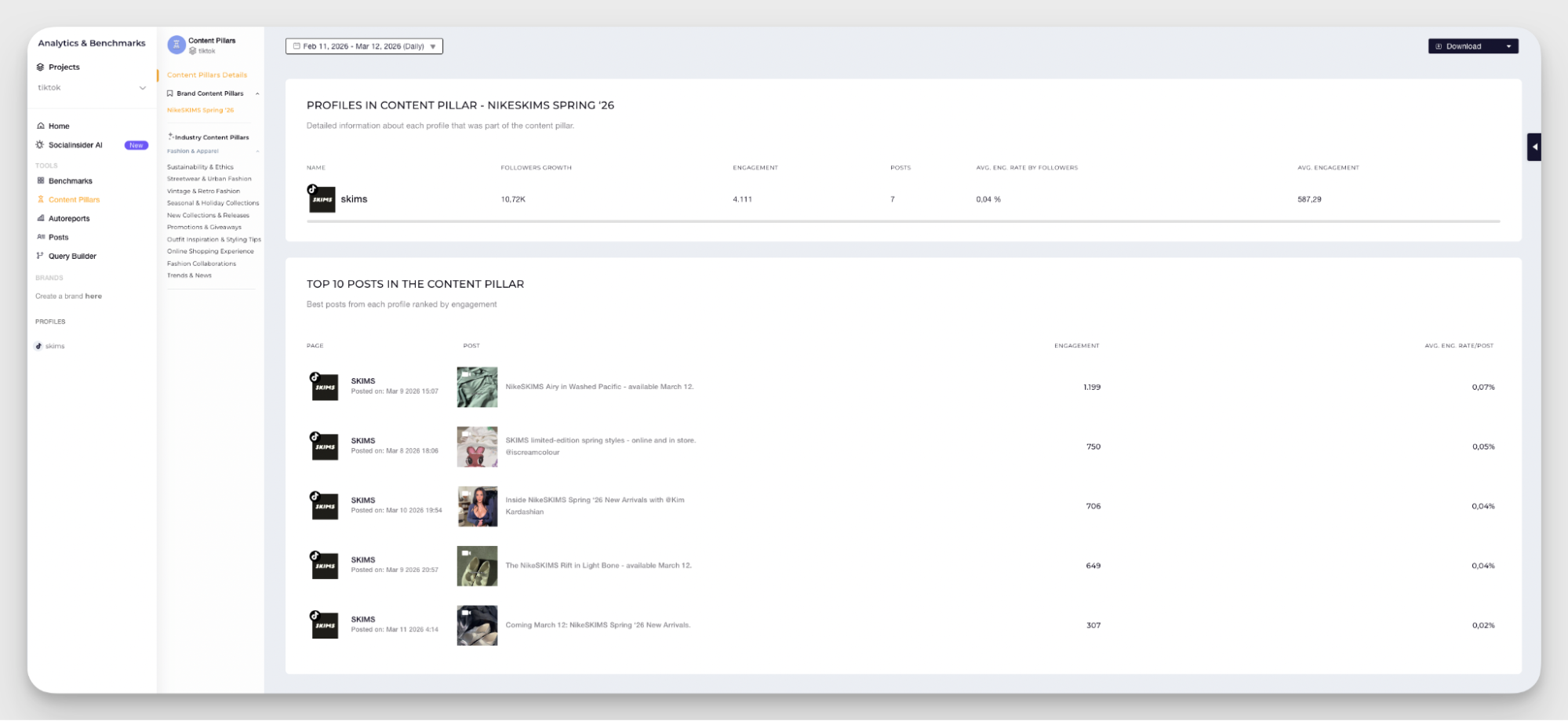
From a broader social media analysis perspective, this approach helps answer better questions: Which creative angles performed best? Which campaign theme generated stronger audience response? Which posts should influence the next launch?
It is also one of the clearest ways to compare campaigns over time using consistent social media metrics.
Organic value calculation to tie campaign results to business outcomes
While platform numbers are useful, many stakeholders want to understand what those outcomes were worth.
This is where organic value reporting becomes valuable.
It estimates the business impact created through unpaid performance.
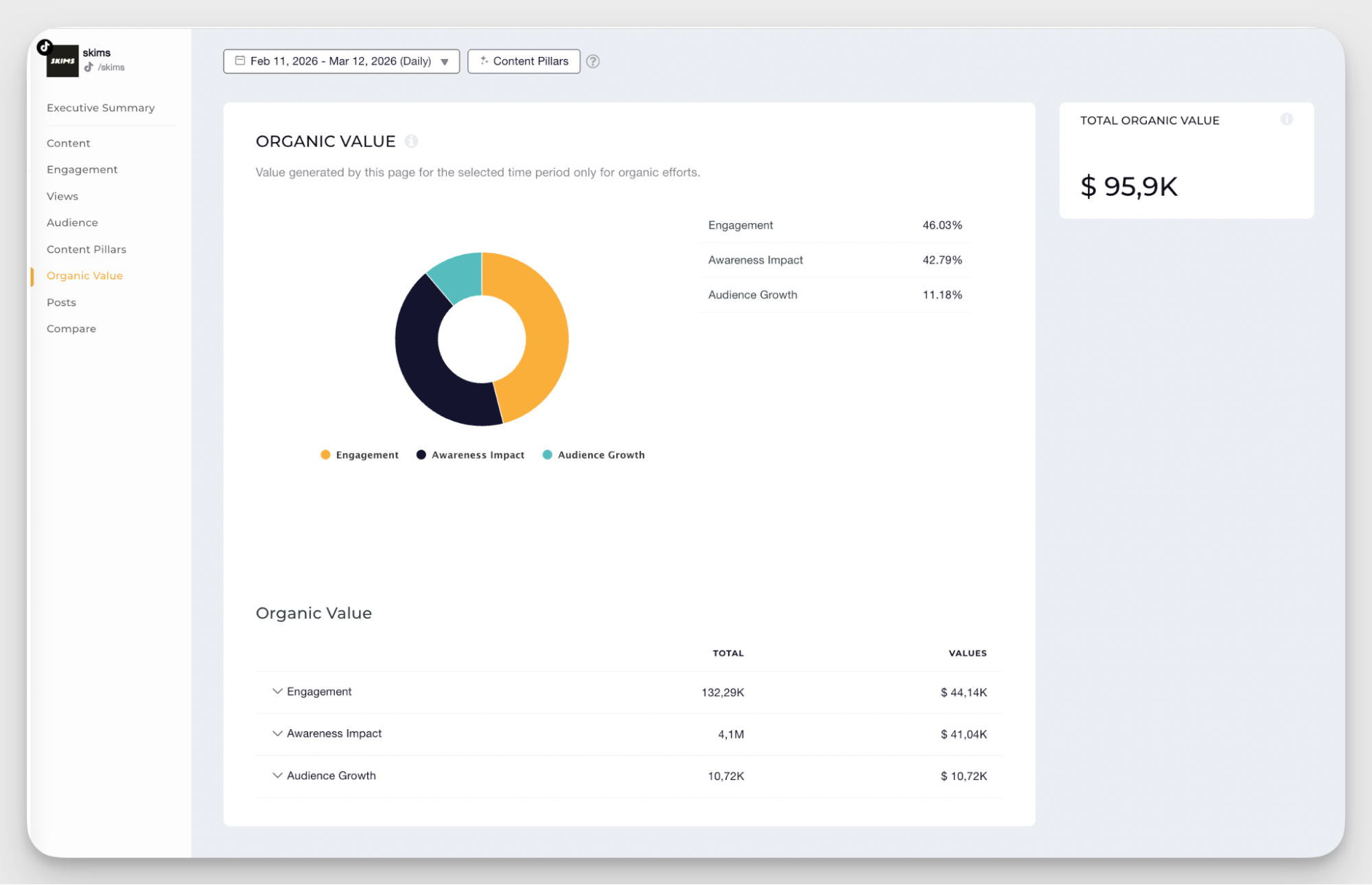
As shown in the Socialinsider dashboard above, total organic value can be broken down into areas such as engagement impact, awareness impact, and audience growth.
This gives a stronger commercial lens for social media analytics, especially when reporting to leadership teams focused on return rather than reach.
The strongest reports do more than summarize numbers. They show what created value, what should be repeated, and where the next campaign can perform even better.
This is why I usually recommend combining standard TikTok metrics such as engagement, views, follower growth, traffic, and conversions with organic value estimates.
That creates a more complete model on how to measure social media success, balancing platform performance with business outcomes.
TikTok campaign examples worth learning from
That is enough theory for now.
You probably want to see some real Tiktok marketing campaign examples, and I’m happy to deliver.
Below, I’ll break down standout campaigns and the lessons you can apply to your own strategy.
Awareness campaign example
Wild Refill created a smart awareness campaign by targeting a highly relevant subculture: runners preparing for and attending the London Marathon.
The brand built a multi-stage TikTok campaign that started with teaser content aimed at marathon participants, including packing lists, race-day prep, and runner-focused messaging.
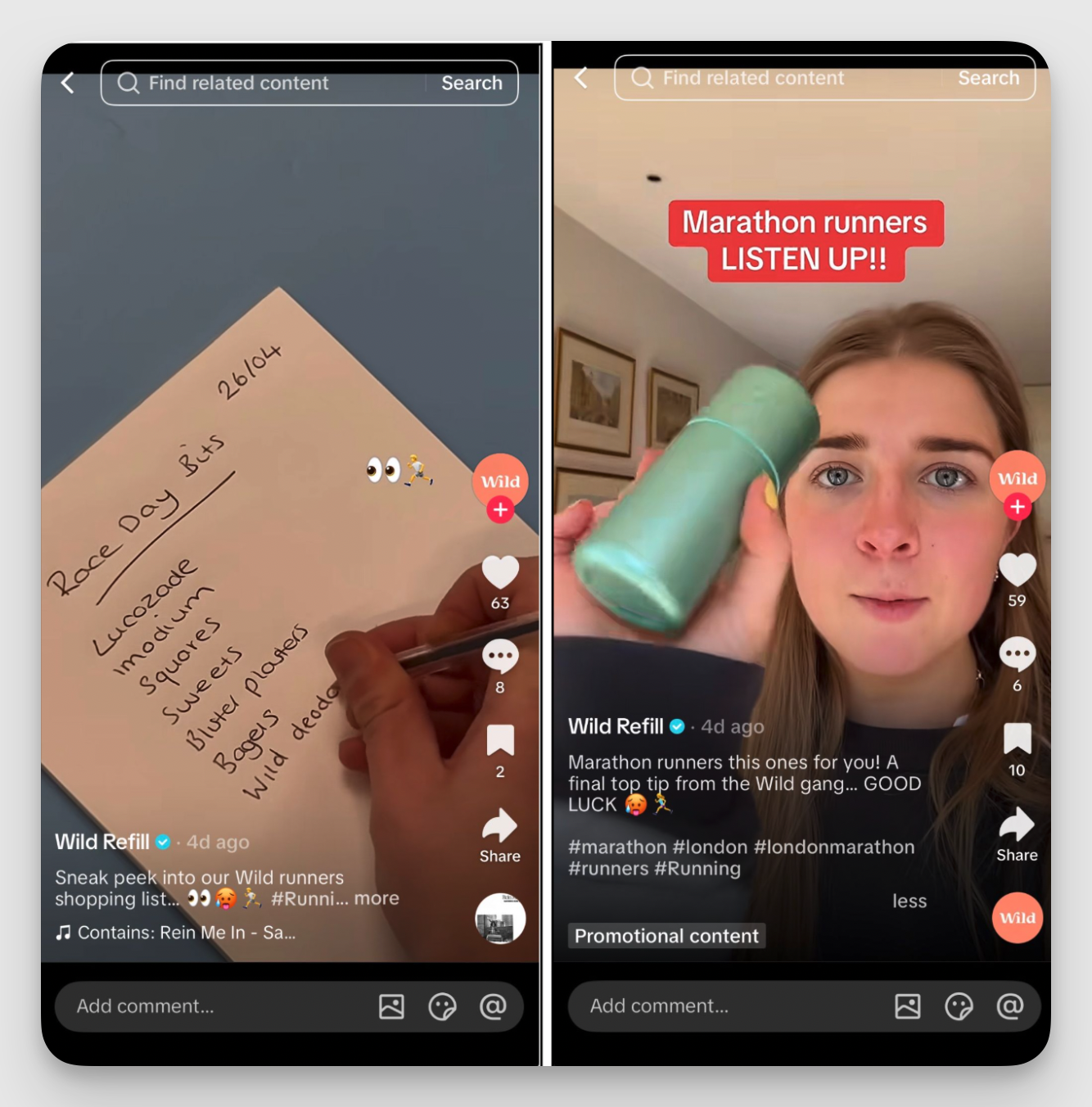
That early content helped Wild enter the conversation before the event even began. as they built familiarity with a niche audience already highly engaged around the marathon moment.
Once the event arrived, Wild extended the campaign into the real world with branded signs, humorous messaging, and a “pit stop” activation placed directly where runners and spectators would notice it most.
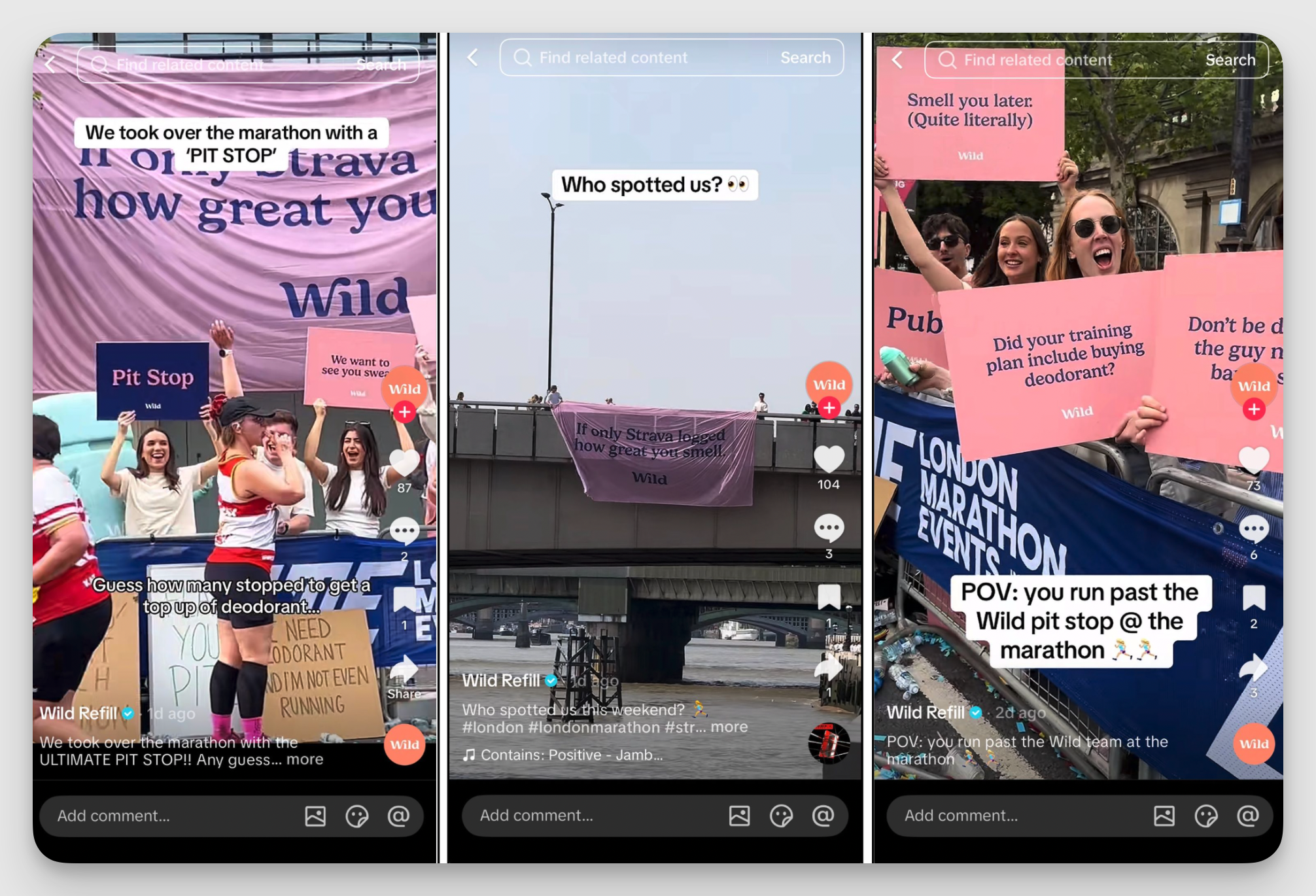
This is what makes the campaign strong from an awareness perspective.
Wild did more than just advertise deodorant. They inserted the brand into a culturally relevant event where freshness, movement, and endurance naturally connect to the product. That created stronger message relevance and far more memorability than standard awareness ads.
From a TikTok standpoint, the campaign also generated multiple layers of content: teaser videos, on-site activations, reactions, POV content, and event-day storytelling.
One live moment became an extended content engine.
Key takeaway: Strong awareness campaigns speak to a specific community, show up where that audience already is, and make the brand feel part of the moment.
Conversion campaign example
I couldn’t go without mentioning Rhode as a strong example of a brand using TikTok to drive direct conversions through product drops and limited-edition launches.
The brand builds demand through visually polished product reveals, creator-led demonstrations, and consistent urgency around new releases.
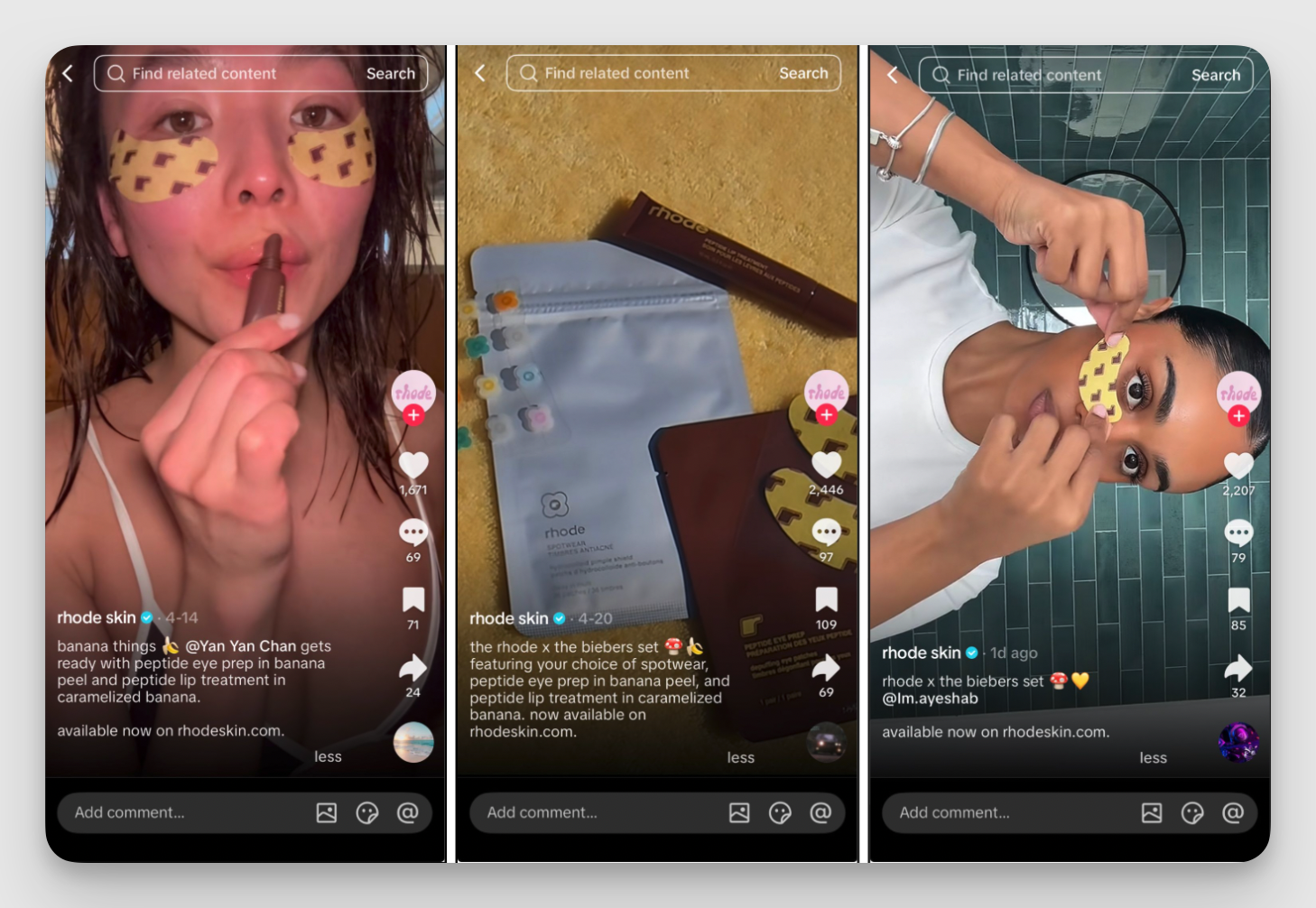
In its campaign promoting the new spotwear launch, Rhode strengthens conversion intent with clear availability messaging that sends viewers directly to rhodeskin.com once demand has already been built. That creates a smooth path from discovery to purchase, allowing audiences to act while interest is still high.
From a performance perspective, Rhode turns TikTok attention into purchase-ready traffic by making the next step obvious and frictionless.
Key takeaway: Conversion campaigns perform best when content builds desire first, then makes buying easy the moment interest peaks.
UGC campaign example
e.l.f. Cosmetics remains one of the strongest examples of user-generated momentum on TikTok.
e.l.f. turned a common beauty-user frustration into a smart UGC campaign by asking people to submit short TikTok videos of their messy vanities and share the “vanity vandal” in their life.
In return, participants had the chance to win prizes including Target gift cards, a year’s worth of products, and a bathroom makeover consultation.
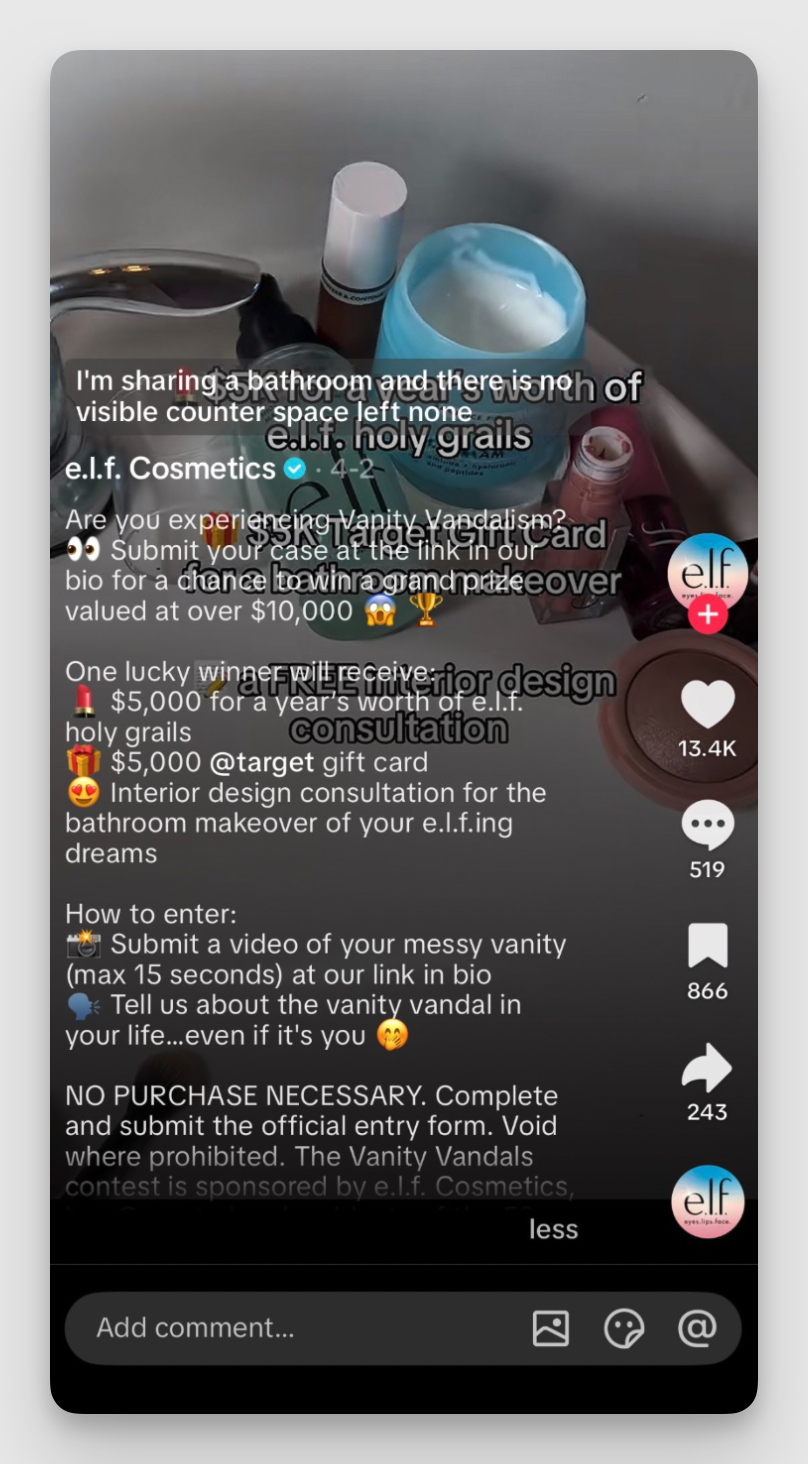
What makes this TikTok marketing campaign strong is that it gives people a clear reason to create content rather than simply asking for engagement.
The concept is relatable, easy to film, and naturally encourages humor, storytelling, and product visibility. It also removes the biggest barrier to UGC participation: not knowing what to post.
From a marketing perspective, every submission becomes branded content created by the audience. That expands reach, reinforces product relevance in real-life beauty routines, and generates authentic social proof at scale.
Key takeaway: The best UGC campaigns start with a relatable problem, make participation effortless, and reward people for joining the conversation.
Influencer campaign example
One of the best TikTok campaign examples is #RevolveFestival.
Revolve has built one of the strongest influencer-led event campaigns on TikTok through its annual Revolve Festival, timed around Coachella.
Instead of relying on isolated sponsored posts, the brand turns the event into a multi-day content engine where creators, celebrities, and lifestyle personalities generate native TikTok content before, during, and after the festival.
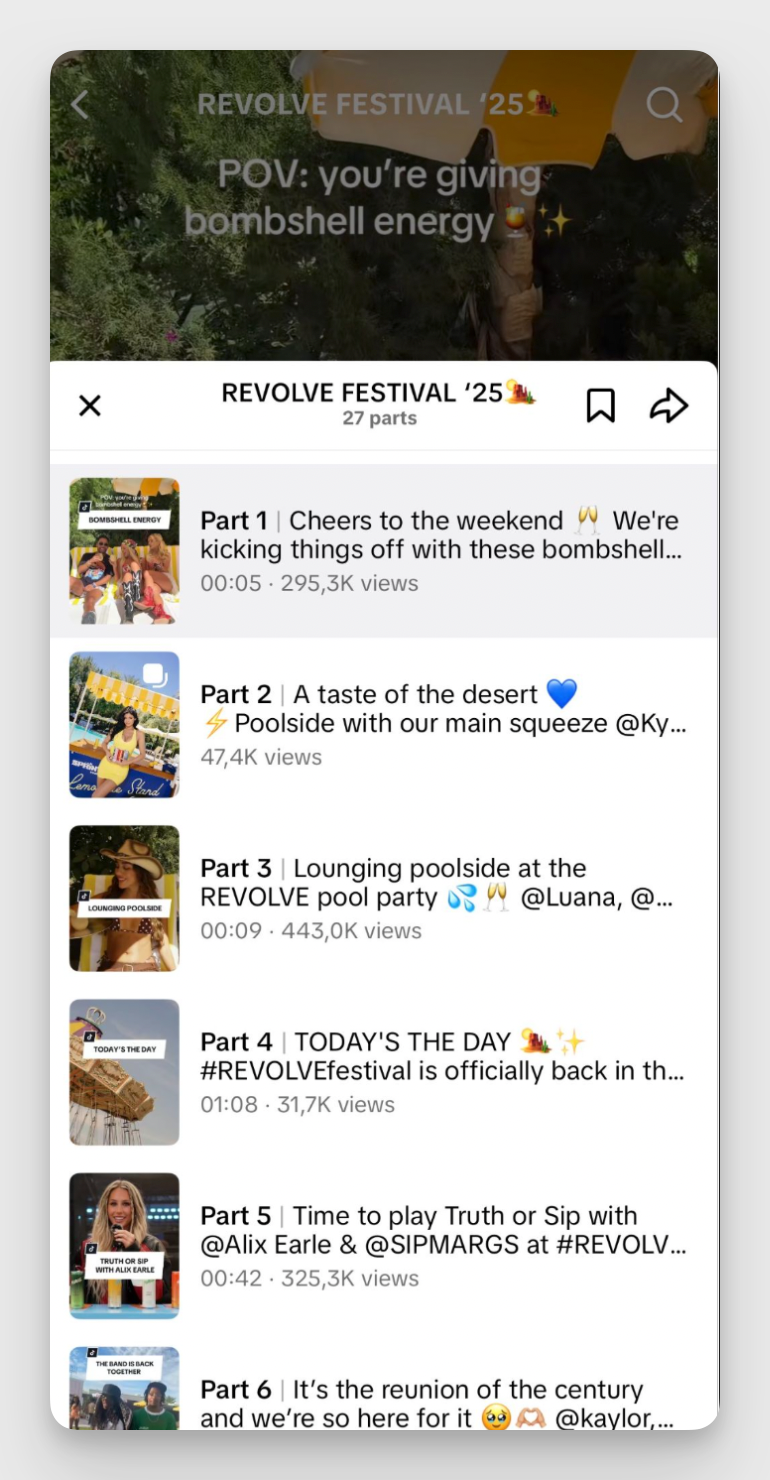
As shown in the campaign example above, Revolve packaged the event into a multi-part TikTok content series, documenting pool parties, creator appearances, behind-the-scenes moments, styling content, and festival experiences.
This is a smart move because it extends one physical event into dozens of digital assets, each with its own reach potential.
From a performance perspective, the campaign blends reach, social proof, and commerce. Audiences see trusted creators wearing Revolve products in a desirable setting, which strengthens brand perception and purchase intent simultaneously.
Key takeaway: The best influencer campaigns do not just sponsor creators. They build experiences creators genuinely want to share.
Common TikTok campaign mistakes to avoid
What if I told you that strong performance on TikTok often depends less on budget and more on avoiding the mistakes that quietly reduce reach?
I regularly see brands miss opportunities because they apply outdated tactics to a fast-moving platform.
But the most successful TikTok campaigns stand out because they understand audience behavior, adapt quickly, and create content that feels natural.
Thus, to get the most social media value, try to avoid these common mistakes:
Ignoring the platform’s particularities
The first most common mistake I often see is brands treating TikTok like just another place to publish content.
That approach rarely works because TikTok plays by different rules.
The platform rewards short attention-grabbing hooks, fast pacing, trend awareness, strong watch time, native editing styles, and content that feels genuine.
Users expect to be entertained or informed within seconds.
So when you ignore those particularities, performance usually drops quickly. The strongest results come from creating content specifically for how people consume and engage on TikTok.
And Georgia emphasized this as well:
The biggest mistake is treating TikTok like every other social platform. Users can tell immediately when content feels too corporate or overly produced.
I also think brands sometimes forget that storytelling matters most. Even quick videos need some kind of emotional connection or payoff to keep people watching.
Tracking metrics only at the end of the campaign
Tracking metrics only after the campaign ends is a mistake because it removes your chance to improve results while the campaign is still running.
By the time you identify weak creative, poor targeting, or wasted spend, the budget has already been used.
TikTok offers valuable insights early on, helping you spot trends in watch time, engagement, click-through rate, and conversions in real time.
And for even better visibility and deeper reporting, I recommend pairing those insights with a trusted TikTok analytics tool so you can optimize faster and scale what is already working or see what needs adjusting.
Over-investing in production quality at the expense of authenticity
Highly polished videos do not always create stronger results on TikTok.
In my experience, content that feels too scripted or overly branded can lose attention quickly. Audiences often respond better to videos that feel genuine, relevant, and credible.
The best TikTok campaigns balance quality with authenticity to build trust and encourage engagement.
Final thoughts
If I’ve learned anything from watching brands succeed on TikTok, it’s that the platform rarely rewards those trying to look perfect.
It rewards brands that understand their audience, move with confidence, and are willing to show up consistently.
I’ve seen smaller brands outperform much larger competitors simply because they felt more relevant, more human, and more connected to the culture around them. That is what makes TikTok such a valuable opportunity.
My advice is simple: treat TikTok as a place to learn, adapt, and build real attention over time. The brands that stay curious and keep testing are usually the ones that win.
Anda Radulescu
Content writer & copywriter with a 5-year track record in digital marketing. Equal parts keen observer & committed go-getter. A proud cat mom with a passion for music & exploring the world.

Know what your competitors do — before your manager asks
Get instant social benchmarks & reports without manual work.