How to Analyze TikTok Video Performance: Methodologies And Metrics For Effective Reporting
Learn how to effectively analyze your TikTok video performance - which metrics to prioritize for different cadences and how to use the insights.


Your competitor’s TikTok keeps popping up on your For You Page. Their videos are pulling crazy engagement, and you can’t help but wonder, “What are they doing differently?”
Chances are, it’s not about posting more. But using performance data to shape every creative move.
And looking at just one or two TikTok metrics won’t cut it. If you want real growth, you need to know how to analyze your TikTok strategy like a pro.
To help you get it right, I talked to Sam Gillies, Chief Content Officer at Nonsensical. They’ve helped major brands like Semrush, Uber Eats, and The Ordinary turn TikTok into a serious growth channel.
Now, I’m bringing those insights to you.
Key takeaways
-
How to analyze TikTok video performance: Regularly reviewing your TikTok videos through initial, weekly, and monthly assessments helps you identify trends, spot viral potential early, and refine your strategy with data-backed insights.
-
Essential TikTok metrics to track: Tracking metrics like views, engagement rate, watch time, shares, and conversions gives you a complete picture of how well your content resonates and drives real business results.
-
How to use insights to optimize your strategy: Use performance data to double down on successful themes, improve weak spots, and continuously evolve your TikTok strategy for consistent, long-term growth.
TikTok performance analysis methodologies
For better tracking and monitoring, I have divided the process into three steps: initial assessment, weekly monitoring, and monthly checks. Here’s how to see insights on TikTok with each step.
Initial performance assessment
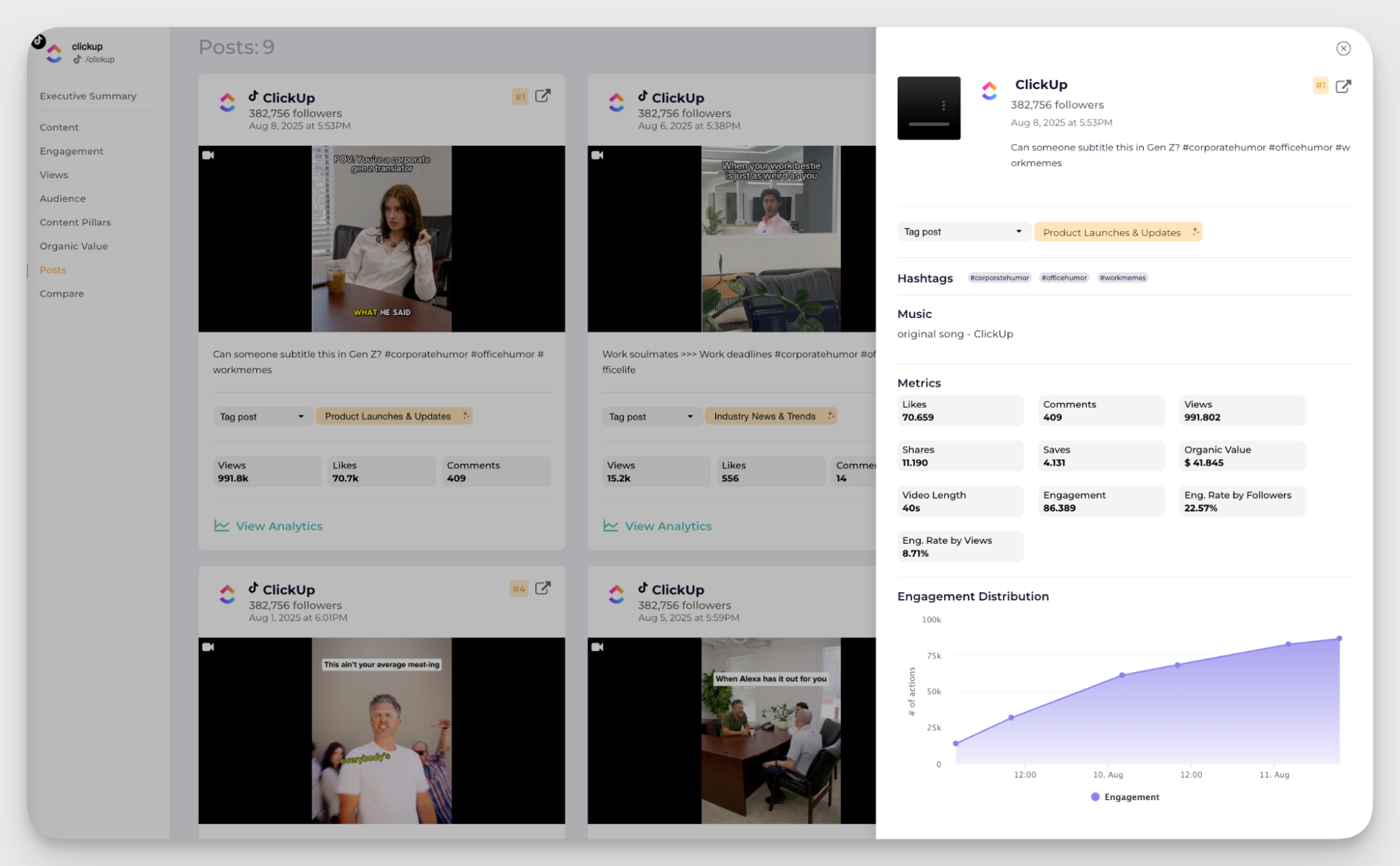
You don’t want to miss capitalizing on TikTok videos that can bring a lot of engagement and conversions. That’s why I always perform an initial assessment a day or two after posting.
At this stage, I’m looking for early signs of viral potential. This can look like:
- Stronger watch time than normal videos: If viewers watch most (or all) of the video, it signals high content relevance and good storytelling.
- Engagement spikes: Early likes, comments, and shares often indicate that the content resonates emotionally or feels relatable.
- Fast view velocity: If views climb rapidly in the first 24-48 hours, that’s a sign the algorithm is picking it up.
- Follower increase: A sudden bump in followers right after posting often means your content is converting casual viewers into fans.
You can use native analytics to look at these metrics, but I prefer to turn to third-party TikTok analytics tools for deeper metrics. For example, Socialinsider is a social media analytics tool that can be used to track TikTok video metrics, such as views, engagement rate, likes, comments, shares, saves, and follower growth — at the individual video and page level and also in an aggregated format, across multiple brand channels.
Weekly performance assessment
When reviewing performance each week, I dive into every video individually to understand why it worked or didn’t. I also look beyond numbers to identify the creative and strategic elements that influenced its results. For example, the tone of the video.
Once that is done, my assessment runs in two steps:
- Identify top 20% performers: I hop on to Socialinsider and select the time period for TikTok data analysis. Then I shortlist the videos that got the highest engagement (or saves and shares if that’s what I am targeting). And look for patterns in these posts.
- Shortlist patterns worth repeating: Based on the data above, you can select patterns you can experiment with for the next week’s content.
Monthly performance assessment
Trends and strategies on TikTok can get old very quickly. That’s why it’s recommended to do a deep dive on your TikTok performance each month.
Sam recommends the same. Here’s what he had to say about it.
For most clients, we track performance weekly to spot trends and compare progress. But for a complete picture of how an account is performing, we typically review results on a monthly basis.
It often takes up to a month to see the true impact of a viral video on your overall account — how it affects overall reach, engagement, and follower growth. That’s why a monthly analysis strikes the perfect balance between quick insights and long-term understanding.
Here’s how to go about it:
- Run a long-term trend analysis: What changes have you seen in the number of views your videos are getting? How has the follower growth been?
For example, here’s what ClickUp’s views span for over a month.
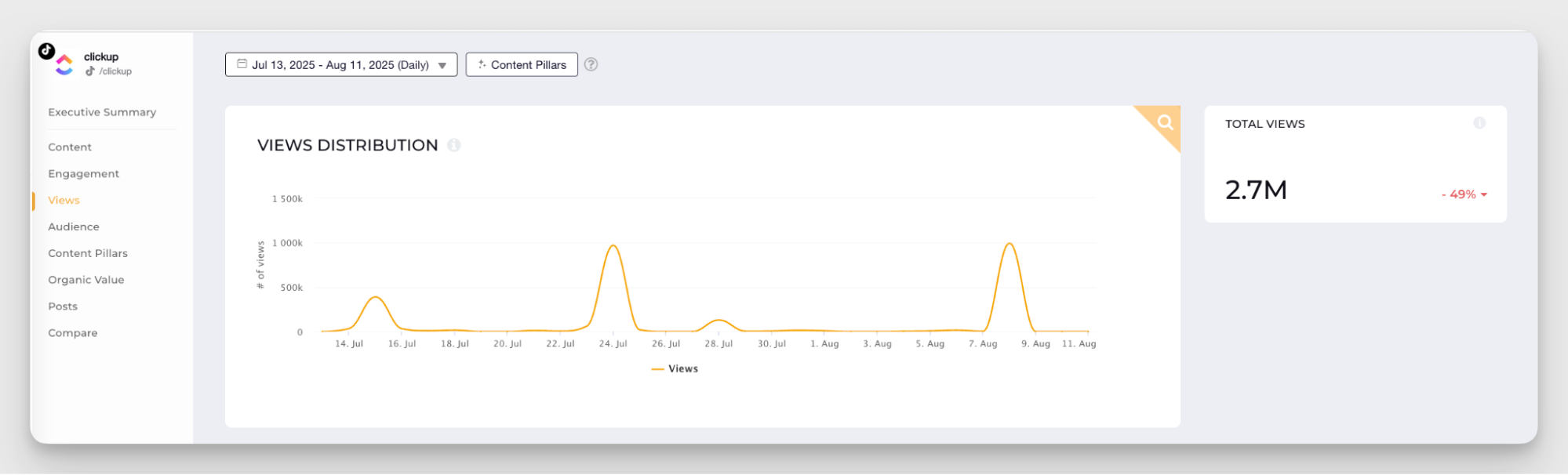
Instead of just looking at absolute numbers, I like to compare these social media metrics month-on-month.
- Get insights for future optimization: What kind of content resonated with your audience? What fetched a lot of views? These insights will help guide your future content strategy.
For example, after seeing those two spikes in ClickUp’s views, I went a bit deeper into the analysis, wanting to identify the posts that led to those spikes.
Here's one of them, for example:
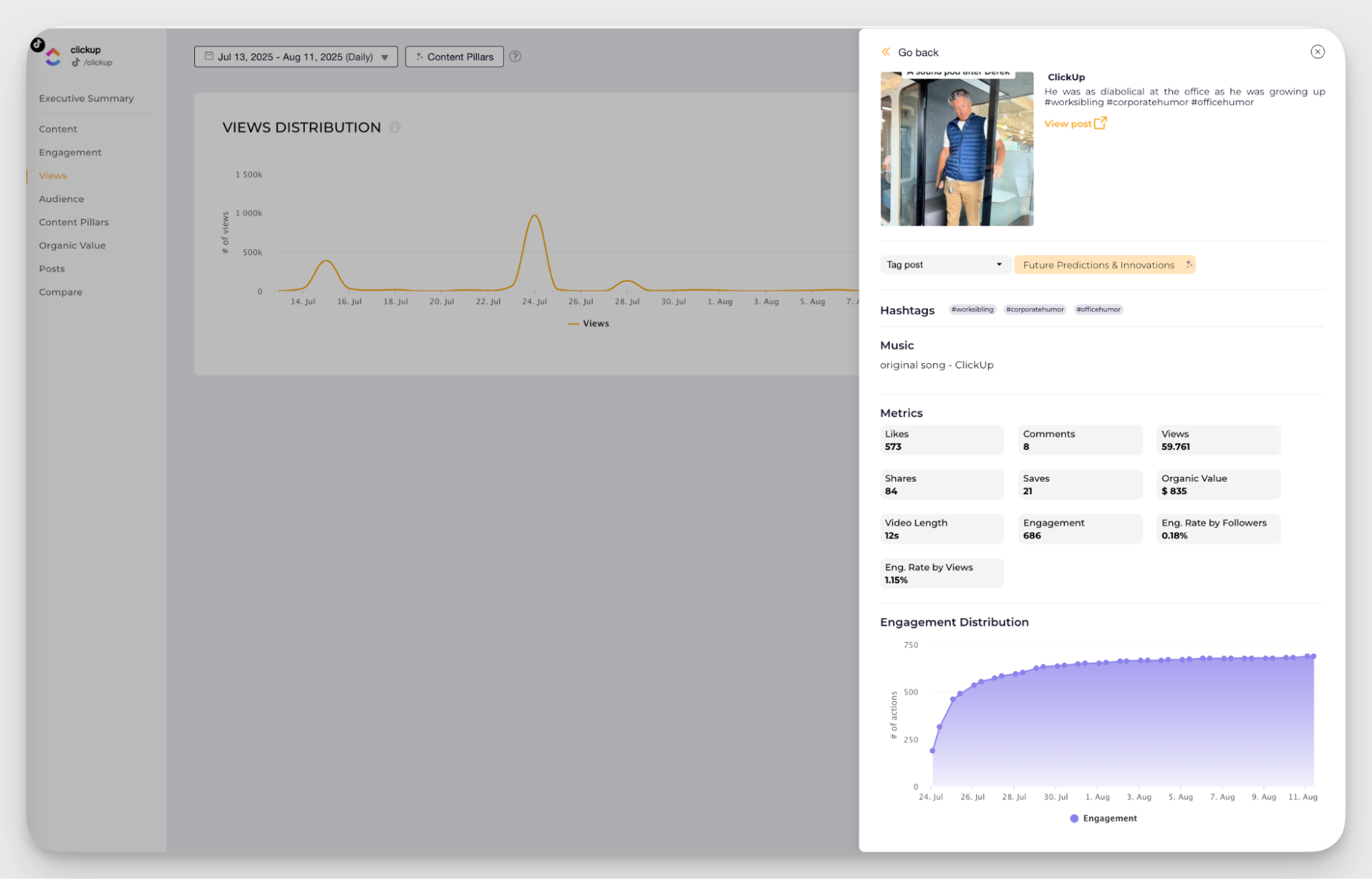
When taking a look at those posts, I could see they belonged to the same theme, with two hashtags being put in both (#corporatehumor and #officehumor), confirming our initial theory of humorous, relatable content getting the most traction.
Sam recommends looking for patterns in both top and bottom-performing content while running these monthly checks.
We track key metrics like video views and engagement, but we also go deeper by analyzing retention rates and identifying where performance starts to drop off.
Beyond client reporting, we run retrospectives for every account, digging into both the hits and the flops. This helps us uncover patterns and insights we can apply across all our clients to continuously improve performance.
Advanced analysis techniques
If you want to understand your overall video or content pillar performance in depth, you can adopt these two advanced techniques recommended by the Socialinsider team.
Cohort analysis for content themes
Every video you post on TikTok follows a certain theme. It could be product education, humour, customer story, or educational content related to your niche. We call these themes content pillars.
You might have a question - Why run this analysis in the first place? Shouldn’t you just target themes that work best for all brands on TikTok?
Sam gave the perfect answer to this. He said:
If you’re posting on TikTok without understanding why someone would actually watch the videos, there’s a high chance they’ll flop. Most people come to TikTok to be entertained, so humor can work well. But when it’s forced into a product promotion, it can easily kill engagement. It’s a fine balance
That’s why we always start with strategy. Every piece of content we create is mapped to the client’s business goals. If the goal is to build cultural relevance, humor makes sense. But if the focus is on reaching new audiences and driving sales, an educational or conversion-led approach performs better.
By running a content pillar analysis, you validate these decisions by aligning content types with the client’s goals.
Start by grouping similar content under different themes. You can do it manually or turn to Socialinsider.
Socialinsider uses AI to tag each post into a specific content pillar. You can even manually tag content to create pillars according to your categorization.
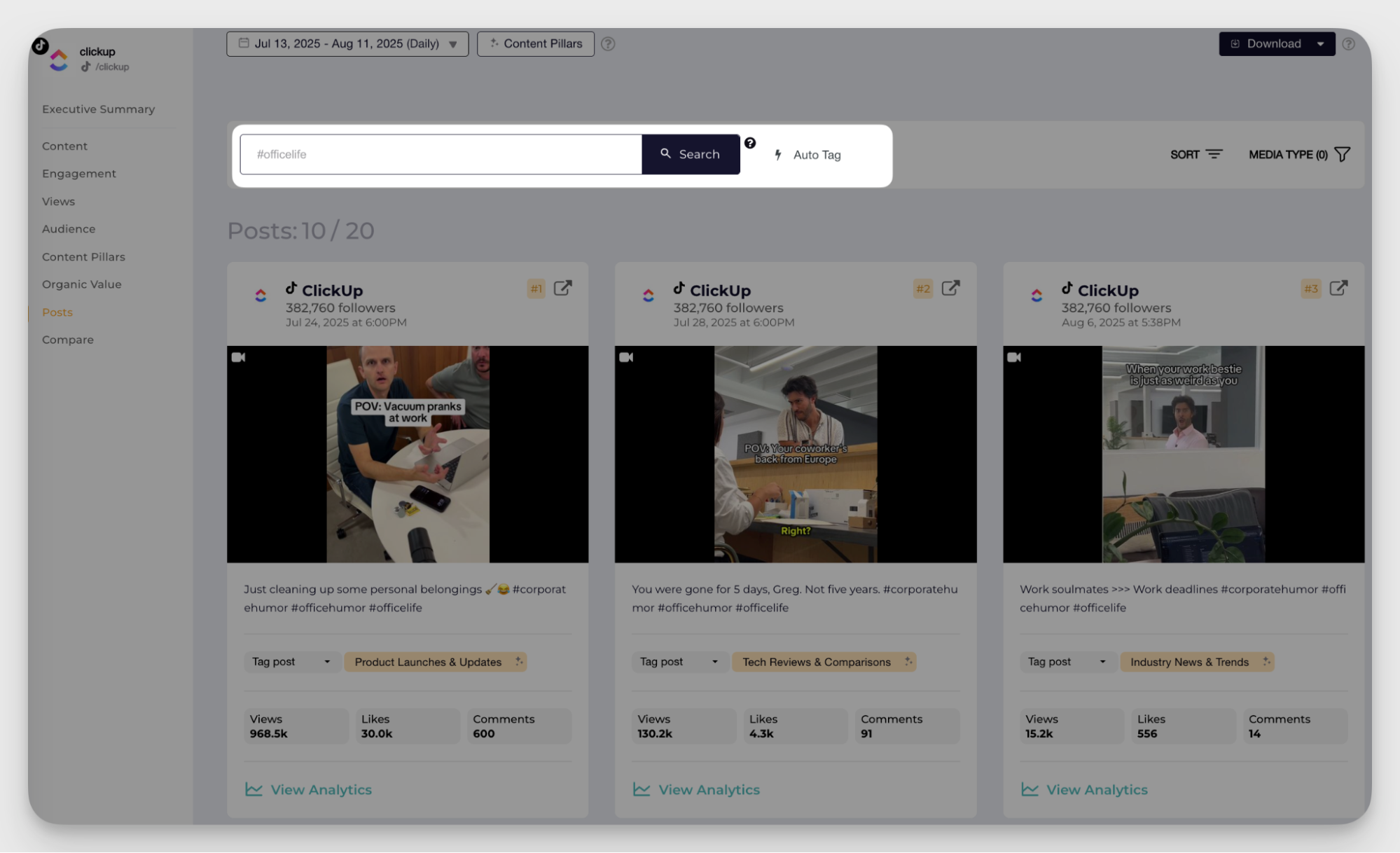
For example, here’s how I searched content with #officelife for ClickUp to find content related to that over the past month.
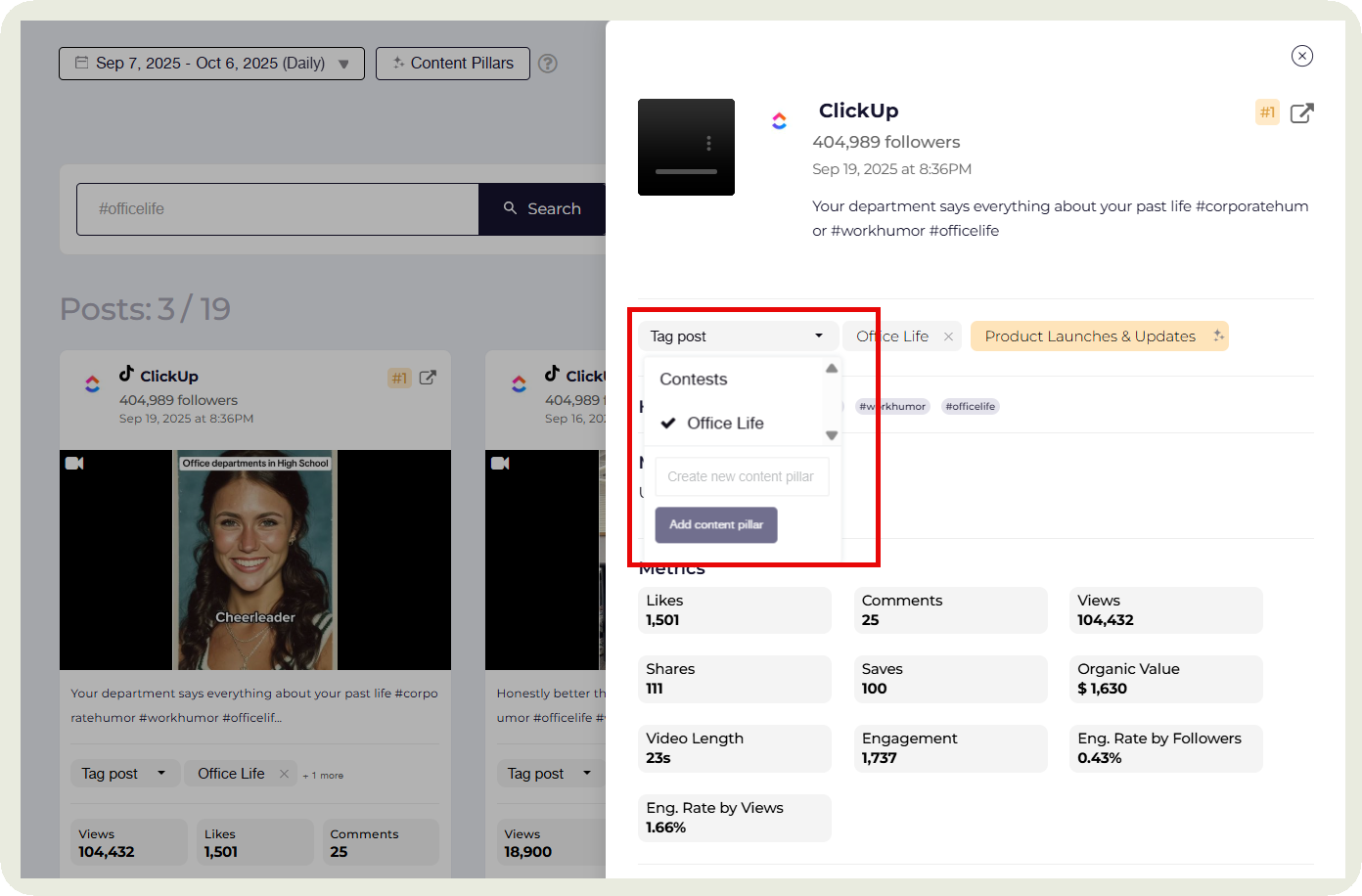
Next, I tagged each post using the labeling feature.
Now that the content pillar is created, you can track how it’s performing compared to other pillars. Go to the Content Pillars section to see metrics like views and engagement for each pillar. By running this analysis, you can find the content pillars that get you the highest ROI.
Competitive performance analysis
You recorded your highest engagement rate on all the videos last month. That’s great. But what if your competitors are outperforming simply because they’re leaning into a content pillar you haven’t explored yet?
That’s why a competitor TikTok analysis is crucial. It gives you benchmarks to compare against and improve your strategy.
Here’s how Sam goes about it for their clients:
We start by looking at their top metrics like monthly organic video views and the engagement that comes with them. Then we take it a step further with what we call a ‘sniff test’: assessing the overall feel of the account. Are they posting consistently? Does the content feel unique and intentional, or is it just a random mix of videos with no clear purpose?
To run this competitor analysis quickly, go through this three-step process in Socialinsider.
- Check the overall metrics of their profile for the same period.
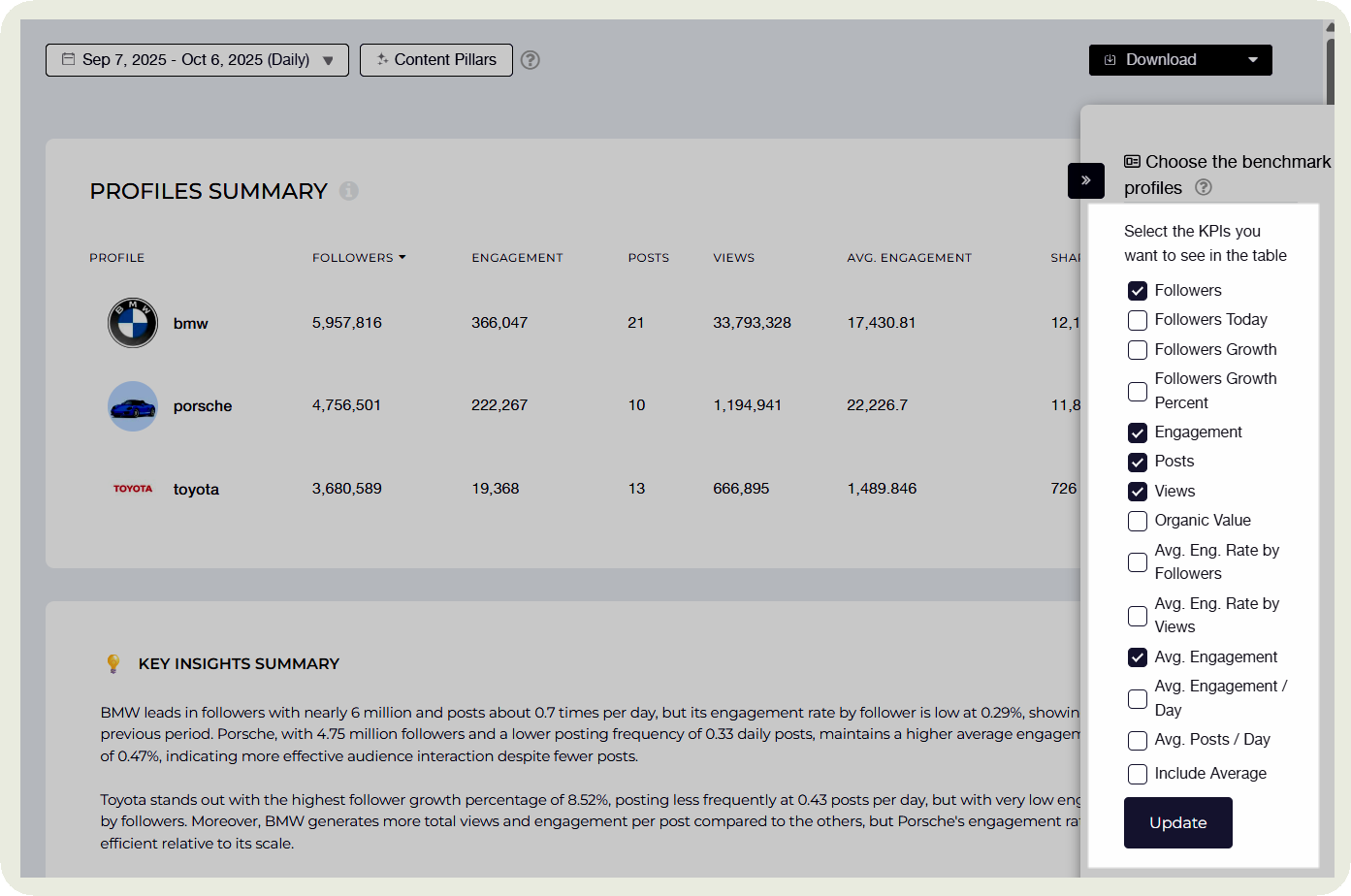
Add competitor profiles to Socialinsider and go to the Benchmarks section.
Choose the metrics you want to track in the right navigation menu to customize your TikTok analytics dashboard. And once you do that, you can get a side-by-side comparison for competitors on each metric.
- Find content pillar gaps: You might be missing on content pillars that could bring a lot of followers to your TikTok profile. One way to find that out is by looking at your competitors’ content.
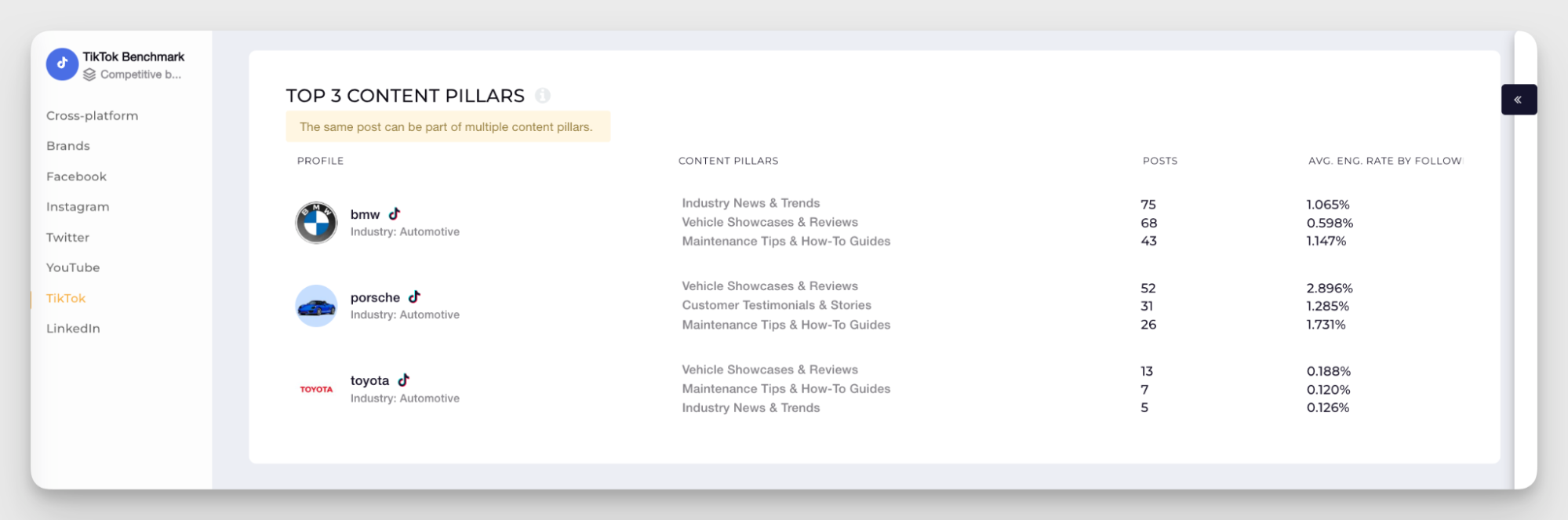
To do that, jump to the Content Pillars section in TikTok profile analyzer tools like Socialinsider.
For example, here I can see that unlike BMW & Toyota, Porsche has integrated an additional content pillar called ‘Customer testimonials & Stories.’ This pillar performs better than ‘Industry News,’ which is covered by the other two brands.
- Reverse engineer successful competitor content: Look at competitors’ top-performing content. Here’s how I find the top posts in Socialinsider.
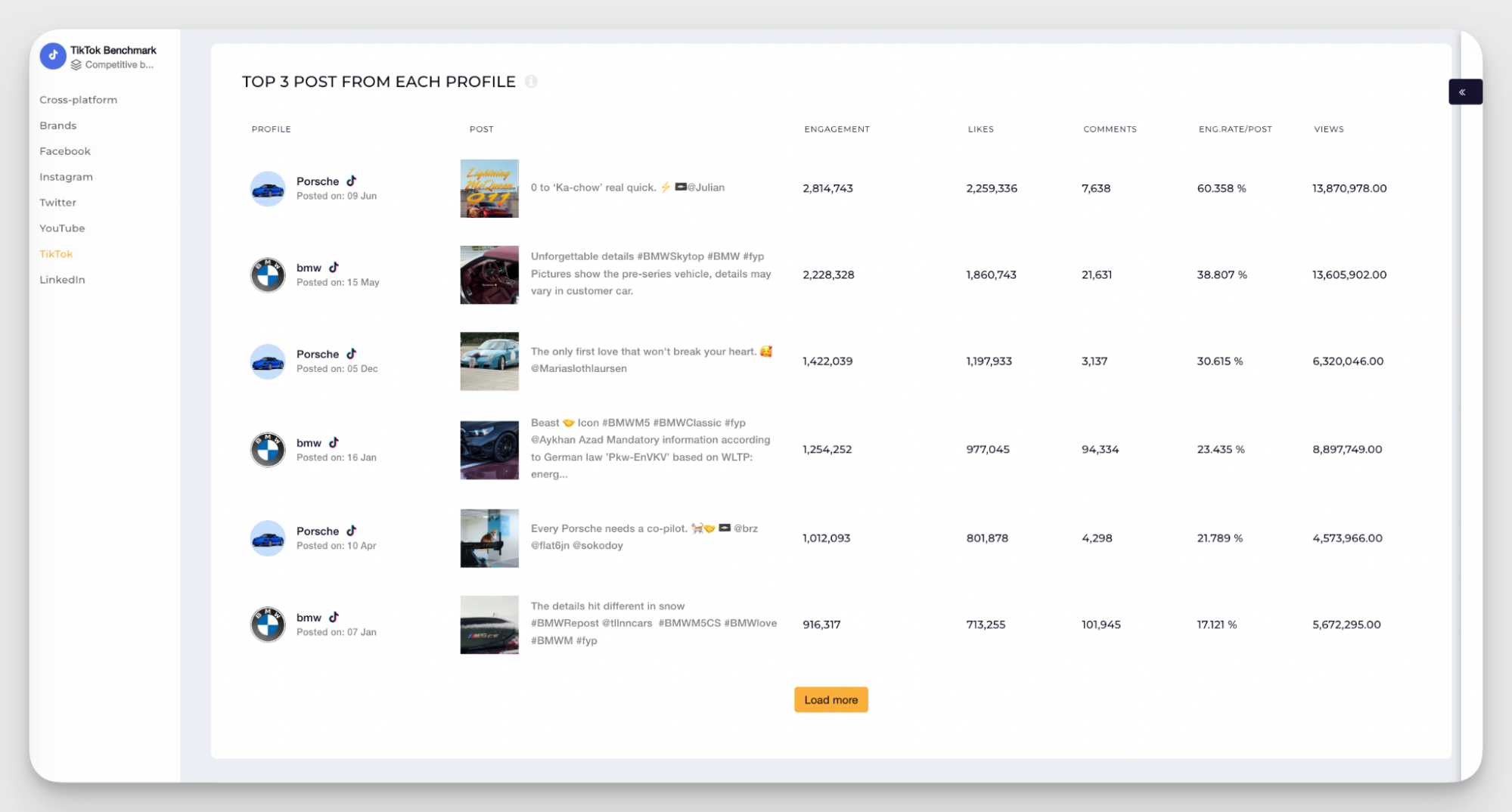
Look at details like the tone each post uses, the types of CTAs in captions that drive engagement, and the storytelling techniques that make their content stand out. By paying attention to these elements, you can identify what resonates with their audience and apply those insights to strengthen your own content strategy.
Most important TikTok video performance metrics to track
Which TikTok metrics should you regularly analyze? Below are a few key ones that are tracked by social media leaders while running a TikTok audit.
- Profile views and audience demographic insights: Profile views show how many people visited your TikTok profile after seeing your videos. This is a strong indicator of genuine interest and potential follower growth.
Audience demographic insights reveal who your viewers are, including their age, gender, and location. If your demographics are off from your target market, it’s a clear indication your content is drawing the wrong target audience.
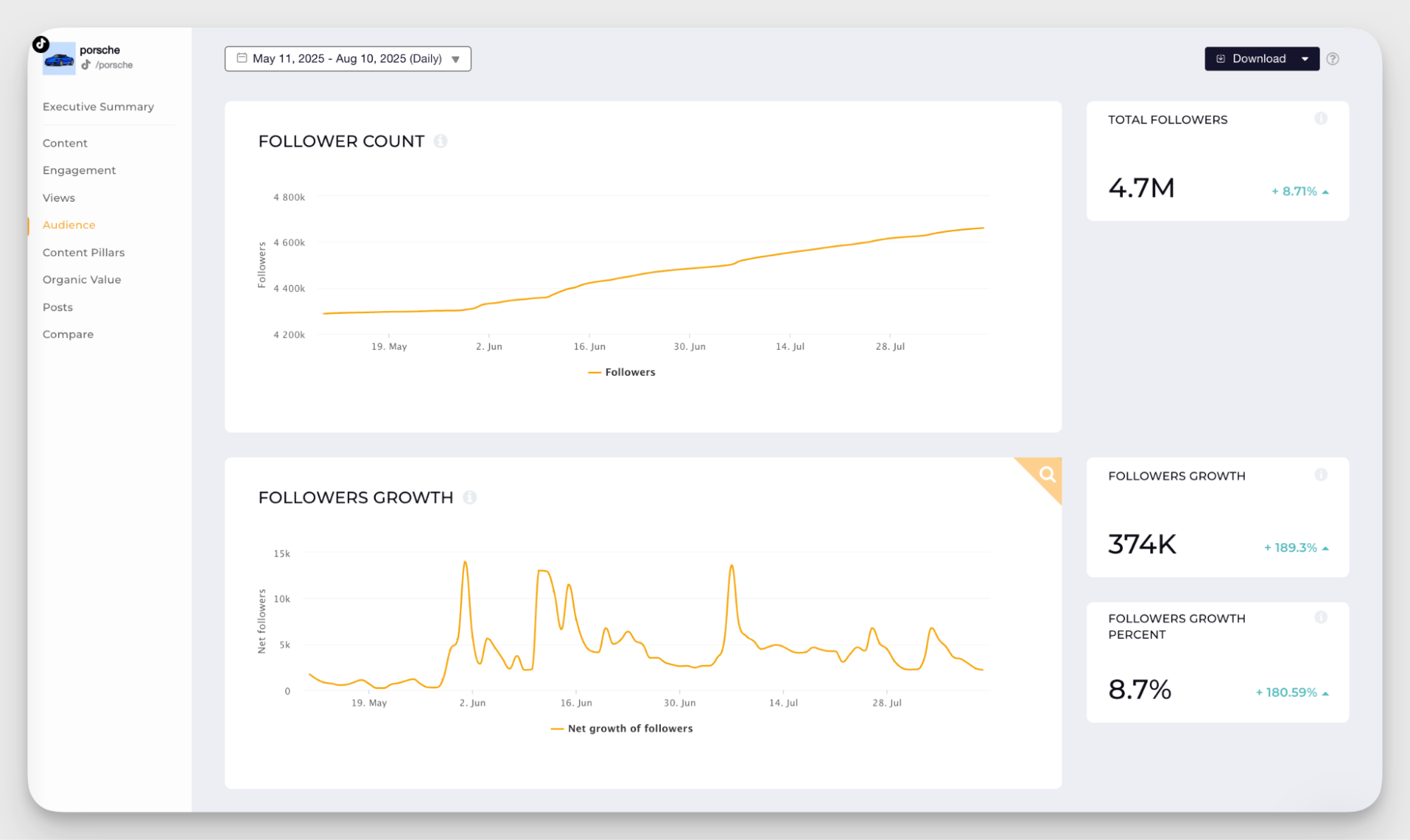
- Follower growth: It tracks how your TikTok audience increases over time, showing which videos or content themes attract new followers.
Keep an eye out for spikes in follower growth. They often follow high-performing videos and you can replicate their success by noting down what worked. In Socialinsider, you can click on those spikes to see which videos resulted in them.
- Video views: This shows how many times your TikTok video has been watched. It’s the most direct indicator of reach and visibility. While high view counts can signal strong initial interest or algorithmic boost, it’s important to pair this metric with watch time and engagement to understand if people are truly connecting with your content.
- Engagement rate: This rate measures how actively viewers interact with your TikTok content through likes, comments, shares, and saves. A high engagement rate means your content resonates, sparks reactions, or encourages participation.
- Comments, shares, and saves: Comments, shares, and saves go beyond likes to show real engagement on TikTok. Comments reveal emotional connection and how viewers feel about your content. Shares indicate virality and that people found it worth recommending. Saves show long-term value, meaning your video is useful or inspiring enough to revisit.
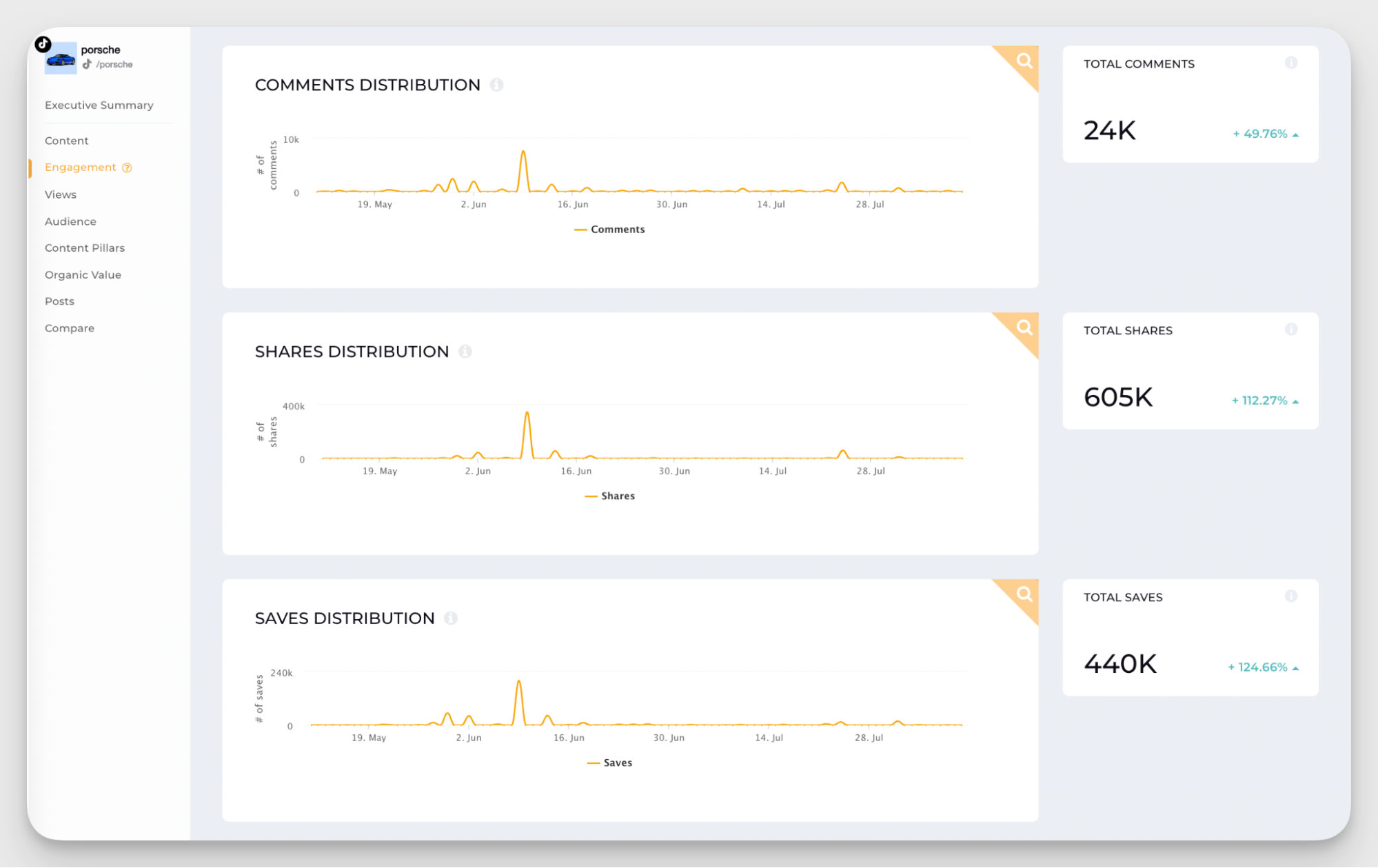
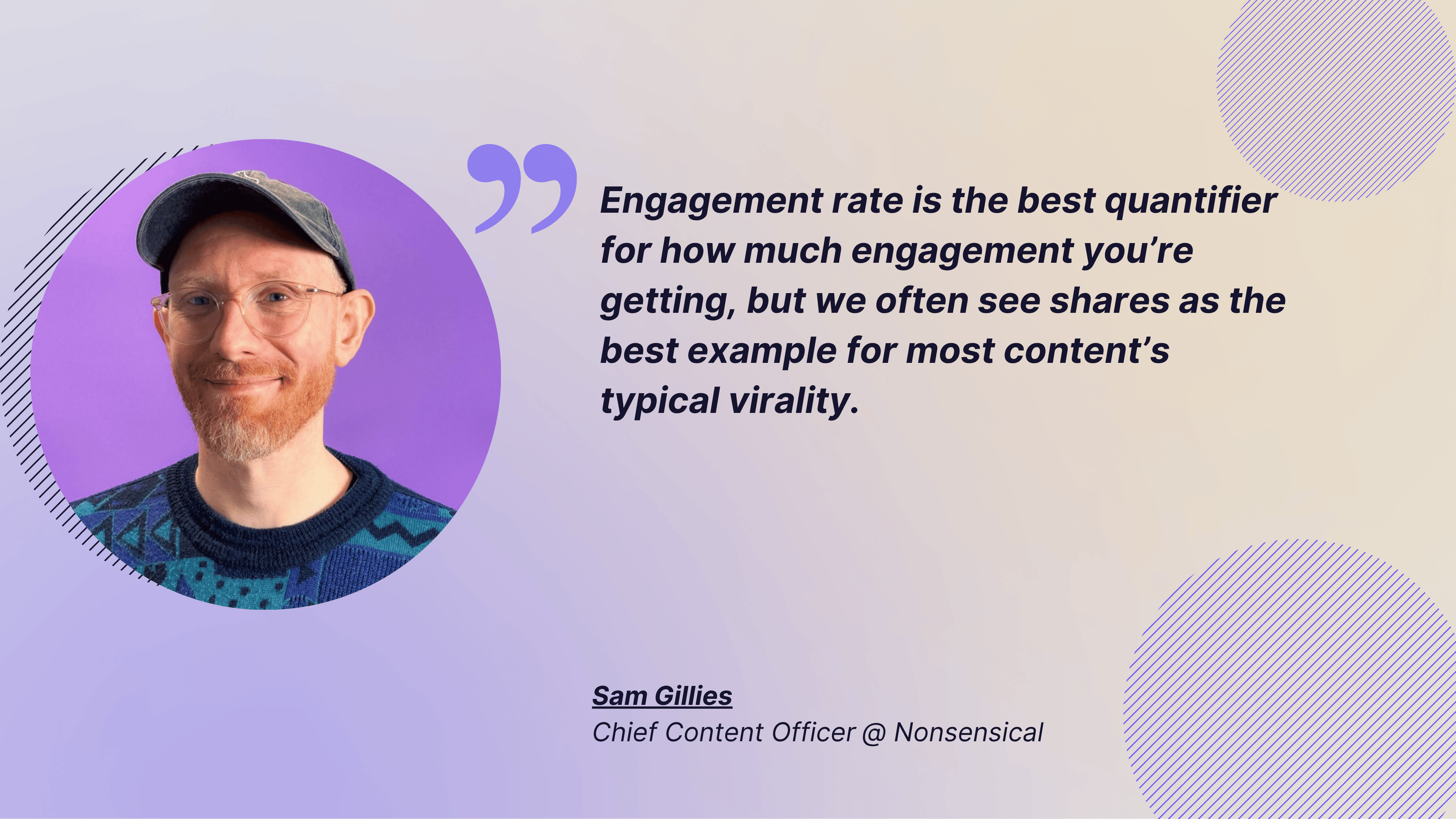
Sam mentioned tracking shares as a key metric for performance data analysis on TikTok. He said:
Engagement rate is the best quantifier for how much engagement you’re getting, but we often see shares as the best example for most content’s typical virality.
- Watch rate and watch time: They reveal how well your TikTok video holds attention. Watch rate shows the percentage of viewers who watched your video to the end: a sign your hook and pacing worked. Watch time measures how long people stayed, indicating overall engagement quality.
Sam suggests a few ways to make sure your videos on TikTok get a good watch rate:
I’ve come across videos with millions of views but surprisingly low watch time. It’s always a bit puzzling. That’s why we stick to a clear structure: start with a strong hook to grab attention, maintain tight pacing to keep viewers watching, and weave in branding subtly so people remember who they’re watching and are more likely to come back.
- Click through rate/conversions: If increasing sales or revenue is your goal, these are the metrics to not miss out on.
CTR shows how many viewers were intrigued enough to tap your link or call-to-action, reflecting how persuasive your messaging and visuals are. Conversions reveal how many of those clicks turned into real outcomes, like sign-ups or purchases.
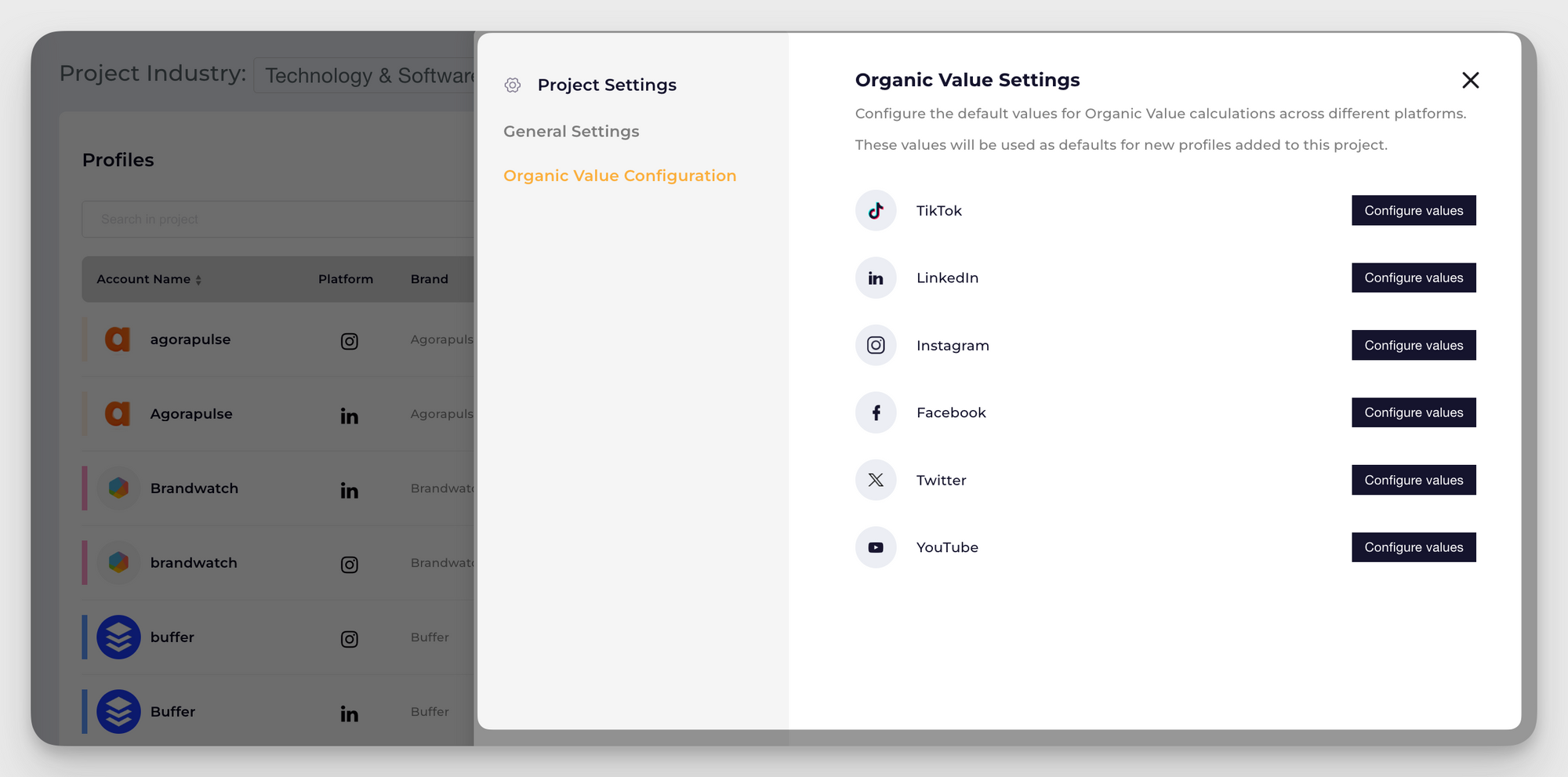
- Organic value: It calculates how much your organic reach would’ve cost if you’d paid for it. Socialinsider calculates this value for you. You can assign a monetary value to each engagement action and let the tool calculate it. This helps you measure your paid vs organic ROI.
How to use TikTok video insights to improve your content strategy
Now that you have all the metrics and insights, here’s how I recommend using them to enhance your TikTok video marketing strategy.
Adjust your content calendar using performance data
Your data should foremost guide your content strategy. Here’s how I go about it:
- Scale successful content themes. These could be the videos with high engagement, completion rates, or follower growth. Schedule more content under those themes.
- Refine bottom-performing content. Dig deep into why it didn’t work. Was it the tone, hook, or the storytelling format? Take notes on what to improve for the next month.
- Set a posting frequency. Do you notice higher engagement when you post more frequently? Pay attention to where that growth starts to dip (signal you might be overwhelming your audience with too much content).
- Balance content pillars: Focus on successful themes but spread them out with other content pillars. Too much of one theme might bore your audience.
Run cross-platform performance correlation
You might be posting similar content on both TikTok and other platforms. Compare how each theme/content works across these social media platforms.
Consider metrics like engagement per follower rate or engagement rate per view to make this comparison fair and easier.
If you find that a certain Instagram Reel gets high engagement but performs poorly on TikTok, it might mean your creative or format needs to be tailored differently for TikTok’s audience.
Build predictive content models
You can turn your TikTok data into a simple predictive model by studying what’s worked before and using it to forecast future wins.
Start by tracking patterns in your top-performing videos: hooks, topics, formats, and timing. Then, test new videos built around those proven elements.
As you collect more data, you’ll start predicting what’s likely to perform well before you even post.
Identify content fatigue and refresh your appraoch
Is your once top-performing content starting to drop? It could be because of content fatigue.
This can happen when you use a content theme too much. It could show up in signs like declining engagement rates, shorter watch times, or fewer comments and shares.
Instead of giving up on these themes altogether, space them out and present them in a different way. Experiment with new hooks, trends, or storytelling angles.
For example, instead of traditional demos, you feature your team trying the product in fun challenges or invite your users to show how they use your product.
Final thoughts
As a TikTok strategist, a big part of your job is figuring out what to post. But hitting ‘publish’ is only half the battle. The real magic happens when you dig into the data. You need to know which videos actually worked, what results they delivered, and how to interpret those metrics to see the full picture.
Once you do that, you can start predicting what will bring success and keep optimizing your strategy. To get deeper insights than native analytics and run content and competitor analysis, turn to tools like Socialinsider. Get your free trial today.
FAQs about TikTok video performance analysis
Why is my TikTok engagement rate dropping?
A dropping engagement rate usually comes down to a few common causes:
- Content fatigue — leaning too hard on one format or theme until your audience tunes out
- Inconsistent posting — gaps in your schedule signal to the algorithm to distribute your content less
- Weak hooks — if watch time drops, the algorithm limits your reach, which drags down interactions
- Audience mismatch — a viral video can pull in followers outside your target demographic who won't engage with your regular content
- Algorithm shifts — sometimes it's platform-wide; run a competitor benchmarking check before overhauling your strategy
Nidhi Parikh
Having worked with several brands in the social media space, Nidhi writes about all things social. With 13K followers on LinkedIn, she's always up for a chat about books or her next travel plan

Know what your competitors do — before your manager asks
Get instant social benchmarks & reports without manual work.


