What Are the Best Audience Engagement Strategies for Social Media in 2026?
Discover the audience engagement strategies that work on social today based on data and experts' insights, from benchmarks to effective tactics.

Knowing how to engage your audience on social media has never been more complex. Algorithms change constantly, audience expectations evolve, and what worked six months ago may already be losing steam.
In this guide, I break down the most effective audience engagement strategies available right now, supported by recent data and top insights provided by Felipe Guzman, social media lead at Patagonia. From understanding platform benchmarks to building content that consistently earns responses, dive into discovering what's most effective now in social media.
Key takeaways
-
What are some specifics of audience engagement on social media nowadays? Audience engagement today is best measured through active interactions like shares, saves, and comments, alongside growing community-based conversations beyond public feeds.
-
How to analyze audience preferences to create engaging social media content? The most effective way to understand audience preferences is to analyze your own performance data and double down on content pillars that consistently drive higher engagement.
-
What content strategies consistently drive audience engagement? High-performing content earns engagement by triggering emotional or participatory responses through storytelling, interactive formats, and platform-specific execution.
-
How to improve audience engagement over time? Improving engagement requires continuously identifying what works, repurposing successful content, analyzing competitors, and refining your strategy based on data patterns.
What are some specifics of audience engagement on social media nowadays?
Audience engagement on social media refers to the interactions an audience has with a brand's content across platforms and is one of the clearest indicators of whether a social media strategy is working. Audience engagement includes passive actions, such as likes, and active signals, such as saves, shares, and comments.
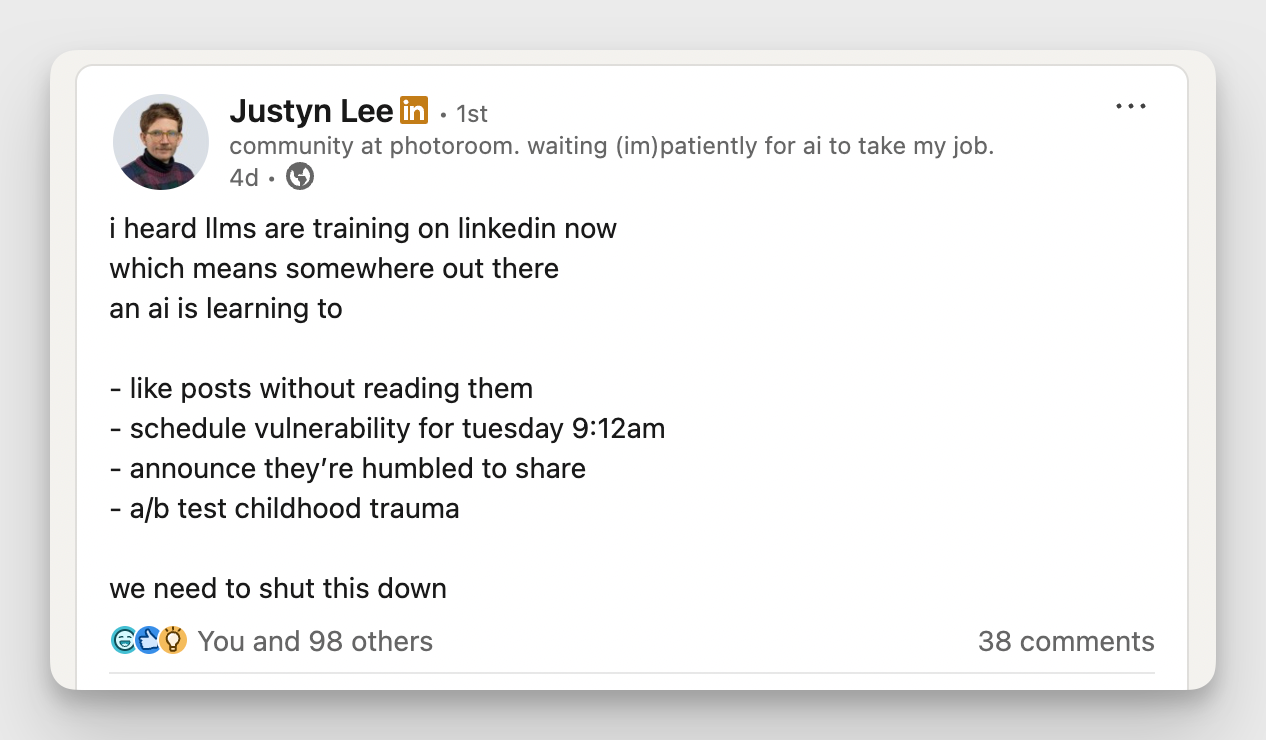
For a long time, likes were treated as the go-to measure of how well content was performing. But a like takes less than a second and requires almost no emotional participation. People are even joking nowadays about likes being an automatic, no-involvement action:
The metrics that tell a more honest story are the ones that reflect active engagement. When someone saves your post, it means that your content was worth coming back to. When they share it, they're putting their own name behind it. When they comment, they're starting a conversation. These actions take meaningful effort.
At the same time, there's a growing shift toward communities, both private and public. Audiences are increasingly moving their conversations to Facebook groups, Discord servers, Instagram broadcast channels, or Slack communities. Here's what this means for your engagement strategy: surface-level metrics alone no longer give you the full picture of how engaged your audience really is.
Whether you're managing one brand or ten, paying attention to advanced metrics and industry benchmarks is what helps you create a genuinely effective audience engagement strategy.
Engagement benchmarks across platforms
To know whether your engagement is actually good or not, you need a reference point, which you can get from Socialinsider’s social media benchmarks reports. Here's how the main engagement metrics break down across platforms, based on the most recent data.
Engagement rate benchmarks
Engagement rate benchmarks vary significantly across platforms, with TikTok leading by a wide margin and growing.
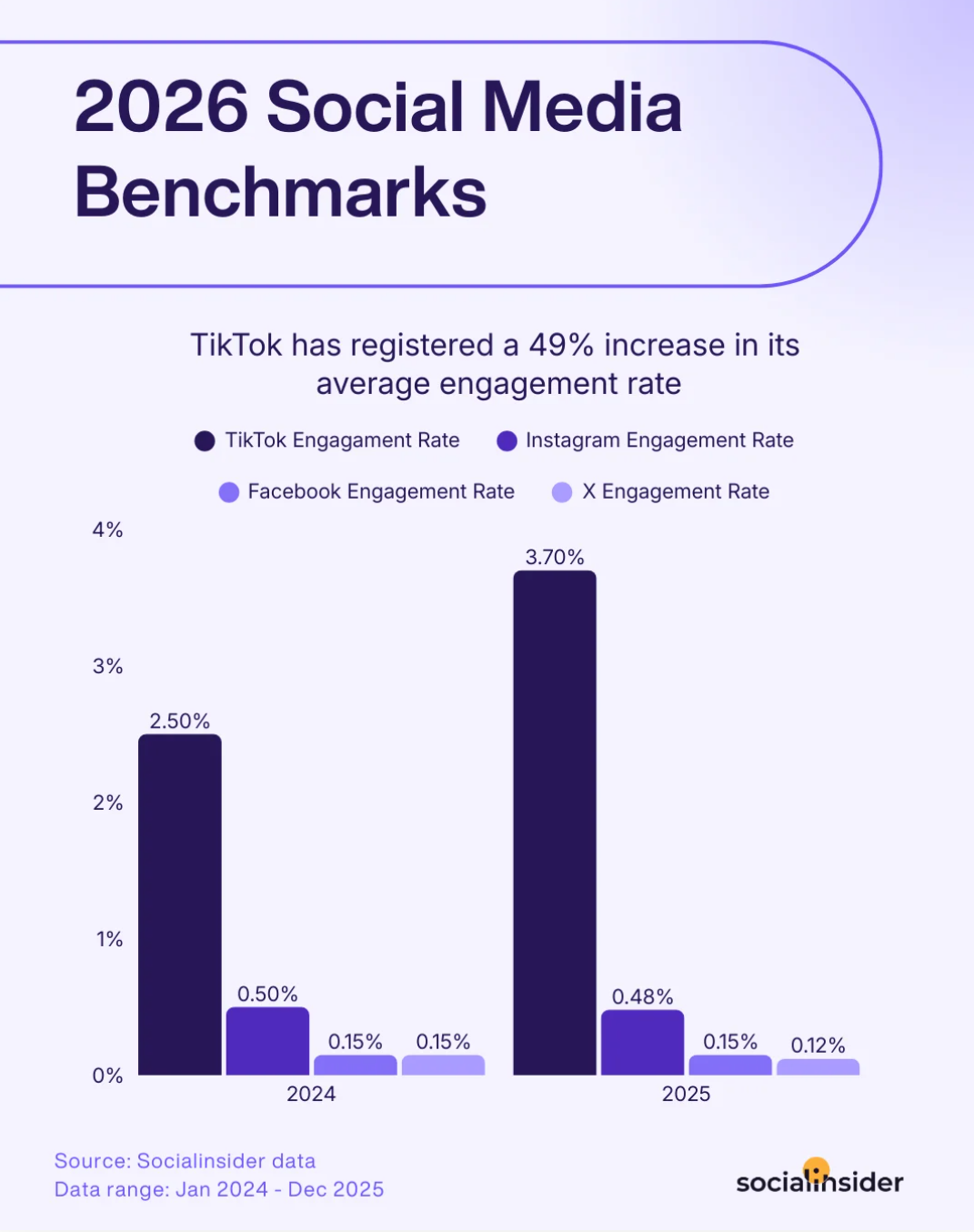
As you can see in the chart above, TikTok's average engagement rate climbed noticeably from 2024 to 2025, pulling even further ahead of Instagram, Facebook, and X.
Instagram holds a distant but stable second place, while Facebook and X remain relatively flat.
If you're wondering why your TikTok content feels like it's getting more traction than the same post on Instagram, the platform-level difference in engagement rates is a big part of the answer.
Here's how Felipe approaches benchmarking as well:
I look at quarterly benchmarks to understand how our audience is responding to our content over time, not just post to post. From there, I dig into campaign performance to see what is resonating most. That includes content hooks, formats, and posting cadence. Those insights help guide adjustments so we are doubling down on what consistently connects with our audience rather than guessing.
Likes benchmarks
Likes tell an incomplete story, but they're still worth tracking and analyzing alongside other social media metrics.
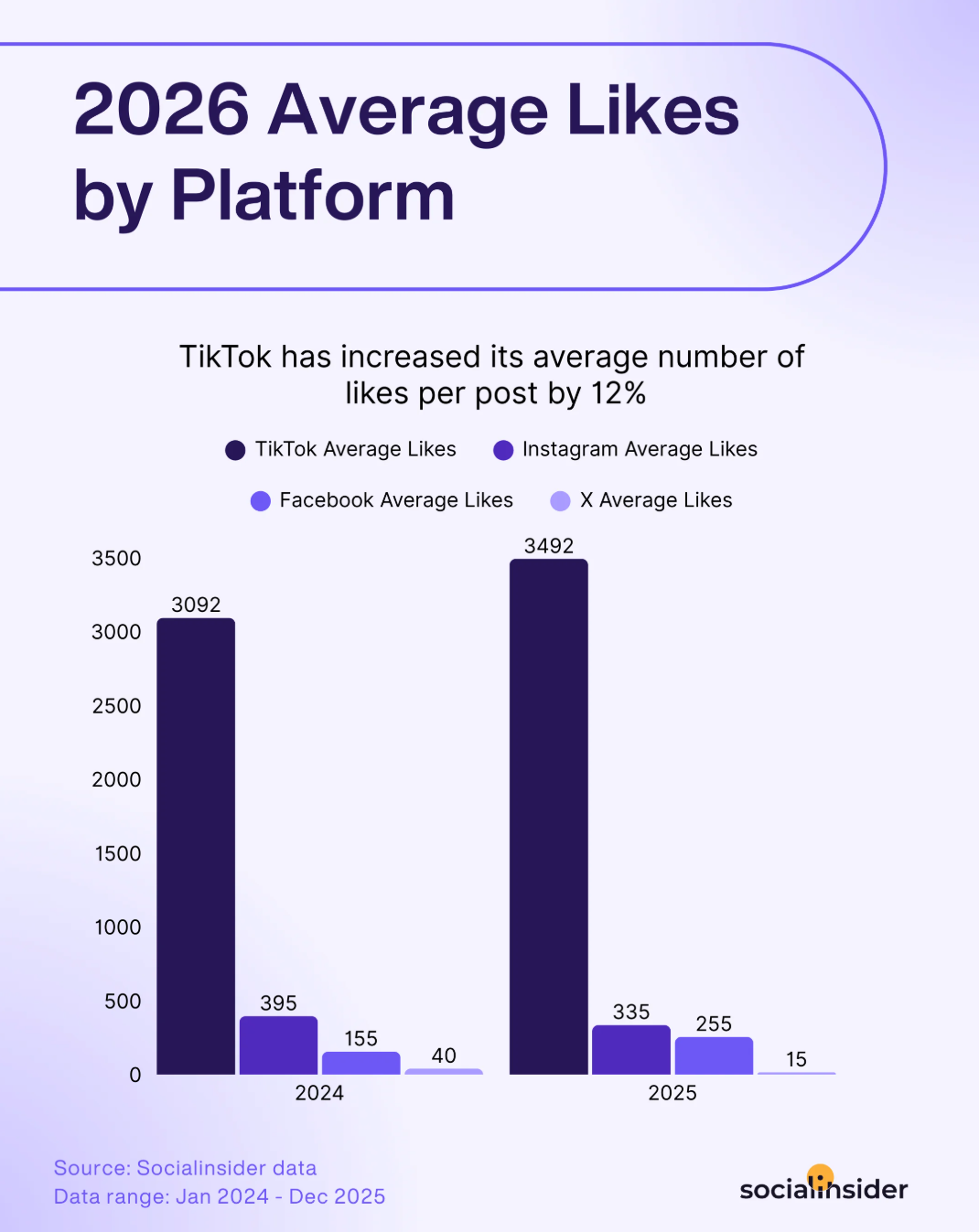
According to Socialinsider reports, TikTok's average likes per post grew meaningfully year over year, while Instagram saw a slight dip and Facebook moved in the opposite direction, picking up modest ground. X, on the other hand, continues to trail all other platforms by a significant margin.
What this chart reinforces is that platform choice has a direct impact on the volume of passive engagement your content can realistically expect.
Comments benchmarks
Comments are declining on TikTok and Instagram, and that's worth paying attention to when building your audience engagement strategy. The drop in average comments per post on platforms between 2024 and 2025 suggests audiences are becoming more selective about when they choose to respond publicly.
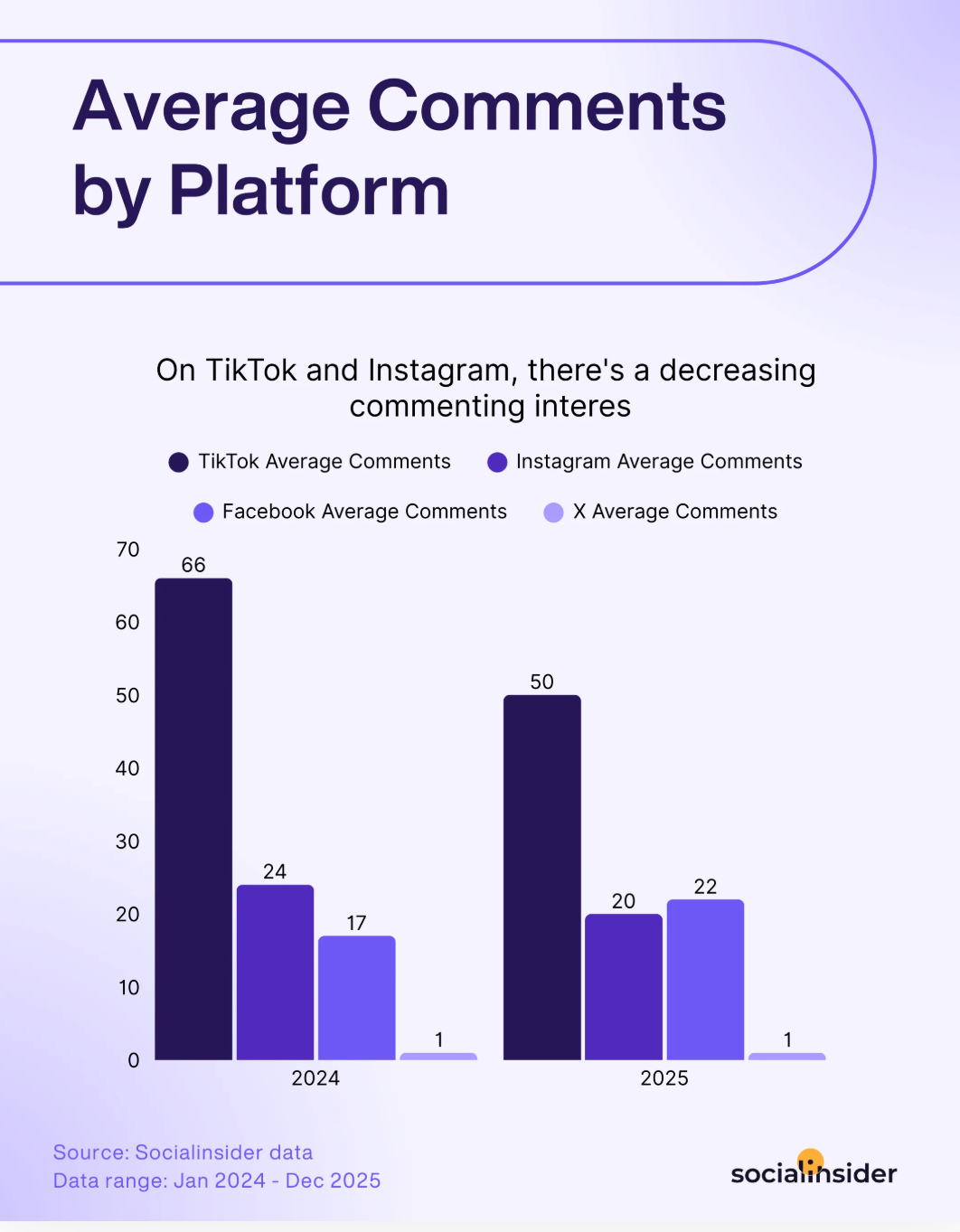
Interestingly, Facebook showed a slight uptick in comments over the same period, which may reflect its stronger community and group dynamics.
For brands focused on sparking conversation, the data points to the importance of being intentional. A comment doesn't happen by accident anymore.
Shares benchmarks
Shares are up across every platform, which is one of the more encouraging signals in recent Socialinsider social media data.
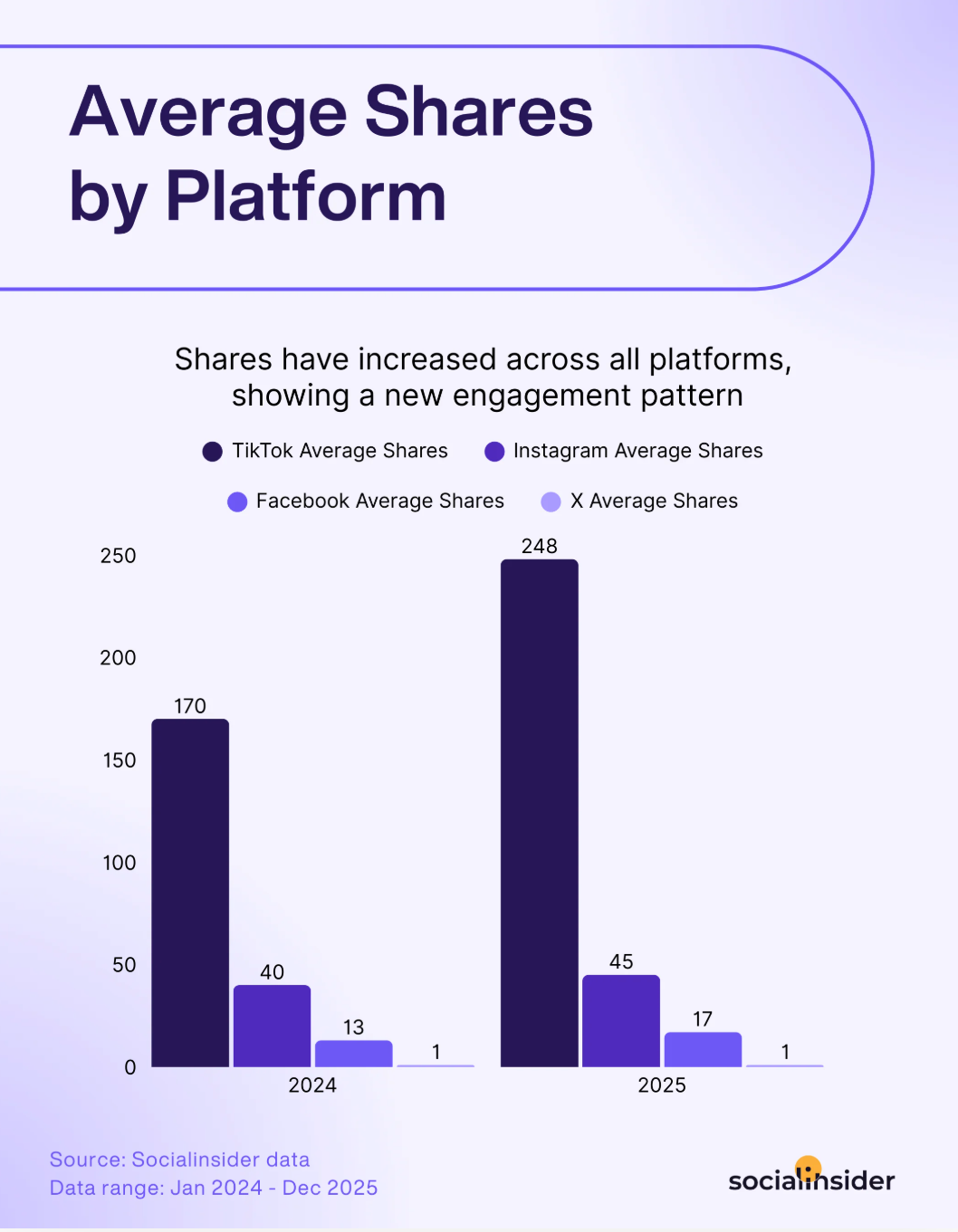
TikTok saw the sharpest rise, with average shares per post growing substantially from 2024 to 2025. Instagram and Facebook both followed the same upward trajectory, even if at a smaller scale.
This trend suggests that while audiences may be commenting less, they're more willing to actively distribute content they find valuable.
For anyone thinking about how to engage your audience beyond surface-level metrics, shares are the signal worth chasing right now.
Here's how Felip approaches data analysis as well:
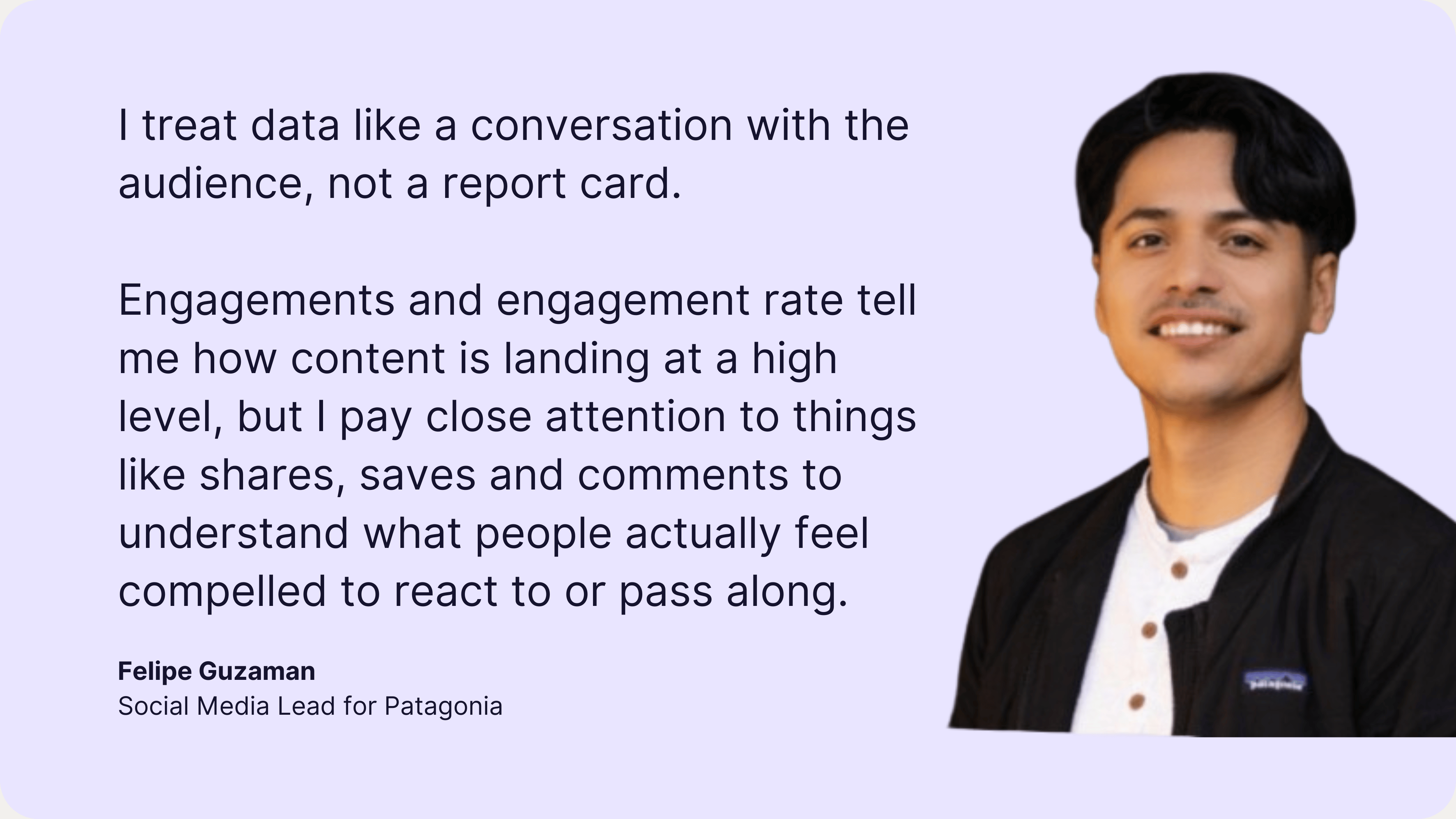
I treat data like a conversation with the audience, not a report card. Engagements and engagement rate tell me how content is landing at a high level, but I pay close attention to things like shares, saves and comments to understand what people actually feel compelled to react to or pass along. This is even more true for our environmental campaigns when we make direct requests of our audience, such as signing petitions or calling their members of Congress. Those patterns help me spot what is worth repeating, what needs to shift, and when the audience is ready for something new.
My hope is that over time, that feedback directly shapes our creative direction so the strategy grows alongside our audience instead of remaining static.
How to analyze audience preferences to create engaging social media content?
Before detailing this, I want to share with you something that Felipe told me, and that I find particularly insightful:
Everything starts with the “why.” Whenever Patagonia engages on a topic, we ask ourselves two important questions: if we are credible about the topic and if we are being additive. Before I publish, I ask why this piece of content exists and what value it is delivering to the audience. Content performs best when it is intentional, when it clearly serves a purpose for the viewer, and when it feels relevant rather than forced into a calendar.
Understanding what your audience wants to see is the foundation of any engaging audience engagement strategy. The fastest way to find that out is to let your own performance data tell you.
Most brands guess at content topics based on instinct or what competitors seem to be doing. A more reliable approach is to look at which content themes are generating the most engagement with your specific audience, then build from there. This is where content pillars become a must, not just as lines in a content strategy, but as insight producers.
Socialinsider's Content Pillars feature groups your published content into thematic categories and shows you how each one performs across platforms: how many posts you've published per pillar, the total engagement each drives, the average engagement rate, and which platform delivers the best results for each topic.
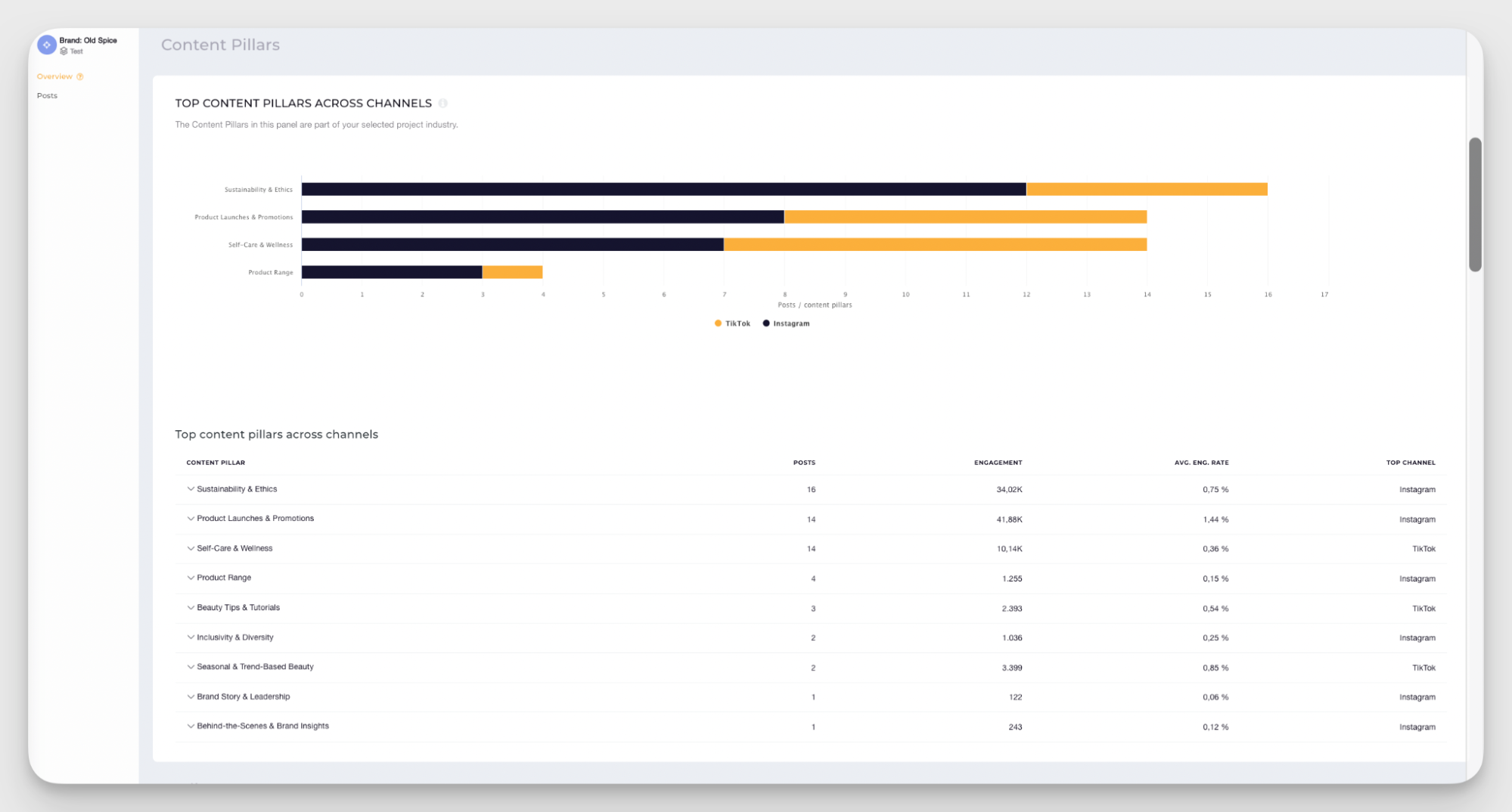
As you can see in the dashboard above, the difference in engagement between content pillars can be striking. Some themes pull significantly more interaction than others, even when the posting frequency is similar, which tells you a lot about where to focus your energy.
This kind of social media audience analysis takes the guesswork out of content planning. Instead of spreading effort evenly across every topic, you can double down on what's already resonating and scale back what isn't connecting.
What content strategies consistently drive audience engagement?
From what I've seen, the content strategies that drive the strongest audience engagement share one thing in common: they give people a reason to react, not just scroll past. Let’s look at some social media best practices to boost your engagement rates.
Storytelling approaches
If you ask me, I'd say storytelling is one of the most reliable content engagement strategies because it triggers an emotional response — and emotional responses drive action. Here's what works in practice:
- Start in the middle. Drop your audience into the most interesting moment first, then fill in the context. "We almost lost our biggest client last year. Here's what happened and what we changed" will outperform a chronological recap every time.
- Use the problem-solution arc. Audiences engage most when they recognize themselves in the problem you're describing. Frame your content around a challenge your audience faces, show the turning point, and land on a concrete takeaway.
- Show the behind-the-scenes. Show how something is made, how a decision was reached, what a day-in-the-life looks like — this outperforms polished promotional content on almost every platform. It feels real, and real is what people share.
- Use a human voice. Whether it's a founder, a team member, or a brand persona, audiences engage more with content that feels like it's coming from a person rather than a company.
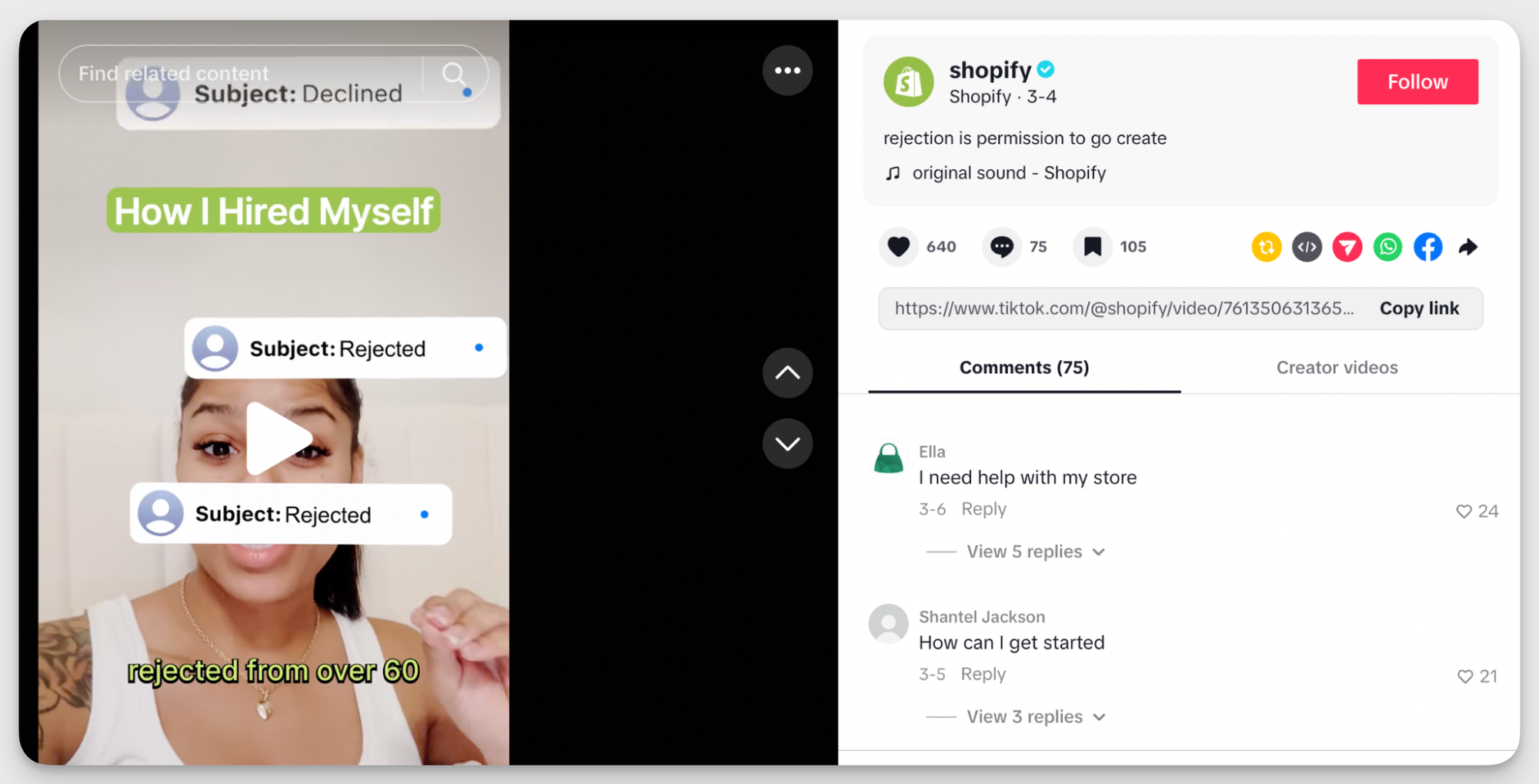
For example, Shopify is doing this well on TikTok, leveraging short stories from entrepreneurs who used the platform to build successful businesses.
Challenges
Challenges work because the audience turns from observer to participant, which is one of the most effective ways to increase audience engagement at scale.
- Make participation low-effort. The most successful challenges have a simple, clear action: recreate this, share your version, answer this question. The lower the barrier, the higher the participation rate.
- Give it a specific hook. A challenge needs a clear identity — a hashtag, a sound, a visual format — so entries feel connected and discoverable.
- Seed it before you launch it. Ask a handful of creators, partners, or loyal community members to post their entries before you officially announce. An empty challenge is hard to join, one with existing entries has social proof built in.
- Respond to entries publicly. Commenting on, reposting, or reacting to participants' content keeps the momentum going and signals to others that joining is worth their time.
- Tie it to something your audience already cares about or to special events. Create challenges that feel like a natural extension of your community's interests or important events, making them meaningful rather than just a marketing exercise.
Spotify’s Wrapped “share your stats” in-app prompt is a great example of offering content to share that feels relevant and tied to seasonality. While not framed as a challenge per se, it acts as one and creates virality every year.
Interactive content
Personally, I see interactive content as one of the most direct ways to keep your audience engaged, because it requires them to do something rather than just consume.
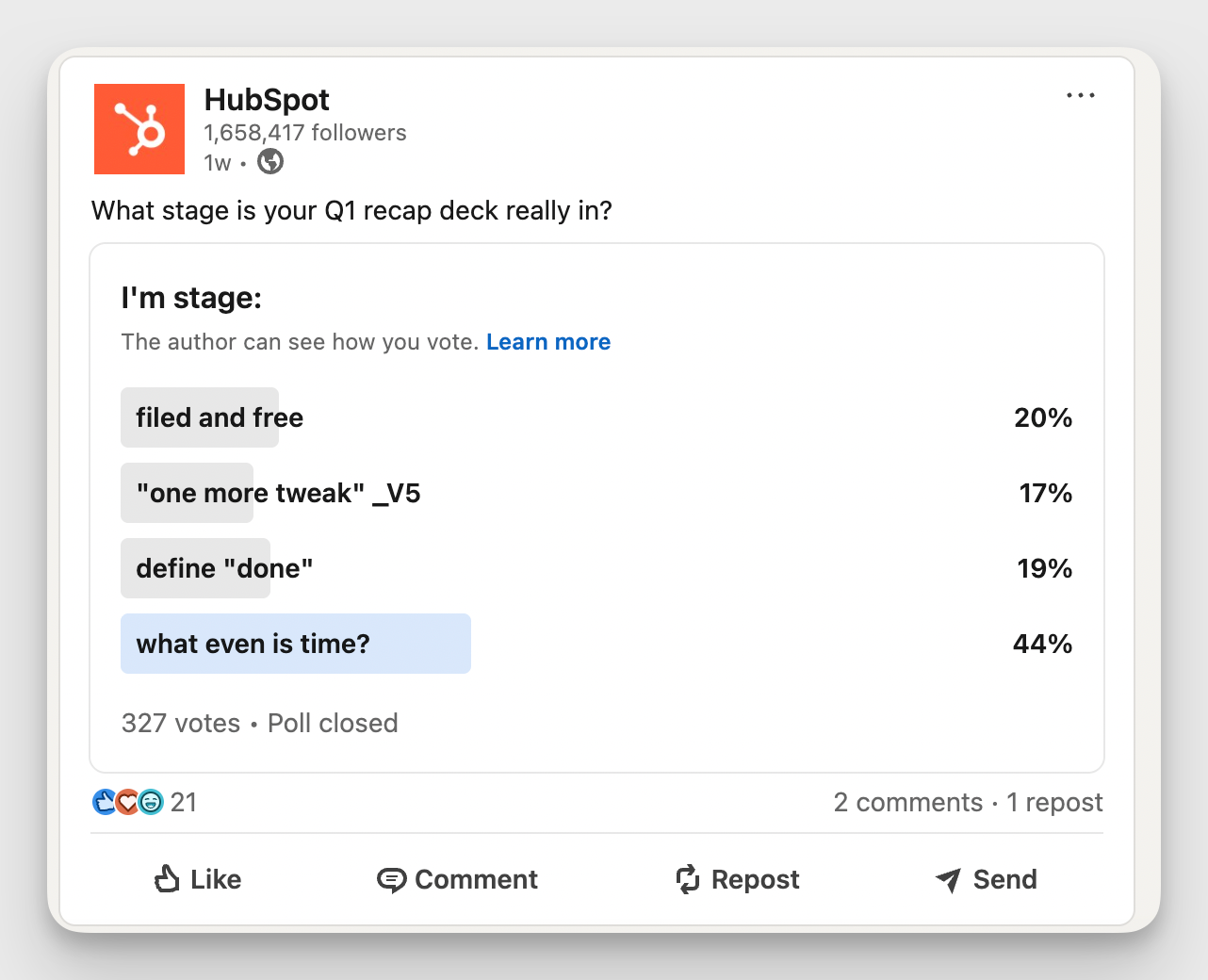
- Polls and question stickers. Simple and consistently effective, especially on Instagram Stories and LinkedIn. Use them to gather opinions, settle debates, or let your audience vote on what content comes next. And don’t forget to make it fun, as HubSpot does in this example below.
- Q&A sessions. Whether it's an Instagram Live, a LinkedIn post, or a pinned comment thread, opening the floor to questions builds a sense of access and dialogue. Schedule these around product launches, industry moments, or topics your audience has been asking about.
- Fill-in-the-blank posts. "The one tool I couldn't do my job without is..." Low effort for the audience, high comment volume for you. Works particularly well on Facebook and LinkedIn.
- Quizzes and tests. Slightly higher production effort, but the payoff in shares and saves is worth it, especially when the quiz result is something people want to show others. Think personality types, scores, or "which category do you fall into" formats.
My tip? Weave interactive content into formats you're already using. Add a poll to a carousel. End a short-form video with a question. Close a LinkedIn article with a fill-in-the-blank prompt. The interaction feels more natural in this way.
Platform-tailored content
The most effective audience engagement strategies are platform-specific. What drives comments and shares on LinkedIn rarely produces the same results on TikTok, and treating every channel the same is one of the most common reasons engagement plateaus.
Here's a quick breakdown of what works on major social media platforms, backed by data:
Instagram engagement best practices
- Carousels remain the highest-engagement Instagram formats by a clear margin — prioritize them in your mix
- Use Stories for interactive content: polls, question stickers, and sliders get consistent responses without requiring your audience to comment publicly
- Broadcast channels are worth exploring for direct, low-friction audience communication
TikTok engagement tactics
- Native, unpolished content is seen as more authentic and favored by TikTok users
- Duets and Stitches are built-in engagement mechanics, and using or encouraging them extends your content's reach organically
- Trend participation works when it's fast and genuine (joining a trend two weeks late rarely pays off)
LinkedIn engagement advice
- Personal voice outperforms brand voice, and posts from individuals tend to reach further than company page posts
- Content that takes a clear position or shares a genuine professional opinion generates far more comments than neutral updates
- Native documents lead in engagement on LinkedIn, consistently outperforming other formats
Facebook engagement winners
- Community-driven content performs best
- Video still drives strong engagement, but status posts and albums are drawing the most engagement according to Socialinsider Facebook data
- Facebook Groups remain one of the few places where organic reach is genuinely strong, making them worth investing in if your audience is active there
X / Threads engagement approaches
- On X, Threads, and similar platforms, opinions and hot takes generate replies
- Threading — posting a connected series of posts — works well for building engagement across a single topic
- These platforms reward consistency and personality over production quality
How to improve audience engagement over time?
Improving audience engagement isn't a one-time-per-year fix. I personally view it as the process of reading your data, spotting patterns, and making deliberate adjustments to social media content. Here are four practical ways to do that.
Identify best-performing formats across platforms and double down on those
The quickest way to improve engagement is to find out what's already working and do more of it. When you look at post types sorted by engagement, the answer is often clearer than expected.
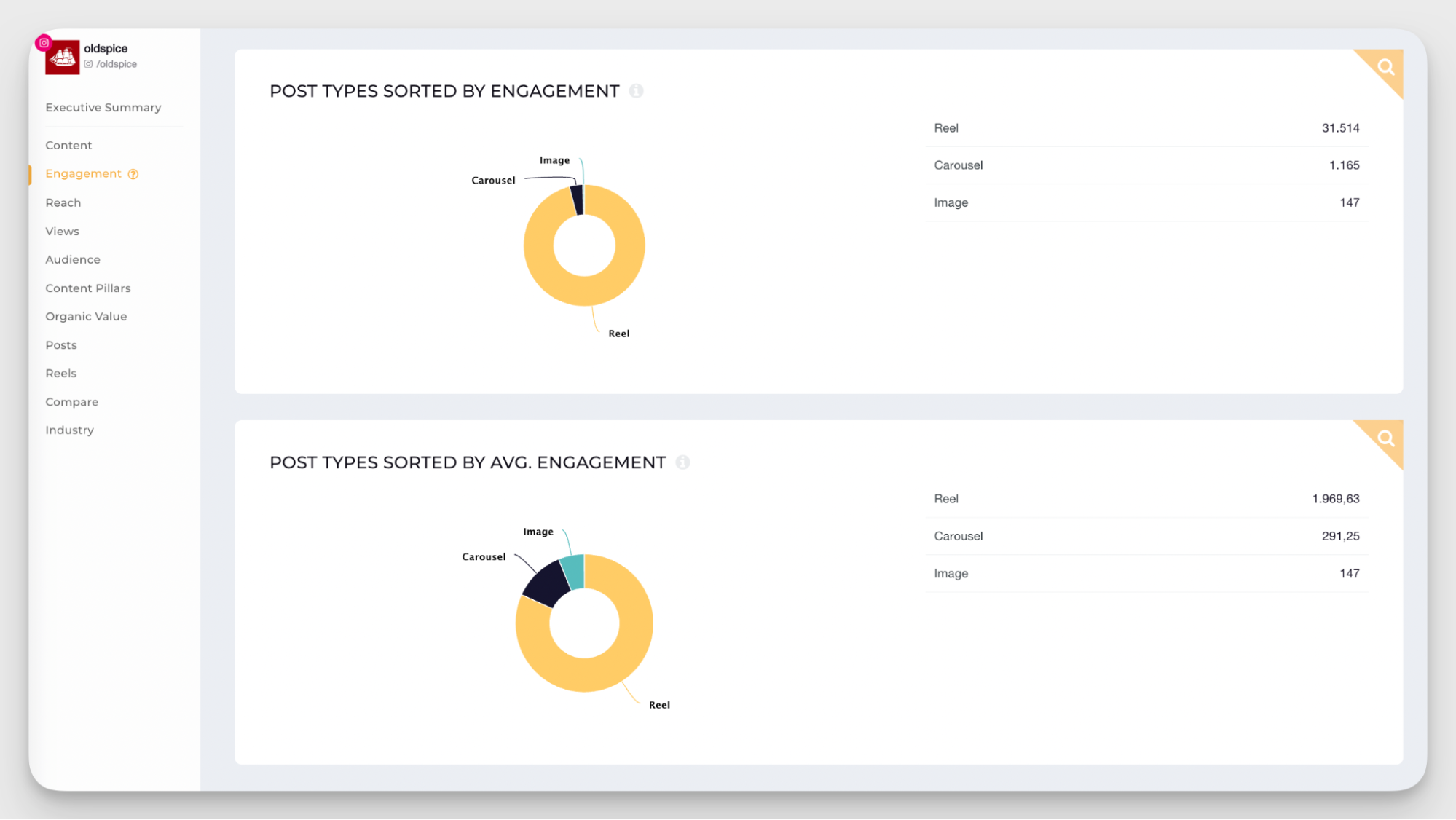
As you can see in the example above, Reels dominate both total and average engagement for Old Spice on Instagram by a significant margin. Carousels hold a secondary position, while static images trail considerably.
This kind of breakdown, available directly in Socialinsider's engagement analytics, tells you exactly where to concentrate your production effort.
Before planning your next content calendar, pull your post type performance data and let it inform your format mix. Not every platform will tell the same story, which is why checking this per channel matters.
Repurpose your most engaging posts
Your best-performing content is a brief for your next steps — treat it like one. Content repurposing means taking a proven concept and giving it new life in a different format or on a different platform.
Here's how to approach it practically:
- Turn a high-engagement carousel into a short-form video. If the information resonated as a slide-by-slide format, it'll often work just as well — or better — as a TikTok or Reel walkthrough.
- Expand a top-performing caption into a long-form post. A comment-heavy Instagram post is a strong signal that people have opinions on the topic. Take it to LinkedIn and open it up as a broader conversation.
- Repost evergreen content with a fresh angle. A post that performed well six months ago can be revisited with updated context, a new stat, or a different creative treatment without starting from scratch.
- Break down a high-performing long post into smaller pieces. One strong LinkedIn article or newsletter section can become three or four standalone social posts without losing impact.
The goal is to extend the reach of ideas that have already proven their value, rather than constantly chasing new ones.
Spot engagement gaps: content pillars your competitors outperform you on
One of the most practical audience engagement strategies is to look at where your competitors are winning on topics you're already covering and ask whether you're approaching those topics effectively.
For example, the Socialinsider dashboard below shows a competitor content pillar comparison between Axe and Old Spice.
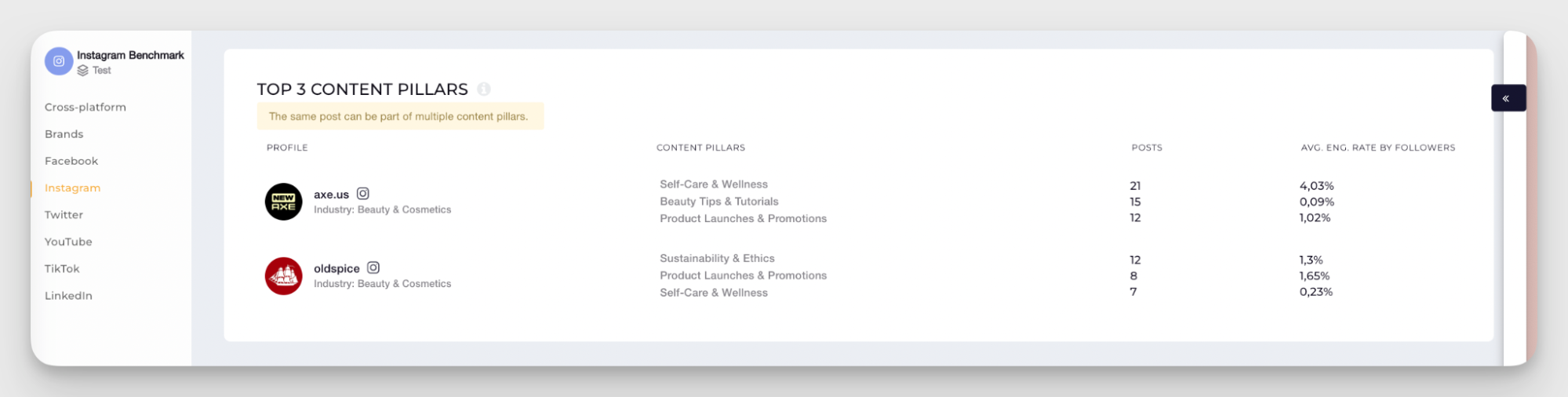
Now, let me zoom in on the Sustainability & Ethics content theme analysis: Old Spice is generating a noticeably stronger average engagement rate through posts in this pillar compared to Axe's Beauty Tips & Tutorials content, for example, which underperforms by comparison. For a brand like Axe, this is a meaningful insight: the audience in this space responds more to values-driven content than to tutorial-style posts. The takeaway can be to reallocate some of the effort toward Sustainability content.
This is the kind of competitive insight that's hard to spot without side-by-side data. Tools like Socialinsider's competitor analysis clearly reveal these gaps, so you're not guessing where the opportunity lies.
Reverse-engineer competitors' top-performing content for your own strategy
Understanding what works for your competitors is a legitimate and practical input into your own content engagement strategies. The goal isn't to copy, but to understand what themes, formats, and angles your shared audience is already responding to.
Continuing with the Axe and Old Spice example: looking at Old Spice's top-performing posts, as shown in the dashboard below, we see a clear pattern. Their highest-engagement content leans into cultural moments, partnerships, and bold brand personality, not product features. These posts connect to events and references that their audience is already paying attention to, then naturally pull the brand into that conversation.
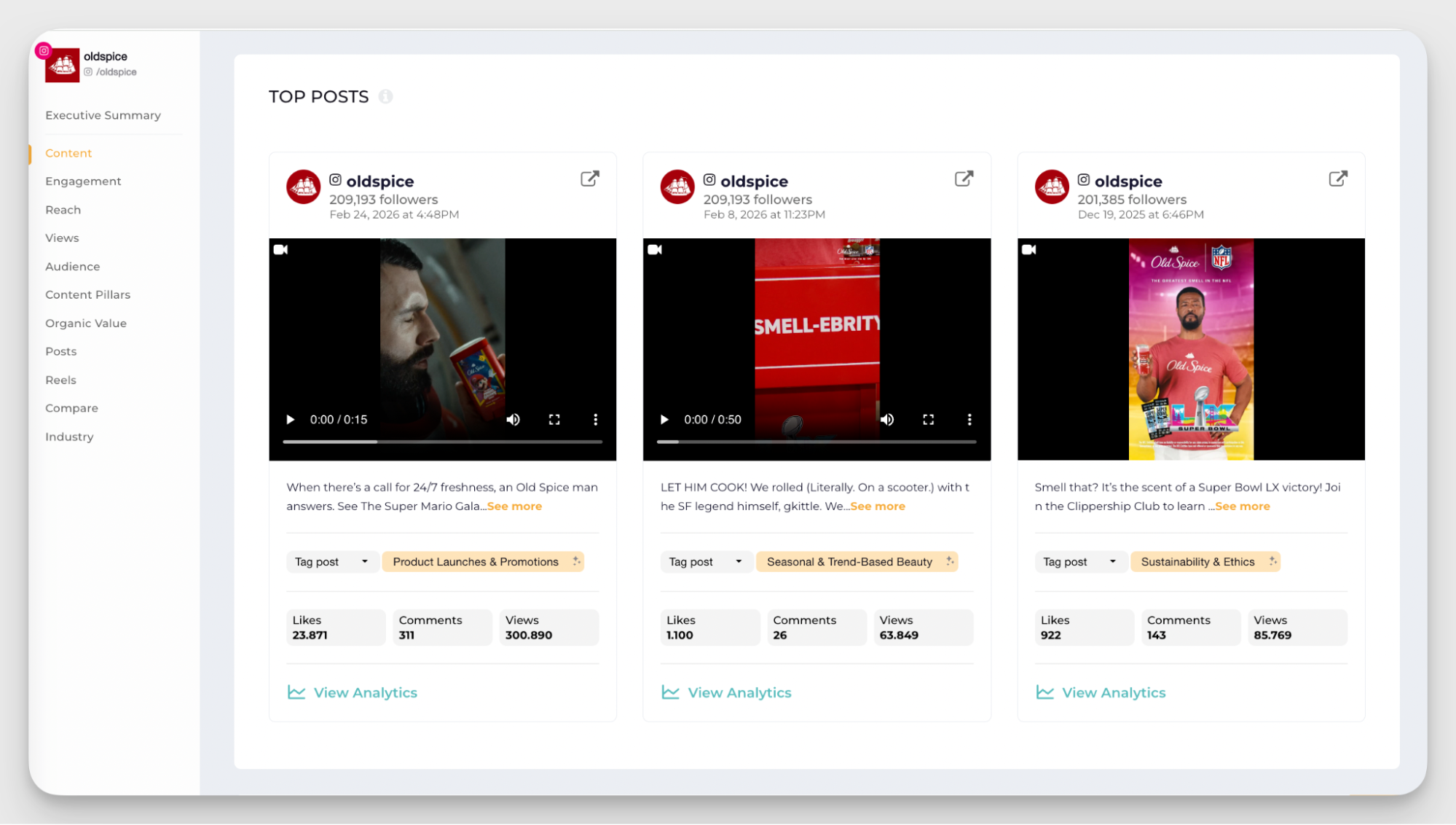
For Axe, this is useful intelligence. It's not about replicating Old Spice's creative approach, but about recognizing that their shared audience responds to content with cultural relevance and personality — and factoring that into how Axe frames its own posts.
When you're doing this kind of content competitor analysis, look for patterns across top posts rather than individual wins. One viral post can be circumstantial. Three or four top performers with a common thread is a direction worth acting in.
Final thoughts
Building an engaged audience on social media takes more than gut feeling. You must pay attention to platform and industry benchmarks, constantly analyze content performance, separate fads from lasting trends, and be willing to test and adjust.
If that sounds like a lot of work, it is. But the right tools can make social media managers' jobs easier and more effective. If you want to stop guessing and start making decisions backed by real insights, try Socialinsider for free and see what you can learn from advanced engagement and competitor data.

Sabina Varga
Sabina Varga is a B2B content strategist with 15 years in digital marketing, helping brands turn social media data into stories that connect and strategies that grow.

Know what your competitors do — before your manager asks
Get instant social benchmarks & reports without manual work.