How To Master TikTok Audience Insights to Optimize Your Strategy
Learn how to unlock the power of TikTok audience insights. Analyze user behavior and demographics, and tailor your content to boost your brand.


Strong TikTok performance starts with audience precision.
When you move beyond broad targeting and surface-level assumptions, you begin to see what truly drives engagement, clicks, and conversions.
TikTok audience insights give you that clarity — helping you refine who you’re reaching and why it matters.
If your current targeting feels wider than it should be, this guide will help you tighten your strategy and make every decision more deliberate.
Key takeaways
What data does TikTok audience insights cover? TikTok audience insights reveal who your audience is (age, gender, location), how they engage with your content, and how their behavior evolves over time—helping you connect performance data to real audience patterns rather than isolated metrics.
How can a third-party TikTok analytics tool help you gain more in-depth audience insights? A third-party TikTok analytics tool uncovers deeper performance patterns—like recurring content themes and narrative trends—transforming raw data into strategic direction for smarter creative decisions and scalable growth.
What is TikTok’s main demographic?
One of the biggest mindset shifts I’ve seen among marketers lately is realizing that TikTok’s audience isn’t as narrow as it used to be.
When you actually look at the latest audience insights report from DataReportal, a clearer picture starts to form.
The platform’s strongest concentration of users sits in the 25–34 age range, with male users reaching 20.7% and female users 14.6%.
The 18–24 bracket is still highly active at 16.6% (male) and 14.1% (female), but it’s no longer the only group shaping trends or driving performance.
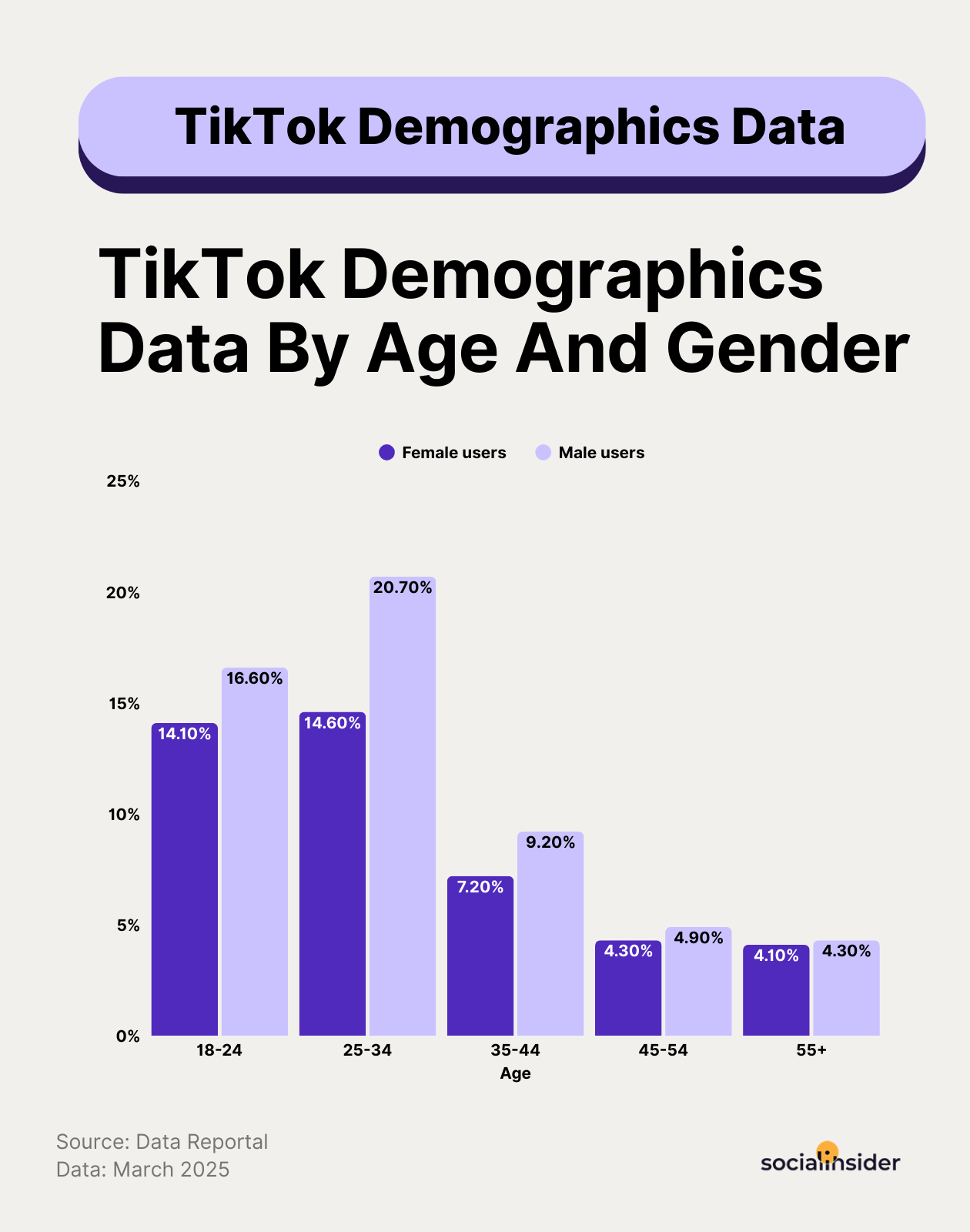
But what I find particularly interesting is how steady the presence remains across older demographics.
The 35–44 segment continues to engage consistently, while 45–54 and even 55+ audiences show meaningful participation.
This shifts TikTok away from the “young-only” narrative and toward something much more valuable for marketers: a platform where different age groups engage with social media content in very different (and often highly intentional) ways.
So instead of building your social media target audience for TikTok around assumptions, you can start aligning your creative and targeting with how each demographic actually behaves on the platform.
And that’s usually where performance starts to change.
What does TikTok audience insights stand for?
TikTok audience insights combine behavioral signals, engagement patterns, TikTok demographics, and evolving consumer behavior to show how people really move through content on the platform.
When you look closely at these insights, you start to understand discovery patterns.
What people choose to watch, how long they stay, and which creative elements trigger interaction all become visible through data.
This is where social media analysis shifts from reporting into social media strategy.
Knowing where to access these insights, and how each data environment works, is crucial if you want to refine your TikTok target audience with intention rather than guesswork.
Essentially, most teams rely on two main environments: TikTok Ads Manager and TikTok Analytics inside the business account.
TikTok Ads Manager
TikTok Ads Manager gives you a broader perspective on platform audiences beyond the users already interacting with your profile.
To explore these insights:
- Log into TikTok Ads Manager
- Open the reporting or audience tools within the dashboard
- Apply filters such as location, industry, or audience attributes
- Review breakdowns like age distribution, gender split, interests, and device usage
Basically, the focus in Ads Manager sits on audience distribution rather than individual content performance.
You get a clearer view of how different groups exist on the platform, how large those segments are, and how behaviors vary across regions or categories.
This broader view helps teams validate targeting assumptions early, which plays a key role in social media optimization by guiding decisions before content or campaigns go live.
Through TikTok Analytics
TikTok Analytics, on the other hand, moves closer to your own ecosystem.
Instead of platform-wide trends, the data reflects the people already engaging with your videos and following your account.
Accessible directly from your business profile, this space gives you a detailed look at how your audience evolves over time.
You can track when followers are most active, where they are located, and how specific demographics respond to different content formats.
Inside TikTok Analytics, you will typically find:
- Follower growth trends and activity patterns
- Audience breakdowns by age, gender, and location
- Peak activity times
- Performance insights connected to individual posts
Looking at Ads Manager and Analytics together gives you two layers of understanding.
One shows how audiences behave across the platform, the other shows how your existing viewers respond to your content.
Combining both perspectives supports stronger social media analytics workflows and more precise optimization decisions.
What data does TikTok audience insights cover?
After exploring where to access audience insights, the next step is understanding how this data supports your social media market research.
The platform surfaces key TikTok metrics that show who your audience is, how they interact with your content, and how their behavior shifts over time.
When you look at these signals together, performance starts to tell a clearer story about audience preferences, not just views or engagement numbers.
Age and gender distribution analysis
Age and gender breakdowns give a quick snapshot of who your content currently resonates with. These numbers help you understand whether your audience composition stays consistent or gradually shifts as your content direction changes.
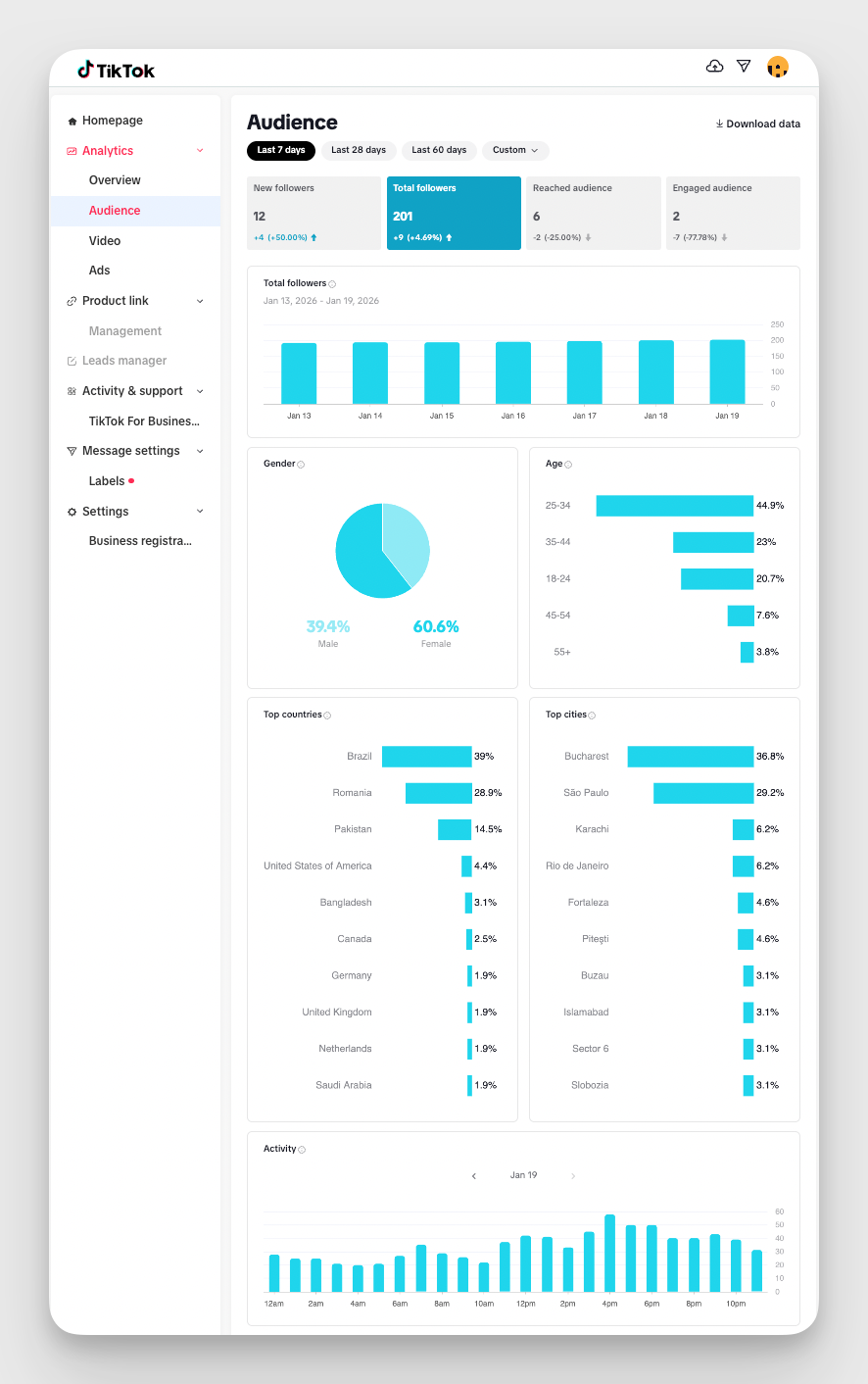
A growing presence from a specific age group might indicate that a new format or topic is attracting attention, while a balanced split can suggest broader appeal across different viewer segments.
If you ask me, I'd say that, used over time, demographic data becomes less about labeling audiences and more about spotting patterns that influence future creative decisions.
Geographic location data and its advertising implications
TikTok highlights top countries and cities, giving you visibility into how your reach spreads across different regions. Sometimes in ways you might not expect.
Here's an approach presented by Irina Makhnach, social media manager at Henkel:
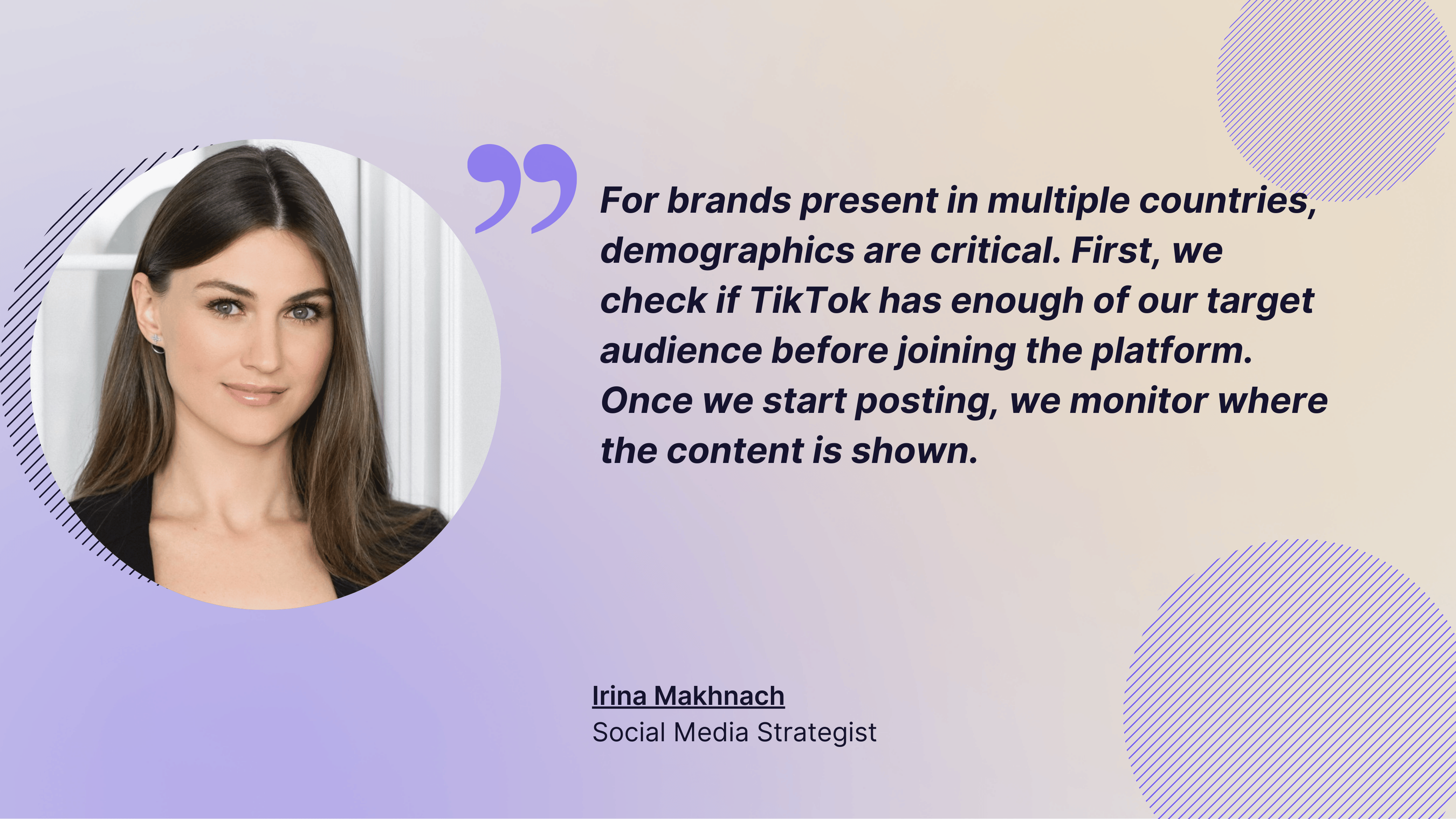
For brands present in multiple countries, demographics are critical. First, we check if TikTok has enough of our target audience before joining the platform. Once we start posting, we monitor where the content is shown. TikTok is a great platform for capturing customers’ attention organically, but a video can go viral in the wrong region, inflating engagement without driving business results. In such cases, it’s more effective to allocate the budget to target the right audience directly.
Her perspective highlights a common challenge behind social media data collection: visibility doesn’t always align with business goals.
Understanding geographic distribution helps clarify whether engagement reflects genuine audience relevance or simply algorithmic reach.
She also shares how often her team reviews performance:
Since we don’t post daily on TikTok, it’s enough to review performance after each post, then analyze the data monthly and adjust the strategy as needed. This gives us enough information to see what worked, what didn’t, and how to improve the next batch of content.
Together, demographic and location data give a clearer view of how audiences interact with your content, helping you interpret reach in a more meaningful way.
How can a third-party TikTok analytics tool help you gain more in-depth audience insights?
At some point, TikTok analytics stops being about checking performance and starts influencing how you think about content.
Native social media dashboards already show reach, audience split, and TikTok engagement trends, but they rarely reveal how individual videos connect to a bigger narrative or why certain ideas keep resurfacing across top-performing posts.
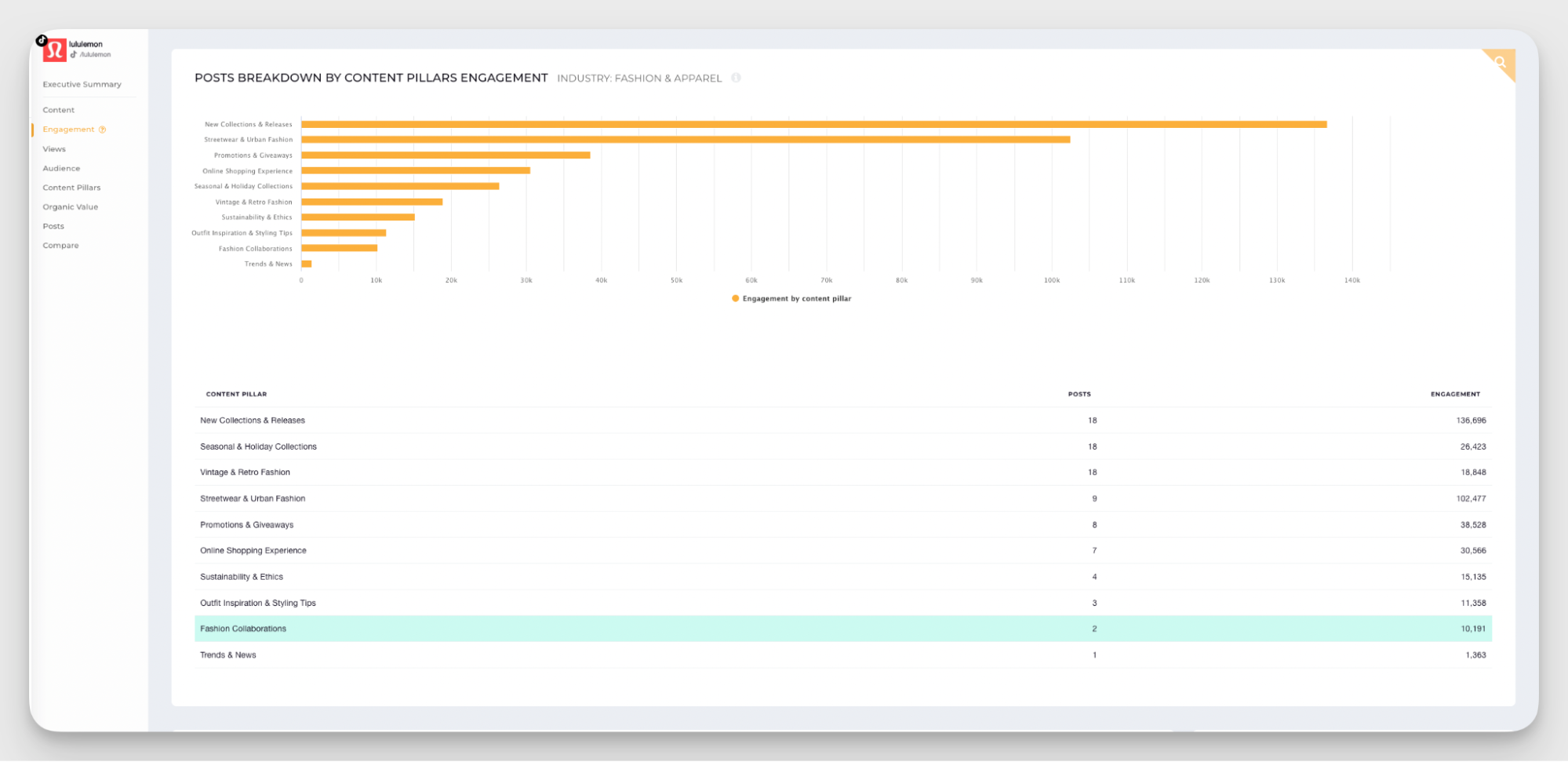
When I work inside Socialinsider, the biggest shift comes from looking at performance through social media content pillars instead of isolated videos.
Seeing posts grouped visually changes how I read the data. Patterns appear faster.
For instance, certain themes show up repeatedly in Lululemon’s strongest content, while others only spike once and disappear.
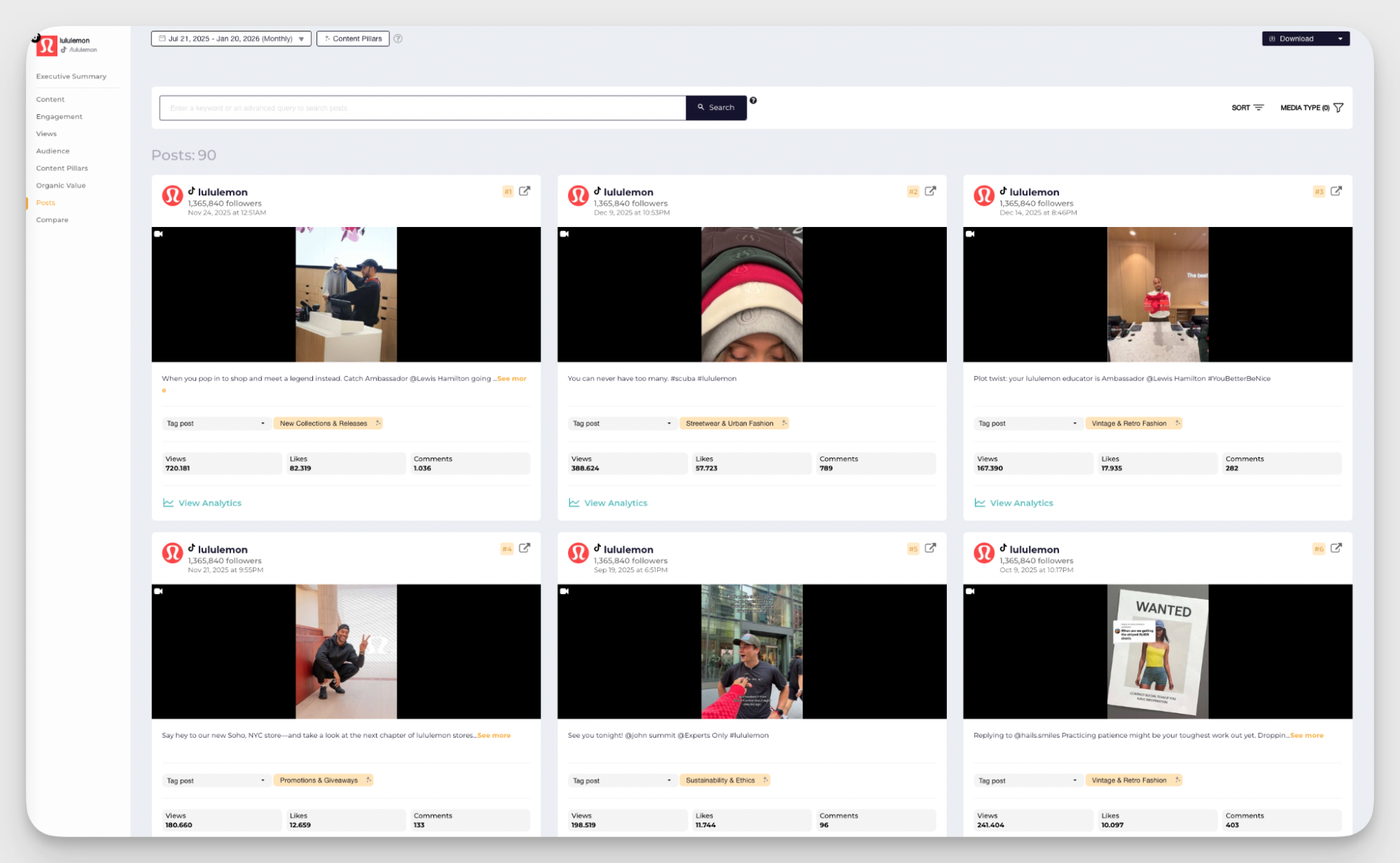
So now, instead of asking whether a single post performed well, the question becomes which narratives consistently attract attention and what that says about audience behavior.
That perspective naturally feeds into creative direction.
Once engagement is viewed at a thematic level, it becomes easier to understand which storytelling angles audiences return to and which ones need refinement.
Below, Irina describes a process that reflects this mindset:
On TikTok, we usually work in reverse: rather than building a community, we search for an audience for our topics. The process is: define marketing goals → create platform-native content → analyze results → select top-performing ideas → adjust and repeat
Seen this way, analytics becomes less about reporting past performance and more about narrowing creative focus.
Themes that repeatedly gather interaction start guiding decisions around messaging, positioning, and future campaign concepts, because they represent observable audience interest.
The shift continues during execution.
Instead of chasing new ideas every cycle, the team can build on patterns that already show momentum: testing variations, refining hooks, and expanding successful formats across platforms.
As Irina explains:
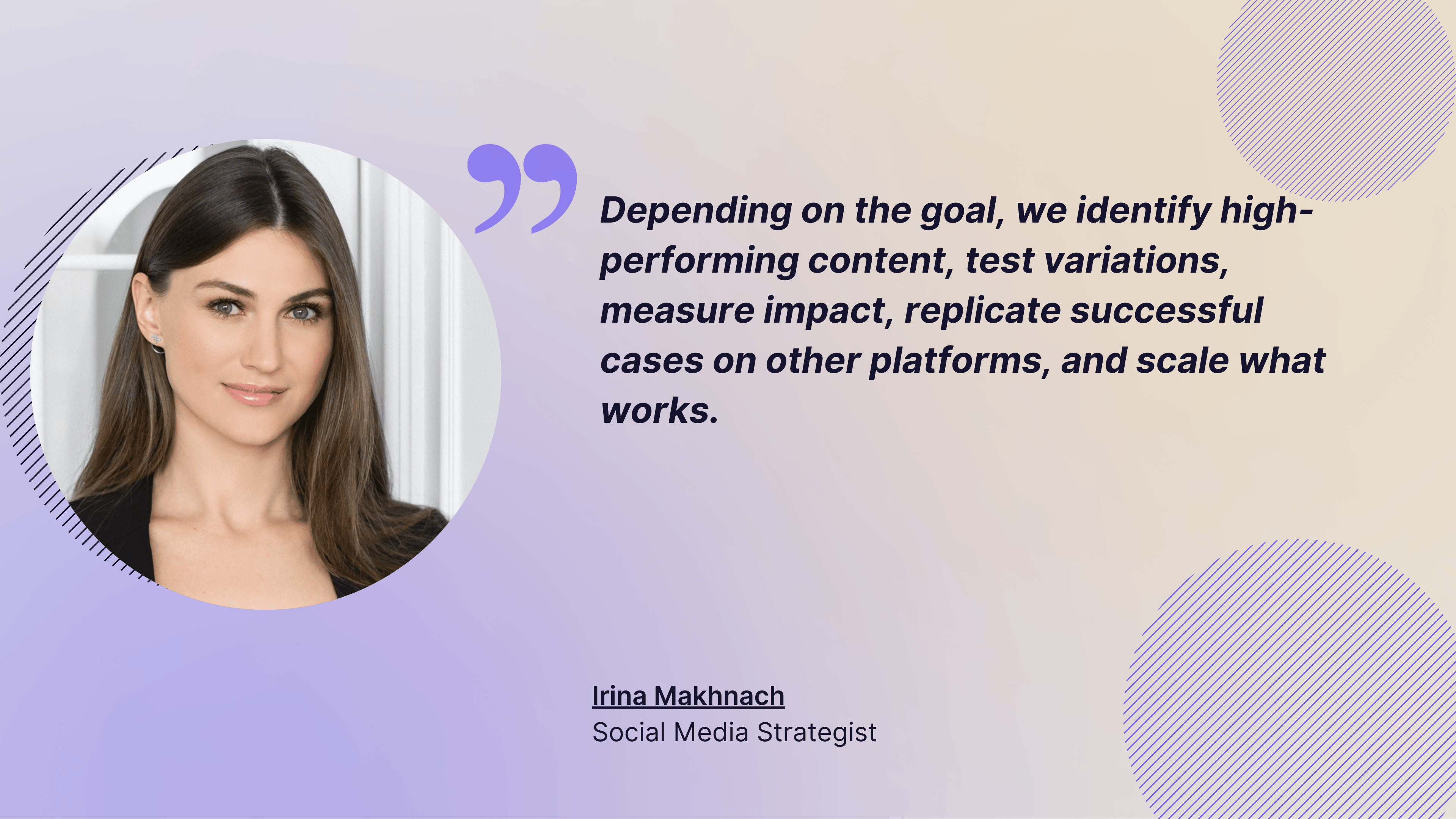
Depending on the goal, we identify high-performing content, test variations, measure impact, replicate successful cases on other platforms, and scale what works.
Working this way turns analytics into a steady feedback loop.
Insights flow directly into experimentation, experimentation reveals new patterns, and over time, the social media content strategy evolves around themes that audiences consistently engage with.
For teams already comfortable with TikTok data, a third-party audience insights tool changes how creative decisions take shape from one campaign to the next.
Final thoughts
If there’s one thing I’ve learned, it’s that stronger TikTok performance rarely comes from doing more. It comes from understanding your audience a little deeper each time you analyze your data.
Audience insights help you see which ideas deserve more investment, which signals to trust, and where your targeting can become sharper without increasing spend. The more intentionally you use behavioral data, the easier it becomes to build campaigns that actually connect.
So take a moment to review your latest insights, look beyond surface-level audience analytics, and start shaping your next TikTok strategy around what your audience is already telling you.
Anda Radulescu
Content writer & copywriter with a 5-year track record in digital marketing. Equal parts keen observer & committed go-getter. A proud cat mom with a passion for music & exploring the world.

Analyze your competitors in seconds
Track & analyze your competitors and get top social media metrics and more!
You might also like



Improve your social media strategy with Socialinsider!
Use in-depth data to measure your social accounts’ performance, analyze competitors, and gain insights to improve your strategy.