Instagram Growth Strategy: How to Build One That Actually Works
A data-led Instagram growth strategy guide — covering Trial Reels, and UGC campaigns, with follower growth and engagement benchmarks
Most Instagram growth strategies focus on posting more, chasing trends, or “beating the algorithm”. But that’s not what consistently growing accounts actually do.
In this guide, I’ll show you how Instagram marketing really works today, and break down an Instagram growth strategy often used behind the scenes by bigger accounts.
It’s simpler than it looks. And once you see it, you’ll understand what’s been missing from your approach.
Key takeaways
- What are the layers of effective growth on Instagram? Instagram growth becomes predictable only when you understand how engagement drives reach, and reach—consistently—translates into followers.
- Top strategies for driving discovery and growth on Instagram: The most effective Instagram strategies don’t chase volume, but deliberately increase content discoverability and early engagement signals that fuel distribution.
- How to leverage data to discover growth opportunities? Growth opportunities emerge when you move beyond surface metrics and use data to identify patterns, outliers, and gaps in both your content and your competitive landscape.
The Instagram growth diagnosis framework
Use this framework to identify where your growth strategy is breaking down before making changes.
Instead of trying every Instagram growth tactic at once, identify which layer is underperforming first. The right solution depends on where your growth is stalling.
What are the layers of effective growth on Instagram?
It’s easy to think of growth as just gaining followers. But in reality, that’s only the visible outcome of a deeper process.
What really drives results in Instagram marketing are a few core layers of social media metrics working together: how many people view your content, how they respond to it, and whether that attention turns into audience.
I’ve seen a lot of strategies focus on doing more: more posts, more formats, more consistency. But without understanding how these layers connect, it’s easy to focus on the wrong thing. Or expect results from the wrong place.
That’s where social media benchmarks become useful.
They give you a reference point so you can tell whether your follower growth, reach, or Instagram engagement are underperforming, or simply reflecting broader trends.
Data from sources such as Socialinsider shows that growth patterns have shifted, and expectations need to shift with them.
Once you look at growth this way, it becomes much easier to break it down into the three layers that actually drive it: followers, reach, and engagement.
Followers
Yes, follower growth is the easiest number to look at.
But it’s also the easiest one to misread.
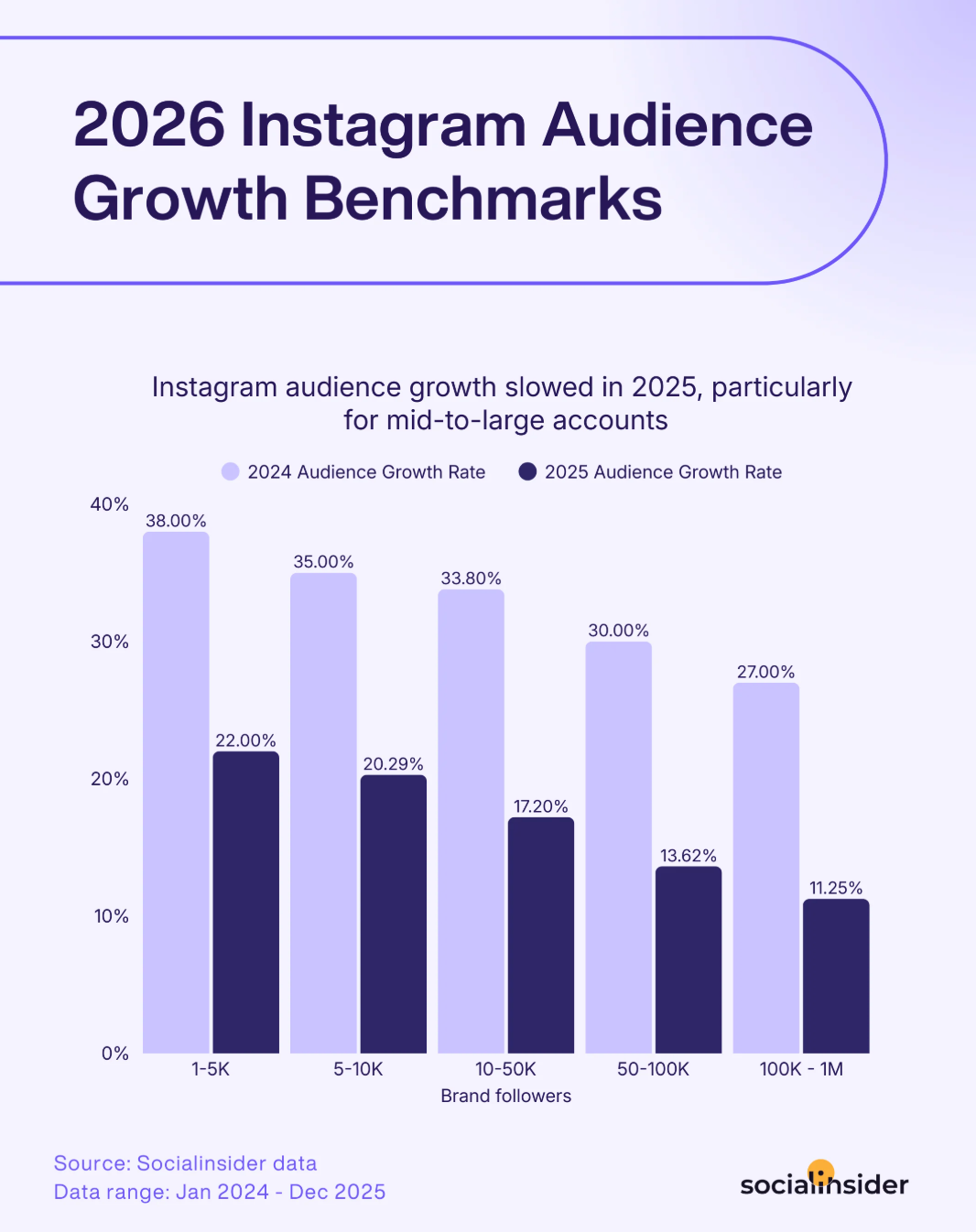
Looking at recent social media benchmarks from Socialinsider, you can see how much follower growth has slowed, especially as accounts scale. That shift changes how you interpret progress.
What used to feel like underperformance is often just the new baseline.
And because of that, follower growth on its own doesn’t say much anymore. It only starts to make sense when you look at what’s happening before it.
Reach
Reach tends to be where things either open up or stay constrained.
It’s less about total views gained and more about whether your content consistently moves beyond your existing audience.
When that expansion happens regularly, growth feels steady. When it doesn’t, everything naturally becomes unpredictable.
There’s also a noticeable difference between content that occasionally spikes and content that distributes reliably. That consistency is usually what separates accounts that scale from those that stall.
Engagement
Engagement is the layer that either unlocks growth. Or caps it.
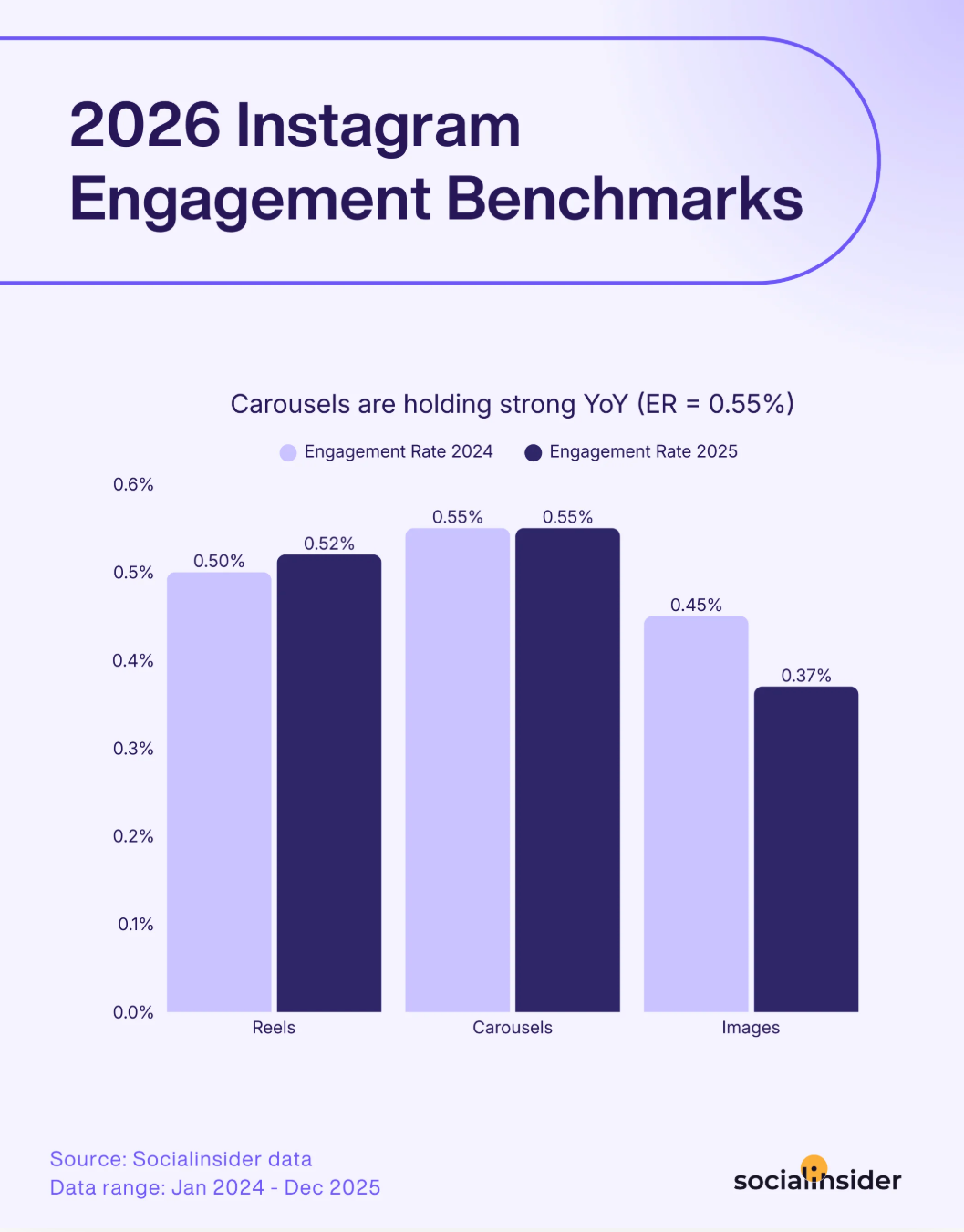
If you look at social media engagement patterns, especially across formats, it’s clear that some content types simply hold attention better than others.
While carousels are holding their engagement, other formats are less consistent.
This tells you how attention is being distributed. Formats that encourage interaction (scrolling, saving, revisiting) tend to sustain Instagram engagement better over time.
And that has a direct impact on reach. Content that keeps people engaged longer sends stronger signals, which makes it more likely to be pushed further.
So at this layer, it’s all about what kind of engagement your content is designed to generate.
Top strategies for driving discovery and growth on Instagram
At this point, you’ve probably seen enough Instagram growth tips to know they don’t all move the needle the same way.
What I want to do here is walk you through a handful that actually hold up, grounded in solid social media best practices according to Adriana Castillo, social media manager, and that are easy to plug into your overall social media strategy.
So let’s go:
#1. Implement Instagram SEO
I’d say Instagram SEO is probably one of the most underused Instagram growth methods right now.
A lot of content doesn’t underperform because it’s bad. It just isn’t discoverable.
And with how search-driven Instagram has become, that’s a big gap. The platform needs context to understand what your content is about, who it’s for, and where it should surface.
That’s where social media optimization starts to look a bit different than it used to.
Stop thinking only in terms of captions as “supporting text.” It helps to think about how someone might actually search for what you’re posting. The clearer that connection is, the easier it becomes for your content to show up beyond your existing audience.
Here’s a good example of how this plays out in practice—how small, intentional shifts in wording can translate into steady, organic social media growth over time:
As I’m currently supporting the page of this Mexican restaurant based in Ottawa (@ayweyottawa) in the last 3 months we have grown the account from 2K to almost 5K organically.
And that’s because I always think about what people might search and naturally include: location, what the post is about (like tacos, coffee, skincare, etc.).the brand name ,action words like “visit,” “try,” “best,” etc. It helps your content show up way beyond your followers. — Adriana Castillo
#2. Initiate collaborative posts
Part of your Instagram growth plan should include collaboration.
Collab posts are simple: you publish one piece of content with another account, and it shows up on both profiles. And if there’s overlap in interests, that usually leads to stronger early engagement, which is what pushes content further.
A good example of this is the collaboration between 818 Tequila and Cash App:
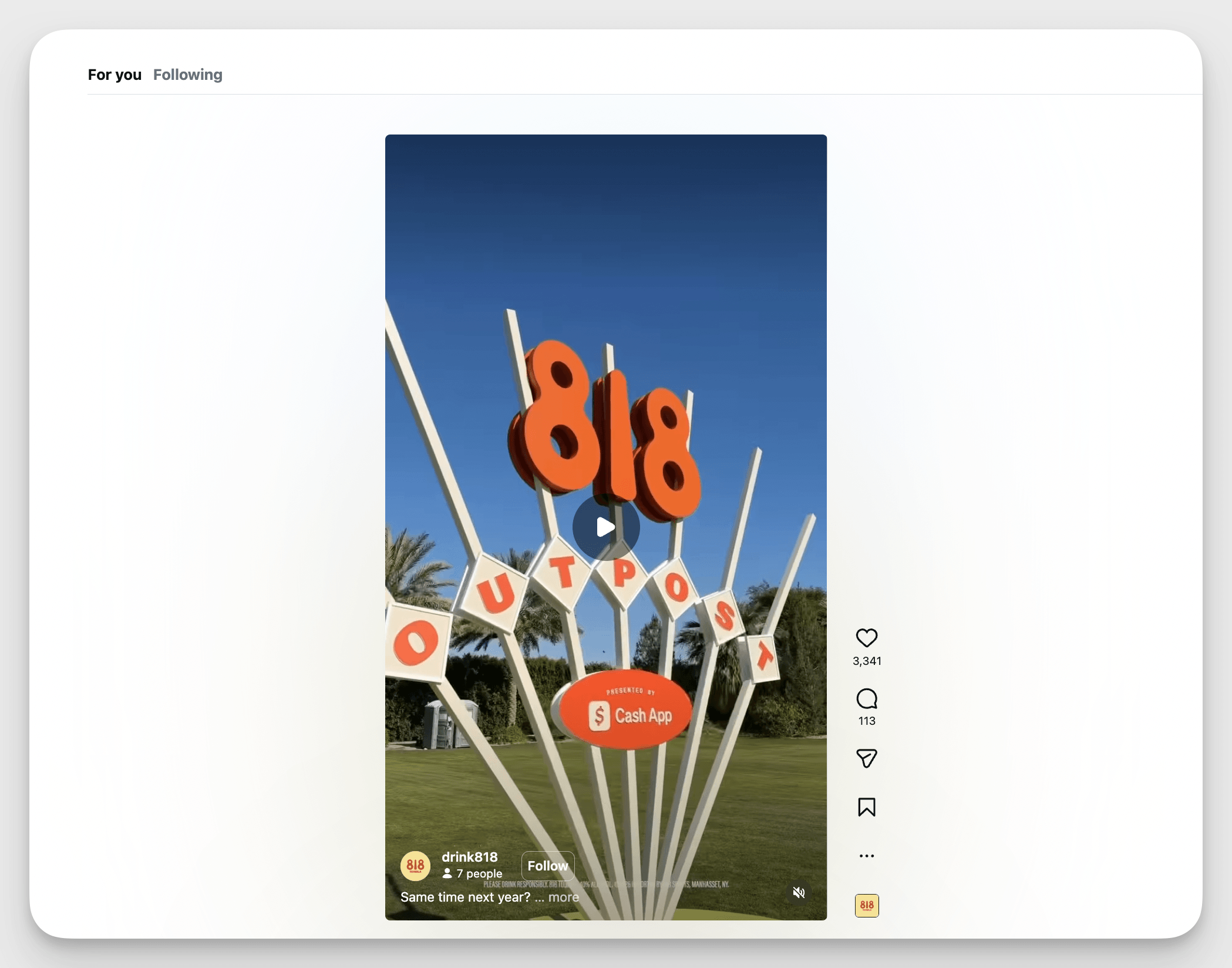
If you look at this Reel, it doesn’t feel like a typical brand post. It captures a moment: people interacting, energy, atmosphere. Both brands are present, but they’re embedded into the experience rather than being the focus.
From a marketing perspective, that’s what makes it effective.
You’re fitting into the feed instead of interrupting it.
And because the content feels relevant to both audiences, it tends to generate more meaningful engagement early on. That initial traction is what helps the post reach beyond both follower bases.
There’s also a positioning effect here. When two brands show up together in a natural way, they transfer context and credibility between each other.
This way, you’re shaping how new audiences perceive you easier.
#3. Test Instagram Trial Reels
Growing your Instagram followers often comes down to recognizing which ideas have real traction early on.
That’s where Trial Reels start to make a difference.
They give you space to experiment more deliberately, putting your social media content out in a limited way, reading the initial response, and then deciding whether it’s worth expanding its reach.
Over time, this approach gives you a clearer read on what actually resonates with your audience and beyond.
How to share a Trial Reel
The setup itself is simple. You just need to know where to look:
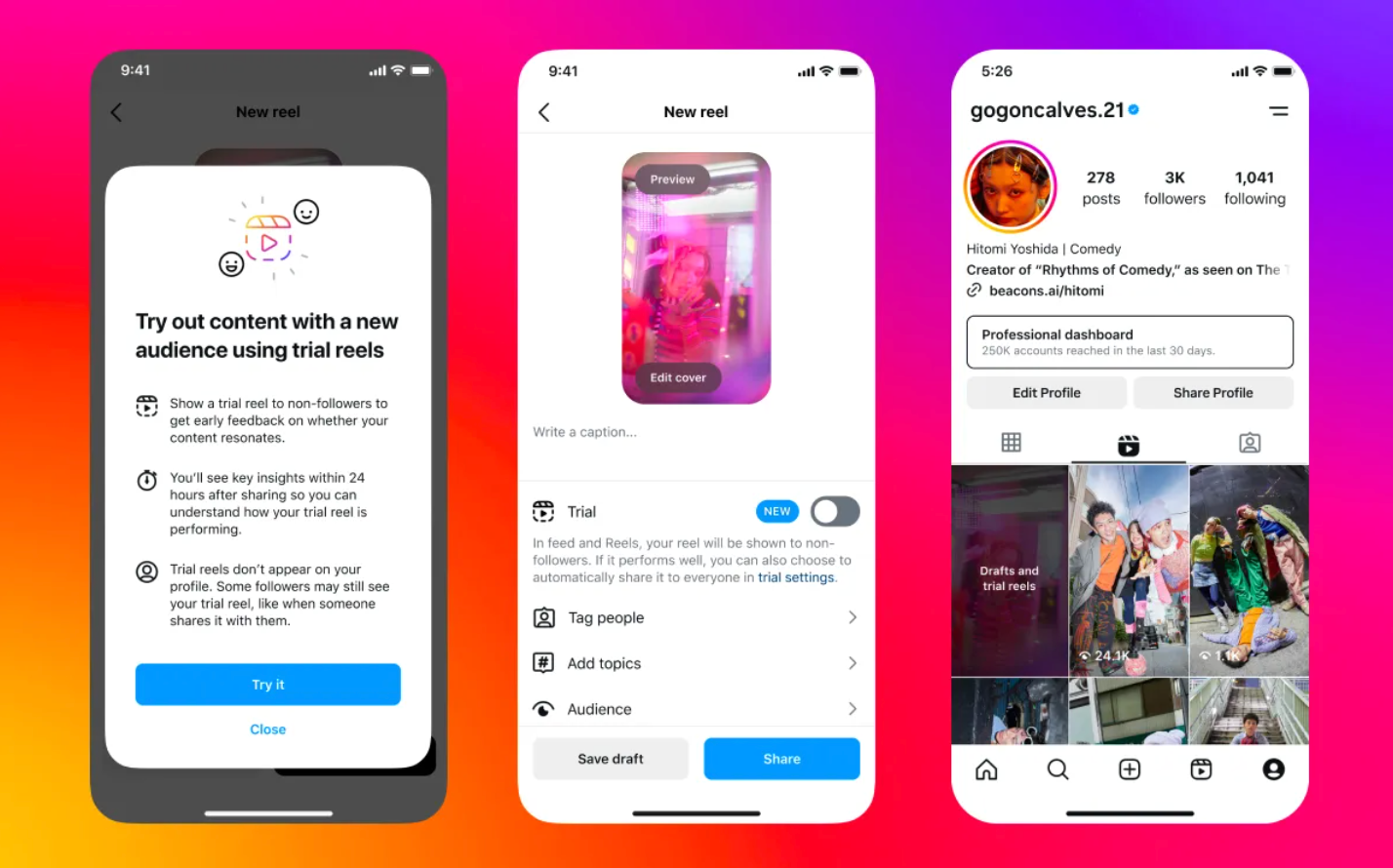
- Create a Reel as you normally would
- Before posting, toggle “Trial” on
- Publish it, and it will appear on your profile (visible only to you)
From there, it works a bit differently than a regular post:
- It won’t show up in your followers’ feed or on your profile publicly
- It can still get some visibility in places like DMs or shared contexts
- After ~24 hours, you’ll get performance insights
- If it performs well, you can manually “share with everyone” or let Instagram auto-push it based on early traction
The advantage here is pretty straightforward: you’re separating testing from scaling.
So instead of committing every idea to full distribution, you’re validating it first, then pushing the ones that are more likely to contribute to your Instagram growth.
#4. Launch UGC campaigns
Sometimes (ok, maybe most times), growth stops being tied to how much you post and starts being tied to how many people post about you.
What makes UGC campaigns particularly effective is the way they increase distribution.
Content coming from multiple accounts—especially smaller creators—tends to travel differently. It feels more native, gets stronger engagement signals, and often reaches audiences the brand wouldn’t access on its own.
A good example of how this looks in practice is how NYX Professional Makeup leveraged UGC for the launch of their Wonder Snatch Concealert.
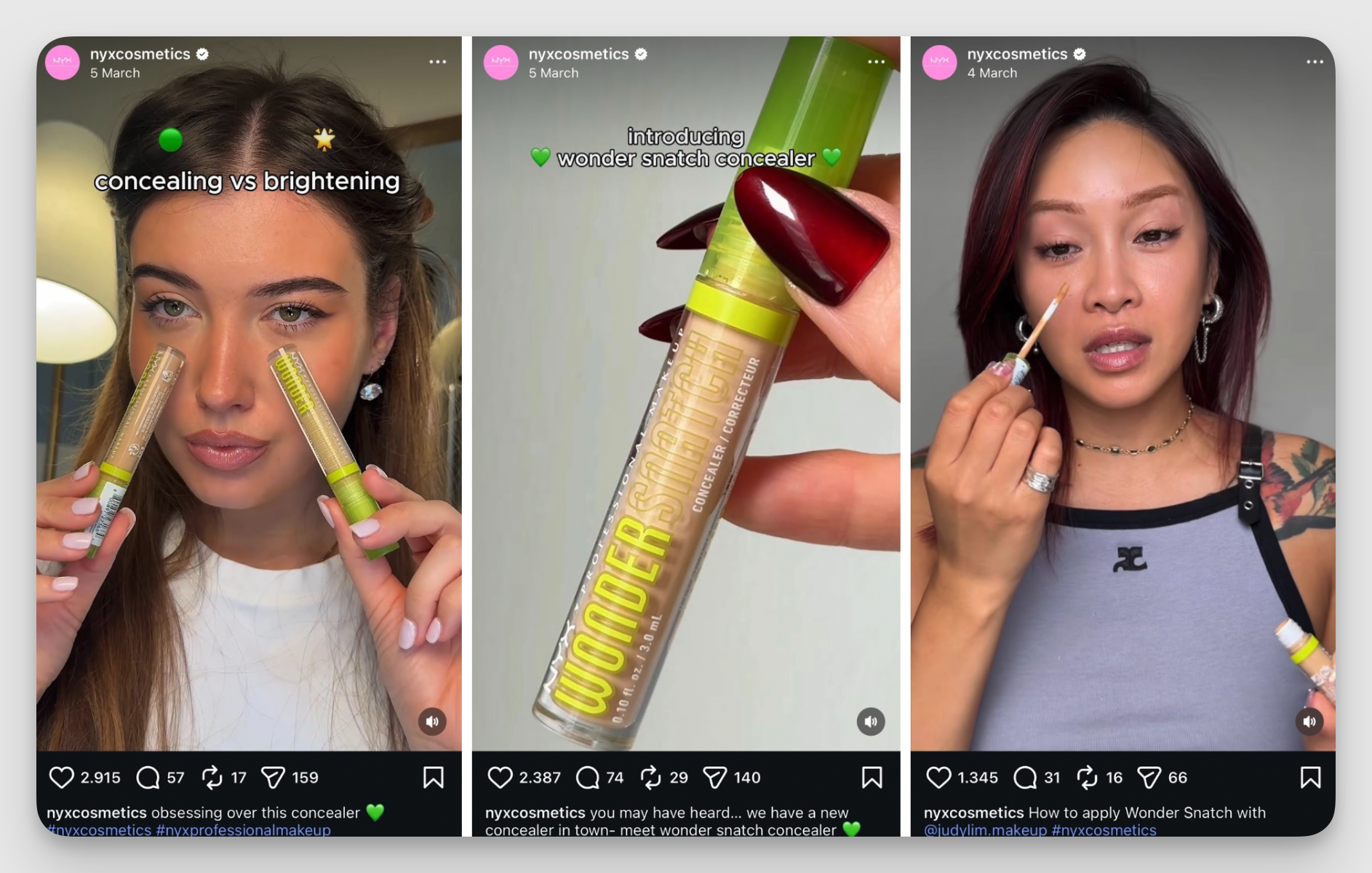
And if you go through the content, you’ll notice it doesn’t rely on a single angle. Instead, the same product shows up across:
- tutorials
- comparisons
- creator-led demos
There’s enough variation to keep it interesting, but enough consistency that the product becomes instantly recognizable.
People see the product multiple times, in different contexts, from different creators. And that tends to build both familiarity and trust much faster.
From a strategic point of view, UGC campaigns help:
- expand reach beyond your own audience
- generate stronger engagement signals (especially saves and shares)
- create multiple entry points into the same product or message
What I usually pay attention to is how easily that content can be picked up and recreated. If the format is clear and the idea is simple enough to adapt, it tends to scale on its own.
And once it does, growth becomes less dependent on your own posting cadence.
Additionally, Adriana adds:
Reply fast and actually care. Answer your comments, reply to DMs, have real conversations. It sounds basic, but it makes a huge difference. People feel it. Instagram does too. It reads as strong engagement
And be active in your niche, not just your own page. Literally don’t just post and disappear. (I know , I’ve done it too!) Go comment on other people’s content, engage with creators in your space, show up in conversations, that’s how people start recognizing your account. — Adriana Castillo
#5. Leverage cross-promotion
Cross-promotion is one of those social media tactics that sounds obvious, but when done well, it can bring in some of your most qualified traffic.
Where it becomes valuable is in how intentionally you connect your channels.
Someone coming from your website, blog, or email list already has context. They’re not discovering you, they’re continuing the journey. And that changes how they engage once they land on your Instagram.
A few things make a noticeable difference here:
- Context carryover: the content they land on should match what brought them there (topic, tone, intent)
- Entry points: linking to specific posts, Reels, or series performs better than sending people to your profile and hoping they explore
- Consistency across channels: the same themes, ideas, or narratives showing up in multiple places reinforce recognition
This way, you’re driving traffic and have control over how people arrive at your content.
And that usually results in stronger engagement signals from the start, which makes your content easier to distribute further.
#6. Repurpose high-performing content
I might have saved the best for last, but one of the most effective social media tactics for how to grow on Instagram is… using what already works.
If a piece of content performed well once, there’s usually more to extract from it.
A lot of effort goes into figuring out how to create content for social media, but high-performing posts already give you that answer. They show you what held attention and what people engaged with.
From there, it becomes a matter of extending the lifecycle:
- Turning a strong Reel into a carousel (or the other way around)
- Breaking one idea into a short series
- Reframing the same concept with a different hook or perspective
- Bringing back a topic once enough time has passed
What this does is reduce the pressure to constantly come up with something new, and shifts your focus toward refining what already has traction.
Over time, that tends to lead to more consistent reach and a clearer direction for your content overall.
How to leverage data to discover growth opportunities?
Up to this point, everything we’ve covered helps you create and distribute content more intentionally. But the next step is understanding what your results are actually telling you.
Because follower growth on Instagram doesn’t happen randomly. It leaves patterns. And if you’re consistently looking at the right signals, those patterns start to point to where your next opportunities are.
This is where social media data collection becomes more than reporting.
It gives you the context needed to evaluate your brand performance over time and identify where growth is being created. Or where it’s being limited.
So here’s some of the Instagram best practices you need to keep in mind:
Track historical trends to identify do’s and don’ts in the long run
One thing I’ve noticed when looking at performance is that most content tends to sit within a predictable range… until something suddenly doesn’t.
That’s usually where I focus.
I prefer to look at how performance evolves over time. It gives me a better sense of your baseline, and makes it easier to spot when something actually stands out.
For this, I usually rely on an Instagram analytics tool like Socialinsider.
It helps me track how key Instagram metrics change over time and makes trend analysis in social media much more straightforward.
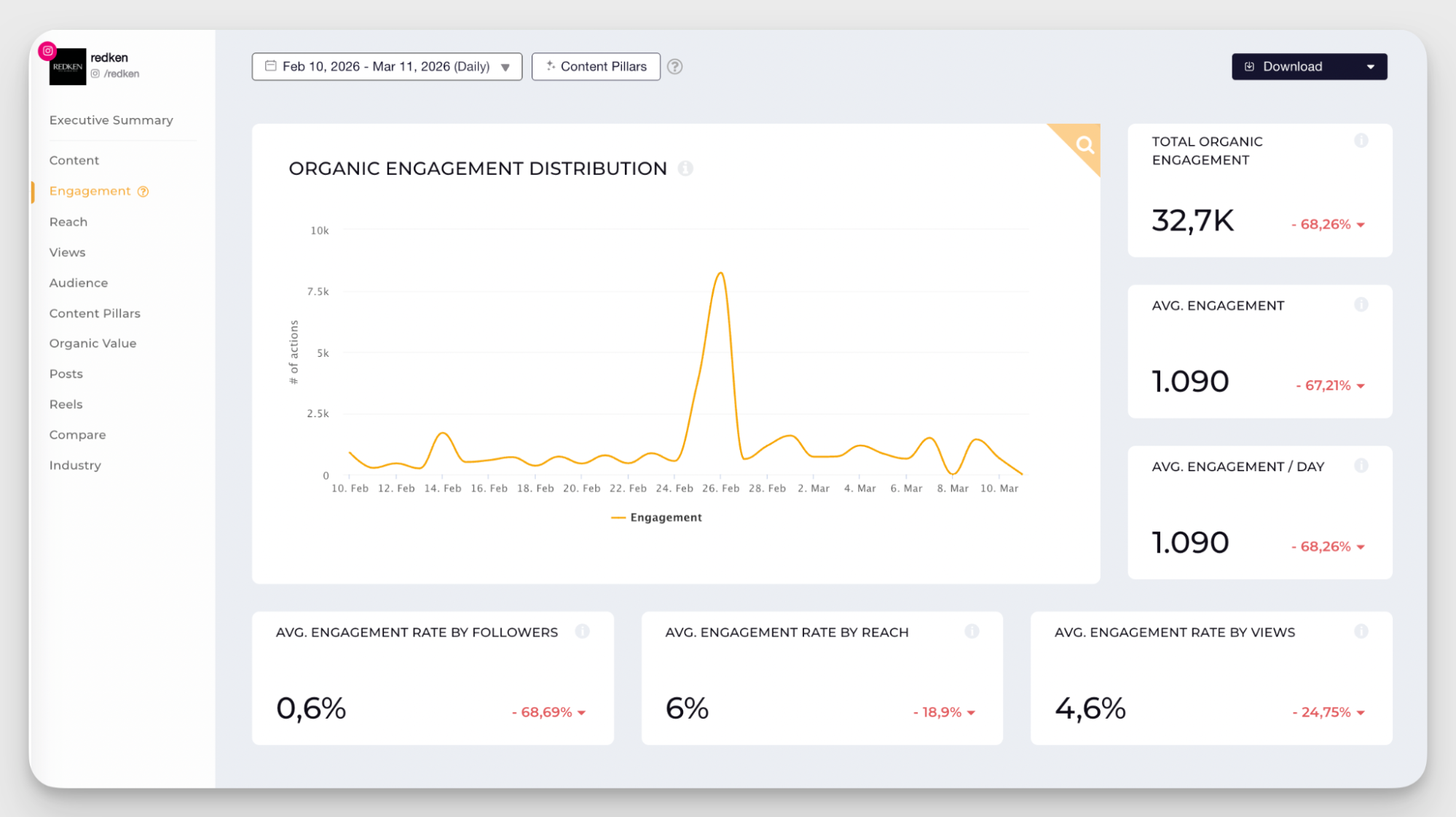
For example, if you look at Redken’s performance across a month, engagement stays relatively consistent… except for a spike toward the end of February.
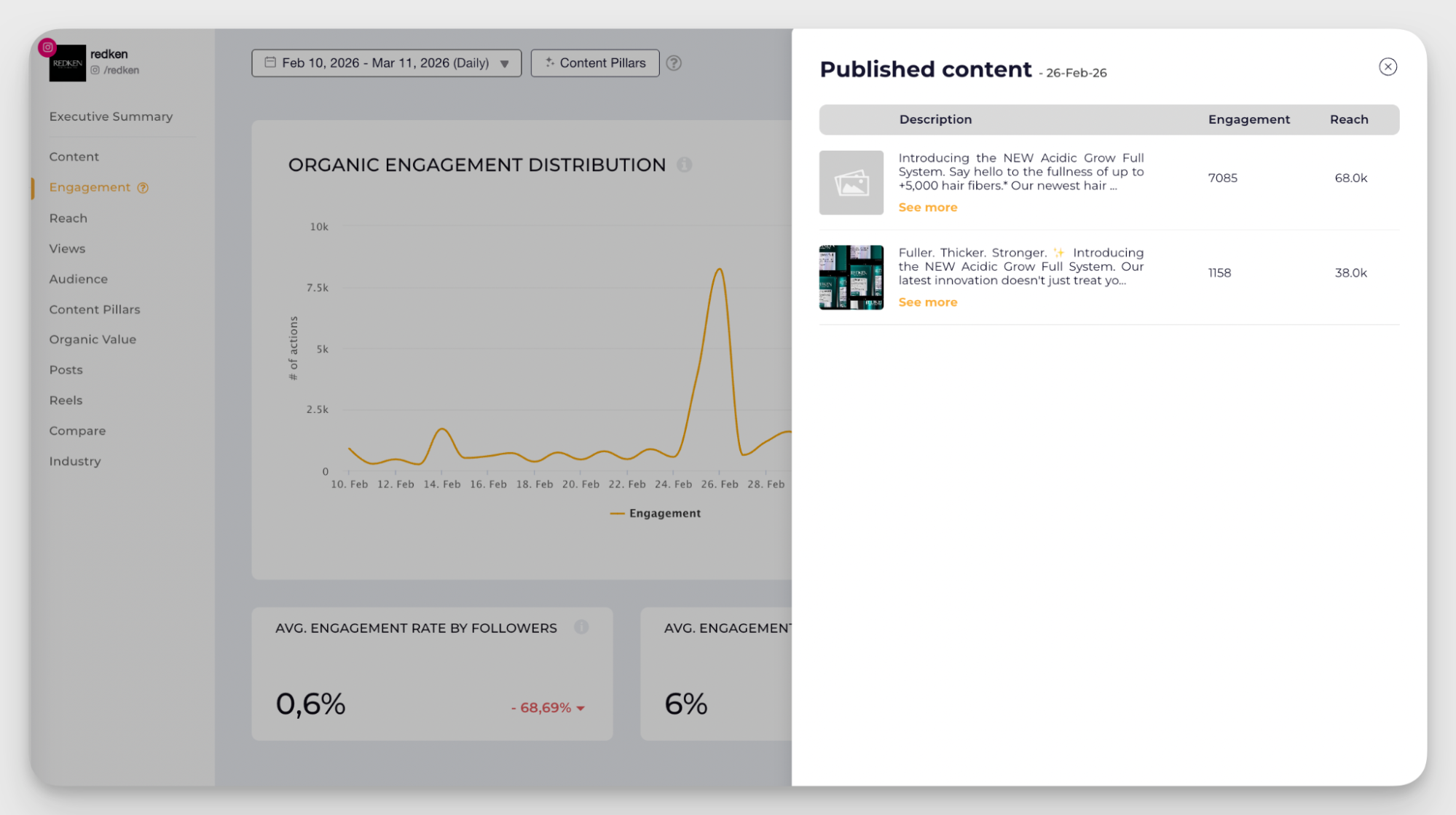
That kind of shift usually points to something specific that worked better than usual. So the next step is to look at the posts behind it.
Which posts contributed to that spike?What kind of engagement did they generate?Do they have anything in common?
Adriana's takeaway below adds a useful perspective on how to think about those signals:
Saves and shares are currently the most valuable signals. That’s what really pushes your content to new people. If someone saves your post or sends it to a friend, Instagram takes that as a strong indicator.
Leverage competitive benchmarking to identify potential content gaps
After a while, your own content stops giving you enough perspective. You know what you’ve been posting, but it’s harder to see what’s missing.
That’s where a quick competitive analysis on Instagram can sharpen things. When you place your content next to others in your space, differences in structure and focus become much more obvious.
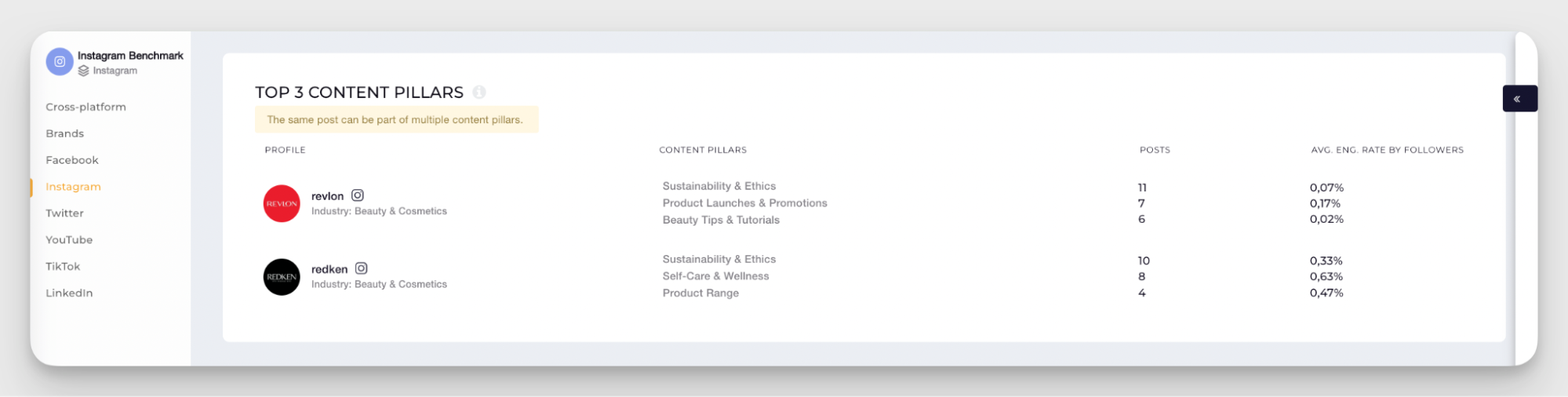
Looking at this side-by-side, both Revlon and Redken touch on similar themes, like sustainability. But the weight each brand gives to its content pillars for social media—and how that translates into engagement—isn’t the same.
Redken leans more heavily into product-driven content and self-care or wellness, and those areas are pulling stronger engagement. Revlon covers a wider mix, but the distribution doesn’t seem to generate the same level of response.
That contrast is where the value sits.
It highlights which pillars are actually driving interaction in your space, and which ones might be overrepresented or underdeveloped in your own mix.
Look for patterns in your competitor's top-performing content
After comparing content pillars, I usually go one level deeper and look at the posts themselves., so things tend to become clearer.
In the example we just looked at, both Revlon and Redken include sustainability in their content. But the results are very different: Redken is generating around 3x more engagement with a similar number of posts.
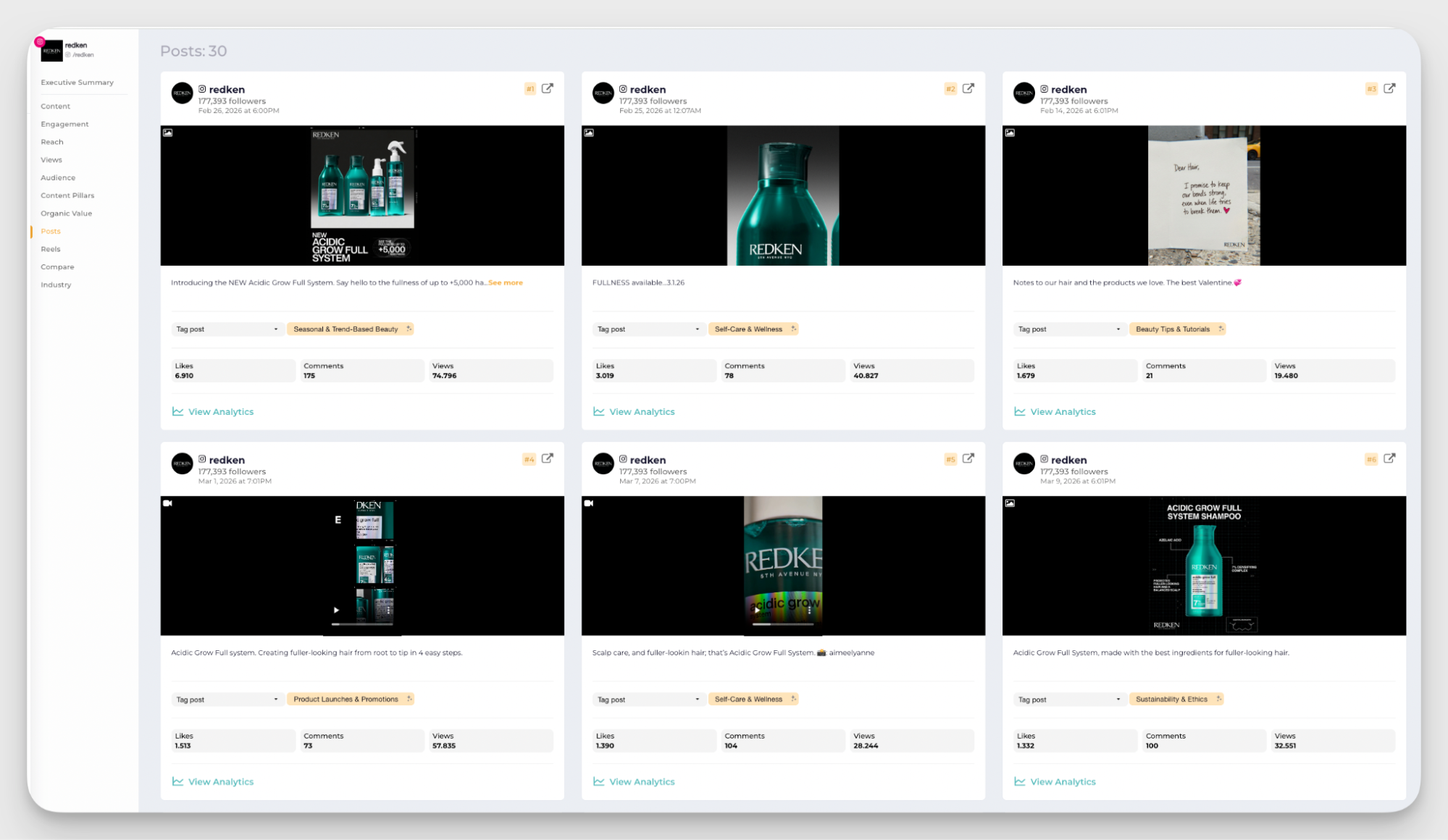
When I see a gap like that, I start going through the posts to understand how they’re being executed.
Interestingly, with Redken, certain things start to repeat once you scroll through their top content.
The way products are introduced, how the message connects to results or routines, the kind of reactions those posts get—there’s a level of consistency behind what performs well.
And no, you don’t need to overcomplicate this. Even a quick pass like this can give you useful competitive insights, especially if you’re looking at your own content side by side.
Adriana's approach reflects that way of thinking pretty well—what to actually pay attention to when you’re reviewing competitor content:
What I'm particularly paying attention to is: what formats are working, what kind of hooks people are using, what is people reacting to / talking about, what’s getting saves/shares. And I'd say it’s less about copying and more about understanding patterns.
After doing this a few times, you start to recognize what tends to land in your space. And from there, adjusting your own content becomes a piece of cake.
How to measure your Instagram growth strategy
The success of your Instagram growth strategy isn't determined by follower count alone. Monitor these four metrics together to understand whether your strategy is attracting the right audience and creating sustainable growth.
- Follower growth rate: Track week-over-week or month-over-month growth rather than total followers. Consistent growth is a stronger indicator of a healthy strategy than occasional spikes.
- Reach as a percentage of your follower base: Compare your average reach to your audience size. If your reach is consistently growing beyond your follower count, your content is being discovered by new audiences.
- Saves and shares: These are some of Instagram's strongest engagement signals. A growing number of saves and shares often indicates that your content provides lasting value and is reaching people beyond your existing audience.
- Reels completion rate and watch time: High completion rates signal that viewers are watching your content until the end, increasing the likelihood that Instagram will distribute it to more users.
Review these metrics regularly instead of focusing on individual viral posts. Sustainable Instagram growth comes from improving these signals consistently over time.
Final thoughts
If I’m being honest, most of the progress tends to come from paying closer attention, not from adding more to your plate.
At some point, you already have enough data, enough ideas, enough examples. The shift happens when you start connecting them and letting that guide what you do next.
So instead of constantly looking for something new, I’d focus on what’s already in front of you. The patterns, the posts that worked, the signals you might have overlooked.
That’s usually where growth starts to feel a lot more consistent. And a lot less random.

Anda Radulescu
Anda Radulescu is a SaaS content writer and copywriter with 5+ years in digital marketing, turning social media data into practical ideas for Instagram, LinkedIn, and beyond

Know what your competitors do — before your manager asks
Get instant social benchmarks & reports without manual work.