How to Develop an AI Content Strategy for Social Media: Your Go-to Guide for Effective Marketing
Learn how to create an effective AI content strategy for social media. Discover tools and experts' insights and step up your game.


AI is reshaping how marketers approach social media content strategies, from ideation to distribution and analysis.
But adopting AI in social media without a clear plan often creates more friction than results.
To help you overcome the challenges AI adoption raises nowadays, in this guide, I’ll walk you through the process how to building an AI content strategy that works: practical, data-backed, and designed for how marketing teams actually operate. Let's dive right into it!
Key takeaways
-
Why should marketers build an AI-based content strategy? AI helps marketers work faster, make smarter decisions, and scale their social media efforts without increasing workload or sacrificing quality.
-
How to set an effective AI content strategy foundation for your social media efforts? Build a strong AI content strategy by setting clear goals, auditing your current workflow and performance, identifying which tasks to automate, and choosing the right AI tools to support your social media processes.
-
What to automate vs. what needs human touch? Automate high-volume, low-creativity tasks like data analysis and content variations, while keeping human judgment for storytelling, brand voice, and strategic decisions.
Why should marketers build an AI-based content strategy?
If you've ever stared at a content calendar trying to fill it while also analyzing last quarter's performance, planning next month's campaigns, and keeping an eye on competitors — I feel your pain.
Planning social media content is just more of everything. More platforms, formats, data, and expectations (from the audience and stakeholders). And while your to-do list keeps growing, your time and resources probably haven't kept pace.
That’s why you shouldn’t postpone understanding how an AI-based content strategy can help.
Let me give you an insight: AI can support various aspects of your content strategy, from planning to execution, without replacing creativity or strategic thinking.
I’ve seen this firsthand. Instead of spending hours putting performance metrics together or guessing which content themes might resonate, AI handles the heavy lifting so you can focus on making progress.
Here are three essential things AI brings to the social media game:
- Faster execution. Tasks that used to take hours can now be done in minutes, from identifying your top-performing posts across platforms to spotting patterns in your engagement data.
- Smarter decisions. AI finds insights you might miss. When analyzing thousands of posts or tracking performance across multiple accounts, AI can detect trends, anomalies, and opportunities that would take you significantly longer to find.
- Scalable processes. The same AI-driven workflows that help you analyze one competitor can help you benchmark against ten. The insights that inform one campaign can shape your entire content strategy.
AI content planning is about working realistically within the constraints most marketing teams face: limited time and money, growing demands, and the pressure to prove results.
A content strategy with AI doesn’t have to be a complete overhaul. It can start small and grow as needed. Below, I go into the details on how to do that effectively.
How to set an effective AI content strategy foundation for your social media efforts?
A good AI content strategy is more than just tools. Trust me on this one. It involves making intentional choices that match your goals, resources, and workflow.
Moving further, I'll walk you through the steps of setting up a foundation that makes your AI content planning sustainable and effective, from defining your objectives to measuring what's actually working.
Set goals for your AI usage
Before you start experimenting with AI tools or automating parts of your workflow, you need to get clear on your goal: what do you want AI to help you achieve?
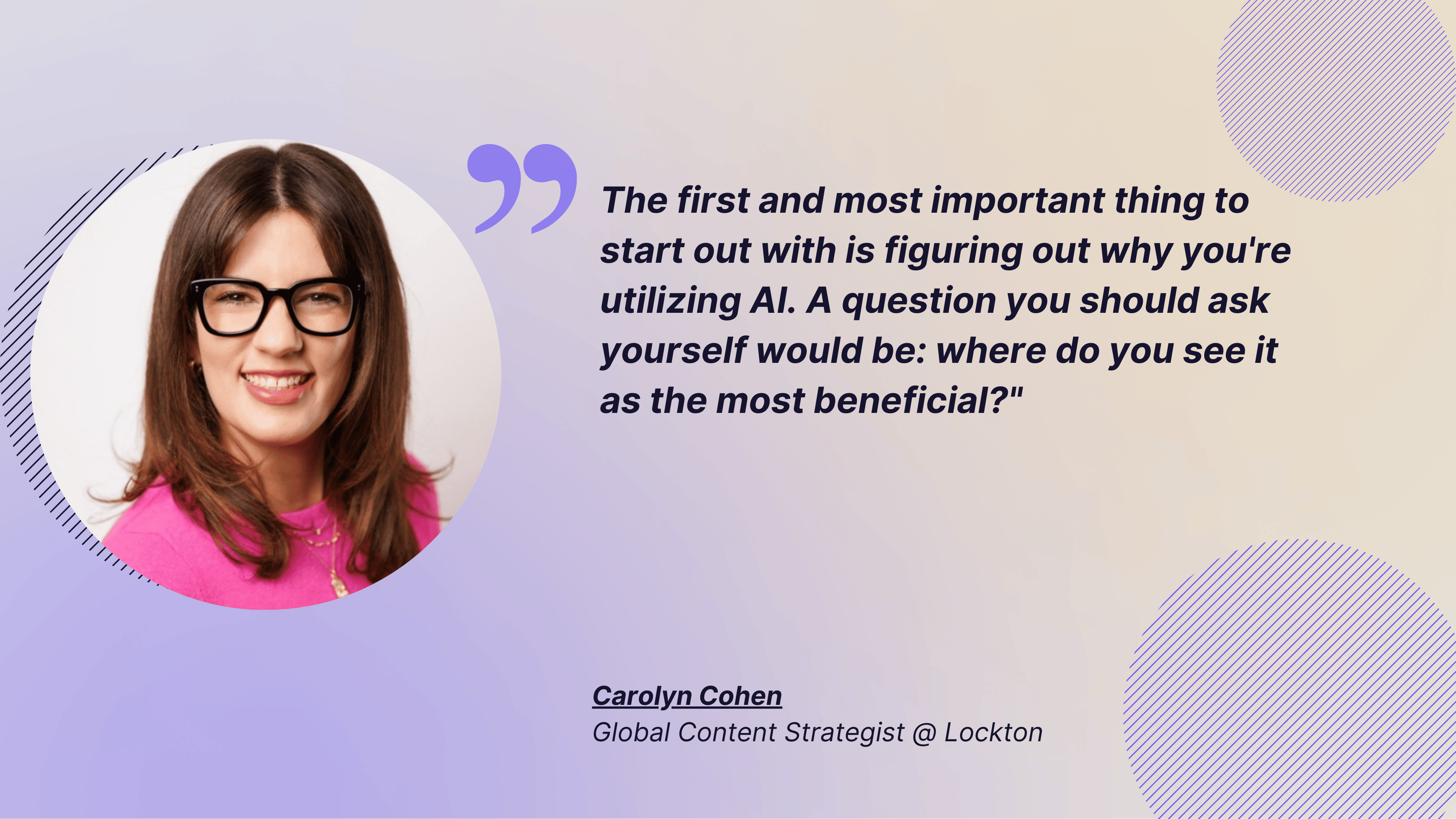
As a matter of fact, I've recently had a chat with Carolyn Cohen, Global Content Strategist at Lockton, where she told me:
I think the first and most important thing to start out with is figuring out why you're utilizing AI. As in really knowing if you'll use it to create content more efficiently, or more quickly, or have better SEO results, or have more research and data on your audiences. A question you should ask yourself would be: where do you see it as the most beneficial?
And if you think "Use AI to improve social media" is a proper goal, you’ll have to do better than that and be specific enough to guide your decisions.
Here are some starting points to help you define clear goals:
- Increase content volume without sacrificing quality. Maybe your team is stretched thin, and you're struggling to maintain a consistent posting schedule across platforms. AI can help you produce more without burning out your team.
- Reduce content creation time. If your current workflow involves hours of writing, editing, and reformatting for different channels, AI can cut that significantly. But you'll want to benchmark how long things take now so you can measure the improvement later.
- Scale across multiple platforms. Creating content for social media becomes exponentially harder when you're managing five platforms instead of one. AI content planning can help you adapt content across channels more efficiently.
- Improve engagement rates. AI won't magically make your content more engaging, but it can help you identify patterns in what's already working and apply those insights more consistently.
Pick one or two primary social media goals to start. You can always expand later, but trying to do everything at once usually means nothing gets done well.
Audit your current workflow and content performance
Start by asking: How much time does it actually take my team to create content across all your channels? And how much time goes into reporting on that content's performance?
In my experience, most marketers underestimate both numbers. When you add up the ideation, creation, editing, scheduling, monitoring, and analysis across the hours stack up quickly.
An honest audit of your current state helps you identify where AI can have the biggest impact. Look at your social media content process end to end and note where the bottlenecks are.
You'll also want to understand current content performance. What posts are resonating? Which platforms are driving the most engagement? You need a baseline against which to measure your AI-driven content strategy.
By the way, did you know that with a tool like Socialinsider, you can quickly identify top-performing posts (both your own and your competitors') along with the metrics that matter?
For example, the dashboard below shows which content is generating the most engagement, with clear performance indicators for each post.
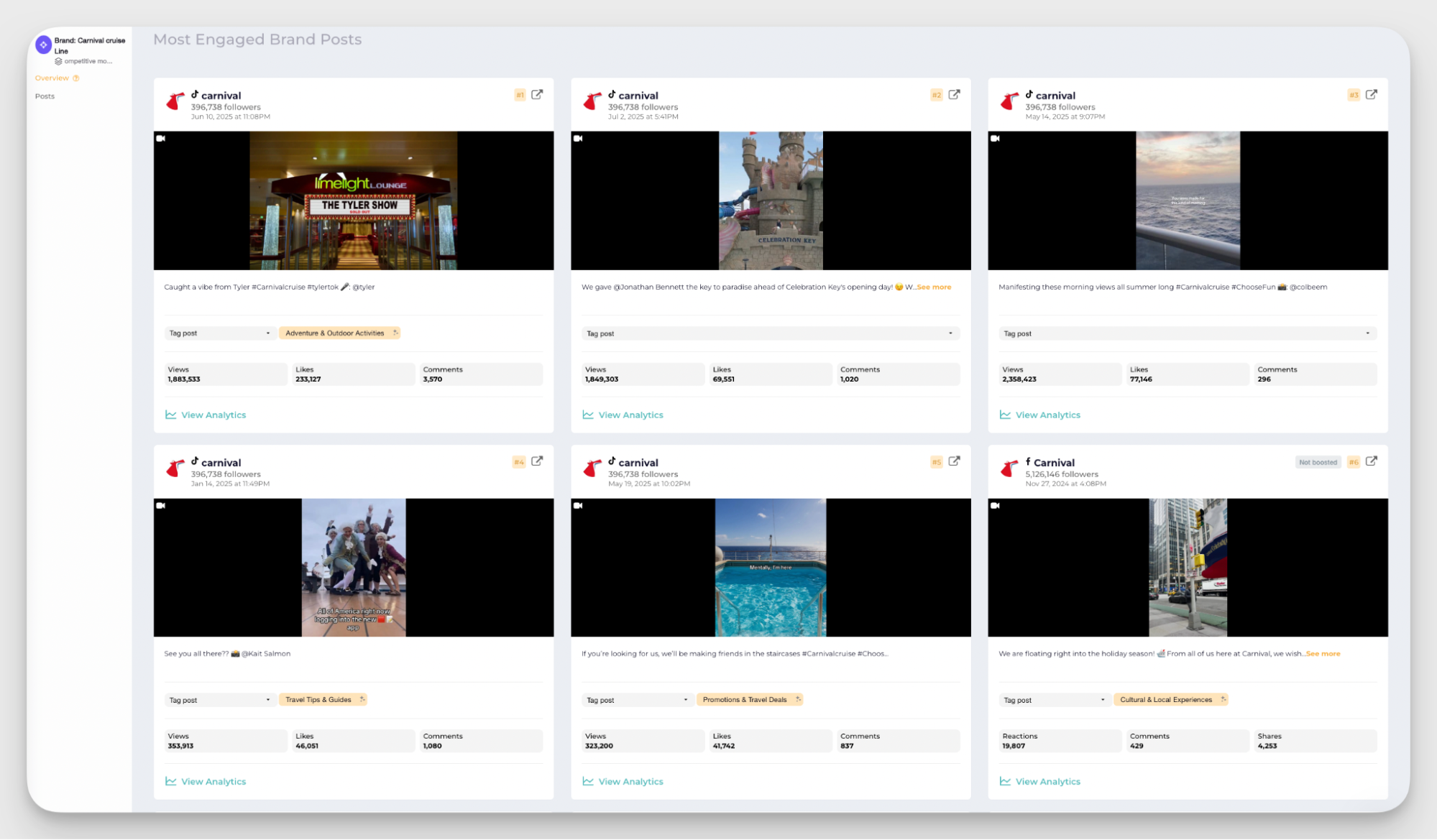
This kind of analysis helps you build your AI content strategy on actual performance data.
Identify the tasks you need the most to automate
Not every part of your social strategy should be handed over to AI. The goal isn't automation for its own sake, but freeing up your time and mental energy for the work that requires more creativity and judgment.
Here's a breakdown of common task categories and how AI can support each:
- Content ideation. This includes trend discovery, competitor analysis, and topic generation. AI can scan massive amounts of data to find what's gaining traction in your industry.
- Content creation. Think captions, scripts, visual concepts, and hashtags. While AI shouldn't replace your brand voice entirely, it can generate first drafts and variations that your team refines.
- Content optimization. Use AI to find the best posting times, run A/B tests on captions, and create variations for different audiences.
- Content distribution. Social media automation tools can handle much of scheduling posts, adapting content for different platforms, and repurposing long-form content into social snippets.
- Performance analysis. Tracking metrics, benchmarking against competitors, and getting insights from data is often where marketers spend the most time manually — and where AI can save the most hours.
Having aggregated performance data across all your channels is a game-changer. Instead of logging into each platform separately, you can see everything in one place.
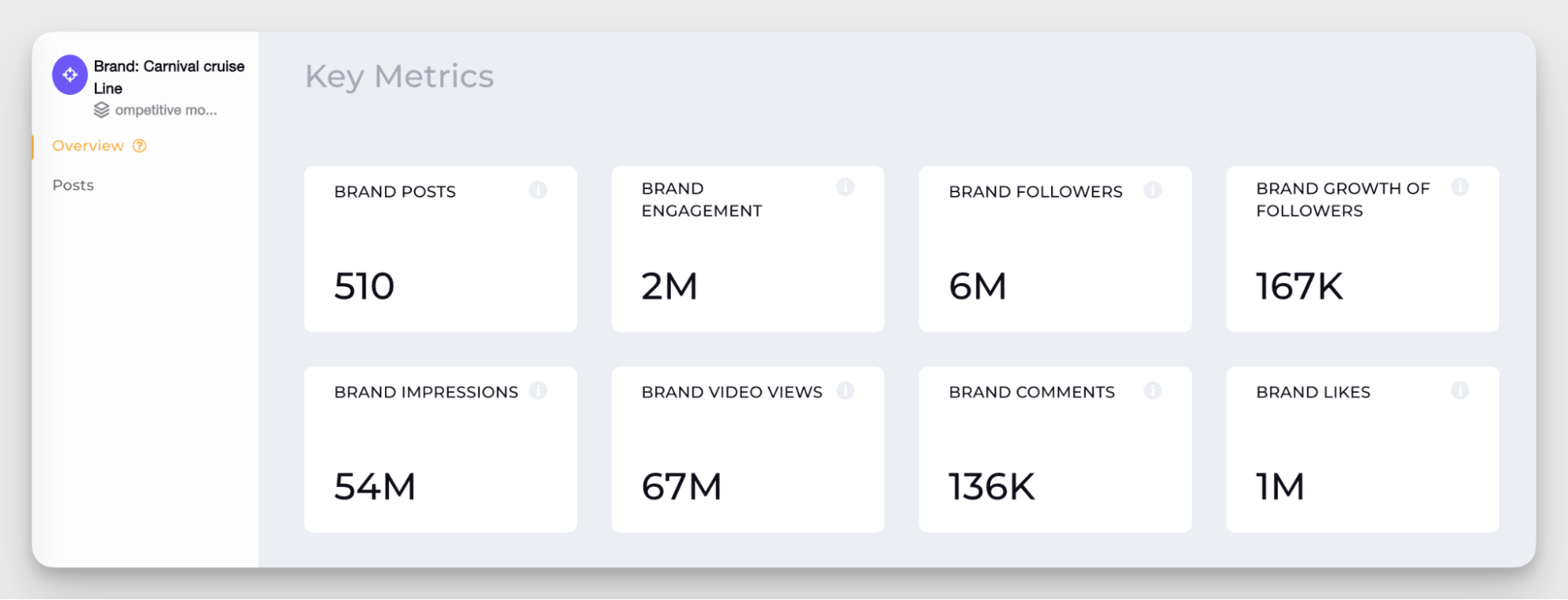
One of the things that I love about Socialinsider is that it provides a consolidated view of key metrics, from total posts and engagement to follower growth and video views, so it's very quick and easy to understand your overall performance at a glance.
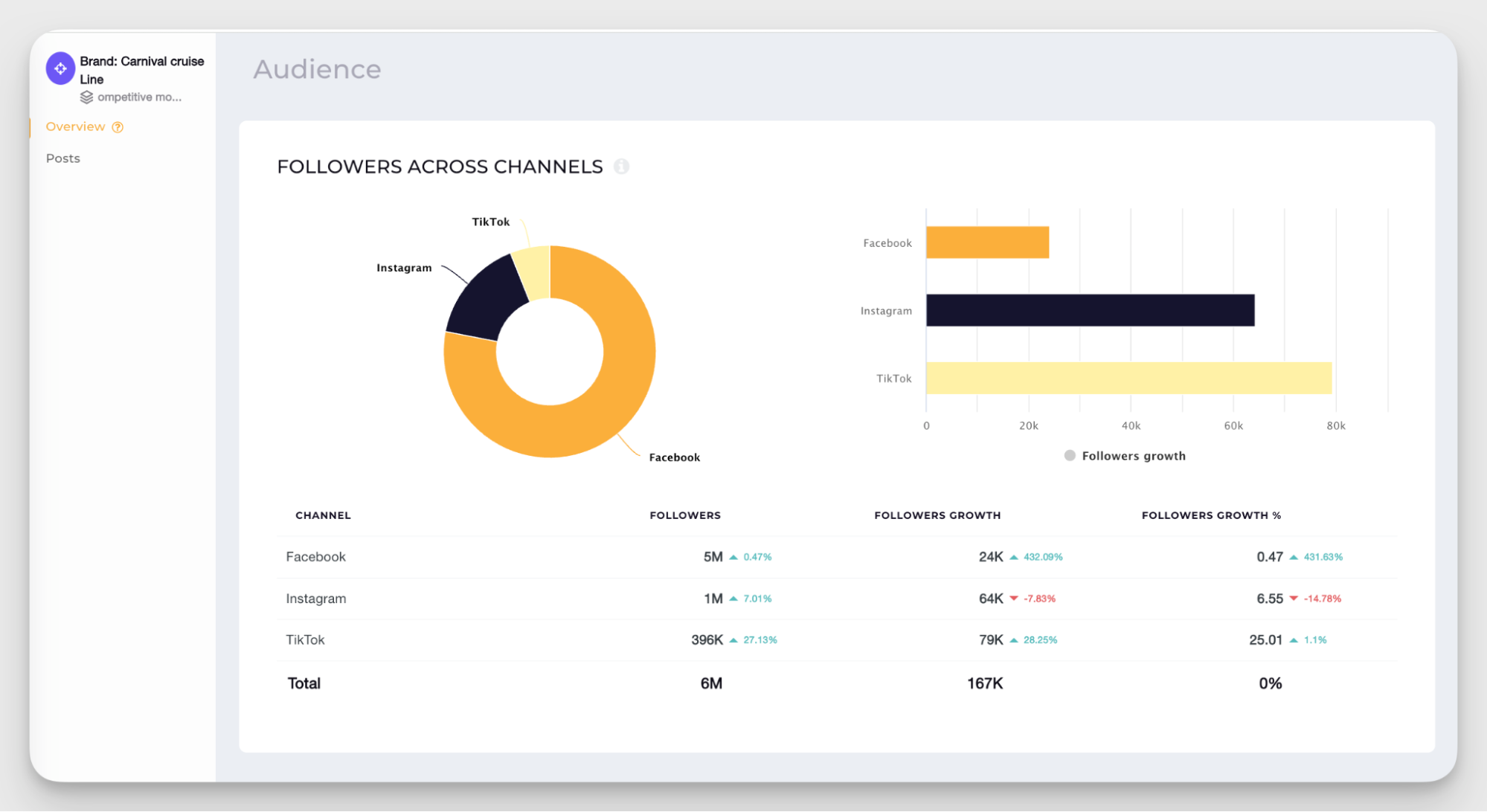
You can also break down your audience across channels to see where you're growing fastest and where you might need to adjust your approach.
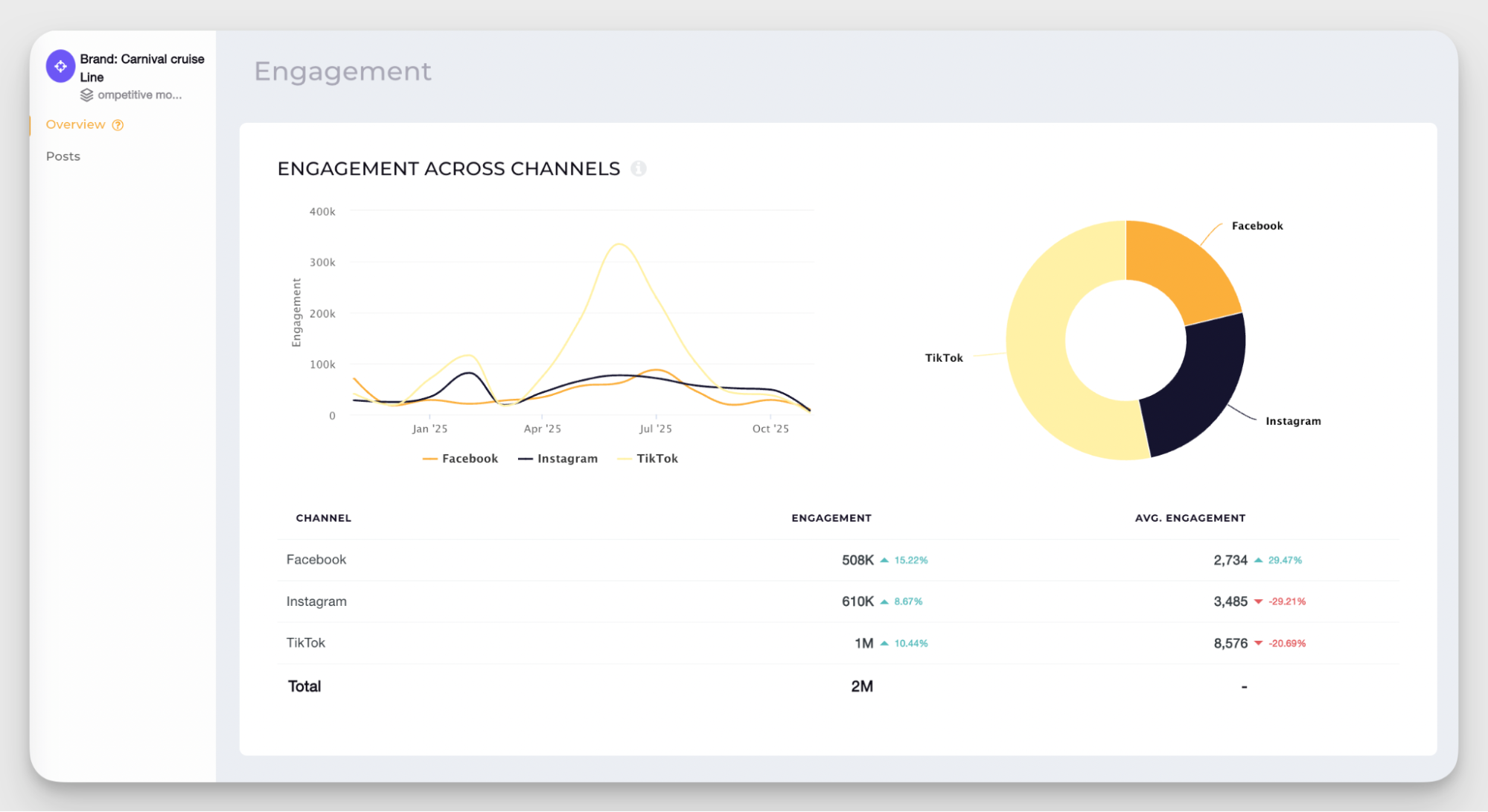
The engagement data shows you not just totals, but trends over time—so you can spot when something's working (or when a particular platform needs attention).
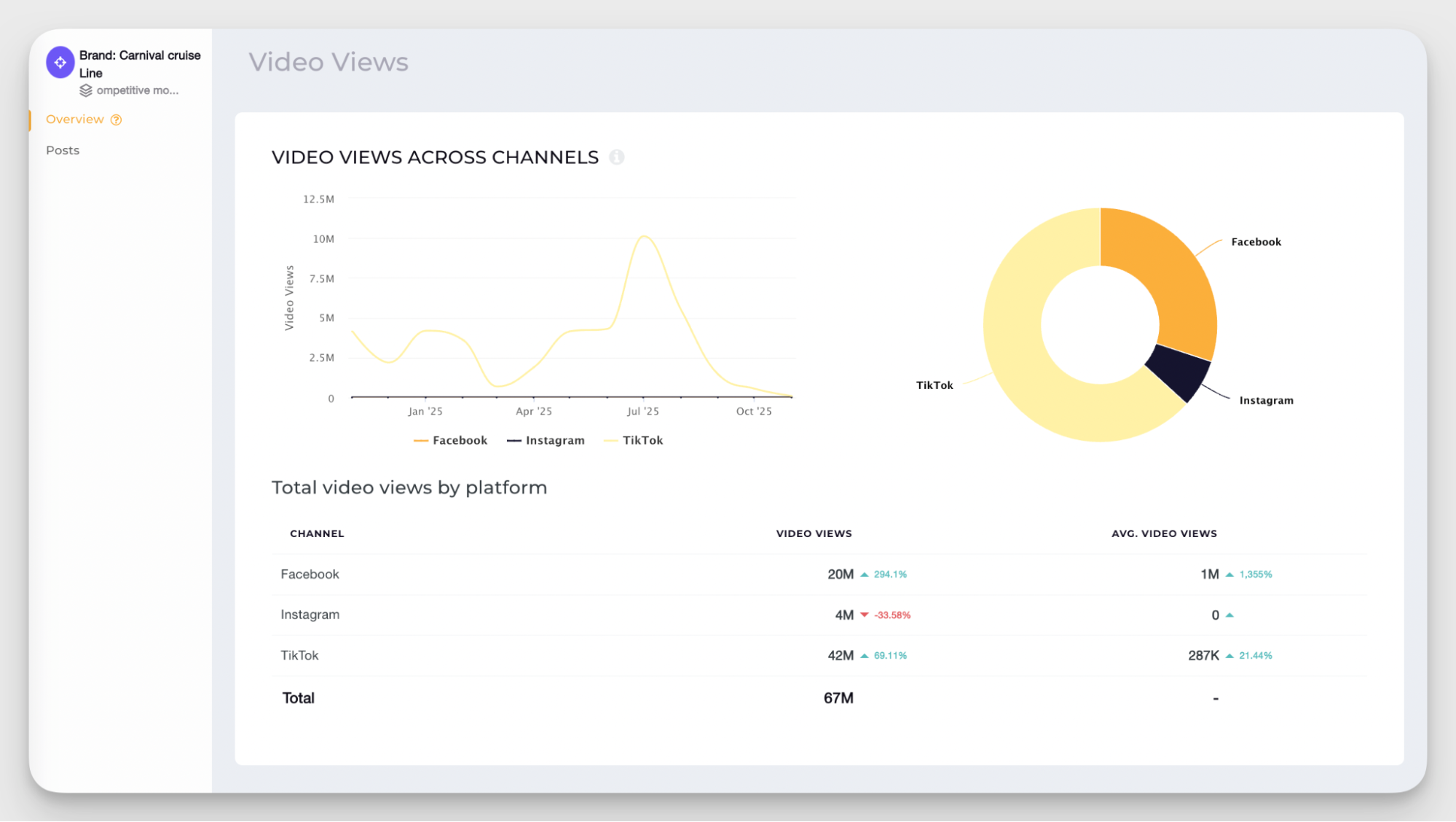
And for video content specifically, you can track views across platforms to understand which channels are driving the most visibility.
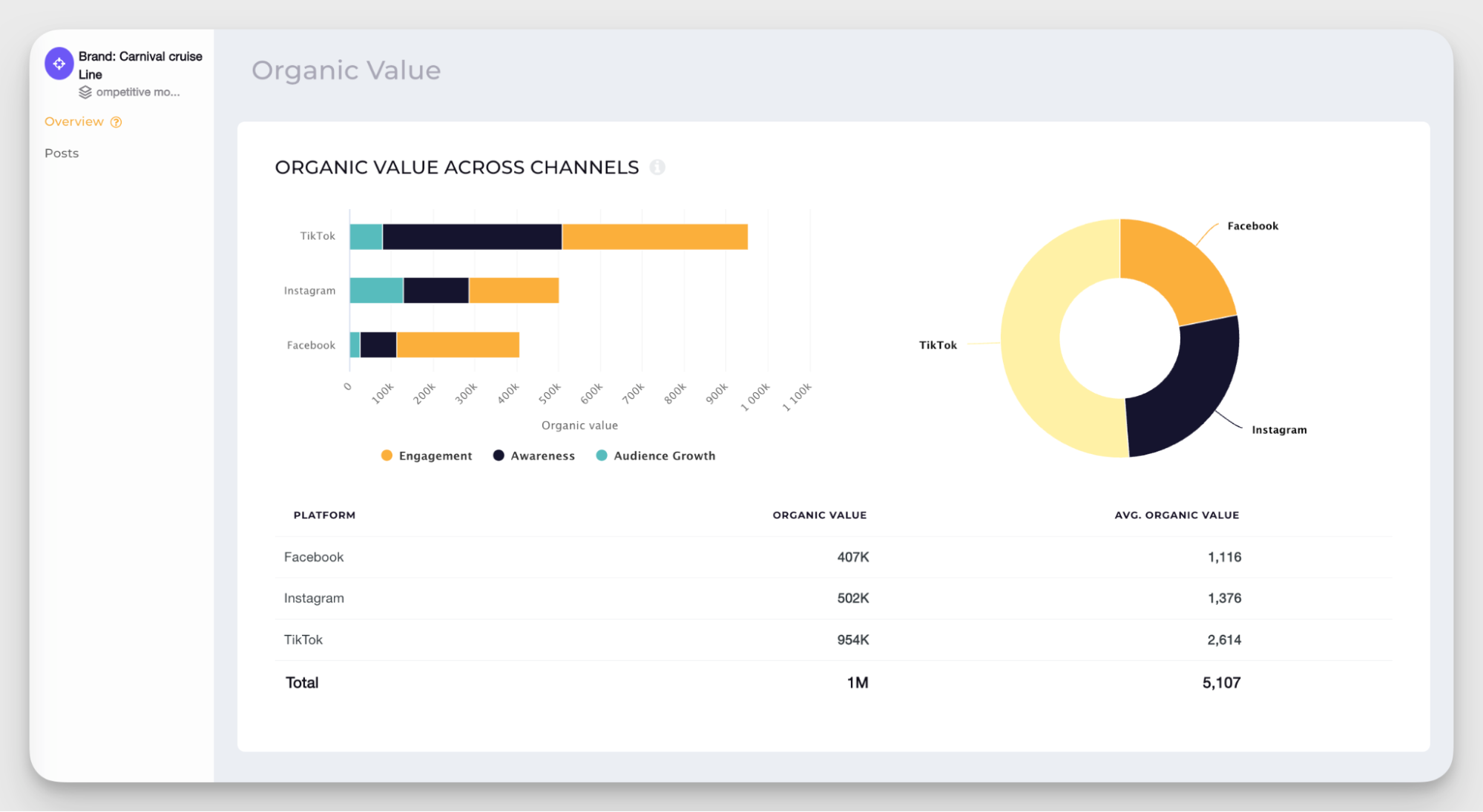
And if you want to understand the organic value of your efforts, meaning how much your content is generating in terms of engagement, awareness, and audience growth, that's easily visible too in Socialinsider’s dashboards.
What makes this even more useful for AI content planning is Socialinsider's AI Assistant. Instead of manually digging through data, you can ask questions directly: What are the key metrics indicating my project's performance? How does this period compare to last? Where are we excelling or struggling?
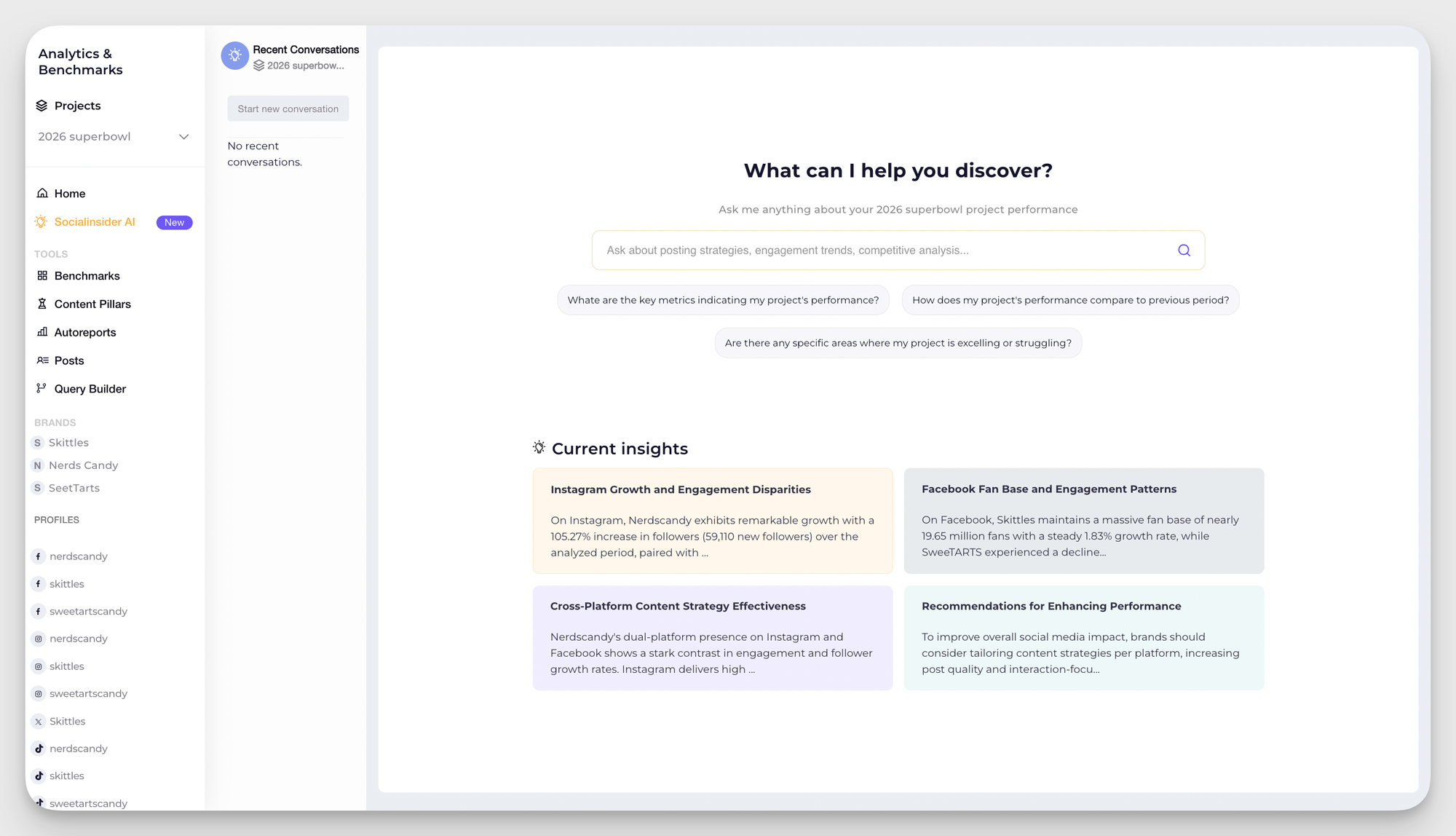
This kind of conversational social media analysis will help you make it faster to get from data to decisions, which is exactly what an AI-driven content strategy should help you do.
💡Insider tip: When automating, start with high-volume, low-creativity tasks. Data collection and analysis typically eat up lots of time without requiring much strategic thinking. With AI’s help, you can step in at the end of the process and use insights strategically to inform your next steps.
Choose the right AI tools for your social media stack
Once you've identified which tasks to automate, the next step is selecting tools that fit your workflow.
This is where many marketers get overwhelmed. There are hundreds of AI tools for social media on the market, and new ones launch every week. How do you know which ones are worth your time?
And luckily, Carolyn offered some practical advice on this as well:
I think one big factor is your company's size and your company's process for integrating and onboarding new partners. We're kind of in an age where a lot of legacy SaaS companies are integrating AI into their existing platforms. And I think you have to consider your budget and your timeline as well. If you're on a really tight squeeze to integrate an AI tool, you might be better off adding on with a system you're already using versus if you have a longer runway you probably want to evaluate some of the newer tools that are more born out of AI.
In other words, the "best" tool depends entirely on your situation. A startup with a limited budget will probably make different choices than an enterprise team with a six-month implementation timeline.
That said, most AI-driven content strategies involve some combination of these tool categories:
- Content generators handle the creation side, such as caption writing, image generation, and video editing assistance. These can speed up your content production, though they work best when you treat their output as a starting point rather than a finished product.
- Chatbots and community management tools support audience engagement by suggesting responses, analyzing sentiment, and helping you stay on top of conversations without monitoring every platform manually.
- AI-powered analytics tools are where strategy meets data. This category includes social listening, sentiment analysis, and, perhaps most valuable for content strategy creation, competitor benchmarking.
This last category deserves special attention because it directly informs what content you should create in the first place. Take it from me, understanding how your performance stacks up against competitors and why certain brands are outperforming others gives you the strategic foundation that makes everything else more effective.
And have I mentioned yet that Socialinsider's benchmarking feature does exactly this? Within the dashboard, you can compare multiple profiles side-by-side across key metrics — followers, engagement, reach, organic value, and more — to see where you stand in your competitive set.
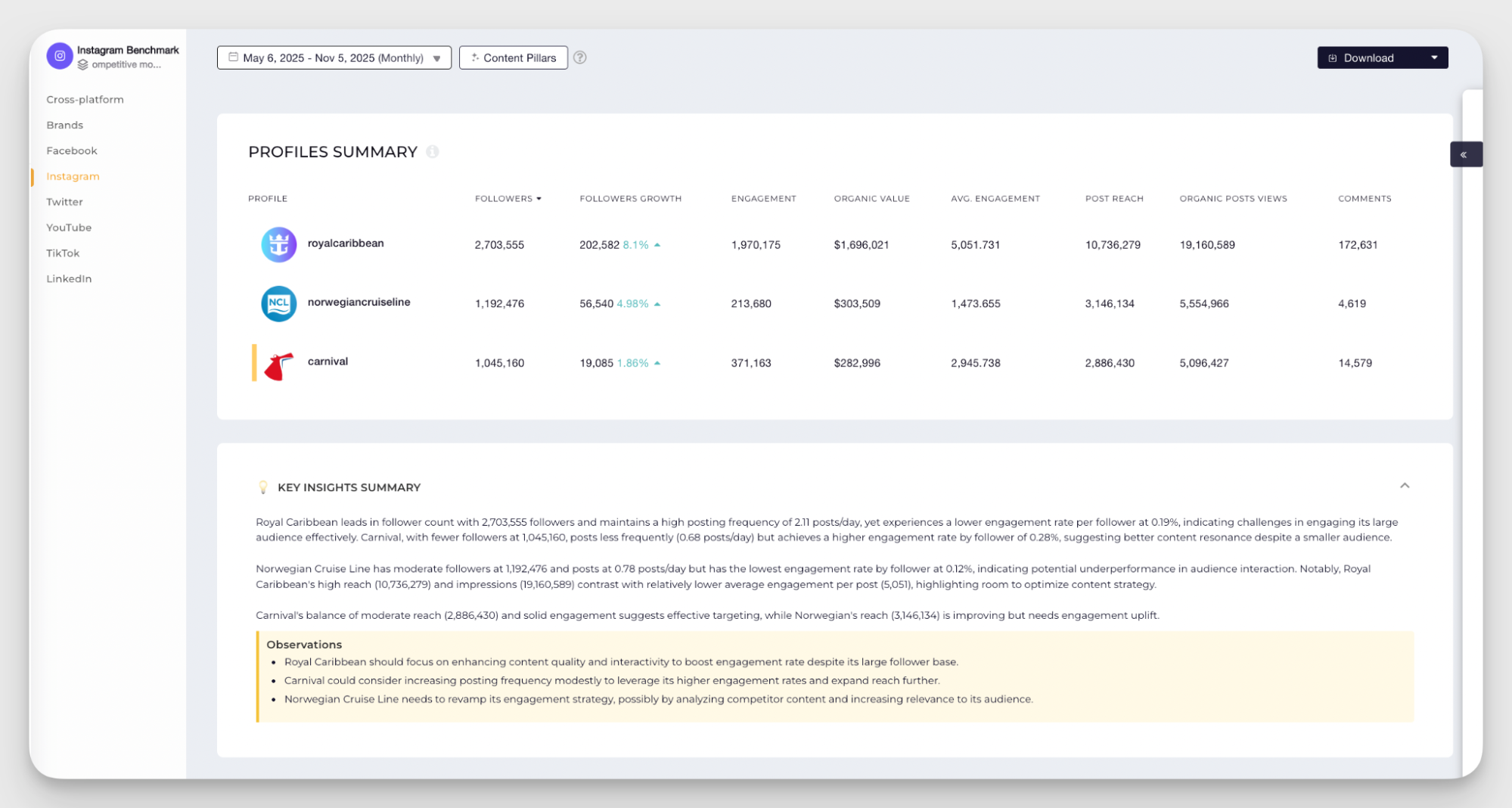
And since we are on the AI content planning theme, I must say that Socialinsider's AI-driven Key Insights Summary is a real helper for me. For example, in the case I just presented, you can see that AI makes observations such as which brand has the highest engagement rate relative to its follower count, which competitor might be underperforming despite high reach, and specific recommendations for each profile's content strategy.
💡Insider tip: Use AI-powered social media analytics to turn raw data into direction. Instead of just seeing that a competitor has more engagement, understand quickly why and what you might do differently.
Start strategizing and planning
With your goals defined, workflow audited, and tools selected, you're ready to move into the actual strategy work.
AI content planning shifts from preparation to action, but here's the key: every strategic decision should be grounded in historic performance data, not just assumptions or short-term trends.
Use AI to identify the best-performing content pillars
One of the most valuable things AI can do for your social strategy is help you understand which content pillars resonate with your audience and are worth doubling down on.
Instead of guessing which themes to build your content around, you can analyze what's already working for you and your competitors.
For example, the AI-based industry content pillars view from Socialinsider's dashboard shows the top content pillars for a couple of competitors across different platforms.
Here's a case for three cruise lines and their Instagram content approach and performance numbers.
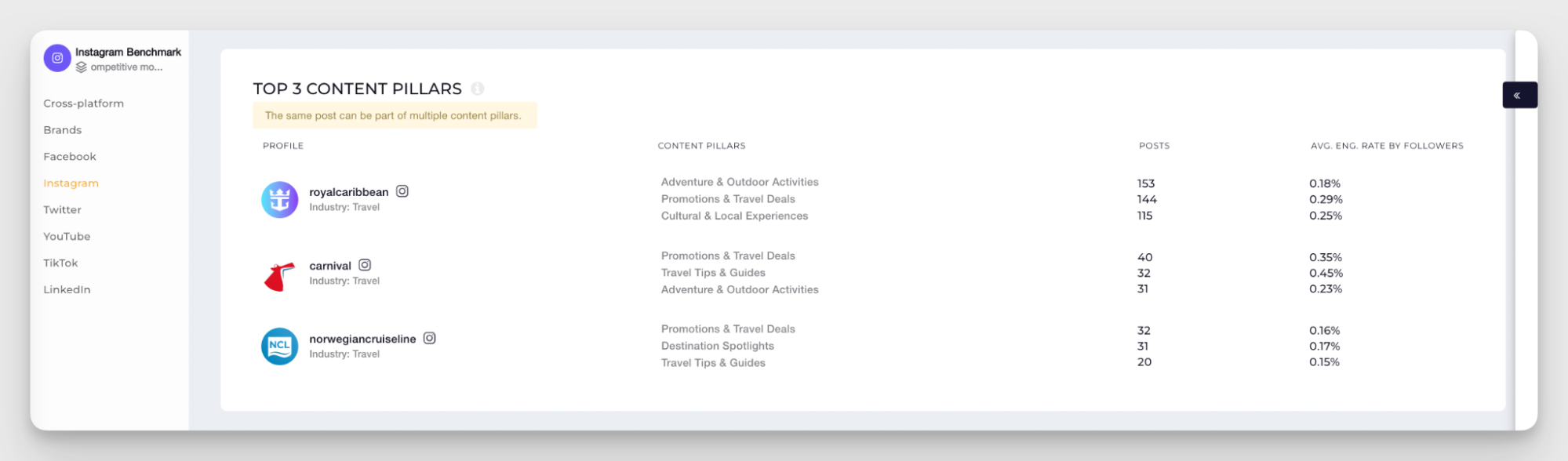
Notice something interesting here: despite these brands having different overall strategies and posting volumes, “promotions and travel deals” appears as a top-performing pillar for all three.
That's valuable. When you see patterns like this across multiple competitors in your industry, you're looking at content themes that have proven appeal. Rather than starting from scratch, you're building your content pillars around themes that have proven engagement potential.
Create an AI-driven content calendar across multiple platforms
Once you've identified your strongest content pillars, the next step is mapping them across channels. Different platforms favor different content types, and understanding where each pillar performs best helps you allocate your resources more effectively.
See below, for example, how Carnival Cruise Line's top content pillars are distributed across Facebook, Instagram, and TikTok, along with engagement metrics and average engagement rate for each.
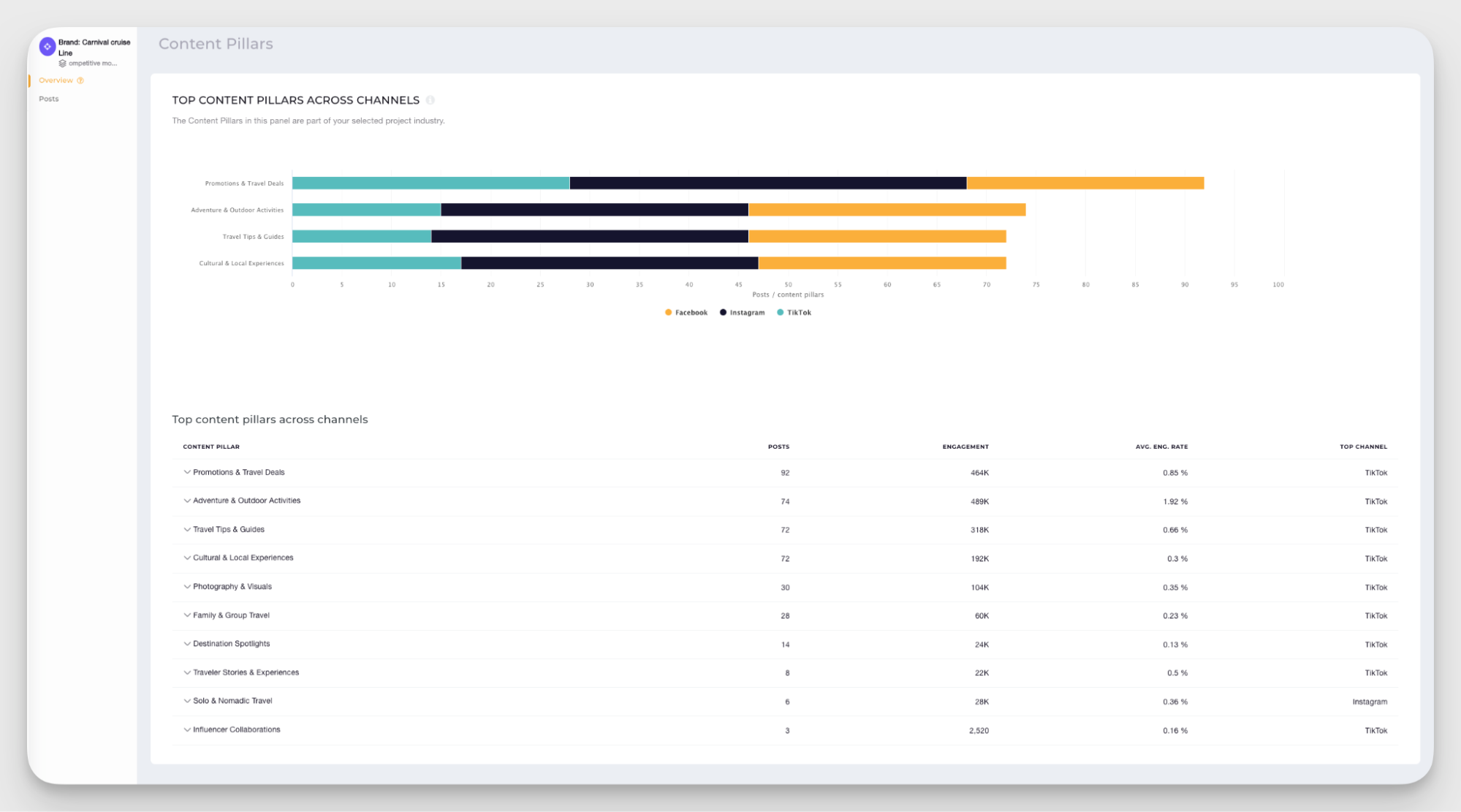
When looking at the example I just mentioned, a few things stand out to me. “Promotions and travel deals” generate the highest total engagement, but “adventure and outdoor activities” has a notably higher average engagement rate. This suggests that while promotional content gets volume, experiential content creates a deeper connection. And there's another thing I observed: TikTok is the top-performing channel across nearly every content pillar.
When you start leveraging this kind of data-driven marketing, it means you're using actual performance patterns to guide your decisions.
So, when you're ready to build your calendar, use these kinds of insights to determine how much of each content pillar to include, which platforms to prioritize for each theme, and how to balance high-volume content (like promotions) with high-engagement content (like education or experiences).
💡Insider tip: Use AI to draft your initial structure based on data, but leave room to adapt as you learn what works. The best AI-driven content strategies are iterative: plan, publish, analyze, and refine continuously.
Bring AI into your content creation process to speed it up
It's time to put AI to work on the actual content. This is where I’ve seen the most immediate time savings and where many marketers find the biggest value in their AI content strategy.
Generate content variations at scale
One of the most practical applications of AI in creating content for social media is producing multiple variations quickly. Instead of spending an hour writing and editing one caption, you can generate several options instantly.
Here's Carolyn's opinion as well:
Personally, I use AI to create content more efficiently and really create a volume of content at scale. I think that's where a lot of marketers are very interested because that's something that takes a lot of time and a lot of people.
She's right. Content volume is one of the biggest constraints marketing teams face, and AI can meaningfully expand what's possible without expanding your headcount.
That said, different platforms call for different approaches. Here's where to focus your AI-assisted content creation for each channel:
- Instagram: Use AI for Reels ideas and trend identification, as AI can help you spot what's gaining momentum before it peaks. AI prompts for social media can be particularly helpful here for generating creative concepts quickly.
- TikTok: Focus on video script generation for trending formats. TikTok moves fast, and AI can help you draft scripts that match current trends while maintaining your brand voice.
- LinkedIn: AI can help you articulate complex ideas more clearly and consistently. Use it for article drafting, post ideation, and commentary on industry topics.
- Facebook: Community-focused content generation works well here. Get help from AI for conversation starter ideas, group engagement posts, and content that encourages sharing among existing followers.
- X (Twitter): The platform's speed makes it hard to keep up manually, but AI can help you respond to trends while they're still relevant.
Keep in mind, though, that even if AI can speed and scale things up, that’s no excuse to remove human oversight and risk posting content that is meaningless or irrelevant.
Repurpose effective content across platforms using AI
Creating content from scratch year after year for every platform isn't realistic for most teams.
My takeaway? A smarter approach is to identify what's working on one channel and adapt it for others.
And AI makes this repurposing process much faster. With AI assistance, a long-form LinkedIn article can become a series of X threads, Instagram carousel posts, and TikTok script ideas in no time. A high-performing Reel can be adapted into a YouTube Short with adjusted captions and hooks — and so on.
The key is using content that's proven to work. Look at your top-performing posts, identify what made them resonate, and use AI to translate those elements across formats. This way, you're multiplying the impact of your best content.
Compare AI vs. non-AI content performance
As you develop your AI content strategy, keep asking: Is the AI-generated content performing as well as your team’s manually created content?
It's an important thing to track, trust me. While AI can speed up your workflow significantly, you need to know whether that efficiency comes at the cost of engagement, reach, or audience connection.
The challenge is that most social media analytics tools don't distinguish between AI-assisted and human-created content. You see aggregate numbers, but you can't easily compare the two approaches.
Socialinsider solves this with post tagging. You can tag individual posts with custom labels — like "AI" for AI-generated content — and then analyze performance by tag. This lets you see exactly how your AI content stacks up against your non-AI content across all the metrics that matter.

In the example above, you can see a post being tagged with both a content pillar (Promotions & Travel Deals) and a custom tag (AI).
Over time, as you consistently tag your posts, you build a dataset that shows you whether your AI-driven content strategy is actually delivering results.
💡Insider tip: This kind of AI social media analysis is valuable because it helps you refine your strategic approach and resource management. Maybe AI-generated captions perform just as well as manual ones, but AI video scripts underperform. That insight tells you exactly where to focus your team's creative energy and where to let AI handle more of the work.
Final thoughts
An effective AI content strategy starts with clear goals, honest workflow assessment, and the right tools for your needs.
Use AI to handle data-heavy tasks and content variations while keeping your judgment at the center of creative and strategic decisions. Finally, track what's working, refine as you go, and let data guide your next move.
Try Socialinsider free and see how AI-powered analytics can shape your content strategy from day one.
FAQs on AI content strategy
What to automate vs. what needs human touch?
Automate the repetitive, data-heavy tasks: data collection and reporting, scheduling posts, generating content drafts and variations, hashtag research, best-time-to-post analysis, and performance tracking.
Keep humans on strategy, creativity, and nuance: brand voice decisions, sensitive content, crisis communication, and major strategic shifts.
In the middle, aim for collaboration: AI drafts captions, humans refine; AI generates ideas, teams choose; AI spots trends, people decide if they matter. Think of AI as a smart first-draft partner, not a replacement.
Sabina Varga
Content marketing expert with 15 years of experience in digital marketing. I dream of beach life but love the city as a multitasking mom juggling playgrounds, books, brunches, and travels.

Know what your competitors do — before your manager asks
Get instant social benchmarks & reports without manual work.
You might also like




Improve your social media strategy with Socialinsider!
Use in-depth data to measure your social accounts’ performance, analyze competitors, and gain insights to improve your strategy.