AI in Social Media: Practical Uses for Social Media Leaders
AI is reshaping social media from content to analytics. Discover the 7 core use cases social media leaders are implementing right now.



AI for social media marketing helps teams move faster on content, analysis, monitoring, and paid decisions without losing strategic control. Used well, AI in social media turns scattered tasks into a repeatable workflow, so social media leaders can spend more time interpreting results and less time chasing screenshots or first drafts.
So, throughout this article, I'll show you how I personally use AI in social media marketing to move faster and optimize my brand strategies for getting the results I want.
Key takeaways
-
AI can dramatically speed up content creation, analysis, and optimization, but it cannot replace human judgment, brand context, or strategic decision-making.
-
AI delivers the most value on repetitive, data-heavy tasks, while humans remain essential for ensuring accuracy, brand voice, trust, and compliance.
-
AI is shifting social media professionals from content producers and report builders to editors, analysts, and strategic decision-makers.
-
An effective AI-ready social media stack uses specialized tools to reduce manual work while preserving human oversight to prevent errors and maintain context.
What AI in social media marketing can and cannot do?
AI can accelerate repetitive work, but it cannot replace a context-based strategy or final judgment.
Yes, AI can summarize comments, cluster themes, detect anomalies, and produce faster first drafts, and many more. But it can also misread nuance, flatten brand personality, and confidently repeat errors if the input data is weak. That is why I treat AI as an assistant, not an author.
To be honest, from what I've seen, I would say the best social media workflows use AI as a shortcut for analysis and drafting, then keep a human in charge of interpretation and approval.
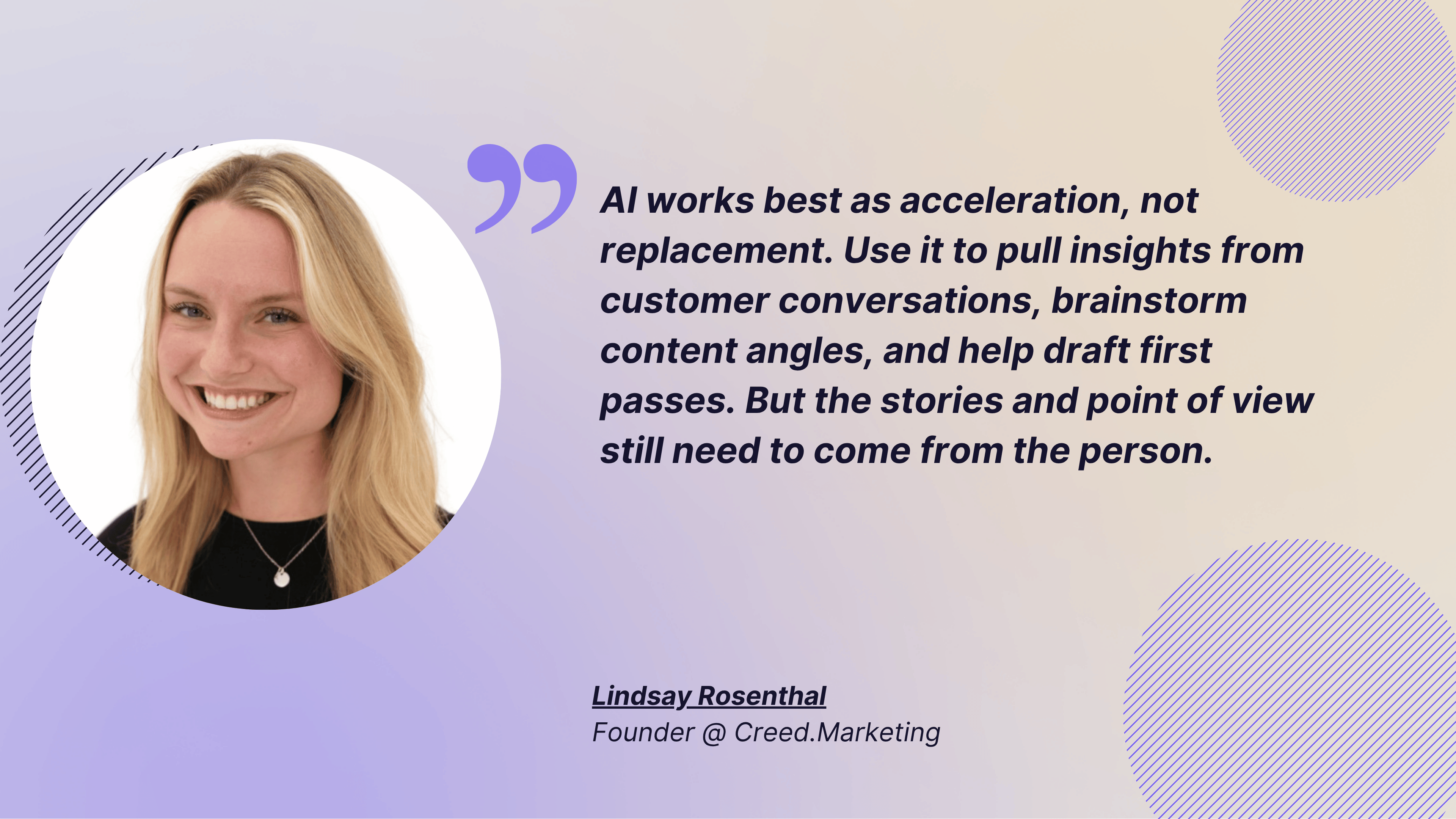
Lindsay Rosenthal, Founder of Creed.Marketing, mentioned this as well:
AI works best as acceleration, not replacement. Use it to pull insights from customer conversations, brainstorm content angles, and help draft first passes. But the stories and point of view still need to come from the person. The content that performs today has a human fingerprint + your own unique taste. AI should make your perspective sharper, not more generic. - Lindsay Rosenthal
The 7 core use cases of AI in social media today
AI is most useful when it solves a specific bottleneck. In practice, that means using AI for social media marketing to draft, classify, summarize, compare, and optimize, then letting the social team decide what should go live. Here are the seven use cases I see matter most.
Content creation
AI helps social teams create social media content faster, but the real win is variation, not volume. I like using AI for social media marketing to draft captions, test hooks, repurpose long-form ideas into short-form posts, and adapt one idea across Instagram, LinkedIn, and Facebook.
A simple workflow works best:
- Start with one approved angle.
- Ask AI for five hook variations.
- Ask for platform-specific captions.
- Convert the strongest idea into a carousel, a short video script, and a LinkedIn post.
- Edit for brand voice before publishing.
AI used in social media should reduce blank-page time, not replace the thinking behind the campaign.
A few examples make the difference clearer:
- On Instagram, AI can turn one webinar takeaway into a carousel intro, a caption, and three story prompts.
- On TikTok, AI can draft three hook options, then reshape the best one into a 20-second script.
- On LinkedIn, AI can convert a product update into an executive-friendly post with a sharper point of view.
Audience segmentation
AI is useful for audience segmentation because it can group people by behavior, engagement patterns, or topic preference faster than a manual review. That gives a social media team a clearer picture of who responds to educational posts, who prefers product stories, and who engages with proof-driven content.
The practical payoff is simple: instead of saying “our audience likes everything,” a marketer can say “our audience splits into three clear groups, and each group reacts differently.” That is much easier to brief, budget, and defend.
Social listening and sentiment analysis
AI makes social listening faster by tagging themes, spotting sentiment shifts, and pulling recurring questions from large comment sets. The goal is not to collect more noise. The goal is to identify what people actually care about and whether a spike in conversation reflects real demand or just a temporary moment.
Here is the distinction I use:
- Signal: repeated pain points, repeated phrases, repeated product questions, or a sustained rise in discussion volume.
- Noise: one-off complaints, or comment spikes with no clear pattern.
That distinction matters because AI used for social media can easily overreact to a single viral post. Manual review still matters when tone is ambiguous, sarcasm is involved, or the topic could affect brand safety.
When I’m setting up listening, I monitor four things first:
- Brand mentions and product mentions.
- Competitor mentions and category comparisons.
- Repeated questions in comments.
- Creator or influencer mentions that shape buyer perception.
For teams building content pillars, AI can also help cluster themes into clear topic groups. That gives the social team a more useful view of what the audience repeatedly rewards.
Performance analytics and reporting
AI is strongest in reporting when the workflow is simple: collect, classify, compare, interpret, and act. That sequence turns raw social media analysis into something that a manager, a board, or a client can actually use.
Here is the workflow I’d use:
- Collect data from each platform.
- Classify posts by theme, format, and campaign.
- Compare performance across channels and competitors.
- Interpret what changed and why.
PS: Socialinsider’s Key insights summary can condense the busy middle of a report into something leadership can read quickly.
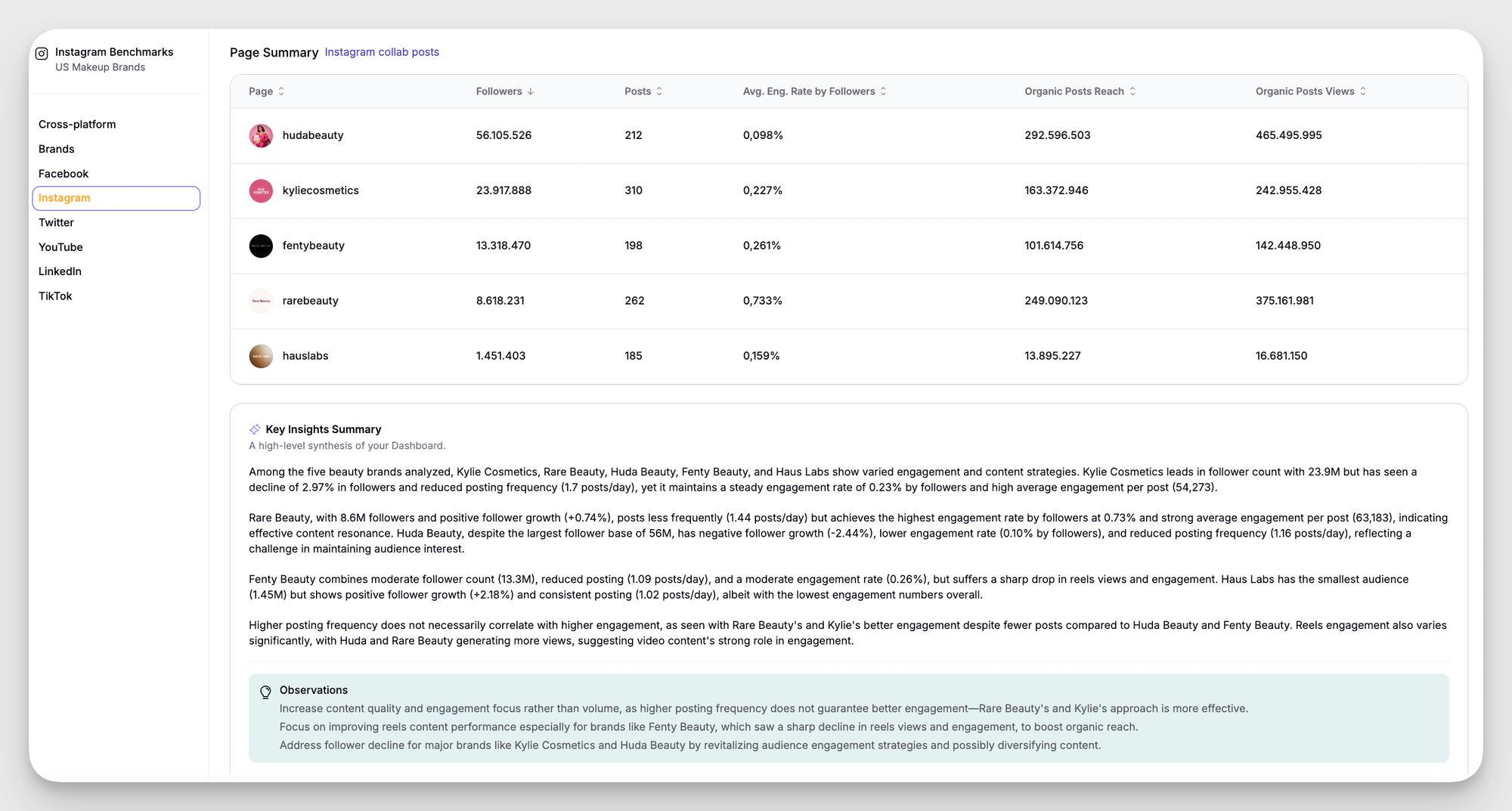
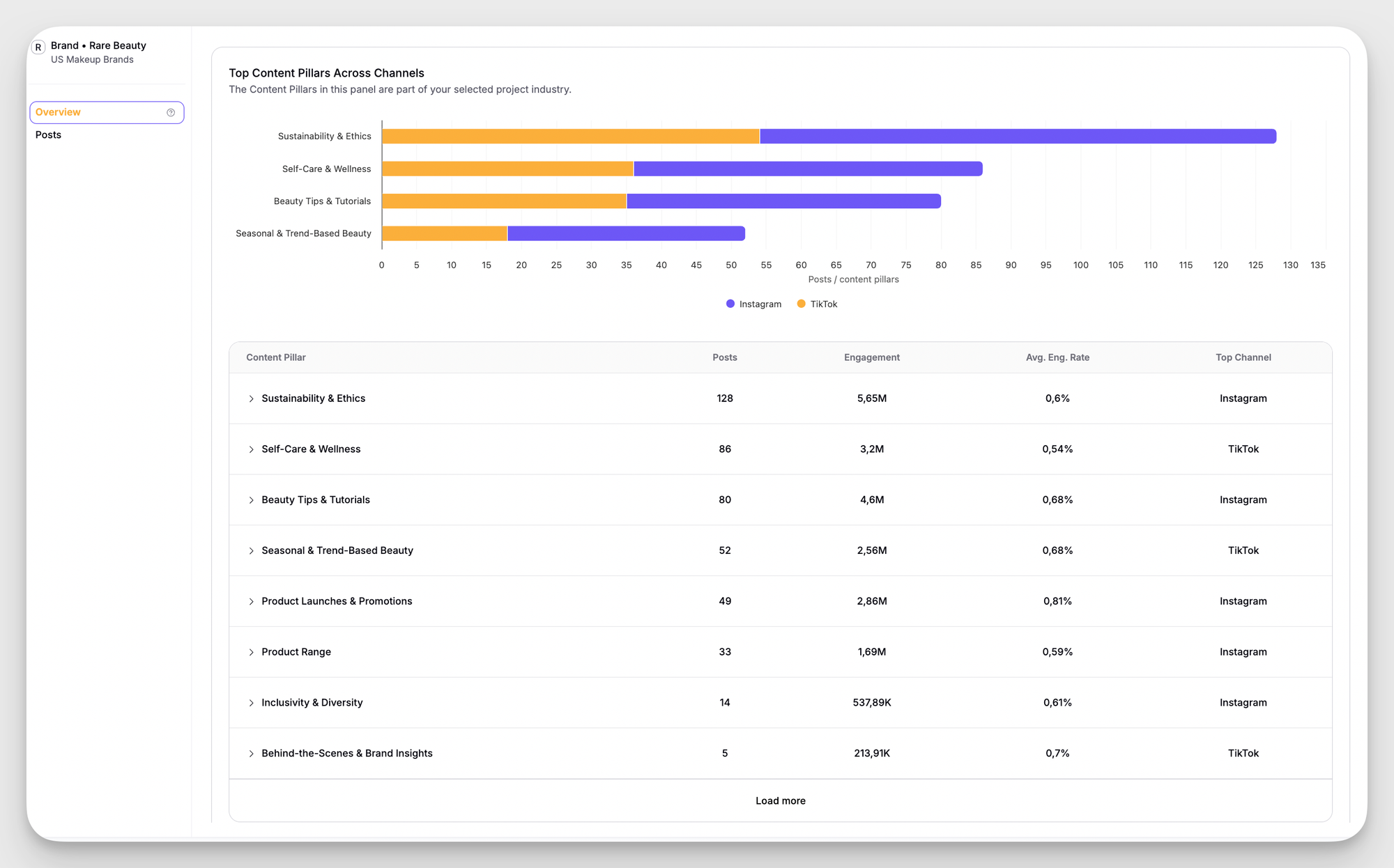
And besides that, its AI-based content pillar analysis can show which themes are actually pulling weight.
- Act with one or two specific recommendations.
If I were building a monthly report, I would ask AI to do three jobs only: summarize the top change, explain the likely cause, and suggest the next test. That keeps the output useful instead of bloated. It also keeps the report closer to decisions, which is where social media metrics matter most.
Trend detection
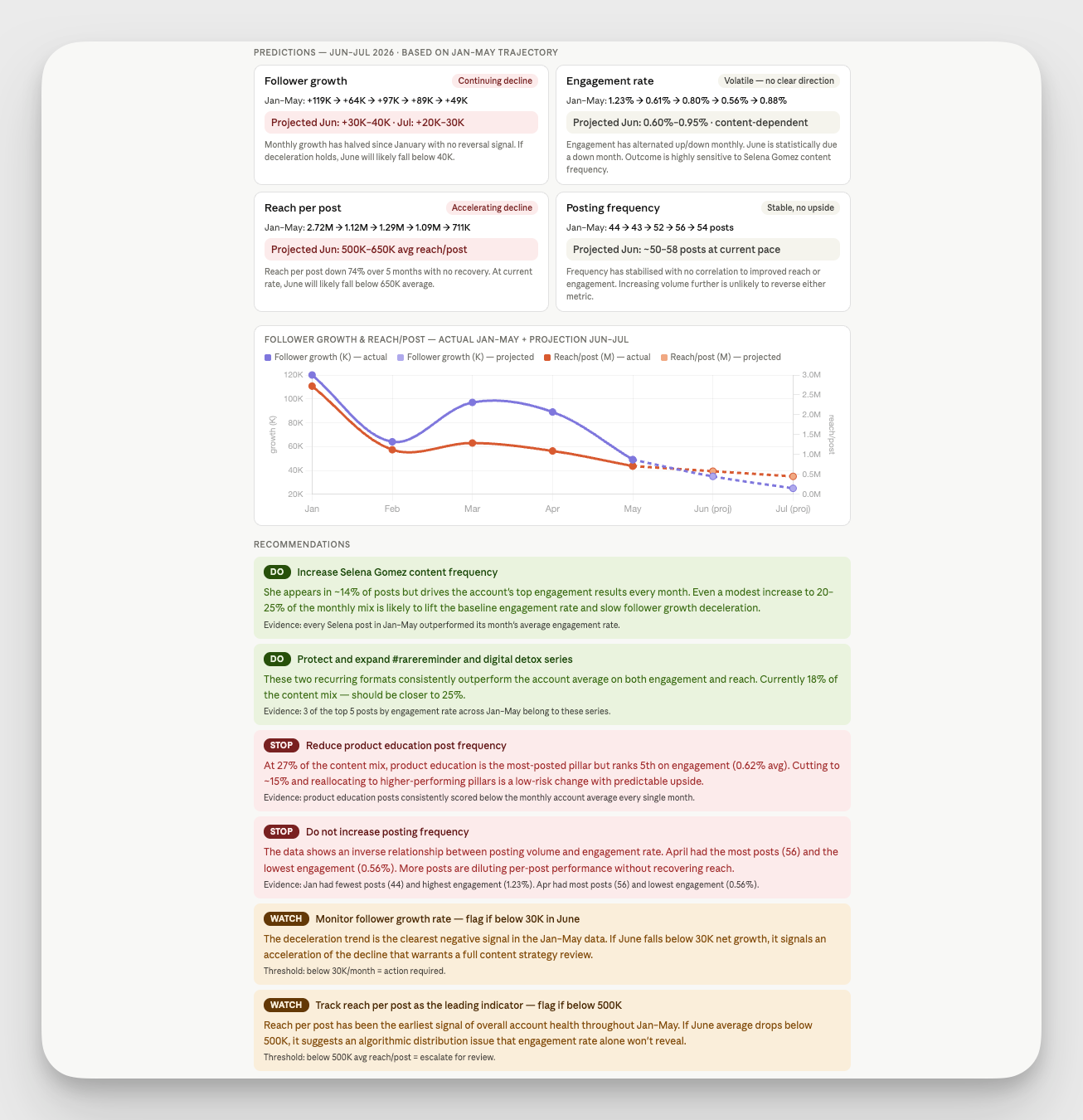
AI helps trend detection by scanning topics, captions, hashtag clusters, and engagement spikes faster than a human team can. The win is speed, but the real advantage is pattern recognition across channels.
I’d use AI for social media here in three ways:
- Build a weekly trend watchlist from recurring topics.
- Compare rising themes against your existing content pillars.
- Flag posts that are climbing unusually fast so a team can respond while the topic still has momentum.
That said, not every trend is worth chasing. A one-day spike can disappear before a content team gets through approvals. Socialinsider’s MCP capabilities can help a team move from manual checking to a more continuous workflow, which matters when trend timing is the difference between relevant and late.
Influencer Discovery
AI helps influencer discovery by filtering for audience fit, content quality, comment sentiment, and posting consistency. That is more useful than chasing follower counts alone, because follower count does not tell a social team whether an influencer actually drives attention or trust.
For example, a creator with modest reach but strong comments may be a better fit than a larger creator with passive engagement. AI can surface that pattern faster, but the decision still depends on campaign goals and brand fit.
A practical screening process looks like this:
- Review recent posts from the last 30 to 60 days.
- Check engagement quality, not just volume.
- Read comment sentiment for fit and authenticity.
- Compare audience overlap with campaign goals.
- Confirm whether sponsored posts still feel native.
This is where AI for social media can save time without replacing judgment. A tool can narrow the list, but the marketer still has to decide whether the creator matches the brand’s tone, timing, and risk tolerance.
Here's some advice from Lindsay as well:
Start with the bottleneck you need to solve, not with the tool. Is the issue idea generation, editing, repurposing, or scheduling? Identify the friction point, then choose the tool that reduces that specific friction. Most people get overwhelmed because they try to adopt everything at once.
Paid social optimization
AI matters in paid social because speed is the main advantage of paid media. If a campaign is underperforming, a social team needs faster signals, better audience segments, and fewer manual reporting loops.
In practice, AI changes paid work in four ways:
- Better audience segments.
- Faster creative testing.
- Clearer optimization signals.
- Fewer manual reporting loops.
That makes social media optimization easier to manage across platforms. AI can suggest which creative variation deserves more spend, which audience cluster is responding, and which ad set needs to be cut before budget is wasted.
A useful way to think about it: AI does not make paid decisions for the team. AI reduces the time between “something is off” and “we know what to change.” That matters when budgets are tight and the next weekly report is already late.
When AI helps most, and when human oversight still matters?
AI helps most when the task is repetitive, data-heavy, or fast-moving. Human oversight matters most when the task affects voice, trust, compliance, or customer perception. The smartest AI and social media teams build clear boundaries instead of assuming every output is ready to publish.
Here are the guardrails I’d keep in place:
- Brand voice review: Every caption, summary, and recommendation should pass through brand guidelines.
- Bias check: Audience segments should be checked for missing groups, weak assumptions, or stereotypes.
- Fact check: Claims, benchmarks, and comparisons should be verified before publication.
- Transparency rule: If AI supports the workflow, the team should know where the machine helped and where a human edited.
The reason this matters is simple. AI can sound confident even when the underlying answer is weak. That is dangerous in social media, where one off-brand post or one lazy summary can weaken trust quickly.
A good way to reduce risk is to use AI for the first pass and humans for the final pass. That keeps the process fast without making the brand sound robotic.
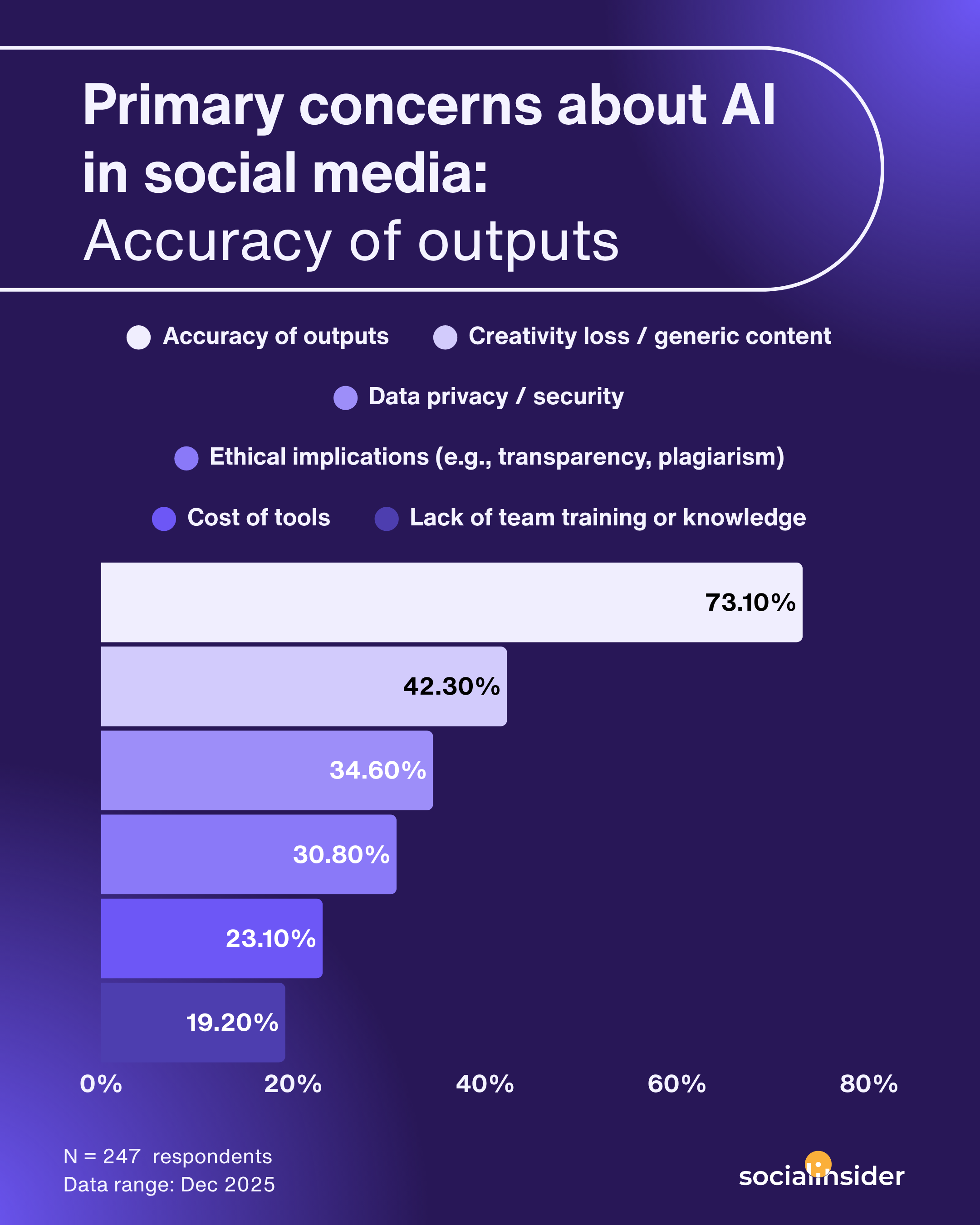
Based on the experience of 247 marketers, Socialinsider's AI usage survey has shown that accuracy of outputs is the number one concern when using AI in social media marketing.
How is AI changing the role of social media teams?
AI is moving social media teams away from manual production and toward interpretation, prioritization, and quality control. The job is becoming less about copying numbers into a deck and more about deciding what the numbers mean.
The new model is more strategic. A social media manager becomes a translator between raw platform activity and business decisions. That means spending less time on spreadsheet cleanup and more time on content direction, executive reporting, and market context.
In practice, AI changes the team’s role in three ways:
- Editor: AI drafts, but the social lead refines tone and message.
- Analyst: AI summarizes, but the marketer decides what changed and why.
- Strategist: AI surfaces patterns, but the human chooses the next move.
From what I've seen from our clients, teams often adopt AI tools when board reporting by screenshots and Excel breaks down, or when competitive benchmarking becomes too manual to trust, for example.
AI adoption stages: from experimenting to scaling
AI adoption usually starts small and gets more valuable as the workflow matures. The smartest teams do not try to automate everything at once. They move from experiments to repeatable systems.
This is where using AI for social media marketing becomes a process rather than a prompt. A team that starts with one task, such as repurposing a LinkedIn article into five post variations, can later expand into sentiment analysis or reporting automation.
How to build an AI-ready social media stack?
An AI-ready stack should reduce friction, not add another layer of complexity. If a tool creates more manual work than it removes, the stack is not ready yet.
For example, I’d choose specialized AI social media analytics tools when reporting, benchmarking, or cross-channel comparison starts taking too long. That is where a platform like Socialinsider earns its place. A social media leader who used to spend hours stitching together screenshots can use automated summaries to produce a cleaner narrative faster.
Final thoughts
AI in social media works best when it makes the work clearer, faster, and more measurable. The teams that get the most value use AI to remove repetition, sharpen reporting, and support better decisions, while still keeping people in charge of voice and strategy.
If the next bottleneck is reporting, benchmarking, or content pillar analysis, start there first. A platform like Socialinsider can help turn AI for social media from a loose idea into a workflow your team can trust, scale, and actually use in the next meeting.
FAQs on AI in social media
What is AI in social media marketing?
AI in social media marketing is the use of machine learning, language models, and pattern detection to support content creation, audience analysis, reporting, listening, and ad optimization. The best AI in social media marketing keeps humans in control of strategy, approvals, and brand voice. AI should speed up work, not replace editorial judgment.
Anda Radulescu
Content writer & copywriter with a 5-year track record in digital marketing. Equal parts keen observer & committed go-getter. A proud cat mom with a passion for music & exploring the world.

Know what your competitors do — before your manager asks
Get instant social benchmarks & reports without manual work.