How to Conduct a YouTube Channel Audit: A Guide Packed With Expert's Insights
Learn how to conduct an insightful YouTube channel audit to evaluate performance and discover how you stack up against your competitors!


You’re creating banging content on YouTube. With time, you see your views and subscribers increasing. Woohoo.
But here’s what hit me the other day while reviewing my YouTube channel - I was celebrating subscriber growth while completely ignoring that my average view duration had dropped by 40%. The numbers looked good on the surface, but people were clicking away faster than ever.
That’s the thing about YouTube audits - they’re either surface level vanity metric checks or overwhelming spreadsheet nightmare. As a marketing manager or a content creator, you need to know how to properly audit your YouTube channel and understand what’s working and (what’s not).
In this article, I’ll walk you through the exact process I use to conduct YouTube channel audits and what you should look for.
Key takeaways
-
Deep dive into channel performance metrics: Look beyond week-to-week fluctuations and focus on longer-term trends to understand whether your channel is truly growing or slowly losing momentum.
-
Perform a content analysis: Step back and review all your videos to spot clear patterns in what your audience consistently loves — and what keeps missing the mark.
-
Start an audience analysis: Get clear on who’s actually watching your videos and how they find you, so you’re creating content for real people, not assumptions.
-
Run an SEO and discoverability analysis: Make sure your videos are easy to find by optimizing titles, descriptions, captions, and playlists for long-term search visibility.
-
Benchmark performance against competitors: Compare your growth and engagement with similar channels to understand where you’re ahead, where you’re falling behind, and what you can learn from others.
-
Compare performance against other video channels: Look at how your content performs across platforms to understand each channel’s role and avoid blindly reposting the same content everywhere.
-
Create a strategy optimization plan based on the insights you found: Turn everything you’ve learned into clear priorities, focusing first on quick wins and then on bigger strategic changes you can test and refine over time.
How to gather the data for your YouTube performance audit?
Without solid data, you’re just shooting in the dark. Before you start your YouTube audit, collect data from two key sources.
Use the platform’s native analytics for content and channel metrics
YouTube studio is an excellent starting point. I always begin here because you get all the basic channel performance data - from watch time and subscriber growth to traffic sources and audience demographics.
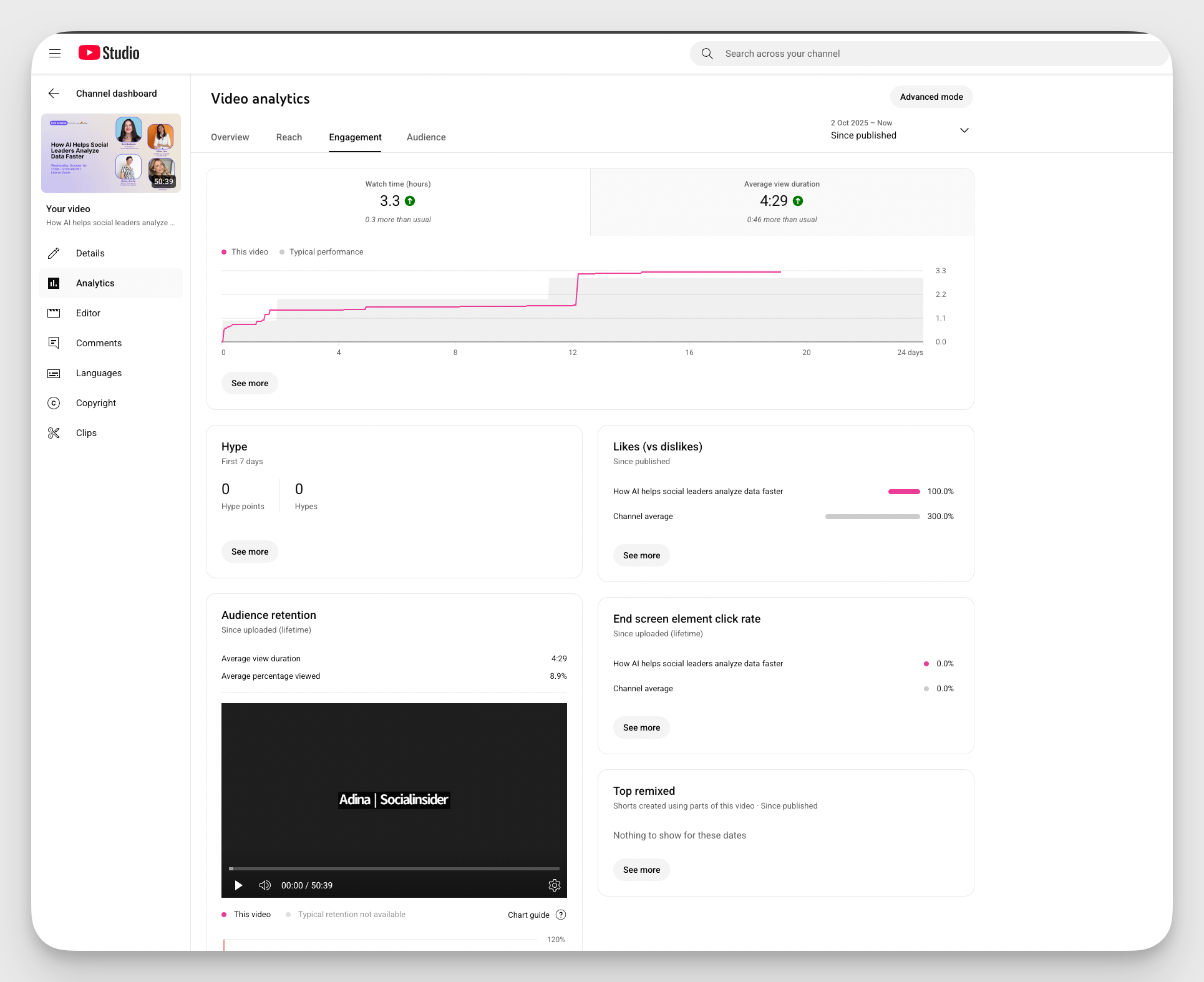
Navigate to YouTube Studio > Analytics.There are four different tabs, each giving you an overview of your performance data.
- Overview: Shows views, watch time, subscribers, and estimated revenue (if monetized)
- Reach: Impressions, click-through rate (CTR), traffic sources, and how viewers found your videos
- Engagement: Watch time, average view duration, top videos, and audience retention graphs
- Audience: Unique viewers, returning vs. new viewers, when your viewers are on YouTube, subscriber demographics, and top geographies.
Leverage a third-party tool for competitive benchmarking to add context to your data
While native tools provide a comprehensive picture of your performance data, third party tools like Socialinsider dive deeper and stack your performance against your competitors.
Socialinsider’s YouTube audit feature lets you benchmark your metrics against other YouTube channels in your industry and add context to your data.
How to conduct an effective YouTube audit?
Here’s how I conduct an effective audit for my YouTube channel.
Deep dive into channel performance metrics
First things first, understand your YouTube channel performance metrics.
Look at overall channel health indicators:
Subscriber growth trends (monthly/quarterly/yearly)
Don’t just look at the rising subscribing numbers - track your subscribers growth rate. I’ve seen channels gain 1000 subscribers one month and feel great, only to realise their growth rate actually slowed compared to the previous quarter.
A slowdown may indicate that your content is getting stale or the algorithm is affecting your reach. If you’re losing more subscribers than you’re gaining, look for videos that are causing this and find out why. You can also find out ‘Videos that gained the most subscribers’ on your Audience’s tab to double down on what’s working.
View velocity and watch time patterns
View velocity is how quickly your video gets views after it’s published. It shows how much your audience awaits your videos. And YouTube algorithm rewards videos that keep viewers hooked for longer with better reach.
Run an engagement rate analysis:
Do you have passive viewers or an active, engaging community on YouTube? Your engagement rate tells all.
Track these key engagement metrics to understand how your content is resonating with your audience:
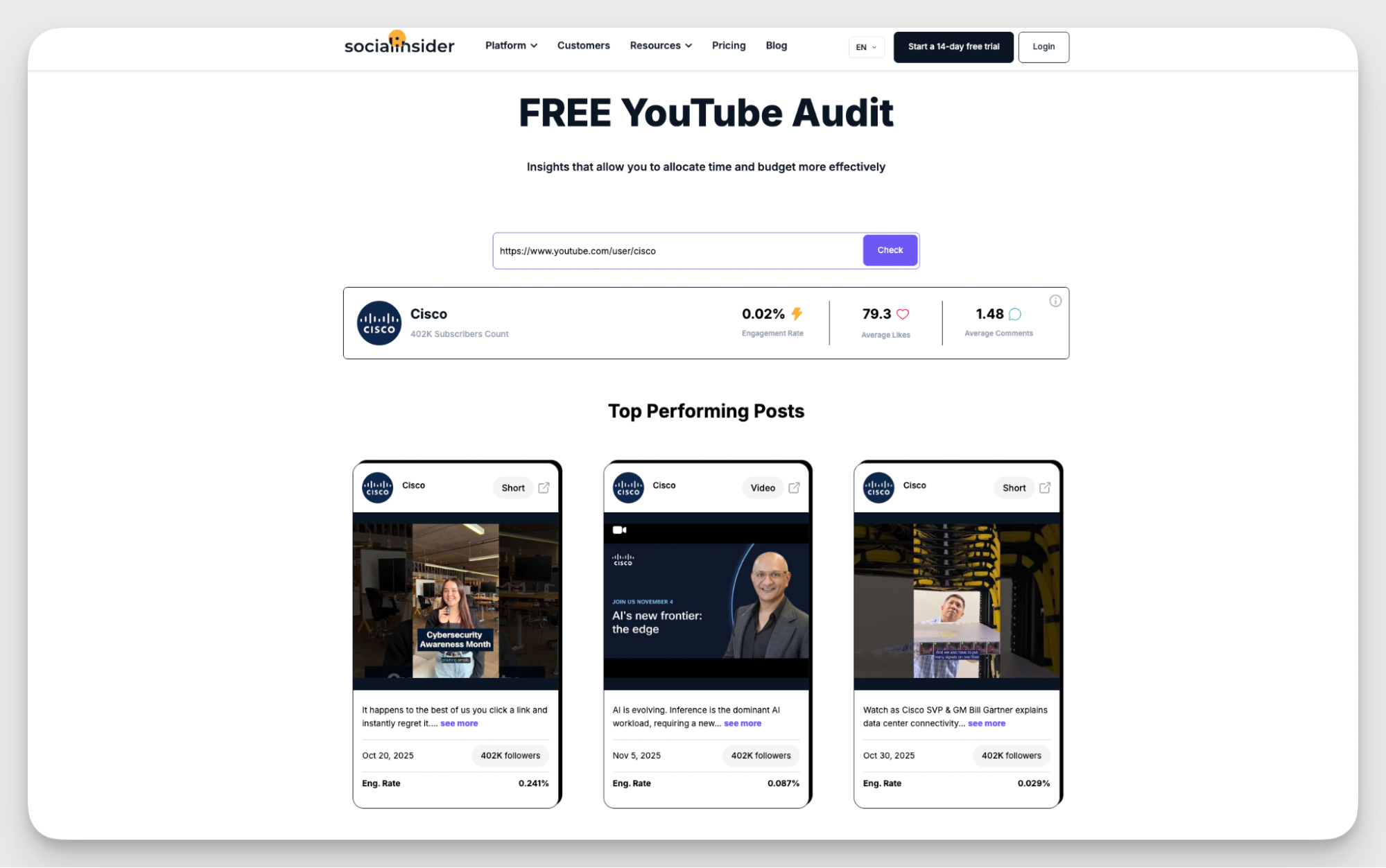
- Likes, comments, shares per video. You can also use Socialinsider’s free YouTube Audit tool to track these YouTube video metrics.
- Click-through rates (CTR) on thumbnails. This is the percentage of impressions that turned into views.
How to spot red flags
The following warning signs appear gradually, which is why frequent content audits are essential.
- Declining engagement rates (even as views stay steady): Your content is no longer resonating. Time to refresh your content approach and make it more engaging.
- Click-through rate (CTR) dropping: Your thumbnails and title aren't compelling enough to hook your audience in.
- Average view duration is less than half of your video length: People are clicking on your content but leaving quickly. Your content isn’t keeping them hooked.
- Stagnant subscriber growth over months: People are watching your videos but not subscribing. You need stronger CTA (call-to-actions).
- Consistent audience drop-off patterns: If your audience is dropping off at the same point in most of your videos (usually within the first 30 seconds), time to analyze why.
Perform a social media content analysis
Instead of thinking ‘how my channel is doing’, start thinking ‘how my content is doing’. Hunt for patterns - what’s consistently getting great response and what's flopping - and why.
Identify top and bottom posts
Not all content is the same. Some types of content consistently perform well and some always tank. The trick is finding out why.
When starting your audit, content strategist Nia Patel recommends looking at your entire content history first:
You need to have a look at all of the videos that you've created so far which ones have been your best performers, which ones didn't do so well and dive into that a little bit more so look at your best performers why do you think they perform so well and what was it that the audience enjoyed.
Ask yourself:
- What type of content is consistently performing well (in the top 10)? Vlogs vs product reviews vs informational long-form content?
- What’s your video length sweet spot? 60 seconds vs 5 minutes vs 10+ minutes?
- Are collaborations outperforming solo content?
- Is production quality making a difference?
With content auditing tools like Socialinsider, you can tag your content and make this analysis at a content-pillar level.
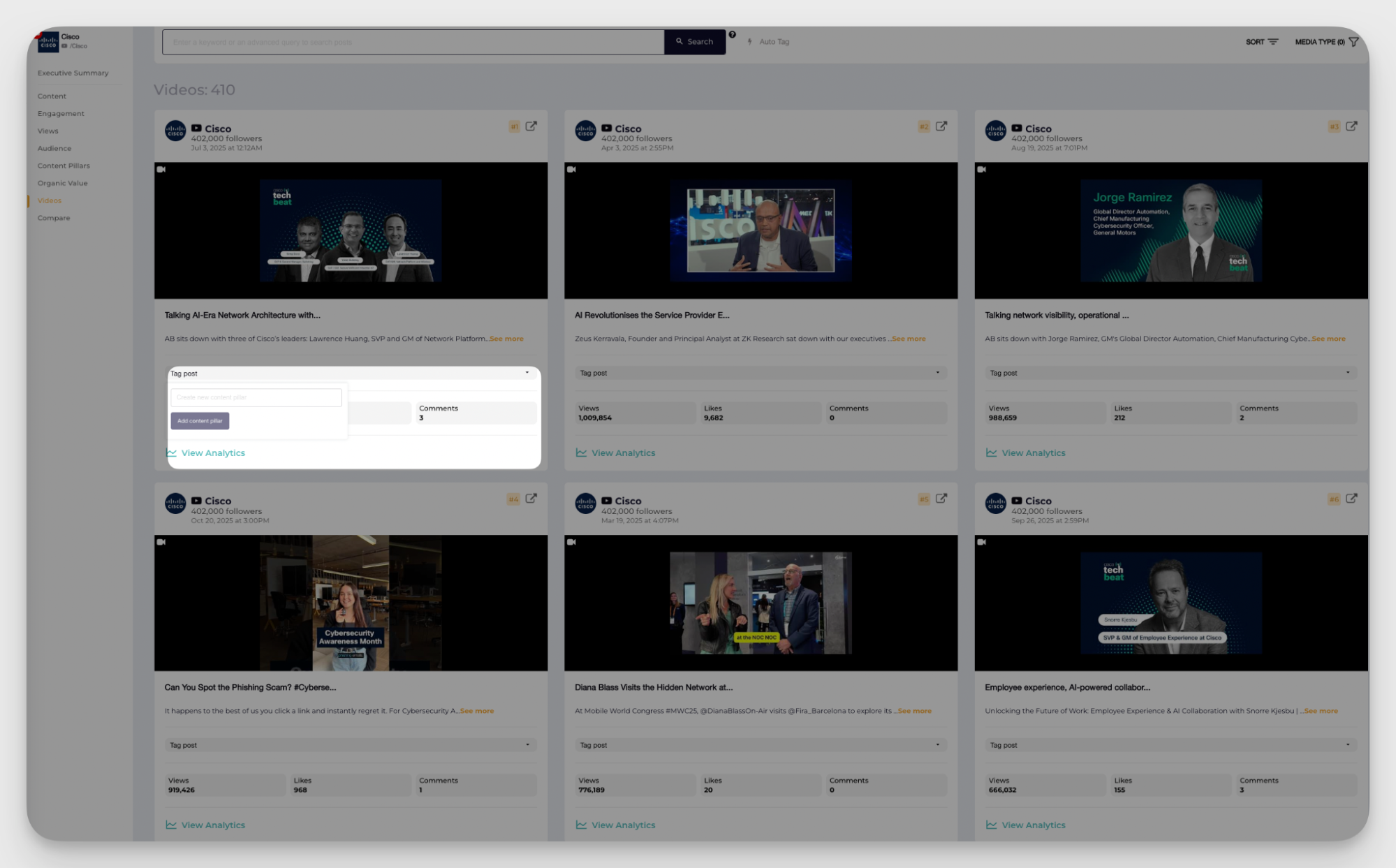
Analyze thumbnail and title effectiveness:
You only have a couple of minutes to capture your audience’s attention. According to YouTube, 90% of the best-performing videos have a customized thumbnail for this very reason - to instantly compel their viewers to click on the video.
Nia Patel emphasizes the importance of YouTube's built-in testing features:
Th great thing with YouTube analytics, is that they have a lot more AB testing features that brands and creators should definitely be making use of.
So, here’s what you should dig into:
- Check for visual identity across thumbnails: do your top performing videos share similar thumbnail designs?
- Look at what’s working and what’s not in terms of CTR: Identify patterns in high CTR thumbnails like colours, text placement and font, contrast, etc.
Run a YouTube Shorts performance analysis:
Don’t treat Shorts like a mini-video or a snippet of your existing videos. They’re a different format and used for different purposes - exposing your channel to new audiences, testing hooks, and boosting overall channel visibility.
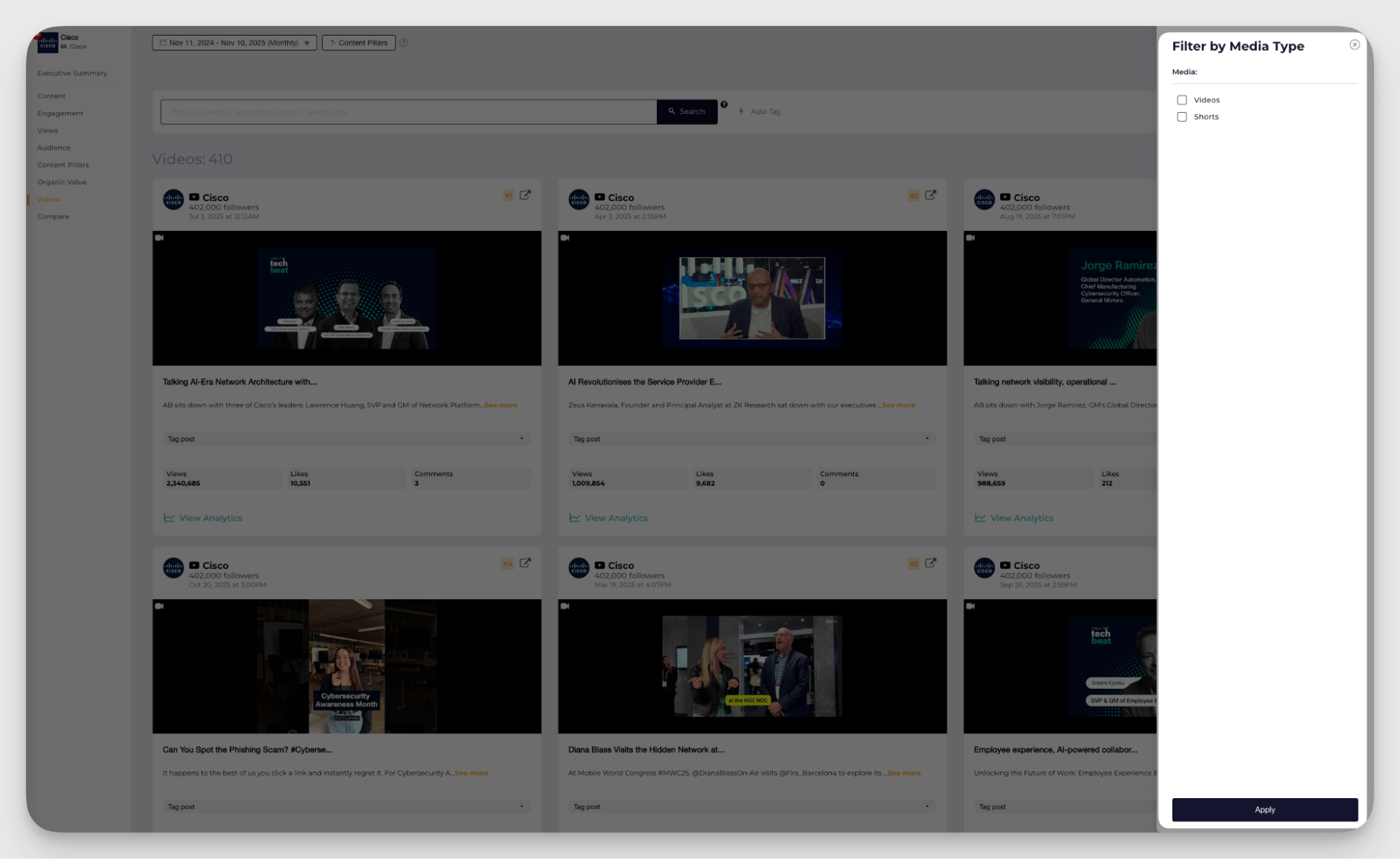
It's crucial to understand that YouTube Shorts operates differently from other platforms. As Nia Patel explains:
The way that trends work on YouTube Shorts is very different to Instagram and TikTok. If a trend on TikTok is taking off, you can create it for TikTok, obviously. You could maybe cross-pollinate it to Instagram as well, depending on the trend and if it's taking off on Instagram as well, great. But you can't do that for YouTube. YouTube Shorts has its own separate algorithm, and you need to be creating content with that in mind.
This means your Shorts strategy needs to be platform-specific, not just recycled content from other channels.
In a YouTube Shorts performance audit, measure,
- Views per Shorts: Usually higher than long-form content (even 10 x to 20 x higher at times).
- Engagement rate: Typically lower than long-form video.
Start an audience analysis
Your audience isn’t one person - it’s a collection of different people with different behaviors, patterns and even discovery patterns. Before you start creating content, you need to understand who watches it and how they find it.
Demographics data:
Your demographics data tells you who you're reaching - is it exactly who you're targeting or is there a disconnect?
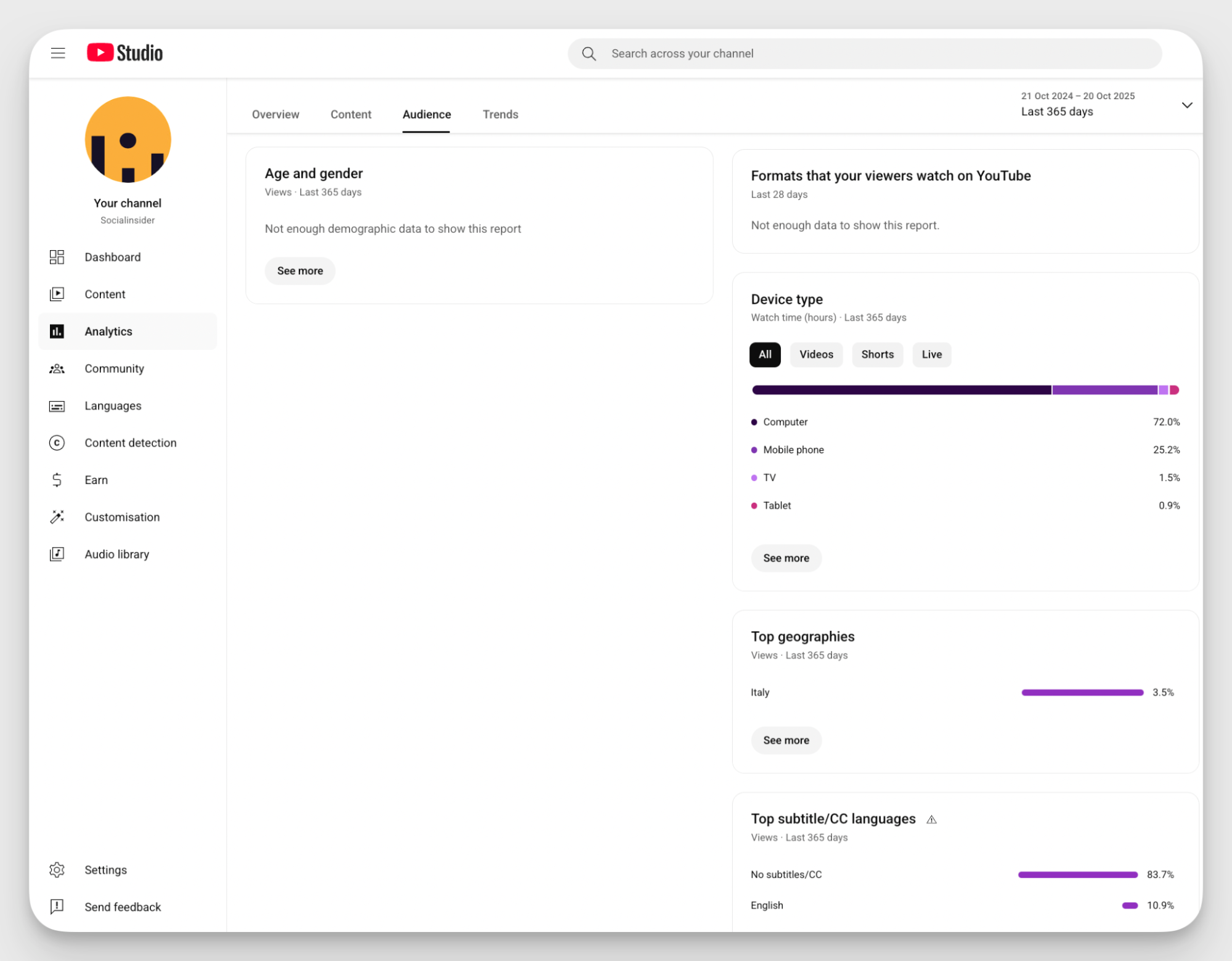
When analyzing demographics, look for:
- Age (Gen Z or millennials?)
- Gender (helps you use the right language in your videos)
- Geographic areas for localization
- Subtitle languages
Understanding your audience is critical, especially if you’re considering a content shift.
Nia Patel offers an important perspective on YouTube's unique audience dynamics:
On YouTube, people are subscribing to you for the content. If you're, maybe if you're creating a vlog channel, it might be slightly different, but if you're creating standard talking head videos like this or a podcast, people are following you for that content. So you need to be, especially on YouTube, the audience is always first
This is fundamentally different from platforms like Instagram or TikTok where people follow you for your personality. On YouTube, if you shift your content focus dramatically - say from fitness workouts to career advice - it's natural that you'll lose subscribers because you're no longer creating for that particular audience subset.
And Nia notes that rebranding on YouTube carries more weight than on other platforms:
There's a lot more pressure on YouTube for it to rebrand in the sense that if you want to rebrand, there's a lot more pressure and a lot more sensitivity around rebranding on YouTube than it is, than there is on other social platforms.
On platforms like Instagram, for example, if you wanted to rebrand, you just switch up your content, nobody notices a difference. Because you have that connection with your community, it's a lot deeper.
Viewer behavior patterns:
How your audience finds you shows you how your distribution strategy is working.
Analyze traffic sources,
- External: Traffic from social media, websites, or direct links. This indicates strong off-platform promotion.
- Direct: Your SEO is working and people are finding you through search queries.
- Suggested videos:YouTube's algorithm is recommending your content alongside related videos.
- Browse features: Your thumbnails and titles are working and people are clicking from their homepage or subscription feed.
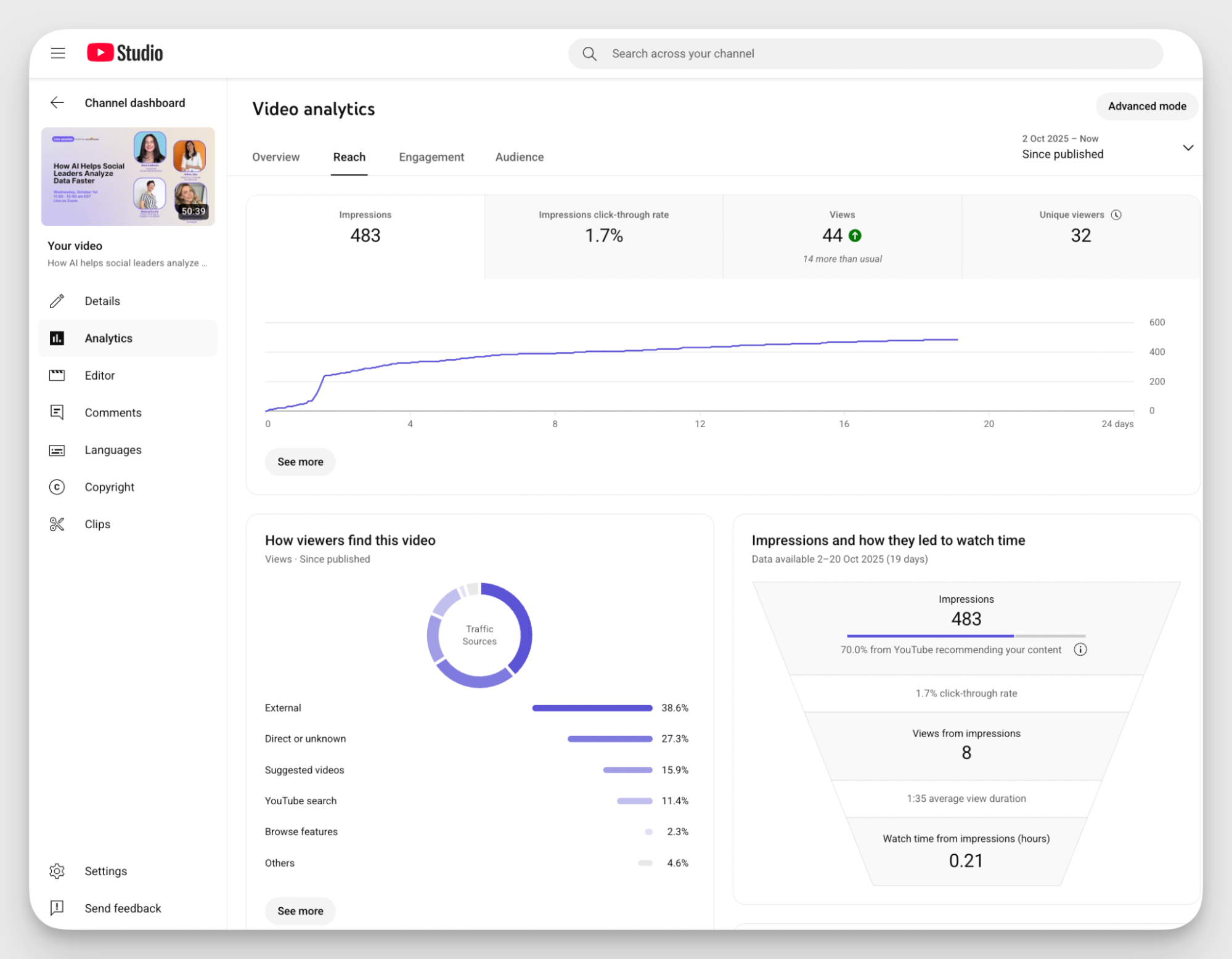
If you're getting all your views from one source, optimize it further but also diversify. Reliance on one source is risky.
Run an SEO and discoverability analysis
YouTube processes over 3 billion searches every single day, making it the second-largest search engine. And search traffic compounds with time. If you’re getting 100 views in the first month, you can easily get 10k views for the same video in the sixth month.
This is free ongoing traffic that smart marketing managers capitalise on.
Start by analyzing your current search performance. Where are you getting most of your traffic from? Is your traffic growing or tanking? Are you ranking for the keywords you want to rank for?
Next, fix the following elements:
- Audit your video meta-data: Your video’s meta-data consists of 3 important elements - title, description, and tags.
Add your primary keyword in the first 40 characters of your title. The first 150 characters of the description matter the most to YouTube’s algorithm, so keep it targeted with your primary keywords + what viewers can learn from the video. Add 5 to 8 simple tags that are a variation of your title and keywords.
- Optimise captions: YouTube can read your captions to discern what your video’s all about. So don’t rely on auto-captions and fix all the details like technical terms, brand names, numbers, and acronyms that YouTube butchers.
- Put time stamps and use end screens: Add time stamps in your video as youTube shows these in search results and link to a couple of your similar videos at the end.
- Do keyword research: Use YouTube’s search engine to see which videos pop up for your keywords. They’re also a great place to identify content gaps and jump on trends.
I also use Google Trends and paid tools to dive deeper into keyword search for my channel.
- Organize your Playlist and Channel: Organise your videos into playlists and give each playlist keyword-rich title and a compelling description. Add a channel trailer to your channel description and all the right keywords and relevant links to help with discoverability.
I conduct a simple SEO and discoverability analysis every month and a comprehensive one every quarter. I refresh descriptions on my best videos, update thumbnails if needed, and add new timestamps.
Look for red flags like search impressions dropping for 3+ months or if you’re getting less than 10% traffic from search - these are signs you need to work on the SEO part of your video and channel.
Benchmark performance against competitors
This is the part of your audit where you see how you stack up against your competitors. Is your social media content strategy working? Are you missing important content trends or keywords?
Compare top performance metrics
These core video metrics tell you if you're falling behind your competitors, keeping up with their pace, or pulling ahead of the game.
Subscriber growth rates comparison
Are you gaining followers faster or slower than your competitors?
I use tools like Socialinsider to track competitor growth. Calculate your monthly growth rate and then compare it against 3 to 5 competitors with similar audience sizes on YouTube.
Analyze:
- If competitors are growing faster, what content are they publishing?
- Are they posting frequently or at different posting times than you?
- Do they have better subscription CTAs?
Average views per video benchmarks
What is the normal average view per video in your industry?
Use tools like SocialInsider to check the average view per video in your industry and how you stack up.
Engagement rate positioning
Who has the most interactive audience?
Calculate your competitors engagement rate and compare it against yours. If they have a higher engagement rate, what are they doing differently?
- Are they responding to commentators instantly?
- Do they have a strong CTA that drives engagement in the comments section?
- Are they using other marketing channels to drive conversations back on YouTube?
Perform a content gap analysis
This is where you find untapped content opportunities.
Identify topics competitors cover that you don't
Use a tool like Socialinsider to map out what’s working for your competitors that you’re not leveraging.
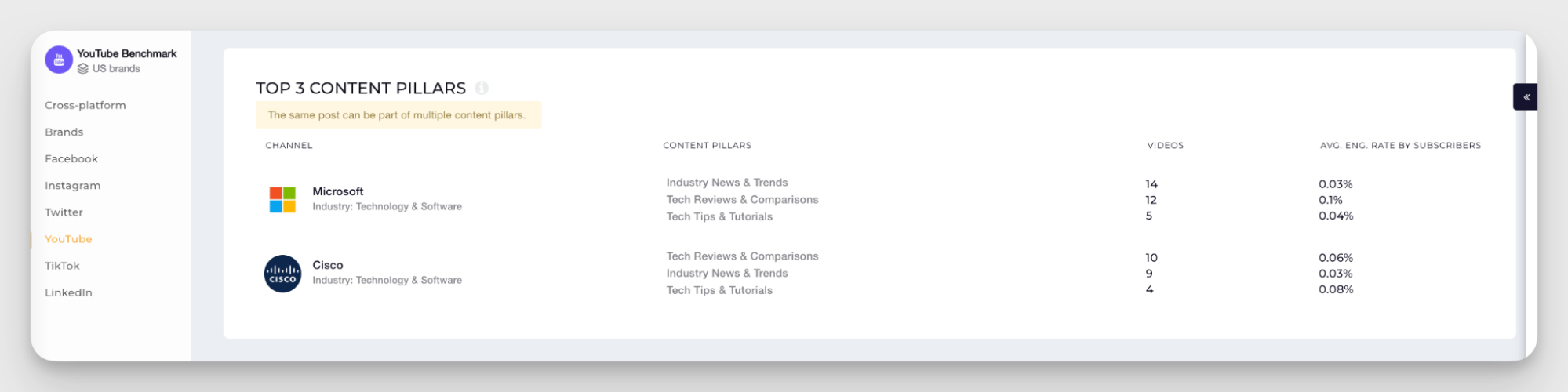
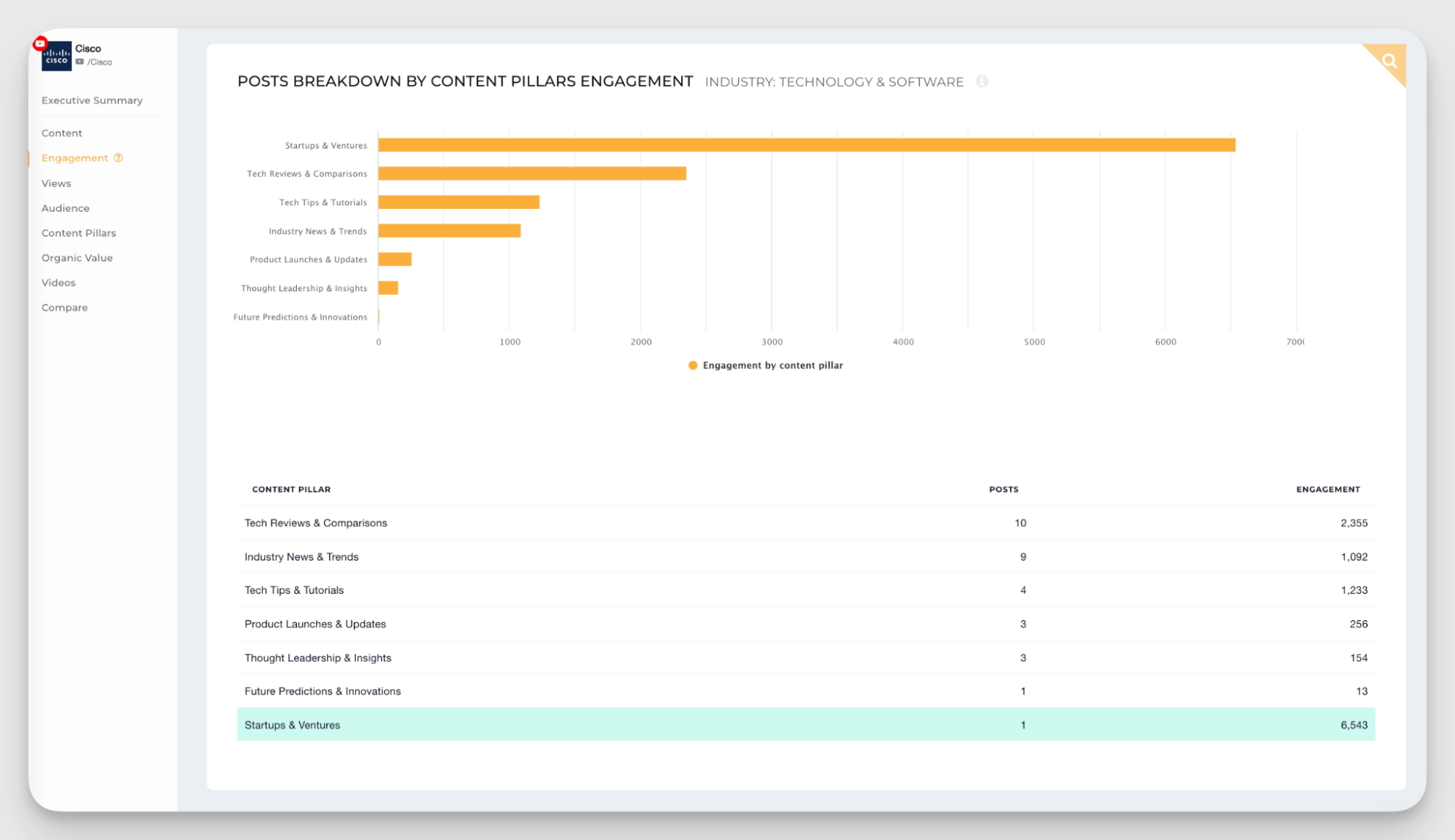
For example, here are Cisco’s content pillars and the results they generated over the past 6 months. With only one post from the Startup content pillar, Cisco generated the highest engagement. A single video outperformed dozens from other categories.
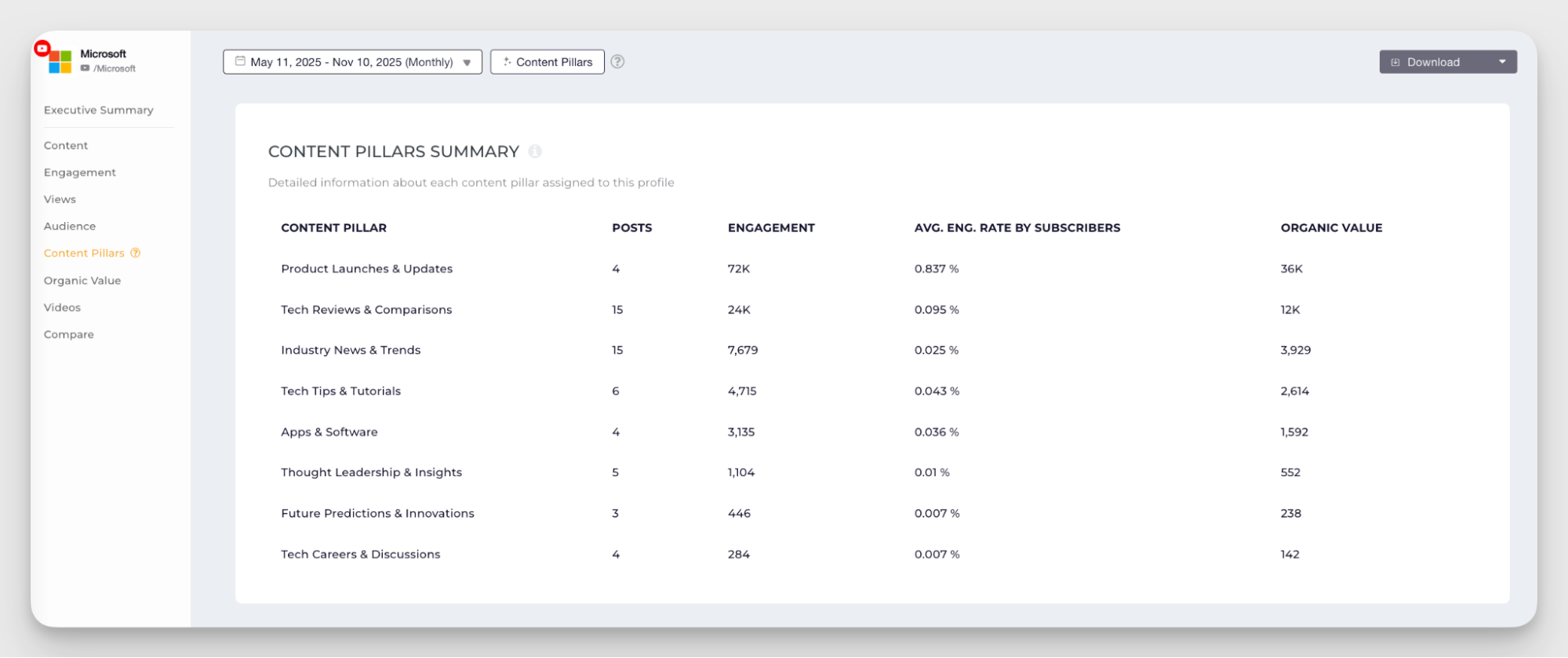
Meanwhile, Microsoft doesn’t leverage the Startup content pillar at all. Based on Cisco’s data, that’s a massive untapped opportunity.
Discover opportunities for differentiation
Even when brands create content for similar content pillars, the type of content they create can vary massively. And this is where you can shine.
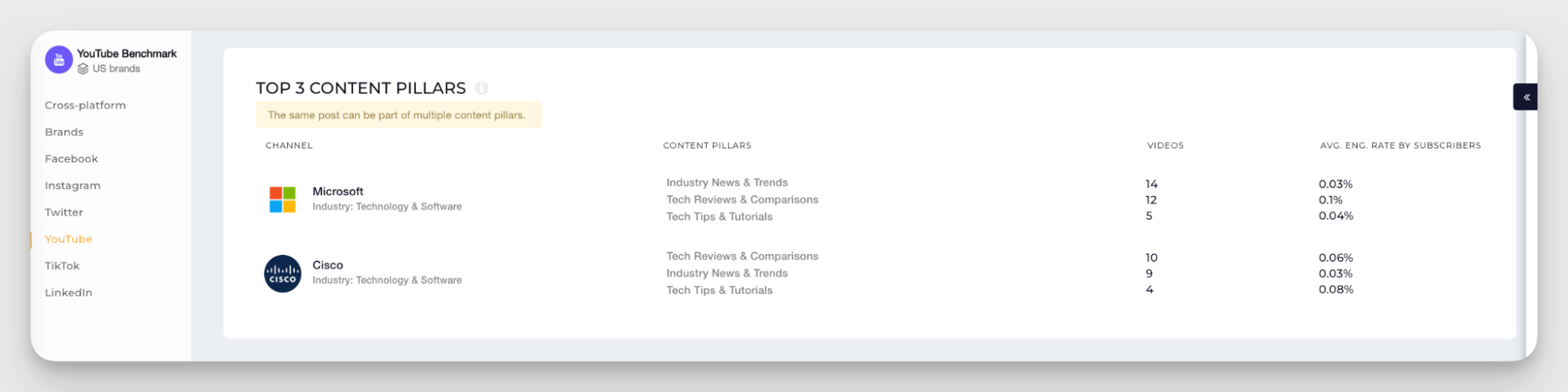
For example, while Cisco and Microsoft have similar top 3 content pillars (technology, innovation, company culture), their top-performing posts look completely different.
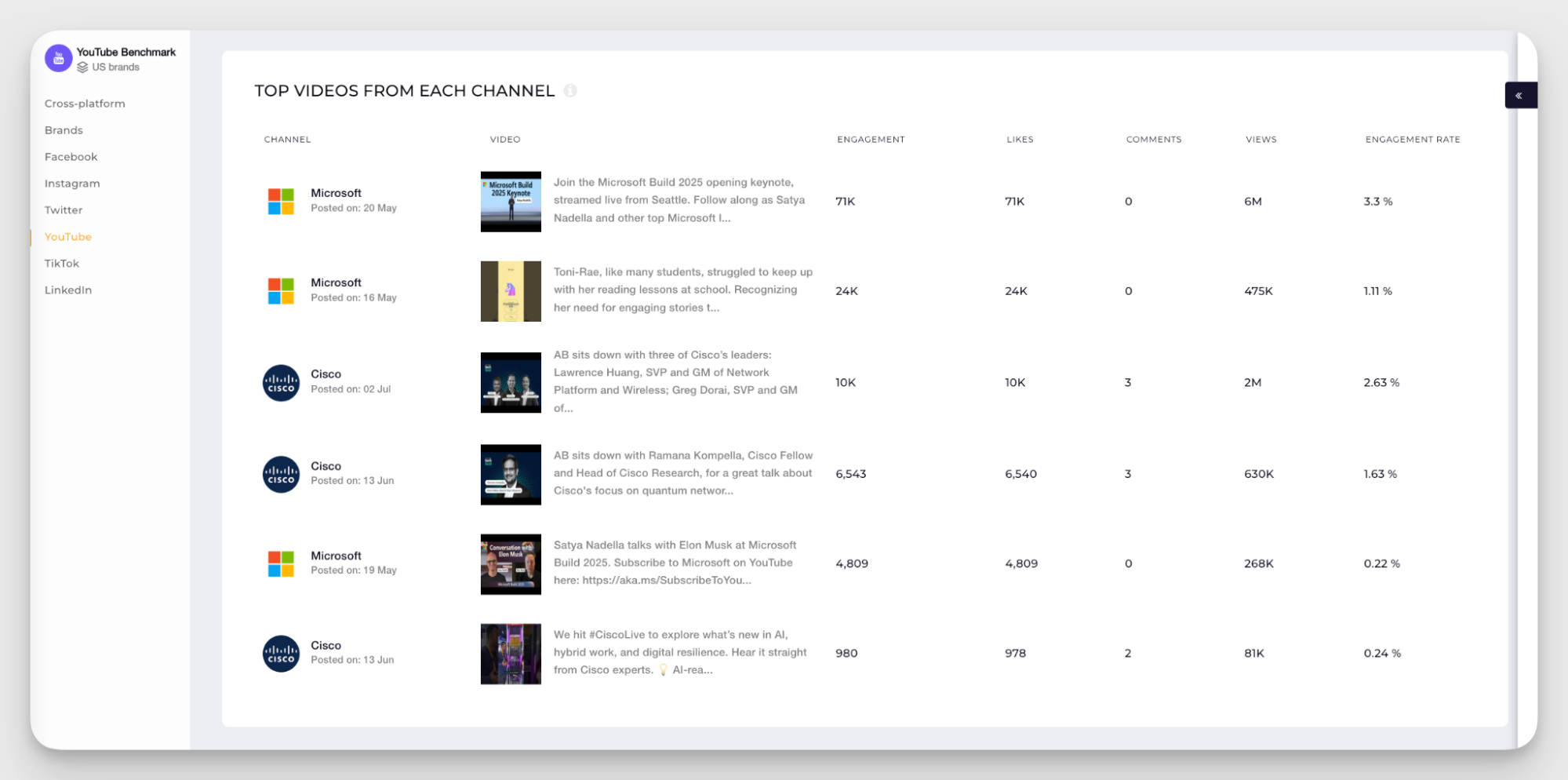
Cisco’s top 3 focus on emotional storytelling with real-world impact, Microsoft’s top 3 posts are more technical in nature and feature product announcements and demonstrations.
Find differentiation opportunities by asking yourself the following questions.
- Can you change the presentation style and add a more casual/formal tone than your competitors?
- If competitors are creating surface-level content, can you go deeper?
- Can you create YouTube Shorts on topics competitors haven't tackled yet?
Keep asking yourself, how can you do better than your competitors.
Compare performance against other video channels
YouTube doesn’t exist in isolation. According to Omdia's 2025 consumer survey, 92% of TikTok users engage with YouTube every month. So your audience overlaps significantly across most social channels.
Understanding where the same content performs differently reveals platform-specific strengths and helps optimize resource allocation.
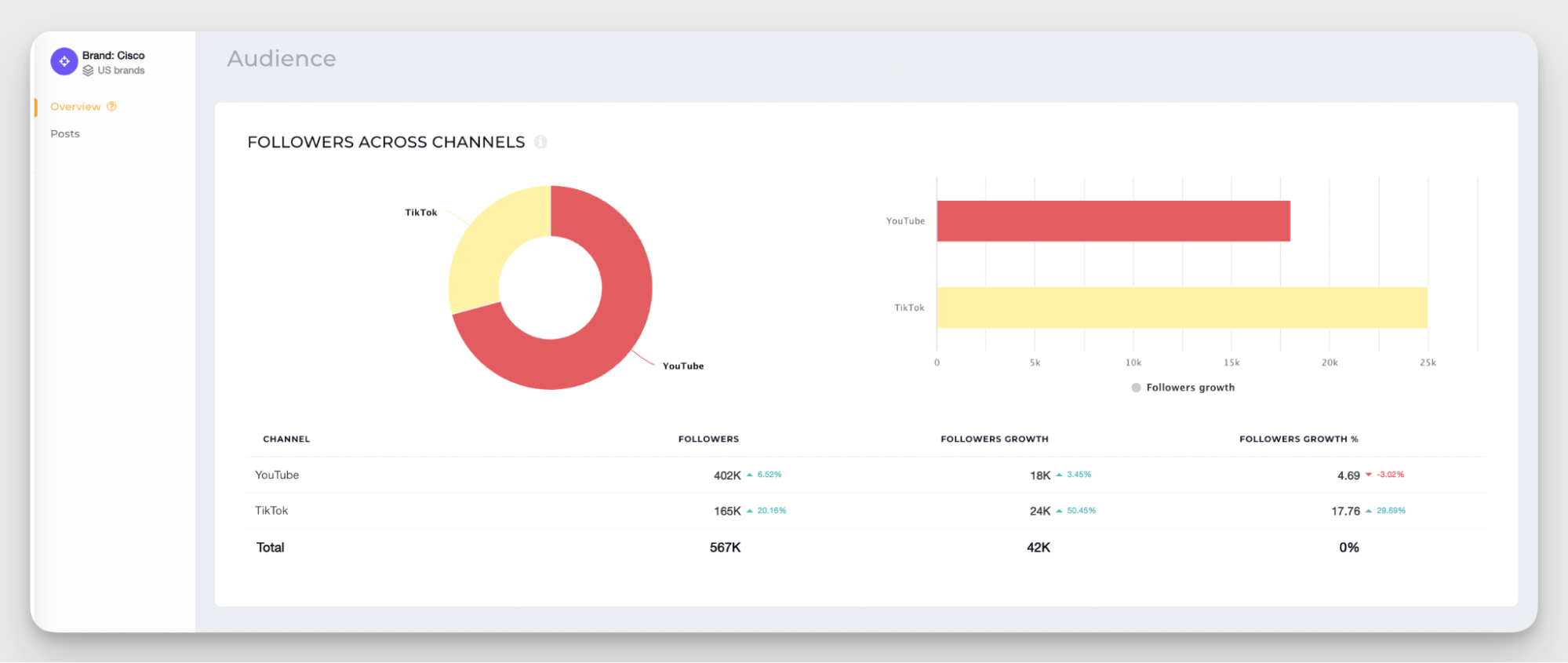
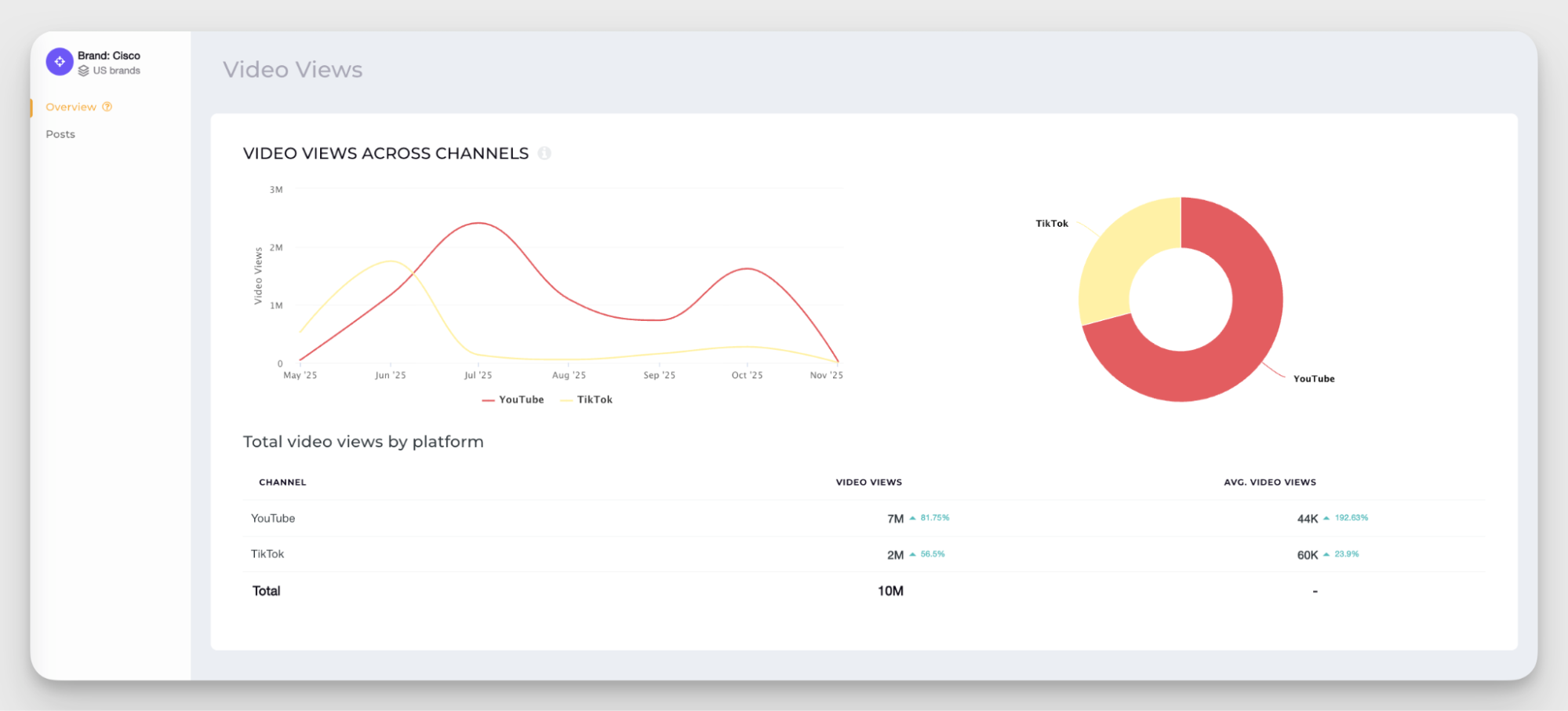
For example, while Cisco has 3x more followers on YouTube than TikTok, the average video views on TikTok are higher than YouTube. This shows that Cisco uses TikTok primarily for brand awareness and top-of-funnel, while YouTube helps with mid-to-bottom funnel education and conversions.
But remember, as Nia Patel cautions, you can't simply duplicate content across platforms:
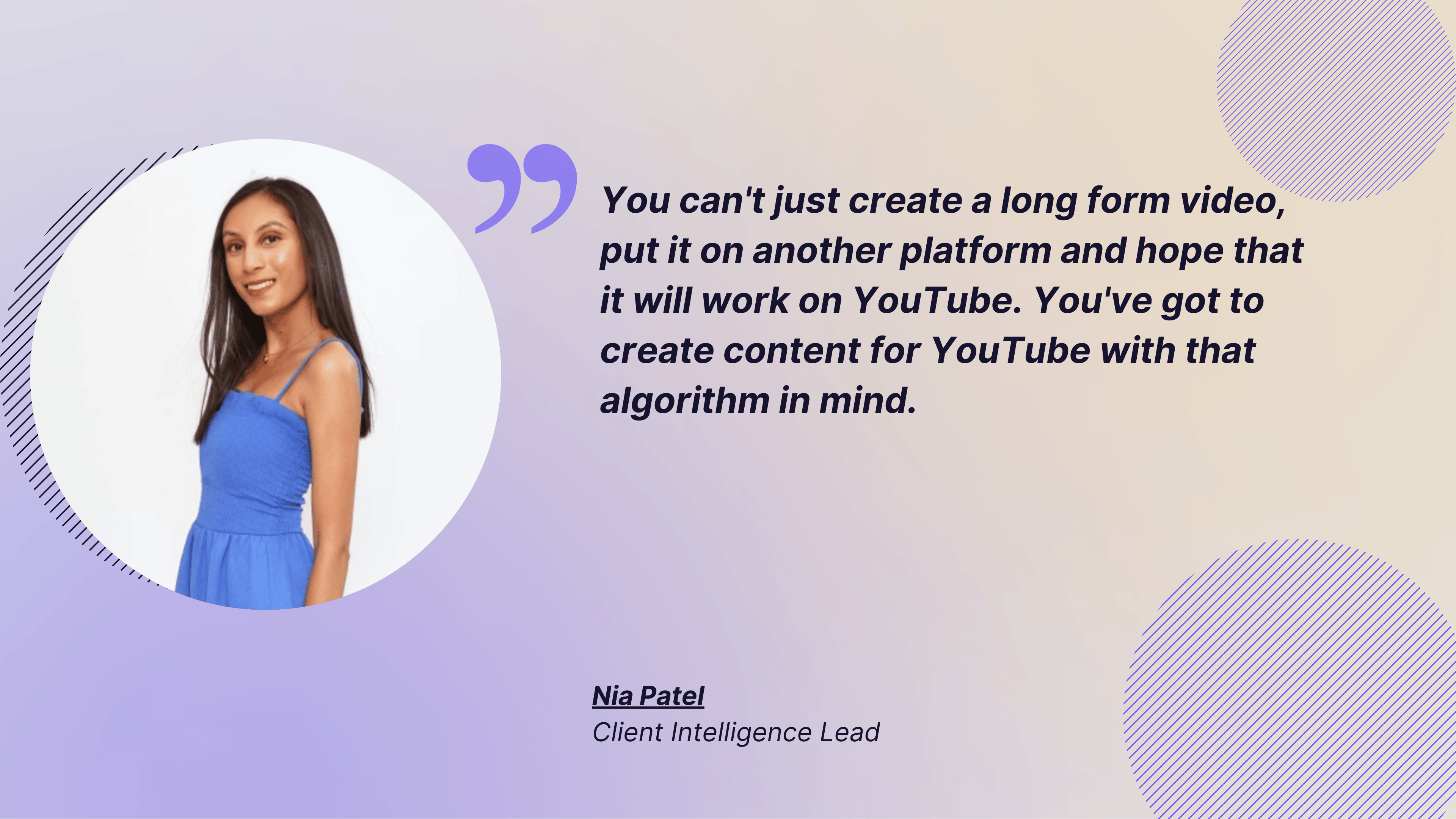
You can't just create a long form video, put it on another platform and hope that it will work on YouTube. You've got to create content for YouTube with that algorithm in mind. You can't just create a post and hope that it will work on the platform because it's not going to, because the way people consume content is so different.
Create a strategy optimization plan based on the insights you found
You’ve spent hours collecting and analyzing all your YouTube data - now it’s time to implement it.
Prioritize audit findings: plan high-impact vs. quick wins
Not all your findings are equal - some of your findings may require small tweaks, others may require complete overhaul of strategy.
I separate my insights into two main categories:
- Quick wins: Updating descriptions with optimized keywords, creating custom thumbnails for high-performing videos, updating your channel description. Little tweaks that yield instant improvement.
- High impact changes: Creating new content strategy based on performance data, starting a new content series after analyzing competitor content gaps, developing a Shorts strategy, building out a new content pillar. These require significant time and effort.
Adjust objectives based on performance trends
Your YouTube audit has revealed your channel's current trajectory - now use these insights to forecast realistically and set achievable objectives.
- Use data for accurate forecasting: Look at your historical data (last 6 to 12 months of data) to establish growth patterns. Review your subscriber growth (last 6 months of net subscriber growth), views per video, and engagement rate forecast and create a realistic target forecast.
However, while data is invaluable, Nia Patel warns against letting it completely control your creative process:
Like with all analytics and like with data, there can be a tendency to get swept up in it and to do literally what the data is telling you. And that can sometimes take away from creativity.
So, for example, if you have a post idea and you're really passionate about it and you want to post it, but you're constantly tied to the data, ooh, the data is saying that this probably won't work, so I'm not gonna post it. You get into planning paralysis and you get into that fear of putting it out.
- Build a quarterly action plan with a performance checkpoint: Break your annual goals into quarters with specific strategies. I measure, adjust and optimise strategies every 90 days.
For example, if your Q1 goal is heavy subscriber acquisition and your growth hits below target, readjust goals for Q2. Shift content towards proven subscriber-converting formats - running 'Subscribe' campaigns, adding aggressive CTAs in every video, and increasing posting frequency.
Final thoughts
The difference between a struggling YouTube channel and a successful one isn’t production quality or posting frequency. It’s understanding what the data is telling you and having the courage to act on it.
Your channel's growth is sitting in your analytics right now. You just need to know where to look and what to do about it.
Ready to see how your YouTube channel stacks up against competitors? Try Social Insider's YouTube audit tool and get data-backed insights that actually move the needle.
FAQs on YouTube audit
When do you need to conduct a YouTube audit?
If you’re actively growing your channel, conduct a full audit every three months, and at least twice yearly. This helps you identify content and performance trends and tweak your strategy accordingly.
What are some common YouTube audit mistakes that should be avoided?
- Not benchmarking against competitors: This is the #1 mistake that renders most audits completely useless. Knowing how your competitor is performing helps to identify if you’re underperforming, meeting expectations, or crushing it! When conducting competitive benchmarking, always look at percentages and rates (not numbers).
- Analysis paralysis: Don’t spend weeks on weeks creating the perfect audit and then not implementing the changes. The best audits are ones that balance action with findings. For each insight, write down one main action point to implement.
- Neglecting Shorts in your audit: Long form and short form content on YouTube, both serve a different purpose. Neglecting YouTube shorts in favor of long-form content is a big mistake. As of June 2025, YouTube’s CEO, Neil Mohan, shares that YouTube Shorts get over 200 billion daily views. A great way to start using YouTube shorts is to test different hooks, experimental content, and different presentation styles before investing in long-form content!
Maham Chappal
Content writer with 10+years of experience in the B2B SaaS niche. I love making complex marketing subjects clear for the laymen. When I'm not writing, I'm devouring biographies!

Analyze your competitors in seconds
Track & analyze your competitors and get top social media metrics and more!
You might also like





Improve your social media strategy with Socialinsider!
Use in-depth data to measure your social accounts’ performance, analyze competitors, and gain insights to improve your strategy.