TikTok Influencer Marketing: Your A-Z Guide
Master TikTok influencer marketing with our expert insights. Learn how to use the platform's uniqueness for effective brand promotion and growth.
TikTok influencer marketing only starts working when you run it like a system you can scale: consistent creator sourcing, structured campaigns, and decisions driven by performance.
I’ve seen a lot of TikTok marketing efforts that look busy on the surface: creators posting, content going out…
But when you dig in, there’s no clear pattern behind the results. One video hits, the next five don’t, and no one can explain why.
That usually comes down to how the program is set up.
The teams getting reliable outcomes know exactly how they’re finding creators, what each campaign needs to produce, and how they’re using performance to decide what happens next.
In this guide, together with influencer marketing specialist Liz Griffin, I’ll walk you through how to approach TikTok influencer marketing in a way that’s structured, repeatable, and built to scale.
Key takeaways
-
What type of TikTok influencers should brands collaborate with?
Brands should collaborate with TikTok creators whose content style, audience trust, and engagement patterns align with the campaign goal, not just their follower count. -
How to create a TikTok influencer marketing strategy?
A strong TikTok influencer marketing strategy comes from clear objectives, careful creator selection, structured collaboration, and performance-driven optimization that turns campaigns into repeatable systems. -
What are some TikTok influencer marketing mistakes you should avoid? Most TikTok influencer campaigns fail when brands overcontrol the creative, choose influencers based only on size, ignore performance data, or treat TikTok like other social platforms.
-
Lessons from successful campaigns: Successful TikTok influencer campaigns scale when they rely on one strong idea, repeat it across the right creators, and use performance data to refine and expand what works.
What type of TikTok influencers should you collaborate with?
Scroll your own feed for a minute and you’ll see it straight away.
Some creators keep you watching without effort. Others lose you in the first few seconds, even when the production looks polished.
That difference carries into TikTok influencer campaigns.
Here's Liz's perspective as well:
The biggest mistake brands make is chasing follower count instead of influence. On TikTok, creators who understand the platform and their audience consistently outperform larger creators who treat TikTok like just another distribution channel. Micro and mid-tier creators often drive stronger engagement because their audiences trust them and their content feels native to the platform. I’ve seen mid-tier creators outperform creators three times their size simply because their audience is more engaged.
When a creator understands how their audience watches, reacts, and engages, the content feels natural in the feed. Comments pick up, watch time holds, and the message lands without friction.
Campaigns built around those creators tend to perform more consistently, regardless of follower count.
So when it comes to choosing creators, you’re really deciding two things: the type of content they produce and the role their audience size plays in your campaign.
TikTok influencer categories by content type
The type of content a creator produces directly affects how your message lands.
Types of TikTok influencers by tier
Each tier plays a different role depending on what you’re trying to achieve.
How to create a TikTok influencer marketing strategy?
A strong TikTok influencer marketing strategy comes down to a few key decisions done right from the start.
When those are clear, everything else—creators, content, performance—falls into place much more naturally.
For this, Liz explained:
The best TikTok campaigns start with a clear goal and give creators the freedom to execute in their own voice. TikTok audiences can spot overly scripted brand content instantly. The brands that win are the ones that treat creators like creative partners, not just distribution.
Here are the key social media tactics to get it right:
#1. Set your objectives
Everything starts here.
If this part is vague, the rest of the campaign usually follows the same pattern.
Establish your primary goal
Start with one clear social media goal.
Are you aiming for brand awareness, a product launch, or sales conversion?
Each direction shapes the campaign differently.
Awareness leans into reach and shareability. Product launches need content that builds understanding and interest. Conversion campaigns depend on trust and clear messaging.
When the goal is defined early, it’s easier to make consistent decisions across the campaign.
Set your target audience
TikTok gives you reach, but relevance comes from knowing who you’re speaking to.
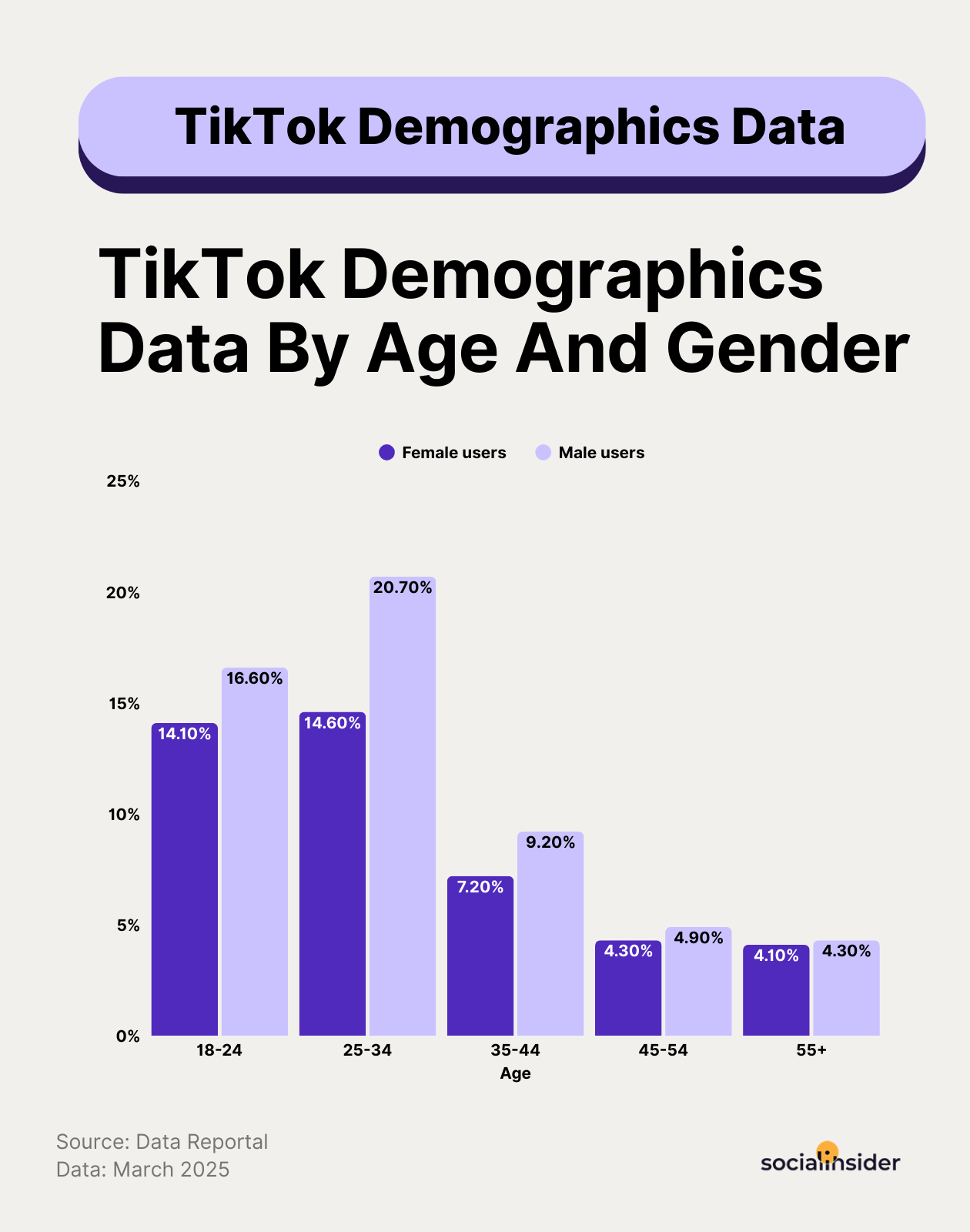
If you look at the data above, a large portion of users sits in the 18–34 range, with strong activity across both genders.
That’s where a lot of attention is concentrated.
However, the real difference comes from behavior: what your TikTok target audience watches, how they engage, and which creators they already trust.
When that’s clear, choosing creators becomes a lot more precise.
Plan a budget
Once your goal and audience are defined, the budget becomes a question of how much room you have to test and adjust.
Most campaigns use a mix of:
- Flat fees for content
- Performance-based deals
- Product gifting
- Hybrid models
The important part is how you distribute that budget.
Spreading it across different influencer tiers gives you flexibility.
Smaller creators help you test and learn quickly. Larger creators help you extend reach once you know what works.
At that point, your TikTok influencer marketing strategy starts to feel less like a series of bets and more like something you can build on over time.
#2. Research TikTok influencers
This is the part that usually decides how your TikTok influencer marketing performs later.
You can have a clear goal and solid budget, but if the creators don’t fit, the campaign struggles to land.
When I look at creators, I’m paying attention to how their content actually works: how they structure it, how they open, how they keep attention, and how their audience interacts across multiple videos.
That tells you much more than a profile overview ever will.
Here's what Liz also had to say about that:
Research starts with identifying creators whose content and audience naturally align with the brand. We evaluate their content style, storytelling format, and how they typically communicate with their audience. For example, whether they talk directly to the camera, use voiceover, or rely on demonstrations. We also look at engagement patterns, posting consistency, and whether the brand would feel authentic within their existing feed.
There are a few ways to approach this, depending on how deep you want to go:
Manual discovery methods
Manual research is how you develop a real sense of fit.
You’re seeing creators in their natural environment, not filtered through metrics. You get a feel for pacing, tone, and how their audience reacts over time.
Thus, you can find TikTok influencers by:
Using TikTok's search and hashtag exploration
This is the best way to understand how your category behaves on the platform.
Start directly in TikTok’s search bar.
Type in keywords your audience would use or hashtags tied to your category (e.g. #skincareroutine, #gymtok, #techreviews).
From there, go into the top-performing videos and follow the patterns.
See which creators appear more than once, which formats repeat, and how topics are framed. Then click into those creators’ profiles and review several posts.
This gives you a real sense of who consistently performs in your niche and what kind of content your audience is already engaging with.
Analyzing competitor campaigns and brand mentions
Open TikTok and search for your competitors by name, or look up hashtags that include your category + “ad”, “review”, or “try” (e.g. “brand name review”, “brand name ad”).
You can also check the tagged content on competitors’ profiles or scroll through creators in your niche. You’ll often spot paid collaborations in their recent posts.
Once you find those, compare them to the creator’s usual content.
Look at engagement (views, comments, shares) and how the product is integrated. Does it feel like part of their content, or does it stand out as an ad?
This helps you understand which creators already know how to work with brands in your space and what kind of integrations your audience responds to.
Exploring TikTok's Creator Marketplace
TikTok’s Creator Marketplace is TikTok’s built-in platform where brands can discover and connect with creators.
Inside it, you can filter creators based on audience demographics (age, location, gender), content category, average views, and engagement metrics.
You also get access to performance data that isn’t visible on public profiles.
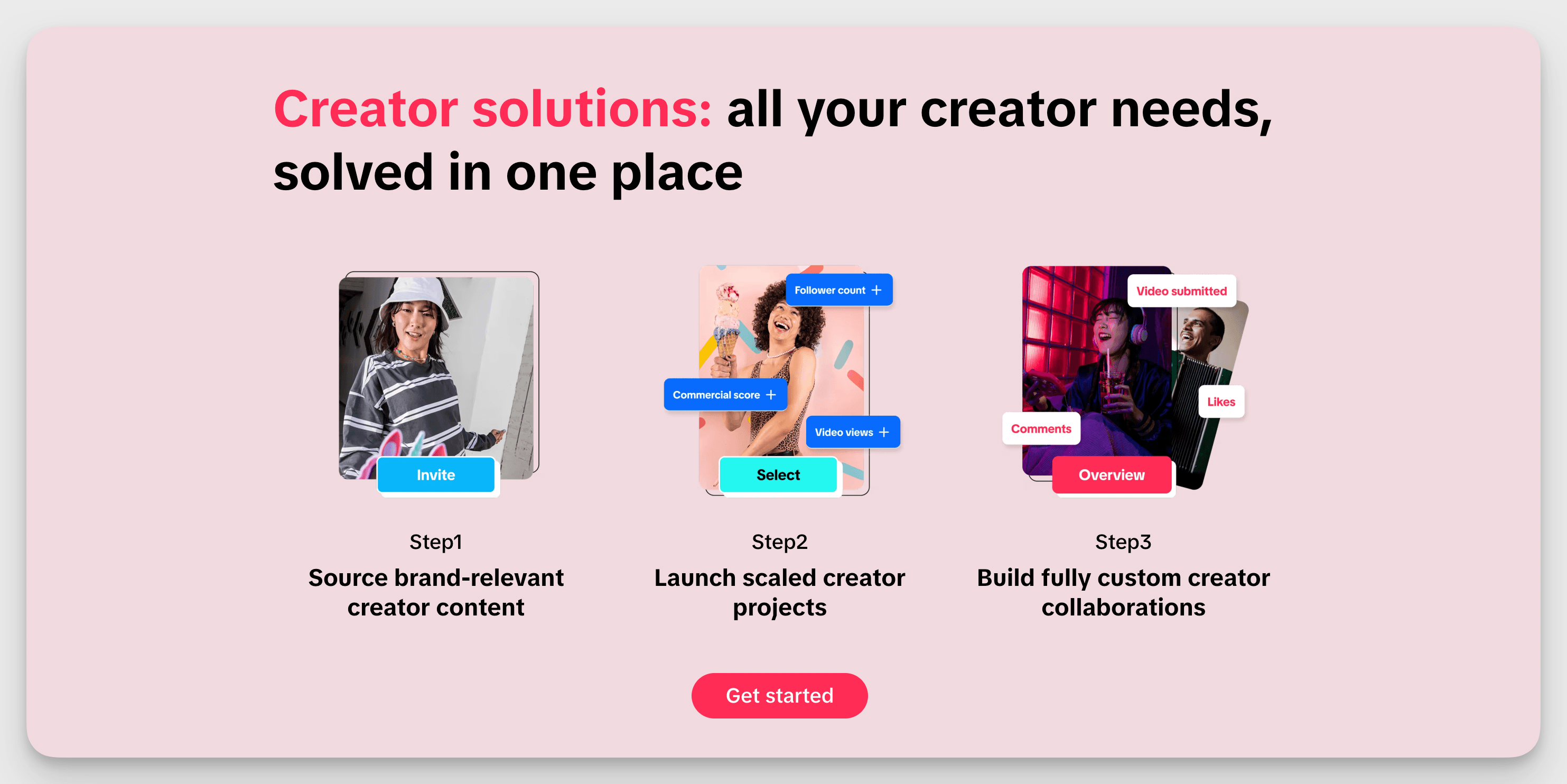
You’d use this when you need to be more precise, matching creators to a specific audience, validating performance at scale, or building a shortlist quickly.
It’s especially useful once you already know what you’re looking for and want to narrow down options efficiently.
Using influencer discovery tools
Once the number of creators grows, it becomes harder to keep track of everything manually.
That’s where influencer discovery tools start to help.
They make it easier to filter creators based on audience demographics, engagement rates, location, or category. This way, you can narrow down a large pool or make sure you’re roughly aligned with your target audience.
They’re also helpful for comparison.
So instead of jumping between profiles, you can review creators side by side and get a sense of how their performance holds over time.
Essentially, tools are most useful for filtering and validation.
They help you move faster and stay organized, but the final decision still comes from reviewing the content itself.
What to pay attention to when vetting influencers?
Shortlisting creators is one thing. Deciding who actually makes sense for your campaign is where things usually get more nuanced.
At this stage, I’m looking for patterns. How the creator performs over time, how their audience responds across multiple posts, and how they’ve handled brand collaborations before.
That’s usually where the difference shows up between someone who looks right on paper and someone who will actually deliver.
To make that evaluation more concrete, there are a few areas worth focusing on:
Engagement rate calculations and what's "good" on TikTok
Engagement rate is one of the most useful signals you have when vetting creators. You just need to look at it the right way.
On TikTok, I don’t rely on a single version of it. I look at two angles:
- Engagement by followers: shows how strongly a creator’s existing audience responds
- Engagement by views: shows how well content performs once it reaches beyond that audience
That second one becomes especially relevant on TikTok, because content isn’t limited to followers. If a video gets picked up, engagement by views tells you whether it actually holds attention.
To see both of these side by side and understand how they evolve over time, I usually run each profile through Socialinsider.
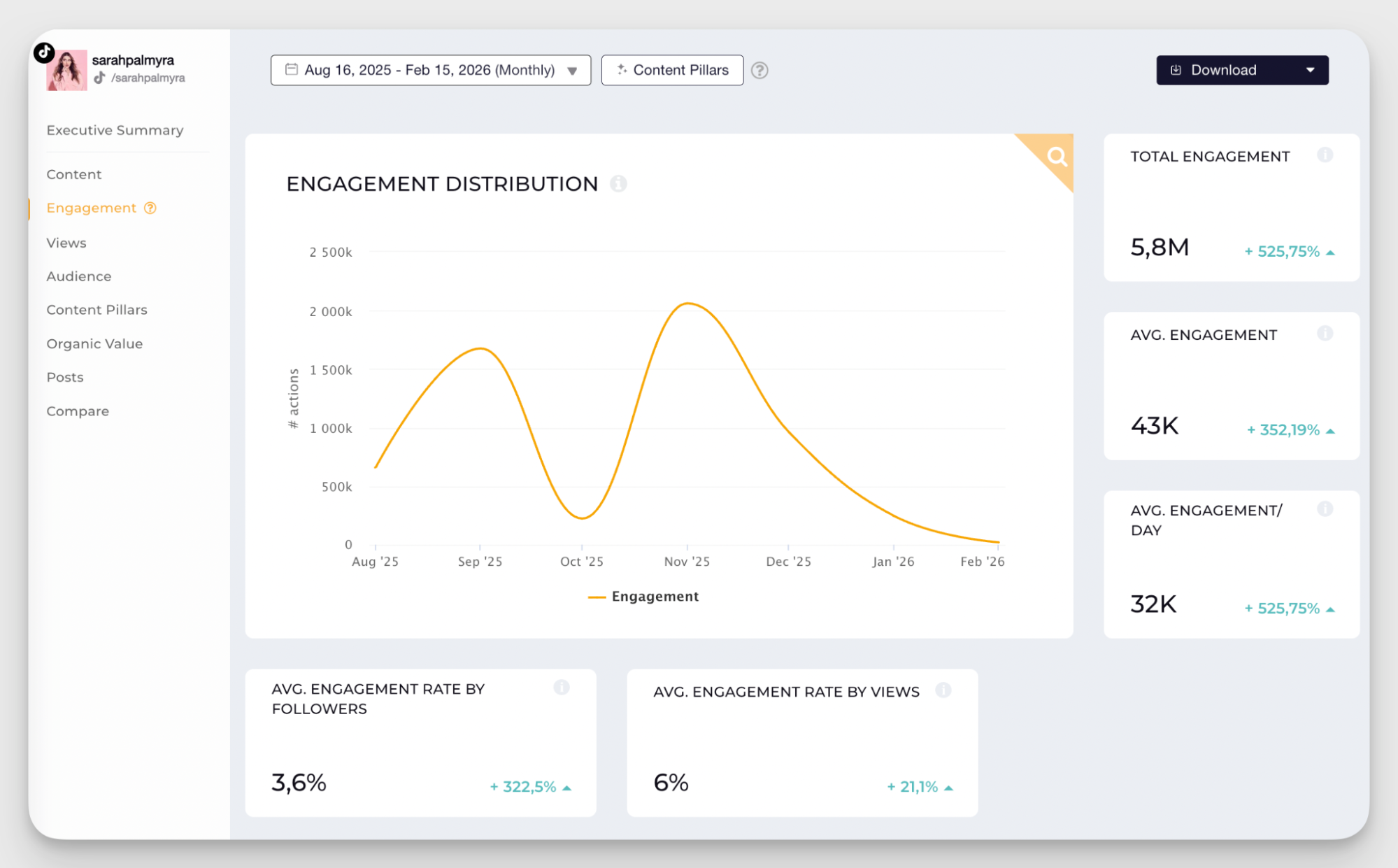
That makes it much easier to spot patterns.
You can quickly tell if a creator has a strong core audience, if their content travels well, or if performance depends on a few outliers.
From there, I want context.
A 2% engagement rate can be strong (or average) depending on the industry.
For this, Socialinsider’s reports give you that reference point.
You can compare a creator’s engagement against industry benchmarks and see how they stack up within your category.
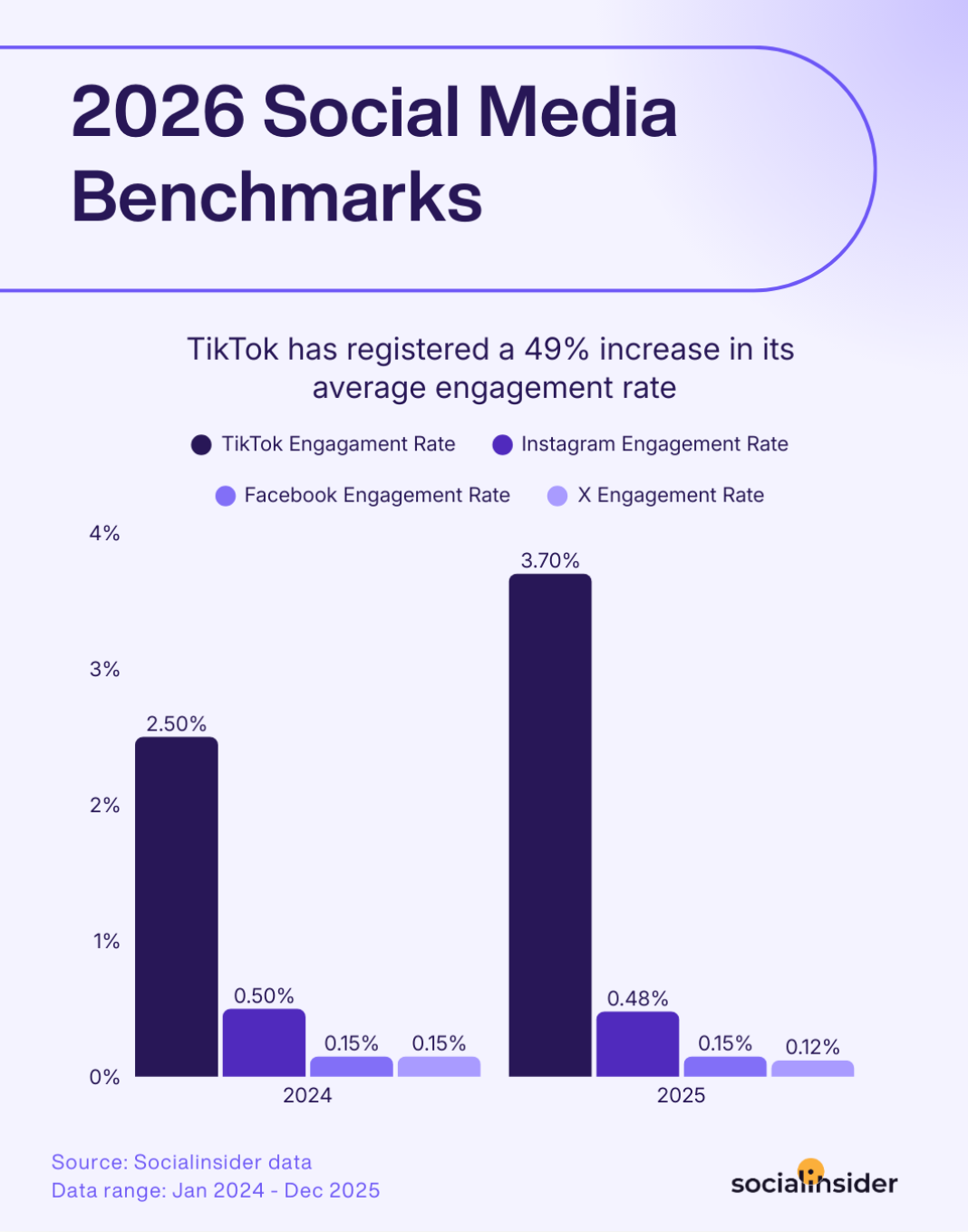
That matters because it removes guesswork. You can finally see where the performance actually sits relative to others in the same space.
At that point, the engagement rate becomes much more actionable because you’re not just reading a number, but understanding what it means.
Content quality and brand alignment assessment
Numbers can point you in the right direction, but social media content shows you how a collaboration will actually feel once it goes live.
The question I’m trying to answer here is simple: does this creator know how to integrate a brand without breaking their content?
Naturally, the easiest way to get there is by looking at past partnerships.
Inside Socialinsider’s Posts section, you can filter and surface specific TikTok influencer campaigns or brand mentions.
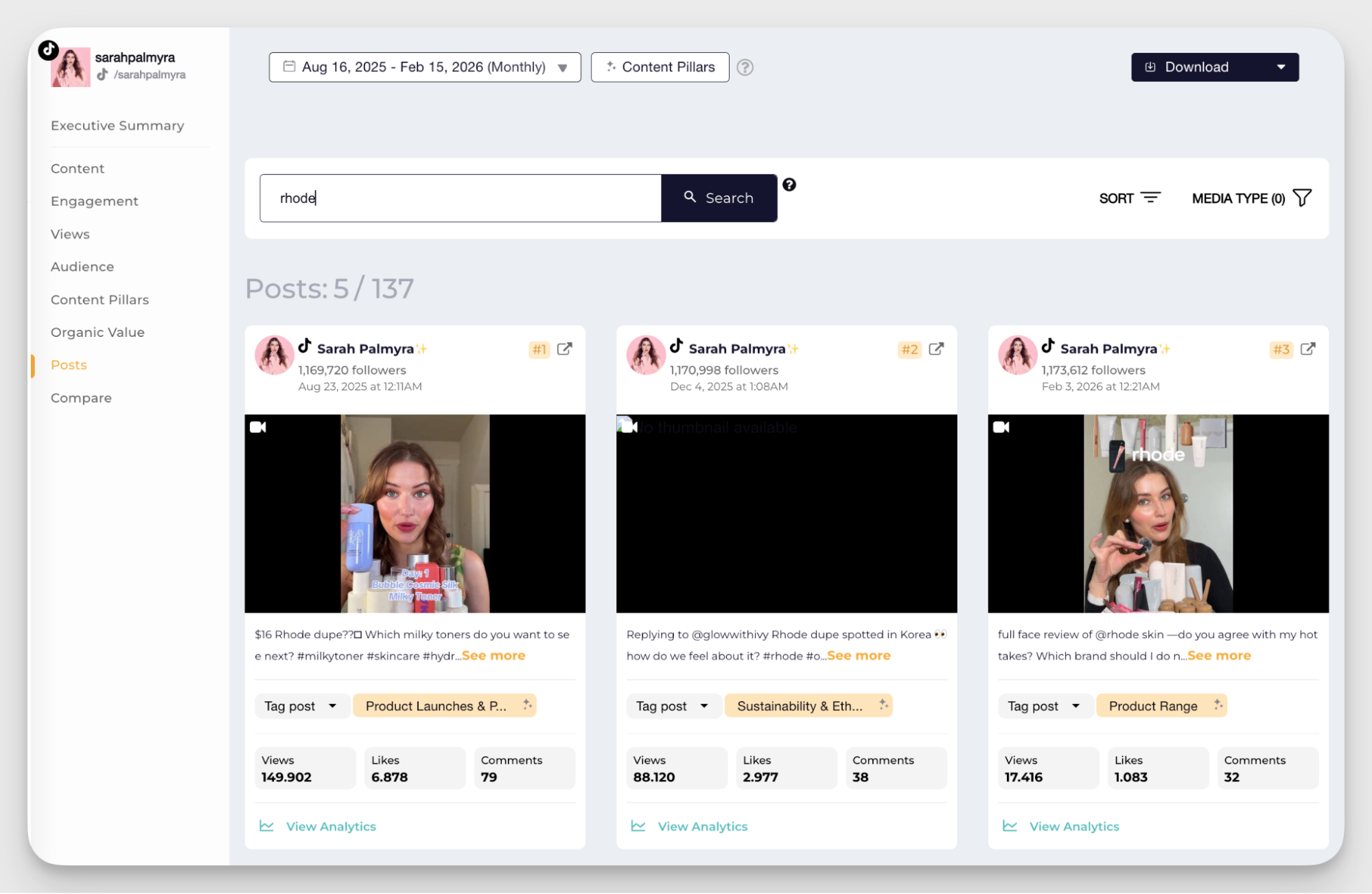
That lets you review how a creator handled the messaging, how early the product is introduced, how naturally it fits into the content, and how the audience responds.
I usually compare those posts to the creator’s organic content.
If the tone, pacing, and engagement stay consistent, that’s a strong signal. If there’s a noticeable drop or the content feels forced, it tends to show up quickly.
And, of course, looking at individual posts gives you context, but it’s still a limited view.
To really understand how a creator handles collaborations, you need to look at patterns across multiple posts.
With Socialinsider, you can build custom content pillars using the query builder, grouping posts based on keywords, brand names, hashtags, or specific campaign identifiers.
So instead of manually reviewing content one by one, you can create a structured set of posts tied to a collaboration or content theme.
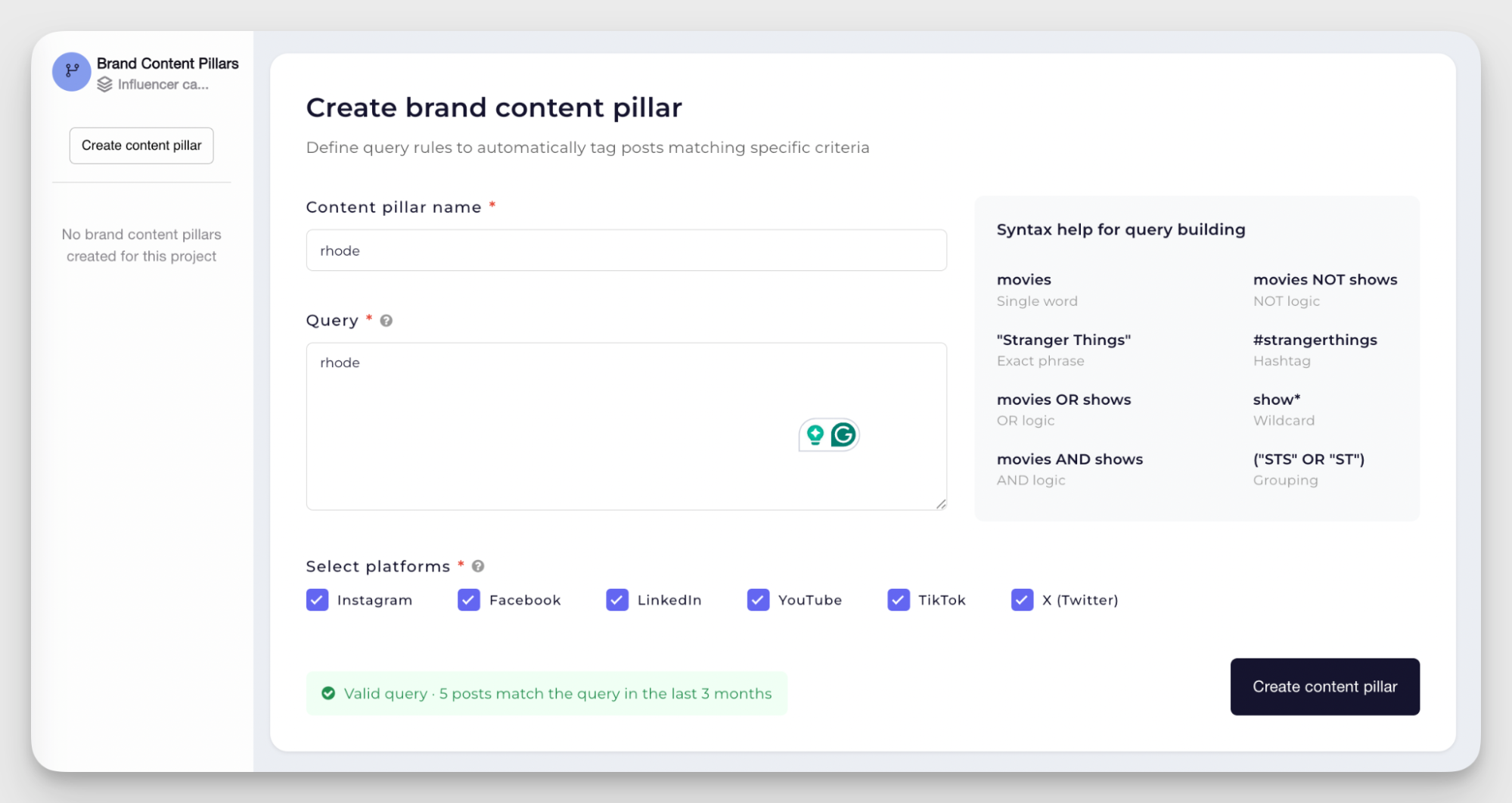
Once that’s set up, you can analyze performance at an aggregated level.
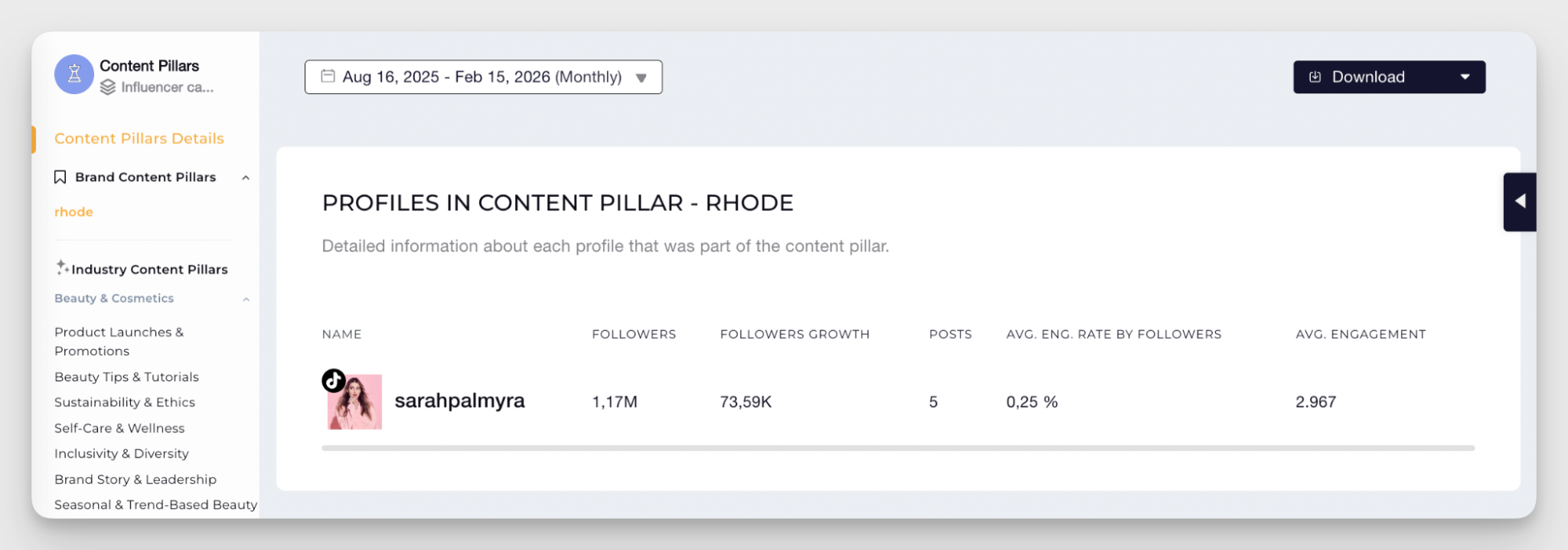
You’re now seeing how that entire type of content performs. Engagement rates, consistency, audience response, even how performance compares to other content pillars.
That’s what makes the difference.
It gives you a clear view of how a creator handles branded content over time and whether that approach aligns with how you want your brand to show up.
Posting consistency and content performance trends
Last but not least when vetting influencers is looking at how consistently they post and how their performance evolves over time.
Individual posts don’t give you that. You need a broader view.
That’s why I often use the Executive Summary in Socialinsider.
It gives you a quick overview of how output and performance are connected.
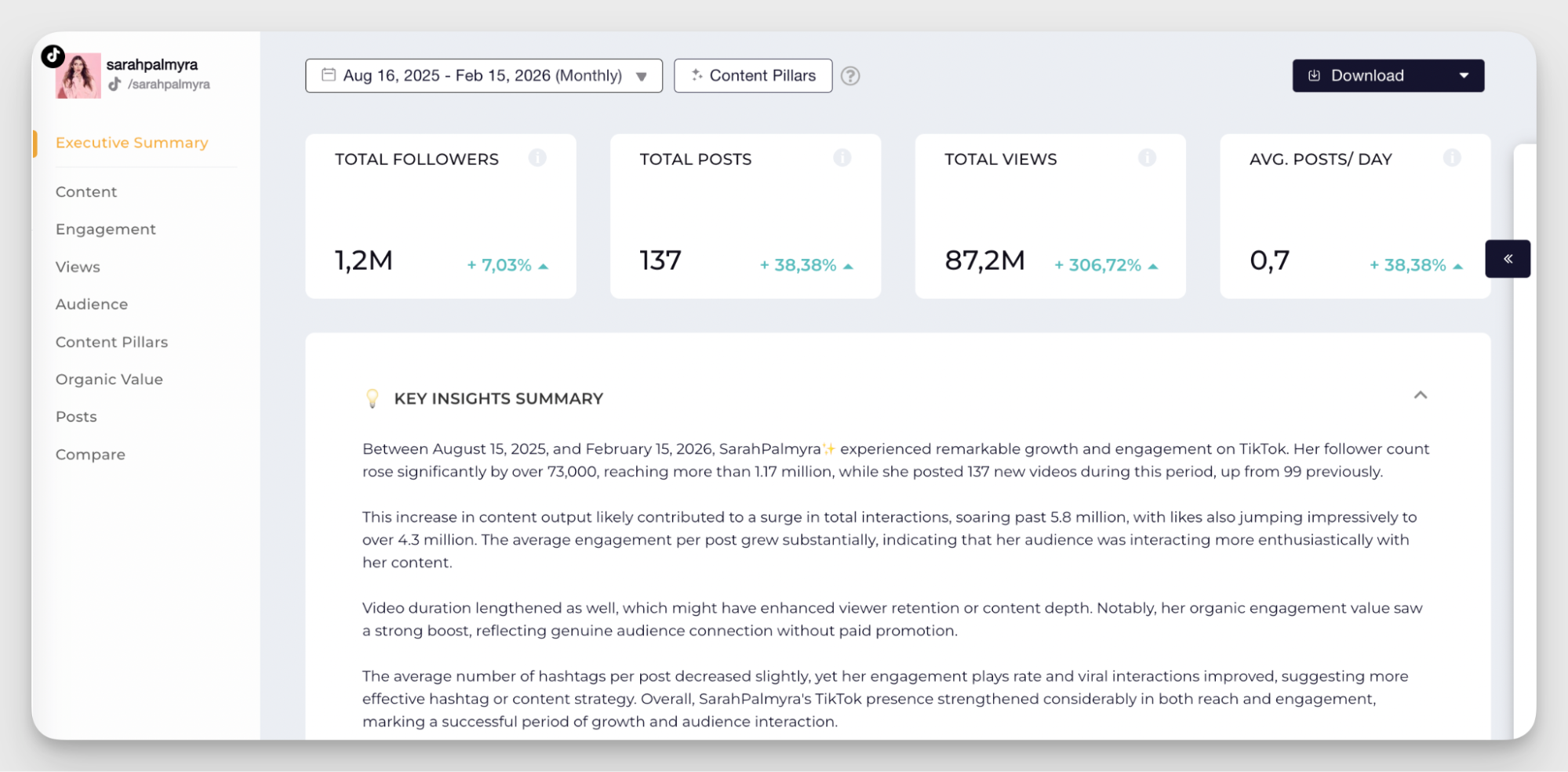
In this example, you can see a clear increase in posting activity, alongside a strong rise in total views and engagement.
That tells you the creator isn’t static and they’re actively producing content and growing their reach.
Some creators grow because they post more. Others improve performance without increasing output. Both are useful signals, but they tell you different things about how that creator might perform in a campaign.
And remember. At this stage, you’re looking for direction, not perfection.
Lastly, Liz adds:
Vetting focuses on ensuring the creator is a strong and safe partner for the brand. That includes reviewing audience authenticity, comment sentiment, past brand partnerships, and historical performance. We also look at how the creator has handled previous collaborations and whether they consistently deliver content that performs well and aligns with brand guidelines.
#3. Start the outreach process
Now that you know who you want to work with, the next step is getting the collaboration off the ground.
This is where a lot of social media campaigns either move forward smoothly or get stuck early.
Obviously, clear communication early on tends to make everything that follows much easier.
There are three parts to get right here:
Craft the message
Outreach doesn’t need to be complicated, but it needs to feel intentional.
Creators can tell very quickly when they’re part of a mass email versus when there’s actual interest in how they create.
Referencing specific content, formats they use, or how their audience engages shows you’ve done the work.
I usually keep it focused on three things:
- why you’re reaching out to them specifically
- what the campaign is about
- what kind of collaboration you have in mind
That’s enough to start a conversation without overloading them with details.
Negotiate campaign terms
This is where expectations get shaped.
Most of the friction I’ve seen in campaigns comes from things that weren’t clearly defined upfront: pricing, scope, or what “social media success” actually looks like.
Pricing
There’s no fixed structure here.
Some creators work on flat fees, others prefer performance-based models, and many use a mix of both.
What matters is aligning the model with your objective and making sure both sides are clear on how value is measured.
Deliverables
Be very specific early on. Number of videos, posting timeline, content format: these all affect how the creator plans and executes. It also avoids back-and-forth later.
Performance expectations and KPIs
Before the campaign starts, it helps to align on the social media KPIs you’ll be tracking, whether that’s reach, engagement, watch time, or conversions.
The exact social media metrics depend on your objective, but having them defined upfront gives both sides a shared understanding of what the campaign is working toward.
It also makes evaluation much more straightforward once content goes live.
Set the contracts and legal considerations
Once everything is agreed on, it needs to be structured properly.
Two areas usually shape how smooth the collaboration will be:
Content approval and revisions
Agree on how content will be reviewed and how many revision rounds are included.
This helps avoid unnecessary back-and-forth once production starts.
Payment terms and milestones
Outline how and when payments are made, whether that’s upfront, after delivery, or tied to specific milestones.
Clear terms here keep timelines predictable and reduce friction during the campaign.
Getting these details in place early tends to make the rest of the collaboration easier to manage.
#4. Collaborate on content creation
The focus now shifts to the actual content.
Here, structure and flexibility need to work together. Too loose, and the message gets lost. Too rigid, and the content stops feeling native to TikTok.
To keep that balance, there are two parts to get right:
Create the content briefs
A good brief gives direction without overloading the creator.
At a minimum, make sure to share:
- brand context (what you do, how you position yourself)
- product details (key features, benefits, anything that needs to be accurate)
- talking points (what should come across in the content)
- assets if needed (logos, visuals, links, discount codes)
That gives creators enough to work with while keeping the message aligned.
Where it gets more important is deciding what actually needs to be fixed and what doesn’t.
Some things should be clear from the start:
- brand guidelines
- key messages or claims
- anything legal or compliance-related
Everything else, such as hook, structure, tone, or format, is usually better left open.
Creators already know how their audience responds. The more they can adapt the message to their style, the more natural the content will feel.
Set the approval workflow
This part tends to save time if it’s defined early.
Agree on how content will be reviewed before anything is posted. That usually includes:
- whether drafts are required
- how feedback will be shared
- how many revision rounds are included
Keep it simple. One or two review rounds are enough to align on messaging without slowing things down too much.
It also helps to be clear on timelines: when drafts are expected, how quickly feedback is given, and when final content goes live.
Once that’s set, the process becomes much smoother for both sides.
#5. Launch the campaign
This is the point where you see how everything holds up in the feed.
You’ve done the planning, chosen the creators, aligned on content. Now it comes down to how it’s released and how you react to it.
Timing plays a bigger role than it seems.
If you’re working with multiple creators, posting everything at once can create a short burst of visibility, but it tends to drop quickly.
Spacing content out gives you more coverage over time and more chances to learn from what’s working.
Then you watch closely.
The first posts usually give you clear signals. Which hooks keep people watching, how the audience reacts in the comments, whether the message feels natural or forced.
It’s important to treat those early videos as feedback, not final output.
Small adjustments can shift performance across the rest of the campaign.
And then there’s what happens after content goes live.
#6 Measure campaign performance
How you measure performance will shape every decision you make after the campaign. And I can’t stress this enough.
If you’re looking at the wrong signals, you’ll scale the wrong things. If you’re reading the data correctly, it becomes much easier to see what’s worth repeating and what needs to change.
But remember. The numbers only make sense when you connect them to your social media content strategy.
And one of the best social media analytics best practices I can give you is to measure performance in a way that ties directly to your goals.
To this, Liz adds:
Success depends on the campaign objective. For awareness campaigns, we focus on metrics like views, engagement rate, shares, and completion rate to understand how well the content is resonating with audiences.
On TikTok, engagement rate is typically calculated based on views rather than impressions because the platform distributes content through the For You feed to audiences beyond a creator’s followers. Strong engagement and share activity are often signals that the content is resonating and being distributed more broadly.
For performance-focused campaigns, brands should measure metrics like clicks, conversions, and return on ad spend. That can come through affiliate links, TikTok Shop integrations, or paid amplification of creator content depending on how the program is structured.
What you track and how you interpret it should reflect what the campaign was meant to achieve in the first place.
Brand visibility and audience engagement
For awareness-focused campaigns, the focus is on reach and social media engagement.
Thus, you’ll want to track TikTok metrics such as:
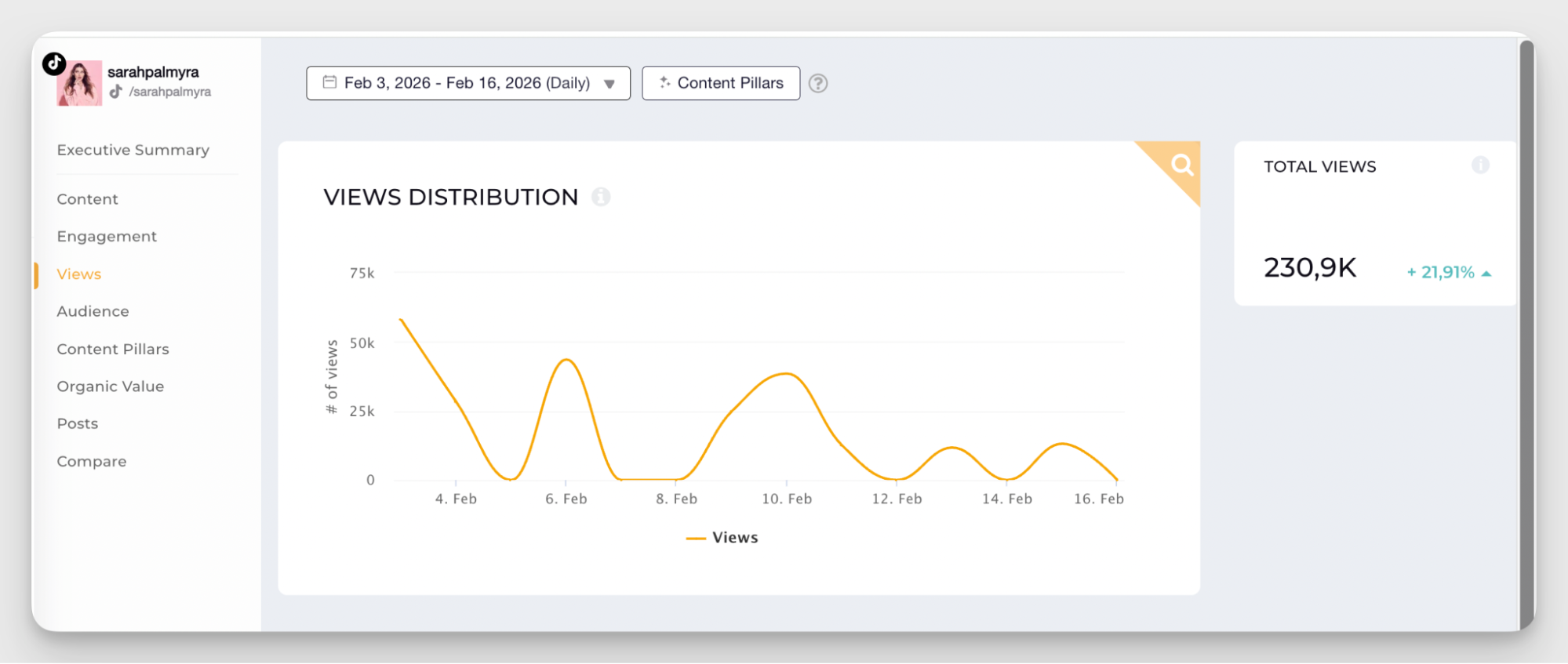
Views
This shows how far your content is being distributed.
On TikTok, strong reach often comes from the algorithm pushing content beyond the creator’s audience.
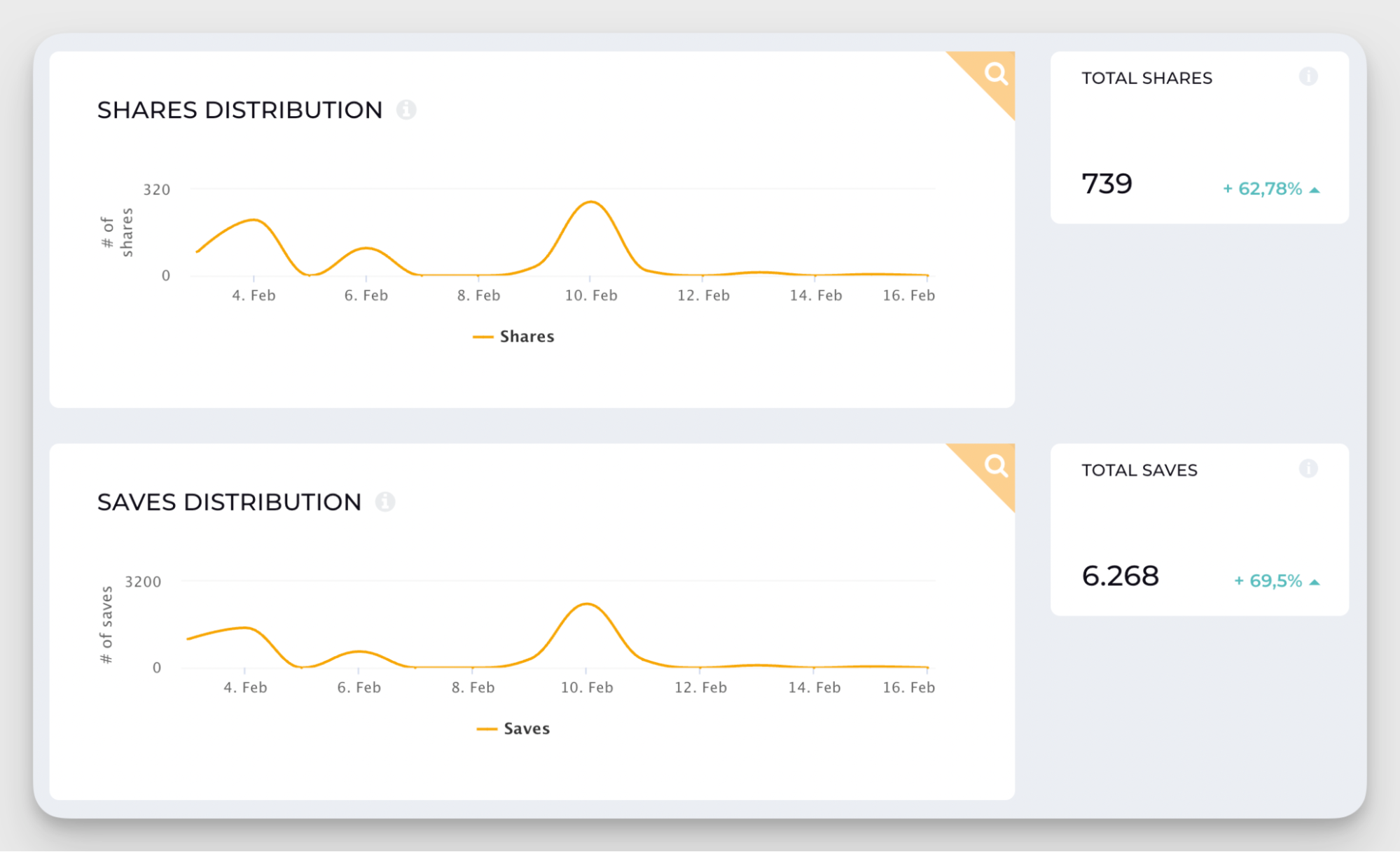
Engagement metrics (shares, saves)
These are some of the most meaningful TikTok metrics.
- Shares indicate that content is being passed along and gaining traction
- Saves suggest longer-term value & content people want to revisit
Conversions and ROI
For performance-driven campaigns, the focus shifts toward outcomes and social media ROI.
Here, you’ll want to track metrics such as:
Click-through rates and link performance
These show how many people move from content to your site, and which creators or posts are driving that traffic.
UTM parameters and tracking links
These are essential for attribution. They allow you to track exactly where traffic is coming from, down to the creator or even specific content.
Promo codes for attribution
Useful for connecting conversions directly to creators, especially when multiple collaborations are running at the same time.
Sales
Ultimately, this is where everything ties together. Which creators are driving conversions, which formats lead to purchases, and what’s contributing to overall revenue.
Essentially, using top social media analytics tools like Socialinsider helps bring these data points together, linking TikTok analytics, engagement, and conversions into a clearer view of performance.
#7. Optimize and scale your strategy
This is the part most people underestimate.
A campaign ends, results come in, and it’s tempting to move on.
But the real value sits in what you do next, how you take those results and turn them into a system that improves over time.
To get there, it comes down to three things: learning from the data, building stronger creator relationships, and repeating what works in a structured way.
Learn from campaign data
Every TikTok influencer marketing campaign leaves behind signals.
If you’re set up properly, that turns into social media data collection you can actually use, patterns you can build on.
You start to see what holds attention, which creators deliver consistently, and how different messages land with your audience across multiple posts, not just one.
The goal here is to recognize those patterns early and use them.
That usually comes down to:
Identifying high-performing content
Look at what shows up across your best posts: hooks, formats, storytelling style, how the product is introduced. Those patterns are often more valuable than a single standout video.
Understanding audience behavior
Pay attention to how people interact. What gets shared, what gets saved, what drives comments. That gives you a clearer view of what your audience responds to.
Adjusting your approach
This is where social media optimization becomes practical.
You might shift toward creators who deliver more consistent results, lean into formats that hold attention, or refine messaging based on what’s resonating.
Over time, those adjustments make performance more predictable.
Build long-term influencer relationships
Working with the same creators over time changes how the content feels. There’s more familiarity, more trust, and less friction in the process.
A few things tend to happen with ongoing partnerships:
- creators understand your brand better
- content becomes more natural with each collaboration
- audiences start to associate the creator with your product
That’s why ambassador programs and repeat collaborations start to make sense.
The focus shifts from one-off promotion to building relationships that lead to more authentic advocacy.
Replicate successful campaigns
Once you know what works, the next step is extending it.
That means taking the elements that drove results and applying them more broadly.
Scale with new creators
Use proven formats, hooks, or messaging with different creators to reach new audiences while keeping what already performs.
Expand into adjacent niches and audiences
Strong concepts often translate across categories. Adapting them to new audiences helps you grow without starting from zero.
When your social media workflow supports this kind of iteration, scaling stops feeling random and starts becoming structured.
What are some TikTok influencer marketing mistakes you should avoid?
I see the same issues come up again and again in influencer marketing on TikTok. Different brands, different products. But the patterns are consistent.
Let’s take a closer look at the ones that tend to hurt performance the most.
Treating TikTok like Instagram
I’ve watched teams reuse content styles from other platforms: clean edits, heavy branding, perfectly framed shots.
On TikTok, that usually creates distance. It looks like an ad straight away, and people scroll.
The content that performs blends in with everything else on the feed.
Restricting creative freedom too much
This is the one that quietly kills performance.
Here's Liz's takeaway on this as well:
The biggest mistake is over-controlling the creative. And unfortunately, we’re still seeing brands struggle with this quite often. TikTok rewards authenticity, not polished brand advertising. You’re choosing to work with these creators because they have built something that you want to tap into. Trust them to know what works for the audience.
I’ve seen campaigns where everything is scripted. And, of course, the result feels flat because it strips away what made the creator work in the first place.
When creators have room to interpret the brief in their own way, the content flows better, feels more natural, and the audience responds.
Ignoring micro and nano-influencers
A lot of brands still focus most of their budget on larger creators.
In practice, smaller creators often bring stronger engagement. Their audience is more attentive, and the interaction feels closer. That makes them valuable for both testing and performance.
Failing to track and measure properly
I’ve seen campaigns judged purely on views, which rarely tells the full story.
Watch time, engagement, conversions, and not only: these give you a much clearer picture of what’s working and what’s worth scaling.
Choosing influencers based solely on follower count
Follower count is easy to compare, which is why it gets overused.
What matters more is how the content performs with the audience.
Smaller creators can often outperform larger ones when their content aligns better with how people engage on TikTok.
TikTok influencer marketing examples and case studies
You can read all the frameworks in the world, but nothing makes it click like seeing how brands actually execute.
Here are a few TikTok influencer marketing campaigns that got it right, each from a different angle:
Brand awareness campaign: Poppi
Leading up to the Super Bowl 2025, Poppi built a TikTok influencer campaign around a single idea: sending oversized branded vending machines to a curated group of creators.
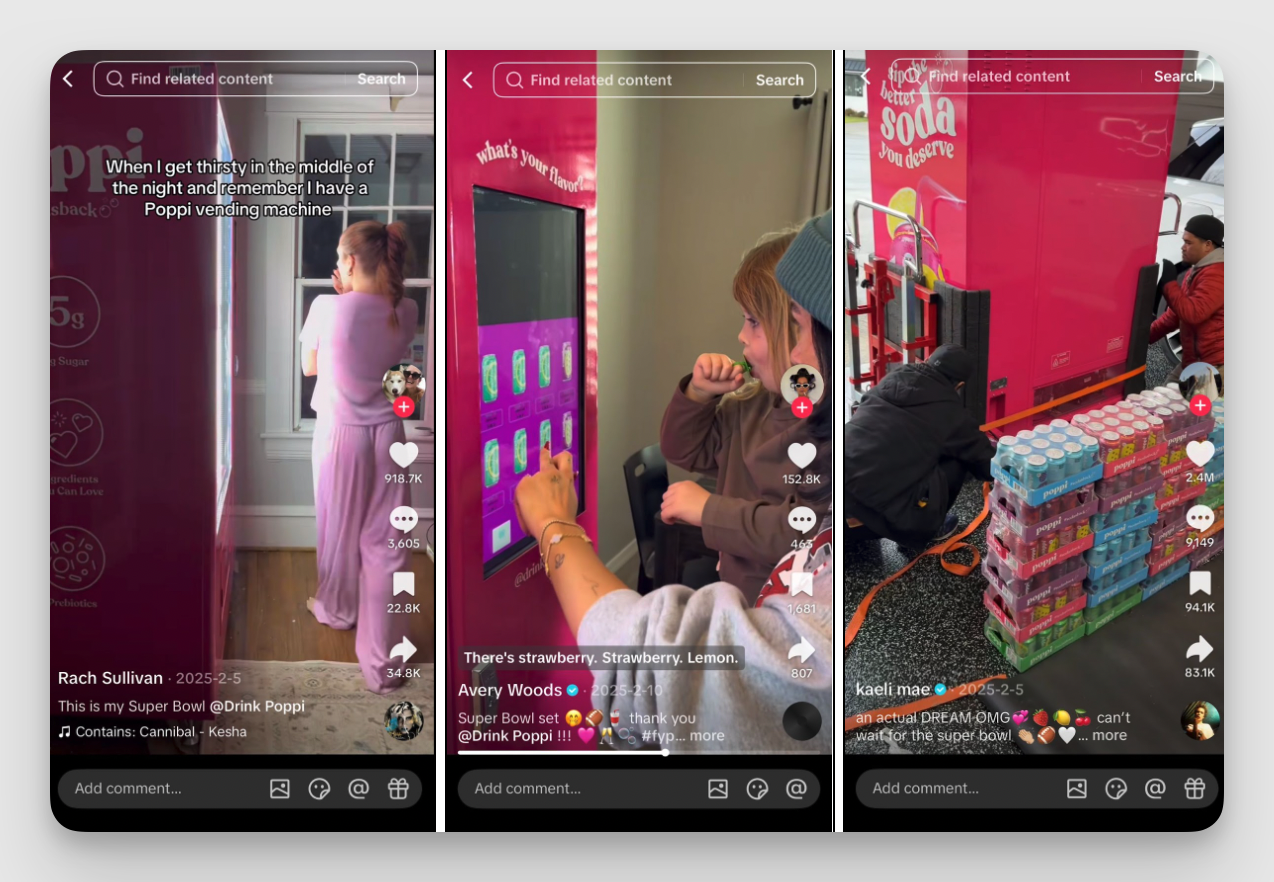
A set of mid-to-large influencers received these machines and posted content around:
- unboxing / revealing the machines
- interacting with them at home
- showcasing the brand in a way that felt bigger than a typical product send
And that’s important. They created a moment. It was coordinated seeding around a visual concept designed to dominate the feed.
The same asset (vending machine) kept showing up across influencers, creating repetition and recognition.
The campaign also tied directly into a larger moment (the Super Bowl ad) so TikTok wasn’t isolated, it was part of a broader awareness push.
Product launch success: Rare Beauty
Rare Beauty has always leaned heavily on UGC. Their products naturally show up in routines, reviews, and GRWMs without much push.
But for the Soft Pinch Liquid Contour in 2025, they stepped into their first fully influencer-led campaign, building on that existing momentum rather than replacing it.
They brought in a select group of high-impact beauty creators, people known for tutorials, product breakdowns, and honest reviews.
From there, the rollout feels intentional.
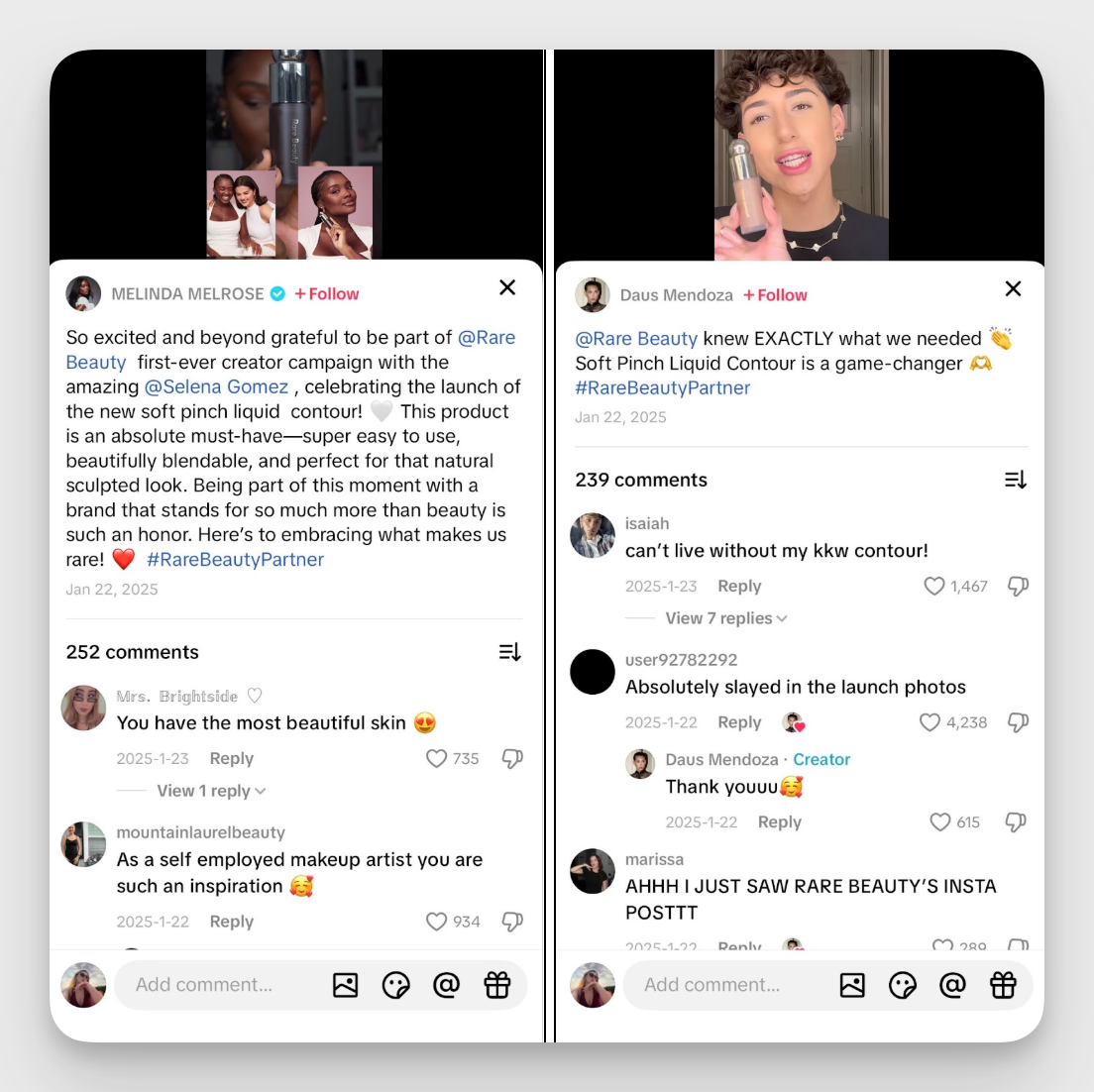
Across videos, you start to recognize the same product strengths coming through: blendability, ease of use, a natural sculpted finish.
The way those points are delivered changes from one creator to another. Some go deep into technique, others keep it quick and reactive, others compare it directly to products their audience already knows.
That variation is what keeps the content watchable.
The comment sections give a clear read on how it landed. People are asking questions, comparing shades, referencing other brands, deciding whether to try it.
That kind of interaction usually means the content held attention long enough to influence.
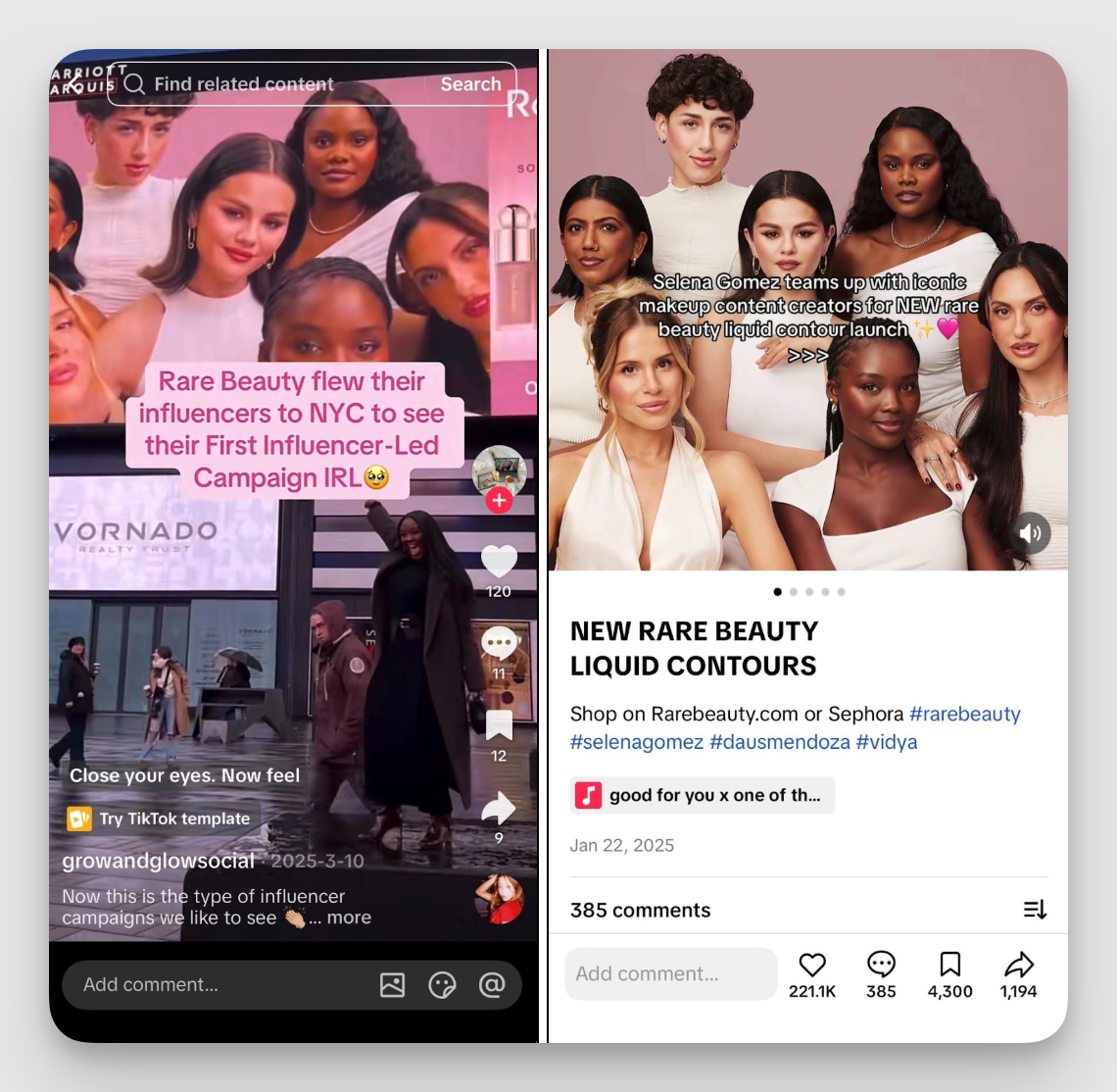
Interestingly, the campaign also carried into a physical layer.
The star-creators were brought to NYC to see their content featured in real-world placements. It added visibility and gave the campaign a different kind of presence beyond the feed.
Micro-influencer strategy win: Stanley 1913
Stanley’s growth on TikTok came from a sustained micro-influencer strategy that built momentum over time.
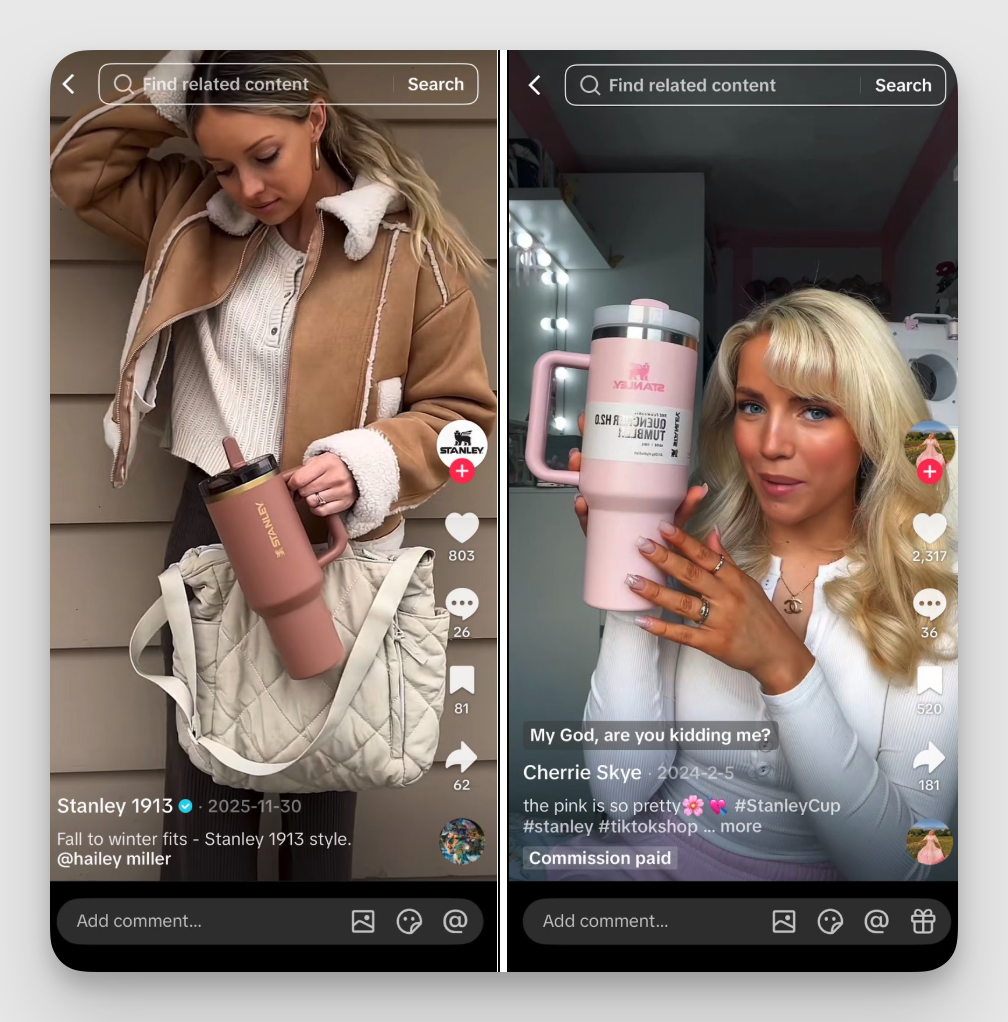
Instead of concentrating the budget on a few large creators, they showed up across hundreds of smaller ones. Lifestyle creators, moms, fitness creators, office routines, people who naturally incorporated the product into daily content.
That distribution is what made the difference.
You’d see the same product appear in completely different contexts: morning routines, gym content, day-in-the-life formats.
Individually, these posts aren’t designed to go viral. Together, they create saturation.
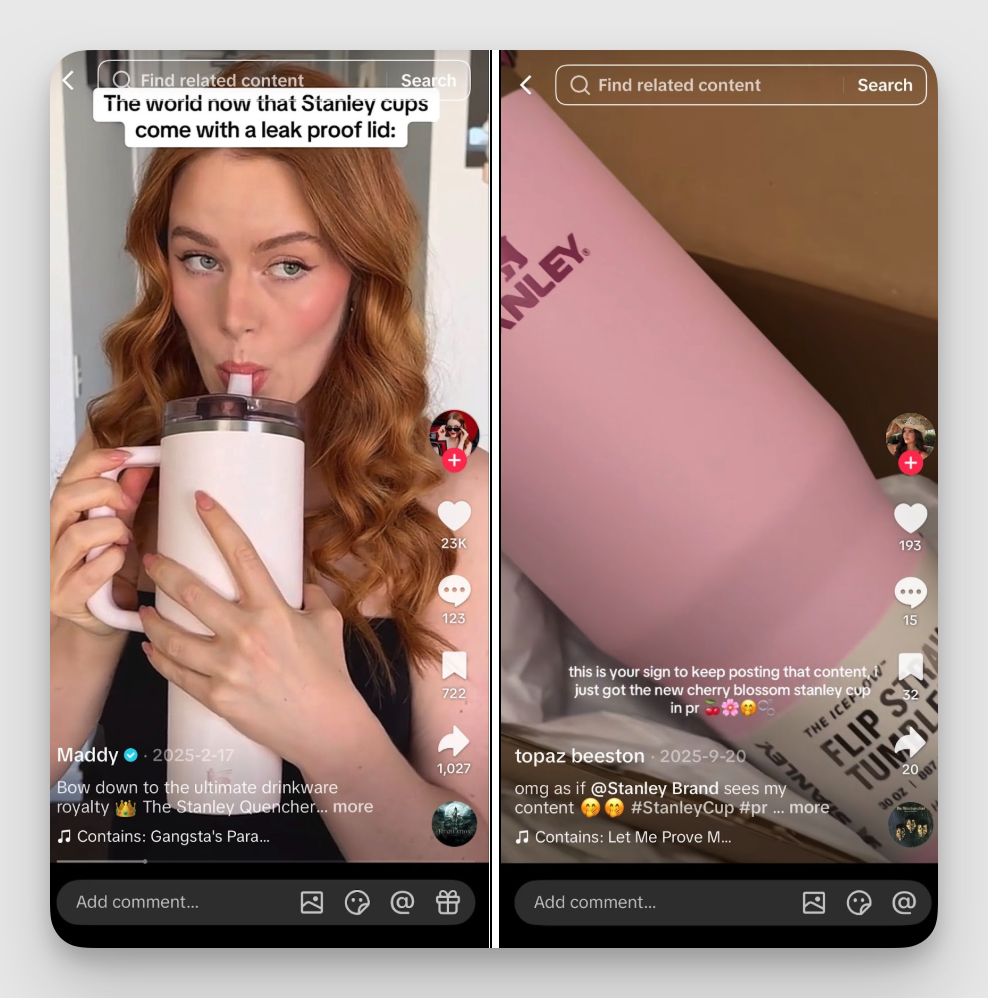
Another thing that stands out is how organic it feels.
The product isn’t introduced as a campaign. It’s already part of the creator’s environment: on a desk, in a car, next to a workout.
That repeated exposure builds familiarity quickly.
And because the creators are smaller, the content tends to feel closer to recommendations than promotions.
It’s a good example of how micro-influencer strategies don’t always look like campaigns, but can outperform them when they’re executed consistently.
Key takeaways from successful campaigns
Across these campaigns, a few patterns show up consistently:
One clear idea scales better than multiple weak onesPoppi’s vending machine concept, Rare Beauty’s consistent product messaging, both rely on a single strong angle repeated across creators.
Repetition drives recognitionSeeing the same product or concept across multiple creators builds familiarity faster than one-off exposure.
Creator fit shapes how the campaign feelsRare Beauty’s choice of tutorial-driven creators and Stanley’s everyday lifestyle creators both align naturally with how the product is used.
Content works best when it matches existing behaviorProducts placed inside routines, reactions, or day-in-the-life content hold attention better than forced integrations.
Distribution matters as much as the ideaNone of these campaigns rely on a single viral post. They spread across multiple creators, formats, and moments.
Campaigns don’t stop at contentThe strongest executions extend beyond TikTok, whether through real-world activations (Rare Beauty) or tying into larger moments (Poppi and the Super Bowl).
Taken together, these campaigns show a shift.
Final thoughts
If there’s one thing I’d keep in mind, it’s this: TikTok influencer marketing rewards people who pay attention.
Not just to trends, but to nuance: how a hook lands, how fast a video gets to the point, how a product fits into the flow. Small details tend to matter more than big ideas.
Control doesn’t help much here. The more rigid the structure, the easier it is for content to lose what made it work.
What holds up is simple: clear direction, the right creators, and space for content to adapt.
Some brands treat it like a checklist. Others build a system around it.
Which one do you want to be?
FAQs on TikTok influencer marketing
What are the specifics of TikTok influencer marketing?
TikTok influencer marketing focuses on content performance, iteration, and creator alignment.
Campaigns rely on multiple creators and formats to test what resonates, then build on what performs. Content is designed to feel native to the platform, with strong hooks, fast pacing, and storytelling that holds attention.
Creators are given flexibility to adapt messaging to their style, which helps maintain authenticity and engagement. Performance is measured using watch time, engagement, and conversions to identify what drives results.
This approach allows brands to build repeatable campaigns that improve over time instead of relying on one-off posts.
How can brands collaborate with TikTok influencers?
To collaborate with TikTok influencers, brands should first identify influencers who align with their target audience. Next, they should establish clear campaign goals and connect with influencers directly or via marketing platforms. By creating authentic, engaging content together, and tracking key performance metrics like views and conversions, brands can effectively reach a wider, engaged audience on TikTok.
Why engagement rates matter more than follower counts on TikTok?
Engagement rates matter more than follower counts on TikTok because the platform distributes content based on how users interact with it, not how large the audience is.
Signals like watch time, shares, comments, and completion rate determine whether a video reaches more people. A creator with a smaller but active audience can generate stronger engagement, which helps content spread further through the algorithm.
For TikTok influencer marketing, this makes engagement a more reliable indicator of performance. It shows how well content resonates and how likely it is to scale, while follower count only reflects potential reach.

Anda Radulescu
Anda Radulescu is a SaaS content writer and copywriter with 5+ years in digital marketing, turning social media data into practical ideas for Instagram, LinkedIn, and beyond

Know what your competitors do — before your manager asks
Get instant social benchmarks & reports without manual work.