How to Create a Social Media Platform Strategy: Detailed Guide Covering Expert Insights
Discover how to create an effective social media platform strategy based on expert insights and data. Learn how to elevate your social presence in no time.

A lot of social media teams put real effort into building a unified strategy and pushing content across every platform (same message, slightly reshaped), but still end up asking the same questions in every performance meeting: why TikTok is flat, why LinkedIn isn’t converting, why Instagram Reels are underperforming.
But the problem is not effort. It is architecture.
A social media platform strategy is not one strategy. It consists of several strategies that share a brand positioning but differ in everything else: objective, format, tone, cadence, and what success looks like on that specific platform.
This guide breaks down when to add a new platform and how to build channel-specific strategies that feel native rather than repurposed, based on insights from Alma Pantaloukas, social media lead strategist.
Key takeaways
-
When is the right time to add a new platform to your social media presence? Add a new platform only when you have clear audience fit, defined goals, and the resources to sustain native content consistently.
-
How to create a channel-specific social media strategy? An effective channel strategy defines each platform’s role, adapts messaging to native formats, and builds content pillars around real audience behavior.
-
Platform-specific strategic insights: Strong performance comes from using platform-native formats, different video lengths, and content structures instead of applying the same strategy everywhere.
When is the right time to add a new platform to your social media presence?
The honest answer to this question is rarely 'now.'I have seen a lot of brands add platforms reactively — a competitor shows up on TikTok, a trend catches fire, someone in a leadership meeting says 'we should really be on Tiktok.' What follows is a burst of content enthusiasm, three weeks of posting, and then a slow fade into the digital equivalent of an abandoned storefront.
Alma Pantaloukas, a social media strategist who has guided brands through platform expansion decisions across industries, puts it plainly:
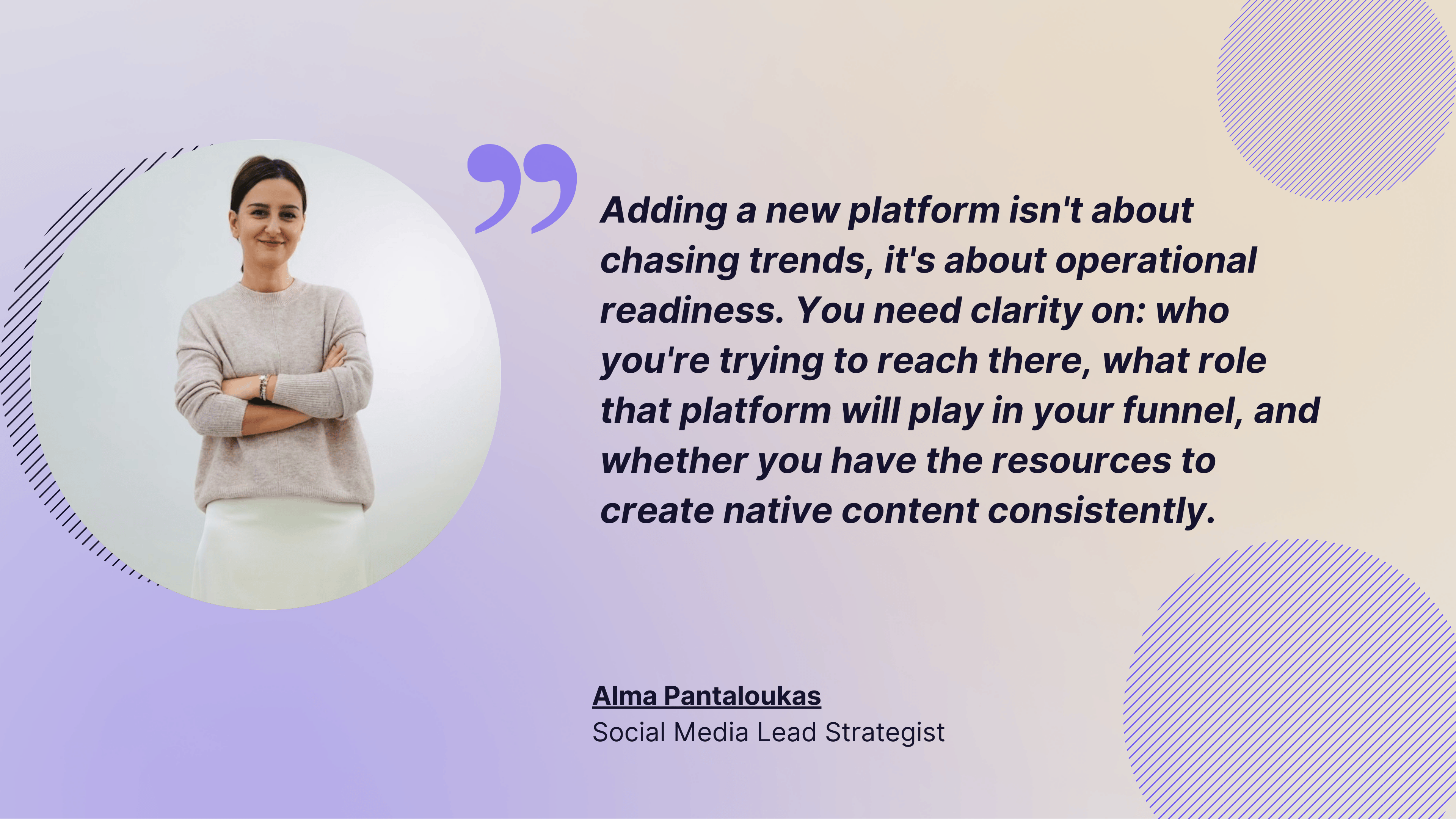
Adding a new platform isn't about chasing trends, it's about operational readiness. You need clarity on: who you're trying to reach there, what role that platform will play in your funnel, and whether you have the resources to create native content consistently. If you can't sustain it for at least 90 days with intention, you're not ready. A neglected platform hurts brand perception more than not being there at all.
That last line is worth underlining. A dormant account with three posts from eight months ago does not say 'we're building toward something.' It says 'we gave up.' And audiences notice.
Before committing to a new platform, run through these three questions:
- Audience fit: Is your target audience meaningfully active on this platform, or is this a bet on future behavior? Check platform demographic data, not just general popularity.
- Resource reality: Can you create genuinely native content for this platform consistently? Native means content that belongs there. TikTok content that was clearly made for Instagram is immediately identifiable and immediately scrolled past.
- Funnel role: What is this platform supposed to do for your business? Awareness, consideration, conversion, retention? If you can't answer this question before launching, you'll struggle to evaluate whether it's working after.
If you can answer all three clearly, you're ready. If you can't, the 90-day clock hasn't started yet. Use tools like Socialinsider to analyze how your competitors are performing on the platform you're considering, this gives you a realistic benchmark for what consistent, effective presence actually requires before you commit to building it.
How to create a channel-specific social media strategy?
Platform-specific strategy is not about creating entirely different brands for every channel. Your positioning, values, and core message should stay consistent. What changes is everything about how you deliver that message; the format, the hook, the length, the tone, and the frequency. Think of it less like speaking different languages and more like code switching: you're still you, but you talk differently in a board meeting than you do at a team lunch.
#1. Set a clear goal for each platform
Different platforms are good for different things, and conflating them is one of the most common strategic errors in social media management.
TikTok's algorithm-first distribution makes it exceptional for awareness and top-of-funnel reach, which means you can hit audiences who have never heard of your brand without a single follower. Instagram, with its established commerce features and shopping integrations, has become a genuine social selling platform. LinkedIn sits at the intersection of B2B authority and professional community-building.
Alma's framework for creating channel-specific strategies is built on four phases that are straightforward but frequently skipped in the rush to post. The order matters as much as the steps:
- Define the platform's role: Is this awareness? Community building? Authority? Conversion support? Each platform should have a job. If it doesn't, your content team has no anchor for decision-making. For example, a B2B SaaS business can use Linkedin for conversion support and authority building, while using Instagram for awareness.
- Understand audience behavior on that platform: The same audience behaves differently on LinkedIn vs. TikTok vs. Instagram. A marketing director who saves thought leadership carousels on LinkedIn is in a completely different headspace when they're on TikTok in passive discovery mode, not actively looking to learn or evaluate. Meet them where they are, not where your brand is most comfortable.
- Adapt messaging and format: The positioning stays consistent. The delivery changes. Hooks, tone, content length, and format must feel native, not like your Instagram caption was copy-pasted into a LinkedIn post.
- Build repeatable content pillars specific to that platform: Not copy-paste pillars. Platform-adjusted pillars. Your educational content pillar might translate into a long-form LinkedIn carousel, a 90-second Instagram Reel, and a 2-minute TikTok; three different executions of the same idea, each built for how that platform's audience actually consumes content.
This is where strategy stops being a slide and starts shaping what actually gets posted. A platform goal without a content format strategy is just a wish.
#2. Research your competitor’s strategy and audience engagement patterns
Competitive analysis in social media usually goes like this: Teams look at what competitors are posting, try to replicate it, and wonder why the engagement numbers don't follow. The problem is they're studying outputs without understanding inputs like what role the content plays, which formats are actually driving performance, and which content pillars are generating durable engagement versus one-off spikes.
Effective competitive research looks at four layers:
Look at their best-performing content pillars
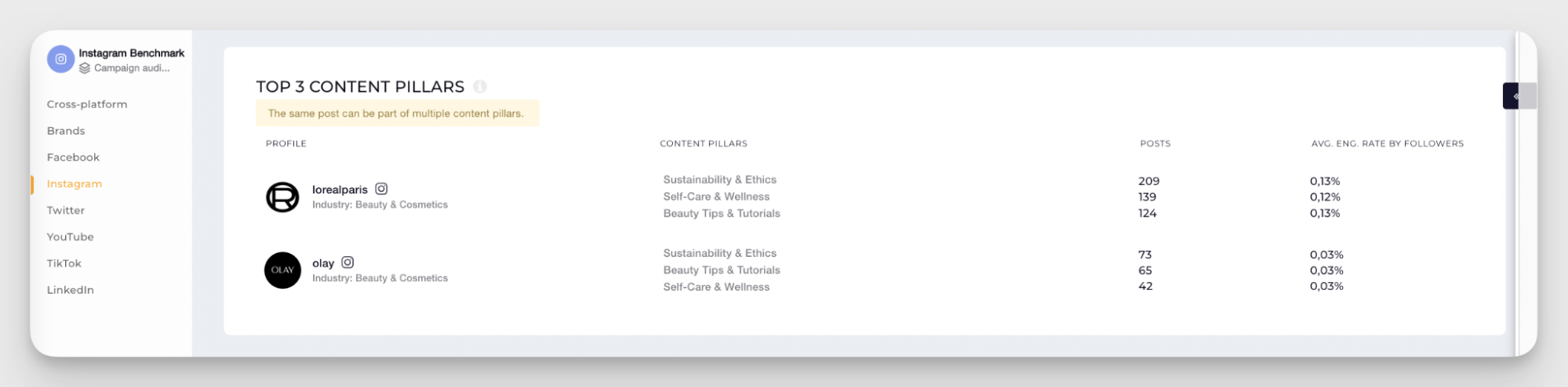
Content pillars tell you what themes a brand has decided to own. Looking at which pillars consistently generate high engagement rates — not just high view counts — reveals what their audience actually values versus what just happens to catch algorithmic attention.
Now, manually tracking competitor performance across platforms is slow, inconsistent, and almost always incomplete.
Instead of guessing, I look at 90-day performance patterns across competitors; what topics consistently drive engagement, what formats repeat, and where spikes actually come from.
Socialinsider's analytics view shows this instantly. Not just top posts but repeatable patterns, so you’re not just copying content, you’re reverse-engineering what works.
Analyze content formats and overall posting strategy
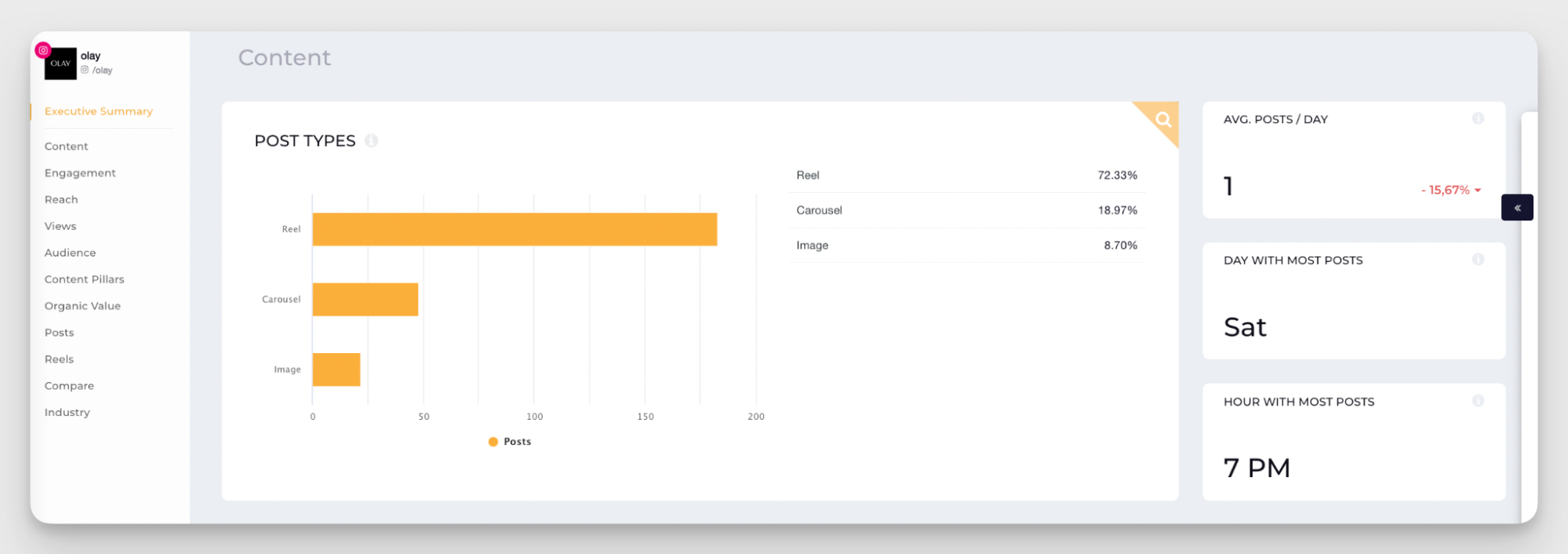
Format distribution matters as much as topic. A brand posting 80% images and 20% Reels on Instagram in 2026 is making a structural mistake that no amount of good copywriting will fix, the algorithm has made its preferences abundantly clear.
Look at what formats your competitors are using and, more importantly, which ones generate disproportionate engagement relative to their posting frequency. A format that represents 20% of posts but drives 60% of engagement is a signal worth acting on.
Identify patterns in their top posts
Top posts reveal the intersection of content quality and audience fit. I recommend looking for structural patterns: do they open with a question or a claim? Do their highest-engagement posts teach something, entertain, or validate? Is there a hook formula that appears across multiple high-performers? These patterns are more instructive than any individual viral post.
Alma is direct about what competitive analysis is actually for:
Yes, we leverage competitive insights, but not to imitate. We analyze competitors to identify patterns, momentum shifts, messaging fatigue, and white space within the category. Tracking cadence, format, angles, and amplification helps us understand what's becoming noise and where differentiation is possible. The goal isn't to follow what's working. It's to understand why it's working and then build something sharper.
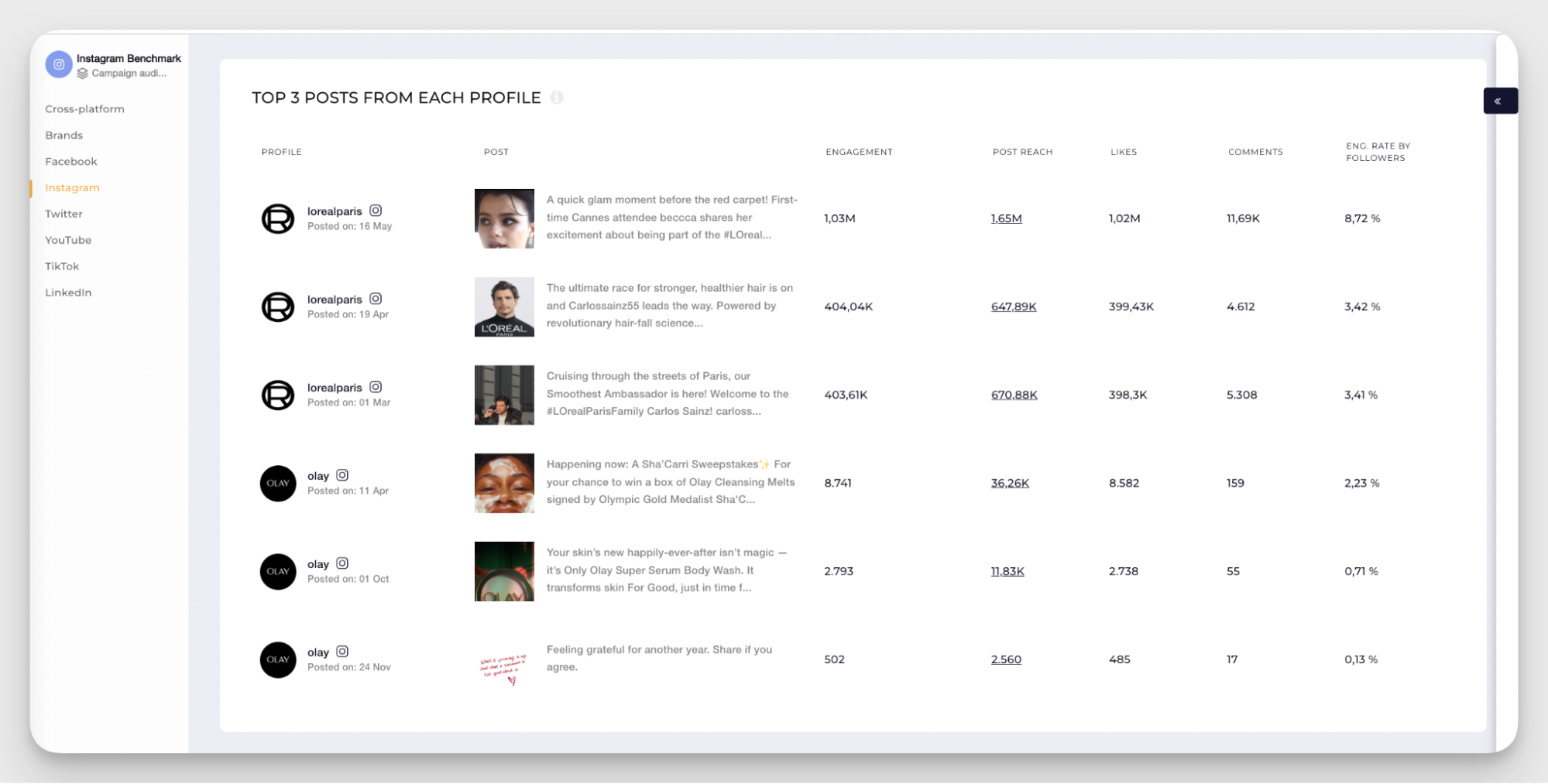
That distinction, the understanding why something works versus copying what it looks like, is the difference between a competitive analysis that informs strategy and one that just produces derivative content. A social media analysis that answers 'why' is worth ten times one that just answers 'what.'
#3. Define your own content strategy
Once you have a clear picture of your platform goals and competitive landscape, your content strategy should emerge from the intersection of three inputs: your audience's pain points (what they're actually trying to solve or understand), your cross-channel performance data (which content themes and formats have already demonstrated resonance on any of your channels), and the white space your competitive analysis has revealed.
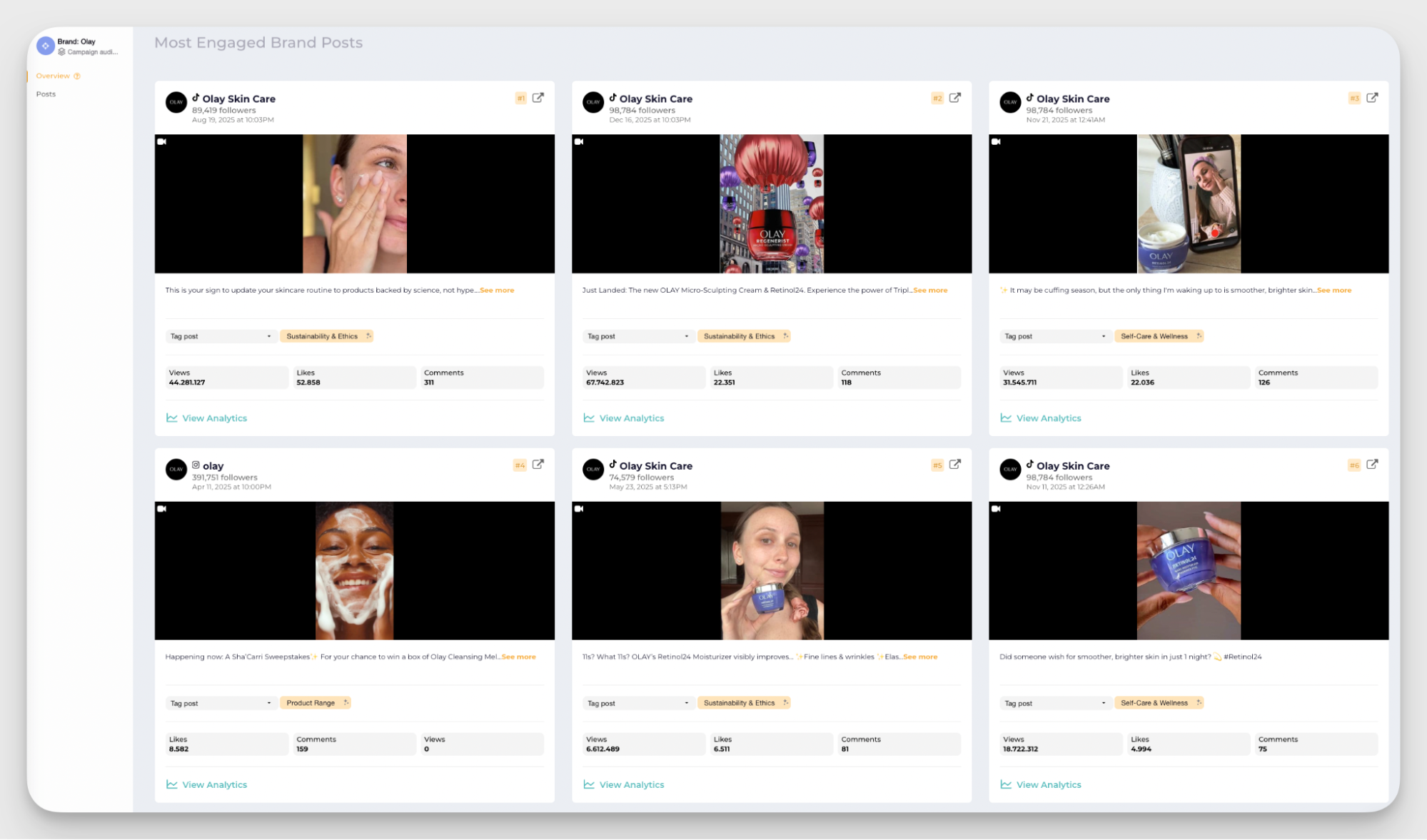
As you can see in the example above, with Socialinsider, you can quickly identify your top-performing posts, taking the guesswork out of the strategy creation.
Instead of relying on assumptions or anecdotal feedback, you’re empowered to make decisions grounded in hard evidence—doubling down on high-performing content and iterating where you see the most traction.
#4. Start measuring results and make data-based adjustments
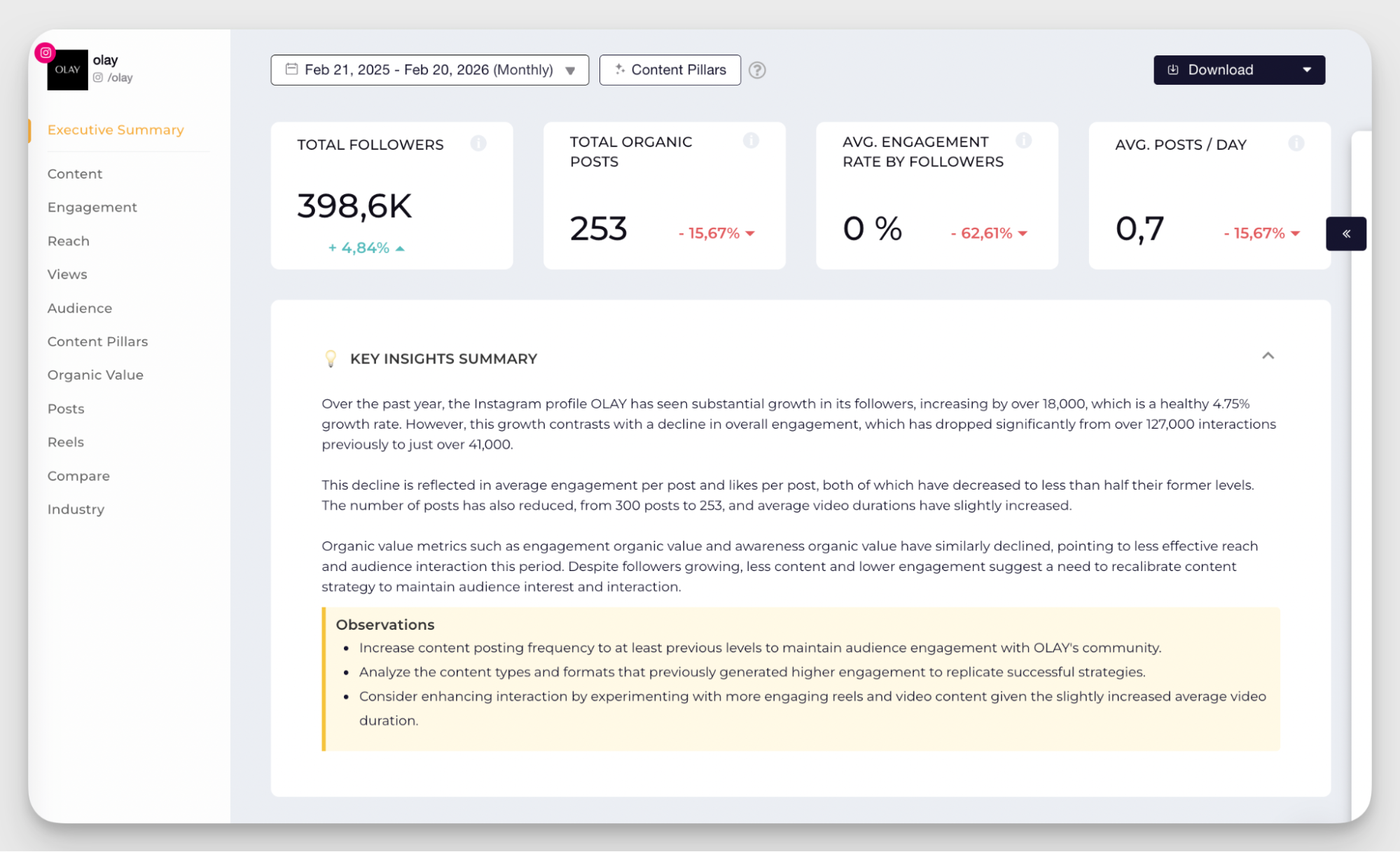
Once your content strategy is in motion, consistent measurement is key to ongoing success. Regularly review your performance data across key metrics like engagement rate, reach, and content formats to see what’s truly moving the needle for your brand.
Now, if you ask me, I'd say the hardest part of measurement isn’t collecting data, but making sense of it fast enough to act (first mover advantage is very real).
And experimenting with several social media analytics tools over the years, what I've seen is that most dashboards will show you what is happening, but they won’t tell you what to do next.
That’s where Socialinsider becomes critical. Instead of looking at isolated posts, you can see performance at a structural level and adjust your strategy accordingly.
Platform-specific strategic insights
General social media best practices are widely available and increasingly insufficient. What moves performance is platform-specific execution, knowing not just that video performs well, but which length, which hook structure, and which format performs best on each platform. Here is what the data actually says.
Focus more on Carousels and Reels, and less on images
According to Socialinsider’s Instagram benchmarks study, carousels are holding strong year-over-year with an engagement rate of 0.55%, matching Reels (scroing an average of 0.52% and significantly outperforming static images (now staying at 0.37% on average).
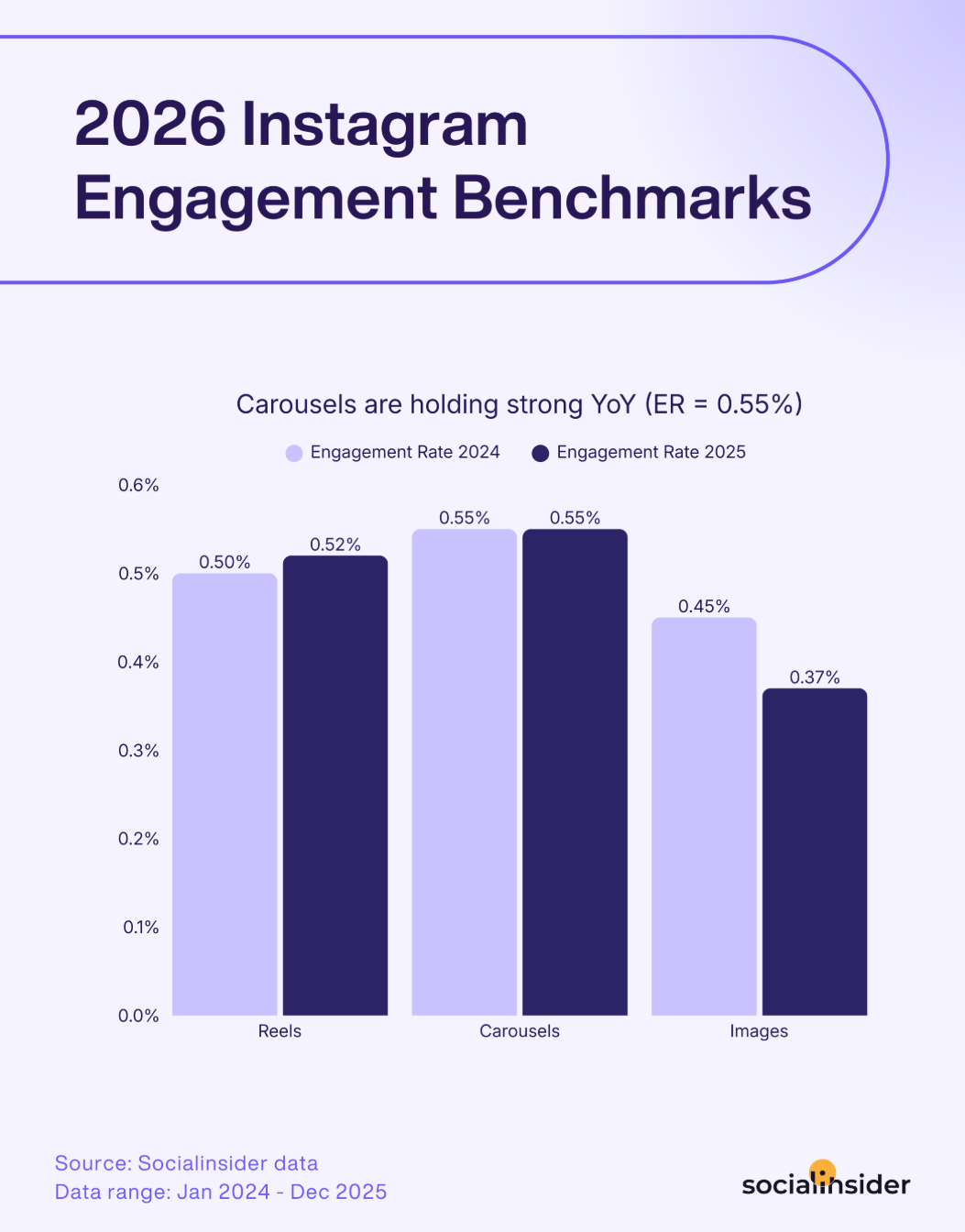
The data reflects a clear directional shift: the algorithm is favoring content formats that generate sustained interaction over passive impressions.
What this means practically is that if your Instagram content calendar is still weighted toward static images, you're working against the algorithm rather than with it. For strong organic performance on Instagram right now, I advise shifting the balance of your content mix toward Carousels and Reels, reserving static images for content that genuinely doesn't benefit from multiple slides or motion.
Carousels work because they generate multiple swipe interactions per session, signaling sustained engagement to the algorithm. They also allow for structured storytelling — building an argument slide by slide, presenting a framework, or walking through a before/after — that a single image simply can't accommodate. For B2B-adjacent brands on Instagram, this format is particularly powerful: it lets you be educational without being dry.
Create Reels between 60 and 90 seconds
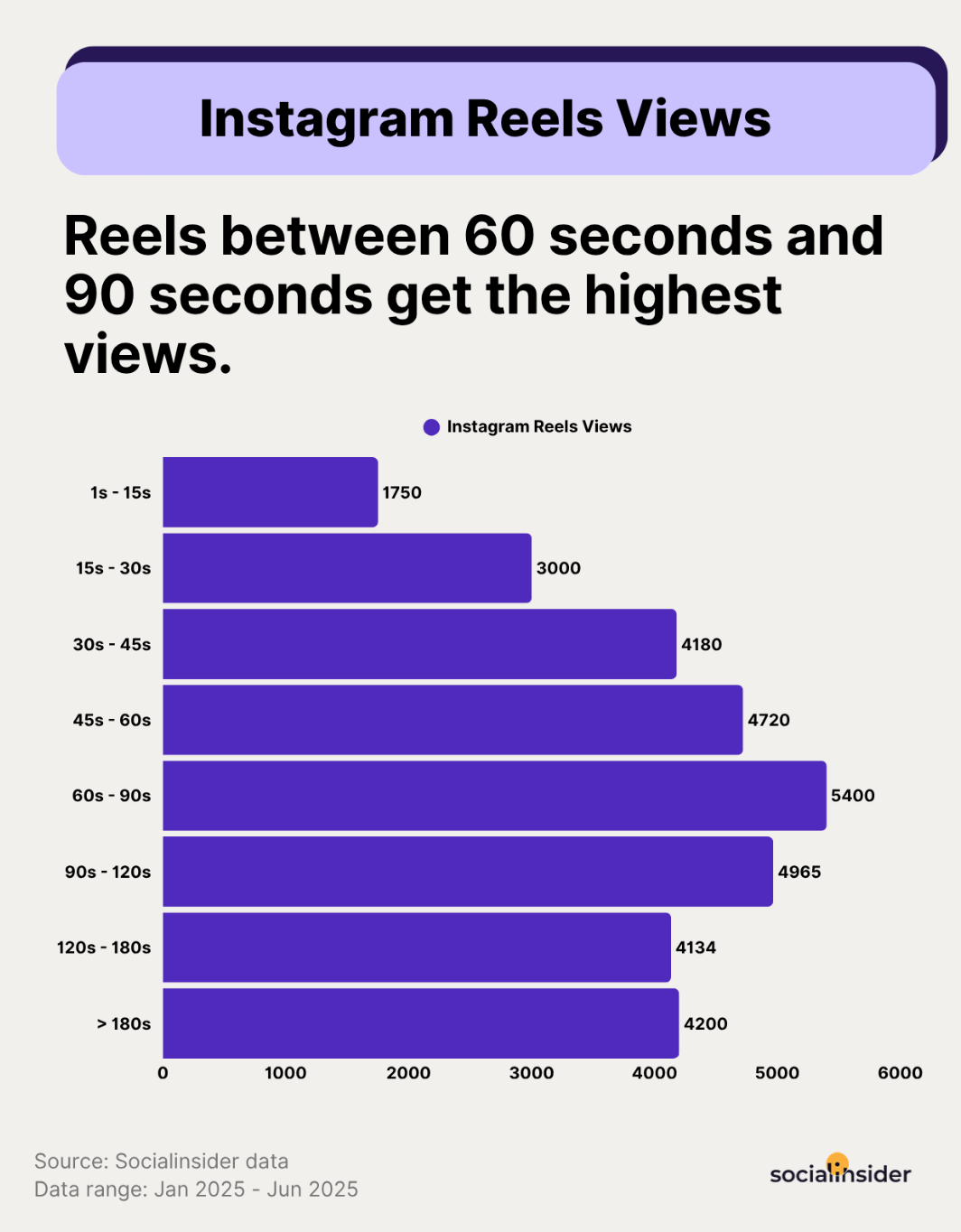
In my experience, length is one of the most consistently misunderstood variables in Reels strategy. The instinct is often to go shorter because people think shorter is snappier, shorter gets watched, shorter is safer. However, our Socialinsider Reels data says something more nuanced. Over 2025, Reels between 60 and 90 seconds got the highest average views outperforming both shorter clips (15-30 seconds) and longer content (120-180 seconds)
The 60-90 second window is long enough to deliver genuine value (a tutorial, a story arc, a framework), and short enough to hold attention if the hook is strong. The implication for your content strategy is that you should stop treating Reels as a format that demands brevity and start treating them as a format that demands a strong opening.
A well-structured 75-second Reel will consistently outperform a weak 12-second clip, and the data backs this up. A well-structured 75-second Reel will consistently outperform a weak 12-second clip, and the data backs this up.
Alma's perspective adds the strategic layer behind the format trends:
Platform-specific tactics work best when they reinforce brand positioning, not just chase trends. Across categories, we consistently see that founder-led content performs well. Not because the algorithm favors founders, but because audiences trust people more than logos. When a founder communicates conviction, point of view, and clarity in a short-form format, even a simple 7-second single-frame clip with a strong hook wins.
We're also seeing a strong resurgence of carousels — on both Instagram and TikTok. Not as filler content, but as structured storytelling tools. Carousels allow brands to build an argument, unpack a belief, challenge an assumption, or educate with depth. Instead of fighting for three seconds of attention, you're earning sustained engagement swipe by swipe.
TikTok
Test 2-minute videos
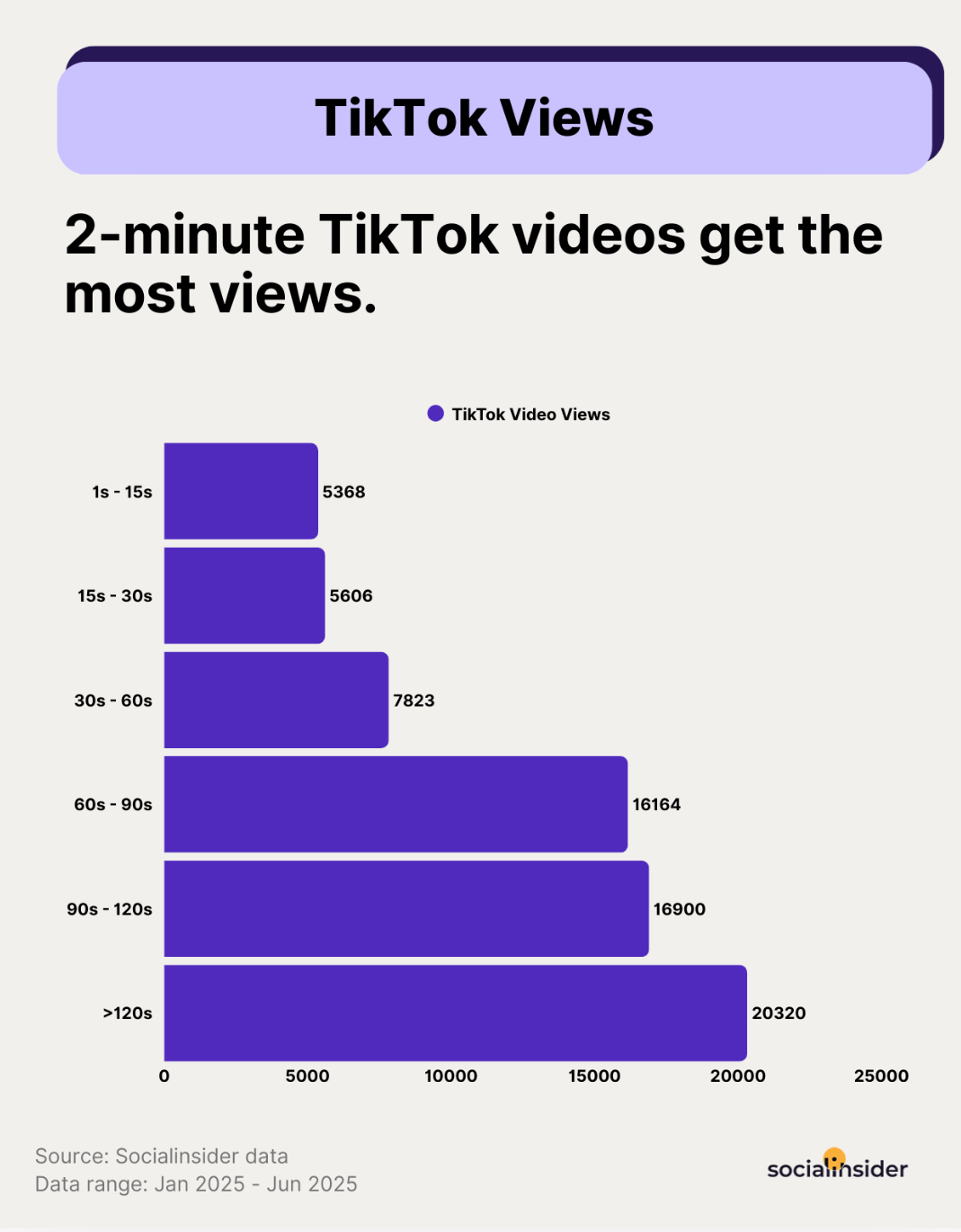
TikTok's data tells a story that surprises most marketers who have been optimizing for short-form content. Socialinsider's TikTok data shows that videos over 120 seconds average 20,320 views, which is nearly four times views for 1-15 second videos. The 90-120 second range also significantly outperforms short content. The platform that everyone associates with 15-second clips is now rewarding depth.
This is not a coincidence. TikTok has been actively pushing longer content as it competes with YouTube for watch time. The algorithm interprets completion rate as a quality signal, and a 2-minute video that holds attention generates a stronger signal than a 10-second clip that gets scrolled past after three seconds.
Alma's broader observation about what drives durable TikTok performance goes beyond any single format tactic:
We don't think in terms of 'posts.' We think in terms of narrative systems, and then deploy them in ways that feel native to the platform. That's what drives durable growth. From a strategic standpoint, what works is alignment: clear positioning, a consistent narrative, repetition of core ideas across formats, and disciplined execution. Platforms change. Formats evolve. Algorithms shift. But brands that build around a strong point of view, founder conviction, and message clarity tend to outperform regardless of platform.
The practical implication for your TikTok strategy is to stop treating 2-minute content as a risk and start testing it as an opportunity. Begin with your best-performing educational or storytelling content formats — the ones that already generate saves and shares at shorter lengths — and extend them. Watch completion rate and shares as your primary signals.
Integrate more native documents, multi-image posts, and videos into your content mix
According to Socialinder's latest LinkedIn benchmarks report, native documents lead with a 7.00% engagement rate, followed by multi-image posts at 6.45%, video at 6.00%, images at 5.30%, polls at 4.20%, and text-only posts at 3.25%.
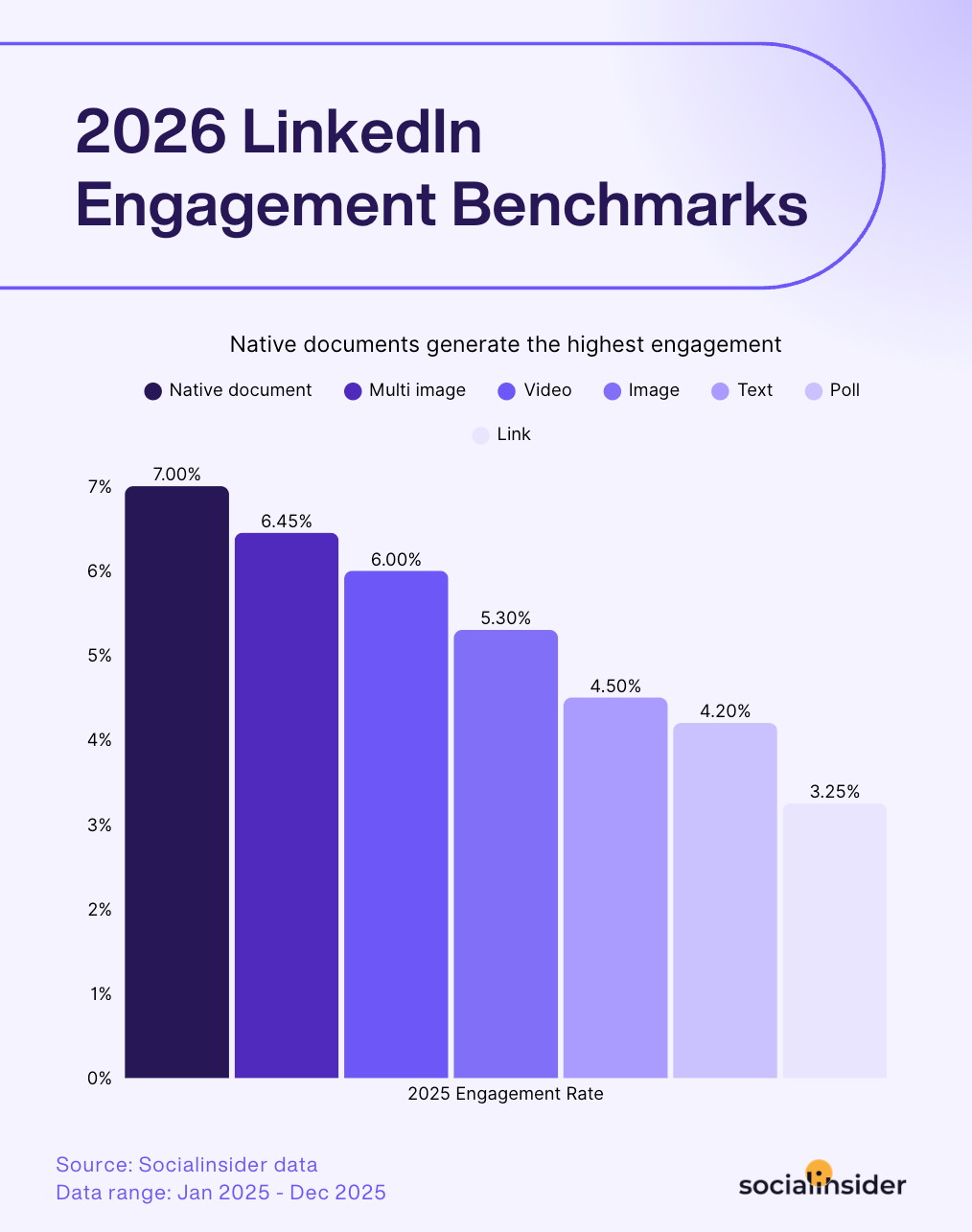
For a platform where text-heavy posts are still the default for many brands, this is a significant missed opportunity. The shift toward multi-image posts and native documents reflects how LinkedIn's audience has evolved: they still want substance and professional insight, but they want it delivered in formats that are scannable and visually structured rather than wall-of-text posts that require your full attention to skim.
Keep your videos between 2 and 3 minutes
LinkedIn video engagement peaks in the 90-120 second range at a 7.20% engagement rate which is the highest of any video length on the platform.
Shorter videos (under 30 seconds) achieve 5.85%, while longer content (over 180 seconds) lands at 6.30%. Sticking to the sweet spot of roughly 2 minutes gives you enough time to deliver a complete, substantive idea while staying within the attention window of a professional audience that is, by definition, busy.
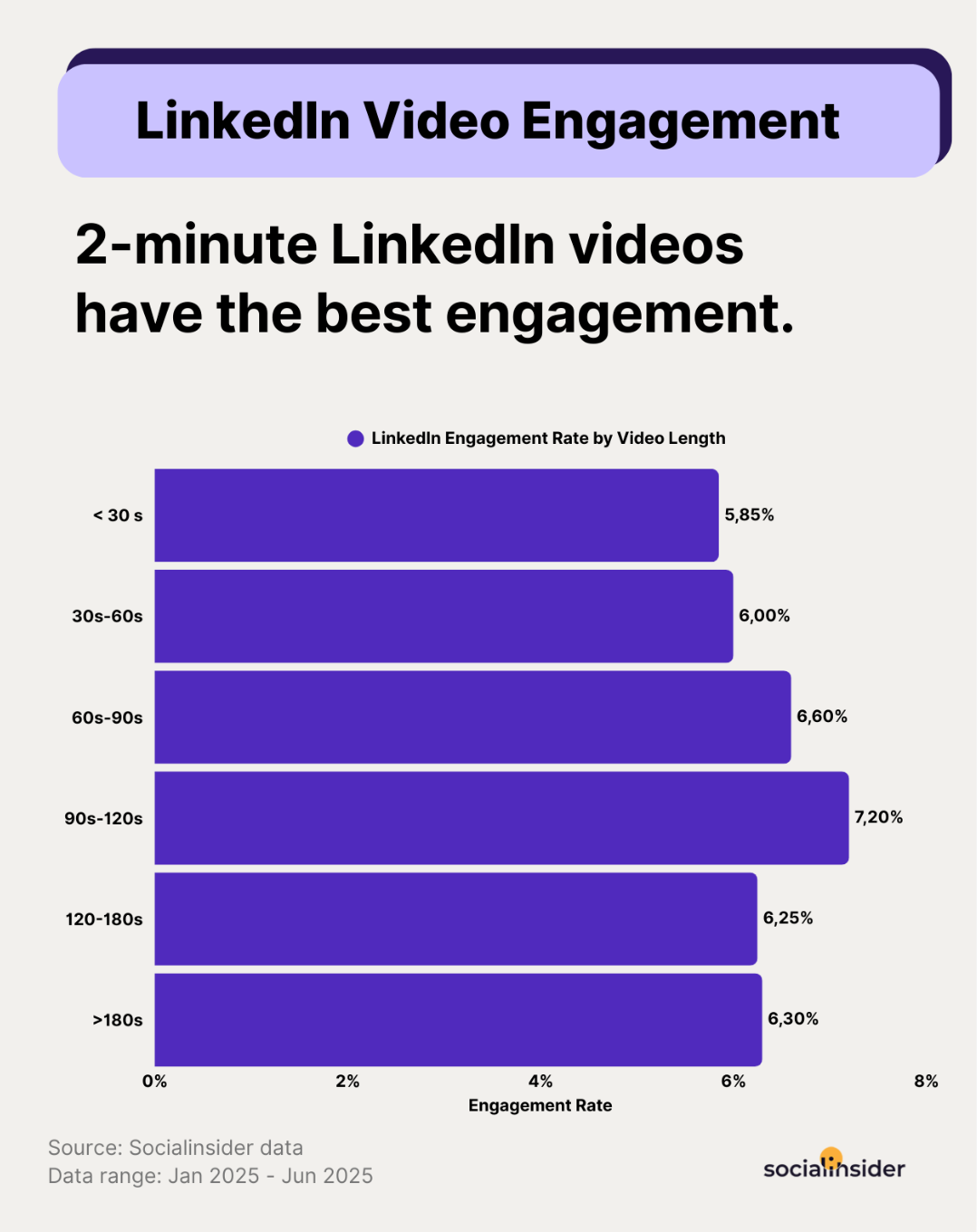
What this means for your LinkedIn video strategy is that you should be structuring videos around single, well-developed ideas rather than trying to pack multiple points into a longer runtime.
A 90-second video that makes one argument compellingly will outperform a 4-minute video that makes three arguments loosely. For a deeper look at video marketing strategy, the same principle applies across platforms: depth beats breadth in a single asset.
Leverage polls for increased impressions
LinkedIn polls are one of the platform's most underused high-reach formats. Socialinsider data shows that for pages with 100K-1M followers, polls generate dramatically higher average impressions than any other format.
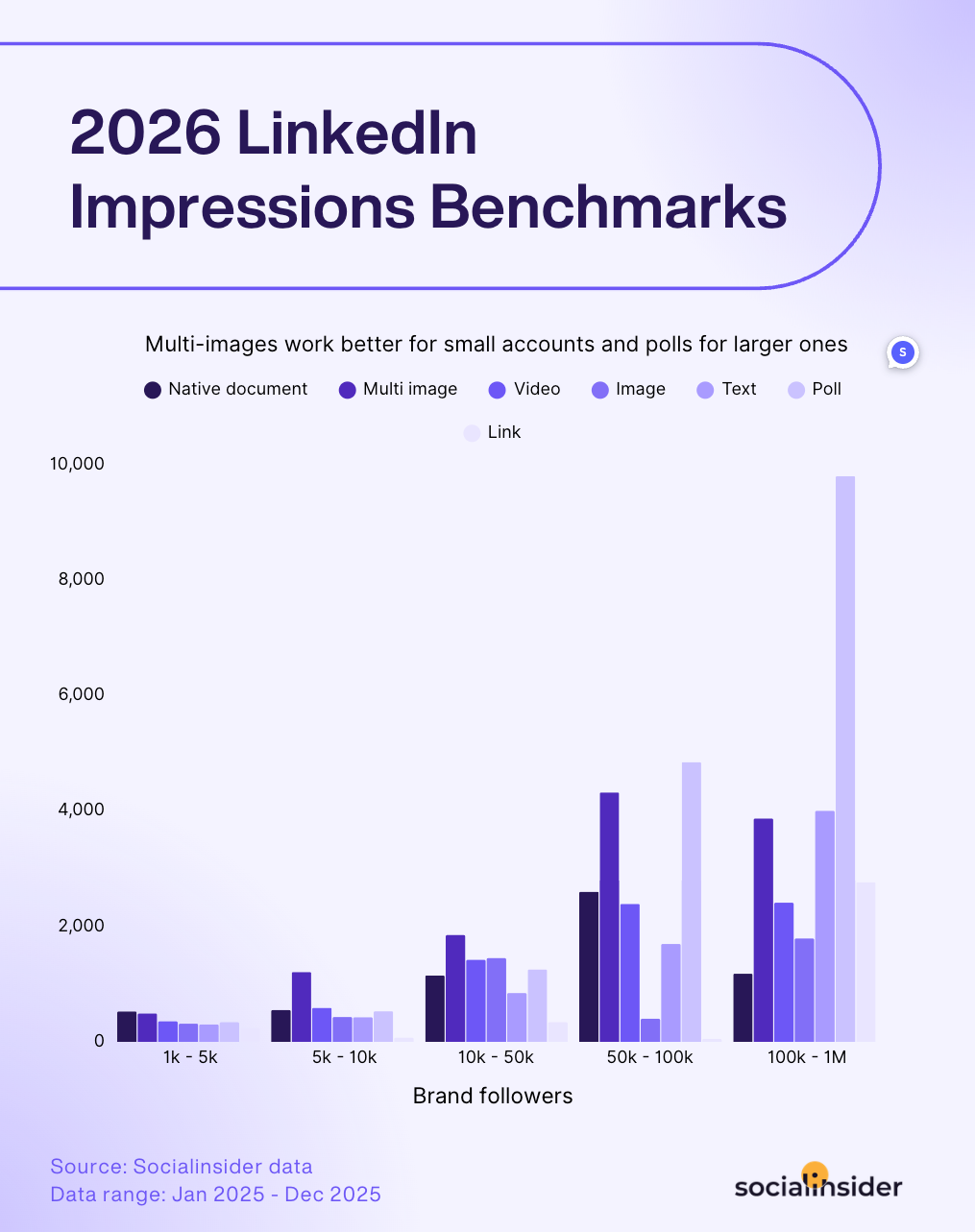
Polls work on LinkedIn for a structural reason: they invite participation rather than just consumption, and every vote or comment extends the post's distribution window. The algorithm treats engagement signals from polls the same as engagement signals from other formats, but polls generate them at a much lower production cost.
A well-framed poll that touches a genuine debate in your industry (not a trivial question with obvious answers), can generate reach and comment volume that would cost significantly more to achieve through paid distribution.
The strategic play is to use polls as a reach mechanism at the top of a content sequence, then follow with the substantive carousel or video that deepens the conversation the poll started. This creates a compounding effect: the poll extends your reach, the follow-up content converts that reach into genuine authority.
Final thoughts
The brands that consistently outperform on social media are the ones that build clear strategic architecture and then execute it with discipline. They know what each platform is supposed to do, they create content that feels native to that platform rather than repurposed from somewhere else, and they measure the right signals to know whether it's working.
Socialinsider gives you the data infrastructure to build and run this system: competitive benchmarks by platform and industry, content pillar analysis that shows which themes are actually driving intent signals, cross-channel performance comparison, and executive-ready reporting that translates social activity into business impact.
Nsikak Tim
B2B content marketer with 9 years in marketing and 6 years in content writing. I focus on sharp, insight-driven content that doesn’t sound like it was approved by five stakeholders and a legal team.
Know what your competitors do — before your manager asks
Get instant social benchmarks & reports without manual work.
You might also like



Improve your social media strategy with Socialinsider!
Use in-depth data to measure your social accounts’ performance, analyze competitors, and gain insights to improve your strategy.