How To Create A Social Media Intelligence Gathering Process: 7 Key Steps
Learn what the process of creating a social media intelligence gathering process looks like. Discover here key components and helpful tools.


If you ask me, I'd say that today, social media intelligence is about anticipation, not just reaction.
With billions of daily interactions across platforms and native analytics offered by most, access to social data isn't a competitive advantage anymore.
Social media intelligence now comes from knowing how to interpret information and act on it before your competitors do.
In this guide, I cover everything you need to build that capability, from the fundamentals to the tools and best practices that make it work.
Key takeways
-
What is Social Media Intelligence (SOCMINT)? Social media intelligence is the process of turning social media data into actionable insights that support strategic decision-making.
-
What are the key components of social intelligence? Social intelligence is built on data collection, analysis, and actionable insights that turn social activity into strategic knowledge.
-
How to set in place a social media intelligence gathering process?
A social media intelligence process follows a cycle of setting goals, collecting data, analyzing results, and acting on insights. -
What social media tools can help you with social media intelligence gathering? Social media intelligence relies on analytics, listening, and influencer tools to understand performance, conversations, and market context.
What is Social Media Intelligence (SOCMINT)?
Building social media intelligence (SOCMINT) stands for the process of collecting, monitoring, and analyzing data from social media platforms to extract actionable insights that support business decision-making, risk management, and strategic planning.
At its core, SOCMINT goes beyond simply listening to online conversations; it uses advanced analytics and technology to transform vast amounts of real-time social content — posts, comments, likes, shares, interactions — into meaningful, organized information. This allows organizations to understand public sentiment, anticipate trends, discover opportunities, and respond quickly to reputational risks or emerging topics.
Unlike basic social media analytics, which focus primarily on performance metrics, SOCMINT provides deeper context and context-driven understanding. It enables brands to not only see what is happening in the social landscape, but also why it’s happening and how they can proactively respond or capitalize on those findings.
Why is social media intelligence mandatory for businesses that want to gain a competitive advantage?
The ground beneath us is shifting fast: consumer preferences, industry trends, and even crises break on social media long before they reach traditional channels. Businesses that take social media intelligence seriously are the ones who:
- Spot emerging trends early: SOCMINT allows you to pick up on shifts in audience behavior and industry trends before they become mainstream, so you can lead rather than follow.
- Enhance customer understanding: Deep audience insights enable the creation of relevant content and personalized experiences, driving loyalty and growth.
- Measure the true impact of campaigns: Go beyond likes and shares; assess sentiment shifts, message resonance, and advocacy changes.
What are the key components of social intelligence?
Let’s break down social intelligence into its three powerhouse pillars:
- Data collection: Every good insight starts with raw material — and in this case, that means robust data collection. Think of it as casting a wide net: you’re gathering not only comments, mentions, and shares, but also less obvious signals — emerging hashtags, influencer chatter, and more. The trick isn’t collecting “more data” — it’s collecting the right data, consistently and ethically, using specialized tools and platforms built for this deep dive.
- Analysis: With a mountain of raw data at your fingertips, analysis separates the “so what?” from the “aha!” This involves everything from sentiment analysis (is the mood positive, negative, or neutral?) to discovering common themes, audience segments, and shareable moments. Analysis is where you go from facts to meaning.
- Actionable insights: Finally, the real magic: insights you can act on right now. Actionable insights are specific, timely, and customized to your brand’s goals. This could mean shifting your content strategy to speak to a new concern you weren’t aware of last month, discovering a sudden rise in brand advocates, or preparing for a seasonal shift before competitors notice. In essence, it’s about arming your team with intelligence that drives confident, forward-thinking decisions.
What is the difference between social intelligence, social listening, social monitoring, and social analytics?
Although the following terms often get used interchangeably, each one brings something unique to the table:
- Social media intelligence: This is your strategic command center. SOCMINT pulls together every tool in your kit—monitoring, listening, analytics—and weaves them into a comprehensive narrative. It’s about knowing what’s happening, why it matters, and what’s likely to come next. If you want your insights to shape business strategy, not just react to it, this is the level to aim for.
- Social media listening: Think of listening as your finely tuned radar. It’s about really “hearing” what’s being said: tracking mentions, hashtags, trends, and sentiment—across platforms, keywords, and competitors. You’ll know what people care about, what makes them happy, and what ticks them off. The focus is on understanding, not just tracking.
- Social media monitoring: Monitoring is a bit more tactical—like a security guard for your brand. It’s about keeping an eye out for issues as they appear and being ready to jump in: that unhappy customer, a fast-spreading rumor, or sudden changes in brand sentiment. Here, speed and response matter most.
- Social media analytics: If you love numbers and benchmarks, this is your playground. Social media analytics turns activity—likes, shares, clicks, reach—into quantifiable metrics. It answers: How did our new campaign perform? Are our followers growing? But it’s typically focused on what’s already happened, not what’s next.
How to set in place a social media intelligence gathering process?
A solid social media intelligence gathering process follows a repeatable, structured cycle. It starts with defining what you want to know, continues with acting on what you find, and concludes with measuring whether it worked.
Whether tracking competitors, monitoring brand sentiment, or uncovering content opportunities, I highlight a framework below that you can adapt to your team's goals and resources.
Step 1: Define your objectives and KPIs
Before you collect a single data point, you need to know what decision this data will support, as that shapes everything that comes after.
Your objectives might range from understanding how your brand is perceived to identifying what's working in your competitors' content strategies. Some of the most common starting points include:
- Brand health monitoring — tracking how your brand is being talked about and how sentiment shifts over time.
- Competitor benchmarking — comparing your performance against key competitors across platforms and content types.
- Audience analysis — identifying who engages with your content, what they care about, and when they're most active.
- In-depth measurement — going beyond vanity metrics to assess marketing performance and impact on the business.
- Content strategy optimization — finding out which content pillars, formats, and topics resonate most with your target audience.
- Social media trend spotting — catching emerging topics or formats in your industry.
- Crisis detection — monitoring for sudden sentiment shifts or spikes in negative mentions that require a fast response.
For example, if your goal is to identify competitors' winning strategies, your relevant social media metrics will likely include posting frequency, engagement rate, content format distribution, and views.
Without this clarity upfront, you end up with a lot of data and not much direction.
Step 2: Select your data sources and platforms
Once you know what you're after, decide where to look. Not every platform will be relevant to every objective — and spreading your monitoring too thin is just as risky as not monitoring at all.
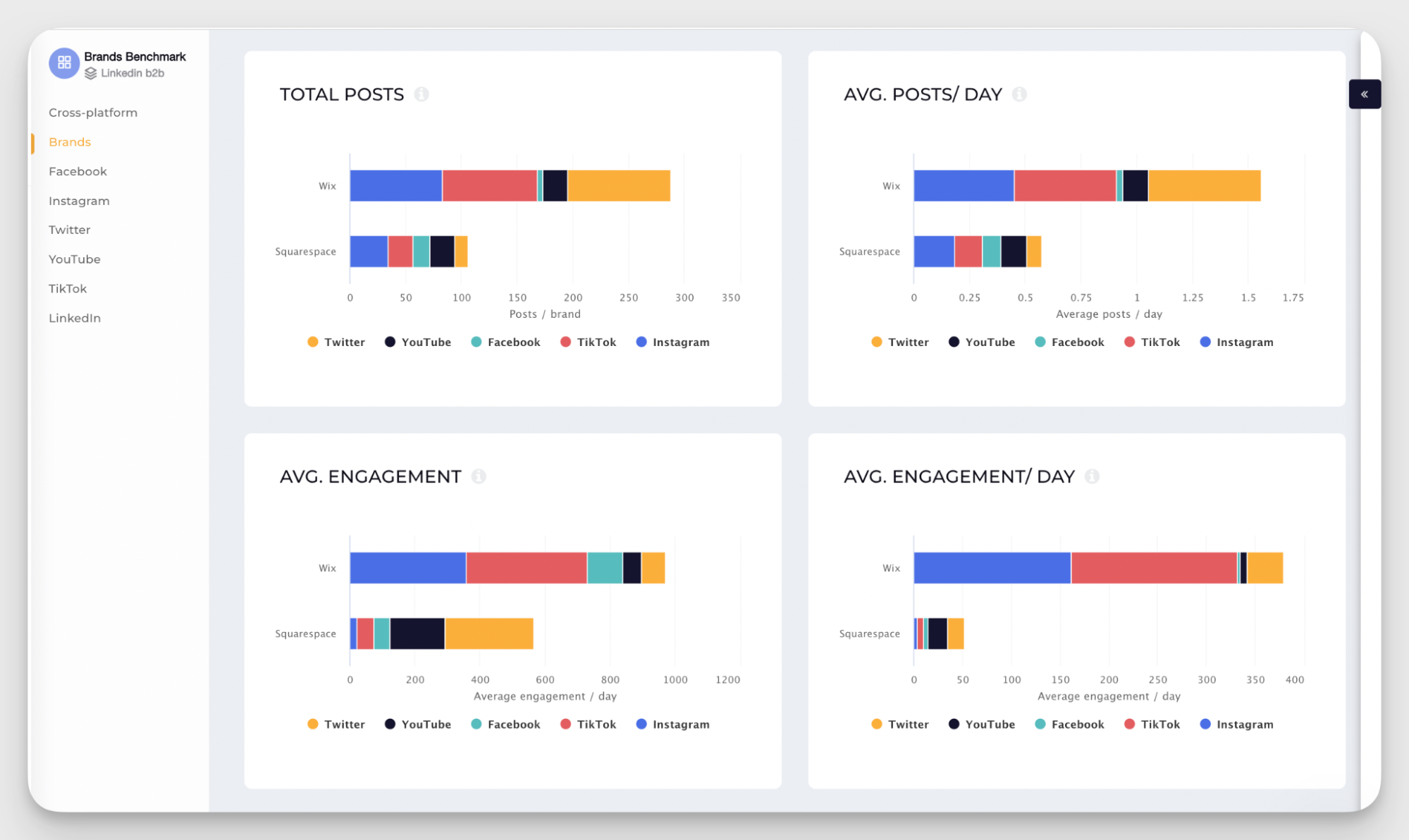
Let's make this concrete. Say Squarespace wants to run a cross-platform performance comparison against Wix. The first step is to pull comparable data across all shared channels, from posting volume and average posts per day to total and daily engagement figures.
As you can see in the view below, social media intelligence platforms like Socialinsider make it straightforward to run this kind of side-by-side brand benchmark across Twitter, YouTube, Facebook, TikTok, and Instagram at once.
Step 3: Set up your tracking and collection systems
With your sources identified, you need consistent, reliable systems to capture data over time. One-off snapshots are useful, but the real value of social media intelligence gathering comes from tracking trends across weeks and months. That's how you separate a momentary spike from a real lasting trend.
This step is where your choice of social media intelligence tools matters most. When evaluating your options, look for platforms that:
- Collect data automatically and consistently — manual exports don't scale, and gaps in data collection mean gaps in your analysis.
- Cover multiple platforms in one place — switching between native analytics tools for each channel makes cross-platform comparison nearly impossible.
- Allow competitor tracking alongside your own accounts — the most useful intelligence comes from seeing your performance in context.
- Break down performance by content format, topic, and posting cadence — surface-level metrics only tell part of the story.
- Offer historical data access — trends only become visible over time, so a platform that only shows you a live snapshot has limited strategic value
- Include social media content intelligence features — like content pillar tracking, top post identification, and engagement breakdowns by category
- Offer insights quickly — whether through clear dashboards or built-in AI assistance that helps you move from data to decision without heavy manual work
If you want to see these capabilities in action, try Socialinsider free for 14 days and explore how it handles your competitive tracking, cross-platform benchmarking, and content analysis in one place.
Step 4: Analyze the data
The data collected is just raw material. Analysis is where it becomes intelligence.
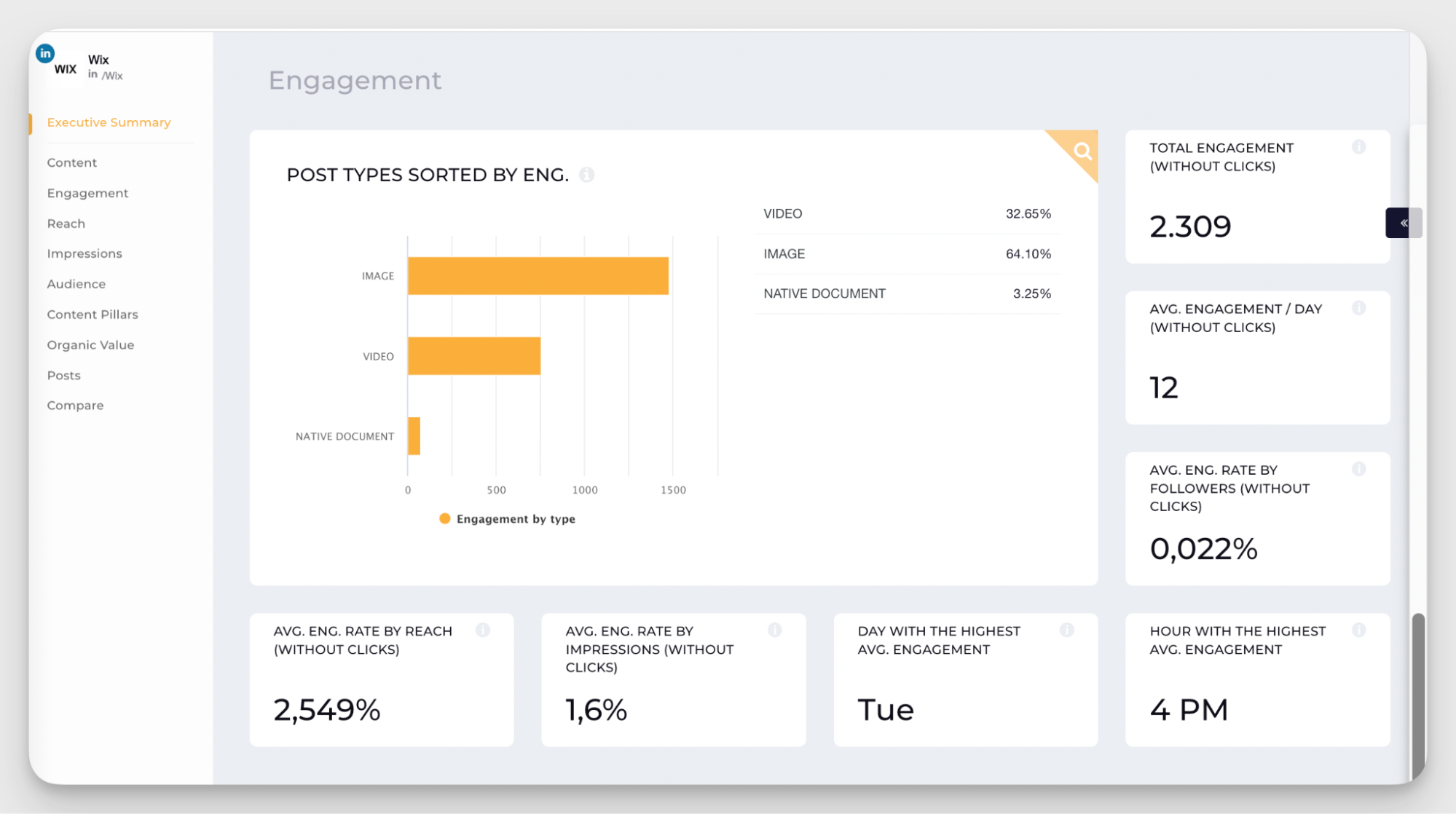
Going further with the Squarespace and Wix example, once you have the high-level benchmark, the next step is to go deeper into channel-specific performance. For Wix on LinkedIn, a look at engagement by content format shows that image posts drive significantly more interaction than video or native documents, with a clear lead in the breakdown.
But format is only part of the picture. Looking at top-performing posts gives you qualitative context: which topics, tones, and creative ideas are resonating.
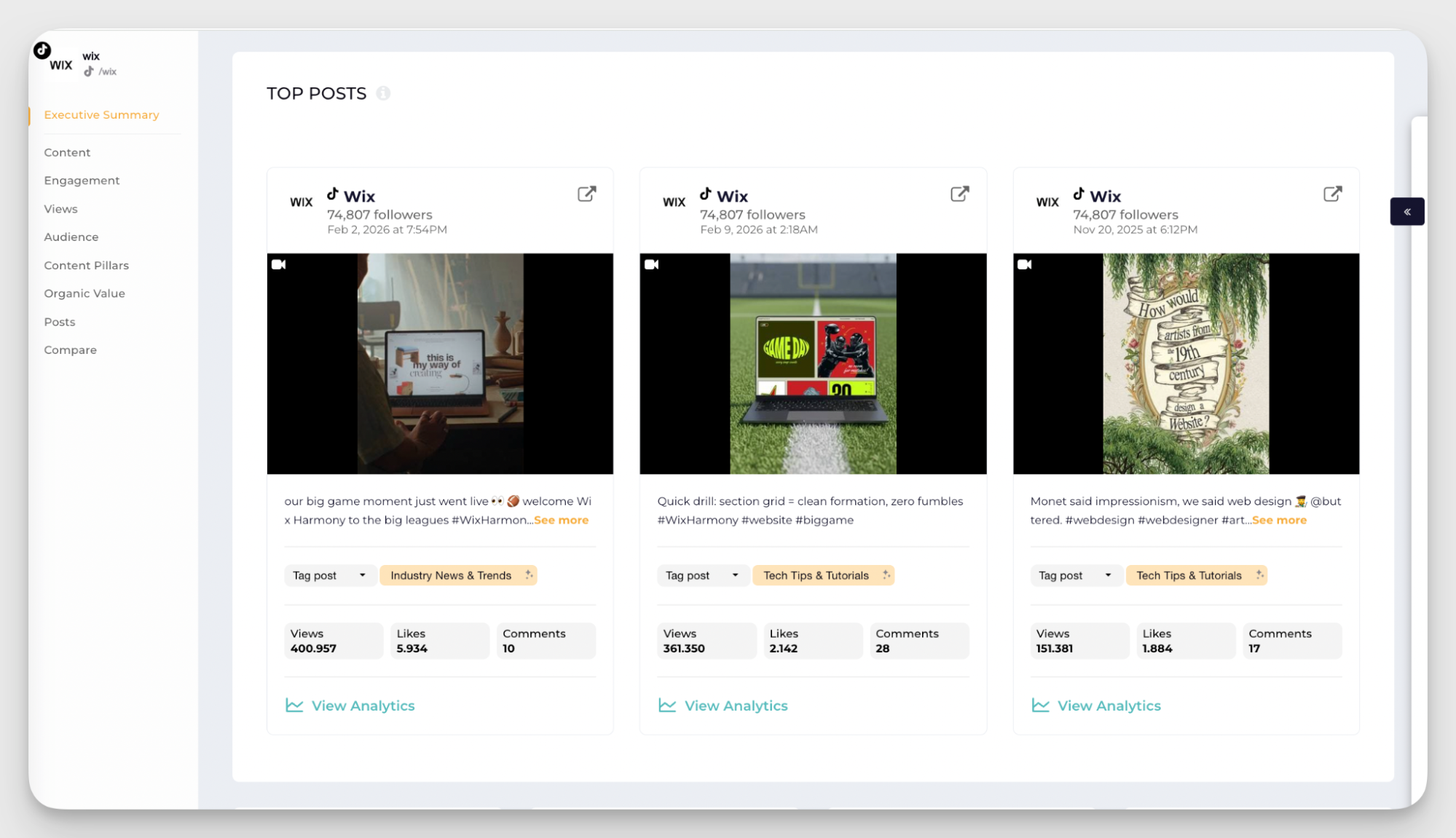
Continuing with my example, for Wix on TikTok, you can see that posts that gather the most views tend to cluster around specific themes, with strong engagement on content that mixes practical value with brand personality.
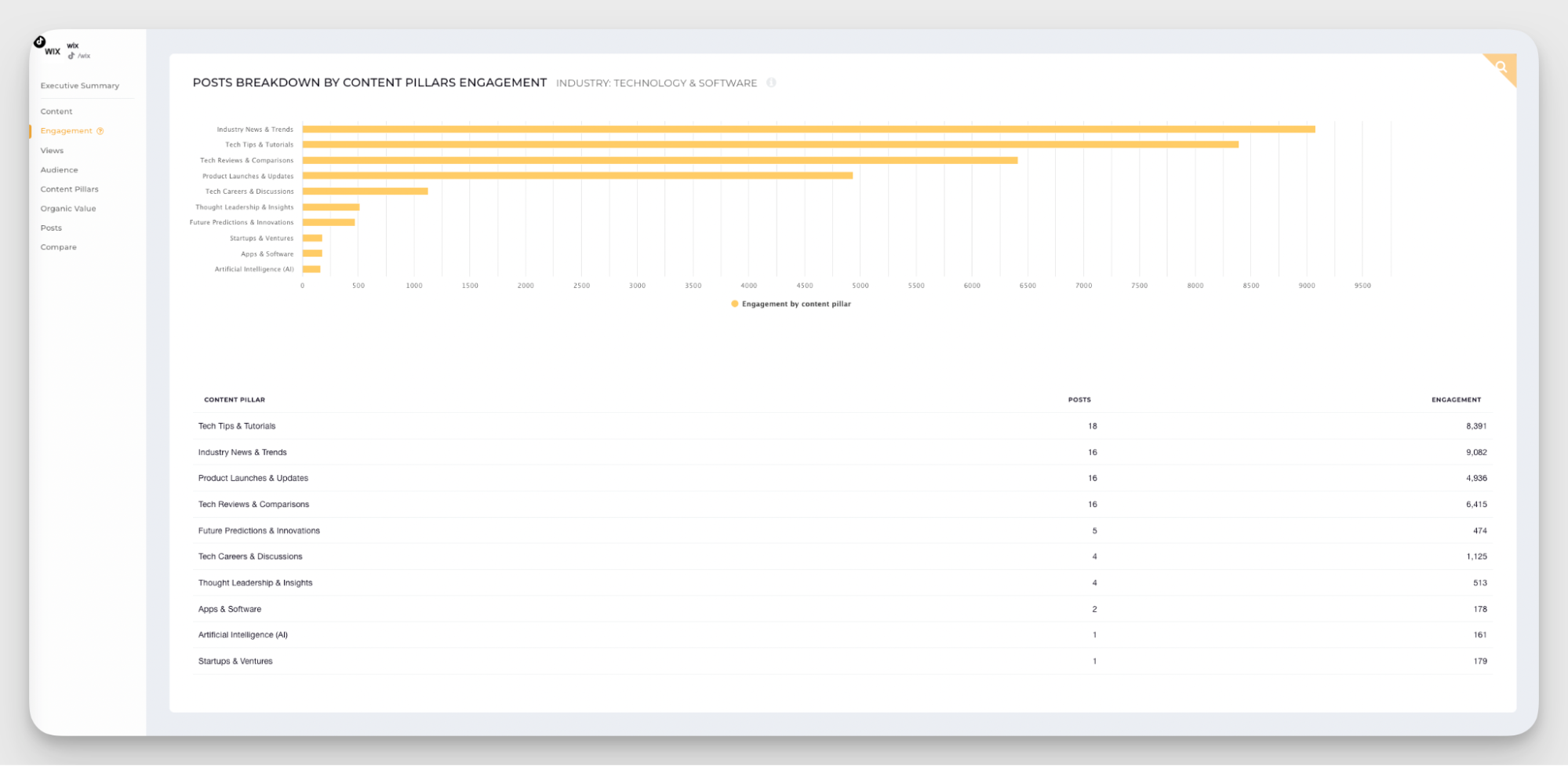
Taking it one level further, a social media content intelligence breakdown by content pillar shows which topic categories are actually generating engagement — not just which ones are being posted most often.
Step 5: Generate actionable insights
Analysis tells you what's happening. Insights tell you what to do about it.
In the Wix example on TikTok, the data points clearly in one direction: content categorized under Tech Tips & Tutorials and Industry News & Trends consistently outperforms other pillars — both in the top posts view and in the engagement-by-content-pillar breakdown.
For Squarespace's strategy team, it suggests which content angles to test, which topics to deprioritize, and where there's likely an audience appetite that isn't being fully met by the current market leader.
This kind of social media competitive intelligence is exactly what the analysis process is designed to give you: specific, timely findings that your team can act on in the next planning cycle.
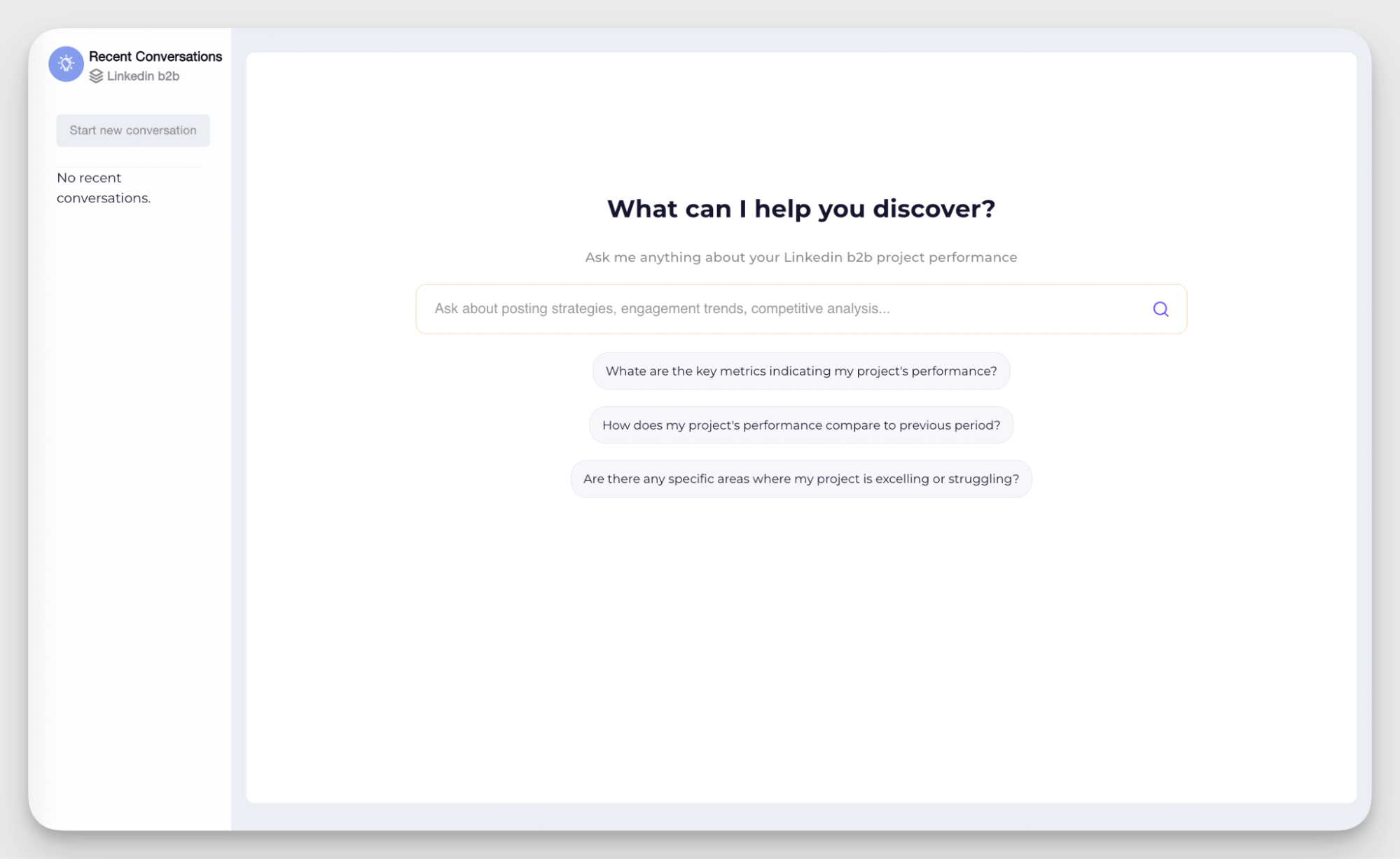
And if you're working through large volumes of data, you don't have to do the synthesis alone. Socialinsider's AI Assistant lets you ask direct questions about your data — things like "where is my project excelling?" or "how does this period compare to the last?" — and get answers without manually cross-referencing multiple reports.
Step 6: Implement strategies based on findings
Findings, not feelings.
Insights only create value when they're acted on. This step is about translating what you've found into concrete changes, whether that's adjusting your content pillars, adjusting posting frequency, testing a new format, or repositioning your messaging on a specific platform.
Say your analysis reveals that short-form tutorial content consistently drives three times more engagement than promotional posts — but your current content mix is heavily skewed toward product announcements. Run a test batch of tutorial-style posts over four to six weeks, and track whether engagement follows the pattern you spotted in your competitor's data.
Or maybe you find that your main competitor posts significantly less on a platform where their engagement rate is higher than on channels where they're most active. That channel is worth testing.
Step 7: Measure impact and iterate
The final step is also the beginning of the next cycle. Once you've implemented changes based on your findings, you need to track whether those changes moved the needle and feed that learning back into your next round of analysis.
This is what separates a one-time audit from an ongoing social media analytics and intelligence practice.
The goal is to create a system that gets sharper with every iteration and helps you improve your marketing strategy and overall business results.
What social media tools can help you with social media intelligence gathering?
The right stack for social media intelligence gathering depends on what questions you're trying to answer. Some teams need deep competitive analytics, while others prioritize brand monitoring or influencer tracking. And most mature intelligence programs combine tools from more than one category.
Let’s look at a few tools that can help you with social media intelligence gathering.
Competitive analytics tools
Competitive analytics tools form the backbone of any social media competitive intelligence program. They track how your brand performs relative to competitors across platforms, content types, and time periods, giving you the context that's missing when you only look at your own data.
Socialinsider is built specifically for this kind of work. Here's why I think it’s a strong fit for teams running ongoing competitive and brand intelligence:
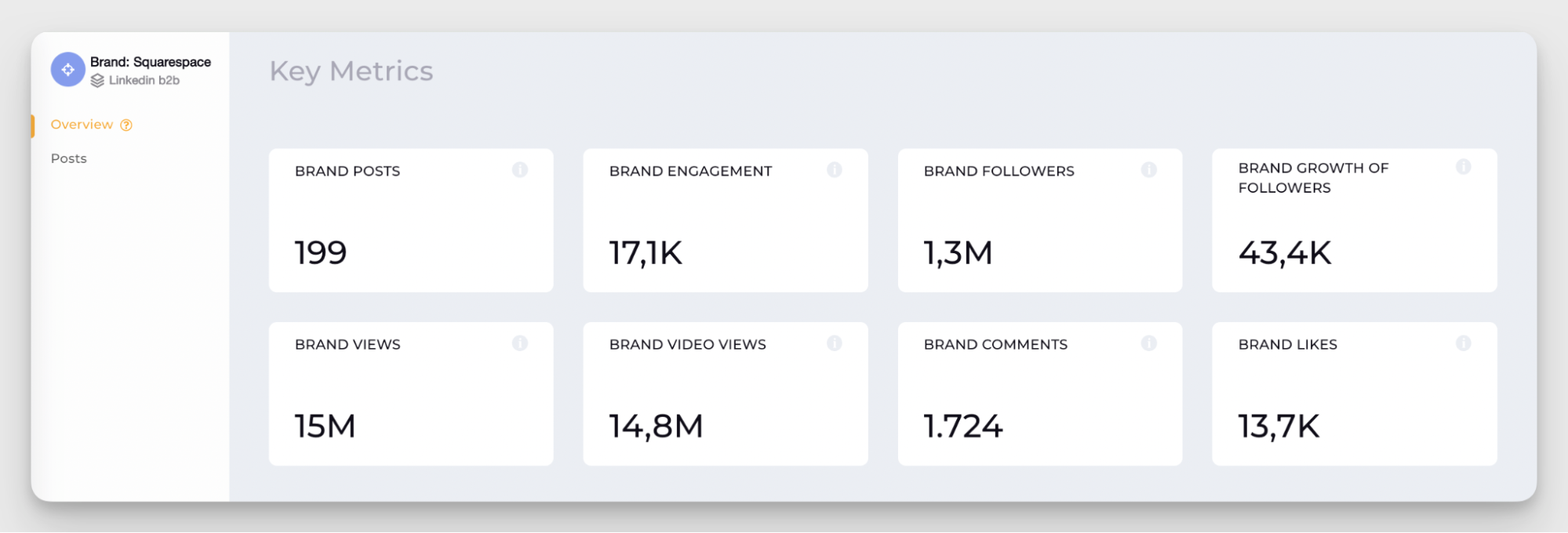
Cross-channel analysis in one place. Rather than toggling between native platform analytics, Socialinsider pulls performance data across all major social channels into a single view. When you're analyzing a brand like Squarespace, for example, you can see aggregated key metrics — posts, engagement, followers, follower growth, views, and likes — all in one dashboard, with no manual consolidation required.
- Channel-by-channel breakdown. Spot which platforms are actually driving results versus which ones are just consuming posting effort.
- In-depth metrics beyond the basics. Where Socialinsider goes further is in the depth of its social media analytics and intelligence features. Beyond standard engagement and reach figures, it shows metrics such as content pillar performance and organic value — the estimated monetary value of a brand's social presence across channels, broken down by engagement, awareness, and audience growth.
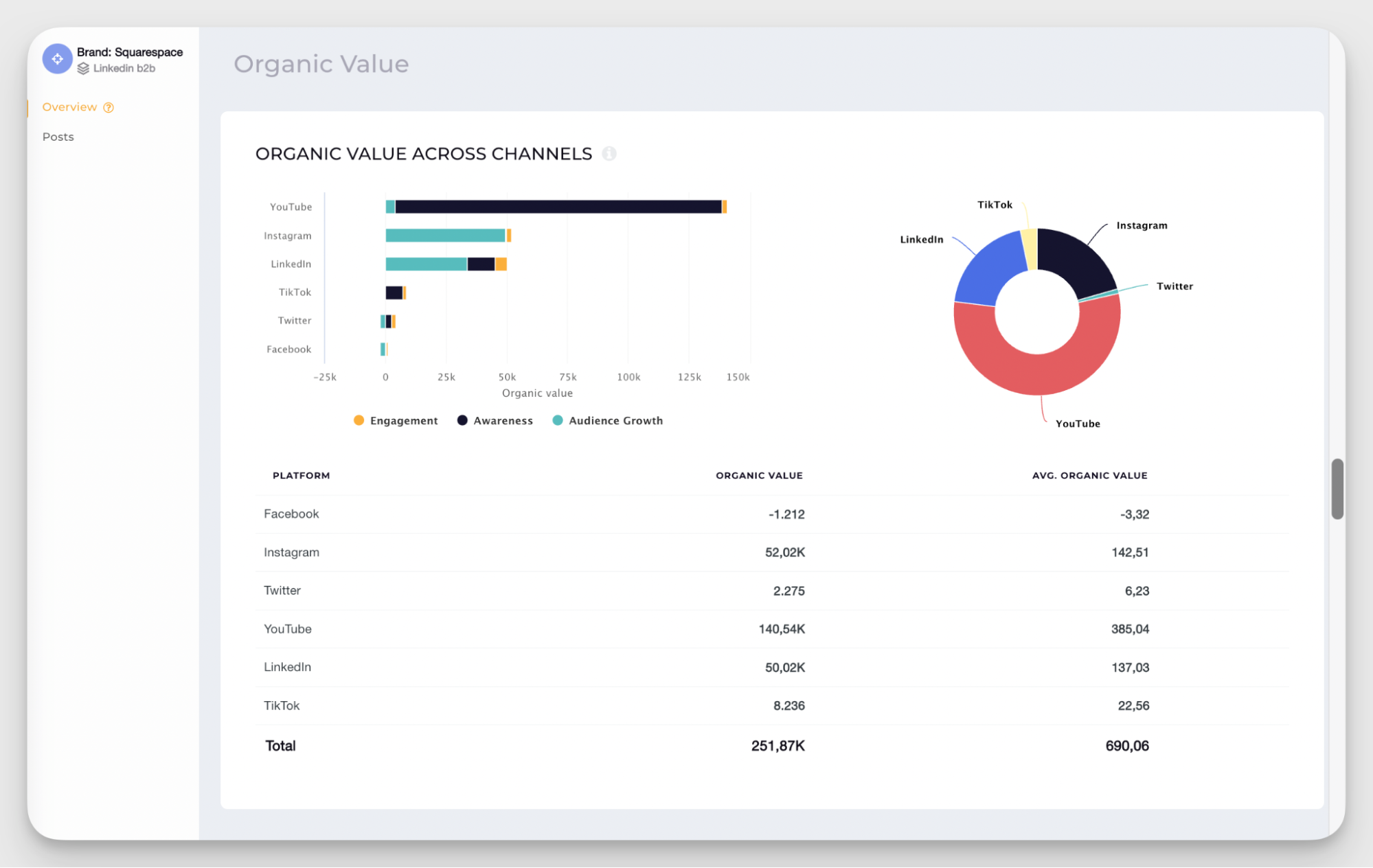
In the example above, seeing that YouTube drives a disproportionate share of organic value compared to channels where they post more frequently is exactly the kind of finding that should shape budget and content decisions.
If you want to explore these features with your own competitive set, plus get powerful AI-analysis, try Socialinsider free for 14 days.
Social listening and sentiment analysis platforms
While competitive analytics tools focus on performance data, social listening platforms are built to track conversations. These tools are essential for brand health monitoring, crisis detection, and understanding audience sentiment at scale.
A few well-regarded options in this category:
- Talkwalker — monitors conversations across social platforms, news sites, and forums, with built-in sentiment analysis to help you understand how audiences feel about brands or topics over time.
- Brand24 — tracks real-time mentions across social media, blogs, and forums, and categorizes each mention by sentiment, making it easier to spot shifts in perception quickly.
- Sprout Social — combines social media management with listening features, embedding sentiment insights directly into reporting and workflows rather than keeping them in a separate tool.
Influencer analytics tools
Influencer analytics tools help you identify the right voices in your category and measure the actual impact of collaborations.
A few platforms worth knowing in this space:
- HypeAuditor — analyzes influencer audiences in detail, detecting fake followers and providing engagement, authenticity, and credibility metrics before you commit to a partnership.
- Upfluence — helps identify relevant influencers based on audience demographics, content performance, and brand fit, with filtering options that go well beyond surface-level category matching.
- Traackr — focuses on influencer relationship management, tracking performance, reach, and the long-term impact of collaborations across campaigns.
Final thoughts
Social media intelligence is an ongoing practice that gets sharper the more consistently you apply it.
The brands that win aren't necessarily the ones with the biggest budgets. They're the ones asking better questions and having the necessary data to get actionable answers.
Start with a clear objective, build a repeatable process, and social intelligence will compound over time. The data is already out there, just use it smartly.
FAQs on social media competitive intelligence
How to choose the social media intelligence platforms suited for your business?
Choosing the right social media intelligence platform is about finding tools that truly fit your brand’s needs — not just today, but as you grow. Here’s what to look for:
Here are a couple of criteria:
- Real-time monitoring capabilities: Make sure the platform helps you track conversations, mentions, and sentiment as they happen. Fast insights mean you can respond to opportunities or challenges before they escalate.
- Custom reporting and dashboards: Every business has unique goals. Look for platforms that let you tailor dashboards and reports, so you only see metrics that matter most to you and your stakeholders.
- Historical data access: Trends and context matter. The best tools offer comprehensive historical data, letting you benchmark performance, spot evolving patterns, and compare campaigns over time.
- Alert and notification systems: If a sudden spike in negative sentiment or a viral mention happens, you want to know immediately. Choose a platform that sends automatic alerts for key changes or issues, so nothing slips through the cracks.
Sabina Varga
Content marketing expert with 15 years of experience in digital marketing. I dream of beach life but love the city as a multitasking mom juggling playgrounds, books, brunches, and travels.

Know what your competitors do — before your manager asks
Get instant social benchmarks & reports without manual work.
You might also like




Improve your social media strategy with Socialinsider!
Use in-depth data to measure your social accounts’ performance, analyze competitors, and gain insights to improve your strategy.