10 Best AI Tools for Social Media (2026): Tested & Compared
We tested the best AI tools for social media in 2026 — for content, analytics, listening and AI agents. See pricing, pros, cons and who each tool fits.

Social media managers already have enough tabs open. They don’t need another one called “AI tools to test.”
But the right AI social media tool can genuinely make the workload lighter. From creating content and analyzing performance to simplifying reporting and social listening, AI can take care of some of the repetitive work so teams can focus on the parts that actually need a human brain.
The key is to keep it focused. Rather than adding AI to every step of your workflow, start with one clear use case, give someone ownership, and measure whether it actually saves time or improves the output.
I’ve tested a range of AI social media tools across analytics, social listening, and content creation. Here’s what’s worth trying, and where each tool fits best.
Key takeaways
- Choose AI tools based on your team's biggest workflow bottleneck, prioritizing solutions that integrate well with your existing stack and prove their value using your real data.
- The strongest AI analytics platforms, such as Socialinsider go beyond reporting metrics by benchmarking competitors, uncovering insights, and delivering executive-ready recommendations automatically.
- AI-powered social listening tools such as Brandwatch or Brand24 turn large volumes of online conversations into actionable insights by tracking sentiment shifts, emerging trends, and brand perception in real time.
Criteria evaluation for social media AI tools
Every tool in this guide was assessed against five criteria:
- AI depth — does the AI actively interpret data and surface recommendations, or does it just display information more efficiently?
- Cross-platform coverage — which platforms are supported, and is the depth consistent across all of them?
- Ease of use — can the full team use it without significant technical expertise?
- Reporting output — does it produce reports that are ready to share, or raw data that still needs manual assembly?
- Value for the use case — does the pricing reflect what you actually get for the specific job it's doing?
Table of contents
- Jasper: best for high-volume written content
- Predis.ai: best for social content generation from existing assets
- Vista Social: best for AI-powered social media automation
- Visme: best for AI-repurposed designs
- VEED: best for AI video generation
- Venngage: best for AI-powered visual content
- Socialinsider: best for in-depth competitor analysis
- Keyhole: best for teams running influencer programs
- Brand24: best for real-time monitoring for mid-size teams
- Brandwatch: best for deep sentiment analysis and audience intelligence
Best AI tools for social media content creation
Content creation is the most crowded category in AI social media tools. Based on Socialinsider's AI social media adoption survey, 70% of marketers use AI for content creation.

Within this category, the tools worth integrating into your workflow are the ones that produce output you can actually use with minimal editing; the others just produce more noise.
#1. Jasper — best for high-volume written content
From all the tools I've tested, I honestly think Jasper is one of the strongest choices for teams that want copywriting support without losing brand voice consistency. It is especially useful when social and campaign copy all need to sound like the same company.
What makes Jasper extremely practical, in my view, is the brand voice layer. I really like that you can train the platform on style guides or previous examples, which helps reduce the generic tone that often shows up in raw AI drafts.

Overall, I'd say that one great advantage is speed across formats. A single campaign idea can become multiple caption options, ad variants, or landing page snippets, which helps maintain consistency when the same message needs to appear in several channels. That makes Jasper useful for teams that care as much about alignment as they do about output volume.
Best for: Marketing teams producing high volumes of social content who need consistent brand voice across formats and platforms without heavy editing on every output.
Pros
- Brand voice training on style guides and past examples reduces the generic AI tone.
- Turns one campaign idea into captions, ad variants, and landing page copy quickly.
- Keeps messaging consistent across channels and formats.
Cons
- Brand voice setup takes upfront time before outputs feel truly on-brand.
- Pricier than general-purpose AI writers, which can be a stretch for small teams.
- Focused on copy, so you'll still need separate tools for scheduling and analytics.
Pricing: Offers a free trial of 7 days, post which their paid plans start from $69 per month.
G2: 4.7/5 (1317 reviews)
#2. Predis.ai — best for social content generation from existing assets
Predis.ai takes a different approach to content creation — rather than generating content from scratch, it works from assets you already have. Feed it a product, a blog post, or a URL and it generates social posts, captions, and video content adapted for each platform automatically.

I think that for teams with a strong content library who need to maximize its social output without building each post manually, it's one of the more practically useful tools in the category.
Best for: E-commerce and product-led brands that need to convert existing assets into social content at scale across multiple platforms.
Pros
- Turns existing assets like products, blog posts, and URLs into ready-to-post content, so you're not starting from a blank page.
- Generates posts, captions, carousels, and videos adapted for each platform in one go.
- Bundles extras like competitor analysis and multi-channel publishing in the same subscription.
Cons
- Credit-based pricing means video-heavy teams burn through allowances fast, since a video uses about nine times as many credits as an image.
- The entry-level Core plan doesn't include auto-posting.
- Generated visuals often need brand polish and editing before they're ready to publish.
Pricing: They have a free trial of 7 days. Their plans start from $32 per month.
G2: 4.7/5 (110 reviews)
#3. Vista Social – best for AI-powered social media automation
Vista Social is an all-in-one social media management platform that weaves AI into every part of the workflow rather than treating it as a separate feature. From automated inbox management and AI-generated content to intent detection and performance reporting, it gives agencies and social media managers a way to scale operations without scaling headcount.
What I find most compelling about Vista Social is that the AI goes far beyond caption writing. It classifies incoming messages, triggers automations, and surfaces specific recommendations from analytics data.

Best for: For agencies and social media managers who want AI running across the full workflow, not just a caption generator attached to a scheduling tool.
Pros
- AI runs across the whole workflow, from classifying inbox messages and triggering automations to surfacing recommendations from analytics.
- Combines publishing, engagement, reporting, listening, and review management in one platform, so teams juggle fewer tools.
- Approval workflows are included on all plans, which is handy for agencies working with clients.
Cons
- The entry price is higher than many competitors for core scheduling and publishing features.
- You can't add profiles beyond your plan's limit on lower tiers, so growing teams have to upgrade to the next plan.
- AI usage is credit-capped on lower tiers (500 credits on Professional), and full social listening is a paid add-on.
Pricing: Free trial of 14 days and the plans start from $99 per month.
G2: 4.8/5 (1133 reviews)
#4. Visme — best for AI-repurposed designs
Visme is the strongest choice in this group for teams that want more design control. It supports posts, stories, animations, videos, and other formats, which makes it useful for teams that need content repurposing for campaigns.
What I like about Visme is that it can quickly turn prompts, links, or files into social-ready content, which helps when teams need to adapt existing material into new formats.

A webinar slide, a customer quote, or a report highlight can become a social post, a story graphic, or a presentation asset without leaving the platform. That flexibility makes the tool useful for marketing teams that work across more than just social.
Best for: Brands that need polished visuals across several content formats.
Pros
- Turns prompts, links, and files into social-ready content, which makes repurposing existing material fast.
- Covers posts, stories, animations, videos, presentations, and infographics in one place, so it's useful beyond social.
- Extensive template library and design control give teams more polished, on-brand results than most quick-create tools.
Cons
- The editor can slow down with heavy, data-rich projects, and text editing can feel clunky.
- AI-generated layouts often need manual cleanup, such as fixing overlapping text boxes.
- Pricing is per user, and key features like brand kit, team collaboration, and PPTX export sit behind the Pro plan.
Pricing: They offer a free plan and their paid plans start from $29 per month.
G2: 4.5/5 (510 reviews)
#5. VEED — best for AI-video generation
VEED is a strong browser-based option for teams that want to create, clean up, or subtitle videos without installing desktop software. It works well for marketers who need a fast way to turn an idea into a publishable clip.

I'd say here the biggest advantage is convenience. VEED supports text-to-video workflows, natural language editing, and automatic subtitles, which means a social manager can do a lot in one browser tab. The subtitle support is especially useful for social video because captions improve accessibility and make videos easier to watch without sound.
Best for: Marketers, creators, and small teams that need simple video production with fast turnaround.
Pros
- Runs entirely in the browser, so there's no software to install and teams can edit from anywhere.
- Automatic subtitles, text-to-video, and natural language editing let social managers go from idea to publishable clip quickly.
- Subtitle translation and AI tools like Clean Audio and Eye Contact make it easy to polish videos without editing expertise.
Cons
- The most useful AI tools, like Magic Cut, Clean Audio, AI avatars, and 4K export, are locked to the Pro plan.
- Monthly billing is nearly double the annual rate, which makes it pricey if you don't commit for a year.
Pricing: You can start for free and their paid plans start from $19 per month.
G2: 4.6/5 (2185 reviews)
#6. Venngage: best for AI-powered visual content
Venngage is an online visual communication platform that makes it easy to create infographics, social media graphics, brochures, flyers, and other branded content. Venngage's AI-powered design tools help users generate and customize visual content faster, while templates make it easier to create polished designs for product promotions, social media campaigns, and other e-commerce marketing needs.
What I found particularly useful on Venngage for social media teams is the combination of AI-assisted design and customizable templates. You can start with a prompt or template, then adjust layouts, colors, fonts, and branding before publishing.

I also found the AI-generated images and icons useful when creating visuals from scratch, while the Brand Kit makes it easier to keep colors, fonts, and logos consistent across different designs.
Best for: Marketers and e-commerce teams that need to create branded social media graphics and other visual content quickly and consistently.
Pros
- Combines AI-assisted design with customizable templates, so you can start from a prompt or template and fine-tune layouts, colors, and fonts.
- AI-generated images and icons make it easy to create visuals from scratch.
- Easy to use and set up, with G2 reviewers rating its support highly.
Cons
- The free plan is quite restrictive, with only 5 designs and Venngage branding.
- The Brand Kit, team sharing, and PDF and PowerPoint export are only available on the Business plan.
Pricing: Offers a free plan. Paid plans start from $19 per month.
G2: 4.7/5 (134 reviews)
Best AI tools for social media analytics, competitive intelligence & reporting
This is the category where the difference between tools that genuinely use AI and tools that just label themselves AI is most significant. A real AI analytics tool interprets your data, benchmarks it against competitors, and produces actionable recommendations.
#7. Socialinsider — best for in-depth competitor analysis
Socialinsider is purpose-built for social media and marketing teams that need their analytics, competitive intelligence, and reporting to work as one connected system rather than three separate tools.
Competitive benchmarking goes deeper than most platforms in its category. Rather than showing overall engagement rates, Socialinsider tracks engagement by content type, content mix, posting frequency, and audience growth trajectory — updated continuously across your full competitive set.
On the reporting side, AI-generated executive summaries are produced at both brand and competitive level — ready to share with leadership without manual assembly. For social media leaders who report upward regularly, this is one of the most immediate time returns the platform delivers.

The cross-channel analysis view is another strength because social teams rarely need one isolated platform dashboard. They need a clean way to compare performance across channels, identify where engagement is strongest, and see how each platform supports the wider strategy, as well as study their competitors across all their channels.
Cross-platform coverage spans Instagram, TikTok, LinkedIn, Facebook, and YouTube with consistent metric depth across all five.
Another feature that stands out in Socialinsider and one of my favorites is the content pillar analysis, which automatically categorizes your posts and your competitors' posts by theme, so you can see what's driving results on both sides without manual tagging.

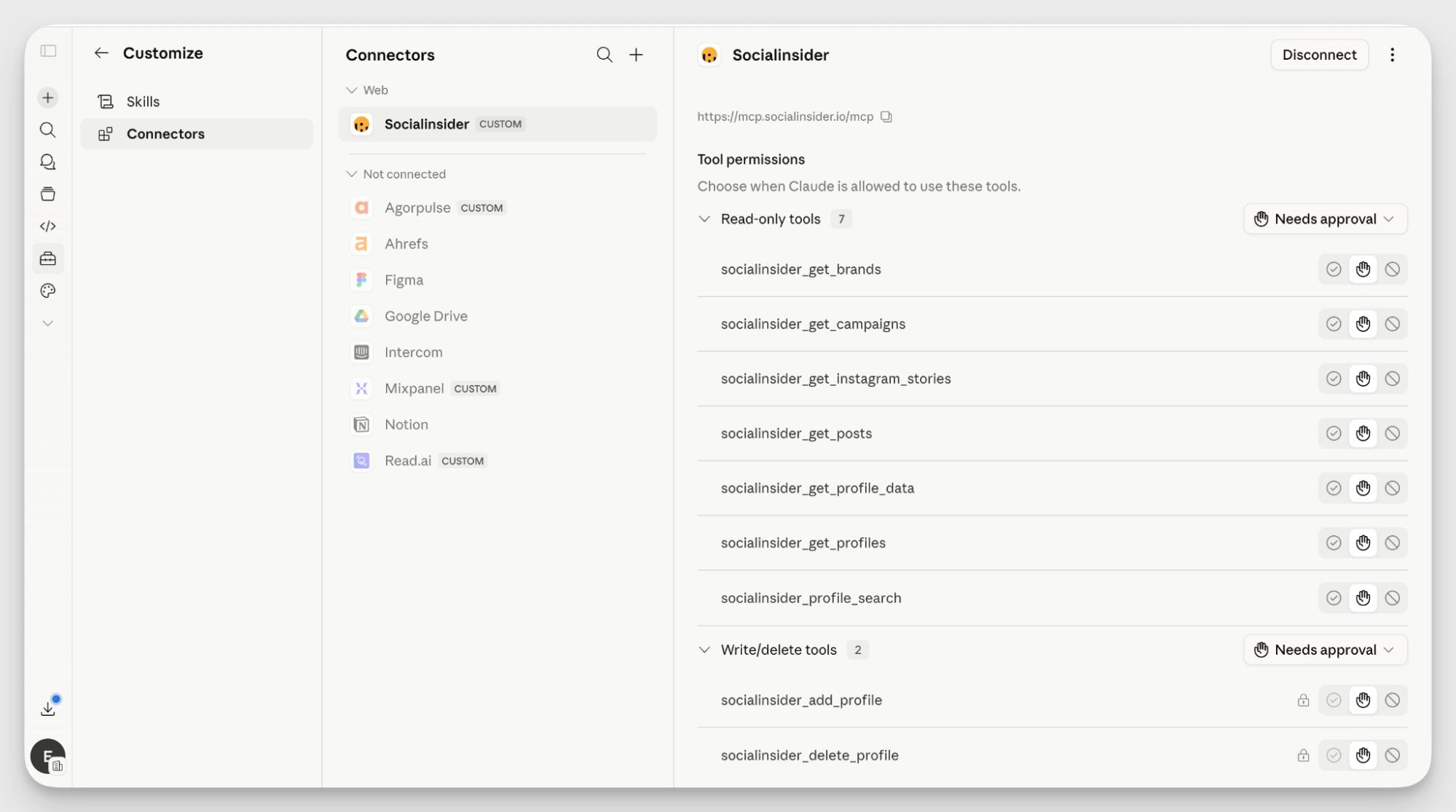
Lastly, Socialinsider has also launched its MCP, which allows access to your live Socialinsider data in any AI assistant, for those of you who want direct access to your analytics in a chat, with copy-pasted information or a spreadsheet.
Best for: Social media leaders and heads of social who need competitive benchmarking, AI-generated insights, and executive-ready reporting — without stitching together multiple tools to get there.
Pros
- Competitive benchmarking goes beyond overall engagement, tracking content type, content mix, posting frequency, and audience growth across your full competitor set.
- AI-generated executive summaries at brand and competitor level are ready to share with leadership without manual assembly.
- You can ask questions in natural language to get quick analysis from your data.
Cons
- It's built for analytics, so teams still need a separate tool for scheduling and publishing.
- Lower-tier plans limit historical data and the number of tracked profiles, which can feel restrictive for larger competitor sets.
Pricing: Free trial for 14 days after which the paid plans start from $99 per month.
G2: 4.7/5 (143 reviews)
#8. Keyhole — best for teams running influencer programs
Keyhole is a dedicated social media analytics platform with a strong focus on campaign tracking, hashtag analytics, and influencer performance measurement.
From what I've seen, its AI capabilities cover performance forecasting, automated reporting, and real-time campaign monitoring — making it particularly useful for teams that need to track results across both owned content and influencer activity in the same analytics environment.

Where Keyhole stands out is in its campaign-level analytics. Rather than just measuring post-by-post performance, it tracks campaign impact over time — reach, impressions, engagement, and sentiment — across all the accounts contributing to a campaign, including influencer profiles. For teams where influencer marketing is a significant channel, this unified view is genuinely difficult to replicate with owned-content-only analytics tools.
Best for: Social media and marketing teams that run influencer programs alongside owned social and need campaign-level analytics that covers both in one place.
Pros
- Campaign-level analytics track reach, impressions, engagement, and sentiment over time across every account involved, including influencer profiles.
- Strong real-time hashtag and campaign tracking makes it easy to monitor launches and events as they happen.
- Owned content and influencer performance sit in the same dashboard, so you don't need separate tools to measure both.
Cons
- It's analytics-only, with no scheduling or publishing, so you'll need another tool for that.
- Entry pricing is steep for small teams, and there's no free plan.
- Some features are only available on the top Enterprise tier.
Pricing: While their website does not reveal the exact pricing, review sites suggest a starting range from $89 to $179 per month.
G2: 4.3/5 (70 reviews)
Best AI tools for social listening & sentiment analysis
Social listening is the category most teams underinvest in relative to the strategic value it delivers. Understanding how your audience actually talks about your brand — and how that sentiment is shifting — is intelligence that raw engagement metrics will never surface. The tools in this category use NLP to process text data at a scale no human team could match manually.
#9. Brand24 — best for real-time monitoring for mid-size teams
Brand24 covers the core listening use case — mention monitoring, sentiment tracking, trend detection — at a price point and complexity level that's accessible for mid-size teams without a dedicated analytics function.
I'd say its AI sentiment analysis is reliable for most use cases, and its real-time alerting means your team catches brand mentions and sentiment shifts as they happen rather than in a weekly report.

Best for: Mid-size teams that need reliable real-time brand monitoring and sentiment tracking without the complexity or cost of an enterprise listening platform.
Pros
- Covers the core listening needs, including mention monitoring, sentiment tracking, and trend detection, in an interface that's easy to pick up without a dedicated analytics team.
- AI sentiment analysis is included on every plan, with features like AI insights and event detection unlocked on higher tiers.
- Email, Slack, and in-app alerts help teams catch brand mentions and sentiment shifts early.
Cons
- Real-time monitoring only starts on the Pro plan, as the Individual and Team plans refresh every 12 hours and every hour respectively.
- Lower tiers are tight, with the Individual plan limited to 3 keywords, 2,000 mentions per month, and one user.
- It's monitoring-only, so you'll still need separate tools for publishing and owned-channel analytics.
Pricing: The free trial is of 14 days and the paid plans start from $249 per month.
G2: 4.6/5 (366 reviews)
#10. Brandwatch — best for deep sentiment analysis and audience intelligence
Brandwatch is the most established dedicated listening platform in the market, and its AI capabilities reflect that maturity. It aggregates conversations from social networks, forums, blogs, news sources, and review platforms — using NLP to understand sentiment, identify emerging topics, and surface brand health signals that engagement data doesn't capture. Its audience intelligence layer goes beyond monitoring what people say to understanding why conversations are shifting and what that means for brand perception over time.

Best for: Brand, marketing, and insights teams that need enterprise-grade social listening to monitor brand health, inform content strategy, and detect emerging risks before they escalate.
Pros
- Aggregates conversations from social networks, forums, blogs, news sites, and review platforms, giving one of the broadest views of what people say about your brand.
- Mature NLP for sentiment analysis, emerging topic detection, and brand health tracking surfaces signals that engagement data misses.
- The audience intelligence layer helps explain why conversations are shifting, not just what's being said.
Cons
- It's priced for enterprises, with no free plan and no public pricing, so it's out of reach for most small and mid-size teams.
- Building and managing complex queries has a learning curve, and teams get the most value with dedicated analysts.
- Annual contracts are standard, and extras like custom reporting, integrations, and implementation can add significantly to the total cost.
Pricing: They have custom pricing plans.
G2: 4.2/5 (1711 reviews)
How to choose the right AI social media tools for your team
- Start with the problem, not the tool: Identify your biggest workflow friction point first — the task costing the most time for the least strategic return. For most social media leaders, that's competitive benchmarking and reporting. Solve that first, then layer in the rest.
- Match depth to team maturity: An enterprise listening platform is overkill for a two-person team. A basic analytics tool is a bottleneck for an agency managing twenty brand accounts. Be honest about what your team will actually use at full capability, not what looks impressive in a procurement conversation.
- Prioritize integration over features: A tool with slightly fewer features that integrates cleanly with your existing stack is almost always more valuable than a feature-rich tool that operates in isolation. Every manual data transfer between tools is friction that compounds over time.
- Test with your actual data: Use free trials with your real accounts and your actual competitors — not demo data. The gap between how a tool performs in a vendor demo and how it performs on your specific dataset is often significant, especially for competitive benchmarking and AI-generated insights.
Still not sure where to start? Here's the short version:
- If you need help creating content, choose Jasper for copy, Predis.ai for repurposing existing assets, Visme or Venngage for visuals, and VEED for video.
- If you need to manage your whole social workflow with AI, choose Vista Social.
- If you need to understand performance and beat competitors, choose Socialinsider for benchmarking and reporting, or Keyhole if influencer campaigns are a big part of your strategy.
- If you need to know what people are saying about your brand, choose Brand24 for affordable real-time monitoring, or Brandwatch for enterprise-grade listening.
Final thoughts
The best AI social media tool isn't the one with the most features — it's the one that solves your biggest problem right now and fits cleanly into how your team already works.
Start with the intelligence layer. Get your analytics, competitive benchmarking, and reporting working with AI first — that's where the strategic value is highest and where most teams are currently underinvested. Build the rest of the stack around it from there.
The teams pulling ahead on social right now aren't using more tools. They're using the right ones, connected well, with a clear sense of what each one is supposed to do.
FAQs on AI social media tools
What are AI social media tools?
AI social media tools use technologies like machine learning and natural language processing to handle tasks that would otherwise take hours of manual work. Depending on the tool, that can mean writing captions, generating visuals and videos, analyzing performance, benchmarking competitors, or tracking how people talk about your brand online.
How to build your AI social media tool stack?
The most common and costly mistake when building an AI social media stack is fragmentation — adopting tools independently without considering how they work together. When your analytics platform, your listening tool, and your content creation tool all operate in separate data environments, you end up doing manually what the AI was supposed to automate.
Are there free AI social media tools?
Yes, several tools offer free plans or free trials. Visme, VEED, and Venngage have free plans, while tools like Jasper, Predis.ai, Vista Social, Socialinsider, and Brand24 offer free trials. Free plans usually come with limits such as watermarks, fewer exports, or restricted features, so they're best for testing before you commit.
How much do AI social media tools cost?
Prices vary widely depending on the category and the scale you need. Content creation tools often start under $70 per month, analytics and social media management platforms typically start around $79 to $99 per month, and social listening tools range from about $249 per month to custom enterprise contracts. Always check what's included in each tier, since key features are often locked behind higher plans.
What is the best AI tool for social media analytics?
It depends on what you need to measure. For competitive benchmarking, cross-channel analytics, and AI-generated executive reports, Socialinsider is one of the strongest options. If influencer campaigns are a big part of your strategy, Keyhole is worth a look for its campaign-level tracking.
How do I know if an AI tool is actually worth it?
Start by defining what success looks like before you sign up, such as hours saved on reporting, faster content turnaround, or fewer missed brand mentions. Then test the tool during its free trial with your real accounts and competitors. If you can't see a clear difference after a month of use, it's probably not the right fit for your team.

Nidhi Parikh
Having worked with several brands in the social media space, Nidhi writes about all things social. With 13K followers on LinkedIn, she's always up for a chat about books or her next travel plan

Know what your competitors do — before your manager asks
Get instant social benchmarks & reports without manual work.