9 TikTok Tips for Increased Brand Visibility and Better Performance
Discover essential TikTok tips to boost your engagement and grow your audience. Unlock the secrets to creating viral content and standing out!

If you want to go viral on TikTok, your content needs to match how the algorithm actually ranks and pushes videos today.
Here’s where things usually go off track…
A lot of TikTok marketing advice sounds useful, but leaves out what really drives views: watch time, retention, and how people react in the first few seconds.
That’s why growth feels inconsistent. But once you understand what the algorithm is really picking up on, patterns start to click.
In this guide, I’ll break down proven TikTok tips that help you get there.
Key takeaways
-
Define your content pillars: Focus on repeatable content themes that consistently drive engagement, not one-off ideas.
-
Set benchmarks for your content: Measure performance against your own baseline and industry benchmarks to understand what “good” actually means.
-
Optimize your video’s length: Make videos as long as needed to keep attention, not longer than the idea can sustain.
-
Don’t neglect the importance of SEO optimization: Use clear, intentional keywords in captions and content to help TikTok (and Google) surface your videos to the right audience.
-
Turn FAQs into video content series: Convert recurring audience questions into a consistent video series that builds long-term value.
-
Test different hook types and CTAs: Experiment with how you start and end videos to maximize attention and drive action.
-
Leverage user-generated content campaigns: Encourage others to create content about your brand to add authenticity and scale your reach.
-
Create "tag a friend" moments: Design content that feels so relatable or specific that viewers instantly want to share it with someone.
-
Track content performance over time: Analyze trends across multiple posts over time to identify what consistently works and refine your strategy.
What are the specifics of TikTok’s algorithm?
Let’s clear something up first. TikTok isn’t trying to make you famous. It’s trying to keep people watching. And once you see it that way, everything you post starts to make a lot more sense.
Most people approach TikTok like it’s a social platform. It’s not. It’s a distribution machine. Every video is tested, measured, and either pushed further… or quietly buried.
So stop thinking “what do I want to post?” and start thinking “what will people actually watch all the way through?” Because that’s the game.
How TikTok's recommendation system differs from other platforms
Most platforms care about who you are.
TikTok cares about how your content performs.
There’s no real “home advantage” here. You don’t get a boost just because you have followers, and you don’t get protected from flops either. Every video is treated like it’s your first.
It gets shown to a small batch of people. Usually strangers. Their behavior decides everything. If they pause, watch, interact, or stick around until the end, your video moves forward. If not, it stops there. That’s why growth on TikTok feels different.
Thus, if you want to learn how to make good TikTok videos, focus less on building an audience first, and more about earning attention over and over again.
The role of watch time, completion rate, and rewatches
Now zoom in on what TikTok is actually measuring while your video plays.
Likes? Followers? Nope.
Attention.
Watch time shows how long people stay.
Completion rate shows whether they make it to the end.
Rewatches signal something even stronger: your content was engaging enough to loop.
And TikTok loooves loops.
You’ll notice it in the videos that perform best. They move quickly, they create curiosity early, and they give people a reason to stay just a little longer than they planned.
Even small details matter more than you think. A slow intro, a predictable ending, a moment where attention drops. Those are the points where reach starts to slip.
So instead of judging your content by how it looks, start paying attention to how it’s consumed.
That shift alone changes how you create and who you reach.
TikTok tips and best practices to use the platform effectively
#1. Define your content pillars
If you want better results on TikTok, you need to know which topics deserve a repeat appearance. And which ones were never pulling their weight to begin with.
That’s the real job of content pillars for social media. They help you separate random post ideas from themes that consistently attract attention, spark engagement, and give your content some shape.
This is one of the first things I look at in Socialinsider.
I group content by pillar, then compare what each theme is actually doing across posts. Not just which video had a nice moment, but which category keeps showing signs of life.
Take Instacart, for example:
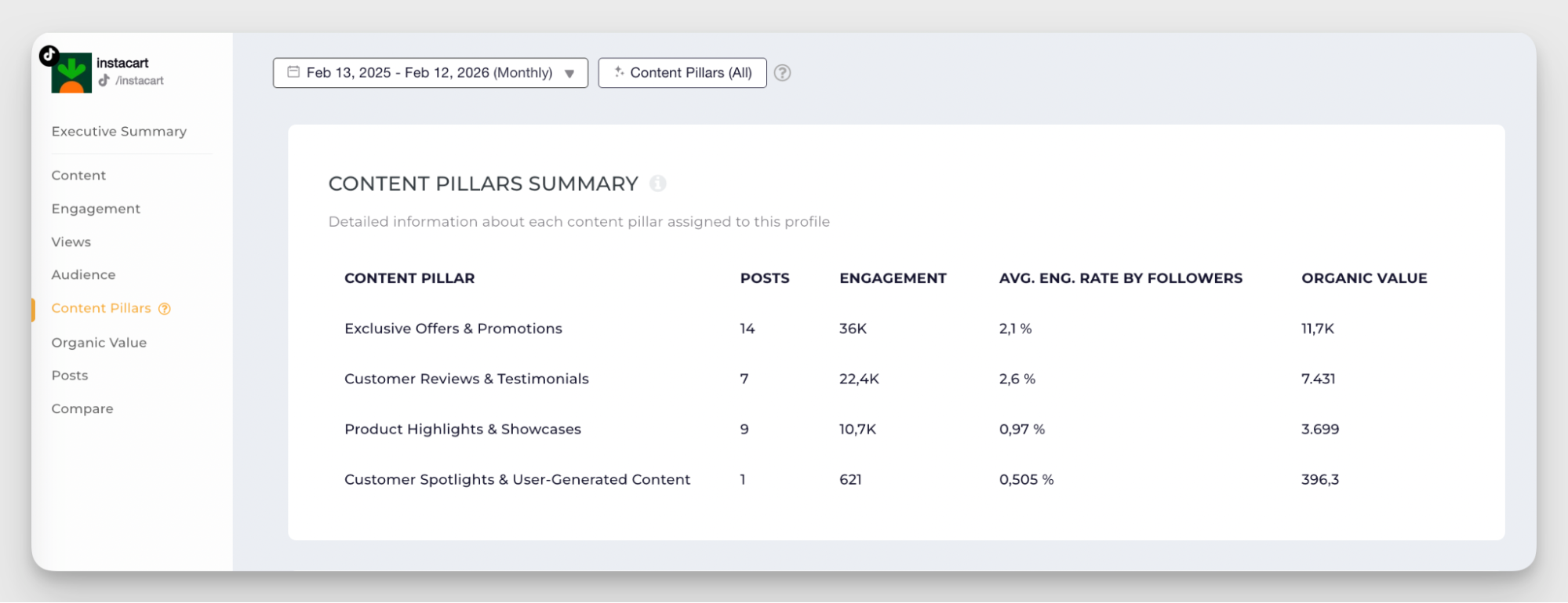
Customer Reviews & Testimonials stands out as a strong-performing pillar.
That matters because it tells them the audience responds to proof, relatability, and real customer experience.
Essentially, this kind of insight makes social media content planning much easier because you’re investing in themes with a clear track record.
#2. Set benchmarks for your content
So one of your videos got 20 comments. Feels good… but is it actually good?
I’d say that only makes sense when you have something to compare it to.
Social media benchmarks give you that context. They show what performance typically looks like at your level, so you can tell whether a video is doing its job or just sitting somewhere in the middle.
Here’s what Socialinsider data highlights: smaller accounts average single-digit comments. Larger ones can reach around 90.
That gap says a lot. It shows how expectations shift as your account grows and why looking at raw numbers without context can be misleading.
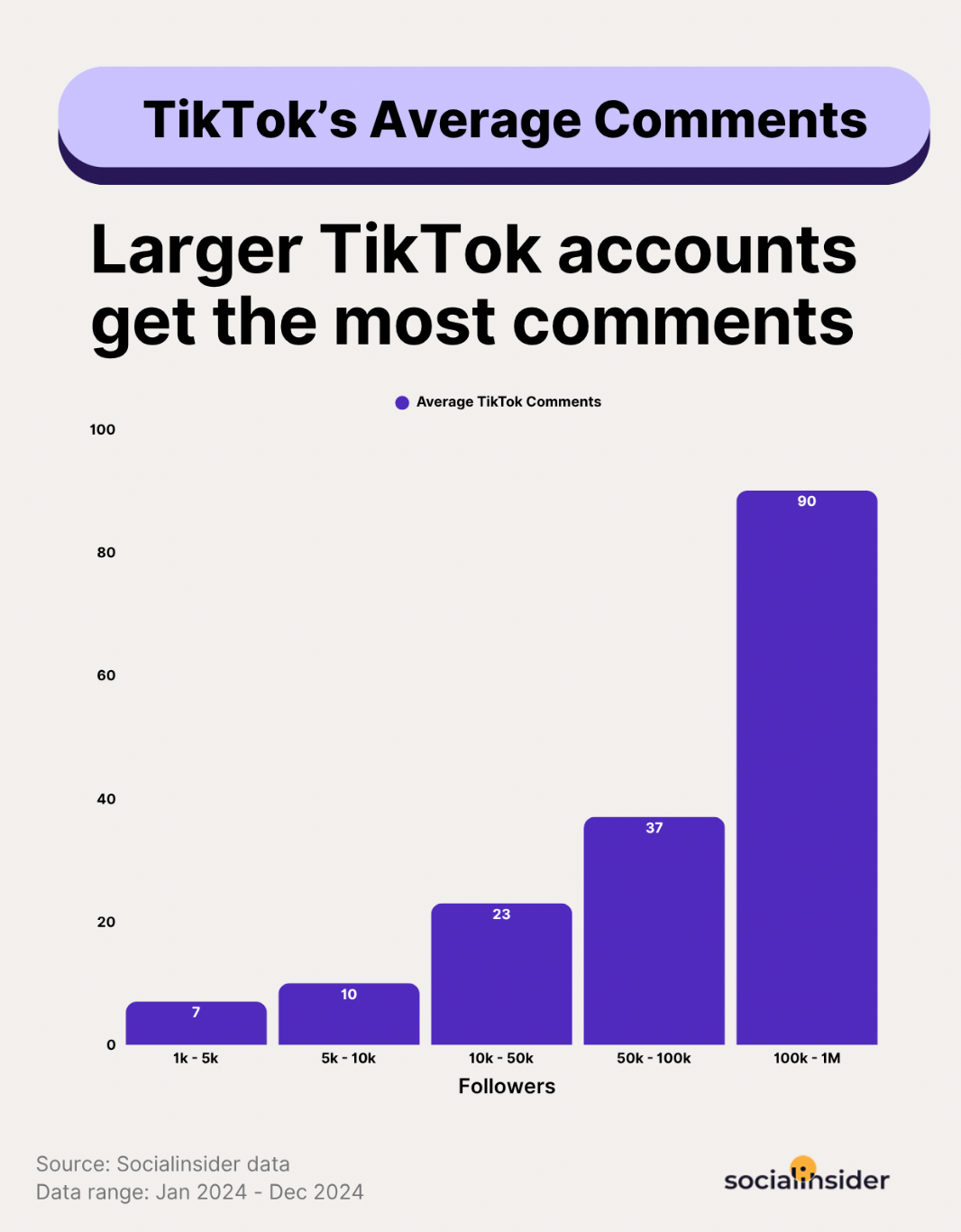
Now here’s one of the more practical tips for TikTok: track your own baseline, then compare it to what’s typical for accounts in your range.
That’s where you start spotting what’s working…and what’s just average.
#3. Optimize your video’s length
“How long are TikTok videos supposed to be?” comes up a lot.
And the honest answer is: long enough to hold attention, short enough to keep it.
But there’s a pattern worth paying attention to.
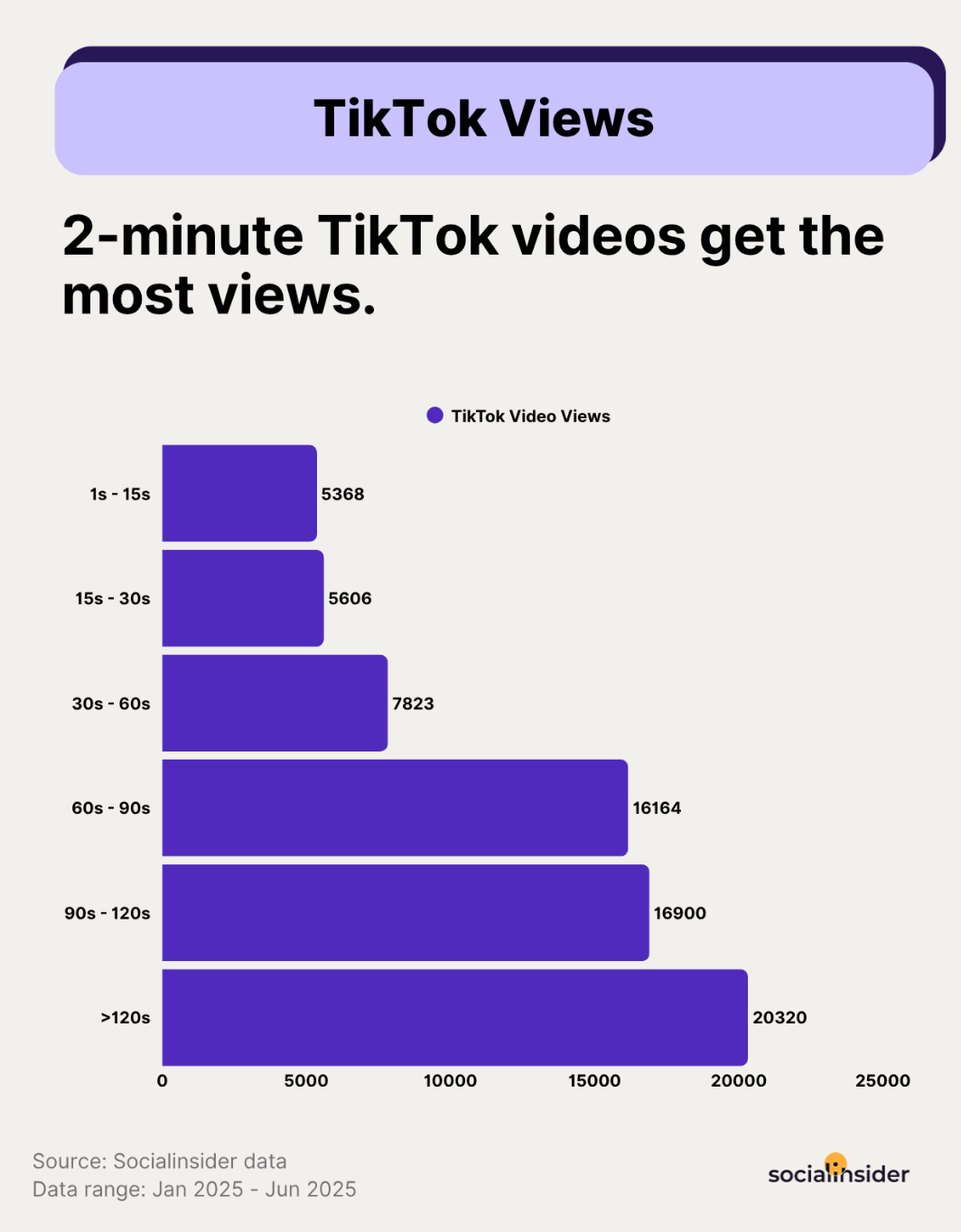
Videos in the 90–120s range (and even beyond) tend to pull significantly more views.
That doesn’t mean longer is always better. It means longer works when there’s a reason to stay.
Most content falls apart because the idea runs out before the video does.
The creators and brands that get this right treat length as part of the format. They give the content space to unfold, whether that’s telling a story, walking through something step by step, or building curiosity all the way through.
There’s a great way to think about this, and I’ll let this perspective speak for itself:
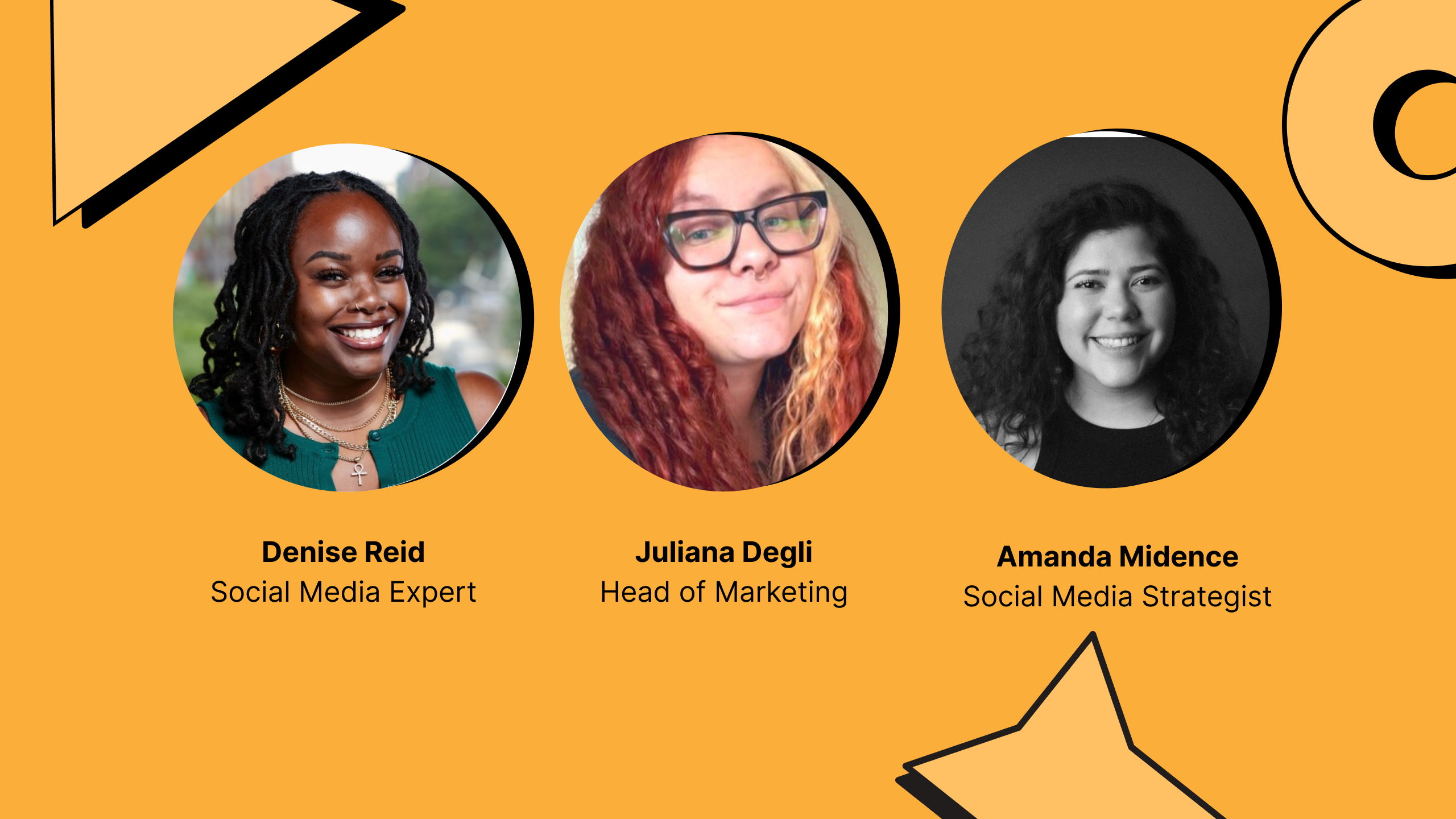
What actually works: being useful in a way that feels human. Behind-the-scenes, strong opinions, showing the process, or even experimenting when your product lets you. And committing to a format long enough to let it breathe, most brands bail right before it would have worked. — Juliana Degli, Head of Marketing
#4. Don’t neglect the importance of SEO optimization
More and more, TikTok is being used like a search engine.
People are actively typing things in. Looking for places to eat, products to try, quick tutorials, honest opinions. And because the content feels more direct and visual, it’s often the first place they check.
That shift changes how content gets discovered.
And there’s another layer to it: Google is indexing TikTok videos too.
So your content can show up in search results even outside the platform, sometimes days or weeks after you’ve posted it.
Which means your videos aren’t only competing for attention in the feed—they can also capture intent.
Social media optimization here comes down to clarity.
The words you use in your caption, what you say in the video, and your on-screen text all help TikTok (and Google) understand what your content is about and who it’s relevant for.
Here's what Denise Reid, Social Media Expert had to say about this:
Having a TikTok SEO strategy is becoming more of a must have then a “nice to have” for getting your content in front of the right audience quickly. Optimizing your captions, audio, and on-screen text with intentional keywords helps TikTok's algorithm categorize your content without relying heavily on hashtags, which carry less weight than they once did. Think of TikTok SEO less as a search tactic and more as a signal you're sending the algorithm about exactly who your content is for.
That idea of signaling matters. You’re giving the algorithm context so it can match your content with the right searches.
At the same time, optimization can’t carry the whole thing.
Here's what Juliana had to add:
TikTok is genuinely a search engine now. People use it to find restaurants, products, tutorials, honest reviews. So yes, thinking about keywords in your captions and spoken audio matters. But the brands winning on TikTok SEO aren’t optimizing their way there. They’re making content people actually want to watch, and the discoverability follows. If you’re keyword-stuffing captions on bad videos, no strategy saves you.
People still need a reason to stay. If the content doesn’t hold attention, it won’t travel far. No matter how well it’s labeled.
Taking a step back helps here too.
Finally, Amanda Midence, Social Media Strategist, also added:
With short video platforms like TikTok leveraging their usage as search engines, I believe having an SEO strategy is as important as the SEO strategy companies have for their website. And even if this strategy is not implemented in each video, having a robust and comprehensive SEO strategy gives you great insight on what's important to your target audience. Utilizing this strategy will also enable your team to make videos that are timely, relevant, and useful to the audience.
A clear SEO direction gives you insight into how your audience searches and what they care about. And that feeds directly into better content.
#5. Turn FAQs into video content series
One of the tips for TikTok I can swear by is this: your next 10 videos are probably already sitting in your inbox.
FAQs are content gold.
Every question you get (comments, DMs, even the ones you hear over and over) points to something your TikTok target audience actually cares about.
And instead of answering once and moving on, turn it into a series.
Give each question its own video. Keep the format consistent. Let people recognize it when it shows up again.
It builds rhythm into your content.
And over time, you’ll have created a library of videos that keep working long after you post them.
#6. Test different hook types and CTAs
Another social media tactic I keep coming back to is this: performance often comes down to how you open and how you close a video.
Get those two right, and everything in between has a much better chance of landing.
Visual hooks vs. audio hooks vs. text hooks
It all starts with the hook.
That first second is where people decide whether they stay or scroll. And there isn’t just one way to get it right.
Sometimes it’s visual: a quick movement, a scene that feels slightly off, something that interrupts the scroll without saying a word. Other times it’s audio: a line that feels direct or intriguing enough to make someone lean in. And then there’s text that hits immediately and frames everything that follows. Each one creates a different entry point into your content.
So instead of sticking to one, it’s worth experimenting and noticing what actually gets your audience to stop.
Creating two-step CTAs for better conversion
At the other end of the video, the close shapes the outcome.
A simple way to make it more effective is to think in two steps.
This simply means you don’t jump straight to asking for something. You set it up first.
Step one creates recognition or emotion.Step two gives the action.
For example:
- “We all know someone who does this…” → “Send this to them”
- “If this felt familiar…” → “Follow for more like this”
That first part does the heavy lifting. It makes the viewer feel involved, so the action that follows feels natural.
#7. Leverage user-generated content campaigns
There’s a point where creating everything yourself starts to feel… heavy.
Same formats, same angles, same perspective.
I’ve seen this happen a lot. And it usually shows up right before growth slows down.
UGC changes that.
When other people start talking about your product in their own way, the content naturally becomes more varied, more relatable, and easier to trust.
It feels like TikTok, not like marketing. And that plays a big role in how to have a successful TikTok that keeps growing.
A good example of this is RYZE Superfoods.
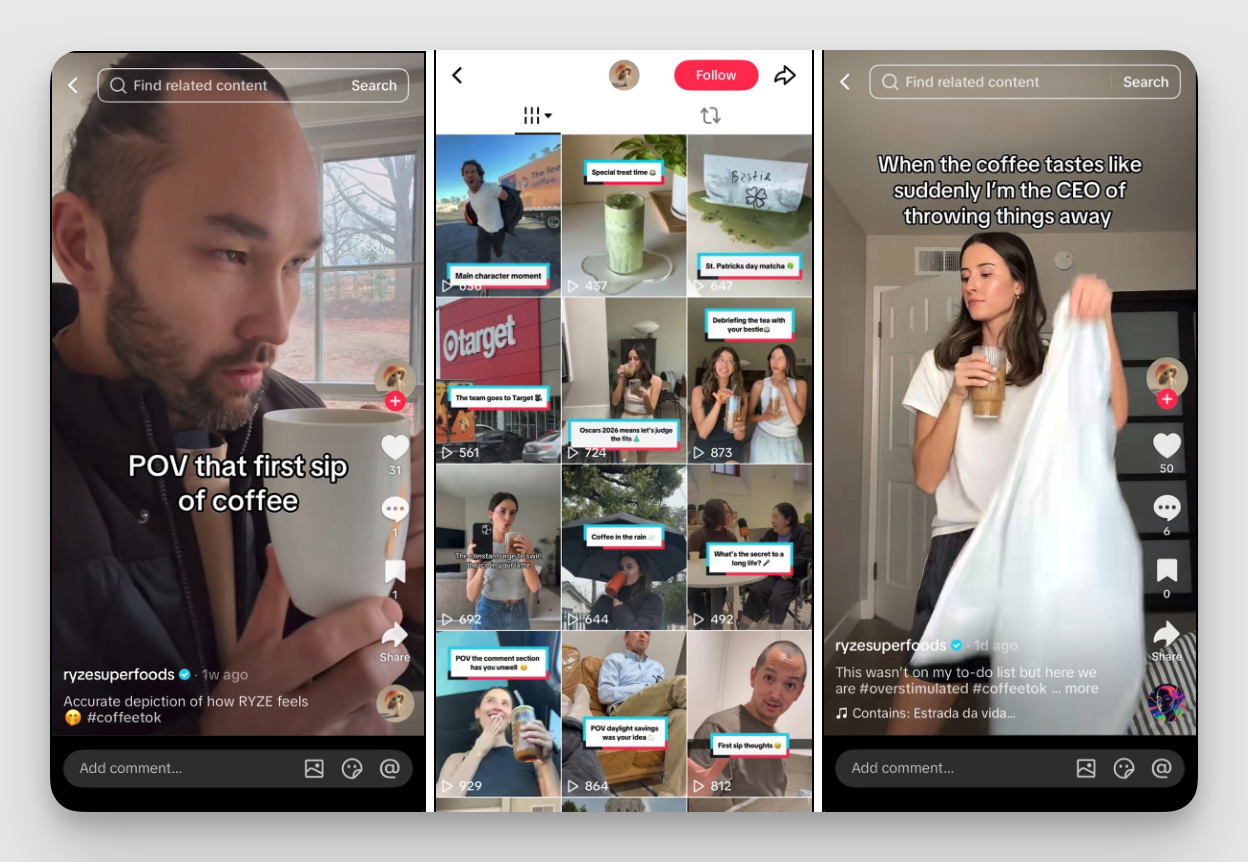
A lot of their presence is built around creators sharing their routines, reactions, or experiences with the product: morning habits, taste tests, small lifestyle moments.
What stands out is how different each video feels.
It’s not one brand voice repeating itself. It’s multiple people telling their version of the same story. And that’s what keeps it interesting. That’s where the advantage is.
So instead of trying to control every piece of content, move the focus to giving people something worth sharing. Something they can easily turn into their own video.
And once that starts happening consistently, you’re no longer the only one driving the content forward.
It starts building momentum on its own.
#8. Create "tag a friend" moments
You know that split second when a video pops up and you immediately think of someone?
That’s the moment you’re aiming for. Specific enough to feel personal.
And that usually comes from sharp observations. Small, recognizable behaviors. Situations people don’t always say out loud but instantly recognize.
It could be:
- a niche inside joke your audience lives in
- a painfully accurate type of person
- a scenario that feels a little too real
The key is how precise it feels.
When it lands, people pass it on. And those shares carry a different kind of weight, because the content arrives with context: “this reminded me of you.”
And that's how to make a good TikTook that travels.
#9. Track content performance over time
Your content already holds the answers. You just need enough data to see them.
At the beginning, it’s tempting to judge each post on its own. I’ve done that too. But the real insight comes from stepping back and looking at how your content behaves across weeks or months.
That’s where social media analysis starts to feel genuinely useful.
By following your TikTok analytics regularly—engagement, views, and other key TikTok metrics—you can start to recognize which formats and topics keep showing up among your better-performing content.
Take Instacart as an example:
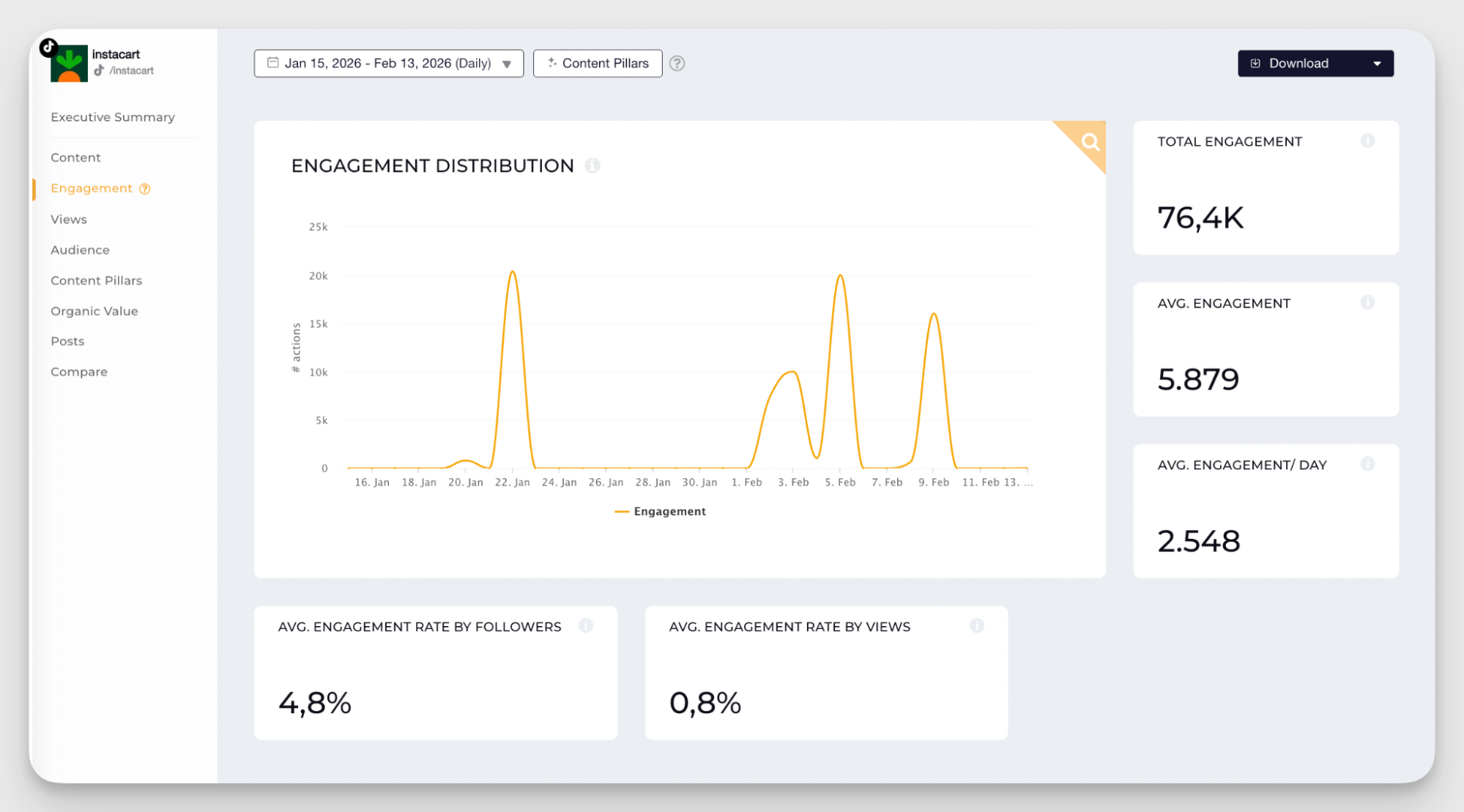
Engagement increases throughout February. That kind of shift usually reflects a change in how the content is landing, something in the execution or topic mix is resonating more.
This is the kind of signal you look for in trend analysis social media.
From there, it helps to pinpoint the posts behind those results.
And with top social media analytics tools like Socialinsider you can quickly pull up the content driving that performance:
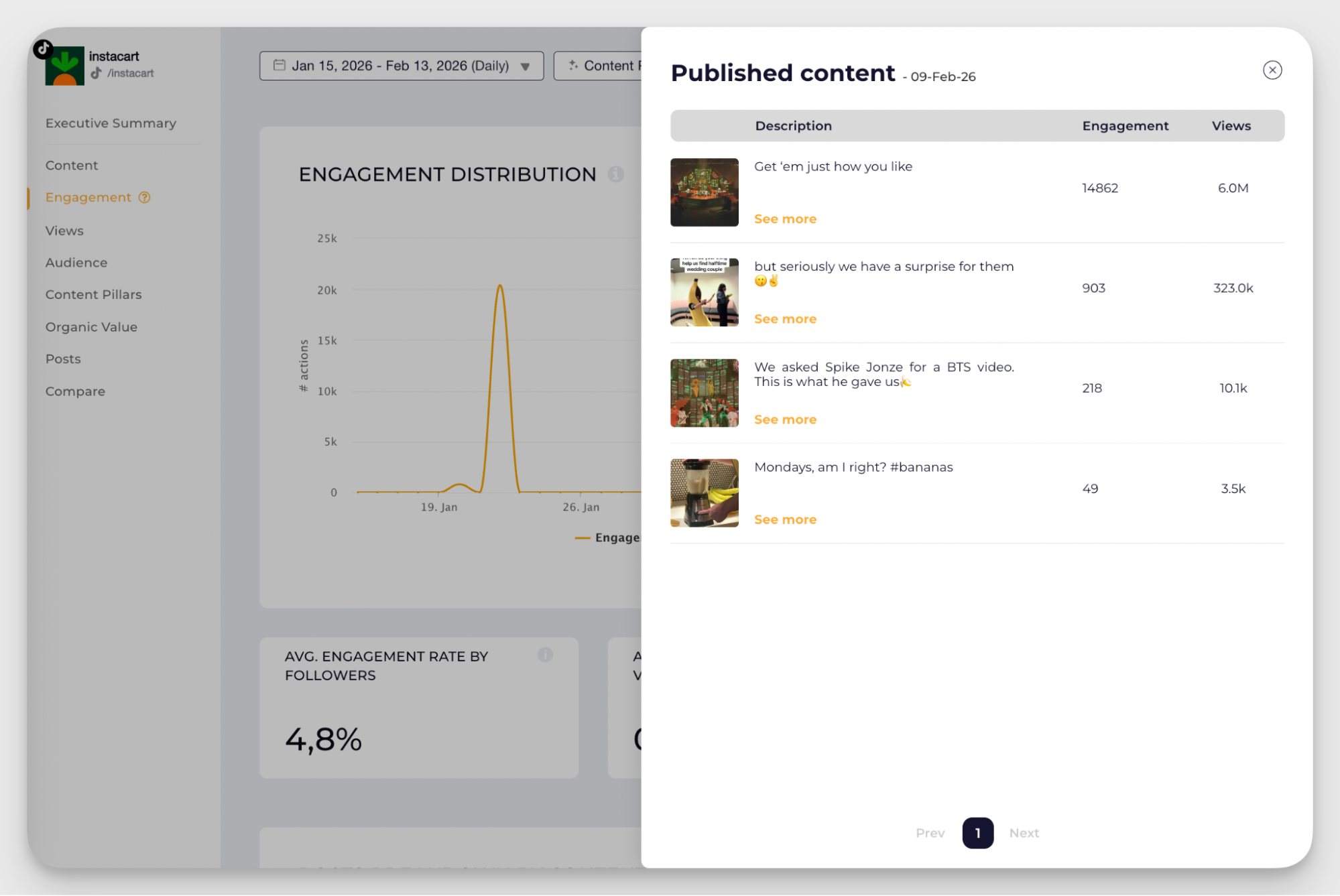
Now you’re not just looking at numbers, but actually connecting them to actual content. You can break down what those posts have in common and apply that insight moving forward.
That’s a practical way to approach a TikTok video performance analysis.
Some other useful tips for posting on TikTok that’ve been useful to me are sorting top posts by timeframes and posts by specific social media metrics.
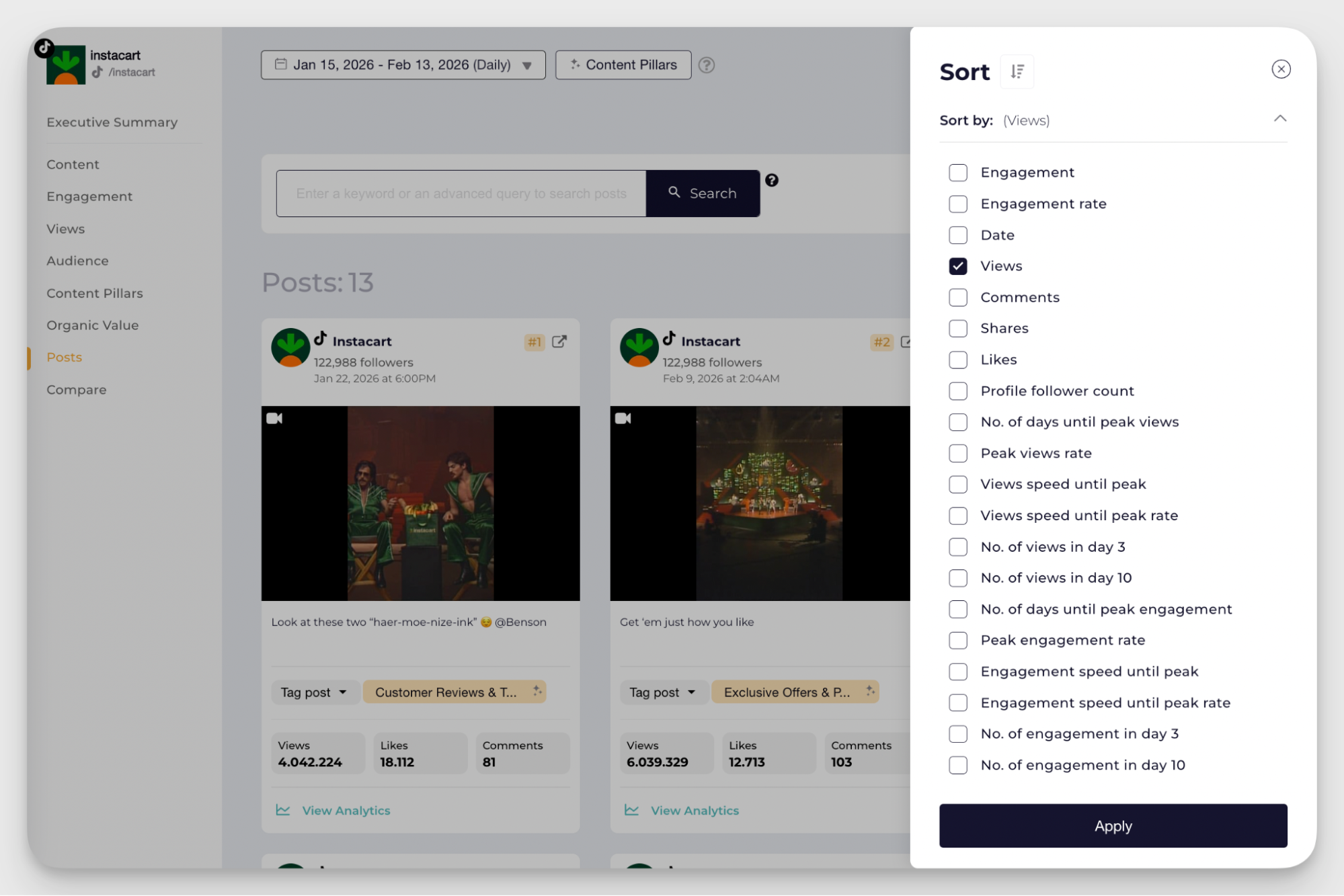
Reviewing top content by views, engagement, or other metrics makes it easier to catch shifts early and see what’s gaining traction and what’s starting to lose it.
Consistent social media data collection builds context.
With that context, your social media content strategy becomes more focused, and your social media growth strategies are grounded in what consistently performs, not assumptions.
TikTok marketing mistakes to avoid
A lot of TikTok posting tips tell you what to do.
But if I’m honest, what usually makes the biggest difference is spotting what’s quietly working against you.
Some of these don’t feel like mistakes at all while you’re doing them. They feel productive. Consistent. Like you’re showing up. Then nothing really moves.
When I asked her about this, Denise mentioned:
The biggest mistake brands and creators make on TikTok is treating it like every other video platform. Over-polished content consistently underperforms because TikTok's culture rewards real, in-the-moment connection over production value. The most effective TikTok strategies are rooted in community building, responding to comments with videos, engaging directly with your audience, and letting people get to know the unfiltered version of you or your brand. Consistency paired with a little strategic whimsy, content that feels spontaneous even when it isn't, is what separates creators who grow from those who plateau.
That idea of showing up in a more real, human way matters more than most people expect. And a lot of the mistakes below come from missing that.
Here are a few I see all the time:
- Posting without analyzing what works: You’re putting content out, but not really looking at what’s landing. Over time, that keeps you in the dark.
The strongest TikTok best practices always include paying attention to patterns for what people actually respond to.
- Having an inconsistent brand voice or messaging: If every video feels like it’s coming from a different place, it’s harder for people to connect.
The accounts that grow tend to feel familiar, even when the content itself changes.
- Neglecting your performance analytics insights: Your data is already telling you a lot. Which videos hold attention, which ones get shared, which ones don’t go anywhere.
Skipping that step means missing out on direction you already have.
- Deleting low-performing videos: It’s tempting, I get it. But those posts are useful. They show you what didn’t connect. And that’s just as important when you’re figuring out what to do next.
- Ignoring the importance of creating save-worthy content: Some videos get watched once. Others get saved and revisited. That second category tends to stick longer and travel further.
- Chasing viral moments instead of long-term growth: Going viral feels great, but it doesn’t always lead anywhere on its own. What actually builds momentum is consistency people recognize, something they come back for.
Most of this comes down to paying a bit more attention to what your content is already telling you. And adjusting from there.
Final thoughts
If there’s one thing I’d leave you with, it’s this:
Growth on TikTok usually comes down to paying attention and making small, deliberate adjustments over time.
The signals are already there, in what people watch, respond to, and come back for.
Build on that. Stay consistent with what resonates.
Treat TikTok as something you learn from as you go, not just a place to post.
That shift alone tends to make everything else fall into place.
FAQs about TikTok tips
How to make better TikToks?
To improve your TikToks, understand your audience and ensure high-quality visuals and audio. Be authentic and use engaging hooks to capture attention. Incorporate trends and music for visibility, post consistently, and interact with viewers. Use TikTok's analytics to refine your approach and experiment with new content ideas.
How to use TikTok as a pro?
To use TikTok like a pro, focus on lighting and positioning: use natural light or a ring light for clarity, and position the camera at eye level for a flattering angle. Optimize video quality with clear, stable shots and experiment with different backgrounds to add visual interest. Engage viewers by keeping the content dynamic and editing tightly to maintain pace.
Anda Radulescu
Content writer & copywriter with a 5-year track record in digital marketing. Equal parts keen observer & committed go-getter. A proud cat mom with a passion for music & exploring the world.

Know what your competitors do — before your manager asks
Get instant social benchmarks & reports without manual work.
You might also like



Improve your social media strategy with Socialinsider!
Use in-depth data to measure your social accounts’ performance, analyze competitors, and gain insights to improve your strategy.