AI Tools for Data Analysis: Top 12 Tested and Reviewed Platforms
Here's a breakdown of the best AI data analytics tools for marketing teams, organized by use case, with pricing and reviews.


AI tools for data analysis won't think for you, but they will cut the time it takes to get from raw numbers to a decision.
AI in social media and marketing can be used in way better places than just rephrasing your copy or summarizing an email. Whether that's spotting why engagement dropped, forecasting next month's conversions, or building a report based on a large dataset, AI data analysis tools can back you up, even when you don’t have a dedicated analyst on the team.
In this article, I’m breaking down what AI data analysis tools do, the main categories they fall into, and 12 specific tools worth knowing across social media analytics, audience intelligence, executive reporting, and predictive marketing.
Key takeaways
- Modern data analytics is no longer owned solely by data teams because AI-powered analytics, self-service dashboards, and accessible reporting tools enable marketers to analyze campaign performance, interpret business context, and make data-driven decisions in real time.
- AI tools for data analytics automate pattern detection, insight generation, natural language querying, and predictive forecasting, helping marketers and business teams analyze data faster without replacing human expertise or strategic decision-making.
- Socialinsider, Iconosquare, and Semrush combine AI-powered social media analytics, competitor benchmarking, content optimization, audience insights, SEO intelligence, and performance reporting to help marketers improve content strategy across platforms.
- Talkwalker, Pulsar, and ThoughtSpot use AI-powered social listening, consumer intelligence, sentiment analysis, audience segmentation, conversational analytics, and trend detection to help brands understand customer behavior and make smarter marketing decisions.
- Meltwater, Pecan AI, and DataRobot leverage predictive analytics, campaign forecasting, customer behavior modeling, risk detection, and AI-driven business intelligence to forecast marketing performance, optimize budget allocation, and identify future growth opportunities.
Why is data analytics no longer a "data team" problem?
Remember when you could throw a sunset photo with your branded cup on Instagram and call it a social media campaign? Yeah, that era is dead and buried.
Every marketing campaign now needs a number behind it, and fast. Marketers have to act on data and market signals in real time, and waiting three days for someone else to pull a report just doesn't work anymore.
Domain knowledge matters here, too. A data team can tell you conversions grew by 20%. Only you know it's because you changed the offer or launched a new campaign.
The upside is that platforms have made data more accessible than ever. Analysis is now part of daily marketing work, while data teams shift toward governance and deeper modeling.
What AI tools for data analytics actually do?
Let's get one thing straight: no AI tool "solves" data analytics (and personally, I am allergic to this phrase).
What AI tools do is speed you up and take over the parts of analysis that used to eat your whole afternoon, like cross-referencing ten posts to spot a pattern an algorithm can flag in two seconds.
Native platforms gave us the numbers. The AI layer on top gives us speed and the ability to digest those numbers without external help, getting automated insights by simply asking, rather than waiting for an analyst to get to your task.
AI also makes forecasting more accessible. It used to require a dedicated analyst and a lot of patience. Now, you don't need a statistics background to get a reasonable read on where your numbers are heading next month.
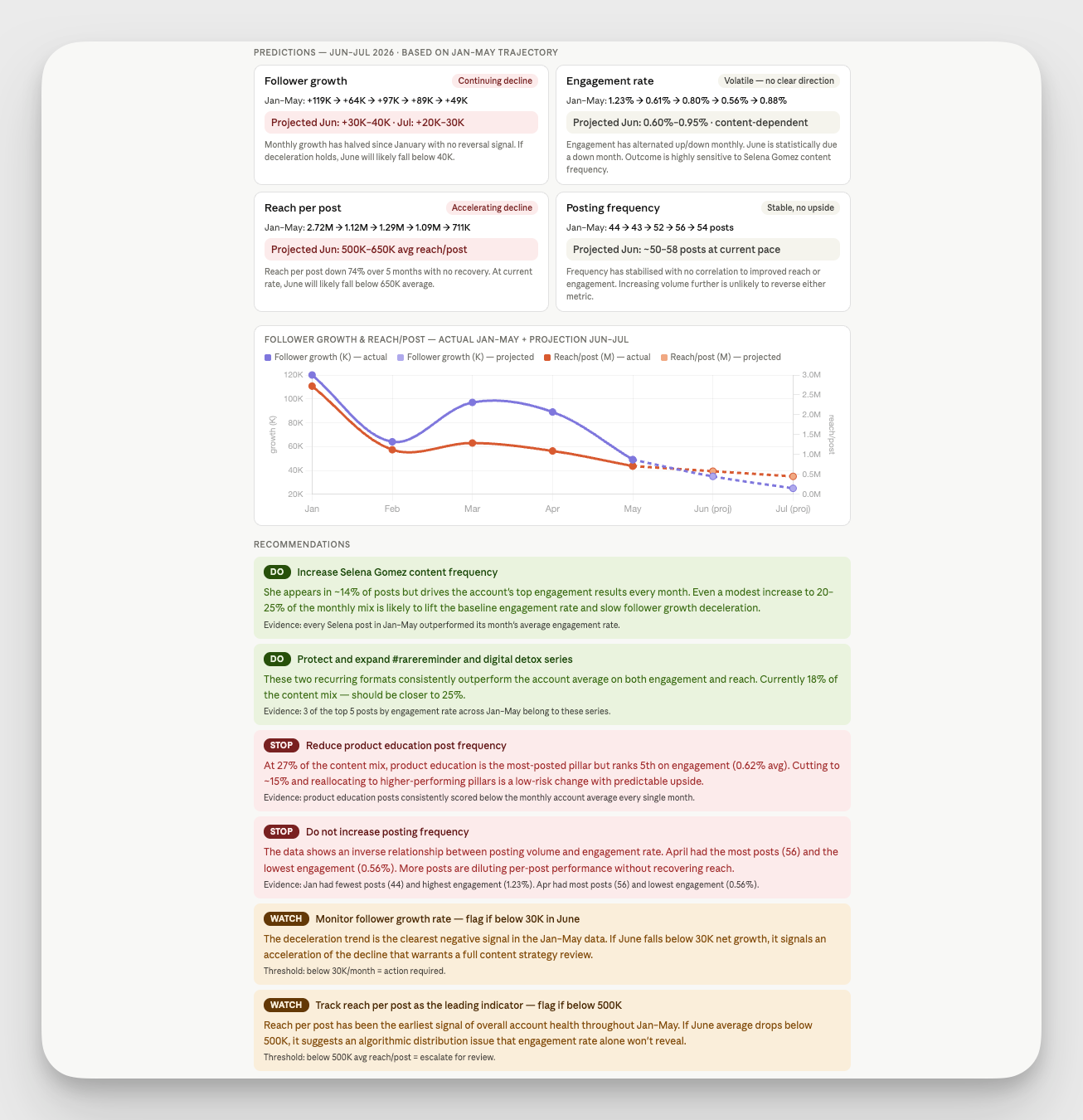
Both the automated insights and the forecasting are what make these tools genuinely useful, especially if data analytics isn't your first language or your only job.
What are the main AI analytics categories, and which one is best for your needs?
Data analysis with AI isn't one big blob doing some mysterious analytics read for you. There are distinct categories of where and how AI supports data-driven marketing:
- Descriptive analytics. Answers "What happened?" It summarizes past data into something readable, like engagement totals or follower growth over the last quarter.
- Diagnostic analytics. Answers "Why did it happen?" It digs into those numbers to find the cause, like connecting a drop in engagement to a change in posting cadence.
- Predictive analytics. Answers "What's likely to happen next?" It uses historical patterns to forecast outcomes, like next month's follower growth or campaign performance.
- Prescriptive analytics. Answers "What should we do about it?" It recommends specific actions based on the forecast, like budget reallocation or underused formats.
- Generative analytics. Answers "Can you just build this for me?" It uses AI to create the output itself, like summaries, reports, or content variations.
Which one do you need? Depends on the problem in front of you. Understanding last month's performance calls for descriptive and diagnostic tools. Planning next quarter puts you in predictive and prescriptive territory. Some AI tools mix all of these, others stick to one narrow lane.
AI tools for social media & content analytics
This first category isn't made up of pure data-crunching machines. These are social media AI tools that happen to cover analytics really well, but also can support you in competitive research, publishing, or SEO content.
(If you’re here for hardcore AI data analysis tools, hang in there — they’re coming)
For now, here are three tools that can support both your day-to-day social media work and your data analysis needs.
Socialinsider
Socialinsider is built around analytics and competitor research, which makes it less of a jack-of-all-trades and more of a specialist that does its one job well. And this job is competitor monitoring and industry benchmarking.
Socialinsider uses an AI layer to help you summarize your and your competitors’ performance, analyze content pillars, and draft action points and recommendations suitable for your specific case.
Main features
- AI-based content pillar analysis. The AI automatically groups your posts and your competitors' by industry-wide content pillar, so you can see which topics are outperforming the rest. It helps you catch a rising trend or to spot a gap in your own content strategy.

- Socialinsider AI Assistant: This is a conversational layer that lets you ask direct questions about your data and get instant answers, benchmarks, or summaries back. Think of this as Claude or ChatGPT, but with all your performance data as its context. You can ask the AI Assistant to find a pattern in metrics or recommend next steps for the upcoming quarter.

- Cross-platform performance analysis. Analyze both your own and your competitors’ data as an aggregated brand performance report or on a channel-by-channel level. Aggregated brand metrics can help you in social media reporting, while individual channel analysis supports your day-to-day strategic decisions.

- LinkedIn and TikTok analytics. Some analytics tools treat LinkedIn and TikTok as an afterthought, even though both platforms are playing a huge role, especially in B2B strategies. Socialinsider goes properly deep on both, with the same level of metric coverage and competitive benchmarking.
- Multi-level competitive benchmarking. Competitor benchmarking is the core of Socilainsider. You can benchmark at the channel level, cross-channel level, or full brand level. That gives you both a zoom in on a specific platform and a zoom out on how our whole brand stacks up against competitors.
Reviews
- “Socialinsider allows for a competitor analysis that gives an insight into performance relative to the market.” — Victor Mukubvu, Digital Marketing Analyst, Mitsubishi Electric.
- “I like the competition analysis summary and suggestions that Socialinsider provides. The accuracy of the numbers is wonderful, and it gives me great support to plan my social media strategy.” — Farhin Q, Marketing Chief Deputy Manager.
Pricing
Socialinsider plans start at $82/month when billed annually. There's a 14-day free trial, no credit card required.
Iconosquare
Iconosquare is a social media management platform. It positions itself as analytics-first, but it also covers planning, publishing, and listening.

What makes Iconosquare stand out as an AI-powered tool is its AI post generator and idea engine, which speed up content creation while keeping your brand voice intact. A pretty comfy setup that speeds you up by a lot when you're managing multiple accounts.
Main features
- AI-generated captions and refinement. Iconosquare’s AI creates content ideas, hashtags, and captions tailored to your brand goals. It helps when you've hit a wall or need to adjust posts to different platforms.
- AI-recommended posting times. Among gathering other social media analytics data, AI analyzes your audience's actual activity patterns and tells you the best time to publish on each network.
- Content scheduling. Iconosquare automates content planning by allowing you to schedule and publish content for all major platforms, including TikTok and YouTube Shorts.
Reviews
- “I love how intuitive and user-friendly Iconosquare is; it's easy to navigate, it's nice to see the layout and preview of the feed before publishing a post.” (G2)
- “Great for reporting to clients, tracking analytics, and scheduling different types of posts.” (G2)
Pricing
Iconosquare has multiple paid plans starting at €39/month with 5 social media profiles. It also has a free plan with 2 profiles and basic analytics.
Semrush
Semrush built its name as an SEO platform. Now, it’s positioned as a brand visibility platform. That includes full toolkits for different parts of the marketing journey, from SEO and content analysis to their own social media management tool.

Semrush pioneers in uniting classic SEO authority tracking with AI search visibility, meaning it can help you work on how your brand shows up when people ask ChatGPT instead of Googling.
Main features
- AI keyword discovery. Semrush uses AI to surface billions of keywords and analyze their ranking potential across global geo-databases, which significantly speeds up research that used to be mostly manual.
- LLM visibility tracking. A dedicated toolkit tracks how your brand gets cited in AI-driven answers like ChatGPT, and shows you your AI market share against competitors.
- AI-driven content optimization. The platform scores content in real time, helping teams write content that's SEO-ready and built to get picked up by AI search agents at the same time.
Reviews
- “Semrush provides a complete SEO toolkit, including keyword research, competitor analysis, backlink insights, ranking insights, and site audits etc.” (G2)
- “Everything in Semrush is a useful feature, but prompt research is the one I like most about Semrush.” (G2)
Pricing
Semrush plans are somewhat overwhelming. Its SEO toolkit starts at $139.95/month, and if you want to add AI search to it, brace yourself for $199/month and up.
AI tools for consumer & audience intelligence
This category gets closer to what most people picture when they hear "data analysis."
These AI data analytics tools are less about analyzing performance metrics and more about understanding what your audience is saying about you, how they perceive your brand, and whether your offer lands.
Talkwalker
Talkwalker, now part of Hootsuite, is a social listening and media monitoring platform built to help brands track global coverage and conversation. The tool catches mentions of your brand all over the Internet, be it a text mention or a logo on a video.

Talkwalker’s Yeti Agent, a self-driving AI, goes through your data and fetches the important changes. You move from raw data about who said what straight to what to do about it.
Main features
- Predictive crisis and misinformation detection. The platform uses AI to flag misinformation and emerging negative sentiment before it snowballs into a full-blown story.
- Visual sentiment analysis. Talkwalker breaks down audience sentiment across different channels. It includes metrics like media value and positive-versus-negative sentiment percentages.
- Product insights. The tool’s AI analyzes broad consumer intelligence data to highlight the needs of your audience that your current offer doesn’t meet.
Reviews
- “I find Talkwalker by Hootsuite super easy to use. I really love the cluster analysis and how it can synthesize key themes in a huge data set.” (G2)
- “Talkwalker has the ability to fully customize your search terms while looking at sentiment, geographic locations, and media types.” (G2)
Pricing
Reach out to the Talkwalker team for a custom quote and a demo.
Pulsar
Pulsar is an audience intelligence platform. It’s a little different from classic consumer intelligence: Pulsar focuses on understanding how different communities behave, perceive information, and use language in online conversations.

The tool uses vertical-specific AI models. That means that the models in Pulsar are trained on industry-specific data and made to solve narrow tasks tied to your domain.
Main features
- Narratives AI. Pulsar uses specialized AI to detect, track, and analyze how public narratives evolve across social media, news, and search data. Teams can use this to monitor reputation intelligence and catch brand-related risks.
- Community-first segmentation. Pulsar breaks down how different communities engage with the same topic. This shows you how your marketing and messaging will land differently across segments, so you can tailor creative and targeting.
- Real-time trend forecasting. The platform connects public conversation to consumer trends by combining search, news, and social data into one multi-signal view. You can forecast trends and choose better timings for your campaigns.
Reviews
- “The query builder is what I lean on most - boolean search and filtering by platform, language, and region let me scope a topic tightly so the data stays clean.” (G2)
- “The technology allows us to quickly understand online sentiment and trends at scale and the customer support is fantastic.” (G2)
Pricing
Pulsar has custom pricing. Reach out to their team for a quote and a demo.
ThoughtSpot
For real AI fans out there, I present you ThoughtSpot — an agentic analytics platform that allows teams to talk to their data.

ThoughtSpot has multiple ways to collect your data: from native integrations to embedded analytics and MCPs. You can get the AI conversational layer directly inside other software platforms you use.
Main features
- Spotter agent and conversational layer. You can ask complex business questions in plain human language and get instant answers from your data. This means stakeholders don’t need to ask the data analyst about every single number.
- Automated dashboarding agent. SpotterViz takes raw data and builds a full dashboard, or "Liveboard," in minutes, planning the data story and the layout on its own. It handles structure, styling, and chart sizing automatically.
- AI-augmented trend and driver analysis. AI gets you the key trends, drivers, and alerts on its own, so you can skip directly to “why XYZ happened.” These insights can be embedded directly into tools like Salesforce or Slack.
Reviews
- “ThoughtSpot allows business leaders, marketers, and regional managers to simply type questions like "Show me the top 5 lifestyle attributes of customers buying item X who aren't on our loyalty program" without waiting on a data engineering queue.” (G2)
- “I love the entire talk to your data concept in ThoughtSpot, as it just makes it easier when the AI knows what our data means.” (G2)
Pricing
ThoughtSpot starts at $25/month per user.
AI tools for marketing reporting & executive dashboards
This category covers AI tools built to share results with stakeholders, whether it's a live dashboard or a static report you send out once a month.
The three tools here are a bit of a step up in complexity and data fluency, made for wider marketing analysis across the whole funnel.
PS: If you're after something simpler and more focused on social media analysis specifically, Socialinsider's automated reports cover that ground well, and you can even integrate it with Data Studio if you want custom dashboards.
Power BI
Microsoft Power BI is a tool for business intelligence that focuses on creating graphs and dashboards. It connects to pretty much any data source and helps you visualize the data and share it all across your teams.

The thing that makes Power BI attractive to some teams is the ecosystem. The tool is deeply tied to Microsoft Fabric (the complete data platform) and Copilot (Microsoft’s AI companion).
So if your team is already using the Microsoft system, which is frankly often the case, Power BI stacks nicely within it.
Main features
- Conversational report creation. You can build and tailor reports with Copilot by describing what you want or asking a question in plain language. It takes you from raw data to a visual report with little to no data crunching.
- AI-powered DAX queries and explanations. DAX is the formula language Power BI uses to calculate things like growth rate or year-over-year comparisons, and it's not exactly beginner-friendly. Copilot can write and explain these formulas for you in plain language and summarize how your data model is structured.
- Advanced pattern and anomaly detection. Built-in AI scans large datasets for hidden patterns, trends, and anomalies on its own. This helps you go from just visualizing your data to uncovering hidden business gems.
Reviews
- “Power BI is incredibly good at turning raw data into information. I regularly use it for dashboards and reports by bringing data in from various sources.” (G2)
- “Its intuitive dashboards, strong data modeling capabilities, and tight integration with the Microsoft ecosystem make it highly effective for business intelligence and decision-making.” (G2)
Pricing
Power BI has a free package included in the Microsoft Fabric free account. The upgrades begin at $14.00/month per user.
Tableau
Tableau is a visual analytics platform that helps you turn spreadsheets into interactive visual dashboards. It's part of Salesforce: Tableau plugs into its CRM data without the usual integration headache, so keep an eye on it if your team is already using Salesforce.

Tableau is helpful when you need not only to read your data, but also to dig around it a little. The graphs Tableau creates are used for the kind of work where you're dragging and clicking your way to an answer instead of writing a query.
Main features
- Agentic analytics. Tableau Pulse runs across the full Tableau portfolio to read the data. If your weekly revenue dropped, Pulse will surface which product line or region drove the dip, compare it against your usual pattern, and send you a written explanation.
- Role-specific AI insights. Tableau tailors its insights depending on who's looking, whether that's an analyst, an IT lead, or a business leader. Analysts get help leveling up their own analysis, while business leaders get a more high-level read.
- Unified AI/ML integration across teams. Tableau bundles its AI and machine learning capabilities with governance and data management to back decision-making by data across all teams in the company.
Reviews
- “I enjoy building products that help users make decisions, and Tableau aligns well with that philosophy by making complex datasets accessible through intuitive dashboards.” (G2)
- “I love the drag and drop feature, makes it simple to build visuals without coding. I use it daily to present key metrics, trends, and KPI to management.” (G2)
Pricing
The standard Tableau plan costs $15/month per user. If you need to bundle Tableau Cloud with other Tableau services, reach out to their team for a custom quote and a demo.
Domo
Domo (not to be confused with the Domo AI app, which is a genAI app) is a cloud-based business intelligence platform that pulls data from over 1,000 pre-built connectors. It turns data into dashboards, reports, and automated workflows with low or no code, making it simple to use even with no tech knowledge.

What sets it apart from Power BI or Tableau is how far it leans into agentic AI. Domo wants AI agents running in the background, handling reporting, alerts, and approvals on their own.
Main features
- Autonomous AI agents. Domo lets you build agents that respond to data changes and adapt to your workflows, automating tasks like recurring reports or approval chains without someone manually triggering each step.
- AI-assisted forecasting. A prebuilt model turns historical data into forecasts automatically, detecting trends, seasonality, and confidence ranges without you needing to build a model from scratch.
- Governed AI on enterprise data. Domo pairs its AI layer with built-in governance and access controls, so as more teams plug into the platform, the data stays secure and consistent rather than turning into a free-for-all of conflicting numbers.
Reviews
- “Domo brings BI, dashboards, data connectors, and executive reporting into one platform.” (G2)
- “Domo can unify massive amounts of complex data into a single, intuitive, and highly visual dashboard without requiring heavy IT or coding expertise.” (G2)
Pricing
Domo offers a 30-day free trial. The pricing is custom, so reach out to the team for a quote.
AI tools for predictive marketing & campaign forecasting
This category of tools is about clever data extrapolation.
These AI tools for data analysis use the existing data to build a forecast or at least a reasonable benchmark for what's likely to happen next, so you can get an idea of how a campaign might land before you've spent the budget.
Meltwater
Meltwater is an intelligence platform for PR, communications, and marketing leaders. It’s not your classical forecasting tool, because it focuses more on qualitative risk: spotting narrative shifts before they turn into a real problem.

Meltwater’s GenAI Lens helps you cover more ground, tracking how your brand looks inside ChatGPT, Google's AI Overviews, and Claude. With the shift toward LLM search, that's where a reputational leak can start before you notice it anywhere else.
Main features
- Narrative shift detection. AI monitors 1.3 billion daily documents to catch unusual spikes in activity or emerging risks before they escalate. That gives communications teams a window to respond while a story is still small.
- Real-time sentiment monitoring. The tool tracks conversations across more than 240 languages to flag shifts in brand sentiment, with visual analytics showing positive versus negative reactions across channels.
- Unified campaign intelligence. Meltwater pulls media coverage, social conversation, and competitive signals into one place, which makes it easier to prove specific KPIs and ROI.
Reviews
- “Query generation is much faster, and the ability to get from question to insight is considerably shorter.” (G2)
- “The real-time alerting capabilities are particularly great for tracking relevant brand and industry mentions across news, social media, and industry mentions.” (G2)
Pricing
Meltwater offers custom pricing.
Pecan AI
Pecan AI is a predictive platform that closes the gap between business teams and data science. This tool does more classic forecasting, like generating predictions on revenue, ROAS, demand, and other business-oriented metrics.

Pecan AI’s conversational predictive AI agent automates the entire data science workflow, so building a forecasting model doesn't require an actual data scientist on the team.
Main features
- Predictive campaign ROAS. Pecan forecasts long-term return on ad spend 24 to 48 hours after a campaign launches, giving managers an early read to scale the winners and cut the losers.
- Customer churn and LTV identification. The platform analyzes transaction history and behavioral signals to flag at-risk customers before they leave. It uses cohort analysis to model lifetime value, helping teams spot and prioritize their highest-value segments.
- Demand forecasting. Pecan predicts future inventory needs by combining historical sales data with seasonal adjustments and external market trends.
Reviews
- “Building and training models is genuinely straightforward, and the prediction quality has held up well in production.” (G2)
- “I appreciate that Pecan AI is not a black box, allowing me to audit and test results.” (G2)
Pricing
Pecan AI starts at a whopping $760/month, paid annually.
DataRobot
DataRobot is an enterprise-grade agent workforce platform that lets organizations build and govern AI agents so they don’t go rogue, especially in crucial sectors like finance or supply chains.

Its main strength for predictive marketing is scale: DataRobot can run complex forecasts across an entire organization at once. It can forecast revenue tied to shifting market conditions or find churn risk across an entire customer base.
Main features
- Predictive AI for forecasting. The platform plugs predictive modeling directly into core business processes like supply chain and finance, unifying data from different sources.
- Agent lifecycle governance. DataRobot tracks every AI asset and activity across the organization for full visibility and control, making sure that every model meets the compliance and approval bar required in its industry.
- Testing and audit frameworks. Automated documentation and testing catch anomalies in agent behavior, helping teams find and fix risks before they hit the business or break a regulatory requirement.
Reviews
- “Automated modeling is a big help because it tries different approaches for me instead of requiring everything to be done manually.” (G2)
- “It is time-saving and can handle large data, and always chooses best model for our project.” (G2)
Pricing
DataRobot offers a 14-day free trial account. Contact the team for a demo and custom quote.
Final thoughts
AI tools for data analysis won't replace a data team, but they let you crunch your numbers faster and easier without asking a dedicated person for every report.
Before committing to any tool on this list, give it a trial run or book a demo to see how it actually behaves with your data. If you're after social media and competitor benchmarking reporting, Socialinsider offers a 14-day free trial — give it a spin today.
Kseniia Volodina
With a background in journalism, Kseniia Volodina writes about social media analytics, audience research, and competitive data for teams that want strategy, not guesswork.

Know what your competitors do — before your manager asks
Get instant social benchmarks & reports without manual work.


