AI Social Media Agent: How to Use An Autonomous AI to Scale Your Strategy
Unlock the potential of your social channels with an AI social media agent that can deliver your smart automation for superior performance.


An AI social media agent helps you draft, adapt, analyze, and route social tasks without forcing your team to do every step manually. If you are juggling captions, reporting, competitor checks, and comment moderation, with the help of an AI agent, you can gain speed, clarity, and fewer repetitive tasks that pull you away from strategy, community building, and the work leadership actually needs from you.
Follow me along as I explain throughout this article what an AI social media agent is and how you can use one to move your social media marketing game to the next level
Key takeaways
-
An AI social media agent is a workflow-driven assistant that helps manage content creation, analysis, and engagement tasks while keeping humans in control of key decisions.
-
The purpose of an AI social media agent is to draft, adapt, analyze, and organize social media activities, helping teams work faster and more efficiently across platforms.
-
The AI agent delivers the most value when a team already has a defined strategy, brand voice, and content foundation that can be scaled.
-
Keeping an AI social media agent on brand requires clear guidelines, strong training data, human review processes, and regular updates as the brand evolves.
What is an AI social media agent?
An AI social media agent is a workflow-driven system that helps with social media creation, analysis, and response management from start to finish. In practice, it can suggest content, organize data, flag issues, and move tasks to a human reviewer when the stakes are higher.
What an AI social media agent does in practice?
The best AI agents for social media are not solely writing helpers. They can create first drafts, repurpose one idea across different social media channels, and keep a team moving when bandwidth is tight. This matters because different social media platforms reward different formats, so the same message usually needs several versions rather than one copy-and-paste caption.
Common jobs include:
- Drafting posts for campaigns, launches, and evergreen content.
- Adapting copy for social media platforms with different lengths and tones.
- Sorting comments, tagging urgent replies, and drafting response suggestions.
- Summarizing audience patterns, trend signals, and report highlights.
A social media AI agent becomes useful when it works like a junior operator, not a replacement for the strategist. That is why a social media leader still has the final say on voice, timing, and risk.
When does an AI social media agent make sense?
An AI social media agent makes sense when a team already knows its audience, voice, and goals. It is most valuable when repetition is high, the workflow is clear, and the team wants to scale good decisions instead of starting from scratch every day.
The strongest fit is a team that already has enough raw material to work from.
When I sat down with Lindsay Rosenthal, founder of Creed. Marketing for a quick chat on how AI shapes social media nowadays, and asked her when social media AI agents make sense, and when they do not, she said:
They make sense when a person already has a strong perspective, social media “muscles,” and enough raw material to work from. Then the agent can help scale tailored and relevant output, research ideas, and repurpose ideas, all without losing identity.
They do not make sense when the person has not developed their voice yet nor know the ropes of social media platforms and algos. There is nothing to scale in that case. Humans must first establish their own strategies and goals, then allow AI to assist in these. Humans in the loop, always!
How to keep an AI social media agent on brand?
An AI social media agent stays useful when the guardrails are specific. The goal is not to make AI sound human at all costs. The goal is to make output predictable, reviewable, and aligned with the brand’s social media content strategy.
The safest setup is simple: define the rules, train on your best content, add approval steps, and update the system as the brand evolves.
Create clear brand guidelines
Start with a short, practical brand document. Keep it focused on what the agent can follow every time.
Include:
- Tone rules: professional, conversational, empathetic, and clear.
- Banned phrases: anything too salesy, vague, or inflated.
- Audience rules: who the content is for, and what questions the audience asks.
- Approval rules: what needs review before publishing.
- Escalation rules: what must go to a human first, especially complaints and sensitive topics.
Train it on the best-performing content
Training an AI agent for social media content creation works best when the input comes from your own winners, not generic examples.
A simple training workflow looks like this:
- Pull top-performing posts.
- Group them by topic, format, and hook.
- Identify recurring phrases, angles, and calls to action.
- Turn those patterns into prompt rules.
- Review the results against brand voice every month.
Add an approval workflow
Human checkpoints should sit before publishing, before scheduling, and before any response automation goes live. That is the difference between helpful support and accidental brand risk.
A simple review chain can look like this:
- Content lead reviews structure and tone.
- Social lead reviews accuracy and platform fit.
- Community manager reviews high-risk replies.
- Legal or brand owners review promotions, claims, or sensitive topics.
Update prompts and rules as the brand evolves
An AI social media agent should change as the brand changes. Audience language shifts, platform behavior changes, and campaign priorities change with them.
Update the agent whenever you launch a new product, enter a new market, or notice that engagement patterns move. The best rule is simple: if the brand would brief a new team member differently, the agent needs a new brief too.
AI use case example: AI agents and competitive intelligence
Competitive intelligence is one of the strongest use cases for an AI social media agent because it can spot patterns faster than a manual review. Its value lies in helping you quickly understand what they repeat, what they ignore, and what your team should test next.
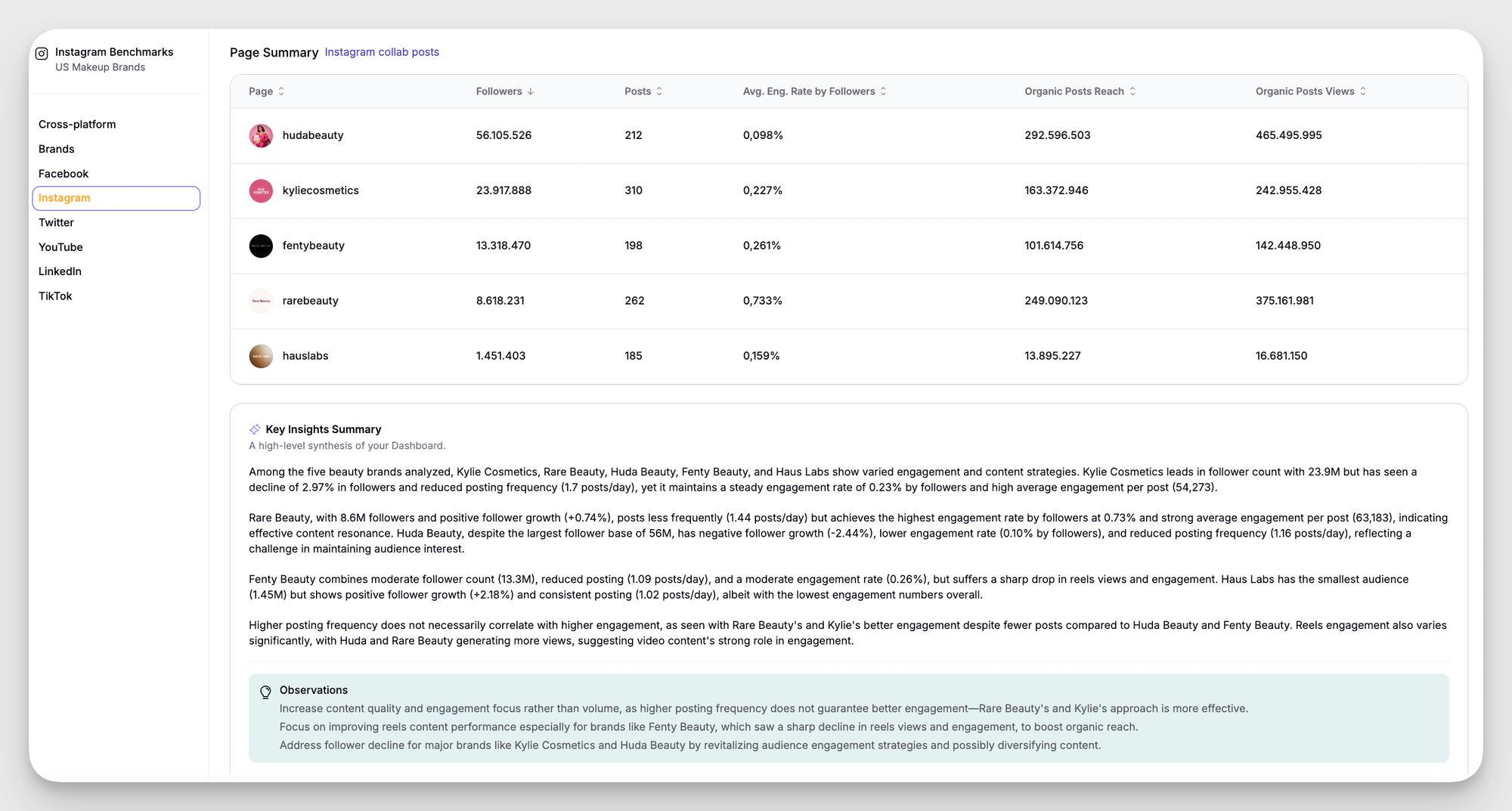
- Use AI for social media to analyze competitors' content strategies: Start with the content pillars. An AI social media agent can group competitor posts by theme, format, and engagement pattern, then show which topics earn the most attention.

- Identify gaps in competitors' coverage: The next step is to find what competitors are not covering well. An agent can surface recurring questions, missing themes, or weak formats across social media channels.
- Turn findings into a content plan: Once gaps are clear, the agent should translate them into tests.
Final thoughts
An AI social media agent is most valuable when a strategy already exists, and the team needs to scale it. The safest first use case is usually content drafting and content adaptation. My advice? Start there, add guardrails, and keep humans in the loop for anything sensitive.
FAQs on AI social media agents
How is an AI agent different from a general AI tool?
A general AI tool can write a caption. A social media AI agent can help you move from draft to decision.
Anda Radulescu
Anda Radulescu is a SaaS content writer and copywriter with 5+ years in digital marketing, turning social media data into practical ideas for Instagram, LinkedIn, and beyond

Know what your competitors do — before your manager asks
Get instant social benchmarks & reports without manual work.


