Understanding AI-Driven Insights: How AI Can Help You Interpret Your Performance Data
Learn how to leverage AI-driven insights to get more effective in your data analysis processes. Uncover powerful strategic insights types with AI.

Everything is AI-driven now. Every team is prompted to include AI in their day-to-day work, but rarely do we know what for and how.
Most teams don’t struggle with collecting data. They struggle with interpreting it. Dashboards are full, reports are long, and real signals are easy to miss when everything changes in real time. This is where AI-driven insights can help — not by replacing human thinking, but by supporting it.
In this article, I’ve looked at what AI-driven analytics and insights really are, where they add value, and how to use them in your workflow to improve it instead of buzz-wording it. Read on!
Key takeaways
-
What are AI-driven insights? AI-driven insights help you understand what your data is really telling you by turning numbers into clear explanations and meaningful next steps.
-
What are the main reasons you should be using AI-driven insights for your strategies?: AI-driven insights save you time and help you see patterns, changes, and opportunities you’d likely miss when analyzing data manually.
-
What types of AI-driven insights should you focus on analyzing?: The most useful AI-driven insights are the ones that support everyday decisions across marketing, business performance, customer experience, and product development.
-
Use cases where AI-driven insights can make a significant difference (and how Socialinsider can help): AI-driven insights matter most when they help you make smarter decisions faster—whether that’s improving content, understanding competitors, spotting trends early, or keeping customers engaged.
What are AI-driven insights?
AI-driven insights are interpretations of performance data generated with the help of machine learning models that surface patterns, trends, and connections a human might overlook.
Simply saying, instead of just numbers and metrics, you get a statement that describes your current stituation, explains the reasons behind the numbers, and offers next steps.
Machine learning is good at recognizing patterns, and it’s often a thing we look for in social media analytics. AI scans performance data sets and pulls out signals you might’ve missed. You get clearer patterns, smarter summaries, and digested reports that your not-so-social-media-savvy stakeholders can understand.
What are the main reasons you should be using AI-driven insights for your strategies?
Let’s make it clear: AI insights don’t replace a strategist or an analyst. They support them.
In social media, there are always two components of sustainable success: creativity and data analysis.
Creativity shapes what you publish and how you show up for your audience. Analysis is when you step back, look at your data from multiple angles, and understand why things happened the way they did and what you can influence next.
Here's what Carolyn Cohen, Global Content Strategist at Lockton, had to say about it when I asked her how she sees the impact of AI in marketing nowadays:
I think where AI shines is when it has a large pool of data. If you ask AI to analyze a lot of data that comes from a source you trust and are confident about, the opportunities are really endless. Those insights can make a significant difference, because it's simply impossible for a human to do that level of analysis within the same time constraint.
Here’s how AI-driven insights support your strategy without taking the wheel:
- Speed. Where humans would need several hours to analyze collected data, AI can do it in real time. This helps you spot shifts or opportunities early and not at the end of your reporting cycle when it’s too late to adjust.
- Scale. AI tools can work with larger data sets from multiple sources at the same time. Instead of sampling a small slice of your content or audience, you see the bigger picture across platforms, segments, or time periods.
- Accuracy. Data analysis comes with personal bias. We expect certain posts to do well or assume specific audiences behave a certain way. And even though a professional gut feeling is still a very important factor, AI helps you cut through that by looking strictly at the patterns in the data, not the assumptions behind it.
- Predictive power. With enough historical data, AI can point out early signals and rising trends: topics gaining traction, formats losing steam, or audience segments drifting away. You can make timely adjustments instead of reacting after the drop has already happened.
- Actionability. AI-driven insights imply that it’s not only the numbers, but the context that comes with them. AI gives you short explanations, highlights changes, and suggests next steps. It’s up to you whether to follow these steps or not, but it still reduces your guesswork.
- Cost efficiency. Manual analysis eats time you could spend on things AI is not that great at — content creation, for example. Automating parts of that process means you’re spending fewer hours compiling reports and more hours doing the work that needs your undivided attention.
What types of AI-driven insights should you focus on analyzing?
Everything AI-driven still needs a good chunk of human oversight. However, there are parts of the marketing workflow that AI can enrich without overriding them.
Below are my four main categories where AI-driven insights can support your day-to-day work.
Marketing & social media AI insights
Social media analytics come with a lot of data. You’re looking at performance across multiple platforms, different content formats, audiences that shift week to week, and algorithmic changes that no one fully controls.
This is where AI in social media becomes useful: not as a replacement for your judgment but as a tool that helps you read patterns faster.
Here’s what AI-driven insights can help you do:
- Predict how your content will perform. AI can review your historical performance and surface the themes, formats, and posting patterns that usually work for you. It won’t account for every nuance like your creative hook or today’s algorithmic quirks. But it gives you a clearer baseline to build from and helps you double down on whatever’s already resonating.
- Understand your audience’s behavior patterns and segment it. AI looks at how people interact with your content and groups similar behaviors together. You can see which types of posts different audiences respond to, when they’re most active, and what topics grab their attention.
- Benchmark your performance against competitors. Competitive intelligence can be time-consuming when done manually. AI tools can scan competitor activity, highlight patterns in their posting schedules or content themes, and show you how your results stack up. This gives you a reference point that’s rooted in data and not assumptions.
- Get practical tips for improving your campaigns. AI-driven insights often translate into actionable steps: which posts got a stronger response than expected, where engagement dropped, which formats you might be underusing, or how posting cadence impacts results. These nuances help you optimize your social media campaigns for better results.
Business intelligence & analytics
Depending on what data you feed into an AI tool, you’ll get different types of insights. When you work with larger data sets, AI can help you spot patterns that describe how the business performs at a higher level.
You can mine through sales trends, operational data, customer histories, and market signals for insights like these:
- Predict your customers’ behavior. With enough structured data, AI can show early patterns in how customers browse, purchase, or return. These signals help you see which behaviors often lead to conversion and which might indicate that someone is drifting away.
- Identify market trends. Usually, this data comes from big reports or market research you’d have to review manually. AI can look across these sources for you and catch early signs of rising demand, seasonal changes, or movements in your industry.
- Forecast revenue. When trained on reliable financial and sales data, AI can suggest possible revenue scenarios. It won’t give perfect predictions, but it can offer grounded projections that support planning and help you understand what’s realistic.
- Improve operational efficiency. AI can analyze internal processes like timelines, workloads, support tickets, and production cycles to find recurring bottlenecks. Knowing where the slowdown happens helps you improve how your team is working.
A quick side note: there’s an important difference between general-purpose LLMs like ChatGPT or Claude and professional BI models built for big, structured data.
LLMs are great for explanations, summaries, and brainstorming, but they aren’t reliable enough for financial forecasting or operational decisions.
Customer experience insights
Customer experience sits at the core of how people perceive your brand. Every review, support conversation, and tiny interaction shapes whether someone stays, buys again, or drifts away.
When the volume grows fast, it’s hard to keep track of all your touchpoints manually. AI can help you look at these signals on a broader scale:
- Analyze sentiment at scale. AI can go through thousands of comments, reviews, and messages to highlight the general mood around your brand or product. It helps spot strong reactions early. Remember, though: sentiment tools still struggle with sarcasm, humor, and context. They get the broad strokes right, but not the finesse.
- Map the customer journey. The smoother your customer journey is, the bigger the ROI. AI can sort through interactions across awareness, consideration, purchase, and support stages to show where people drop off or get stuck. You can see which touchpoints need smoothing out.
- Personalize recommendations. One of the earliest uses of AI in retail came from understanding what customers view, click on, or buy, and turning that into granular, tailored suggestions. AI still helps here by matching behavior patterns with relevant offers or content.
- Predict (and possibly prevent) churn. With enough data, AI can pick up early signals that someone might be drifting away. If AI detects fewer logins, slower responses, or reduced activity, you can step in early with support, better onboarding, or a targeted offer.
Product development insights
Product development is, in a way, similar to finding the right social media content for your audience. Some ideas come from your vision and intuition, others come from the signals your users and the market send back.
The challenge is that these signals are often mixed, and our own bias can make them even harder to interpret. AI helps you look at these patterns with a bit more distance:
- Predict which features might be in demand. AI tools can look at similar products, broader market trends, and the requests people share in places like LinkedIn or community forums. It won’t hand you a perfect roadmap, but it can point you toward areas worth exploring.
- Analyze user feedback. Reading every review yourself is ideal, but not always realistic. Bias also creeps in when you expect certain responses. AI can process feedback at scale and give you a clearer picture of what people consistently mention: the good, the bad, and the things that matter for your next iterations.
- Identify product-market fit indicators. AI helps you gauge whether your product is landing where it should by analyzing engagement data, sentiment, usage patterns, and retention. The final call is on you, but AI can highlight the signs for your specific case.
Use cases where AI-driven insights can make a significant difference (and how Socialinsider can help)
Not every workflow will benefit simply because of AI. But for others, AI-driven insights can be a game-changer.
Let’s take a look at the four use cases where AI-driven insights lend social media analysts a helping hand:
Content strategy optimization
- Challenge: Identifying what content resonates
- AI solution: Content pillar analysis, engagement prediction
- Result: 3 new content pillars to try
Let’s say I’m working with a skincare brand and trying to figure out which content pillars should guide our strategy. A natural first step is competitor analysis — looking at bigger players like Dove to see which themes perform well for them.
I could do this manually, but going through hundreds of posts and grouping them by pillar would take forever.
If I use analytics tools like Socialinsider for this, it becomes much faster. The platform’s AI-based industry content pillars analysis handles the sorting automatically. I can review Dove’s pillars by channel and cross-platform without doing any manual tagging.
Based on the data, I can see that Dove’s most engaging content pillar on Instagram is Sustainability & Ethics, followed by Beauty tips & Tutorials.
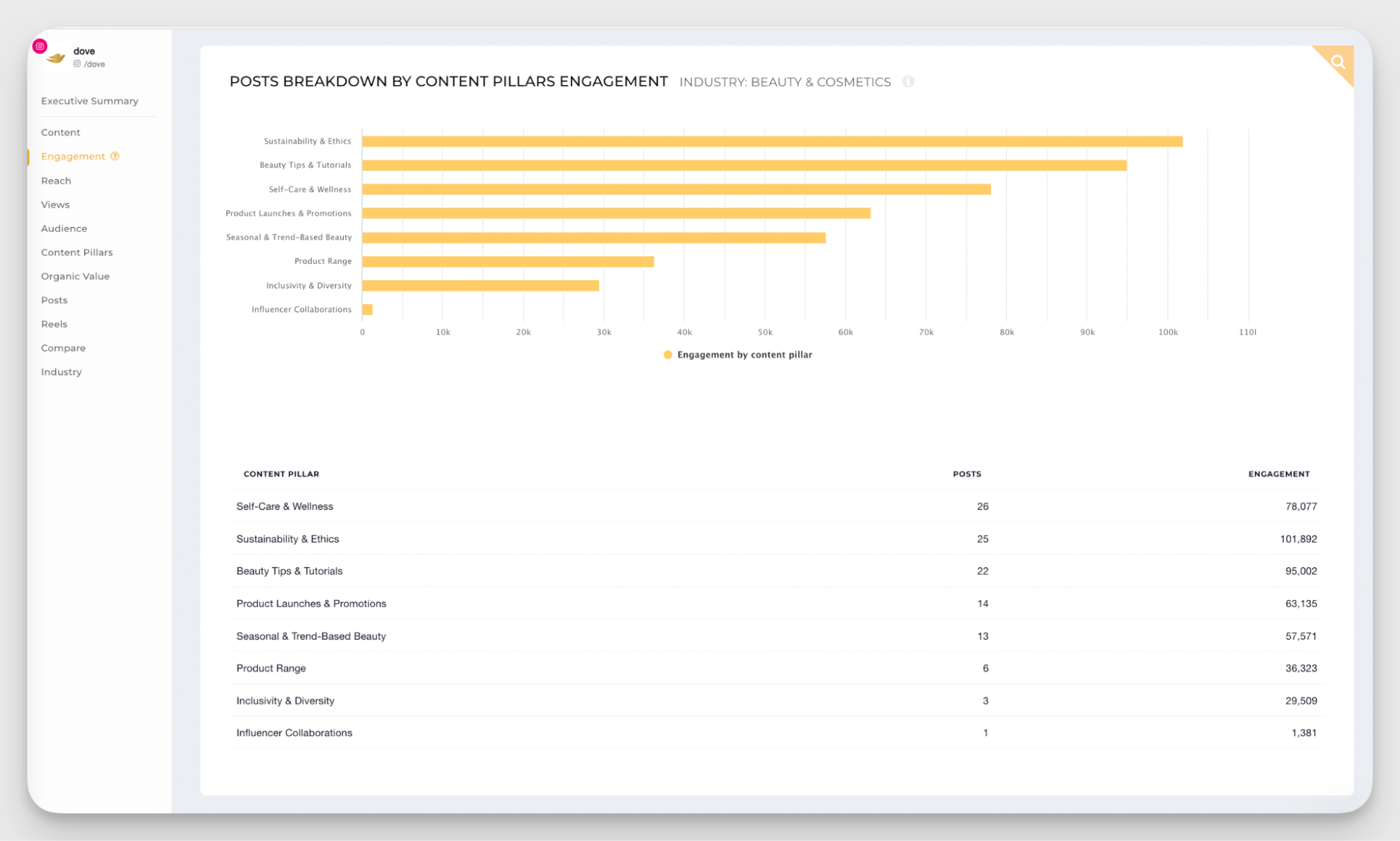
Socialinsider’s AI also shows how many posts fall into each category. For example, Self-care and Wellness has the most posts (26), but it still brings in less engagement than Beauty tips & Tutorials with fewer posts (22).
The cross-platform view confirms that Sustainability & Ethics performs best for Dove across both Instagram and TikTok. Interestingly, Self-care and Wellness climbs to the no.2 spot on TikTok, which changes how I might prioritize it.
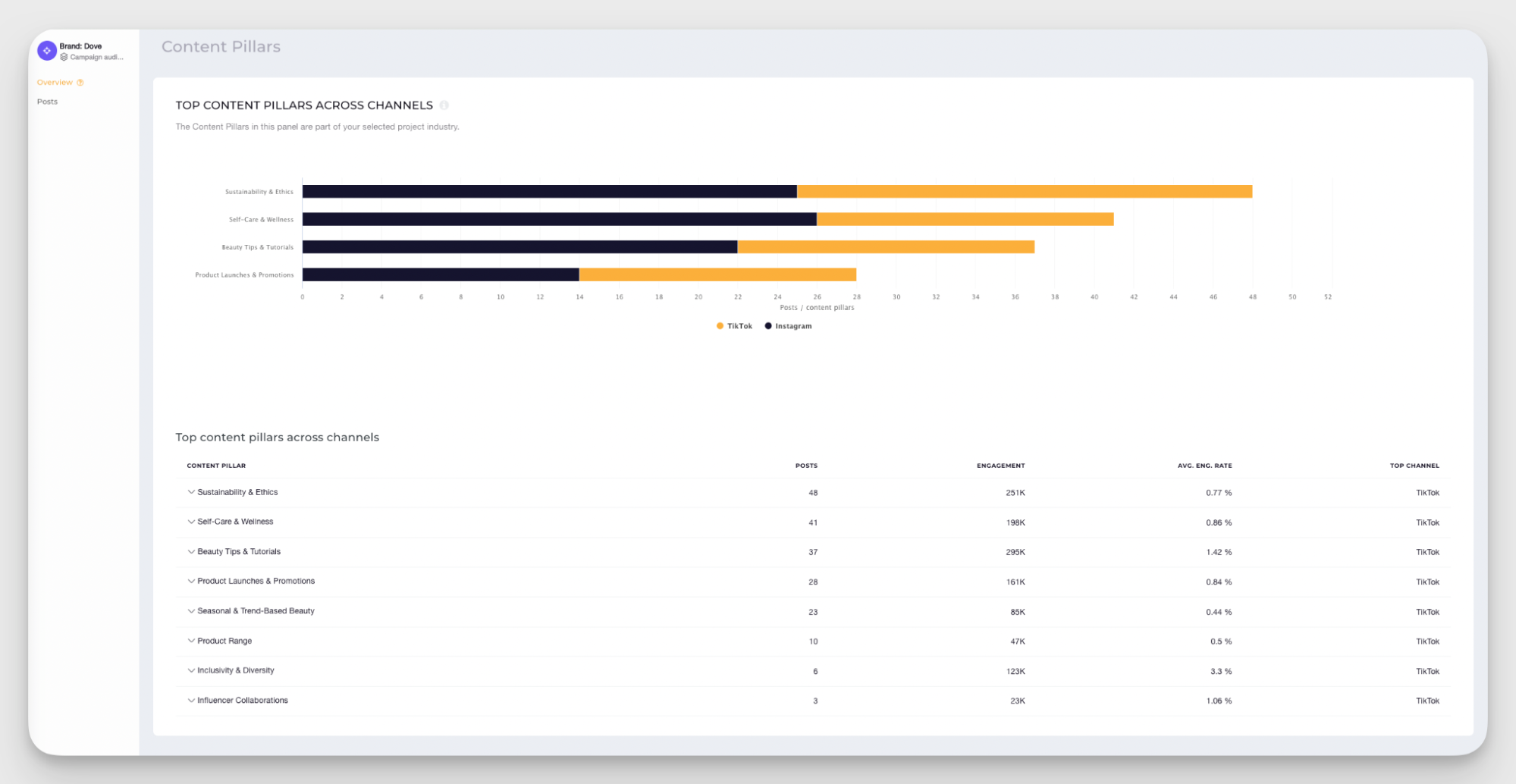
This kind of data gives me a confident top-three set of content pillars to test for my own strategy. Extracting this kind of data manually would be way too time-consuming and nearly not as accurate.
Social media competitive intelligence
- Challenge: Understanding competitor content strategy
- AI solution: Automated content analysis, benchmark tracking
- Results: Strategic positioning insights
Normally, competitor monitoring is a slow process — you’d have to track likes and comments manually and then take a wild guess at each brand’s average reach just to calculate engagement rates. Not fun.
Socialinsider handles all of that for you. And instead of just giving the raw numbers, it also generates an AI-powered Executive Summary that adds context to competitive insights, which is usually the part that takes the longest to do by hand.
For example, I can see that L’Oréal has the biggest audience, but Dove’s audience is more engaged.
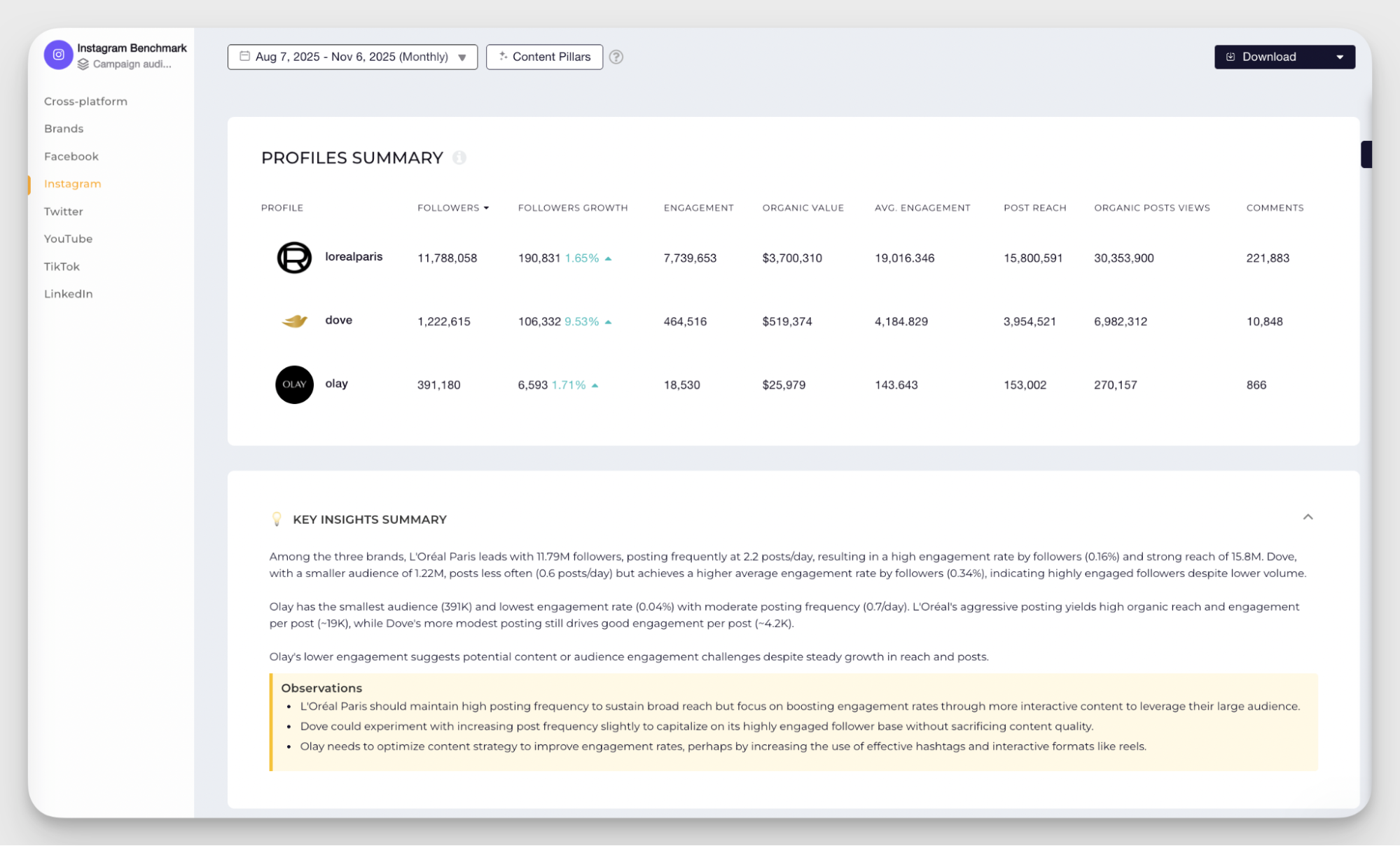
Some of that is simply scale — engagement rate tends to drop when a brand gets very big. But if my goal is stronger engagement, Dove makes a much stronger case. Compared to Dove, Olay also looks bleaker as a benchmark: although it’s the smallest of the three, its engagement is on the lower side.
All three brands share the same top-performing Instagram pillars, but Dove’s results are more consistent.
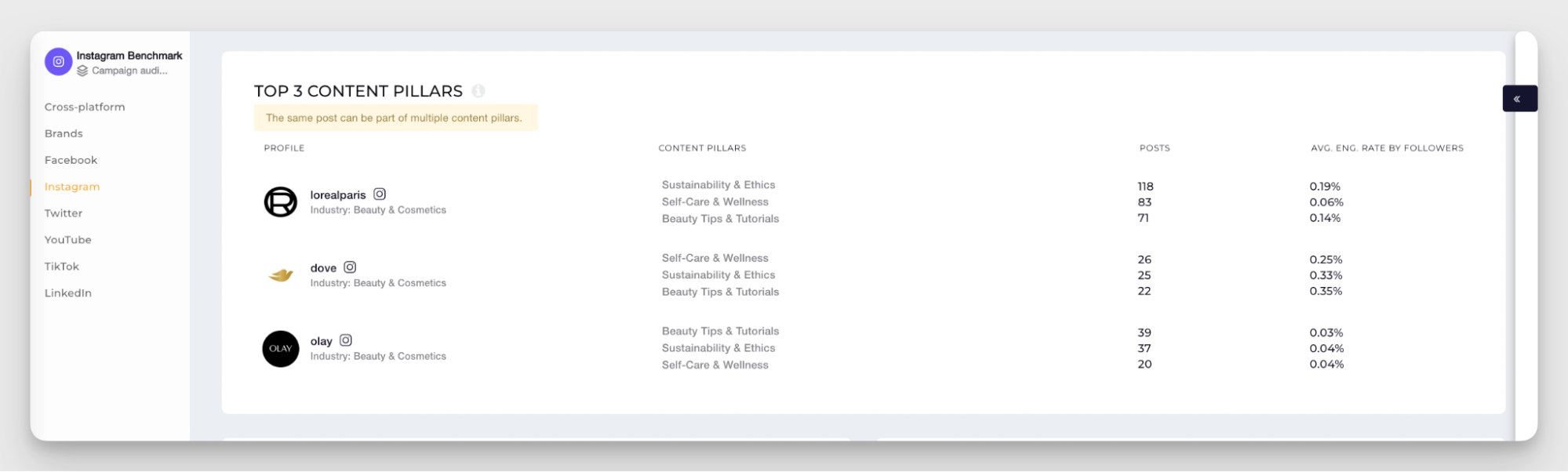
That tells me it’s worth taking a closer look at how Dove structures its posts. I can do this by going into the posts section and scanning for recurring themes, formats, and creative choices.
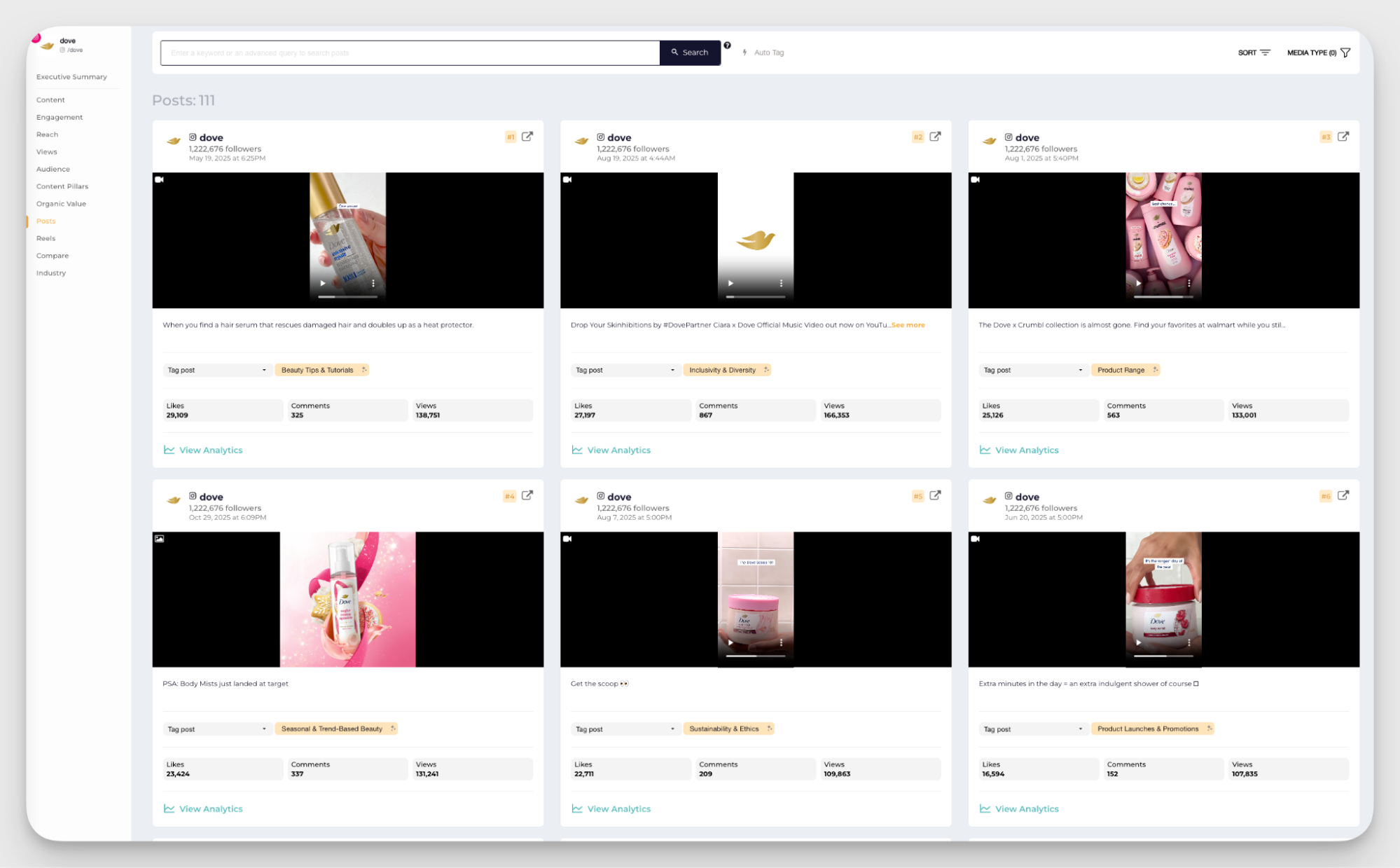
Market trend detection
- Challenge: Staying ahead of industry shifts
- AI solution: Real-time trend monitoring and prediction
- Results: First-mover advantage on emerging opportunities
Identifying emerging trends isn’t easy — that’s why most brands end up following trends rather than setting them. Spotting a small pattern turning into a bigger shift takes time, and humans aren’t great at scanning huge amounts of data for tiny signals.
AI is, though. Pattern detection is where this machine rocks.
Customer retention
- Challenge: Spotting early signs of disengagement
- AI solution: Detecting patterns in social engagement and sentiment
- Result: Users re-engaged before the churn takes power
Retention usually lives in CRM and sales data, and AI can help you catch the upcoming churn signals early.
UK retailer Travis Perkins used AI-powered predictive analytics to review its customer database and behaviour patterns. AI analyzed the whole cycle, from past purchases to engagement, and identified customers who were likely to walk away.
Travis Perkins acted on these predictions. Based on the AI-drive insights, they sent highly personalized messages to each client. Eventually, they reduced their lapsed customer segment and drove a 34% increase in customer lifetime value over 12 months
However, it’s not only sales. Social media can also show the first warning signs.
You might notice that posts aimed at existing customers get fewer comments from familiar usernames. At the same time, sentiment around product-related posts can shift from enthusiastic to more neutral or frustrated.
AI tools help by tracking these changes over time. Instead of checking posts one by one, you can see when engagement patterns start to dip, which topics lose traction, or when reactions slowly cool off.
For example, Socialinsider lets you track comment volume over time, making it easier to spot when conversations start to fade and pinpoint the moment engagement begins to drop.
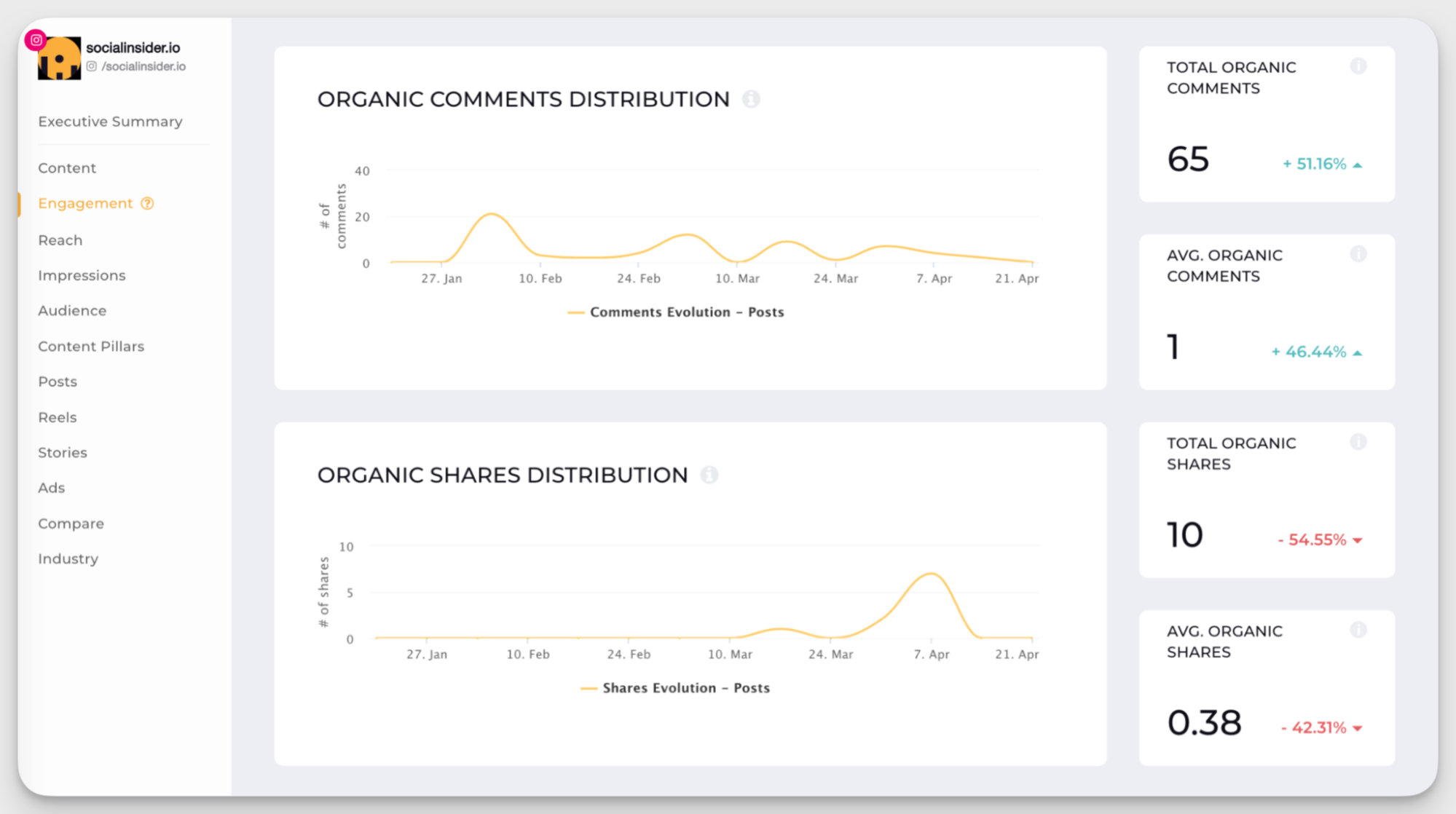
That early visibility gives you a chance to act before a dip in engagement turns into churn.
Common challenges when integrating AI-driven insights and how to overcome them
AI tools are fascinating, but they come with restrictions and challenges if you want to use them for good.
From legal uncertainty to critical analysis of the output, here are some of the most common things to stay aware of when you implement AI insights into your workflow:
Data fragmentation
AI can only work with the data it sees. Each team collects data — social, sales, product, customer support — but if they don’t talk to each other, every group ends up looking at only their fragment.
That separation creates a “data silo.” And it makes it harder for AI to give you a full picture.
The marketing department’s AI sees a drop in engagement. But if it doesn’t know there’s a spike in customer support tickets, it wouldn’t be able to combine this data for a cohesive explanation.
To get reliable insights, try to bring key data sources together. The more complete the view, the more balanced the AI’s interpretation will be.
Ensuring data quality and accuracy
AI makes mistakes, even when your data is clean. But if the data you feed into an AI model is already messy, outdated, or unreliable, the insights will be even further off.
Remember, AI doesn’t have critical thinking — if your data set consistently says “the sky is red,” AI will build its slice of reality based on it.
Before running any analysis, make sure the data is accurate, consistent, and coming from a source you trust. Clean inputs don’t guarantee perfect results, but they dramatically improve how grounded your AI-driven insights will be.
Interpreting complex AI outputs
AI can highlight patterns, correlations, and unusual shifts, but that doesn’t mean it always explains them well. Some outputs are vague, overly technical, or missing the “why” behind the result. Without context, it’s easy to misread an insight or give it more weight than it deserves.
The best way to handle this is to treat AI outputs as clues, not conclusions. AI is artificial for a reason — you’re the real intelligence behind the outputs. Add your own understanding of the brand, audience, and past performance before making a call.
Building trust in AI recommendations
Carolyn Cohen believes there’s still an adoption hurdle when it comes to AI. As she puts it:
People don’t trust AI or feel skeptical — and that’s natural because it’s still new. Until we reach a break point where more people use it daily than not, this will stay a challenge. You’re not just advocating for a tool; you’re advocating for an entire technology system.
If you haven’t noticed by now, I’m also somewhat skeptical about AI. It can make mistakes, the legal landscape is far from clear, and there are still many areas we don’t fully understand.
But even with these gaps, AI can speed up certain parts of the social media workflow. Analytics and insights are areas where AI can genuinely help, as long as you stay aware of its limits.
My personal advice is simple: stay critical of the output. Don’t treat AI-driven insights as final answers. They are helpful clues that point you in the right direction and save you time when working through large data sets.
Balancing automation with human expertise
The concern that always comes up when we talk about AI is whether it replaces human work. It shouldn’t, and it can’t.
Human expertise is imperative for any AI-generated insight. To understand whether an output makes sense, you need to know the ropes yourself and be experienced enough to call it out when something feels off.
Do these two metrics actually correlate? Are two brands comparable if one is much larger or has just went through a PR crisis? Questions like these require judgment.
As Carolyn Cohen explains:
AI is good at analyzing data and showing correlations. It’s not great at telling you what you should do — nor should you expect it to. It can help you make better-informed decisions, but you’re still the one making the decision.
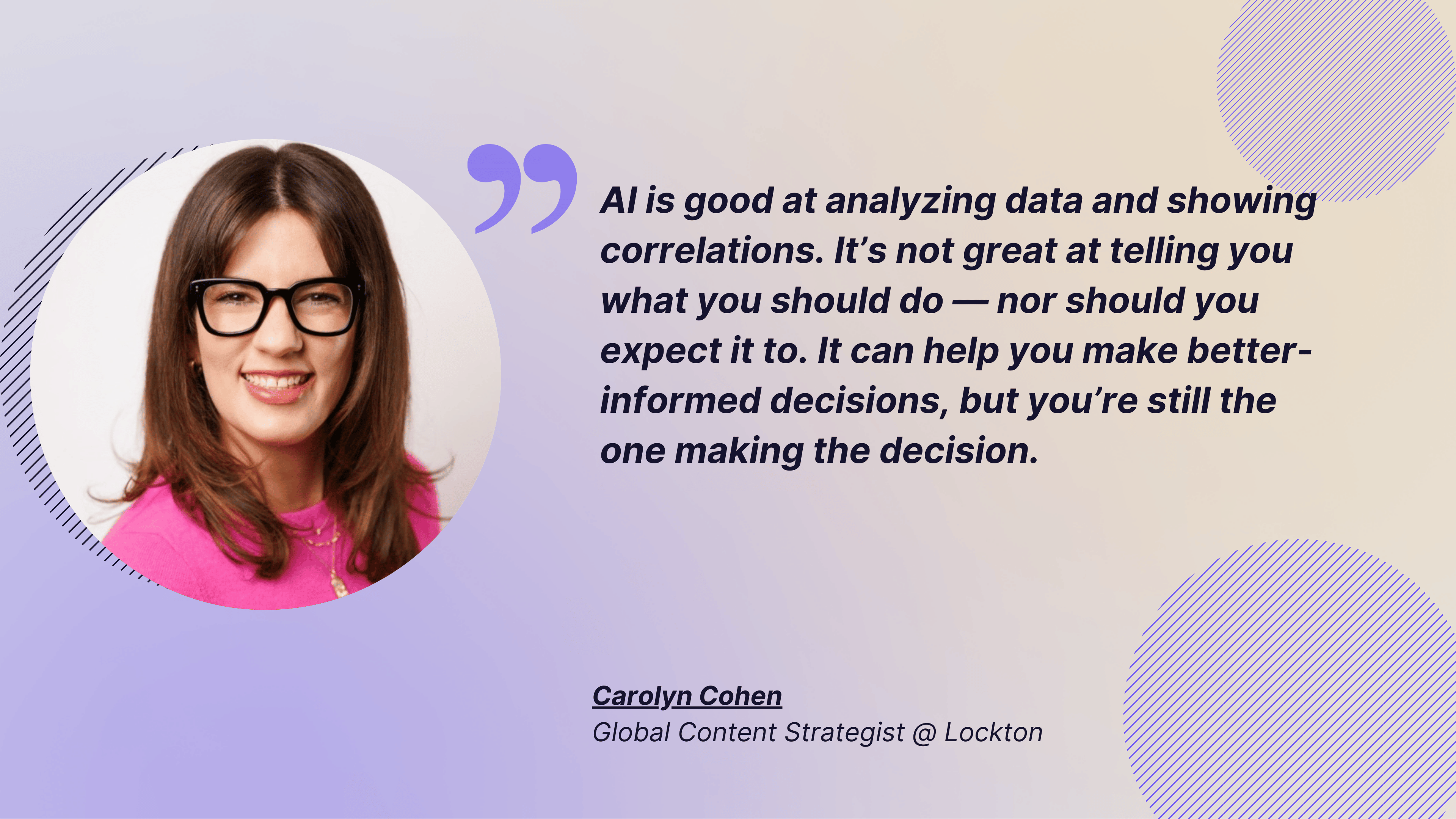
AI speeds up the analysis, but it doesn’t replace the strategist. A human still has to decide what to do with the insight, how much weight to give it, and how it fits into the bigger picture.
Final thoughts
AI-driven insights can genuinely support your strategy when they’re used with intention. They help you keep up with large volumes of data, spot changes as they happen, and move faster without losing sight of what matters.
The key is approach. If you approach AI tools mindfully, with clear goals and human judgment, you gain a helpful supporter instead of a distraction.
Socialinsider’s AI tools help you analyze social media performance faster and more precisely, while keeping final decisions in human hands. Try it with a 14-day free trial and see how it fits into your process!
FAQs on AI-driven insights
How does AI-driven analytics differ from AI-driven insights?
AI-driven analytics focus on collecting, measuring, and organizing data. AI-driven insights go a step further by interpreting that data, highlighting patterns, and suggesting next steps.
How accurate is performance measurement with AI?
AI can be very accurate at spotting patterns and changes at scale, but it’s not flawless. Accuracy depends on data quality, context, and human review to catch nuance and edge cases.
Are AI-driven insights enough to build a social media strategy?
No. AI-driven insights support strategy, but they don’t replace creativity, brand knowledge, or judgment. They help you move faster, not decide what your strategy should be.
Kseniia Volodina
Content marketer with a background in journalism; digital nomad, and tech geek. In love with blogs, storytelling, strategies, and old-school Instagram. If it can be written, I probably wrote it.
Analyze your competitors in seconds
Track & analyze your competitors and get top social media metrics and more!
You might also like



Improve your social media strategy with Socialinsider!
Use in-depth data to measure your social accounts’ performance, analyze competitors, and gain insights to improve your strategy.