How to Develop an AI-Based Content Strategy for Social Media
Learn how to build an AI content strategy that actually performs — from pillar planning and ideation to repurposing and measuring results.

An AI content strategy gives social media teams a repeatable way to use AI for planning, drafting, repurposing, and reporting without handing over strategic control. It works best when AI handles the heavy lifting, while people keep the final say on voice, judgment, and timing.
That matters right now because AI is already part of everyday marketing work. If you are figuring out how to use AI in your content strategy, I'd advise you to start with one workflow, not all at once.
For teams trying to move faster without making content feel generic, this guide shows how to build an AI content strategy that fits a real social workflow, where data, approvals, and brand voice still matter.
Key takeaways
-
An AI-based content strategy goes beyond defining content goals and themes by using AI to accelerate research, creation, testing, and performance analysis while humans retain strategic oversight.
-
Build an AI content strategy by setting a clear objective, auditing performance, creating data-driven content pillars, using AI for ideation and repurposing, and continuously measuring AI-assisted versus human-created content.
-
The biggest AI content strategy mistakes are adopting AI without clear goals, over-automating brand decisions, failing to measure results, and allowing AI-generated content to become repetitive or generic.
What is an AI content strategy?
An AI content strategy is a planned way to use artificial intelligence across the content lifecycle. For social media teams, that means using AI to find patterns, generate options, speed up drafting, and organize reporting so the team can make better decisions faster.
The important part is that AI supports the strategy instead of replacing it. In practice, AI helps you decide what to post, how to adapt it for each platform, and which results matter, but the brand still sets the message, the audience, and the standard for quality.
According to Socialinsider’s AI adoption survey, nearly 70% of marketers use AI for content and caption creation, which shows how quickly content creation with AI has become normal.

A simple definition for social media teams
For a social team, an AI content strategy is a workflow that connects four jobs:
- Research what is already working.
- Draft faster with AI-powered content creation.
- Repurpose AI-powered content across formats.
- Measure whether the output is better, worse, or simply faster.
That makes the process practical, not theoretical. It turns content strategy and AI into a repeatable system instead of a pile of disconnected prompts.
A useful test is simple: if AI helps you save time, identify stronger ideas, or improve social media analytics without weakening brand voice, it belongs in the workflow. If AI creates more review work than it removes, the setup is too broad.
How does this differ from a general content strategy?
General content strategy usually focuses on themes, channels, and business goals. An AI-powered content strategy adds a second layer: it uses machines to accelerate research, drafting, testing, and analysis.
That difference matters because social media moves faster than many other content channels. A blog calendar can be planned a month ahead. A social media content strategy often needs same-day adaptation, especially when a trend, a competitor post, or a platform shift changes the context.
In other words, AI in content strategy is not just about writing. It is about helping teams react, compare, and refine with less manual work. The most useful AI-powered content strategy framework is the one that fits how your team already plans and reports, not the one that forces a completely new operating model.
How to build an AI content strategy for social media?
The best AI content strategy starts with one clear goal, a content audit, and a small set of tasks that AI can improve immediately. From there, you build content pillars, create drafts, repurpose what performs, and measure the difference between AI-assisted and human content.
A strong AI content marketing strategy starts with intention, not tools. When the goal is clear, AI becomes a practical helper instead of another source of noise.
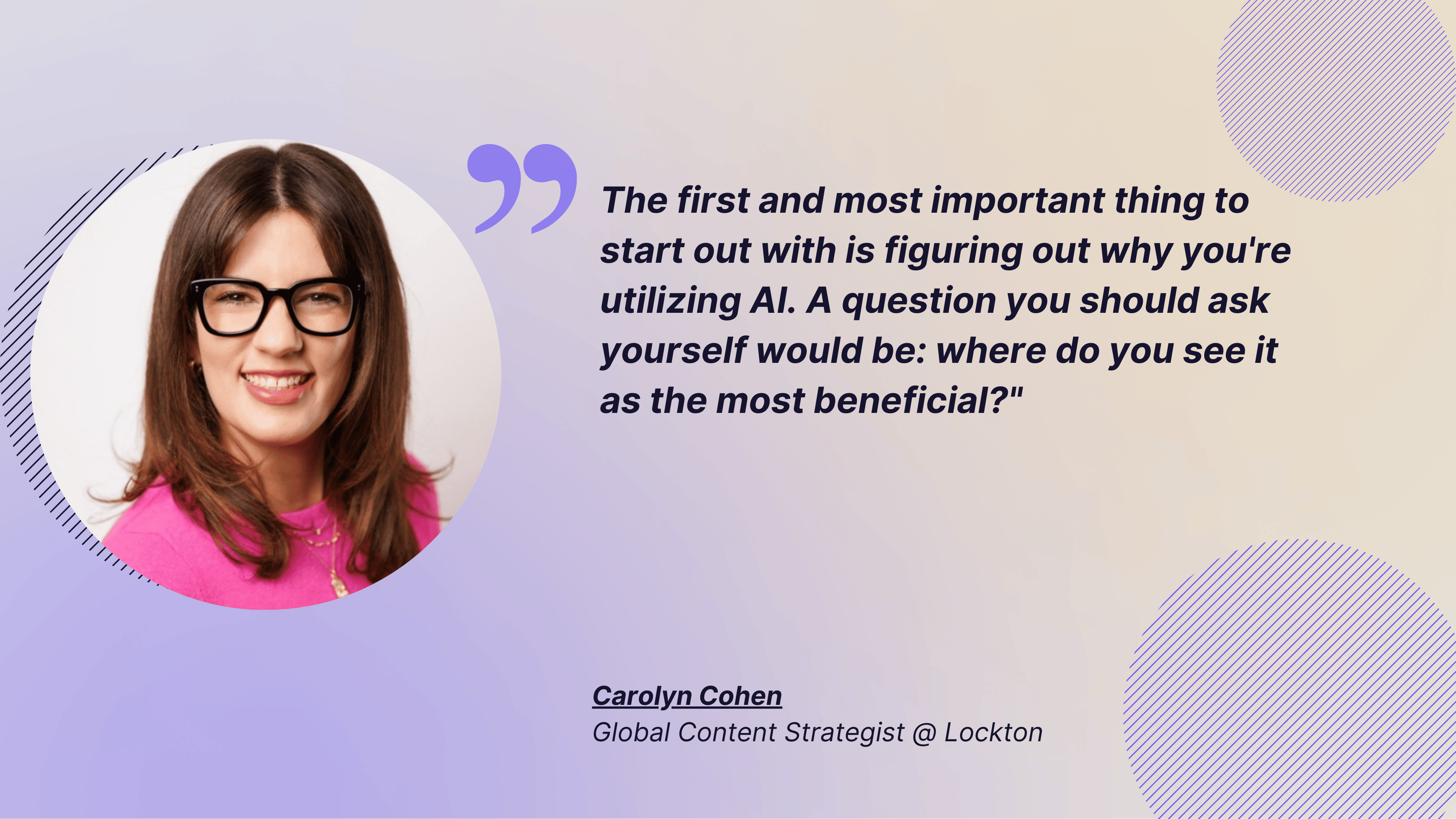
As Carolyn Cohen, Global Content Strategist at Lockton, said:
I think the first and most important thing to start out with is figuring out why you're utilizing AI. As in really knowing if you'll use it to create content more efficiently, or more quickly, or have better SEO results, or have more research and data on your audiences. A question you should ask yourself would be: where do you see it as the most beneficial?
Step 1: Use AI to audit your existing content performance
Start by asking what is already working, what is slowing the team down, and what needs a faster review cycle. An AI audit should give you a baseline, not a vague summary.
In Socialinsider, the Key Insights Summary is useful because it turns a dense set of metrics into a readable list of observations. That helps teams move from “we have data” to “we know what to do next.

Step 2: Build your content pillars with AI-assisted research
Content pillars give your AI-driven content strategy a structure. They help you decide which themes deserve repeated treatment, which formats fit each theme, and which topics should be retired.
A strong way to build them is to combine your own performance data with competitor patterns. That is where social media benchmarking becomes useful, because AI can surface repeated themes across brands faster than a manual review can.
Socialinsider’s AI-based content pillars view helps by grouping posts into themes, so you can see which pillars actually carry weight across platforms. The point is not to copy competitors. The point is to see which themes repeatedly earn attention, then shape your own angle around them.

Step 3: AI-assisted ideation - from brief to batch
AI is most useful in ideation when it turns a blank page into a structured set of options. That makes the early stage of a generative AI content strategy much easier to manage, especially when the team needs volume without losing direction.
A practical process looks like this:
- Feed AI the goal, audience, and content pillar.
- Ask for five angles, not one.
- Ask for hooks, not full posts first.
- Review for brand fit before writing the full draft.
- Batch the strongest ideas into a content calendar.
If you are asking how to use AI for content creation, start with hooks, outlines, captions, and variations.
AI for social media marketing is great because, beyond creatives, it can also help you with trend inputs, even before your team learns about emerging trends.
Step 4: Repurposing at scale — one post, many formats
Repurposing is where AI-powered content can create the biggest time savings. A strong idea should not live in one format if the message can be adapted for different platforms and audiences.
Think of repurposing as translation, not duplication. A post that performs on LinkedIn can become a short Reel or a carousel outline. It is about reusing what already proved to be worth attention, then adapting it for each channel with less manual work.
This is also where Socialinsider’s MCP capabilities become helpful in a real workflow.

And here's Carolyn's takeaway as well:
Personally, I use AI to create content more efficiently and really create a volume of content at scale. I think that's where a lot of marketers are very interested because that's something that takes a lot of time and a lot of people.
Step 5: Measuring AI-generated Vs. human content performance
If AI saves time but weakens performance, the strategy needs adjustment. The only way to know is to compare AI-assisted posts with human-created posts using the same metrics and the same test window.
Measuring the success of an AI content strategy means comparing like with like. Keep the content pillar, platform, and posting window consistent, then watch the difference in output.
Start by tagging your content. In Socialinsider, tagging lets teams label posts as AI or human, then compare results across pillars, formats, and platforms.

Then compare metrics that show both reach and quality:
- Engagement rate
- Views
- Comments
- Shares
- Saves
Two to four weeks is usually too short for a final verdict, so many teams test for one full content cycle before changing direction.
A simple comparison table helps:
Once the comparison is tagged, you can spot AI content strategy optimization opportunities that aggregate reports hide. A team might find that AI-assisted captions match human performance, while AI video scripts underperform. That creates a clear testing path instead of a vague opinion.
The goal is not to prove that AI is always better. The goal is to learn where AI adds speed, where human editing still wins, and where the best result comes from both.
Running the final draft through an AI checker before publishing can also help teams identify content that may need additional human editing to better align with their brand voice and quality standards.
Common mistakes in AI content strategies
The most common mistakes in AI content strategy come from speed without structure. Teams get quick drafts, but not clear decisions, and the workflow ends up feeling busier instead of better.
- One mistake is using AI before setting a goal. If AI is asked to “help with social media,” the output will be broad, generic, and hard to measure.
- Another mistake is automating brand judgment. AI can draft captions, but it should not choose crisis language, sensitive topics, or final messaging on its own.
- A third mistake is skipping measurement. Many teams test AI-driven content creation, but they never tag the content or compare it against human posts. Without that step, the team cannot tell whether AI is actually improving the workflow.
- Finally, do not let AI flatten the content mix. A strong AI-powered content strategy still needs variety, including educational posts, community posts, trend-based posts, and promotional posts. If every caption sounds similar, the audience will notice.
The best fix is a simple guardrail:
- Automate first drafts, research, and tagging.
- Keep humans on tone, judgment, and final approval.
- Measure one content cycle at a time.
- Change one variable before changing the whole workflow.
That is the cleanest path to AI content strategy best practices that actually hold up in a busy team. It also keeps the AI in content creation workflow useful instead of noisy.
Final Thoughts
An effective AI content strategy is not about posting more for the sake of it. It is about using AI to make social media work clearer, faster, and easier to manage, while keeping the final judgment with the team.
Start with one content pillar, one platform, and one comparison test. Tag the posts, review the engagement rate, and note where AI saves time without weakening performance. That gives you a practical baseline for content strategy AI work, not just a new set of prompts.
If your team still spends too much time stitching together screenshots, spreadsheets, and manual reports, the next step is to make the workflow more visible before you automate more of it. That is usually where the quickest win appears.
Need a practical place to begin? Audit one month of posts, tag AI-assisted content, and compare the results with human content. Many teams use Socialinsider for that first pass because benchmarking, tagging, and reporting live in the same workflow, which makes the comparison easier to explain to a manager or board.
FAQs on AI content strategy
Why should social media leaders build an AI-based content strategy?
Marketers should build an AI-based content strategy because social teams are expected to do more with fewer hours. According to SurveyMonkey, 88% of marketers now use AI in their daily work, and CoSchedule says 85% use AI tools for content creation or writing. The real benefit is faster research, quicker drafting, and clearer reporting.

Elena Cucu
As Content & SEO Manager at Socialinsider, Elena Cucu helps social media leaders make sense of the numbers behind their performance. Featured in TechCrunch, TNW, and ReadWrite.

Know what your competitors do — before your manager asks
Get instant social benchmarks & reports without manual work.