A 3-Step Framework for Running an AI Competitive Analysis for Social Media
Elevate your social strategy through an AI for competitive analysis. Learn how to use AI to access critical insights and outperform competitors.


AI makes competitive analysis faster, more accessible, and easier to turn into action. Imagine that instead of manually comparing the competitor data and searching for underlying motives, you ask an AI trained on said data to highlight the pattern you’ve been missing. That doesn’t mean AI replaces strategic thinking. It does what it does best: recognizing patterns.
AI spots trends, breaks down performance shifts, and models scenarios in real time, making it easier to use competitors’ insights every day.
In this guide, I’ll walk you through how AI in social media is transforming competitive research, how to build a practical workflow around it, and where it makes sense to use it.
Key takeaways
-
How is AI transforming the process of running a competitive analysis? AI turns competitive analysis from a slow, periodic task into a fast, on-demand process by helping marketers quickly analyze large datasets, spot patterns, and turn insights into actionable decisions.
-
How does AI help with an effective competitive analysis in practice?
In practice, AI makes competitive analysis more useful by letting you ask direct questions about reliable performance data and instantly get clear explanations, benchmarks, and test ideas. -
How to set up an AI competitive analysis process for social media?
An effective AI competitive analysis workflow starts with clear objectives and competitors, then combines reliable data, the right AI assistant, and continuous testing to turn insights into repeatable strategy improvements. -
Common AI competitive analysis use cases: AI is most valuable in competitive analysis when you need to understand why competitors succeed, identify positioning gaps, or forecast performance using patterns from large amounts of social media data.
How is AI transforming the process of running a competitive analysis?
Competitor research is a vital step in improving your social media strategy. You look at what others are doing to spot gaps, benchmark performance, and answer questions you can’t solve by looking at your own data alone.
But even with tools in place, competitive analysis often becomes a separate task you run once a month or once a quarter. And social media doesn’t wait for you to finish your analysis and only then come up with new updates.
I’ll be frank: I’m not a fan of forcing AI into every step of the workflow. But when it comes to using AI in social media analytics, spotting patterns and making sense of large sets of data, especially in a timely manner, it fits in rather naturally.
At its core, competitor research is about analyzing data, identifying patterns, and understanding what drives performance. That’s exactly the kind of task AI handles well, as long as the data behind it is solid.
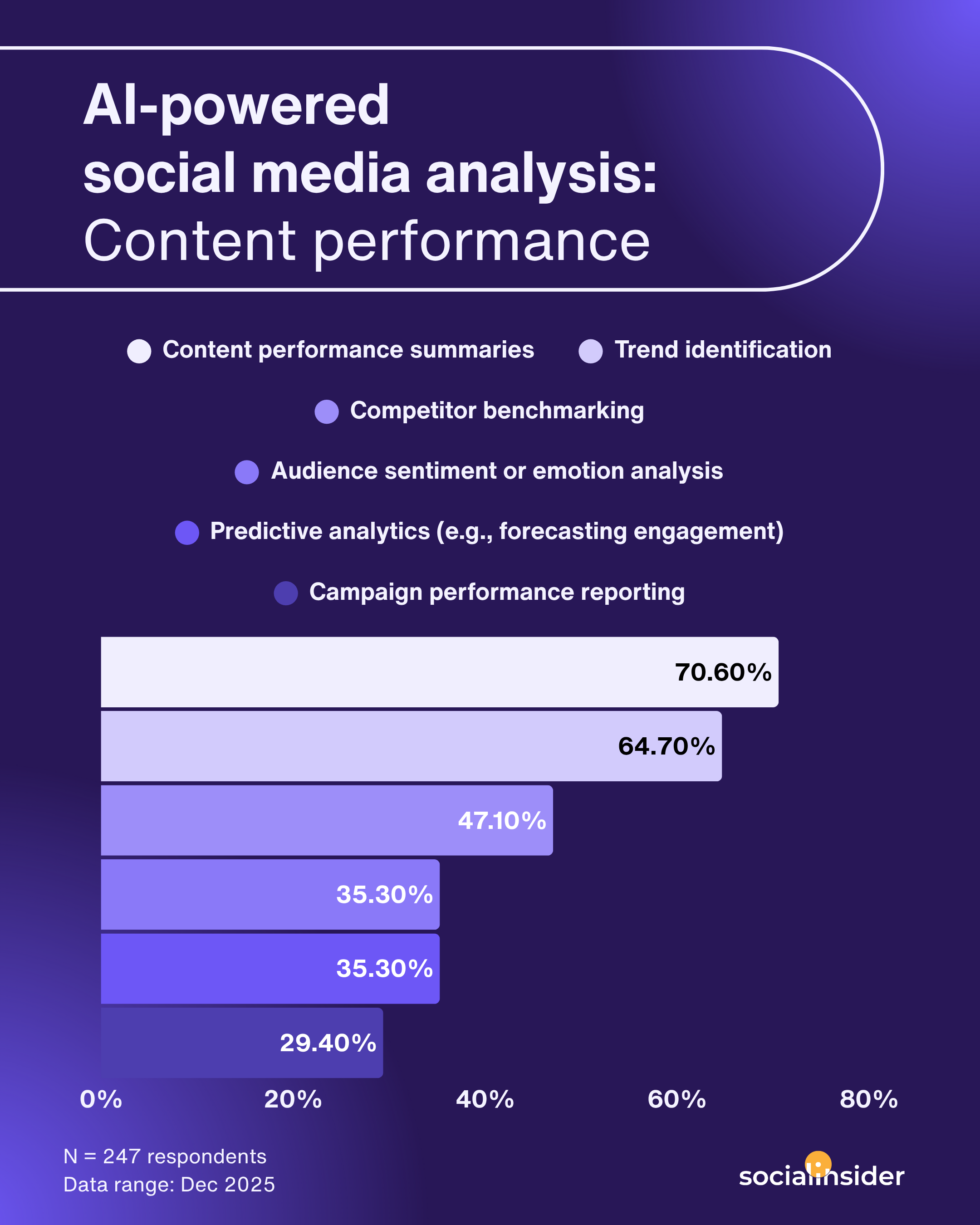
In practice, adding AI to your competitive research workflow helps you:
- Analyze competitor strategies faster. Go through large volumes of content and performance data in minutes instead of hours.
- Benchmark your performance clearly. Compare your results with competitors or industry standards to understand where you stand.
- Understand performance changes. Break down spikes or drops and identify what’s driving them.
- Ask questions and get direct answers. Skip manual digging and get insights by querying your data directly.
- Identify what to test next. Spot patterns in competitor success and turn them into test ideas for your own strategy.
- Act on insights. Convert findings into small, concrete steps instead of broad or unclear conclusions.
How does AI help with an effective competitive analysis in practice?
Running a competitive analysis with AI only works if the data behind it is reliable. That’s why, besides the AI assistant itself, you need the dataset it will base its answers on.
Socialinsider AI Assistant delivers exactly this.
So imagine a familiar ChatGPT or Claude, but it runs on your specific social media metrics and is built specifically to answer social media-related questions.
The AI Assistant combines Socialinsider’s proven competitor data with an AI layer that builds on top of it and helps you interact with the data in a more direct way.
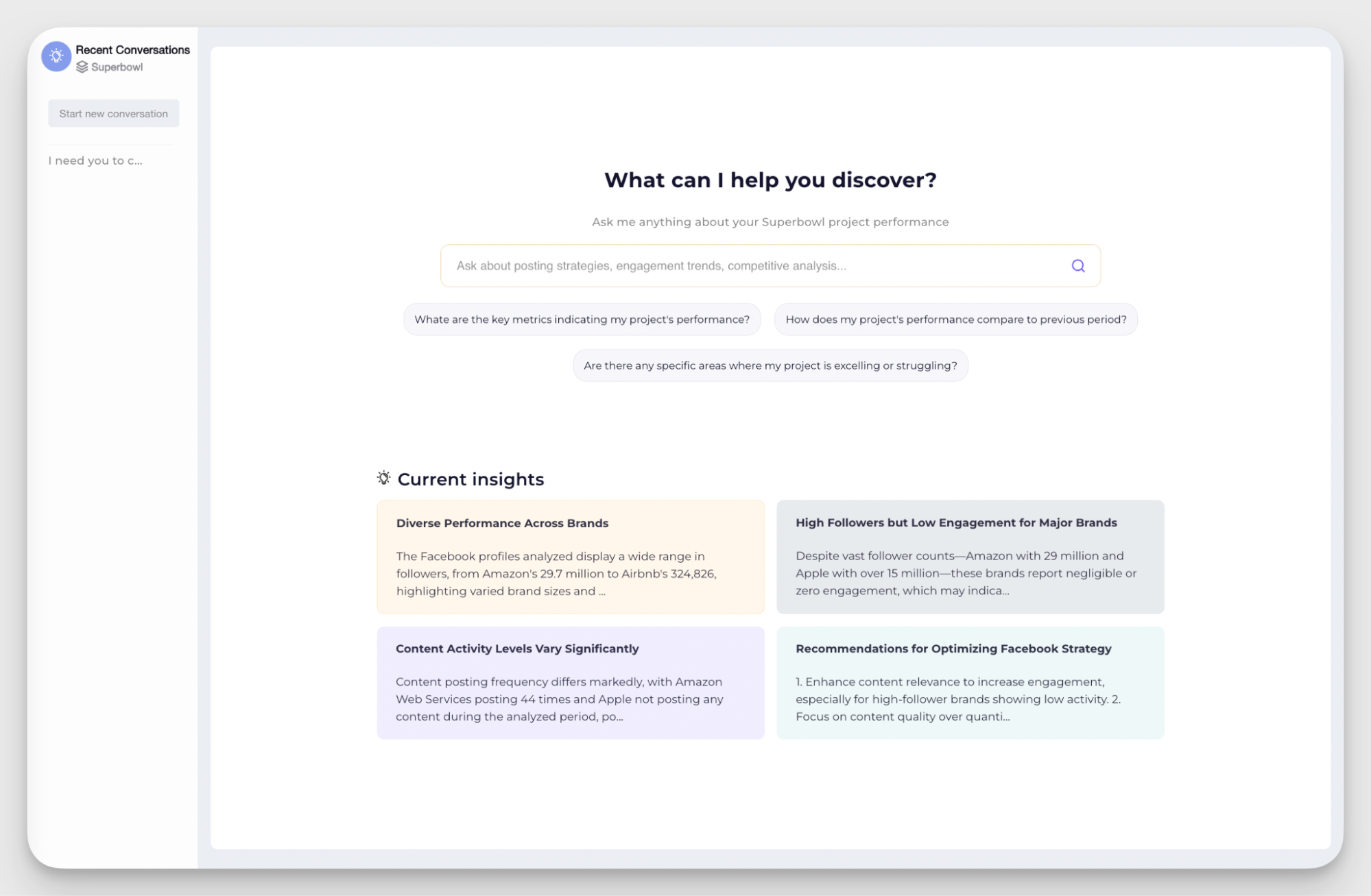
You can ask it things like:
- Why is my engagement rate lower than that of a specific competitor?
- What should we test to lift saves by 20%?
- What changed last week across our competitors’ channels?
- What creative angles are driving the best results this quarter? Turn those into testable ideas
In this case, an AI Assistant doesn’t replace an insightful competitive analysis, but makes it faster and more ad-hoc. If your performance dips while a competitor suddenly skyrockets, you can skip the report-building phase and go straight into asking questions.
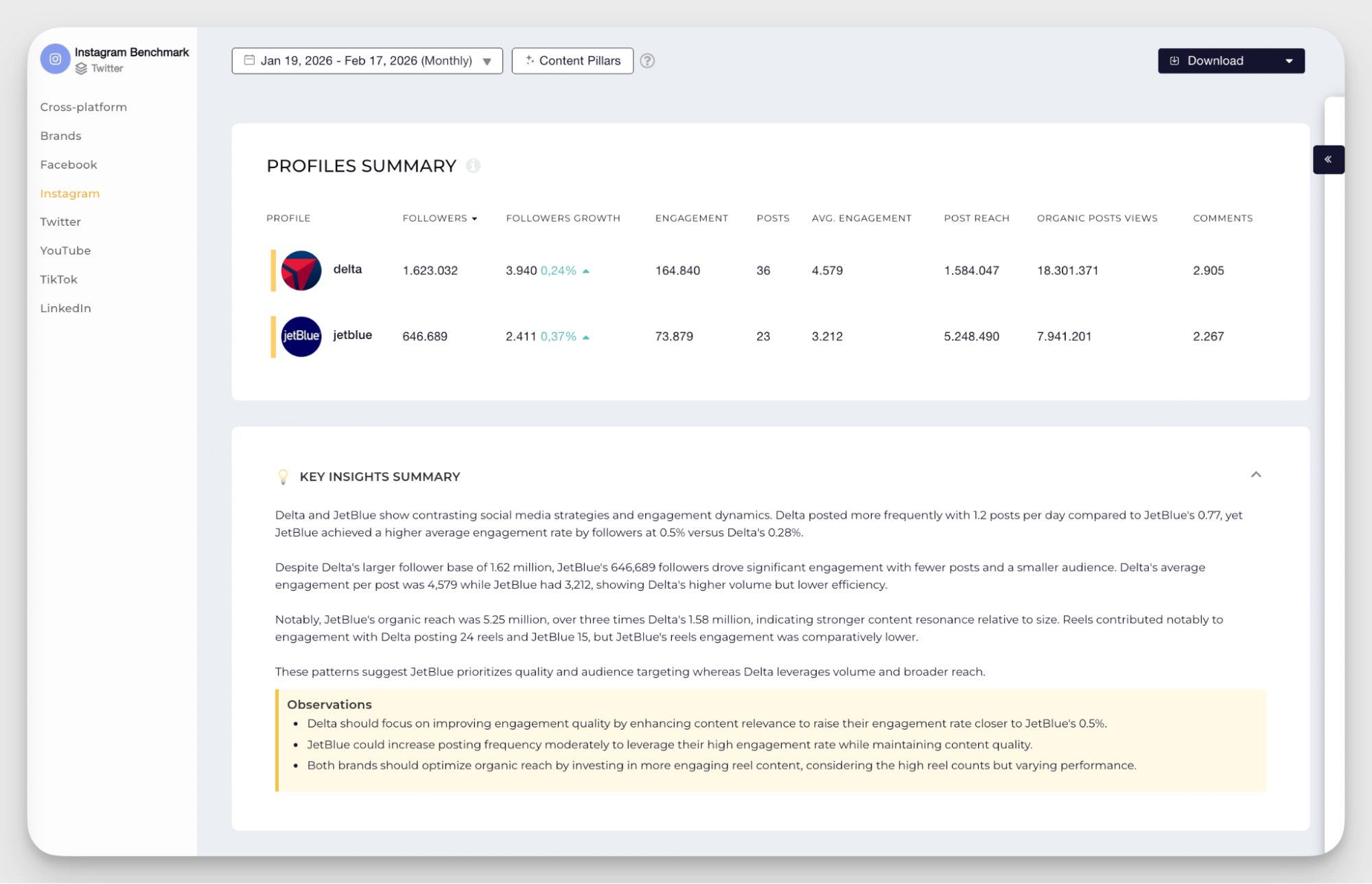
And if your boss suddenly asks for a high-level overview of your benchmarks, you can use the AI-generated executive summary, which highlights the most important points in the benchmarking section, so you can have a rapid snapshot of where your brand stands compared to competitors.
How to set up an AI competitive analysis process for social media?
AI speeds things up, but you first need something to accelerate. So I always begin with mapping out a reliable, comfortable process that helps me ask the right questions and get consistent insights.
Here’s how to build a simple, repeatable workflow for AI-powered competitive analysis.
Define your objectives and competitors
The first step in any competitive research process is simple: define what you want to know and who you want to analyze.
Your competitors usually fall into three main categories:
- Direct competitors. Brands in your space with similar products, targeting the same audience
- Indirect competitors. Brands that don’t sell the same thing but still compete for your audience’s attention
- Aspirational brands. Brands outside your niche that are doing social media really well and are worth learning from
Each group gives you a different type of insight, so it’s worth including all three.
Once that’s clear, you need to define your objective. What are you trying to understand? Here are three of the most common ones I use:
Content performance analysis
Content analysis is the most common type of competitor research, and it works across all three competitor groups.
I usually run this when I need content ideas, want to test new approaches, or understand what resonates outside my own audience.
This type of analysis looks at both:
- What competitors post (formats, topics, angles)
- How that content performs (engagement, reach, interactions)
Socialinsider helps automate this through its AI-based content pillars analysis. It detects top-performing content themes across competitors and shows their engagement benchmarks.
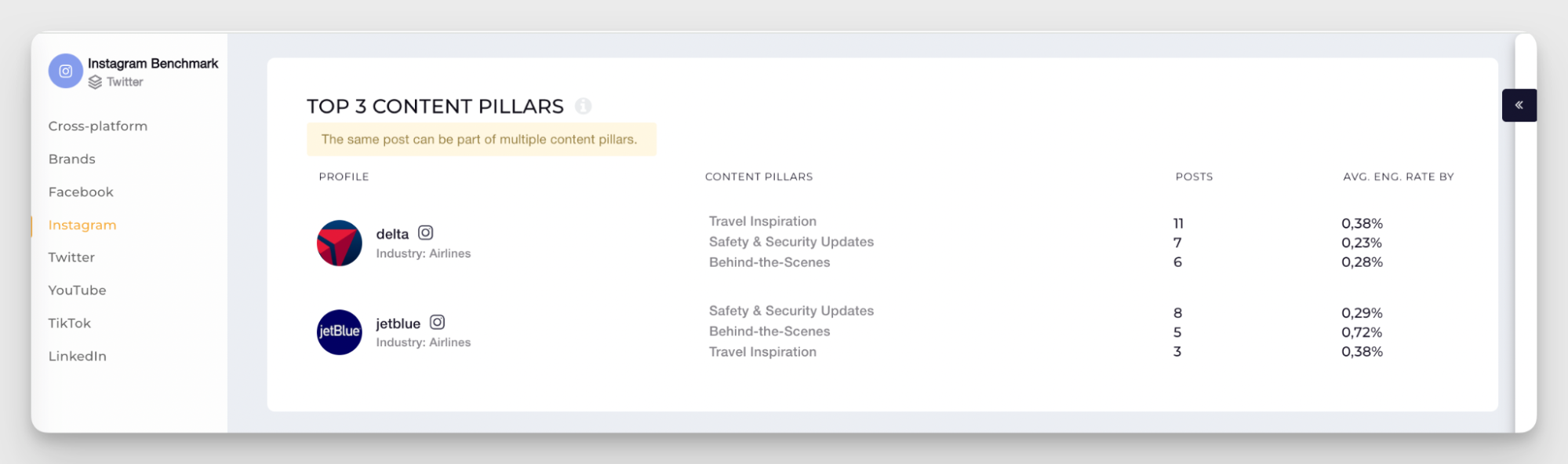
This gives you a quick overview of what works, where you might be missing opportunities, and where it’s worth digging deeper.
Campaign strategy identification
This type of research focuses on how competitors approach specific social media campaigns. Think product launches, seasonal campaigns, or events like Black Friday.
Analyzing competitors’ campaigns reminds me of reverse engineering: you’re seeing the results, and you need to backtrack the thought process behind them. I usually run this when I want to understand:
- How the campaign was structured
- What formats were used
- How often did they post
- Whether the campaign performed well
It’s useful both for inspiration and for reality checks. Looking at performance alongside structure helps you avoid implementing things that didn’t work.
Trend prediction and forecasting
This one is about spotting patterns early and using them to guide your next moves.
Early bird gets the worm, and it’s true for early trend adopters, too. Instead of reacting to what already worked, you look for signals that something is starting to gain traction.
Trend analysis can include:
- Recurring content formats across multiple competitors. Maybe all your competitors are switching to PDF carousels on LinkedIn, and this is the main engagement driver?
- Sudden spikes in engagement around specific topics. A new meme is on the rise in your field, and you’d want to be the one jumping on that trend before everyone else does.
- Shifts in posting frequency or platform focus. If some of your competitors are migrating to TikTok from Instagram, it can be very beneficial to do so sooner rather than later, before the audience is divided and conquered.
AI helps here by scanning large volumes of data and highlighting patterns that are easy to miss manually. You can use these insights to test trends before they peak ot prioritize formats or topics that are gaining momentum.
Choose the right assistant
Not all AI assistants work the same way, especially when it comes to consistent competitor monitoring.
If your team already uses Claude or ChatGPT, the natural first step is to utilize the agents you already have to analyze the competitor data. And it’s a valid way to test out the concept and see what kind of insights are available.
However, in my opinion, Claude, ChatGPT, or Grok are a temporary solution to competitor analysis. Their context windows are limited, making ongoing analysis harder. Besides, you’d still need to manually gather, clean, and upload competitor data every time you want to run an analysis.
So teams lean toward AI assistants that are built directly into analytics platforms.
Socialinsider AI Assistant is one of these solutions. Built on top of proven competitor data and knee-deep in your own performance metrics, Socialinsider AI Assistant is a great fit for:
- Marketers who need fast answers without digging through spreadsheets. You can go from question to insight without manual prep work
- Teams that want consistent analysis across platforms. The data is already structured, so insights are easier to compare and reuse
Eventually, the AI assistant you choose should help you get consistent insights faster and remain a sustainable part of your process.
Test the recommendations and analyze results
AI can give you fast answers and solid suggestions. But a big part of making AI work in your workflow is staying critical about what it gives you.
I like to approach AI outputs in competitor research and general analytics overviews as starting points instead of directives.
Datasets are important, but so is your context. AI doesn’t know your internal constraints, priorities, or audience nuances. If AI suggests something that doesn’t fit your reality, like doubling down on a platform you don’t use, take a step back.
Pro tip: Turn AI suggestions into small experiments first. A/B test content ideas and formats, try different hooks or designs, and compare results against past performance.
These tiny shifts in implementation help validate whether the insights are, in fact, helpful instead of following them blindly.
Common AI competitive analysis use cases
You don’t need to use AI in every part of your analytical workflow. But there are a few situations where it really makes sense.
Mostly, these are the cases where you’re trying to understand why something worked or what to do next.
Here are three common use cases for AI in competitor research.
Reverse-engineering competitor campaign strategies
Imagine you’re working for a skincare brand. One of your competitors launches a new product — say, a vitamin C serum.
Within a week, their Instagram engagement doubles, and their TikTok videos get significantly more views than usual. You want to understand what they did to achieve that and possibly repeat some of this success in your own product launch. To do so, you analyze their content.
Instead of manually scrolling through weeks of content, you gather the performance data in a dataset (Socialinsider can get you all the posts with performance metrics) and use AI to break it down:
- You see that they posted daily short-form videos for 10 days before launch
- Most videos follow a “problem → solution” hook (dull skin → brightening serum)
- They reused the same 3 creators across multiple posts
- Their highest-performing posts are UGC-style demos
These insights help you see the phases, strong formats, and approaches that landed nicely. You can resume some of the elements of this structure in your own launch instead of starting from scratch.
Finding your competitive positioning gap
Sometimes, when you see your competitor performing better, you can’t help but wonder: what are they doing differently?
They post about skincare, you post about skincare. You promote similar products. But your content looks and feels different.
These positioning differences are easy to overlook when you’re analyzing content manually. AI can help you analyze your content against competitors’ posts to highlight the game-changers.
It can be that they use more visual hooks — “brighter skin in 7 days” — instead of deep-diving into ingredients. It can be heavy UGC or review-oriented content that brings in more social proof. It can be as easy as targeting additional audiences you didn’t consider before.
Performance forecasting
Forecasting performance manually is tricky.
You can look at past metrics, calculate averages, and maybe factor in campaign periods. But once things get slightly irregular, projections get messier.
Since AI can process larger datasets quickly, it’s better at building projections based on patterns across both your performance and your competitors’. It won’t predict the future with certainty, but it can help you model possible outcomes.
The approach I personally like to take is to ask AI to build three possible scenarios based on both your data and your competitors’ trends: positive, negative, and realistic.
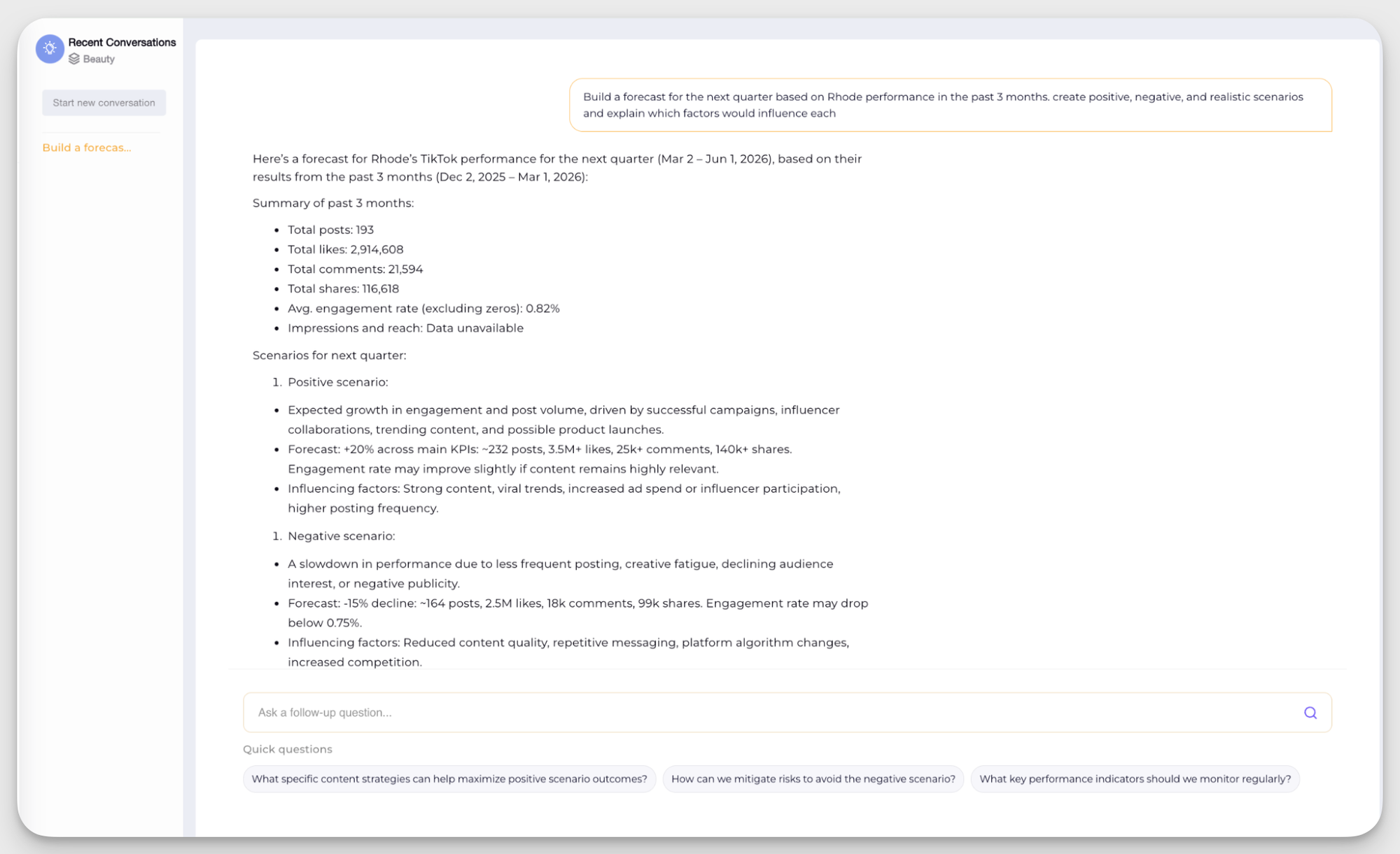
Competitors are an important factor influencing your performance, the content you post, and the KPIs you set. So keeping multiple scenarios in mind can help you stay competitive and ready to change your game if needed.
These projections are mighty helpful for planning meetings and stakeholder presentations.
Final thoughts
You don’t have to use AI in all of your analytics tasks.
But when it comes to competitor research, it helps remove the most tedious parts. You get answers faster, move from quarterly check-ins to ongoing monitoring, and turn scattered insights into a structured benchmark you can use every day.
Just remember: your results are only as good as your data.
Socialinsider is built on solid competitor research, and its AI Assistant uses this data to help you extract insights without digging through spreadsheets. Try Socialinsider yourself — first 14 days are on us.
Kseniia Volodina
Content marketer with a background in journalism; digital nomad, and tech geek. In love with blogs, storytelling, strategies, and old-school Instagram. If it can be written, I probably wrote it.
Know what your competitors do — before your manager asks
Get instant social benchmarks & reports without manual work.
You might also like


Improve your social media strategy with Socialinsider!
Use in-depth data to measure your social accounts’ performance, analyze competitors, and gain insights to improve your strategy.