7 Top Influencer Analytics Tools: Features, Pricing & Reviews
Discover top influencer analytics tools to track performance, analyze audience demographics, and optimize influencer marketing campaigns.

Influencer marketing looks simple from the outside.
Find a creator. Send a brief. Launch the post. Watch the numbers roll in.
But if you’ve ever run a campaign yourself, you know it’s rarely that clean.
Without the right data, influencer marketing quickly turns into chaos: fake engagement, unclear audience quality, and no real visibility into conversions.
That’s where influencer analytics tools change everything, helping you make the switch from guessing to making profitable influencer marketing decisions.
They show you real audience quality, true engagement, and actual conversions. So you can choose better partners, protect your budget, and scale influencer marketing with confidence.
In this guide, I’ll break down the tools that actually help you make better decisions.
Let’s get into it.
Key takeaways
-
How do influencer analytics tools differ from influencer management tools? Influencer analytics tools focus on measuring creator performance and audience insights, while influencer management tools are designed to handle campaign workflows, communication, and relationship management with creators.
-
Why are influencer management tools and influencer analytics tools complementary? Influencer analytics tools help you understand which creators and campaigns perform best, while influencer management tools help you efficiently execute and scale those partnerships.
-
What are the core capabilities of an effective influencer analytics tool? An effective influencer analytics tool should provide contextual engagement insights, campaign-specific content performance analysis, and cross-platform visibility to evaluate real creator impact.
How do influencer analytics tools differ from influencer management tools?
In my experience, this is where a lot of brands get confused and end up buying the wrong platform.
Influencer management tools are built for discovery and coordination. They help you find creators, filter by niche or audience size, manage outreach, track conversations, and organize social media campaigns in one place. They’re your operations hub. Your CRM for creators.
Influencer analytics tools, on the other hand, are built for something else entirely: evaluation. Their job is to help you decide whether some influencers are actually worth your budget.
In simple terms:
- Management tools help you run campaigns.
- Analytics tools help you measure results.
If your biggest struggle is finding influencers, a management tool might be enough for now. But if you’ve ever asked, “Was that campaign actually worth it?” that’s where influencer analytics tools become essential.
Why are influencer management tools and influencer analytics tools complementary?
They don’t compete. They complete each other.
Management tools give you access. A list of creators. Filters. Audience size. Location. Maybe some basic engagement data. That’s helpful when you’re building a shortlist and deciding who looks like a good fit.
But “looks right” and “performs right” are two very different things.
That’s where influencer marketing analytics tools step in. They show you how campaign-specific posts actually performed.
What kind of engagement did they drive? Whether that engagement was authentic. Whether the content performed above or below the influencer’s usual baseline.
When you use both, you close the loop between selection and performance. And that’s when influencer marketing starts feeling strategic instead of experimental.
What are the core capabilities of an effective influencer analytics tool?
The purpose of an influencer analytics platform is to help you make decisions you’d otherwise hesitate to make.
Here’s what that actually requires:
Cross-platform visibility
Creators rarely build influence on one channel anymore. And performance isn’t evenly distributed.
An effective tool lets you evaluate Instagram, TikTok, YouTube (and more) side by side, so you can see where the creator actually drives impact.
Without cross-platform data, you risk scaling in the wrong place.
Engagement rate calculations (with context)
Yes, engagement rate matters. But the calculation alone isn’t the point.
An effective tool should show you:
- Engagement consistency over time (not just one spike)
- Engagement relative to follower growth
- Benchmarks against similar creators or industry averages
Because a 4% engagement rate on a 20K niche creator means something very different than 4% on a 2M lifestyle account.
Context is what turns a number into insight.
Content performance analysis (campaign-specific)
This is where most brands fall short.
You need to know how your campaign’s social media content performed, not just how an influencer performs in general.
A strong influencer data analytics tool lets you isolate campaign posts and analyze:
- Which creative angles triggered the most interaction
- Whether engagement translated into meaningful actions (clicks, saves, shares)
- How performance compares to the influencer’s usual baseline
That’s how you learn whether success came from the creator’s audience, your offer, or the creative itself.
Top influencer analytics tools compared
There’s no shortage of platforms claiming to deliver influencer insights.
I’ve seen brands jump between influencer tracking tools, chasing better dashboards, only to realize they still don’t have clearer answers.
What you really want are better influencer marketing campaigns.
Thus, you need to understand audience quality, campaign impact, and where your budget is actually working.
Because at the end of the day, you need confidence in your next move.
So let’s compare some of the top social media analytics tools for influencer marketing.
#1. Socialinsider: for cross-platform influencer analysis and competitive benchmarking
Socialinsider is built for teams that want a 360° view of performance across all major platforms, not isolated dashboards.
Where some tools specialize in discovery, audience verification, or commerce tracking, Socialinsider helps you see performance in context, including how creators stack up against competitors and trends over time.
It’s especially useful if you care about benchmarking influencer results alongside overall brand and industry performance, instead of treating influencer data as a remote set of numbers.
Key features
Instagram and TikTok influencer analytics
One of the core capabilities in Socialinsider is its dedicated Instagram and TikTok influencer analytics.
The platform breaks performance down into several layers so you can understand how an influencer grows, what kind of content performs best, and how audiences interact with posts.
Here’s how those insights are structured inside the platform:
- Followers and followers growth
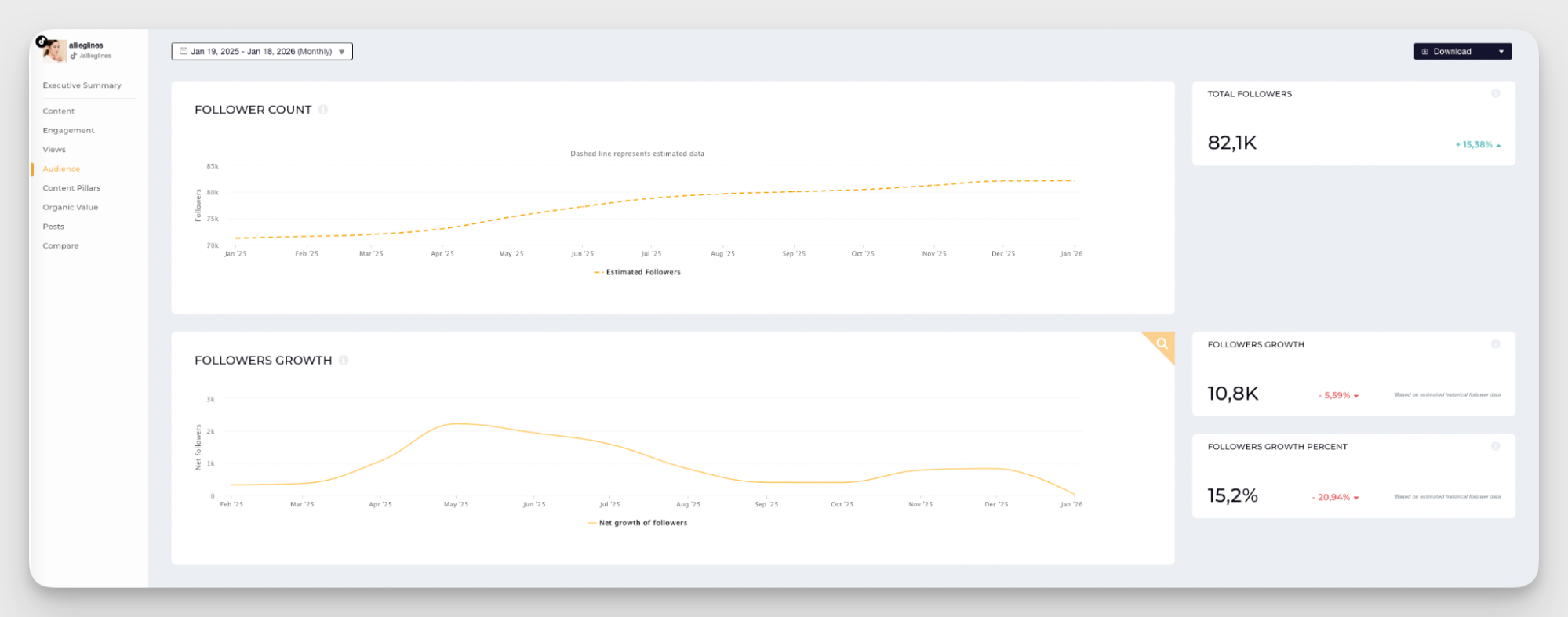
With Socialinsider, you can track both the total follower count and how that number evolves over time.
The growth chart makes it easy to identify patterns, for example whether an influencer is steadily gaining followers, experiencing sudden spikes, or going through periods of stagnation.
For brands evaluating potential partners, this provides useful context around audience momentum and consistency, not just current size.
- Engagement data
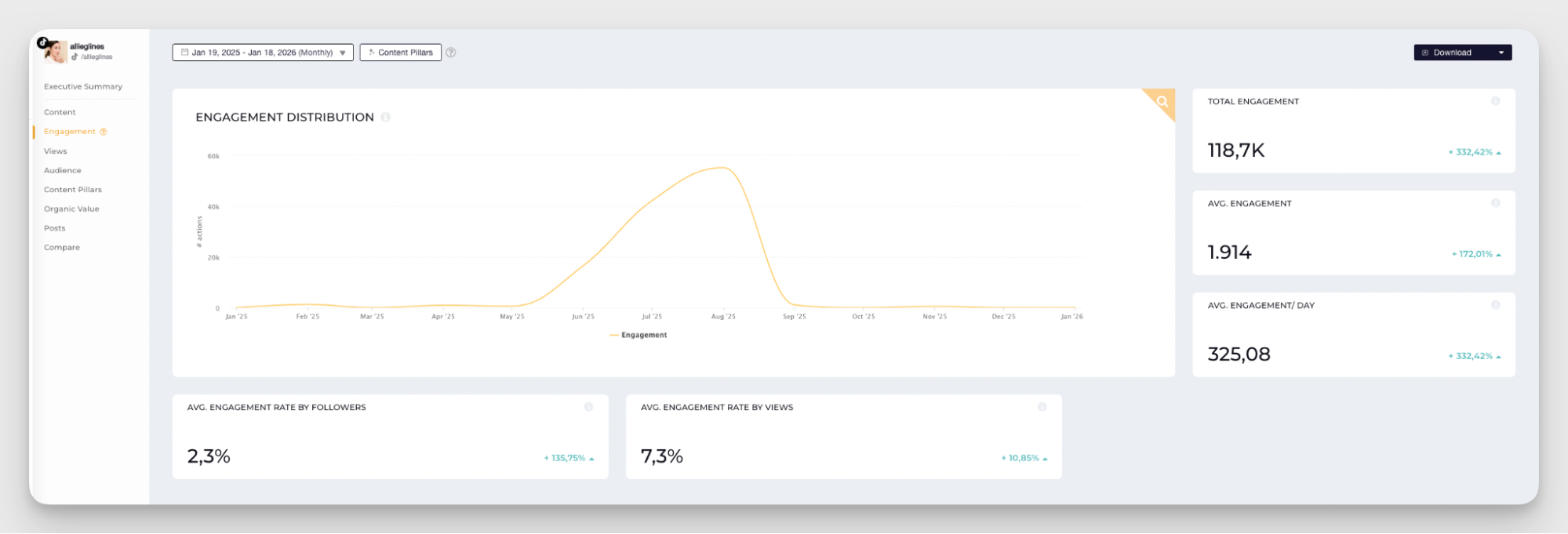
Beyond audience size, the platform can track influencer engagement. Basically, this shows how actively followers interact with the creator’s content.
The engagement dashboard aggregates total interactions and also shows averages and engagement trends across the selected time range.
This helps you understand whether engagement is stable over time or concentrated around a few standout posts.
- Comments, shares and saves distribution
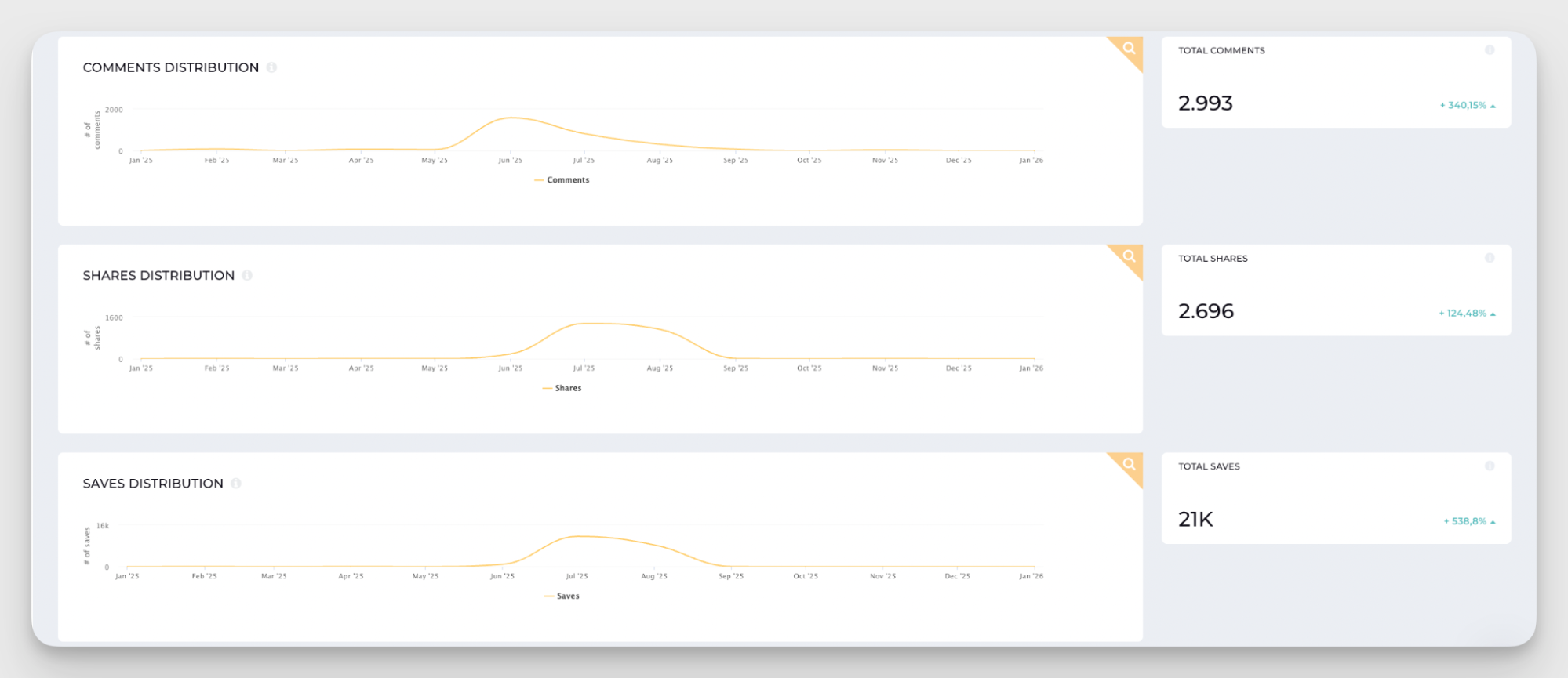
Socialinsider separates engagement into different interaction types, giving you visibility into how audiences behave beyond likes.
You can track how many comments, shares, and saves posts generate over time, which often reveals deeper audience interest.
- Content pillars
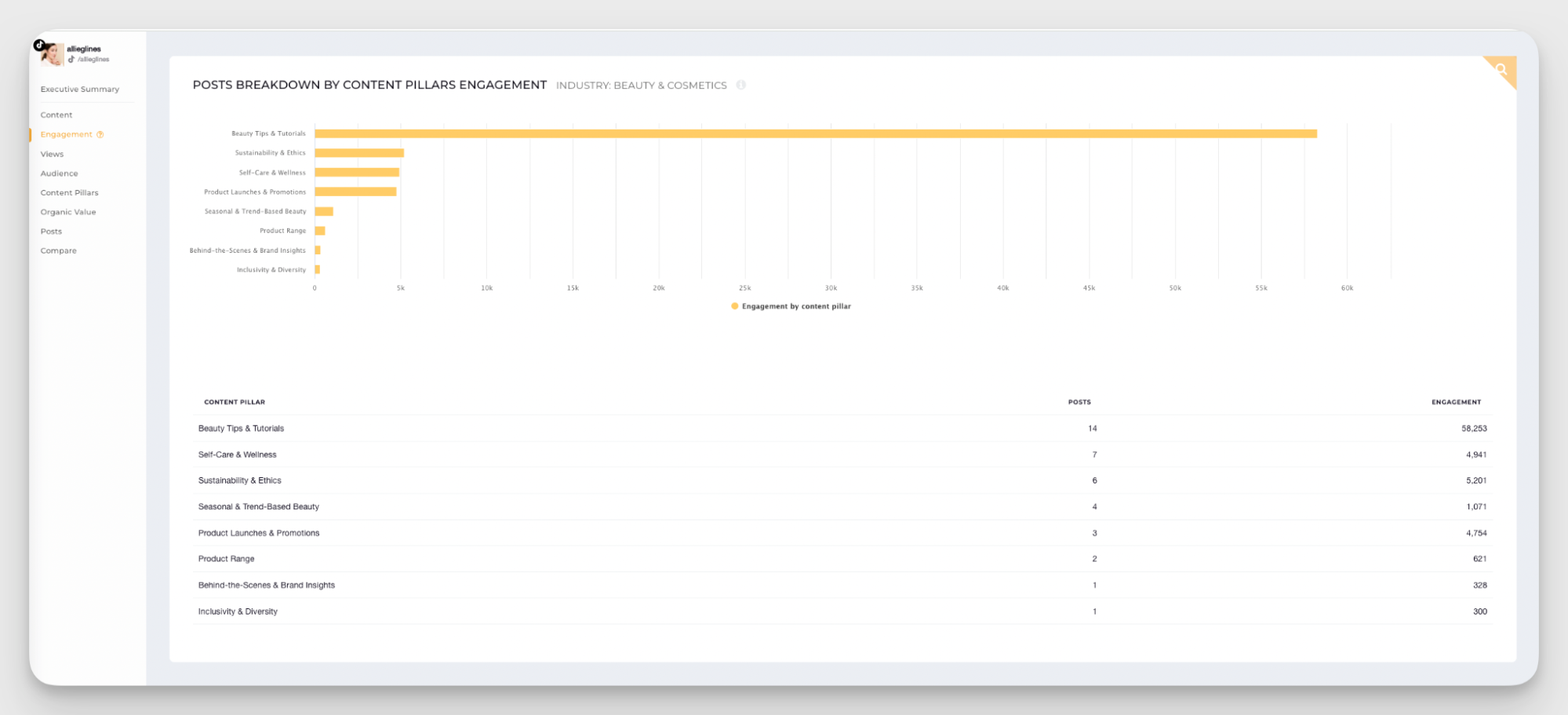
The platform organizes posts into content pillars for social media, grouping content by theme or topic. This is powered by a content tagging system that categorizes posts based on their subject or format.
This allows you to quickly see which categories drive the most engagement.
For brands, this is particularly useful when planning collaborations, because it highlights the types of content that naturally resonate with the influencer’s audience.
- Top posts
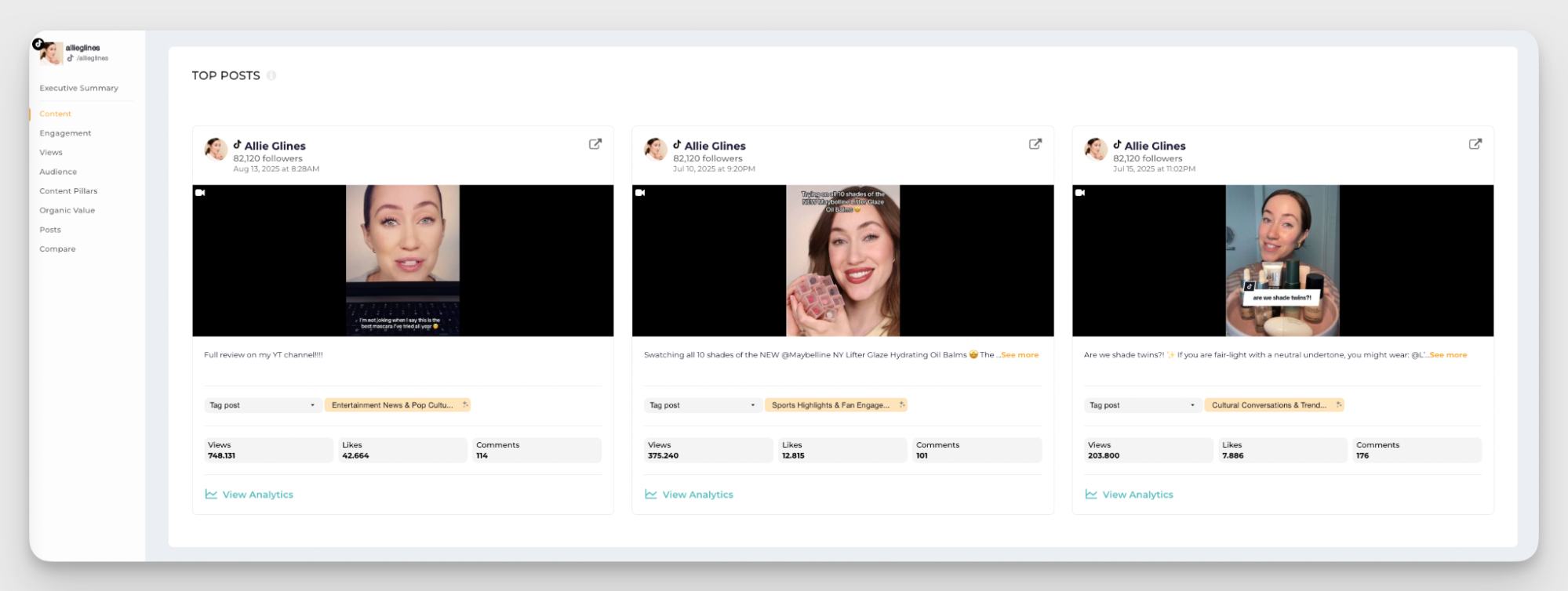
Socialinsider also highlights the influencer’s best-performing posts, displaying key metrics such as views, comments, and more.
Reviewing top-performing content gives brands a clearer sense of what formats, topics, or storytelling styles tend to perform best for that creator.
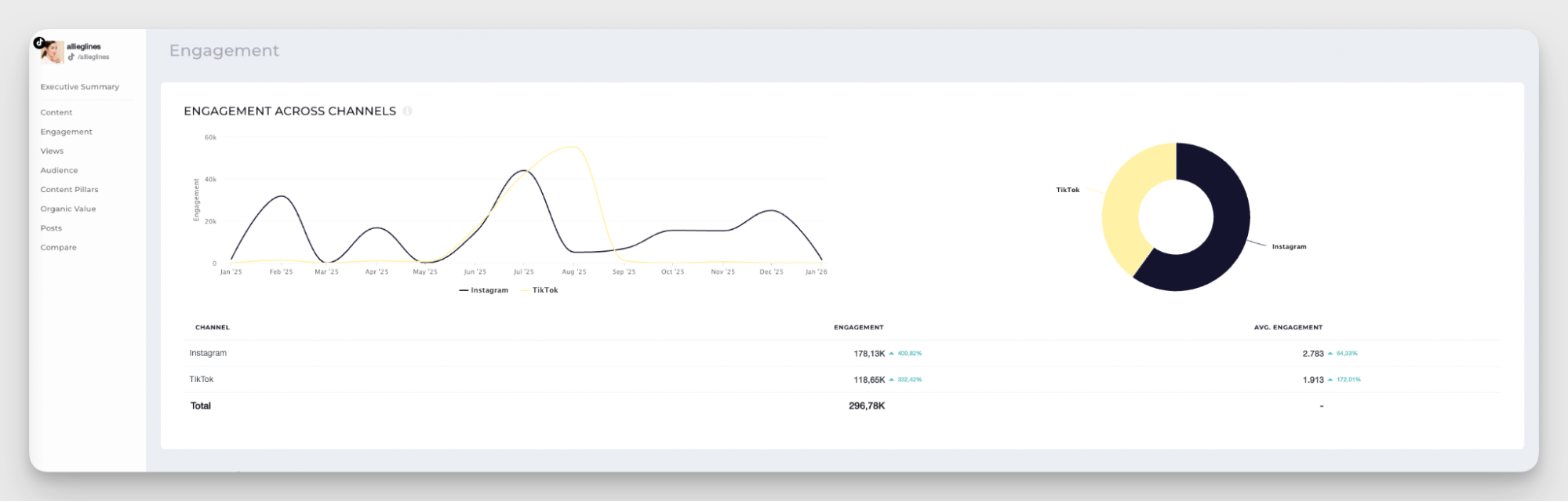
Cross-channel analysis
Another useful feature in Socialinsider is its cross-channel analysis, which helps you understand how an influencer performs across multiple platforms at once.
So instead of looking at TikTok and Instagram separately, Socialinsider brings the data together so you can run a clearer social media analysis.
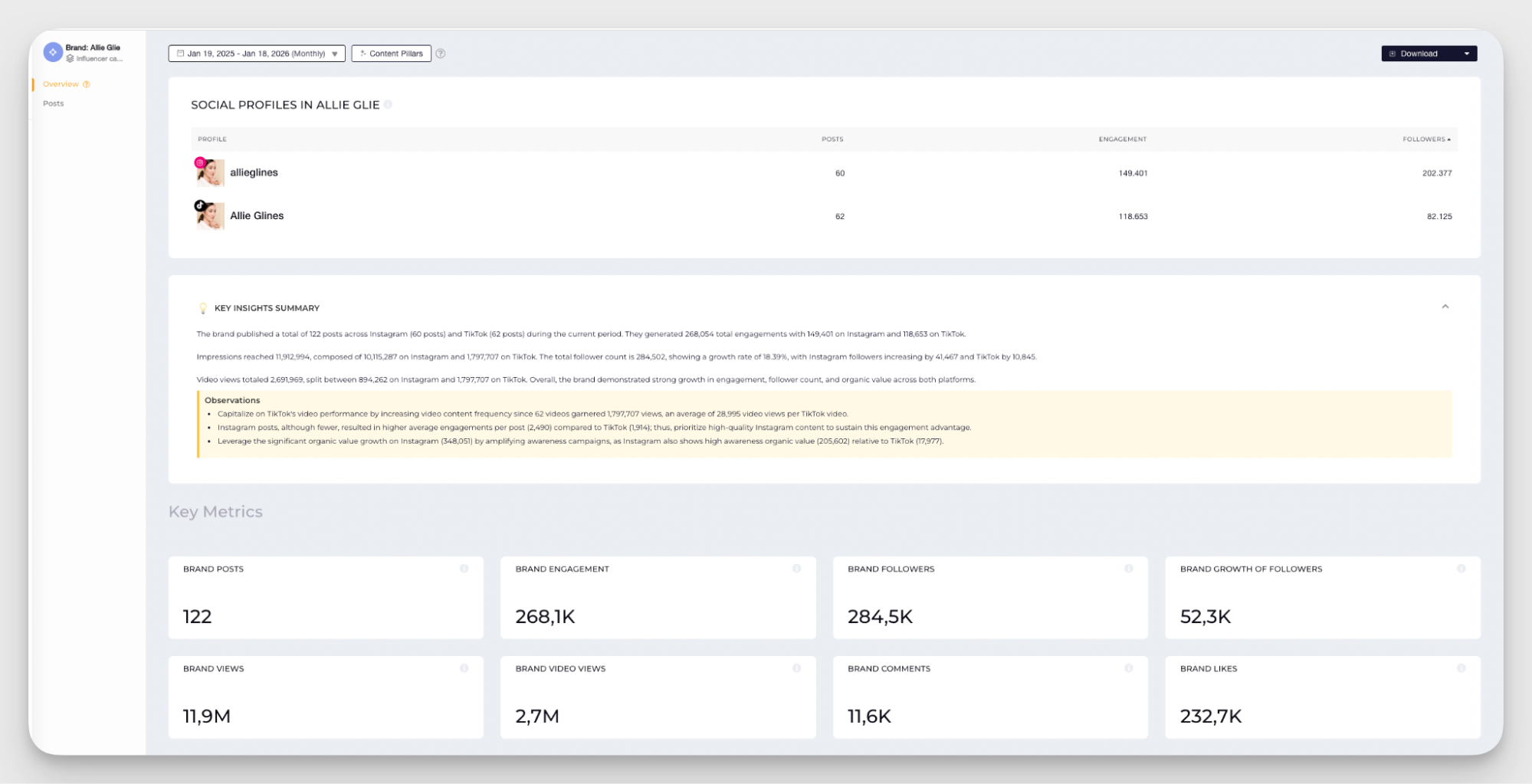
Essentially, you can view aggregated performance metrics while also breaking them down by platform for specific influencer marketing KPIs like followers, engagement, views, or content output.
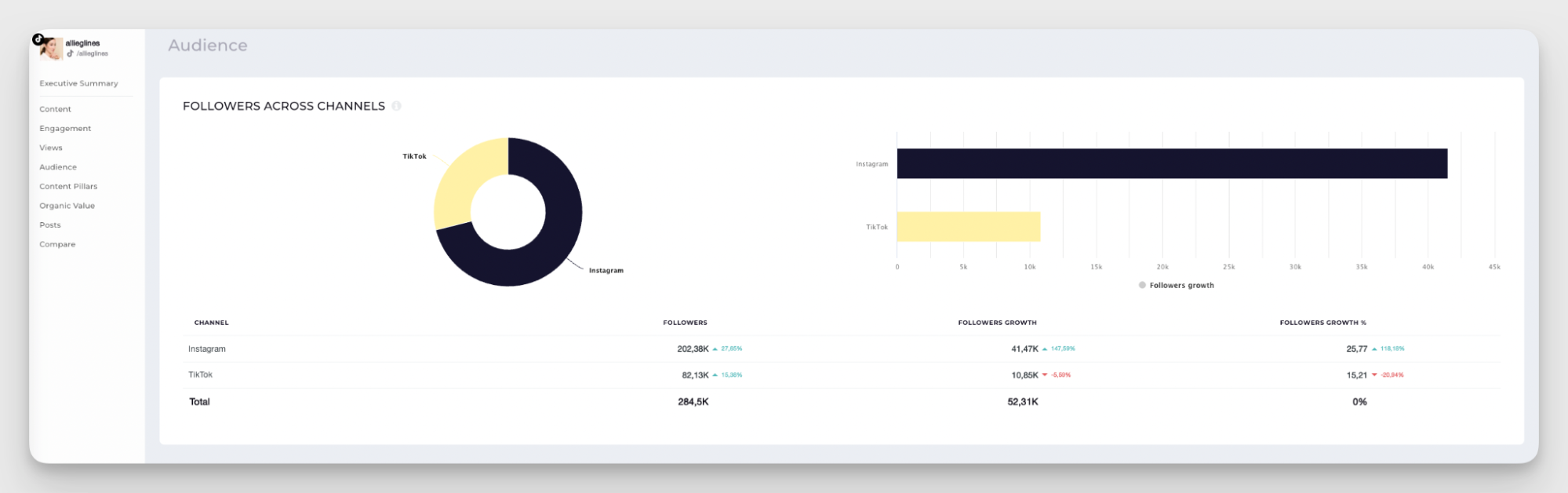
This makes it much easier to track influencer performance and understand where their impact actually comes from, which is essential when building a data driven marketing strategy.
Performance benchmarks
One of the social media best practices I rely on the most is benchmarking.
Looking at numbers in isolation rarely tells the full story. Performance only becomes meaningful when you compare it against other creators, campaigns, or industry patterns.
And within the benchmarking dashboard from Socialinsider, you can compare multiple influencers across the same set of metrics.
This includes indicators like posting frequency, views, engagement rates, comments, likes, shares, and saves.
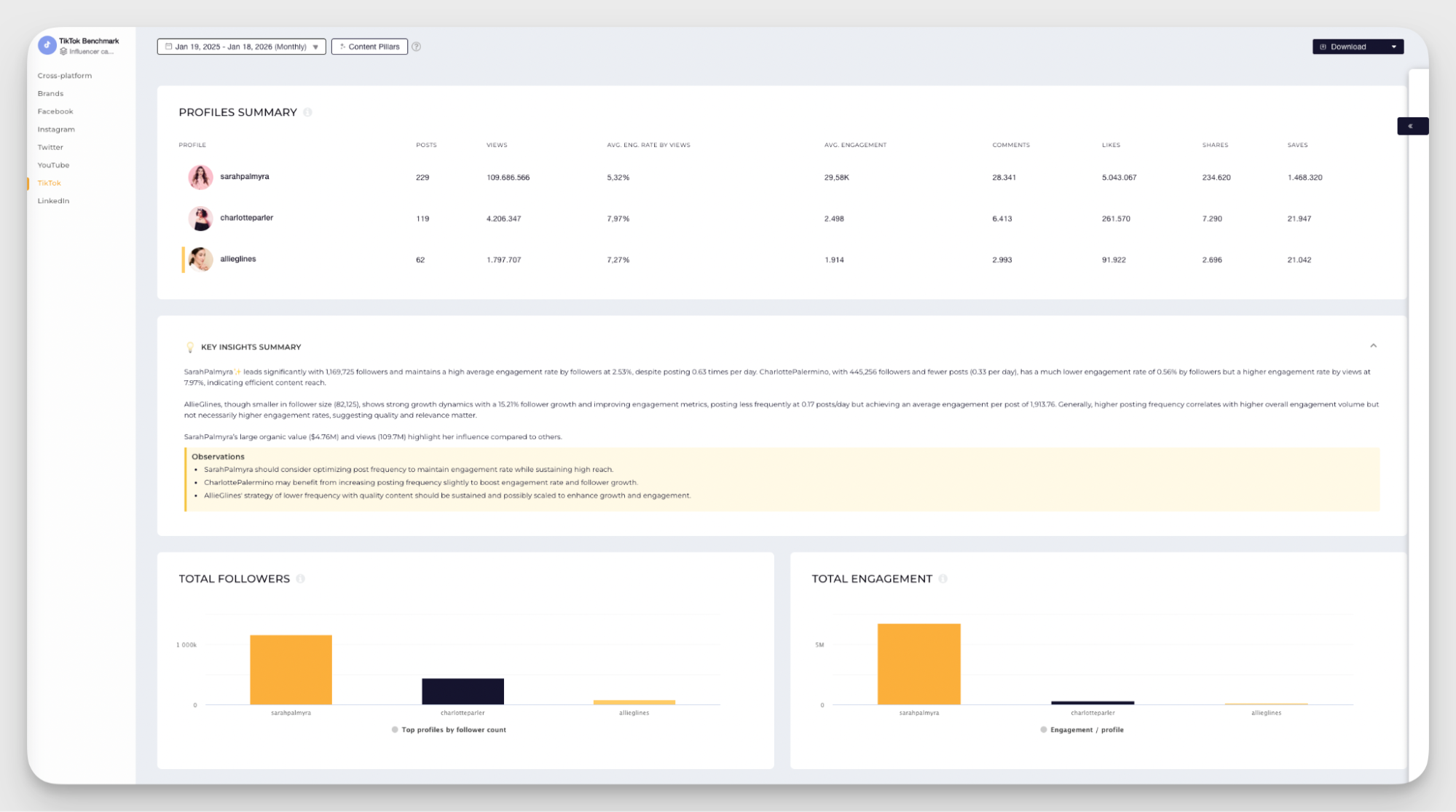
This way, you can quickly see which creators generate stronger engagement, how posting frequency impacts performance, or whether audience size actually translates into higher interaction.
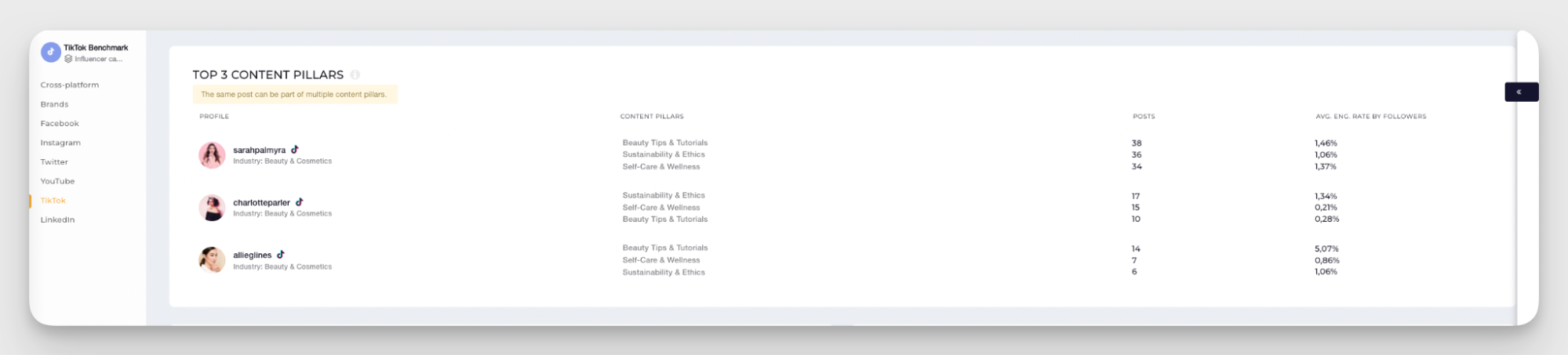
Socialinsider also benchmarks content pillars across influencers, showing which themes appear most often and how they perform.
Pricing
Socialinsider's pricing starts from $86 billed annally, offering various payment options for different needs, including a custom quote. As you move up the tiers, you get support for more social accounts, longer historical data access, and more advanced analytics features.
All standard plans come with a 14-day free trial, allowing you to explore the platform’s analytics dashboards before committing.
Reviews
Socialinsider provides a good foundation of being able to analyze—at a high level— the social space for a certain industry or certain influencer set and adding on additional tools that help formulate a social strategy based on facts as opposed to people feeling like: ‘I think it should be this.’ - Review from David (WPP Media / formerly known as Groupm.com)
#2. Klear (Meltwater) for deep audience analysis and influencer performance measurement
Klear is one of those influencer management tools that sits between influencer discovery and serious social media analytics.
It’s designed not just to help you find creators, but to understand their audiences, manage collaborations, and track the real performance of influencer campaigns.
Key features
AI-powered influencer discovery with brand-fit insights
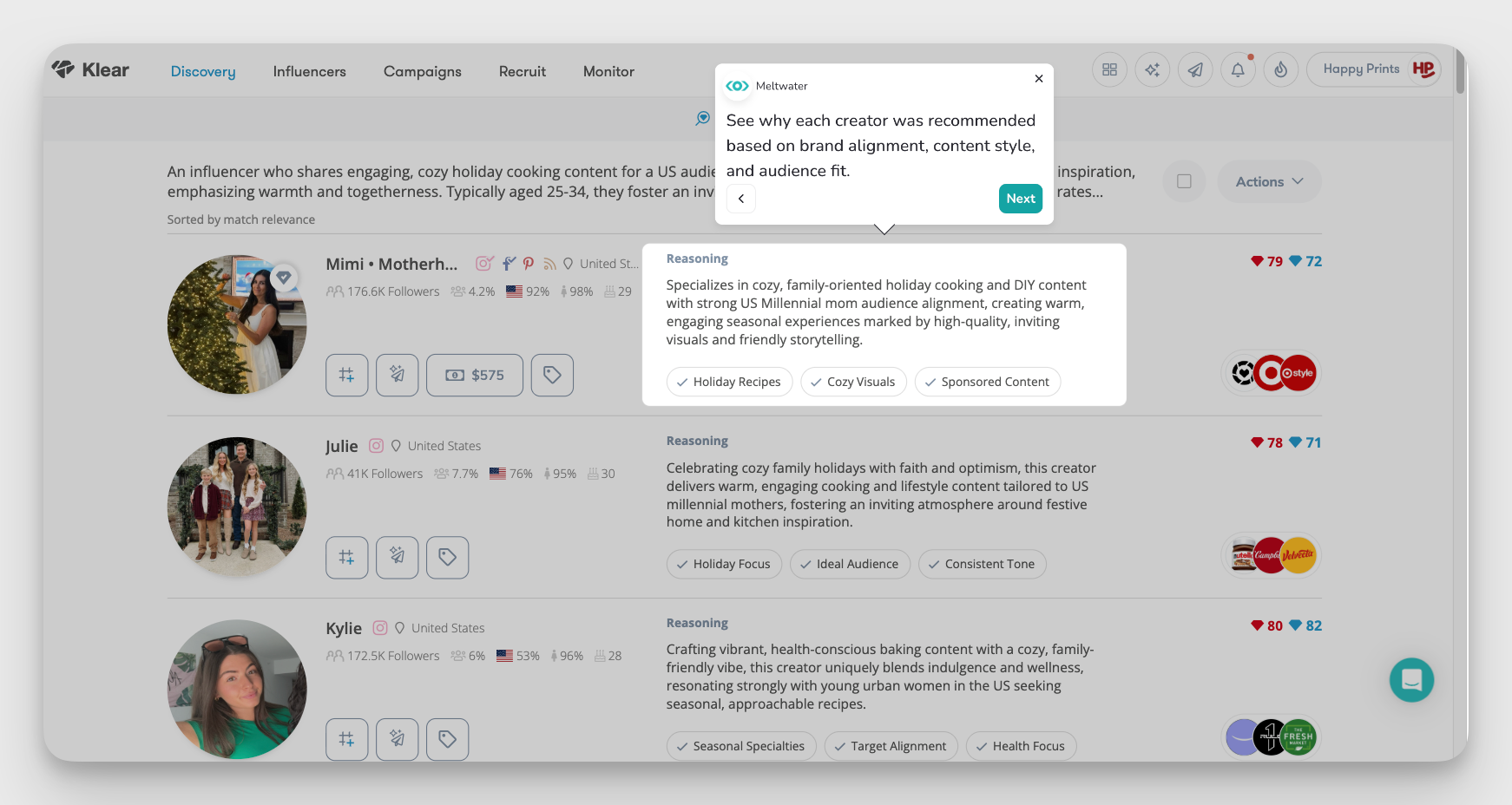
When browsing influencers in Klear, I’m not just seeing a list of creators and follower counts.
The platform actually explains why a creator might be relevant for a campaign.
Each profile includes an AI-generated summary that breaks down the creator’s content themes, audience characteristics, and how well they align with a brand’s positioning.
For example, the tool highlights things like main topics, audience demographics, audience authenticity, and brand safety signals directly in the profile snapshot.
It also estimates metrics like true reach, engagement per post, and potential content pricing, which makes it much easier to quickly assess whether a creator is worth exploring further.
This way, instead of having to manually dig through social profiles, I can get a structured overview of both the creator and their audience in one place.
Campaign workflow and influencer relationship management
Klear functions as a centralized workspace for managing influencer collaborations once a creator is selected.
Inside a campaign, I can handle briefs, product gifting, coupon codes, content approvals, agreements, and payment tracking without leaving the platform.
What really stood out to me was how well the tool keeps communication and campaign logistics organized.
Messages with creators, campaign deliverables, and status updates are all tied to the same campaign dashboard. That makes it easier to track which influencers have accepted invitations, who have submitted content, and what still needs approval. So, basically, the workflow stays contained inside the campaign environment.
Performance analytics and ROI tracking
Where Klear becomes especially powerful is in campaign measurement and performance reporting.
The analytics dashboard tracks metrics such as total posts, engagement, reach, conversions, EMV (Earned Media Value), and sales generated through influencer campaigns.
These metrics can be analyzed across platforms and campaigns to understand which creators, formats, or partnerships are driving the most impact.
Klear also provides predictive estimates and ROI forecasting, helping teams plan budgets and estimate potential performance before launching a campaign.
Pricing
Klear does not publish exact pricing numbers on its website, but it does outline three main plan tiers: Essentials, Suite, and Enterprise.
The Essentials plan includes the core tools needed to get started with influencer marketing and is typically positioned for smaller teams launching or managing their first campaigns. It focuses on foundational capabilities and onboarding support to help teams implement the platform quickly.
The Suite plan is designed for teams that want a more comprehensive solution.
It combines multiple tools into one system for managing influencer discovery, campaign workflows, and reporting across teams.
For larger organizations, Enterprise plans offer a fully customizable setup with premium services, expanded datasets, and integrations tailored to complex marketing operations.
Reviews
This tool greatly facilitates the tasks that need to be carried out in the area of influencer marketing and marketing in general. The ability to search for profiles easily and quickly, as well as organize them into campaigns and other categories, contributes to making the work much more efficient. - Estefania B
#3. Creator.co for fast influencer discovery and marketplace-style campaign execution
Unlike tools that are strictly analytics-first, Creator.co feels more like a hybrid marketplace with analytics baked in.
Fast discovery, easy campaign setup, and a community-centric approach.
If your priority is getting campaigns off the ground quickly and working with influencers in a more streamlined, marketplace-style environment, this platform often feels more intuitive.
It’s especially useful when you don’t want a complicated onboarding or overly technical dashboards.
Key features
Marketplace style interface for quick influencer discovery
When I log into Creator.co, it feels more like browsing a marketplace than digging through a database.
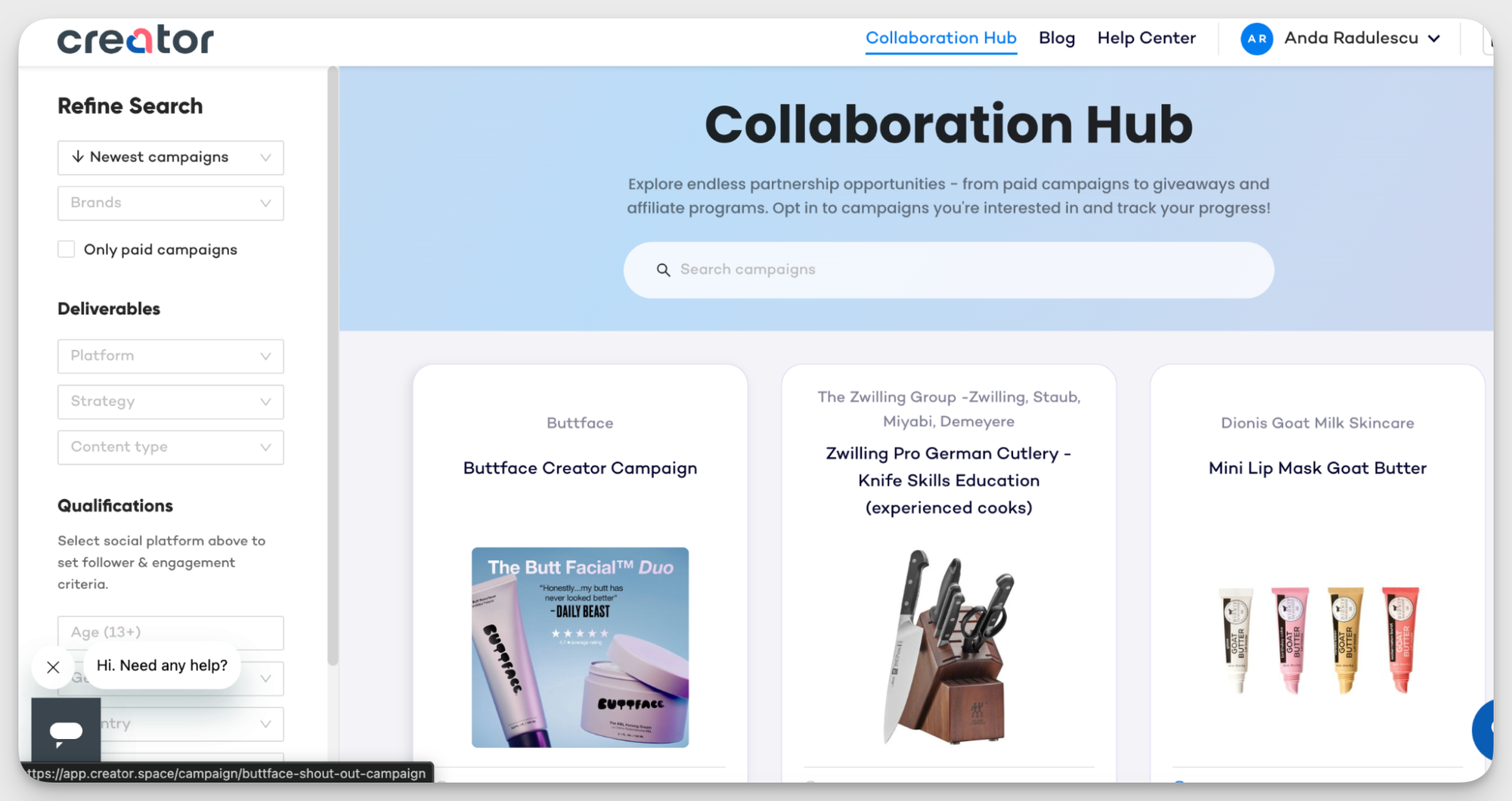
The Collaboration Hub lays out campaigns in a clean grid, so I can quickly scan what’s available, click into a campaign, and immediately see what the brand is looking for.
I’m not stuck guessing whether it’s a fit. I can spot the basics fast (brand, campaign type, and what they want creators to deliver) and move on if it’s not relevant.
Creator profile pages that function like a built-in media kit
Something that I really liked when testing this tool was that the profile view is basically a ready-to-share creator page.
The platform surfaces key metrics like follower count and engagement rate, and shows content highlights so brands can quickly get a sense of the creator's style and performance.
I also like that I can display channel rates, so pricing expectations are visible upfront rather than being a back-and-forth.
Basic performance context + workflow and payment tracking
From a day-to-day workflow perspective, Creator.co keeps the “admin” parts in one place.
It’s not an ultra-deep analytics platform, but it gives enough structure and visibility to make managing campaigns and payments feel organized rather than scattered.
Pricing
Creator.co offers three pricing tiers designed for brands at different stages of influencer marketing, from self-managed campaigns to fully managed partnerships.
The Self Serve plan starts at $199/month and provides access to the platform’s AI-powered creator marketing tools. This includes unlimited creator collaborations, access to a database of over 400 million creators, AI-powered creator matching, AI-generated campaign briefs, personalized outreach at scale, and real-time performance tracking.
The Managed plan starts at $1,495/month and includes everything in Self Serve plus hands-on support from Creator.co’s team.
For larger brands, the Enterprise plan offers custom pricing and provides a fully tailored influencer marketing solution. This includes a dedicated strategic team, unlimited creator collaborations, proactive weekly campaign optimization, custom dashboards and integrations, advanced reporting, and support for large-scale activations such as in-store promotions and events.
Reviews
I appreciate being able to work with great creators and the flexibility of selecting through the campaign process. Creator.co helps us reach a wide variety of creators with different styles of content, which allows us to promote our CBD products on social media platforms effectively. It enables us to work with our specific niche of creators who truly bring our products to life and help us get the word out to new customers. - Dana G
#4. HypeAuditor for influencer authenticity verification and fraud detection
While broader influencer analytics softwares help you evaluate performance and manage campaigns, HypeAuditor goes deeper into one specific question: Is this audience real?
It’s built for verification first.
So before you think about ROI, scaling, or social media optimization, HypeAuditor helps you validate the foundation: follower authenticity, suspicious growth patterns, and engagement quality.
Key features
Advanced influencer discovery with detailed filtering
HypeAuditor’s Influencer Discovery tool is one of its strongest capabilities.
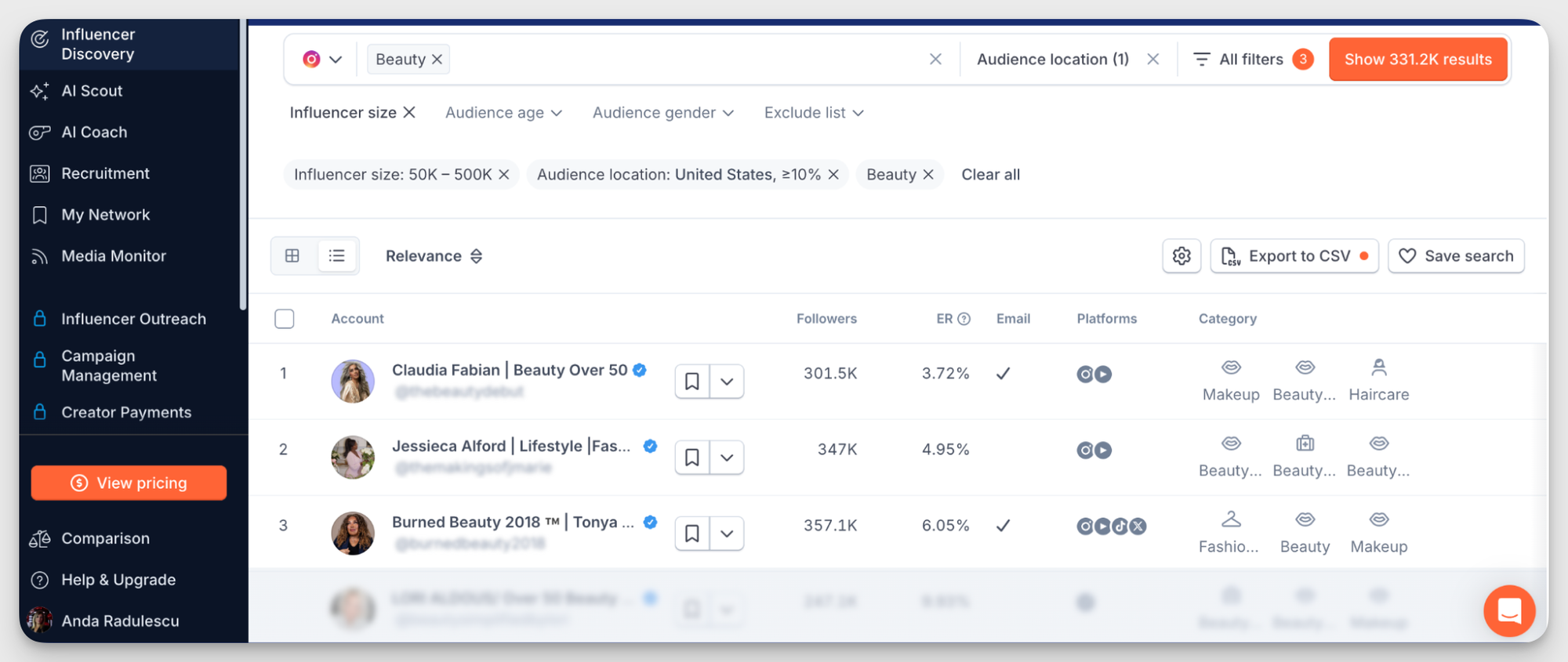
From the discovery dashboard, I can filter creators by niche, follower size, audience demographics, engagement rate, and even audience location percentages.
For example, if I want beauty influencers with 50K–500K followers whose audience is at least 10% in the United States, I can set those filters and instantly generate a list of relevant creators.
The results show key metrics upfront such as follower count, engagement rate, platform presence, and category, so I can quickly shortlist potential partners without needing to open every profile individually.
AI Coach for influencer campaign strategy
One feature that immediately stands out in HypeAuditor is the AI Coach, which acts almost like a built-in strategist inside the platform.
It helps translate data into actionable campaign ideas.
I could input a goal like promoting a product or launching a campaign and the AI suggests approaches, influencer types, and potential campaign structures.
For teams that are newer to influencer marketing or looking for quick strategic guidance, this feels like having an extra expert on hand rather than just another analytics dashboard.
Deep audience authenticity and fraud detection
Where HypeAuditor really differentiates itself from many influencer platforms is its audience quality and fraud detection analysis.
This means the platform looks for signals like suspicious follower growth spikes, unusual engagement patterns, and potential bot activity.
This helps identify whether an influencer’s engagement is genuinely coming from real followers or inflated through fake interactions, something that can significantly impact campaign ROI.
Pricing
HypeAuditor offers several subscription tiers depending on how many campaigns, feeds, and brand mentions you want to track.
The Small plan starts at $59/month and is designed for monitoring brand mentions and a single campaign.
The Medium plan starts at $129/month and is better suited for brands running multiple campaigns or tracking competitors alongside their own mentions.
Larger organizations with more extensive monitoring or analytics needs can request custom enterprise plans, which provide higher limits, expanded tracking capabilities, and additional influencer marketing tools across the platform.
Reviews
I like how comprehensive and detailed it is in influencer management. I primarily use it to search for relevant and effective influencers across different countries, which saves me a lot of time in building strong campaign strategies. Beyond discovery, I also appreciate the other tools it offers—like the ability to send direct emails to influencers and track their content drafts. And it also saves time when it comes to reporting the campaign results. Having everything in one platform makes campaign coordination more seamless and organized. - Mikaela T
#5. Upfluence for e-commerce sales tracking and affiliate program management
Upfluence is built with direct e-commerce impact in mind.
If you run online stores, Shopify integrations, affiliate initiatives, or performance-based campaigns, this tool is designed to tie influencer activity back to actual sales and revenue.
Unlike tools that focus mainly on audience insights or fraud detection, Upfluence helps you understand which partnerships are driving purchases and reward creators accordingly.
Key features
Native e-commerce integrations that connect influencer marketing directly to your store
What stood out to me immediately with Upfluence is how tightly it connects influencer campaigns to actual e-commerce data.
The platform integrates directly with stores like Shopify, WooCommerce, Magento, BigCommerce, and Amazon.
Because of this integration, your store data and influencer activity live in the same system.
For example, Upfluence can match your customer database against millions of creator profiles to identify existing customers who already have influence and could become brand partners.
It also simplifies common campaign tasks tied to e-commerce operations like product gifting and order fulfillment, so creators can choose products directly from your store rather than manually coordinating shipments.
This makes Upfluence particularly attractive for DTC brands that want influencer marketing to behave more like a scalable sales channel than a standalone marketing experiment.
Revenue attribution and real-time influencer sales tracking
Another feature that differentiates Upfluence is how clearly it connects influencer activity to actual revenue and ROI. It automatically attributes sales, clicks, conversions, and revenue to individual creators and campaigns.
The system does this using tools like unique tracking links and promo codes, allowing every sale to be tied back to a specific influencer or post.
Inside the analytics dashboards, you can find performance metrics such as total campaign revenue, ROI, commissions owed to creators, and which influencers are driving the highest conversions.
This makes it much easier to identify high-performing creators and double down on partnerships that actually generate sales rather than just engagement.
Affiliate-style influencer programs with automated payouts
Upfluence blurs the line between influencer marketing and affiliate marketing.
The platform automates a lot of the operational work behind this model.
Brands can generate bulk promo codes or affiliate links, track the performance of each partner, and automatically calculate commissions based on conversions.
Payment management is built into the platform as well, allowing teams to pay creators in different currencies and handle payouts at scale without managing external spreadsheets or finance tools.
Pricing
Upfluence uses a modular pricing model, meaning the final cost depends on the specific tools and capabilities your team needs rather than fixed feature tiers.
Based on available pricing information, plans start at around $478 per month for the Search & Contact module, which covers influencer discovery and outreach features.
From there, businesses can add additional modules depending on the level of campaign management, automation, and analytics they require.
Reviews
For us, the winning feature it the market place. It makes it so much easier to work with influencers and find the right affiliates to sell our products. Plus, it saves us a lot of time. - Mick R
#6. GRIN for revenue-focused influencer marketing and e-commerce attribution
GRIN approaches influencer marketing from an e-commerce operations perspective.
The platform is structured to connect creators, products, and revenue inside the same system, which makes it particularly useful for brands running ongoing creator programs tied to sales rather than one-off social campaigns.
Key features
Direct checkout tracking to connect influencer clicks to revenue
GRIN supports direct checkout tracking that connects influencer traffic to completed transactions in your ecommerce store.
When a user clicks a creator’s affiliate link or uses their promo code, GRIN can associate that session with the final purchase once the order is completed.
For revenue-driven marketing teams, this is critical because it enables transaction-level attribution instead of engagement-level reporting.
Rather than relying on impressions or clicks as proxies for performance, brands can directly evaluate creator partnerships based on actual revenue generated, aligning influencer marketing with the same performance metrics used in paid acquisition channels.
Affiliate link and promo code management with automated payouts
GRIN includes built-in tools for generating creator-specific affiliate links and discount codes, enabling brands to run structured affiliate-style influencer programs.
Each creator receives unique tracking identifiers that capture conversions across multiple content platforms.
The system automatically tracks purchases generated through these identifiers and calculates commissions according to predefined payout rules (such as percentage-of-sale or fixed payouts).
This allows brands to scale creator partnerships without manually reconciling sales data or commission payments.
Native integrations with ecommerce platforms for order and customer data
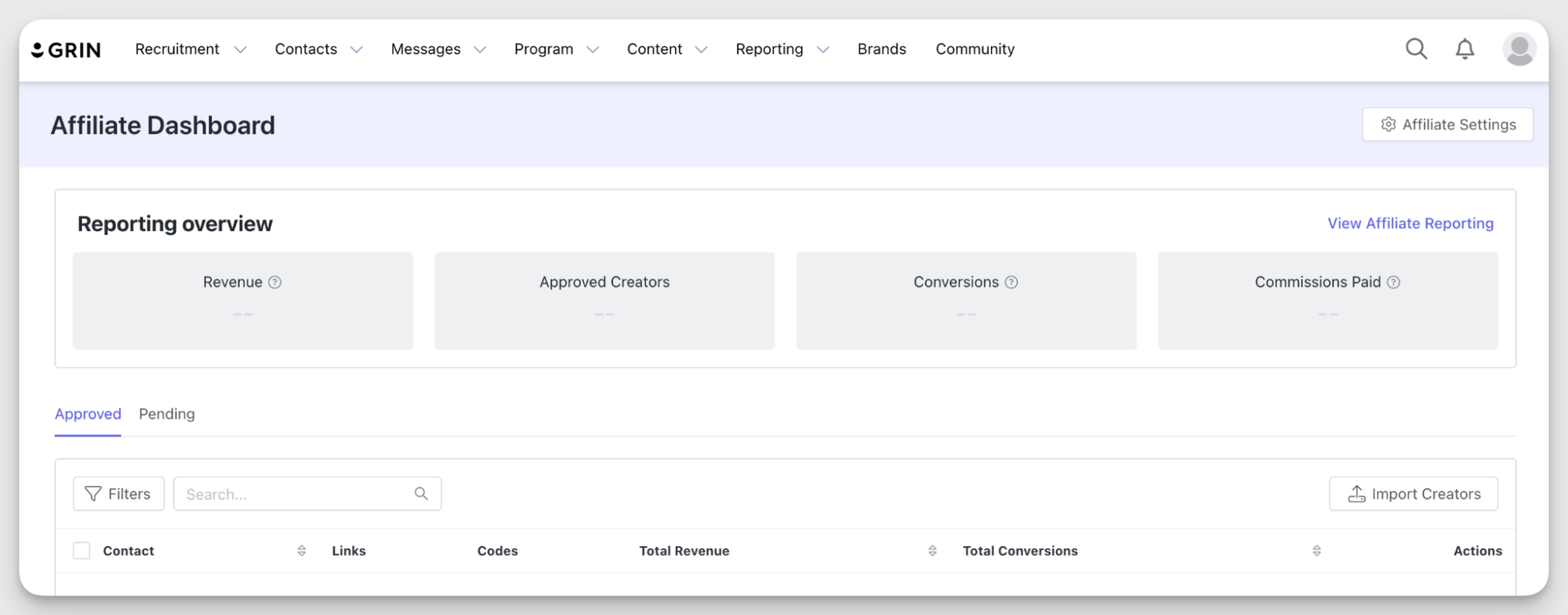
GRIN integrates directly with major ecommerce platforms such as Shopify, Magento, and BigCommerce.
These integrations allow the platform to pull order data, product information, and customer details directly from the store backend.
Because influencer activity is connected to the underlying commerce data, brands can analyze deeper performance metrics such as:
- revenue generated per creator
- average order value from influencer traffic
- repeat purchases from influencer-acquired customers
- campaign-level ROI
This tight ecommerce integration is what allows GRIN to position influencer marketing as a revenue-generating channel rather than purely a brand awareness tactic.
Pricing
Grin doesn’t display fixed plans publicly.
Pricing is customized based on your needs.
Key factors that influence cost include:
- Number of users and team seats
- Volume of influencers and campaigns
- E-commerce integrations required
- Whether you use revenue attribution and affiliate features
Because Grin ties into checkout and revenue pipelines, it’s typically priced for mid-market to enterprise brands rather than small one-off campaigns. For most teams, that means scheduling a demo and getting a tailored quote.
Reviews
GRIN is a game-changer for managing influencer campaigns from start to finish. I use it every day to streamline the entire process—allowing me to contract, brief, and pay influencers seamlessly in one place. One of my favorite features is the detailed date metrics for gifting campaigns, which provide valuable insights to optimize performance. Plus, their customer support team is incredibly helpful and quick to respond, making the experience even smoother. - Soleil E
#7. Modash for large-scale influencer discovery and creator database management
Modash feels different from many influencer platforms because it doesn’t try to be an all-in-one campaign automation suite.
After spending time inside the platform, it felt more like a powerful creator search engine combined with a lightweight influencer CRM.
If you’re doing a lot of influencer prospecting (or building large creator databases for future campaigns) this approach actually makes the platform very practical.
What stood out to me while using Modash is how fast it is to scan large numbers of creators and turn discoveries into structured creator lists you can manage over time.
Key features
Large-scale influencer discovery across multiple platforms
When I started searching for creators in Modash, the discovery experience felt more like working with a database than browsing social media profiles manually.
The platform indexes millions of influencer profiles across platforms like Instagram, TikTok, and YouTube, making it possible to search for creators based on a wide range of filters.
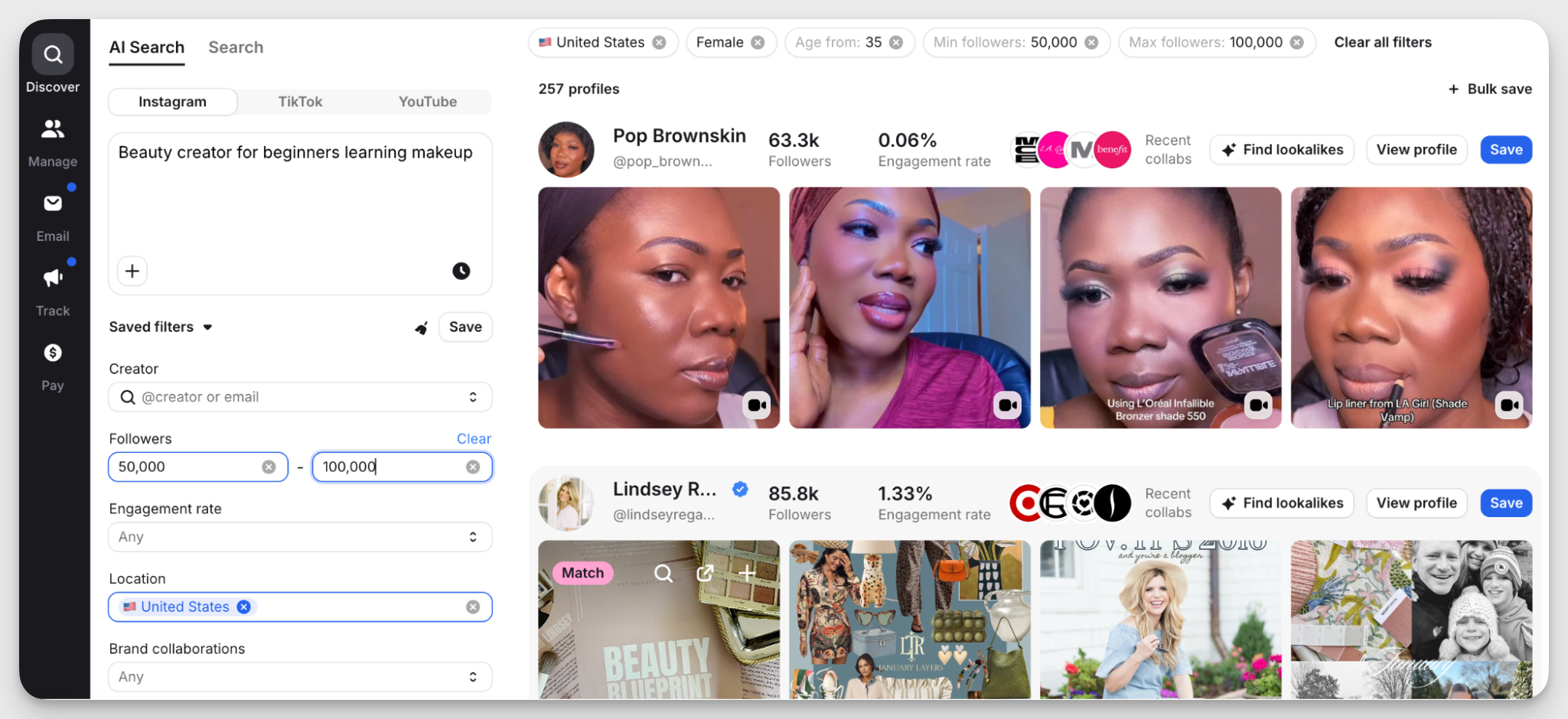
What I found useful is how quickly you can narrow results using criteria like:
- niche
- follower ranges
- engagement rates
- audience location
- creator demographics
- past brand collaborations
For teams that spend a lot of time sourcing creators, this makes the platform feel more like a high-speed influencer prospecting tool than a traditional campaign platform.
Lookalike creator discovery based on existing influencers
Another feature I found particularly useful is the lookalike creator search.
Once I found an influencer that seemed like a strong fit, Modash could automatically suggest other creators with similar audiences, niches, and engagement patterns.
This way, instead of repeating the discovery process from scratch, I could essentially use one good creator as a starting point and expand from there.
In practice, this becomes helpful when you’re trying to scale a campaign beyond a few influencers.
If one creator performs well, finding others with similar profiles makes it easier to build a broader creator roster without spending hours manually searching.
For agencies or brands that regularly run campaigns across multiple creators, this feature can significantly speed up the process of expanding influencer lists.
Built-in creator CRM for organizing influencer relationships
Once I started saving creators inside the platform, Modash shifted from being just a discovery tool to something closer to a creator relationship database.
Instead of exporting influencer lists into spreadsheets, I could organize creators directly inside the platform. The creator management view lets me:
- assign labels like affiliate or ambassador
- attach documents such as contracts or campaign files
- add internal notes about conversations or outreach
- group creators into structured lists for different campaigns
Over time, this essentially becomes a centralized database of influencers you’ve already evaluated or contacted.
Pricing
Modash offers several subscription tiers designed to support brands as they scale their influencer marketing programs.
The Essentials plan starts at $199/month and is designed for campaigns with up to 100 creators. It provides access to Modash’s influencer discovery tools, allowing smaller teams or brands to validate influencer marketing strategies before scaling.
The Performance plan starts at $499/month and supports campaigns with up to 250 creators. This tier is intended for growing influencer programs and includes expanded access to creator discovery, campaign management, and performance insights.
For larger brands running high-volume campaigns, the Enterprise plan starts at $14,700/year and is fully customizable. It is built for organizations managing more than 250 creators and includes advanced analytics, higher usage limits, and tailored features to support large-scale influencer marketing operations.
Reviews
Modash has been an effective platform for managing and tracking our influencer campaigns. The interface is well-designed and intuitive, which makes it easy to navigate. We particularly value how content is organized by campaign, giving us quick access to all key performance metrics and content insights in one place. The Discovery feature is also very effective. It allows us to find creators that match our brand by filtering based on topics, audience, and other campaign needs. - Vanessa V
Final thoughts
If there’s one thing I’ve learned about influencer marketing, it’s this: the brands that win are the ones who measure the smartest.
At some point, you either keep relying on surface-level metrics, or you decide you want real answers. Real clarity on who’s driving results. Real confidence when you increase budget. Real understanding of what’s actually moving the needle.
That’s what the right influencer analytics tools give you. Not more data, just better decisions.
And in this space, better decisions are everything.
FAQ in influencer analytics tools
How to choose the right influencer analytics tool for your business?
Choosing the right influencer analytics tool depends on three main factors: your business size & budget, your primary platform focus, and your marketing goals.
Here’s how to break it down:
By business size & budget
Startups & small businesses (low budget)
Look for tools that offer:
- Affordable monthly plans
- Free trials or freemium versions
- Basic analytics (engagement rate, audience demographics, fake follower detection)
- Simple campaign tracking
These tools are ideal if you’re running occasional campaigns or testing influencer marketing for the first time.
Mid-Sized brands (growing budget)
Prioritize tools with:
- Advanced audience insights
- Competitor analysis
- Influencer discovery filters
- Campaign performance tracking
- CRM or email integrations
At this stage, automation and reporting efficiency become more important.
Enterprises & agencies (high budget)
Choose platforms offering:
- AI-powered influencer discovery
- Multi-platform tracking
- Fraud detection & brand safety analysis
- Team collaboration features
- Custom reporting dashboards
- API integrations
These solutions are built for managing multiple campaigns and large influencer networks at scale.
By primary platform focus
Different tools specialize in different platforms. Choose one that aligns with where your audience spends the most time.
Instagram-focused brands
- Look for strong engagement rate analysis
- Story & Reel tracking
- Audience authenticity scoring
TikTok-focused brands
- Short-form video performance metrics
- Trend & hashtag tracking
- Viral content identification
YouTube-focused brands
- Subscriber growth analytics
- Video retention & watch time insights
- Historical performance data
LinkedIn or B2B focus
- Professional audience demographics
- Industry & job title targeting
- Thought leadership performance tracking
If you run campaigns across multiple platforms, choose a tool with unified cross-channel analytics.
By marketing goal
Your objective should directly influence your tool selection.
Brand awareness
- Reach & impressions tracking
- Audience growth trends
- Share of voice metrics
Sales & conversions
- Affiliate link tracking
- UTM integration
- ROI & revenue attribution
Long-term partnerships
- Influencer relationship management
- Historical collaboration data
- Performance benchmarking
Influencer discovery
- Advanced search filters
- Audience demographic breakdown
- Fake follower detection
Anda Radulescu
Content writer & copywriter with a 5-year track record in digital marketing. Equal parts keen observer & committed go-getter. A proud cat mom with a passion for music & exploring the world.

Know what your competitors do — before your manager asks
Get instant social benchmarks & reports without manual work.


