How to Craft a Powerful Social Media Pitch Deck to Pitch Strategies
Learn how to put together a social media pitch deck when you need to show executives that something needs to change.


The other day I read about the impact of telling stories. Stories can help people feel emotions, empathise, and relate to your situation.
A social media pitch deck could be like telling a story. One packed with data, one that has a very intricate plan at its core.
In what follows, I’ll showcase everything you need to know about how to put together a social media pitch deck when you need to show executives something is not working and needs to be changed (including asking for a budget increase for your marketing stack).
What is a social media pitch deck?
A social media pitch deck (for pitching new strategies, not selling) is basically your “Hey, leadership, we have a problem and we can’t keep pretending everything’s fine” document.
It’s not a glossy sales deck.
It’s not a mood board with pastel slides.
It’s the thing you use when you need executives to stop nodding politely and actually understand what’s going on. Think of it as your company’s social reality check.
It’s the place where you show people:
- what’s working (usually less than they think)
- what’s broken (usually more than they think)
- and how you’re gonna fix it before the competitors lap you… again.
David from WPP Media had this exact moment. His social media analytics tool flat-out couldn’t show TikTok numbers in his region. Imagine explaining to a CFO why one of the biggest social platforms “just kinda… isn’t in the report.”
So he pulled together a mini competitive analysis during a trial of Socialinsider, plopped the data into a deck, and the CFO basically went, “Oh. Yeah. We need this.”
“The big issue when we got the subscription was they were limited in Ireland on TikTok.” — David, Head of Invention at WPP Media
That’s what a pitch deck does internally—it gets the room to stop arguing opinions and start reacting to facts. You’re not performing. You’re not selling. You’re pointing at the fire and saying, “We should probably fix that.”
How to build a social media pitch deck
Irrespective of the type of business you have, learning how to build a social media pitch deck can really ease your work.
Know your audience
Do your homework when it comes to the people you’re presenting to. Find out more about their background, expectations, daily tasks, struggles, KPIs, and more to be able to personalise the social media pitch deck in a way that speaks to them.
A CEO, CFO, and Head of Marketing will respond to widely different stimulents. A CEO might want to know they’re losing market share, a CFO might be more inclined to increase your tool stack budget if they realize not doing so will actually cost the company more long-term, and a Marketing Manager might want to know how your competitors have double your engagement rate on TikTok when they’re posting less. Write your pitch accordingly.
Do your competitors research
When developing your social media pitch deck, it is also time to spill the tea. Yes, you have competitors and yes, you need to show everyone that you are aware of them. So include industry benchmarks in your pitch to paint the whole picture of your social media performance.
And speaking of painting the entire picture, no matter how engaging your social media pitch deck is, stakeholders won’t automatically take your word for it. You need to support the claims you’re making with case studies, customer stories, and testimonials.
Make your case for social media changes
Start with the moment that made you realize things had to change.
For Alfonso at NoxSport, that moment came when he realized his tool simply didn’t support TikTok. At all. And for his company, TikTok wasn’t just “nice to have”—it was the platform his competitors were using to grow. The company needed visibility there, and he couldn’t give it to them.
So he did what many teams quietly do: he patched together a messy workaround. Screenshot by screenshot. Account by account. Until it became obvious that leadership needed to understand how impossible the current setup was.
“Semrush had a dashboard… what I did was I made some screenshots of the tool and put it in the PowerPoint. We had to manually add the TikTok information because there was no data. To know what worked best on TikTok, we had to go manually account per account and check it.” — Alfonso, Marketing Manager at NoxSport
This section of your pitch deck should feel like that.
Not panicked, but honest.
Not polished, but clear.
Not “here are 10 reasons we could consider a change,” but “here’s the reality, and here’s what staying the same will cost us.”
Tell stakeholders the actual pain point in plain language:
- We’re blind on TikTok.
- We’re guessing on LinkedIn.
- Our competitor posts twice as often as us and somehow has time to eat lunch.
Your job here is to make them feel the gap.
Present the current position/situation
Once you’ve made the emotional case, drop the receipts. Show the brand exactly as it is.
This is where Alfonso’s reporting reality says everything. When your “data source” for a key platform is a stack of screenshots and late-night manual checks, something’s off.
“We had to manually add the TikTok information because there was no data… we had to go manually account per account and check it.” — Alfonso, Marketing Manager at NoxSport
And sometimes the problem is even simpler: the data literally doesn’t exist.
That was the case for David from WPP Media. His analytics tool simply didn’t support TikTok in his region.
“The big issue when we got the subscription was they were limited in Ireland on TikTok.” — David, Head of Invention at WPP Media
Once executives see the real picture—strengths, weak spots, and blind spots—it becomes a lot easier for them to understand why the strategy needs to shift.
Create a new strategy plan
Now, it’s time to shift from “here’s what’s broken” to “here’s the plan.”
This is NOT the place for a 42-page audit. Keep it simple and simply explain the pivot:
- We need LinkedIn visibility, not because it’s trendy, but because that’s where industry leaders are gaining ground.
- TikTok is no longer optional. Not having data is the same as having bad data.
Then, show what happens when the team does have proper visibility. Executives don’t need inspiration, just proof that your plan isn’t a gamble.
Social media pitch deck best practices
The best internal social media pitch decks aren’t pretty. They’re honest.
The worst mistake you can make is hiding the truth under “strategy speak.”
Executives hate that. It feels slippery.
You don’t need 20 slides. You need a narrative spine: Here’s the issue → here’s the impact → here’s the fix.
Speak in the metrics executives care about (this goes back to knowing your audience, knowing whom you’re presenting to). Use plain English. Use short sentences. Use contrast. Use silence if you need to.
And above all: keep it relevant! There is nothing more painful than watching a room of executives glaze over because someone decided to read engagement rate definitions out loud.
You know the metrics that matter:
- Growth
- Reach potential
- Competitive position
- Risk of staying blind
- Efficiency of the team
Everything else? Optional.
Free social media pitch deck template
Finally, let’s go over what your social media pitch deck should include, slide by slide. You can of course take this model and adjust it according to your own needs.
Slide 1 — “Here’s what we need to talk about.”
A blunt, one-sentence statement of the problem.
Slide 2 — “Here’s where we actually stand.”
Your current numbers, but without the corporate gloss.
Slide 3 — “Here’s the platform gap that’s hurting us.”
Insert the TikTok/LinkedIn/YouTube blind spot moment.
Slide 4 — “Here’s what competitors are doing while we’re guessing.”
The wake-up call slide.
Slide 5 — “Here’s the cost of staying the same.”
Executives perk up here.
Slide 6 — “Here’s the strategy shift.”
Short. Human. Clear.
Slide 7 — “Here’s proof this works.”
Case studies, benchmarks, internal wins, whatever shows this isn’t a moonshot.
Slide 8 — “Here’s what we get if we do this.”
Near-term and medium-term outcomes.
Slide 9 — “Here’s what I need from you.”
Budget, tool approval, team resources—don’t be shy.
Slide 10 — “Timeline + next steps.”
Keep it simple. People love simple.
Executives don’t want to be impressed, they want to be convinced. So make the deck feel like the truth, not a performance.
How to develop your social media pitch deck with Socialinsider
To make sure your social media pitch deck is complete, you will have to include performance data for both yourself and your competitors.
To collect accurate and in-depth infos about your previous campaigns’ performance, you need a trustworthy analytics tool.
Socialinsider is a complex tool, providing social media analytics and reporting, campaign reporting, competitive analysis, and cross-channel data.
In what follows, I will show you how to perform a competitive analysis.
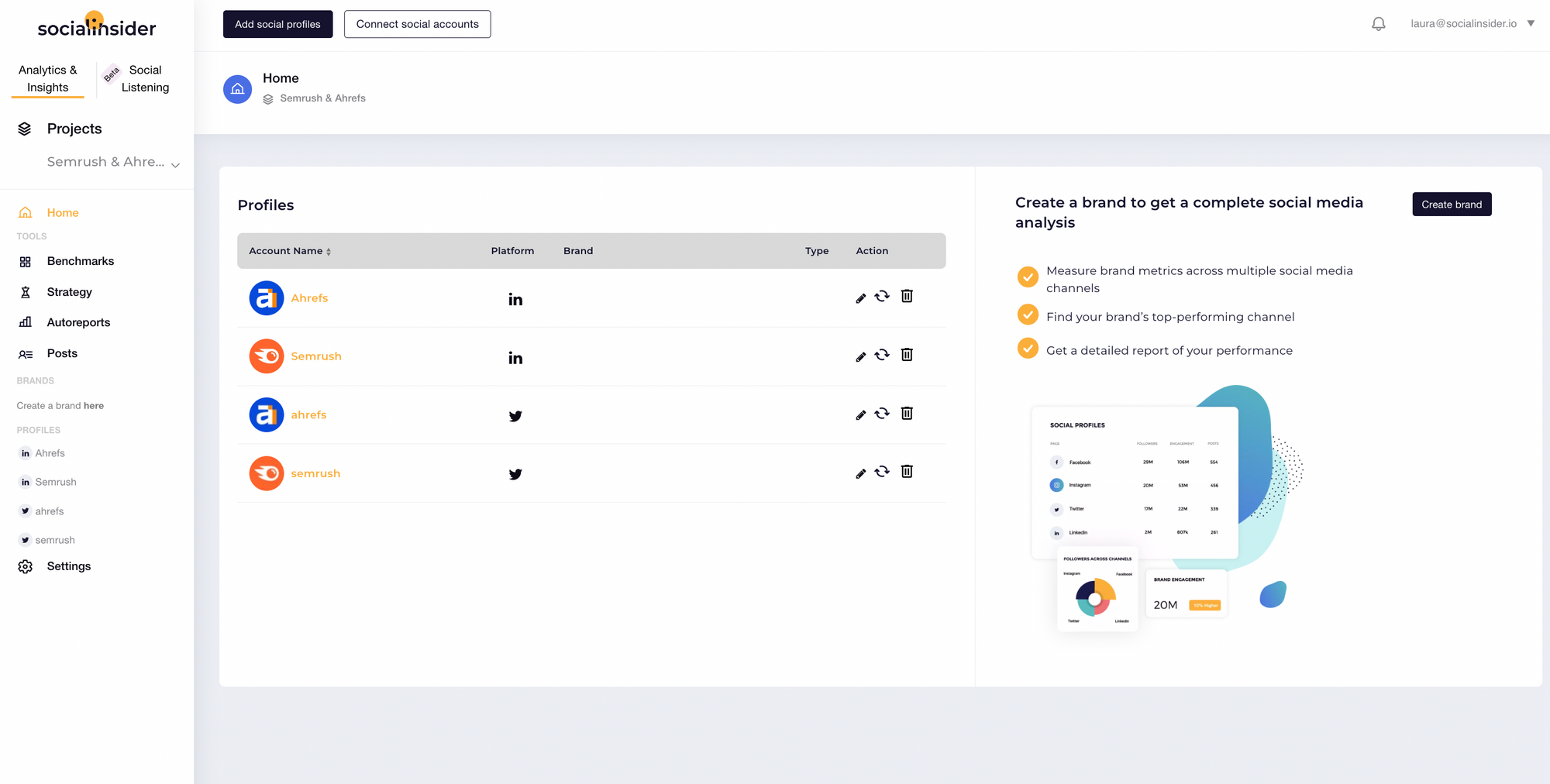
First, I created a new project where I developed a head-to-head comparison between Semrush and Ahrefs. I added the Twitter and LinkedIn profiles for both brands.
By going to Benchmarks, I was able to run a comparison between both brands' LinkedIn metrics for the last 6 months.
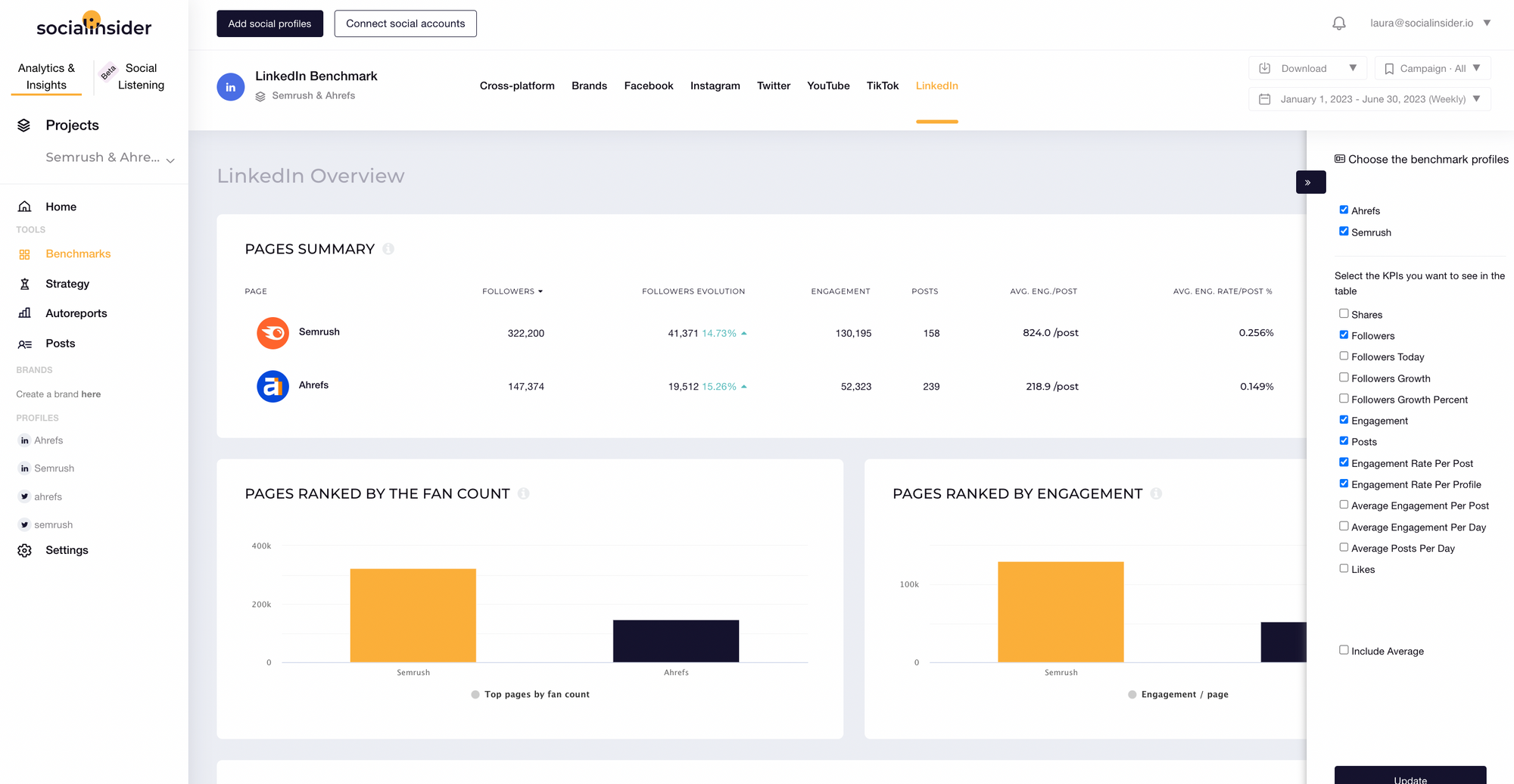
In the benchmark section, you can choose exactly what KPIs you want to see in the dashboard.
By scrolling down, you will get insights about top 3 posts for both brands, average engagement per day, average number of posts per day, distribution of engagement, distribution of posts, changes in fans, and many more metrics.
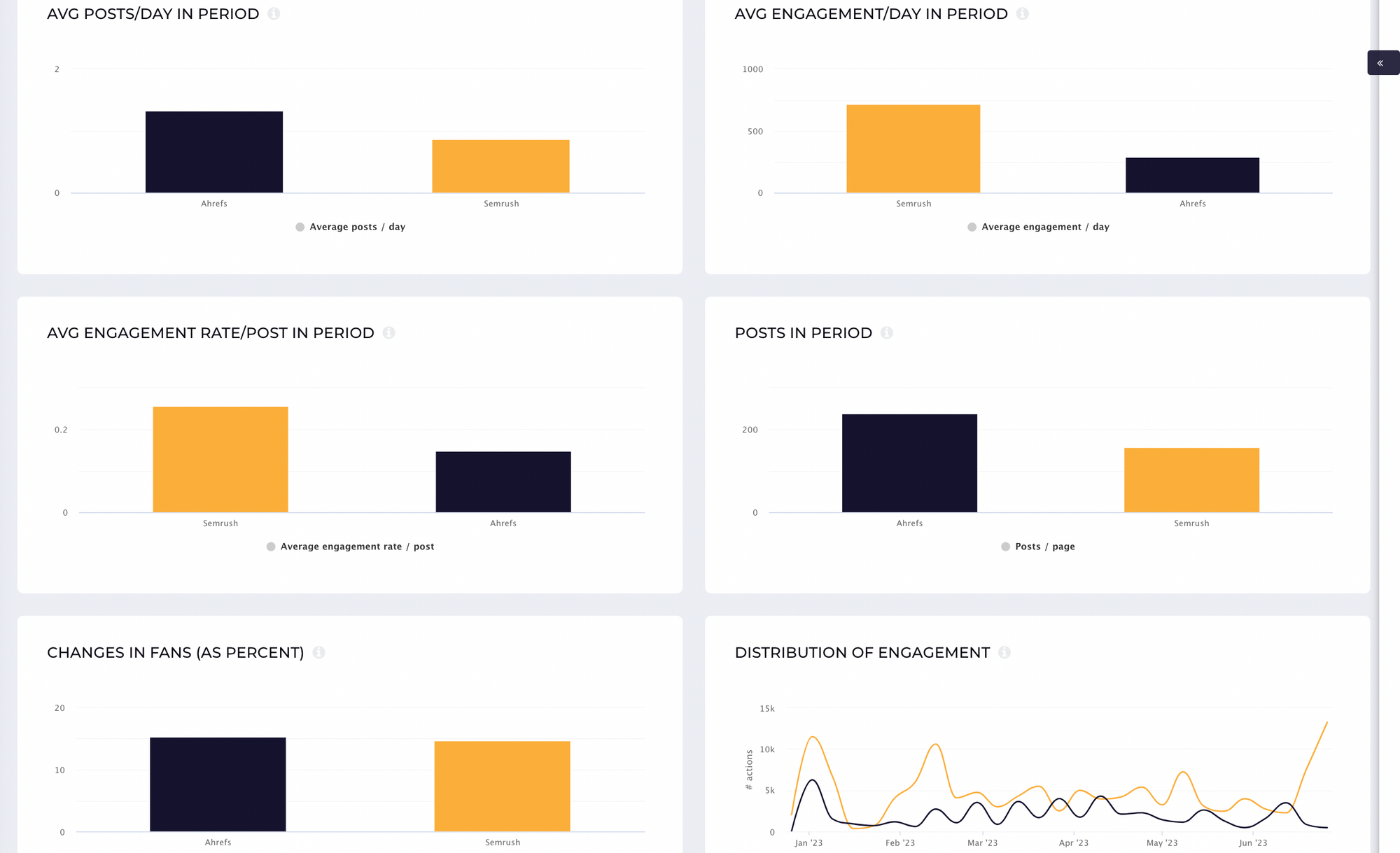
Including all these insights in your marketing pitch deck helps executives get a clearer picture of your performance and how you compare with your rivals.
Moreover, all the data provided by Socialinsider’s social media analytics tool will provide you with tons of actionable insights to help you improve your strategy before pitching your ideas.
Final thoughts
Drafting a social media pitch deck for executives isn’t about showmanship. It’s about telling the truth clearly enough that people finally stop hand-waving and start deciding. When you strip away the fluff—the fancy templates, the buzzwords, the “here’s our content pillars again” slides—what you’re really doing is saying, “Here’s what’s happening, here’s why it matters, and here’s how we fix it.”
That’s it. That’s the job.
And yes, it can feel uncomfortable to point out gaps. But the alternative is worse: staying silent while competitors outrun you simply because your team never had the tools or visibility to keep up.
FAQs about social media pitch decks
What should be included in a social media pitch deck?
Here are the infos you should include in your social media pitch deck:
- Map the field and assess competitors
- Explain your process
- Add infos from your case studies
- Keep things concise
- Add visuals
- Personalize your pitch deck and proposal
Andreea Udescu
Content writer with 7 years of experience in digital marketing. When I’m not writing, I like to go on coffee dates with friends, dabble in poetry and fill my house with flowers.

Analyze your competitors in seconds
Track & analyze your competitors and get top social media metrics and more!
You might also like





Improve your social media strategy with Socialinsider!
Use in-depth data to measure your social accounts’ performance, analyze competitors, and gain insights to improve your strategy.