Social Media Goals: 10 Examples, How to Set Them + SMART Framework
Set social media goals with a 6-step framework, 10 examples, a goals-to-KPI map, and realistic growth targets backed by real benchmarks.

High engagement. More followers. More leads from social.
Every head of social has all three on their list, and trying to hit them all at once is exactly why quarterly reviews turn into seven half-explained numbers instead of one clear win.
My advice for you? Pick one goal instead, and everything else gets easier to defend to leadership: your content plan, your budget ask, your next headcount request.
In this guide, I'll walk through the 6-step process for setting a goal that actually holds up, the SMART framework, 10 goal examples mapped to KPIs, and how to set realistic growth targets based on real benchmarks instead of guesswork, with input from social media leaders: Irina-Alexandra Drăguțu, social media specialist at Clinica Sante.
Key takeaways
- Setting a social media goal that holds up starts with naming the business tension it's meant to solve, then translating that into one or two measurable outcomes validated with the SMART framework.
- Social media goals should match each platform's strength: LinkedIn for thought leadership and B2B lead generation, TikTok and Instagram for awareness and community, and Facebook and X for customer service and real-time engagement.
- Realistic social media growth goals are set by anchoring targets to your own historical performance, platform-specific benchmarks, and actual posting capacity, not to an arbitrary number that sounds good in a planning meeting.
How to set social media goals
Social media goals are the specific, measurable outcomes, like brand awareness, engagement, lead generation, or revenue, that a social media strategy is built to hit, validated with the SMART framework and tracked through a defined set of KPIs.
Most teams agree with that in theory, but turning a vague ambition into something this specific is usually where the process breaks down.
Based on my experience, I'll give you below a 6-step, tried-and-tested process marketers use for setting social media goals that actually hold up under scrutiny.
Step 1: Start with the business tension, not the goal
Most people jump straight to goals like "increase followers." That's the fastest way to create a social media marketing goal that sounds nice but does nothing for the business. Start with the tension instead.
Ask yourself, "What problem is social supposed to solve this quarter?"
Maybe your leads are low quality. Maybe decision-makers barely know your brand. Maybe repeat purchases are flat. Maybe the sales cycle moves at the speed of a Sunday nap. Whatever the tension is, name it. This instantly grounds your goal in reality and sets you up to create a social media strategy goal that actually drives revenue.
Step 2: Identify the behavioral change you want in your audience
Every social media strategy goal comes down to one simple idea. You want your audience to do something.
Before you pick metrics, figure out what that behavior is. Ask yourself, "What do I want people to do differently because of my content?"
Do you want them to trust you more? Inquire more? Click more? Stay longer? Share your posts without being asked? Once you name the behavior, everything else becomes clearer.
This step saves you from choosing metrics that look impressive but do nothing to move your audience toward your actual social media objectives.
For example, instead of saying, "we want to increase engagement," figure out first what that means for your brand. Irina mentioned looking for signs like:
The real indicators of connection are the actions that require more effort. When someone leaves a thoughtful comment, asks a question, answers your poll, or shares a personal experience, that matters. Saves and shares are even more telling. People only save content they find genuinely valuable, and they only share what they believe others should see. And then there are private messages. When someone reaches out directly after seeing a post, that's a sign of trust and genuine interest.

Step 3: Translate the desired behavior into 1-2 core social outcomes
Once you know the behavior you want from your audience, turn it into a clear outcome. This is where your social media marketing goal starts taking shape and where it stops being a vague ambition and becomes something you can actually plan against.
Maybe you want to become top of mind. Maybe you want to strengthen thought leadership. Maybe you want people to consider your product more seriously. Maybe you want to drive trial sign-ups or demo requests. Pick one or two outcomes and stop there.
Each outcome points you toward the right KPIs.
Step 4: Choose only the metrics that directly tie to the outcome
Now that you have your core outcome, pick the metrics that actually prove you achieved it. Not the ones that look fancy or the ones everyone else is tracking.
It's time to be really selective and stick to the ones that tie straight back to your outcome.
For example, if your outcome is brand visibility, your metrics might be reach, profile visits, and shares. If your outcome is product consideration, you might track demo clicks or time spent on key pages.
This step saves you from bloated social media dashboards filled with numbers. And most importantly, it keeps your team focused on a handful of selective KPIs instead of everything at once.
Step 5: Set "lagging" and "leading" goal pairs
I've seen most social media marketing objectives fall apart because they only target the result. Those KPIs are your lagging metrics. They tell you what happened after the work was done. While they're helpful, they're not enough. You also need leading indicators, the inputs that make the result possible.
Think of it as pairing the destination with the route.
Here are some examples:
- Lagging goal: 300 demo requests Leading: 3 expert videos/week + 2 customer stories/month
- Lagging: 10% increase in reach Leading: 5 Reels/week + trending audios + collaboration posts
This helps your team stay on track and know what inputs they need to focus on.
Step 6: Stress-test your goal using the "Would leadership care?" check
A goal is only as strong as its impact on the business. So before you lock anything in, run it through the most honest filter you have. Would leadership care?
I generally ask these three questions to see if my social media strategy goal is actually worth it:
- Does this metric tie to revenue, trust, or pipeline?
- Will this goal influence any real decisions?
- Would achieving it actually change something for the business?
If the answer feels shaky, I go back, refine it, and anchor it closer to what the business values.
Validate your goals using the S.M.A.R.T goal framework
Before you finalize your social media goals, run them through the SMART framework. It helps you turn broad ambitions into smart goals for social media that are easier to execute, measure, and communicate to stakeholders.
For example, instead of writing a vague social media marketing smart goal like:
❌ Grow our LinkedIn presence
Write:
✅ Increase LinkedIn engagement rate by 15% over the next three months by publishing four thought leadership posts per week, supporting our goal of generating more qualified B2B leads.
A smart social media goal gives your team a clear direction, defines how success will be measured, and makes it easier to demonstrate the impact of your social media marketing strategy to leadership.
Getting into the habit of writing social media marketing smart goals this way, instead of one-line ambitions, is what makes quarterly reporting painless instead of a scramble.
10 social media goals examples
Maybe you have one overarching goal or a handful of smaller ones. If you're unsure how to shape your goals for social media marketing, or you want some clarity, the examples below will help.
Here are 10 common goals for social media, the metrics that actually matter for each one, and practical ways to achieve them.
#1. Goal: Increase brand awareness
This goal is all about getting your brand in front of the right people consistently. The more familiar they are with you, the easier every future conversion becomes.
Metrics to track:
- Reach: Reach shows how many unique people your content is getting in front of.

One thing I like about Socialinsider is that, beyond the raw reach number, it also offers an evolution for your reach across diferent timeframes, to easily identify sudden changes, together with a posts' format performance breakdown, to understand which content type is more effective for this particular goal.
- Profile visits: It tells you how many viewers were curious enough to explore your brand page beyond a single post.
Use this metric to gauge whether your content sparks enough interest to make users take further action. Also, optimize your bio, highlights, and pinned posts for stronger first impressions.
- Follower growth: Reflects how many people see your post, page and hit the "Follow" button to stay connected with your brand long term.
And here's something you should know: while native platforms don't offer extended past data, Socialinsider's estimates can help you ace reporting whenever you need trend tracking.

How to achieve/exceed this social media goal?
- Build creator partnerships into the plan, not as a one-off: Partnering with voices your audience already trusts buys credibility and reach faster than organic content alone. Budget for it as a recurring line item.
- Set an explicit expectation for share-worthy content: A portion of each month's output should be built to be passed along, not just liked. Review what actually gets shared and feed that back into the next brief.
#2. Goal: Boost engagement
You set this goal when you want people to interact more with your content. It signals that you have a strong, participative community and helps your brand gain more visibility across platforms.
Metrics to track
- Engagement rate: This shows how many people actively interact with your content compared to how many saw it.

A tip that I have for you is to compare your engagement rate to previous periods to see whether you're heading in the right direction. And one of my favorite things about Socialinsider is that I can compare even with my direct competitors.
- Comments: Comments reveal depth of engagement and how willing people are to start conversations with your brand.
Track them to identify content that sparks dialogue, questions, or strong reactions.
Irina goes a step further and talks about how she labels quality comments:
I also pay attention to meaningful comments versus generic reactions. It's one thing to get a flood of "Love this!" or emojis, but it's something entirely different when people ask follow-up questions, challenge an idea, or share their own experience related to the topic you shared on social media. That kind of engagement usually comes from people who are actively thinking about the problem your product/service solves.
- Saves: It indicates content that audiences find valuable enough to revisit later.
I use this metric to double down on formats that deliver strong educational or inspirational value.
Irina mentioned saves as an important metric to track when she talked about engagement as a goal. She said,
I take saves into consideration because they are a strong signal that your content is useful enough for someone to return to later — and buyers who are in research mode tend to save a lot. When a post gets a high number of saves relative to its reach, I know I've created something that speaks directly to a real need or pain point. So, I know that piece of content attracts the right buyers.
- Shares: They show that your content is compelling enough for someone to pass it along to others.
High share numbers help expand your reach organically and boost algorithmic visibility.
- Completion rate: It tells you how many viewers watched your video content from start to finish.
It's a strong indicator of content quality and is often rewarded with greater reach by the algorithm.
Irina talked about this metric when she said:
When people watch a video (until the end or 70-80%) or swipe through every slide, it shows a level of interest that goes far beyond casual scrolling. Buyers who see value in what you're saying tend to stay with you until the last frame.
How to achieve/exceed this social media goal?
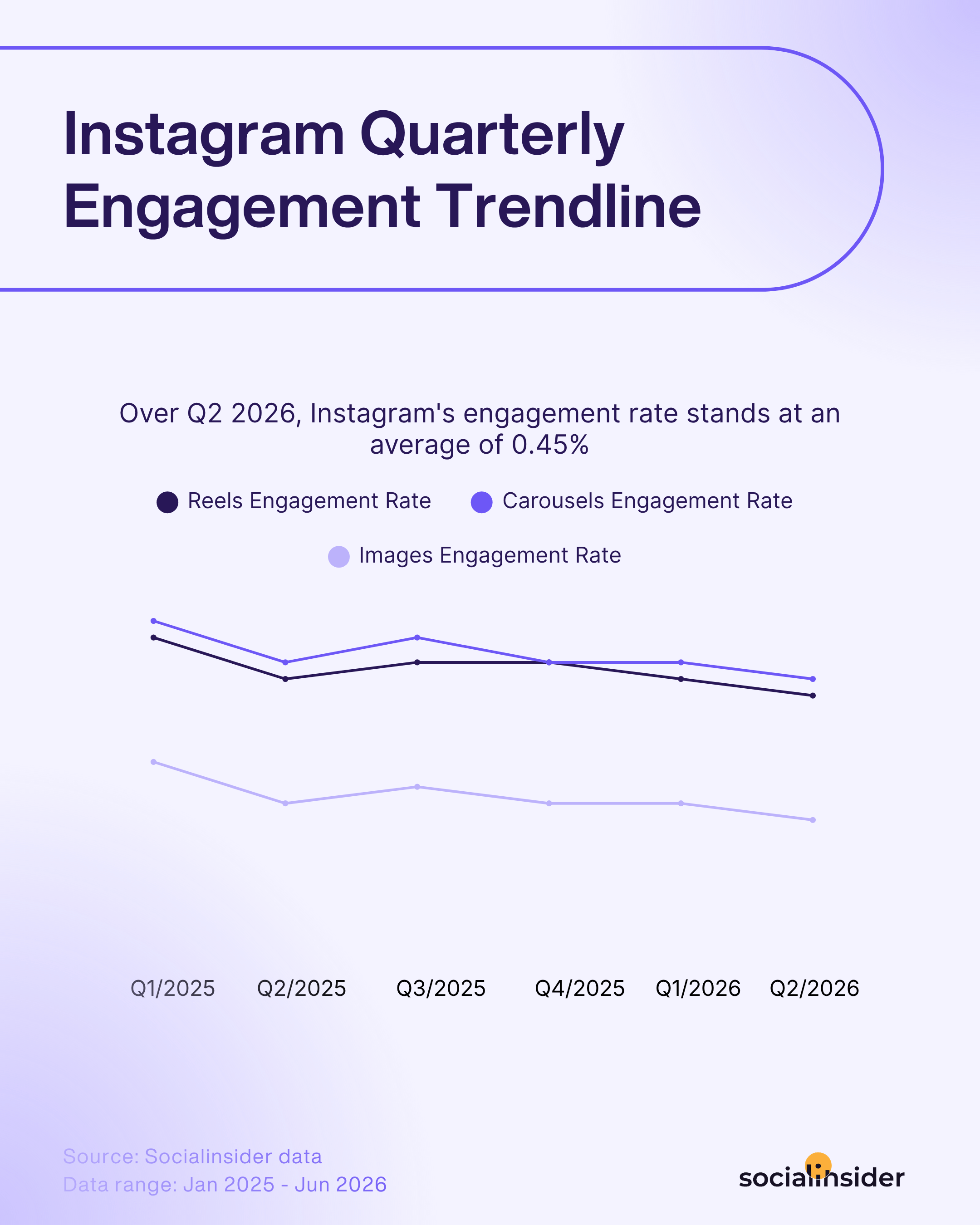
- Push your team to test carousels and multi-photo formats where the content allows: According to Socialinsider's social media benchmarks reports, this format lifts engagement, by letting you pack more value into a single piece of content.
- Review pillar-level performance with your team on a set cadence: Instead of leaving it to instinct, look at which content pillars consistently drive engagement and which ones flop and capitalize on that. Socialinsider gives you an automated summary so this doesn't eat a full afternoon.

#3. Goal: Strengthen brand credibility and trust
You set this goal when you want your audience to see your brand as reliable, knowledgeable, and worth paying attention to.
It helps your audience choose you over competitors.
Metrics to track
- Positive sentiment: Track how often conversations around your brand lean positive versus neutral or negative.
Rising positive sentiment signals growing trust and healthier brand perception.
- Testimonials or UGC volume: More user-generated content and testimonials mean people feel comfortable associating publicly with your brand.
This is one of the strongest signs of trust and social proof.
How to achieve/exceed this social media goal?
- Prioritize customer transformation stories in the content pipeline: Before-and-after wins and real results are strong social proof, and they're worth the extra sourcing effort even though they take longer to produce than standard posts.
- Build an employee-as-creator program rather than a one-off ask: Letting real people front content is one of the highest-trust formats available, but it needs ongoing coordination and buy-in from other team leads, not a single campaign.
#4. Goal: Drive website traffic
You set this goal when you want social media to actively send people to your website, landing pages, or blog.
This gives your brand more opportunities to convert.
Metrics to track
- Link clicks: This tells you how many people took the first step from social to your site.
- CTR (Click Through Rate): CTR shows the percentage of viewers who clicked after seeing your content.
How to achieve/exceed this social media goal?
- Brief for curiosity-driven carousels with a clear link-in-bio close: Don't leave the CTA as an afterthought. Ending on a deliberate "link in bio" prompt is what actually nudges people to keep looking on your site.
- Coordinate with SEO and content so social amplifies pages already built around real search demand: This is a cross-functional win that's easy to leave on the table when social and content operate in silos.
#5. Goal: Generate leads from social
You set this goal when you want social media to do more than create buzz and actually bring in qualified prospects.
It focuses on turning attention into action so your channels start generating steady inquiries, sign-ups, and high-intent leads.
Metrics to track
- Form submissions: Tracks how many people are willing to share their information after engaging with your content. It's a direct indicator of lead interest and conversion potential.
- Demo requests: Shows how many viewers are ready to look at what your product or service offers. Demo requests often signal high intent and stronger lead quality.
How to achieve/exceed this social media goal?
- Put a recurring live product workshop on the calendar: It's a direct, low-cost way to move interested viewers toward a demo request without waiting on a bigger campaign.
- Treat creator and influencer endorsements as a lead channel, not just an awareness play: Measure them against lead quality, not reach, and hold partners to that standard.
#6. Goal: Build a community of loyal followers
You set this goal when you want more than followers. You want a group of people who engage consistently, advocate for your brand, and feel genuinely connected to what you create.
Metrics to track
- DM conversations: Frequent, meaningful DMs show that people trust your brand enough to talk privately. These conversations can turn casual followers into true community members.
- UGC volume: User-generated content reflects how excited people are to create content for your brand. More UGC means your community feels connected and proud to represent your brand.
How to achieve/exceed this social media goal?
- Put one feedback or story-sharing prompt on the calendar every week: A poll, a "caption this," or a "tell us your experience with X" post. It's cheap to produce and consistently pulls in replies and shares.
- Build a monthly "featured follower" slot into the content calendar: Have someone track standout comments, tags, and UGC weekly, then pick 2 to 3 to feature each month, whether that's a dedicated post or a Story repost.
#7. Goal: Increase sales or conversions from social
This social media goal is all about directly driving purchases, sign-ups, or other measurable conversions from your social platforms.
The main focus is turning your channels into a revenue engine instead of just a visibility tool.
Metrics to track
- Purchases: Tracks how many sales are directly driven by your social content or campaigns. I see it as the most direct indicator of revenue impact.
- Conversion rate: Shows the percentage of social visitors who complete a desired action, like buying or signing up.
- ROAS (Return on Ad Spend): Measures how much revenue you earn for every dollar spent on paid social. I use it to assess the profitability of my advertising campaigns.
How to achieve/exceed this social media goal?
- Prioritize testimonial-based content in the pipeline and treat it as a conversion asset, not just brand content: Real customer wins and reviews reduce hesitation at the exact point prospects are deciding.
- Have your team build direct product comparison content: Clear, honest comparisons shorten the evaluation cycle for prospects further down the funnel instead of leaving them to search elsewhere.
#8. Goal: Enhance customer support experience
This goal focuses on improving how quickly and effectively you respond to customer questions or issues on social.
A smoother support experience boosts loyalty and keeps frustrations from escalating.
Metrics to track
- Response time: Measures how quickly you reply to customer questions or issues on social. Customers want faster responses from brands.
- Support-related DMs: Counts the number of people reaching out for help privately. This helps you understand demand, identify recurring issues, and improve your support workflow.
- Public sentiment: Monitors how customers feel about your brand in comments and mentions. I take a rising positive sentiment as a reflection of smoother and more helpful support interactions.
How to achieve/exceed this social media goal?
- Have your team track recurring questions and convert the top ones into proactive content monthly: This is what actually reduces repeat-question volume over time, instead of just responding faster to the same questions.
- Put monthly FAQ Lives on the calendar as a standing commitment: Not an ad hoc response to a spike in complaints, but a recurring part of the support workflow.
- Invest in DM auto-reply infrastructure: This keeps first response time consistent regardless of staffing coverage or time zone gaps.
#9. Goal: Build thought leadership
This is a social media marketing goal I see senior social teams underinvest in, even though it's often what makes every other goal on this list easier to hit. If your organization wants to be seen as an authority in your space, thought leadership needs its own line item, not a byproduct of "posting more."
Thought leadership is especially valuable for B2B companies, where buying committees quietly research a brand's people long before anyone books a demo call.
Metrics to track
- Executive post engagement: Likes, comments, and shares on posts published from leadership profiles, not just brand accounts.
- Follower growth on executive profiles: A growing personal audience for your leaders signals rising industry influence.
- Social share of voice: How often your brand and its leaders get mentioned relative to named competitors in industry conversations.
- Earned mentions: Podcast invitations, press coverage, or speaking opportunities that trace back to social visibility.
How to achieve/exceed this social media goal?
- Publish original research or data: Original data, even a small internal dataset, tends to get cited and shared far more than generic advice content.
- Run an employee advocacy program: Equip your subject matter experts with talking points, not scripts, and let them post in their own voice.
#10. Goal: Attract candidates for open roles
Using social media to fill open positions is a form of conversion that's easy to overlook when you're focused on demand generation, but for growing teams it's a real social media marketing goal in its own right.
Metrics to track
- Applications per platform: Which channel is actually sending qualified candidates your way.
- Employer brand engagement: Comments and shares on culture, team, and behind-the-scenes content.
- Quality of applicants: How many social-sourced candidates make it past the first screening round.
How to achieve/exceed this social media goal?
- Share real employee stories, not stock culture content: Career journeys, day-in-the-life content, and honest team spotlights outperform polished recruiting ads.
- Feature the actual team members who'd be a candidate's future colleagues: People want to know who they'd be working with, not just what the office looks like.
- Encourage employee advocacy for open roles: A role shared by an actual team member reaches further and converts better than a brand post.
How social media goals differ by platform?
Not every platform is built for the same social media objectives, so it's worth tailoring your goals for social media channel by channel rather than copying the same KPI set across all of them.
- LinkedIn: Best suited for thought leadership, B2B lead generation, and recruiting. Prioritize engagement from decision-makers and lead form completions over raw follower count.
- Instagram: Strong for brand awareness, community engagement, and increasingly, social commerce. Track reach, engagement rate, and shopping activity.
- TikTok: Built for awareness and reaching younger, discovery-driven audiences. Video views, shares, and follower growth are the metrics that matter most here.
- Facebook: Still effective for community management, customer service, and local awareness. Group engagement, Messenger response rates, and referral traffic are worth watching.
- X (Twitter): Better suited to real-time engagement, customer service, and industry conversation than long-term brand building. Response time and mention volume are the useful signals.
Matching the goal to the platform's strength, instead of running identical social media marketing goals across every channel, is one of the fastest ways to make a flat-looking strategy start showing results again.
How to set realistic social media growth goals?
One of the fastest ways to lose credibility with leadership is setting a growth target that has no relationship to your actual starting point or your industry's realistic ceiling.
A few things I check before locking in any realistic social media growth goals:
- Your own historical trend, not just the last 30 days. A single strong month can make a target look conservative when it's actually a fluke.
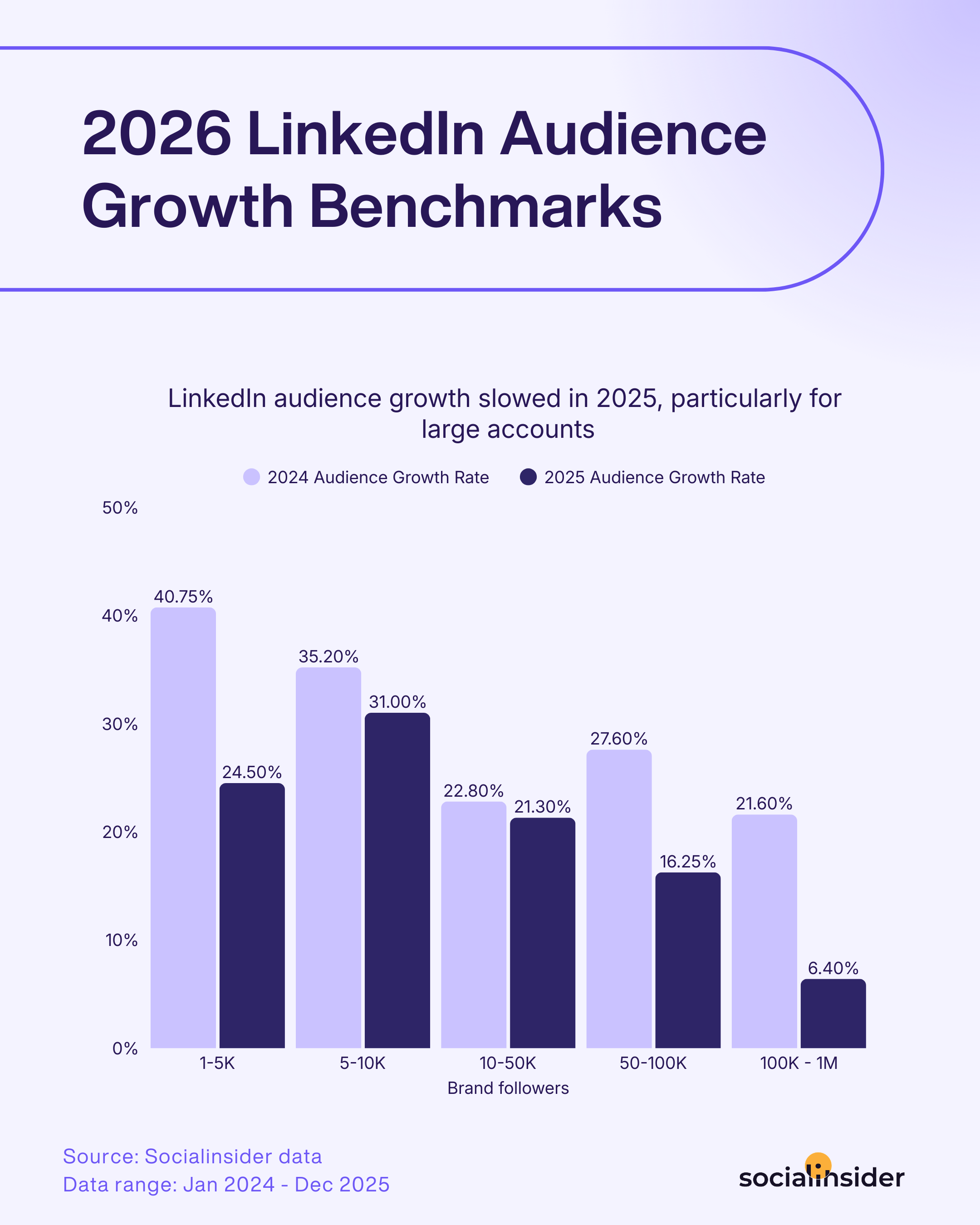
- Platform-specific benchmarks. Growth on TikTok looks nothing like growth on LinkedIn, so borrowing one platform's target for another sets the team up to miss.
- Where your competitors currently sit. If your closest competitor is growing 3% a month and you're targeting 20%, that's a conversation worth having before the target gets locked into a quarterly OKR, not after.
Realistic doesn't mean unambitious. It means the goal survives contact with an actual algorithm change, a slow news month, or a competitor's viral moment, and sooner or later, all three will happen.
Common goal-setting mistakes and how to avoid them
You don't want to spend hours crafting social media goals only to stumble over mistakes that are completely avoidable. Here are five common pitfalls and how to sidestep them.
- Focusing solely on output metrics instead of outcomes: Tracking likes or views without tying them to a meaningful result leads to vanity goals. Always link your metrics to the behavior or business result you actually want.
- Not accounting for algorithm changes and platform evolution: Social platforms shift constantly, so smart social media goals based on outdated assumptions fail fast. Build flexibility into your strategy so you can adapt when features, reach, or formats change. This is also where social media smart goals age fastest: a target built around last year's algorithm rarely survives this year's update.
- Failing to connect social performance to business impact: If your social media strategy goals don't map back to revenue, loyalty, or pipeline, leadership won't take them seriously. Every social target should clearly support a wider business priority.
Final thoughts
Setting social media goals becomes easier once you stop guessing and start working with a structure. I recommend beginning with the business tension, defining the behavior you want, choosing the outcome that matters, and matching it with metrics that prove progress.
Also, remember to review your goals often and let data guide your next move instead of relying on gut feeling.
If you want a simple way to track your social media goals and understand what's actually working, subscribe to our 14-day free trial at Socialinsider.
FAQs on social media goals
How often should you review your social media goals?
Review key metrics weekly, review tactic performance monthly, and revisit whether the goal itself still makes sense quarterly. Annual-only reviews leave no room to course-correct while a target is still reachable.

Nidhi Parikh
Having worked with several brands in the social media space, Nidhi writes about all things social. With 13K followers on LinkedIn, she's always up for a chat about books or her next travel plan

Know what your competitors do — before your manager asks
Get instant social benchmarks & reports without manual work.