Top 5 Metrics CMO Actually Cares About in Social Reporting
Find the 5 social media metrics CMOs truly care about. Learn how to connect reporting to business impact, and turn data into strategic insights.

Every month, social teams spend hours building detailed reports packed with charts, post-level stats, and platform breakdowns. Then the meeting starts and the first question from the CMO is simple: “What does this mean for the business?”
I have seen how quickly a beautifully designed social media marketing report loses attention when it fails to connect social performance to real impact.
The truth is, CMOs want clarity and proof that social is moving the needle instead of more metrics and dashboards.
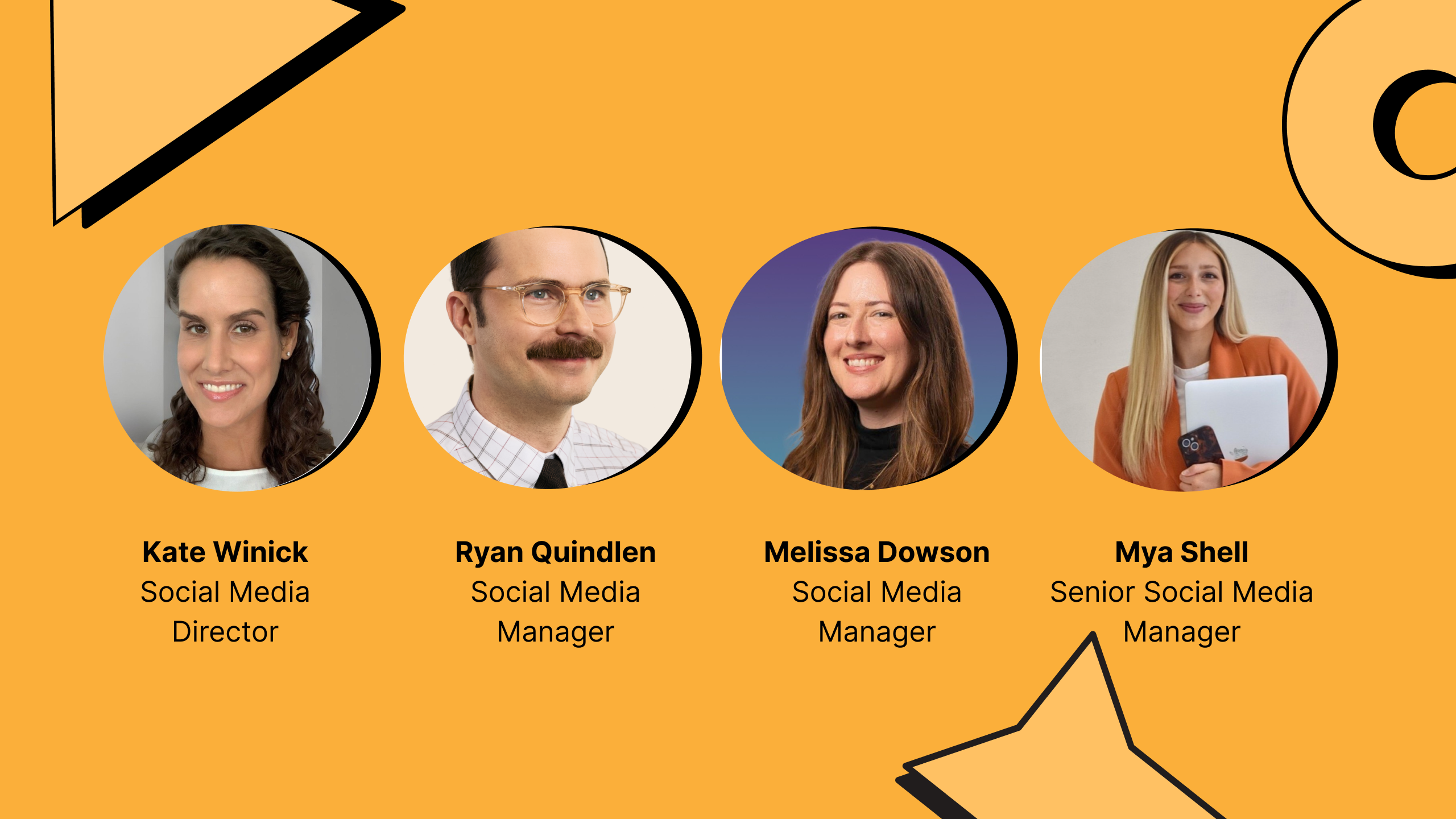
In Socialinsider’s recent Live session, we unpacked the social metrics that capture a CMO’s attention. In this article, I’ll break down the insights shared by:
- Melissa Dawson, Social media manager at Western Digital
- Mya Shell, Senior social media manager at Quill
- Ryan Quindlen, Social media manager at Zapier
- Kate Winick, Social media director at Klaviyo
Key takeaways
-
Why most social media reports fail with CMOs?
Most social media reports fail because they focus on vanity metrics and channel details instead of clearly connecting performance to business impact, competitive context, and revenue growth. -
5 social media reporting metrics CMOs actually care about: CMOs care about metrics that prove social’s contribution to revenue, competitive position, high-quality engagement, audience growth within target segments, and long-term brand sentiment.
-
What kind of framework CMOs actually care about in social reporting? CMOs respond best to a simple Objective–Outcome–Opportunity framework that ties social performance to business goals and clearly outlines what actions to take next.
Why most social media reports fail with CMOs?
I have seen most social reports fail because of three key reasons:
- Too many vanity metrics: Reports often highlight likes, impressions, and follower counts without explaining what they actually contribute to growth.
These numbers can look impressive, but they rarely show how social supports revenue, brand demand, or customer acquisition. Without clear business relevance, social media performance metrics feel disconnected from decision-making.
- Too much channel focus: Many reports dive deep into platform-by-platform performance instead of presenting a unified story.
CMOs are not evaluating Instagram versus LinkedIn in isolation. They want to understand how social performs as a whole and how each channel contributes to broader marketing goals.
- Too little business context: Social results are frequently presented without tying them to campaigns, launches, or company objectives.
When performance is not connected to what the business was trying to achieve, it becomes difficult to judge success or decide what to do next.
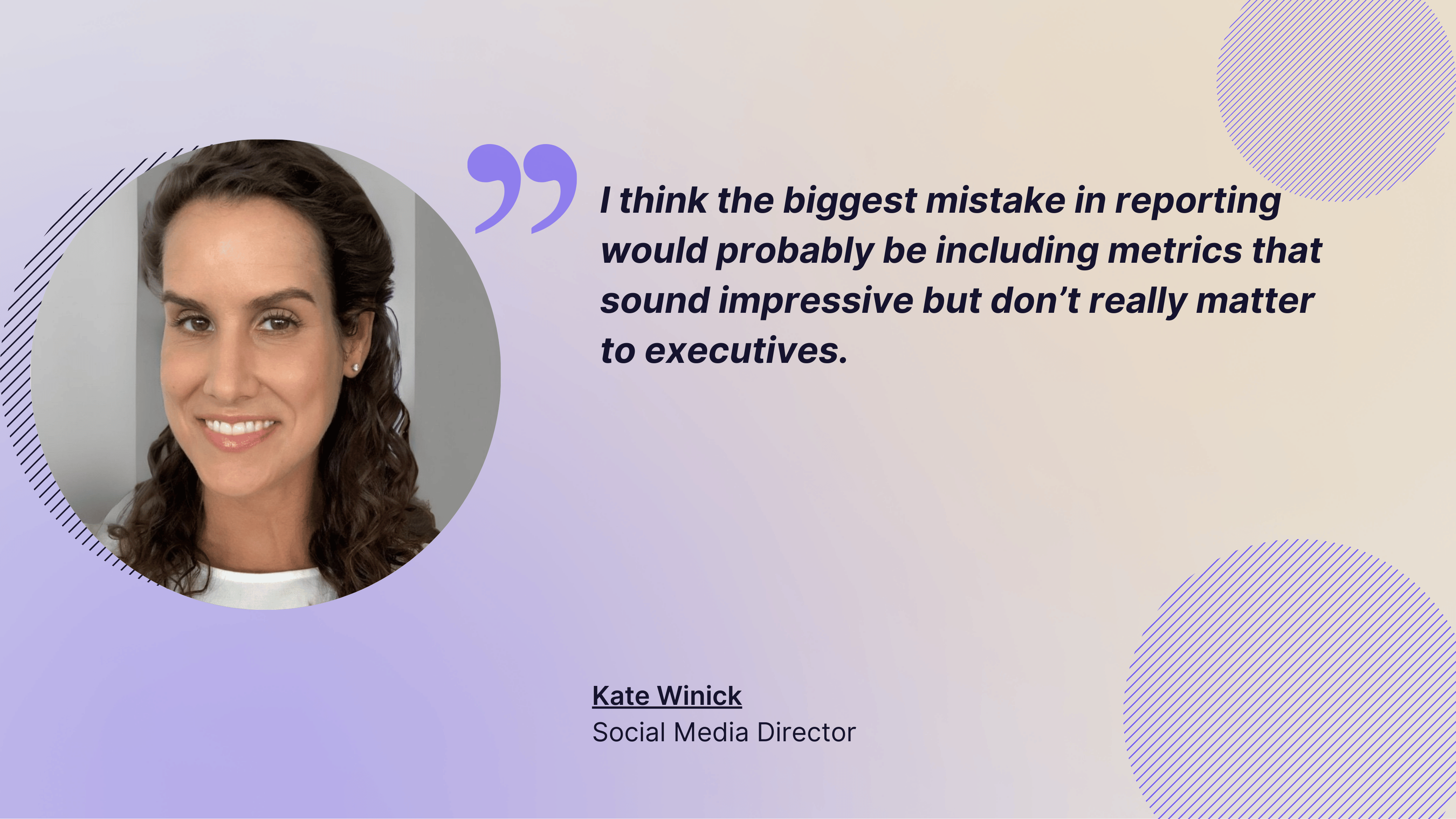
Kate talked about the same —
I think the biggest mistake would probably be including metrics that sound impressive but don’t really matter to executives. To me, the place for that is your resume, not your reporting. It’s about making sure you highlight metrics that actually have some meat to them and that you can clearly explain and justify both the numbers you’re reporting and the reason you chose them.
5 social media reporting metrics CMOs actually care about
After listening to many of our customers and talking with social media strategists and managers, here are five kinds of metrics you should include in your report.
Attribution and revenue influence
When a CMO reviews a social report, the first instinct is to connect activity to revenue.
I have seen campaigns that looked strong on engagement but failed to generate any meaningful pipeline. That gap raises immediate questions about the role social is playing.
Direct attribution is not always clean, especially across longer journeys, but influence can still be tracked in a credible way.
Here are the social media strategy metrics you can track to understand social’s impact:
- Leads from social: Track how many qualified leads originate from social channels. This helps position social as a demand generation driver rather than just a visibility channel.
- Email captures: Measure how social contributes to growing your owned audience. Email signups signal intent and create opportunities for deeper nurturing.
- Asset downloads: Monitor downloads of ebooks, reports, or guides driven by social. These actions indicate mid-funnel engagement and interest in your offering.
Kate talked about measuring these metrics when she said —
I am in B2B, where the sales cycle is much longer and much more complicated. So even if direct sales isn’t something you’re able to attribute to social, you still need some form of attribution, whether that’s tracking email captures or downloads of a valuable asset that you know is used in the sales process.
- Demo requests: Highlight how many users move from social to requesting a demo or sales conversation. This directly ties social activity to potential revenue.
- Last-touch attribution (UTMs): Use UTMs to track when social is the final interaction before conversion. This provides a clear, trackable link between social efforts and outcomes.
Mya talks about how UTMs largely solve the problem of connecting social to revenue —
Obviously, most companies care deeply about revenue, so the question is how to connect social to it. It’s challenging because there are so many touchpoints. Someone might discover you on social, explore later through other channels, and eventually convert, which makes attribution difficult. It often feels like a maze trying to connect everything back together. One way I approach this is by using UTM parameters and looking at last-touch metrics, so if someone lands on the website and their final interaction was from a platform like Instagram, we can start to draw a clearer line between social and conversions.
Share of Voice and competitive position
Are you actually winning on social, or just growing in isolation? That is the question CMOs care about.
I have seen reports highlight steady gains while competitors quietly pull ahead in visibility and engagement. Without competitive context, performance can feel misleading. CMOs want to understand where the brand stands in the market and whether social is helping strengthen that position.
Melissa also emphasized adding competitor evaluation to the report. She said —
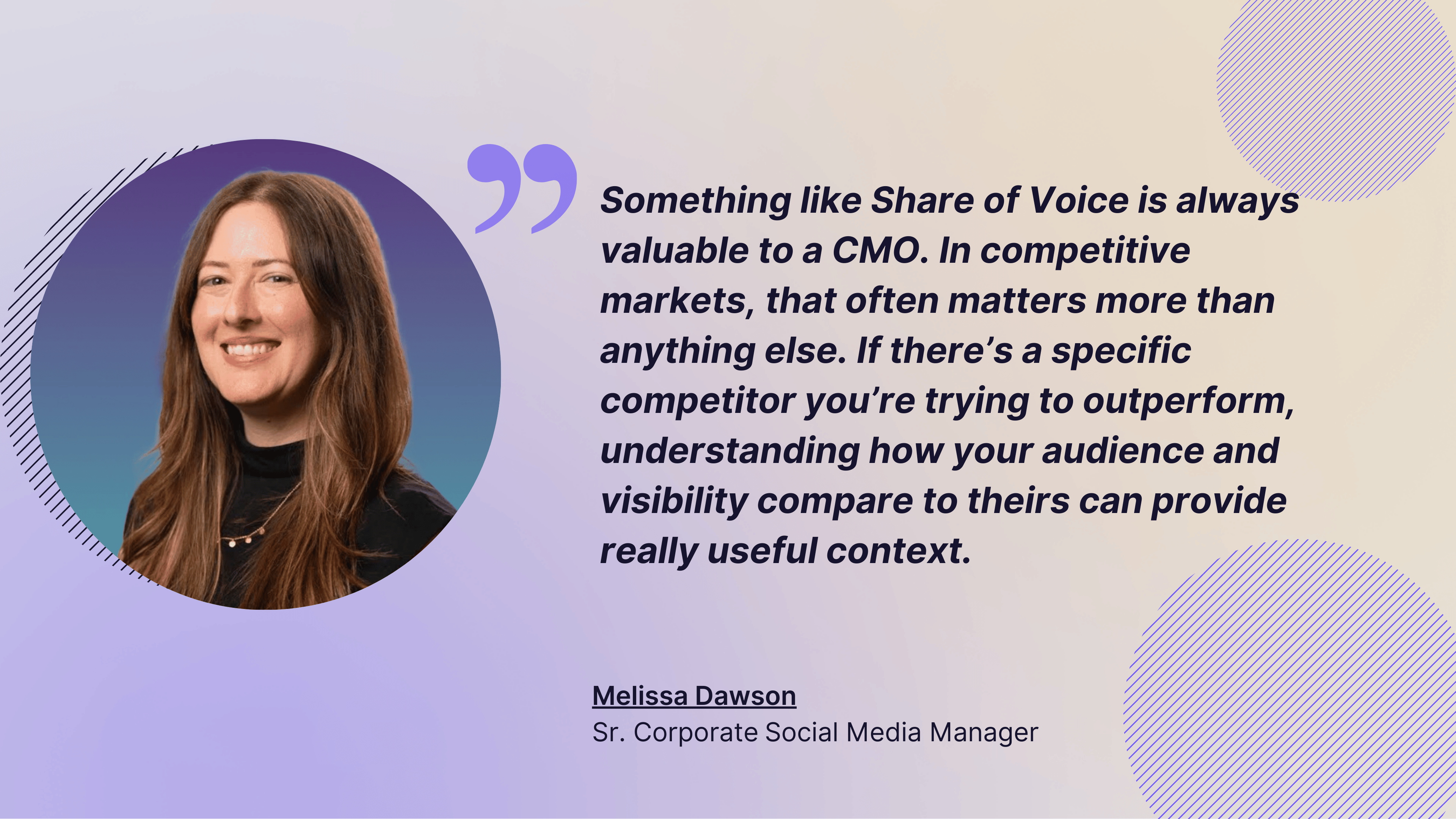
Another thing I would add, which really strengthens the narrative, is including competitive comparisons. If you have access to that data, it can make your report much more complete. For example, LinkedIn is our main channel, and bringing in competitor insights helps us show not just how we’re performing against our past quarters, but how we’re performing relative to others in the space.
Something like Share of Voice is always valuable to a CMO. In competitive markets, that often matters more than anything else. If there’s a specific competitor you’re trying to outperform, understanding how your audience and visibility compare to theirs can provide really useful context.
Competitor analysis tools like Socialinsider help you benchmark performance against competitors, do a side-by-side metric comparison, and even run an industry analysis.
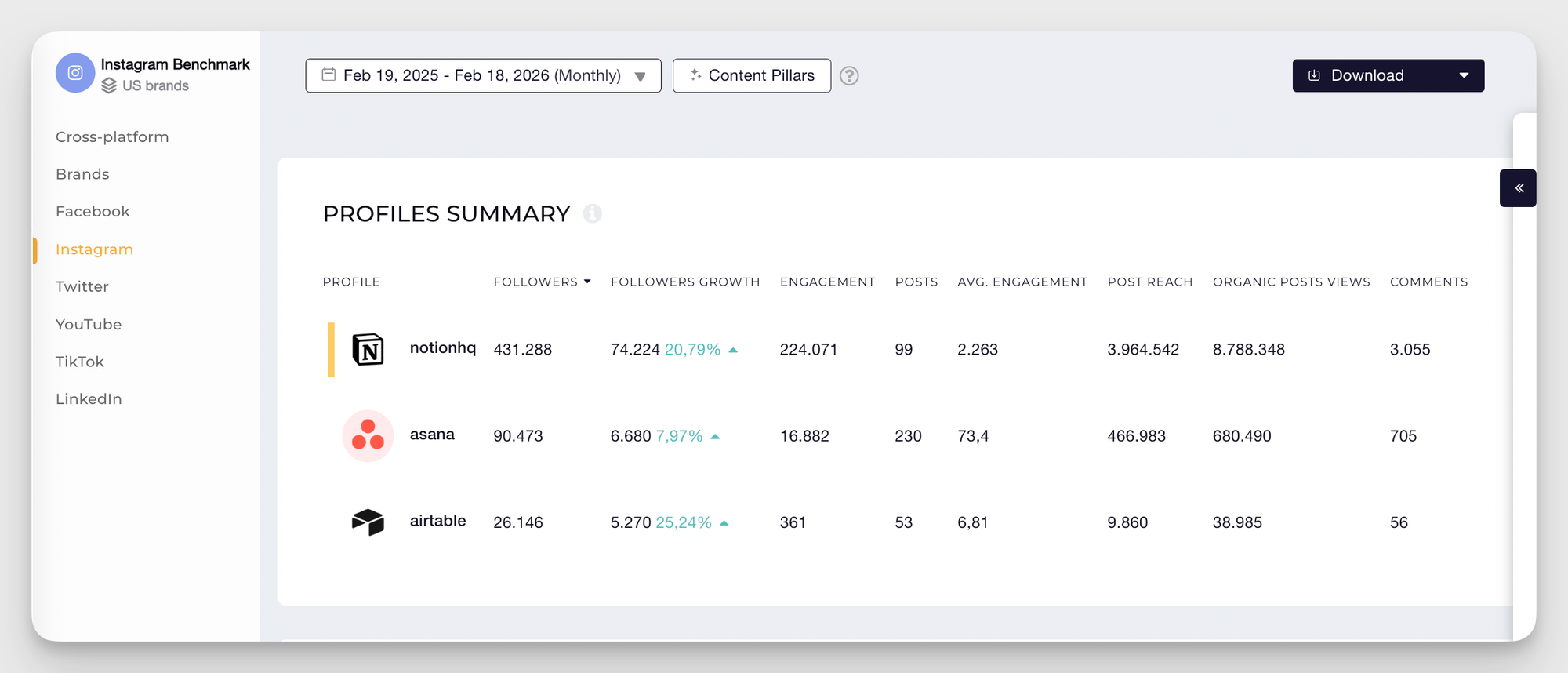
Metrics that you should include in your report:
- Share of voice vs competitors: Measure how much of the total conversation your brand owns compared to competitors. This reflects visibility and relevance within your category.
- Audience size vs competitors: Compare follower growth and total audience size to understand how your brand is scaling relative to others in the space.
- Engagement vs competitors: Benchmark engagement rates to see if your content is resonating more or less than competitors, not just in absolute terms but proportionally.
- Competitive benchmarking: Analyze posting frequency, content formats, and performance trends across competitors to identify gaps and opportunities.
Kate talked about what things you can look for here —
There’s the engagement signal, which can range from standard social engagement metrics that show how your current audience interacts, to more post-level indicators like reach among new followers, watch time, and dwell time that reflect deeper content consumption.
- Brand lift studies (if available): Use brand lift data to understand how social efforts are impacting awareness, recall, and perception compared to competitors.
High-quality engagement
Not all engagement carries the same weight. A post with hundreds of likes can look successful, yet have little impact if it is not reaching the right people.
Leadership can quickly shift focus from volume to quality when they realize social media engagement is not coming from buyers or decision makers. What matters more is who is paying attention and how deeply they are engaging.
Ryan describes how this works at Zapier —
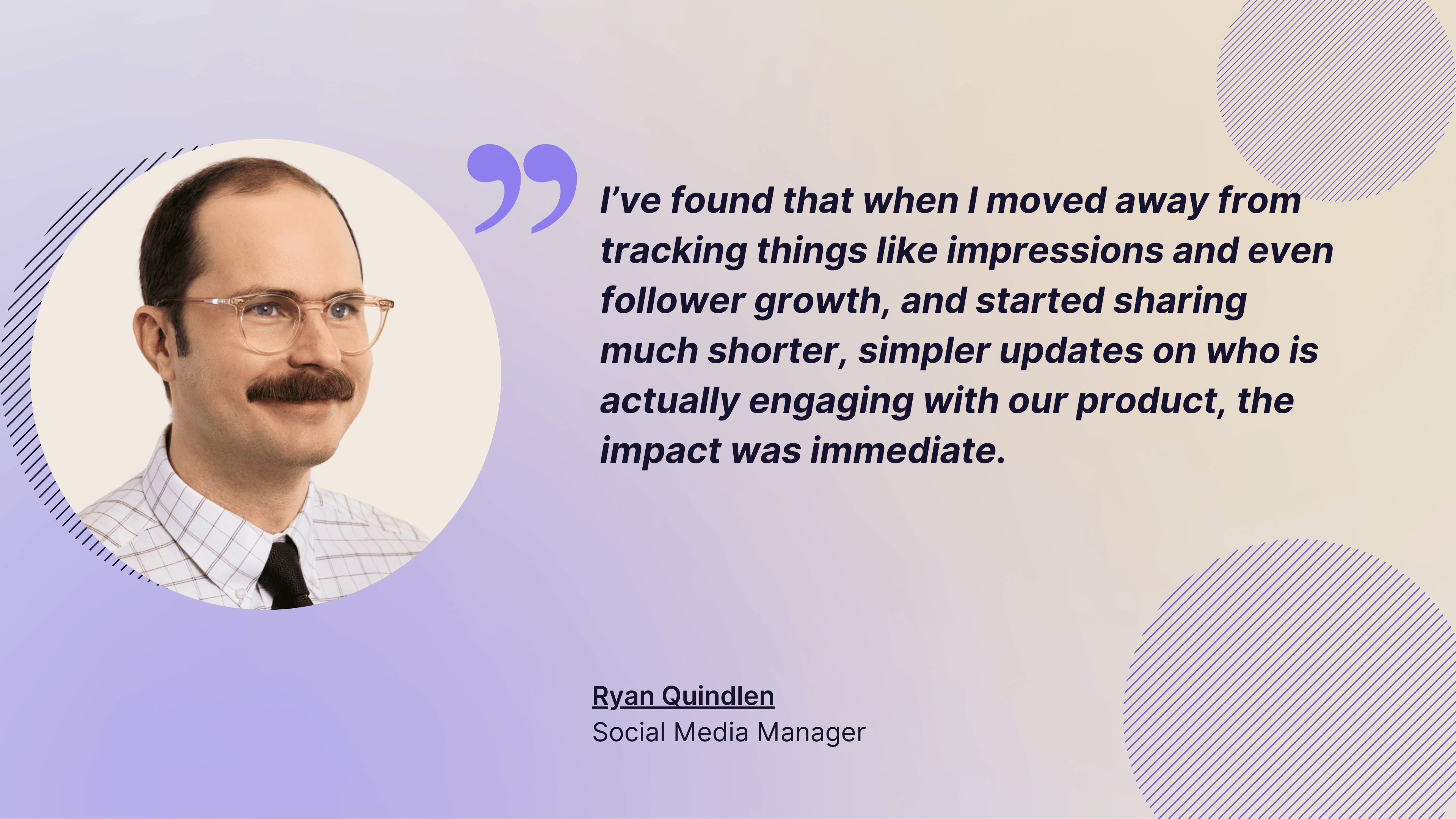
So, I’ve found that when I moved away from tracking things like impressions and even follower growth, and started sharing much shorter, simpler updates on who is actually engaging with our product, the impact was immediate. I shifted almost entirely to focusing on ICP accounts, which leaders from those accounts are engaging with our content, and what they’re engaging with.
That’s when people across the company started paying more attention. Those insights sparked more interest than the usual surface-level metrics, even though we still have them available. Questions like who is engaging the most, which accounts care about which topics, and what content is resonating became far more actionable.
That’s why I keep coming back to this idea: when reporting, always think about how it ladders up to an action or a clear takeaway. It has to be something leadership can use, something that feels immediately relevant to their decisions.
Based on this, here are the metrics to include:
- Engagement from ICP accounts: Track interactions from accounts that match your ideal customer profile. This shows whether your content is reaching the right audience.
- Engagement from decision makers: Measure how often senior roles or key stakeholders engage with your content. This indicates potential buying influence.
- Watch time/dwell time: Look at how long people spend consuming your content. Longer attention signals stronger interest and relevance.
- Reach to new audiences: Monitor how much of your content is reaching users beyond your existing followers, especially within your target segments.
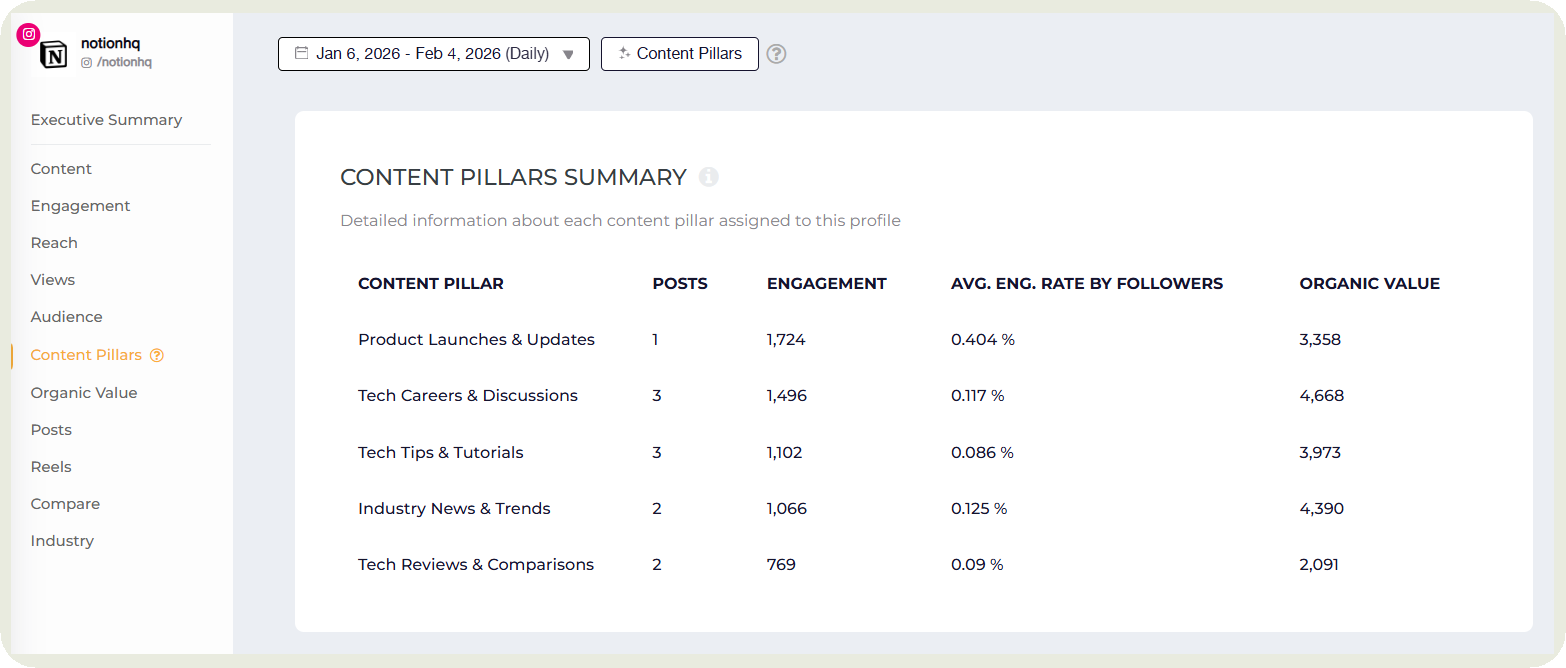
- Topic engagement insights: Identify which themes or topics drive meaningful interactions from your ideal audience, helping refine content strategy. You can do this via the Content Pillar analysis on Socialinsider.
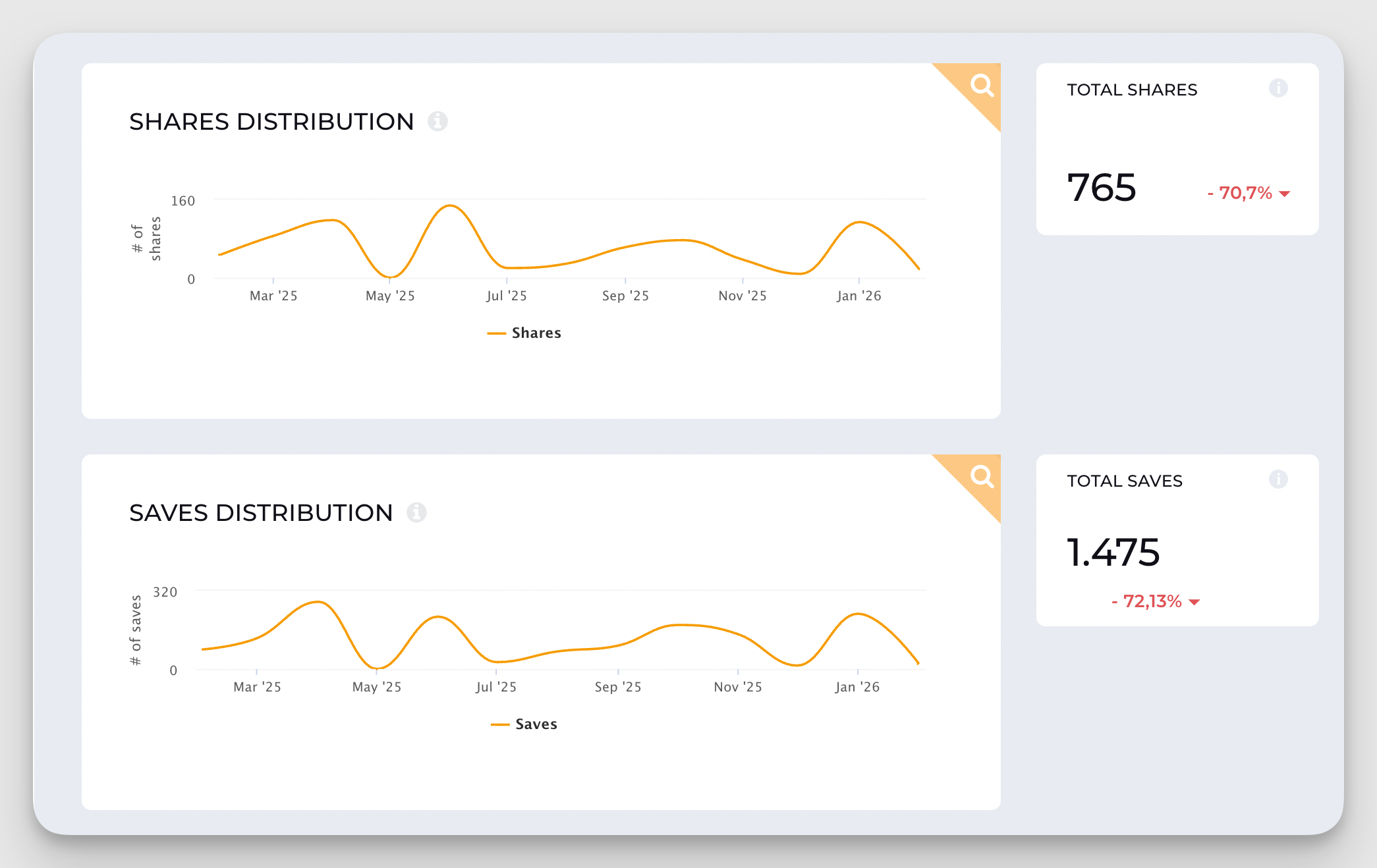
- Shares and saves: Track how often content is shared or saved, as these actions reflect higher intent and longer-term value than passive engagement.
Audience growth and brand awareness
Growth on social only matters when it reflects real awareness among the right audience. You can get thousands of likes or new followers. But would it really matter if your brand remains invisible to the people who actually influence buying decisions?
CMOs care about whether awareness is expanding within target segments and whether that attention is translating into real interest.
For example, Ryan talked about how data from social helped the sales team at Zapier.
I pretty much changed my role with one thing I did a couple of months ago. I ran a small AI pilot where I manually pulled hundreds of people and accounts who had liked or commented on our posts over the past 30 to 60 days, across both executive and brand content.
I connected it with HubSpot, filtered for companies that matched our ICP, and used AI to identify which leaders from those companies had engaged with our content. From there, I put together a short, simple report showing which key prospect accounts and decision makers were already interacting with us. I shared it with sales as a ‘Come and get it’ moment, and the response was much stronger than I expected. Since then, it has really shifted how we think about social.
If one meaningful interaction can lead to a conversation that influences a high-value deal, impressions start to matter a lot less. It also reinforced how important it is for sales and marketing to stay closely connected. There is often a bigger gap there than we realize, and bridging it can unlock some very quick wins.
Metrics to include here are:
- Reach and impressions (in context): Track how far your content is spreading, but always tie it back to campaigns, audiences, or goals to make it meaningful.
- Audience growth in target segments: Measure how your audience is growing within your ideal customer profile, not just overall follower count.
- Brand awareness campaigns performance: Evaluate how specific campaigns contribute to visibility, recall, and top-of-funnel engagement.
- ICP traffic and profile visits: Track how many ideal customer profiles are visiting your social pages, such as LinkedIn, and share those insights with sales. This helps connect awareness directly to potential pipeline and gives teams a clear signal of growing interest.
Customer sentiment and loyalty
What are people actually saying about your brand once they find you? Do your followers remain happy fans or do they drift away? That is where social starts to move beyond awareness and into real business impact.
I have seen how quickly perception, trust, and loyalty shape the outcomes CMOs care about most.
Social often plays a quiet but powerful role across the entire funnel, influencing how customers feel and how they decide.
Below are the metrics that show this impact:
- NPS / sentiment: Measure how people feel about your brand through sentiment analysis or NPS trends to understand overall perception.
- Community health signals: Look at repeat engagement, active followers, and meaningful interactions that indicate a strong and loyal community.
- Social as a discovery channel: Capture insights from customers who say they first heard about your brand through social, reinforcing its role across the funnel and in long-term growth.
What kind of framework CMOs actually care about in social reporting?
Melissa suggested a three-part framework to follow while creating your social media report. It goes like this —
1. Objective: What were we trying to achieve?
We can use a framework that starts with three pieces. First, what was the objective? Whether it was a campaign, a specific post, or even a full quarter, what were you trying to do? And that should always tie back to high-level business goals CMOs care about.
This is where you set the direction. Without a clear objective, social media ROI metrics lose meaning.
- Awareness campaign
- Traffic campaign
- Product launch
- Market expansion
Melissa shared an example. At Western Digital, the objective was to drive awareness around a major shift when the company separated from SanDisk.
The goal was to ensure that a broader audience, beyond just existing customers, understood this change and recognized the brand’s new focus and identity.
2. Outcome — What actually happened?
Second, what was the outcome of what you actually did? What were the metrics, and how did they specifically tie back to that objective? Context is the most important thing.
This is where you connect performance to intent.
- Tie metrics directly to the objective
- Add context around why those metrics matter
- Show whether the goal was achieved and to what extent
In that campaign, success was measured through reach and impressions to understand how widely the message spread, along with engagement to gauge whether people actually noticed and interacted with it.
They also used a brand lift study on LinkedIn to compare awareness before and after the campaign, giving a clearer picture of its real impact.
3. Opportunity — What should we do next?
And then the third piece is opportunity. Your CMO doesn’t just want to know what happened. They’re always thinking about what we’re going to do next.
This is the part that turns marketing performance reporting into action.
- What should we double down on
- What needs to change or stop
- What are the next experiments or bets
Every report should clearly outline how learnings from the campaign will shape the next one. Whether it is refining messaging, doubling down on high-performing channels, or targeting new audience segments, this is what helps CMOs make forward-looking decisions.
How to improve your social media reporting?
Now that we know the framework and the metrics to include in our report, here are four ways to make them more powerful.
- Use analytics tools like Socialinsider: Social media analytics tools like Socialinsider help you go beyond basic metrics by offering competitive benchmarking, industry insights, and performance breakdowns in one place. This makes it easier to track what matters, compare results, and present data in a way that feels structured and decision-ready.
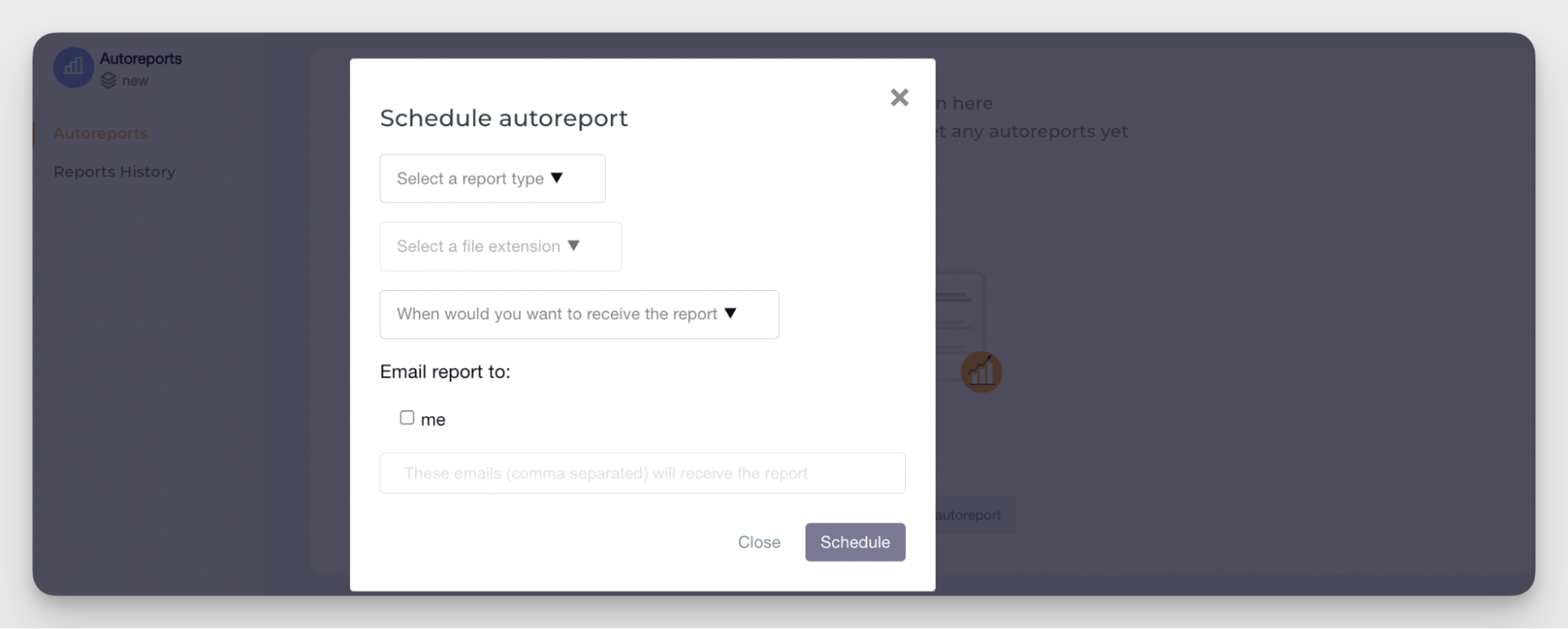
You can even use their Autoreports feature to get daily/weekly/monthly reports delivered to your inbox.
- Turn numbers into a narrative: Raw data alone rarely holds attention. Shape your report like a story by connecting objectives, outcomes, and insights.
When metrics are presented with context and a clear flow, they become easier to understand and far more impactful for leadership discussions.
- Always connect metrics to actions: Every metric should answer a question or lead to a decision. Instead of just reporting performance, highlight what needs to change, continue, or improve.
This ensures your report drives action rather than simply documenting what has already happened.
- Add competitive context: Performance in isolation can be misleading. Including competitor benchmarks helps CMOs understand where you stand in the market.
It brings clarity to whether your results are strong, average, or falling behind, and highlights opportunities to gain a competitive edge.
Final thoughts
Social reporting gets stronger when you start with intent and stay focused on what decisions need to be made next.
Before pulling any numbers, think about the questions your CMO is likely to ask and build your report around answering them. As you do that, keep your metrics tight, your context clear, and your insights tied to specific actions. This naturally opens up better conversations with sales and leadership, helping you align on what actually matters to the business.
Over time, pay attention to which insights drive real discussions and refine your approach around them. And if you need a tool to help get competitive insights or profile analytics, subscribe to a 14-day free trial of Socialinsider.
Nidhi Parikh
Nidhi Parikh is SaaS writer that believes scrolling through social media is research for work. When not working, find her binge watching the latest series or reading anything she can get her hands on.

Analyze your competitors in seconds
Track & analyze your competitors and get top social media metrics and more!
You might also like


Improve your social media strategy with Socialinsider!
Use in-depth data to measure your social accounts’ performance, analyze competitors, and gain insights to improve your strategy.