RivalIQ Alternatives: 6 Tools Reviewed (2026 Edition)
Compare 6 Rival IQ alternatives for social benchmarking, from deeper content analysis to suites that bundle competitor data.

A new competitor just launched in your category, two others are suddenly spending big on social, and leadership wants all three in next month's benchmark.
Simple enough. Except your Rival IQ landscape is already full, and the next step up is a bigger plan.
That's the moment many teams start comparing Rival IQ alternatives. Rival IQ is a capable benchmarking tool, but the way it prices competitor tracking doesn't suit every team.
Below, I look at six alternatives, from dedicated benchmarking tools to suites that bundle competitor data with publishing.
Key takeaways
- Socialinsider helps teams explain competitor performance, with content pillars, an AI assistant and earned media value on every plan, starting at less than half of Rival IQ’s entry price.
- Emplifi bundles competitor benchmarking into a full customer experience suite with unlimited users, but that means buying and rolling out far more than benchmarking.
- Dash Social pairs competitor insights with AI creative predictions for visual-first brands, though benchmarking is just one part of a wider content platform.
- Sprout Social puts a summary of competitor performance next to publishing, the inbox and approvals, but its competitor reports are less detailed than Rival IQ’s.
- Metricool tracks a large number of competitors for very little money, but its competitor data stays at a surface level.
- Quid, Rival IQ’s parent company, goes beyond social benchmarking into market and consumer research, but it’s an enterprise platform with a longer setup.
How does Rival IQ pricing work?
Key takeaway: Rival IQ prices by the number of companies you track, from $239 a month for 10 companies, one user and six months of history up to $559 a month for 40 companies, five users and 24 months of history.
Rival IQ builds everything around "landscapes": groups of companies whose social profiles you track together. Your plan decides how many companies fit in a landscape, how far back the data goes and how many people can log in.
Here's how the plans compare on monthly billing:
- Drive: $239 a month for 10 companies, six months of history and one user.
- Engage: $349 a month for 20 companies, 12 months of history and two users, plus saved listening searches.
- Engage Pro: $559 a month for 40 companies, 24 months of history and five users.
Paying yearly saves about 15%.
The model is easy to follow, and it works well when your competitive set rarely changes. The friction shows up when it does change. Adding a new rival, a sub-brand or a second market can push you into the next plan, even if you only needed one extra company.
Is Rival IQ still independent?
Key takeaway: Rival IQ has been owned by consumer intelligence company Quid since 2021, but it still runs as its own product with separate plans and pricing.
The deal closed in December 2021, when the company was still called NetBase Quid. At the time, Rival IQ promised to keep operating on its own while gradually bringing Quid's listening and AI-powered analytics into the app.
Almost five years later, not much has changed for customers. Rival IQ still has its own website, plans and support team.
Since Rival IQ and Quid are still sold separately, it helps to know what each one covers. Rival IQ compares how brands' social accounts and posts perform, with some basic keyword listening on its higher plans. Quid is a separate, much larger platform that analyzes public conversations across social media, news and the web, mostly for research and insights teams.
So if your team ever outgrows Rival IQ's listening, Quid is the more advanced option from the same company, sold as its own product.
Which Rival IQ alternatives are worth comparing?
Key takeaway: Socialinsider is the dedicated benchmarking tool closest to Rival IQ, with a lower entry price and profile-based tracking; Emplifi, Dash Social and Sprout Social include competitor data in broader social suites; Metricool is the lowest-cost option for light tracking; and Quid suits wider market research.
| Tool | Best for | How it prices competitor tracking |
|---|---|---|
| Socialinsider | Benchmarking a growing or changing competitor set, with reports ready for leadership | By number of profiles, on every plan |
| Emplifi | Global brands running publishing, care and benchmarking in one platform for many users | Included from the Advanced plan |
| Dash Social | Visual-first brands picking which creative to post and checking it against competitors | Included from the Advance plan, quote-only |
| Sprout Social | Teams that want competitor checks, publishing, a shared inbox and approvals in one tool | Per seat, with competitor reports on Professional and up |
| Metricool | Publishing for up to 10 of your own brands while tracking up to 100 competitor accounts, for $25 a month | Up to 100 competitors on paid plans |
| Quid | Research teams studying markets, audiences and emerging trends beyond social | Quote-only |
Is Socialinsider a good Rival IQ alternative?
Key takeaway: Socialinsider is the stronger choice for teams that have to explain competitor performance to leadership: content pillars show which topics drive results, the AI assistant answers questions from your own data, and earned media value ties social to business impact, all from $99 a month, less than half of Rival IQ's entry price.
If your Rival IQ reports keep raising questions the landscape view can't answer, Socialinsider is where I'd look first.
Why it's on the list
Engagement and follower counts only tell you so much. Socialinsider's content pillars go a layer deeper, sorting your posts and your competitors' into themes, whether AI suggests them, you set rules in the Query Builder or you tag posts by hand.

Then each pillar comes with its own numbers, average engagement, and top posts, so you can quickly see which themes are pulling their weight.

Something that I really like is that there’s also an AI assistant built into every plan. You can ask it about your performance or your competitors, and it answers from your own data.
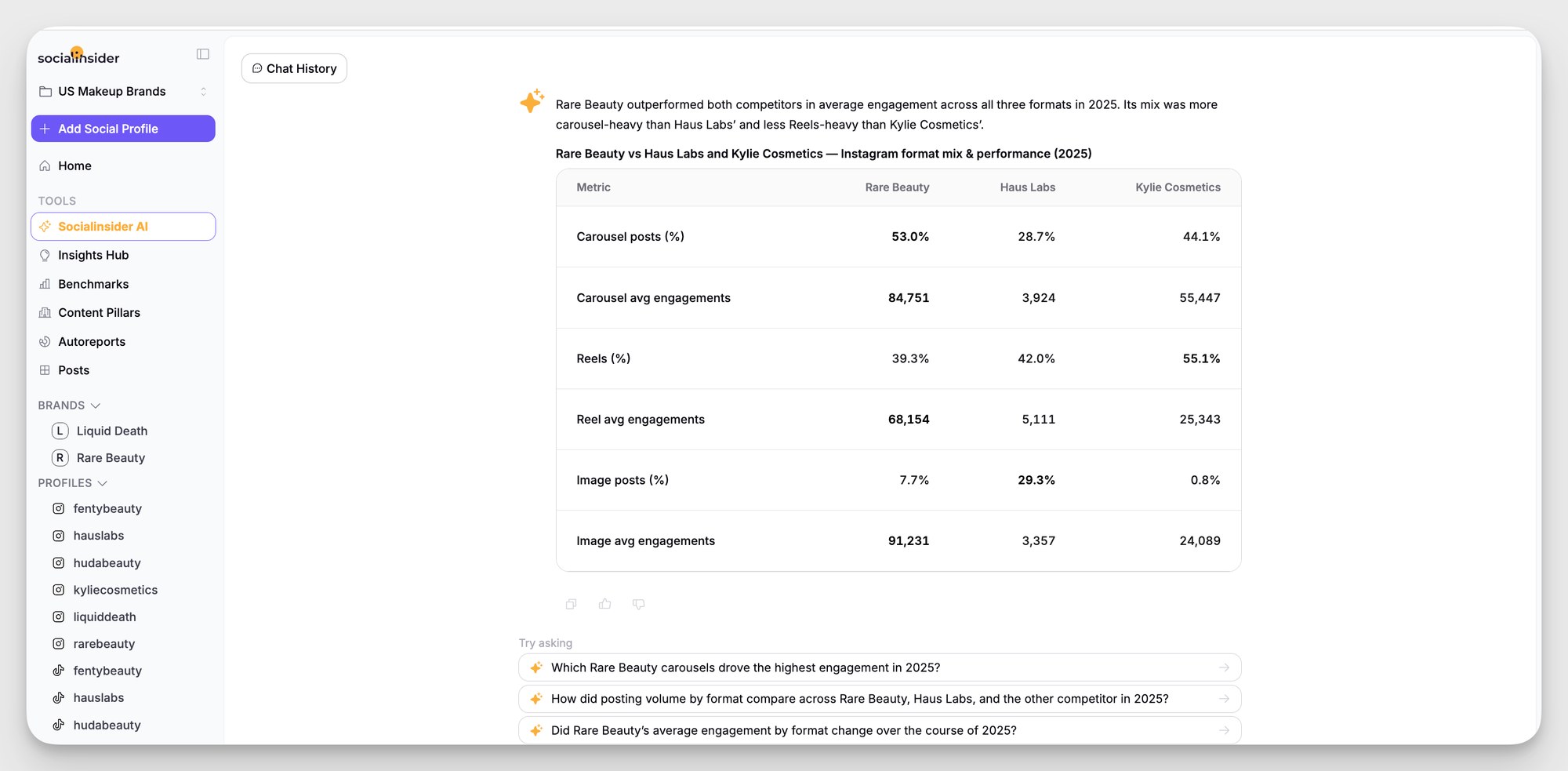
The MCP connector does the same inside Claude or ChatGPT. Rival IQ doesn’t offer either.
And when leadership asks what social is actually worth, earned media value helps. It estimates what your organic results would have cost as paid ads, for your profiles and your competitors’, so the answer comes in dollars.
Where Rival IQ still wins
Paid signals and listening. Rival IQ flags competitor Facebook posts that were likely boosted with ad spend, so you can tell organic wins from paid ones, and its Engage plan adds social listening across sites like Reddit, blogs and news.
Pricing
Adapt costs $99 a month for 20 profiles, one seat and three months of history. Optimize costs $149 a month, and Predict $239 a month for 40 profiles, five seats and 12 months of history. See all plans.
What users say
I like the competition analysis summary and suggestions that Socialinsider provides. The accuracy of the numbers is wonderful, and it gives me a great support to plan my social media strategy and outperform the competition. I find it really helpful to understand the content bucket and approach each of my competitors is taking. Also, knowing what's performing better helps me rework my approach. It's one of the best for competitive analysis, and the initial setup was pretty easy. - G2 reviewer
Worth it if: you want competitor benchmarks that explain results, with earned media value and content insights, at a lower entry price.
Is Emplifi a good Rival IQ alternative?
Key takeaway: Emplifi is a Rival IQ alternative for enterprise brands that want competitor benchmarking inside a full customer experience suite with unlimited users, but benchmarking starts on its $2,499-a-month Advanced plan.
If benchmarking is just one of many jobs your social team does, Emplifi wraps it into a much larger platform.
Why it's on the list
Emplifi wraps competitor benchmarking into a much bigger platform. Next to the benchmarks, you get publishing, community management, customer care and social commerce, plus AI-driven content insights on the Advanced plan.
The other draw is access. Every plan includes unlimited users and owned profiles, so regional teams and brand managers can all work from the same competitor data without anyone rationing logins.

Where Rival IQ still wins
Focus and simplicity. Rival IQ is built around benchmarking, so it’s quicker to set up and easier to live with if competitor data is all you need.
With Emplifi, benchmarking sits on a higher plan of a full customer experience suite, which means paying for, and rolling out, far more than that one job.
Pricing
Essential costs $1,249 a month and Advanced $2,499 a month. Higher tiers and the Care and Commerce products are quote-only.
What users say
Emplifi is a powerhouse tool with reporting, UGC gathering, ratings/reviews, and so much more, all under one "roof". It allows teams to work together in one platform vs have information scattered all over. - G2 reviewer
Worth it if: your company wants one enterprise platform for social, care and commerce, with benchmarking included.
Is Dash Social a good Rival IQ alternative?
Key takeaway: Dash Social is a Rival IQ alternative for creative-led consumer brands that want competitor insights alongside AI content predictions and publishing, but it's quote-only and benchmarking sits on its higher plans.
For brands where the creative matters as much as the numbers, Dash Social pairs competitor data with tools for choosing what to post.
Why it's on the list
Dash Social is built for teams whose biggest question is which creative to post. Its Vision AI predicts how photos and videos will perform before they go live, and since April 2026 it also works inside Canva.
Competitor insights and benchmarking come on its higher plans, and every plan includes unlimited users, so creative, social and brand teams can all look at the same data.

Where Rival IQ still wins
Focus. Rival IQ is built around competitor benchmarking, so its landscapes, leaderboards and post comparisons go further for teams whose main job is tracking rivals.
Dash Social puts creative intelligence first, with benchmarking as one part of a wider content platform.
Pricing
Quote only.
What users say:
From a reporting perspective, we can create custom dashboards and select the metrics we want to track. Social listening is also great as it helps quantify how often our brand is spoken of along with trends in industries and competitors so our team is aware of what campaigns to launch and how certain categories i.e. haircare is doing. - G2 reviewer
Worth it if: you're a visual-first brand that wants creative intelligence and competitor data under one roof.
Is Sprout Social a good Rival IQ alternative?
Key takeaway: Sprout Social is a Rival IQ alternative for teams that want competitor reports inside the same tool they publish from, but its benchmarking covers fewer networks and costs climb per seat.
Some teams would rather not run a separate benchmarking tool at all. For them, Sprout Social puts competitor reports next to publishing, the inbox and approvals.
Why it's on the list
Sprout Social keeps competitor checks inside the tool your team already uses every day. Its Professional plan adds competitor reports next to scheduling, the Smart Inbox and approvals.
For teams that just want a regular pulse on rivals, that means one login, one bill and no extra tool to learn.

Where Rival IQ still wins
Depth. Sprout Social’s competitor reports are designed as a quick summary, giving you a high-level view of how rivals are growing and engaging.
Rival IQ is built specifically for competitive analysis, so it offers more ways to rank companies against each other, spot standout posts and slice the data the way you need.
Pricing
Essentials costs $99, Standard $249, Professional $399 and Advanced $499 per seat a month. Competitor reports start on Professional.
What users say
What I like most about Sprout Social is that it centralizes all of our social media accounts in one platform. This makes it much easier to manage content, schedule posts, monitor engagement, and analyze performance across multiple brands and channels. I also really value the reporting and analytics tools, since they help me spot opportunities, track results, and make more informed strategic decisions. - G2 reviewer
Worth it if: light competitor checks are enough, and you'd rather have them in your publishing tool.
Is Metricool a good cheaper Rival IQ alternative?
Key takeaway: Metricool lets you track a large number of competitors for very little money, but its competitor data stays at a surface level, so it works better as a quick monitor than as a source of real competitive insight.
If cost is your main reason for leaving Rival IQ, Metricool will look tempting. The catch is in what you get for that price.
Why it's on the list
Metricool offers a lot of quantity. Its Starter plan lets you follow up to 100 competitor accounts while publishing for up to 10 of your own brands.
For a quick weekly glance at many rivals, that breadth is hard to beat.

Where Rival IQ still wins
Depth of analysis. Metricool shows how competitors are growing and engaging, and lets you browse their posts, but it doesn't group that content into themes or dig much further into why it works.
That gap matters once leadership asks why a competitor is winning. Rival IQ, and dedicated analytics tools like Socialinsider, are built to answer that question.
Pricing
Free for one brand and five competitors. Starter costs $25 a month and Advanced $67 a month.
What I appreciate most about Metricool is how intuitive and user-friendly the platform is. The interface is well designed, pleasant to navigate, and makes it easy to access a wide range of features, from content scheduling and analytics to reporting and competitor tracking. - G2 reviewer
Worth it if: you mainly need a quick headcount of many competitors and can live without deeper content analysis.
Is Quid a good Rival IQ alternative?
Key takeaway: Quid, Rival IQ's parent company, suits enterprise teams that have outgrown social benchmarking and need deeper consumer and market intelligence, but it's quote-only and far more complex.
Quid makes sense when your team's questions start reaching beyond social media, like how a whole market feels about a product category or which trends are about to take off.
Why it's on the list
Quid looks well beyond social accounts. It uses AI to analyze conversations across social media, news and the wider web, helping research and insights teams understand markets, audiences and emerging trends.
For a team that started with competitor benchmarking and now needs the bigger picture, it's the natural next step within the same company.

Where Rival IQ still wins
Simplicity. Rival IQ is built for social teams, so it's quick to set up and easy to read week to week.
Quid is an enterprise research platform, with a longer setup and a steeper learning curve for teams that only need social benchmarks.
Pricing
Quote only.
What users say
Quid takes complicated data and makes it consumable, I love that! These visualizations are amazing and so insightful — I can spot trends and patterns at a glance, where previous data wrangling would take hours of scrolling and plotting. It saves a lot of time and it streamlines decision-making. - G2 reviewer
Worth it if: your company needs research-grade consumer intelligence on top of social benchmarks.
Should you stay with Rival IQ or switch?
Key takeaway: Stay with Rival IQ if boosted-post signals and built-in listening matter most; move to Socialinsider for deeper content analysis, AI-powered insights and a lower entry price; choose a suite like Emplifi, Dash Social or Sprout Social if you want benchmarking bundled with publishing.
Before you decide, look at your last few competitor reports.
Did they mostly answer "who's ahead?" or "why are they ahead?" The first is easy to get from almost any tool. The second needs content-level analysis, and that's where a dedicated analytics tool earns its place.
Then check what you'd lose by switching. For some teams, that's Rival IQ's paid-post flags or listening. For others, it's simply having competitor data in the same place they publish.
Final thoughts
Rival IQ is a solid benchmarking tool, and for some teams it will stay the right one.
But if your competitor reports keep stopping at the numbers, the bigger opportunity is a tool that helps you explain them. That's where I'd start looking.
Want to see how your current landscape would look in Socialinsider? Add the same competitors and compare during the trial.
FAQs on RivalIQ alternatives
How much does Rival IQ cost?
Rival IQ costs $239 a month for Drive, $349 a month for Engage and $559 a month for Engage Pro on monthly billing. Paying yearly saves about 15%.
Who owns Rival IQ?
Quid, a consumer and market intelligence company, has owned Rival IQ since December 2021. Rival IQ still runs as a separate product with its own plans.
Does Rival IQ have social listening?
Yes, in a limited form. Rival IQ's Engage plan and above include saved listening searches for keywords and hashtags.
Can I move my competitor list from Rival IQ to Socialinsider?
Yes. Add the same public profiles to Socialinsider, and it loads their past posts, 3, 6 or 12 months depending on the plan, so you can start comparing right away.

Elena Cucu
As Content & SEO Manager at Socialinsider, Elena Cucu helps social media leaders make sense of the numbers behind their performance. Featured in TechCrunch, TNW, and ReadWrite.

Know what your competitors do — before your manager asks
Get instant social benchmarks & reports without manual work.

