How to Track Your Instagram Follower History: Essential Tools and Methods
Wondering how to get Instagram follower history? Discover a series of tools and methods that will help you easily access the data you need.

Follower counts move. Quietly at times. Suddenly when something clicks. A reel lands. A campaign rolls out. A few posts miss. The graph shifts anyway.
On Instagram, growth rarely follows a neat path. It climbs in bursts, flattens out, then picks up again when you least expect it. Zoom out, and those movements start to form patterns. Not obvious at first glance, but hard to ignore once you see them.
Follower growth history brings those patterns into focus. It shows what actually happened, when it happened, and how often it repeats. I have used it to get a better sense of what actions are worth repeating again.
To gain a better understanding of how to track and analyze follower growth history, let’s first look into how it has evolved over time.
Key takeaways
-
What does Instagram follower history show? Instagram follower history reveals how your audience grows, drops, and reacts to your content over time by highlighting patterns, spikes, plateaus, and momentum shifts.
-
Why should you track Instagram follower history? Tracking Instagram follower history helps you understand which strategies attract and retain the right audience so you can improve content decisions, forecast growth, and refine positioning.
-
Common mistakes when analyzing follower growth: The biggest mistakes in follower growth analysis are obsessing over short-term fluctuations, ignoring the context behind spikes, and comparing inconsistent timeframes.
What does Instagram follower history show?
Instagram follower count history shows how your audience evolves over time. Not just how many people follow you, but when they chose to, and just as importantly, when they didn’t stick around.
It gives you a timeline of how your community evolved on Instagram.
It reveals:
- Growth patterns: steady, spiky, or flat
- Follower spikes: moments when content or campaigns pulled people in
- Drop-offs: points where interest faded or expectations weren’t met
- Momentum shifts: periods where growth accelerates or stalls
In a nutshell, Instagram following history shows how your audience responded to what you did, across weeks, months, or even years.
Why should you track Instagram follower history?
I have used Instagram follower history to get data that informs my content strategy and even corrects my brand’s positioning. Here’s how.
- Shows content strategy effectiveness: Follower count history for Instagram makes it easier to connect content decisions with actual outcomes. You might notice that every time you post educational carousels, growth ticks up steadily, while meme-style posts bring reach but no new followers. I’ve seen accounts double down on what ‘performs,’ only to realize later that it wasn’t driving growth at all.
- Helps identify growth patterns: Over time, patterns start to repeat. Maybe your account grows in short bursts after campaigns, then slows down for weeks. Or weekends consistently underperform. These patterns aren’t obvious day to day, but Instagram historical follower count makes them visible. Once you spot them, you can plan content and campaigns around what actually works.
- Detects misalignment with brand positioning: Sometimes growth looks fine on the surface, but the audience isn’t the right fit. You might gain followers quickly after posting broad, trending content, then lose them just as fast. That’s a signal your positioning isn’t aligned. Follower history for Instagram helps you see whether you’re attracting people who actually want to stay.
- Enables accurate forecasting: With consistent historical data, growth stops feeling random. If you’ve been gaining 500-700 followers after each promotional campaign, you can estimate future growth with more confidence. I’ve used this to set realistic targets before campaigns instead of guessing numbers that look good but aren’t achievable.
The evolution of follower growth on Instagram
In Instagram’s early years, follower count was treated like a scoreboard. Bigger numbers meant bigger influence, and growth itself was often seen as proof of success. Brands chased visibility, creators chased scale, and “how many followers do you have?” became the defining social media question.
That thinking has shifted. Today, follower quality, engagement, retention, shares, and audience relevance matter equally if not far more than raw growth. Accounts with smaller but highly engaged communities often outperform larger accounts with passive audiences.
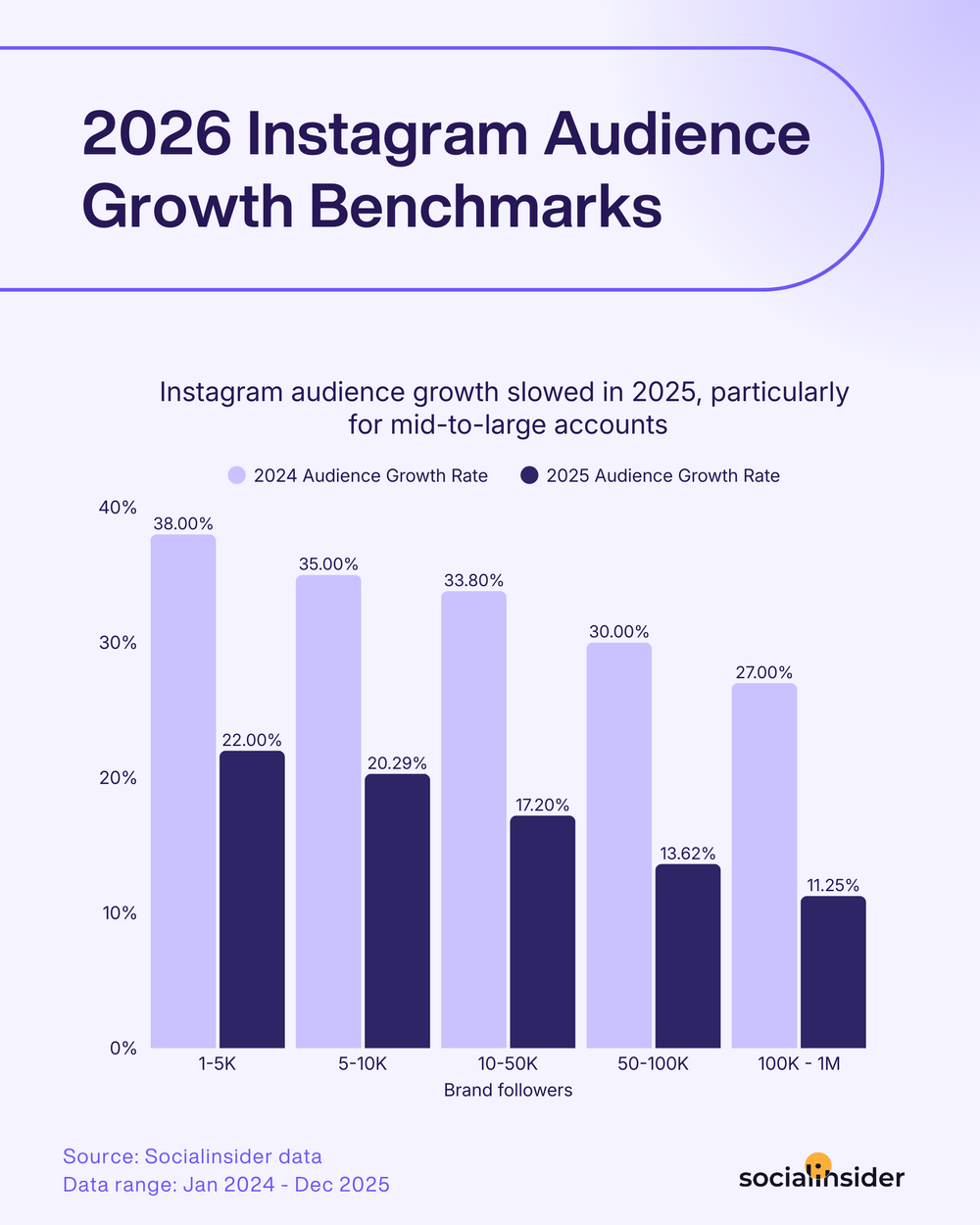
Platforms and marketers alike now prioritize meaningful interaction over vanity metrics.
Growth patterns have changed too. Instagram is now heavily driven by recommendations, Reels distribution, AI-based discovery, and algorithmic amplification. That means brands rarely grow in smooth, predictable lines anymore. Growth comes in bursts. A Reel takes off and follower count jumps overnight. Reach cools down and growth plateaus for weeks. Then another spike appears after a campaign, collaboration, or trending format lands at the right moment.
How to use Instagram native analytics to get follower data
Native Instagram analytics can give you a head start when it comes to follower data. You can get basic-level information to understand what campaigns and content brought what results.
To access Instagram's native analytics (for a business account), go to your main profile page and click on the three lines in the upper right corner of your screen. Head over to ‘Insights’ in the ‘For professionals’ section.
You will see a general overview of the data on the first page. Click on ‘New followers’ to track the evolution of your Instagram followers over a certain timeframe.
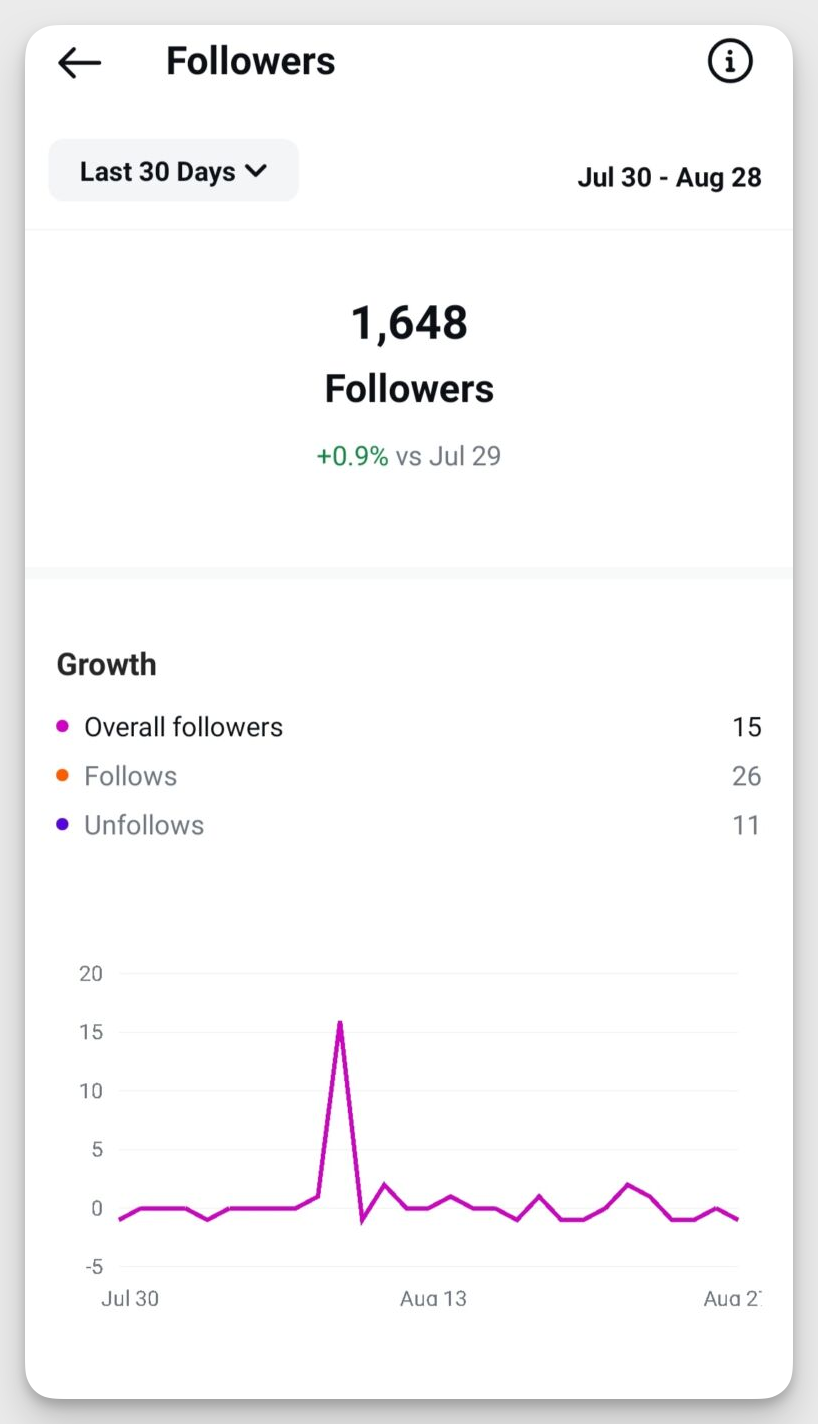
You’ll notice that Instagram only provides historical growth data for a maximum of 90 days. If you need to see more than 90 days of data, native analytics will not cut it.
What you can observe and track though, is:
- Follower details: Follows and unfollows from the last 7, 14, 30, or 90 days
- Top locations of your audience: cities and countries
- Age range
- Gender
- Most active times
You can even access Creator Studio to get limited insights on historical follower count for Instagram in a report format. Log in with your Facebook account that’s linked to your Instagram business or creator profile. Click the Instagram icon at the top of the screen.
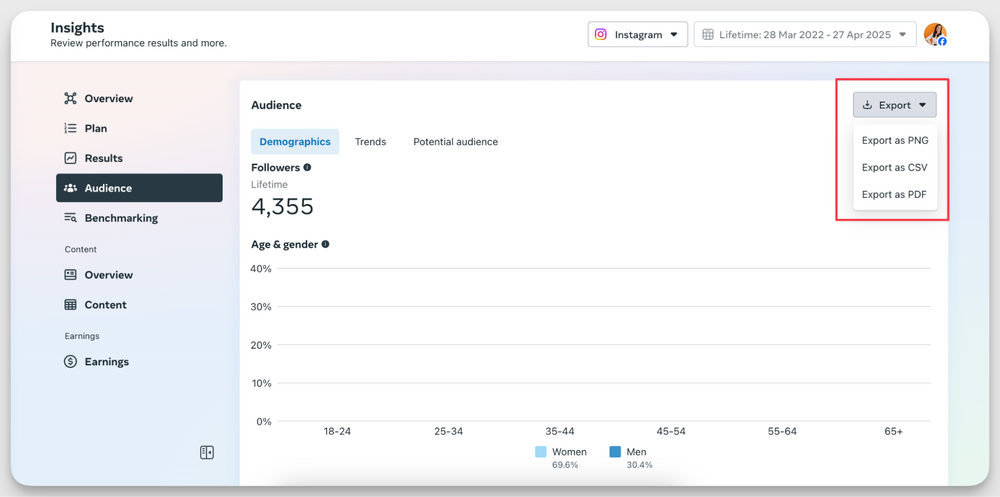
Navigate to the Insights section and click on Audience.
This will show you details like follower count (number, not historical trend), top locations, age range and gender, and follower activity.
Go to Export, and you can get this report in PNG, CSV, and PDF format.
Why do you need third-party solutions for tracking followers on Instagram?
Instagram native analytics can only get you so far. Here are three reasons why we recommend using third-party tools for Instagram followers history.
- Lack of historical follower data. Instagram only shows your current follower count and very limited growth data.
- Limited time window. Instagram Insights usually shows follower data for the last 90 days, with no custom date range options. Third-party platforms can store and display long-term data over months or even years.
- Limited export or download options. The follower graph can’t be exported or downloaded for offline analysis. Contrarily, many third-party tools allow you to export data for reporting or presentations.
While using Socialinsider, you can get historical follower growth for up to 2 years, and you can even set a custom range to track Instagram followers over time.
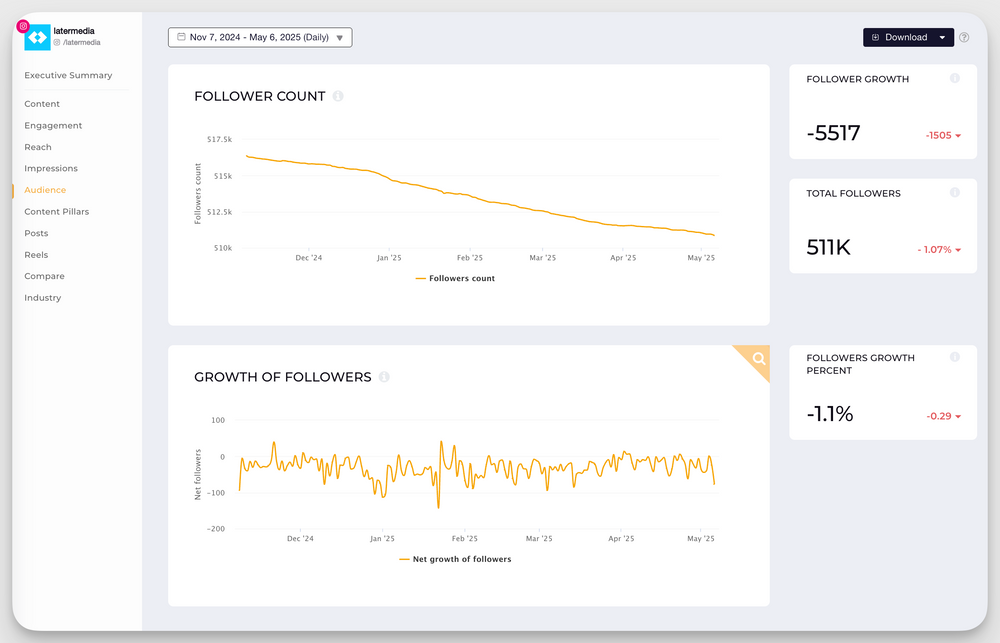
You can download these metrics into PDF, PPT, or CSV formats.
What’s more? You can see how your content strategy correlates with follower growth by getting all content and follower-related insights in one place.
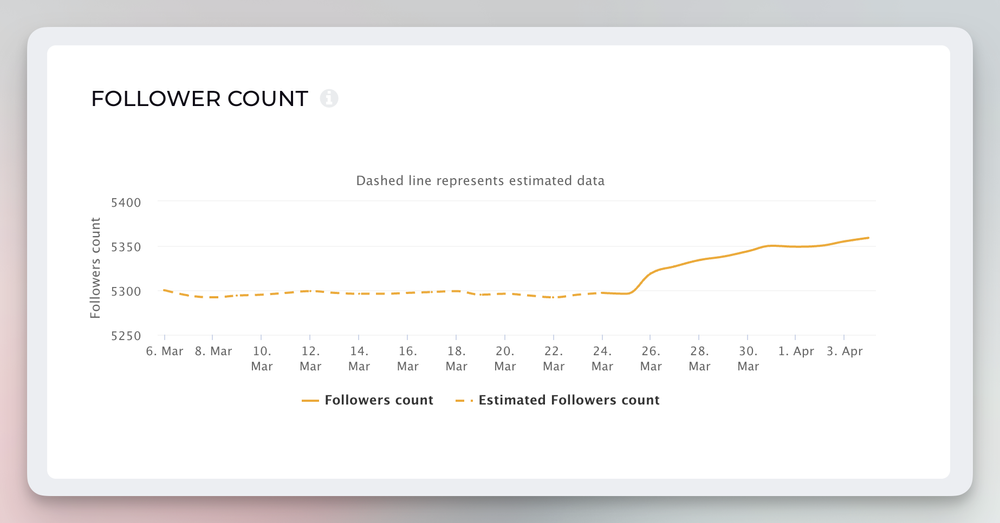
My favorite part? Estimated historical followers data. Due to social media platform API limitations, it's typically impossible to access historical followers from before you started using our tool. But with this feature, we fill these gaps so you can get a more complete view of your account’s growth trajectory over time.
Tools and methods to track Instagram follower history
If you want a detailed history of follower growth over time, you will have to resort to methods other than native Instagram analytics. Here are two methods businesses or creators often use for tracking Instagram followers over time.
Excel/Google Sheets for manually tracking Instagram follower history
Excel and Google Sheets are great options if you want to use free tools. Depending on how granular you want your reporting, you can manually enter the follower counts every week or every month.
You can calculate weekly/monthly changes to see if there’s a gain or a loss from the week/ month before.
Using the built-in chart tools, you can create a line graph of follower growth over time. This makes trends easier to spot, like which content led to spikes.
When to use this method?
- You’re just starting out. For example, if you're a small creator or business with manageable follower numbers.
- You want full control. You can customize your Instagram follower count tracker with columns for posts, engagement, hashtags, etc.
- You don’t want to pay for tools. Most third-party analytics tools are paid. This method is 100% free.
When not to use this method?
- You have thousands of followers. Manually tracking large numbers daily becomes time-consuming and error-prone.
- You need real-time or historical data. Sheets only track what you input. They can’t fetch past data or update automatically.
- You need professional reports. If you're managing social media for clients, they may expect automated, branded reports.
Socialinsider for automated tracking of Instagram follower history
If manually updating a spreadsheet feels like too much work, Socialinsider offers a smart, automated solution for Instagram followers tracking.
The tool helps you see how your followers increase over time. You can even set custom date ranges to track how specific campaigns resulted in a change in followers.
The main drawback is that Instagram provides minimal access to followers' growth evolution.
When you add an Instagram profile to tracking tools like Socialinsider, you cannot retrieve follower count data from before the profile was added — the exact past follower numbers. This is a limitation imposed by Instagram's API, not by the analytics tools themselves. That’s why we built estimates for followers.
Historical follower data helps you:
- Understand long-term growth patterns even if you just started using our tool.
- Correlate past marketing campaigns or events with follower changes.
- Create more comprehensive reports with complete timelines.
- Benchmark performance against competitors with a fuller dataset.
If you’re looking to switch tools, we can get your historical posts into Socialinsider dashboard to get accurate reporting on your data.
Which are the different types of follower growth patterns on Instagram?
Follower growth on Instagram rarely follows a straight line. Most accounts cycle through a few distinct patterns. Understanding which one you’re in helps you decide what to fix, double down on, or completely rethink.
Linear follower growth
This is the cleanest pattern. A steady, predictable increase in followers over time with no major spikes or drops. This is the most stable growth pattern to have but it’s very rare.
What it signals
- Strong content-market fit
- Consistent posting and positioning
- Reliable audience acquisition
What marketers should do
- Scale what’s already working
- Introduce experiments carefully without disrupting momentum
- Layer in distribution tactics like collaborations to accelerate growth without breaking consistency
Spike-driven follower growth
Sharp increases in followers over short periods, usually tied to a viral Reel, campaign, giveaway, or collaboration.
What it signals
- High-performing content or distribution moment
- Strong discovery but not always strong retention
- Dependency on external triggers
What marketers should do
- Analyze what caused the spike (format, hook, topic, timing)
- Turn one-off wins into repeatable formats
- Strengthen profile and content to retain new followers after the spike
Plateau phases in follower growth
Growth slows down or flattens despite consistent posting. There are no major spikes and growth involves minimal movement.
What it signals
- Content is no longer resonating with new audiences
- The algorithm is not pushing content as strongly
- Possible audience saturation
What marketers should do
- Refresh formats, hooks, or storytelling style
- Experiment with new content types like Reels or collaborations
- Re-evaluate positioning to attract a broader or more relevant audience
Volatile growth
Follower growth has frequent ups and downs. For example, you might see follower gains followed by quick drops and there’s no clear trend over time.
What it signals
- Inconsistent content strategy
- Mixed audience signals
- Attracting the wrong audience segments
What marketers should do
- Narrow down niche and messaging
- Align content with a clear audience intent
- Focus on retention and not just acquisition
How to analyze Instagram follower growth?
Those spikes and falls, they can mean a lot of things. Or they can mean just momentary changes in the algorithm. Here’s how to read and get meaningful insights from your follower data changes.
Adopt the trigger analysis method
Start by looking at what caused a spike.
On Instagram, growth is usually triggered by a combination of factors:
- Content: What was the topic or idea?
- Format: Reel, carousel, static post
- Timing: When was it posted?
- Distribution: Was it shared, boosted, or picked up by the algorithm?
For example, if a Reel brought in 1,000 followers in two days, don’t stop at “this worked.” Break it down. Was it the hook? The format? The timing? That’s how you can create patterns that keep bringing new followers to your Instagram account.
Identify meaningful trends vs normal fluctuations
When analyzing Instagram follower growth, it’s important to differentiate between meaningful trends and normal fluctuations.
Small daily changes, like gaining or losing a few followers, are completely normal and often reflect routine user activity or even algorithmic changes.
However, consistent patterns or sudden shifts are worth paying attention to. For example, if you gain over 100 followers across a few days after posting a specific type of content, that suggests a trend driven by audience interest.
On the other hand, if you notice a steady decline in followers every weekend, it might signal something about your posting schedule or content relevance.
In Socialinsider, I can easily click on any upticks or downfalls to see the content that may have resulted in them.
Correlate follower growth with other metrics to get deep insights
Follower growth in isolation can be misleading. You need to look at it alongside other signals.
For example, there's a strong connection between engagement and follower growth. In an ideal scenario, consistent, engaging content encourages shares, brings your profile into more feeds, and builds trust with new visitors.
For example, if a carousel post receives significantly higher comments and saves than usual, you may notice a spike in followers shortly after.
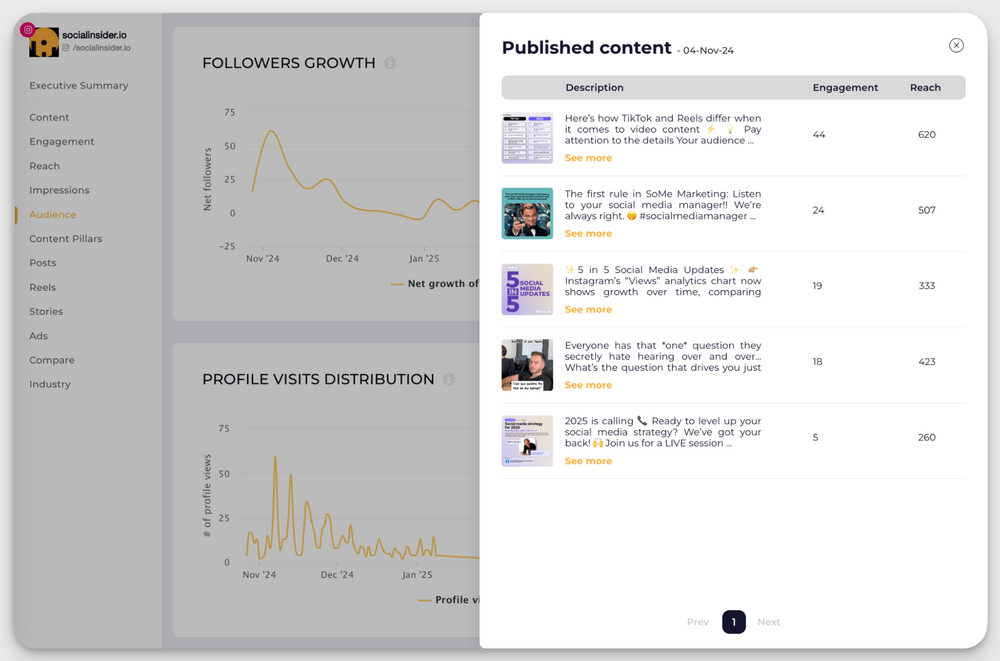
Sometimes, the opposite holds true as well. For example, while we’ve seen a spike in followers for Socialinsider’s account in November, we didn’t see a spike in engagement. This was because the content published in that timeframe had a followers increase objective instead of engagement.
By tracking both Instagram metrics side-by-side using tools like Socialinsider, you can identify which content types drive interaction and growth, and double down on what works.
How to correlate follower growth with audience quality
Just getting a lot of followers is no longer enough. You need to have the right set of people that will engage, share, and buy from your brand over time.
Here’s how I check audience quality .
- Identify low-quality followers: Not all growth is good growth. Sudden spikes after giveaways or viral content can bring in people who don’t care about your content long term. Signs include low engagement, random or inactive profiles, and quick unfollows.
- Check metrics to evaluate audience quality: Look beyond follower count and focus on how your audience behaves. Engagement per follower shows how actively people interact with your content. Reach-to-follower ratio indicates how many followers you’re actually reaching. A healthy account maintains strong ratios even as it grows.
When losing followers is actually a good sign?
A drop in followers isn’t always negative. If you’re refining your niche or shifting positioning, some people will leave. That’s expected. Losing disengaged or irrelevant followers often improves overall engagement and content performance, making your audience more aligned and valuable in the long run.
How to run a competitive analysis of follower growth?
Want to see how you fare against your competitors? What does their follower growth rate show? Can you get more details about their audience? Let’s answer all these questions in the next sections.
Benchmark against competitors with more historical data points
To see your competitors’ follower data and other metrics, you will have to take help from third-party tools such as Socialinsider.
To use Socialinsider for benchmarking, simply add your profile and competitor profiles to the dashboard.
Go to the Benchmarks tab on the left side of the pane, and you will see the profiles you added to the dashboard.
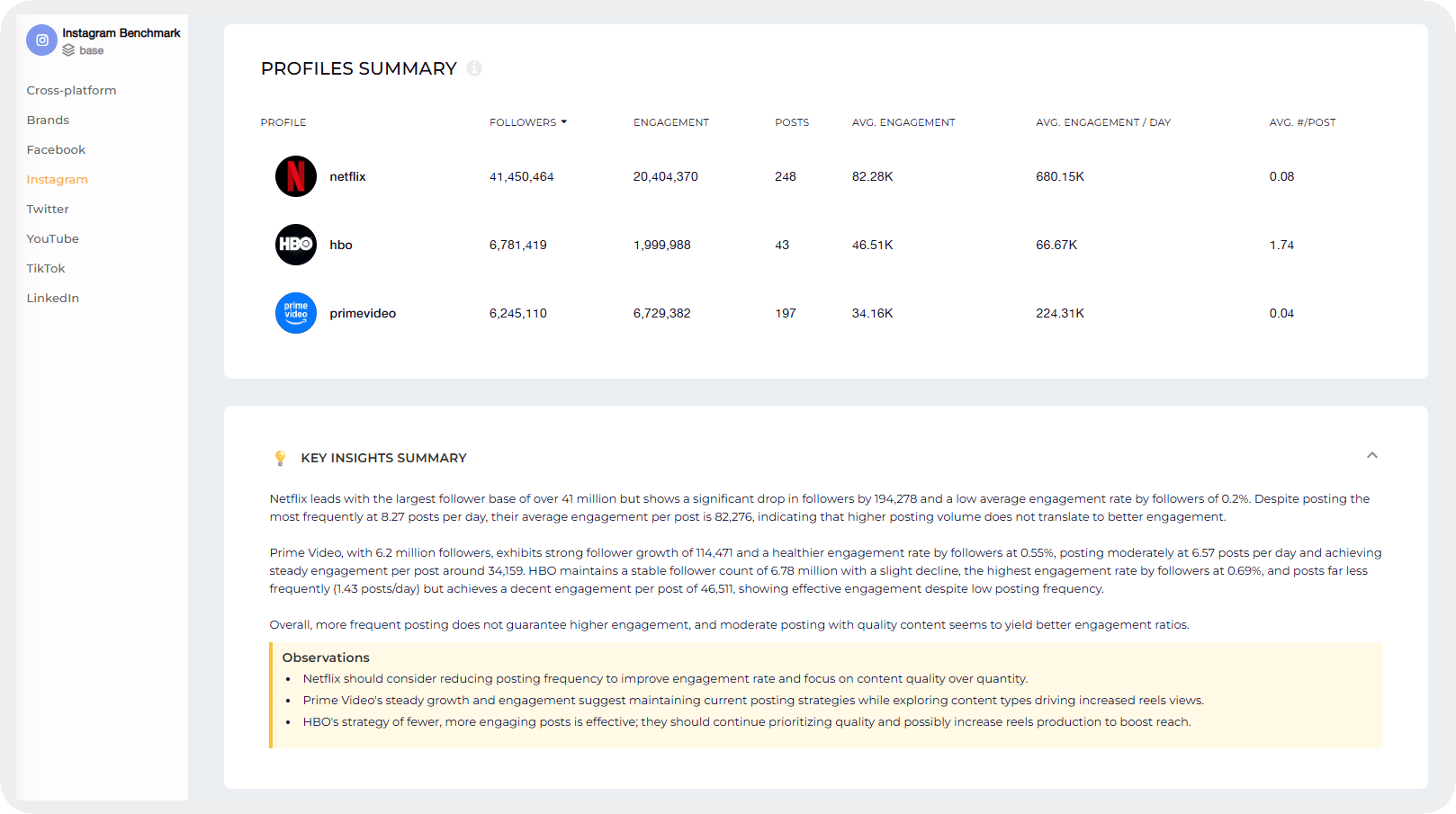
Scroll to the bottom, and you will find a comparison of the followers' growth percent and the actual follower growth for the selected time period.
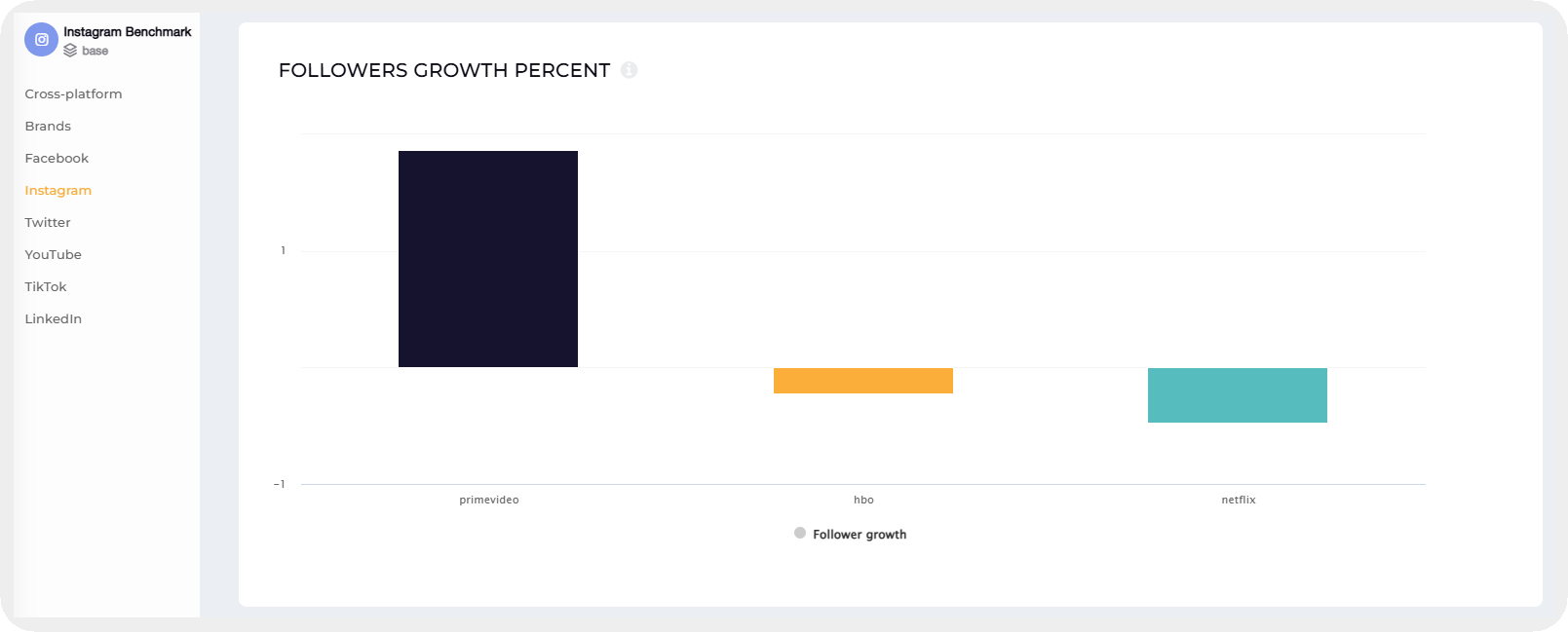
Using this competitive comparison, you can:
- Compare growth velocity. Not just the follower count, but the rate of growth over weeks or months. Are you gaining followers faster than competitors or stagnating?
- Identify industry patterns. Add all your major competitors to the dashboard. Spot seasonal growth patterns or common trends across them.
- Find missed opportunities. If your competitors saw growth spikes and you didn’t during similar timeframes, you can dig into what you missed. Was it a lack of posting, ads, or influencer outreach?
- Set realistic goals. Use competitor trends to set achievable growth targets based on actual industry data.
Use reports to get data on overall industry follower growth
What is going on in your industry? Are you an emerging brand on Instagram? Should you be adopting certain strategies to grow your followers?
Based on a lot of data from our clients and different industries, we continuously publish new reports that you can use to guide your strategies.
For example, according to Socialinsider's latest report on Instagram benchmarks, small brands (accounts with less than 5K followers) on Instagram see an average audience growth rate of 22%.
That’s not all. We regularly publish industry-specific reports so you can get an idea of the latest trends, average follower growth rate, engagement metrics, and content strategies working well in your niche.
Common mistakes when analyzing follower growth
- Obsessing over daily changes: Day-to-day fluctuations are noisy and often meaningless. A drop of 20 followers or a gain of 30 doesn’t tell you anything about performance. What matters is the direction over weeks and months. Zooming in too much leads to reactive decisions instead of strategic ones.
- Ignoring context behind spikes: A spike in followers looks great, but without context it’s just a number. Was it a viral Reel, a giveaway, or a collaboration? Each has a very different implication. Without understanding the trigger, you can’t replicate success or learn from it.
- Comparing mismatched timeframes: Looking at one week of growth and comparing it to a month, or comparing campaign periods with non-campaign periods, leads to flawed conclusions. Growth needs to be evaluated across consistent, comparable timeframes to understand what’s actually changing.
How to grow followers on Instagram?
How do you increase your follower growth rate? What strategies can be used to build a strong community that keeps attracting more people? Here are three ways we suggest.
- Use Reels for discovery: Reels are still the primary way new audiences find you on Instagram. Focus on strong hooks in the first few seconds, fast pacing, and clear value. The goal isn’t just views, but getting the right people to land on your profile and consider following.
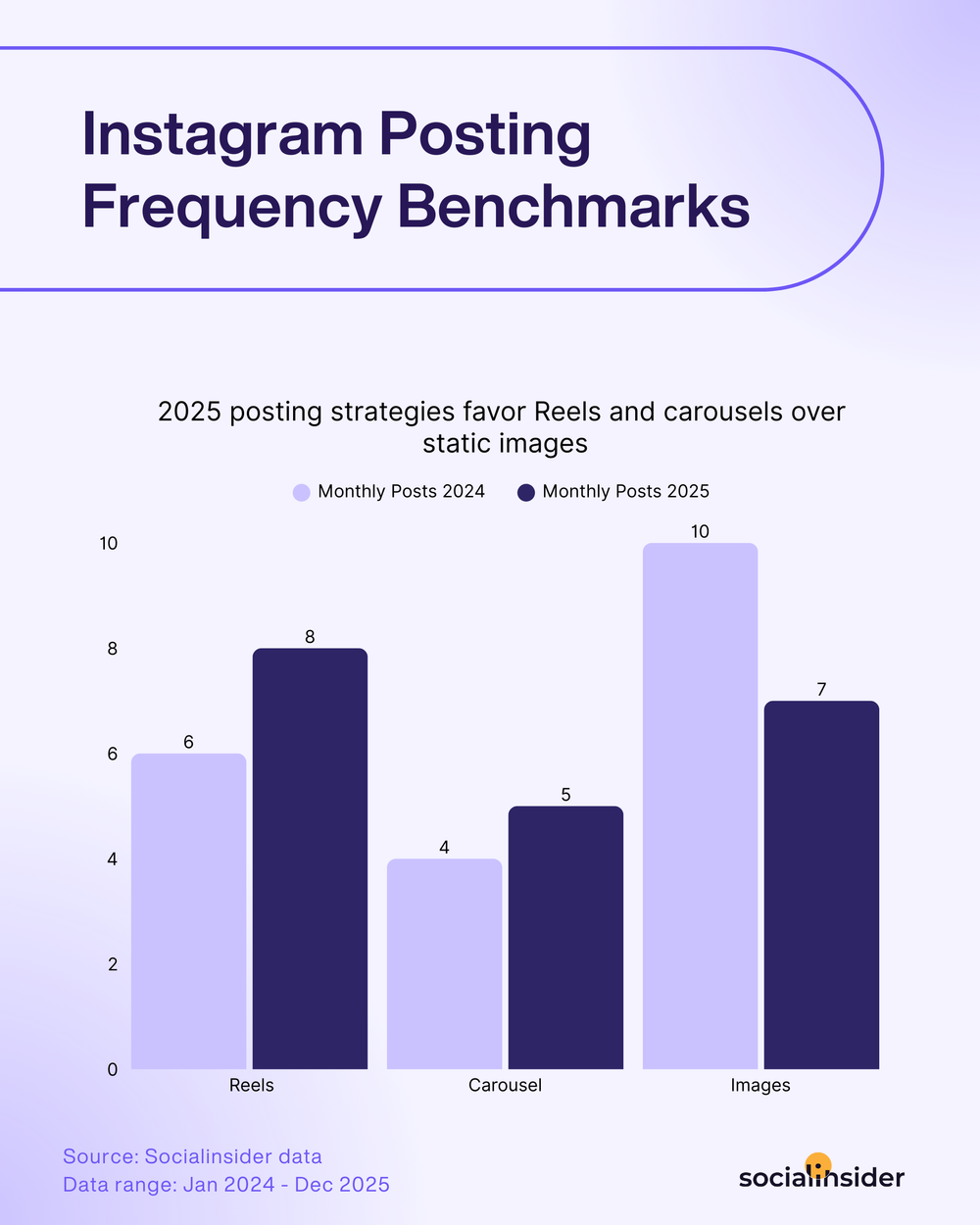
- Engineer “follow” triggers inside content: Don’t assume people will follow on their own. Give them a reason. Mention what they’ll gain by following, tease upcoming content, or build anticipation. Small cues like “follow for more” or “part 2 coming soon” can significantly increase conversion.
- Create series content: Series build habit. When your content feels like an ongoing journey, people follow to stay updated. Think in formats like “Day 1/30,” “Part 3,” or recurring themes. This creates continuity and makes your account more memorable.
- Collaborate strategically: Partner with creators or brands that share your target audience. The right collaboration introduces you to people who are already likely to care about your content.
- Double down on what already works: Growth often comes from repeating successful patterns, not constantly trying new things. Identify which posts brought in followers, break down why they worked, and create variations. Consistency in what works builds momentum over time.
- Find best times to post based on audience activity: Posting when your audience is most active increases early engagement, which helps content get pushed further. I use Socialinsider to get this insight based on my past content.
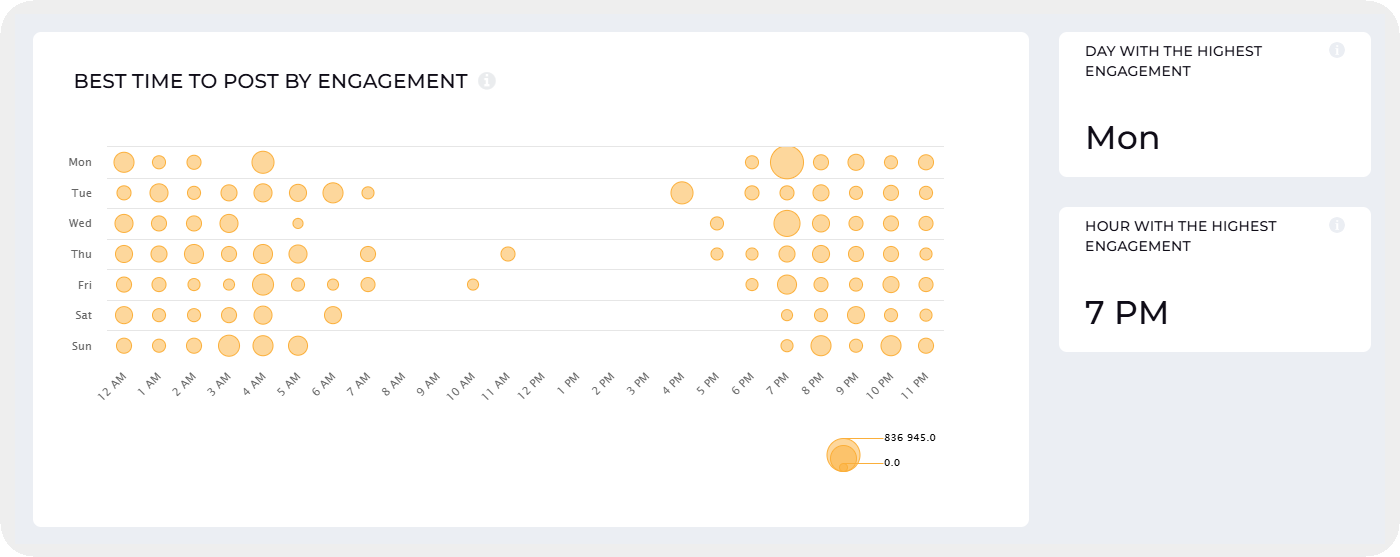
Small improvements here can make a noticeable difference in reach and follower growth.
Final thoughts
Tracking your Instagram followers is more about understanding what drives growth and how to keep it going, rather than just seeing your numbers grow. By consistently monitoring follower trends, engagement, and audience quality, you can make smarter content and strategy decisions that actually move the needle.
Use tools like spreadsheets or platforms like Socialinsider to spot what’s working, what’s not, and when growth spikes happen. The more intentional you are in how you track your Instagram followers over time, the easier it becomes to attract the right people and turn followers into loyal fans.

Nidhi Parikh
Having worked with several brands in the social media space, Nidhi writes about all things social. With 13K followers on LinkedIn, she's always up for a chat about books or her next travel plan

Know what your competitors do — before your manager asks
Get instant social benchmarks & reports without manual work.


